




Abstract
Although a recent body of scholarship focuses on how business professionals infuse spiritual practices in their workplaces, comparatively little attention has been paid to faith in the scientific workplace, especially in an Eastern, non-Christian context. Between 2014 and 2015, we conducted a survey of 892 scientists in Taiwan and completed interviews with 52 of our survey respondents. In this paper, we examine how scientists navigate religion in the scientific workplace. Survey results demonstrate that while scientists perceive religion and scientific research as generally separate in the abstract, in practice, they regard the boundary between religion and their workplace as somewhat permeable. Interviews further show how different groups of Taiwanese scientists create sacredness and defend secularity in scientific work. Results have implications for future research on how scientists (and potentially those in other types of professions) in non-Western and non-Christian countries navigate faith at work.
Introduction
A growing body of literature on lived religion argues that spiritual practices are not only found in traditional sacred spheres, such as churches, mosques, temples, and synagogues, but also in seemingly secular spheres, such as workplaces (Ammerman 2014b; Cadge and Konieczny 2014; Hall 1997; McGuire 2008). For example, low-income mothers rely on their faith to overcome workplace frustrations (Sullivan 2006), and business professionals pray when they encounter difficulties in their work (Ammerman 2014b; Williams 2010). This lived religion perspective indicates that the institutional boundary between religion and the workplace is becoming increasingly permeable (Day 2005; Grant, O’Neil, and Stephens 2004; Lindsay and Smith 2010; Williams 2010). Studies on religion in the workplace largely focus on the corporate workplace (Day 2005; Lindsay and Smith 2010) and nursing (Ammerman 2014b; Reimer-Kirkham 2009), a sphere that may not stipulate a rigid boundary between the world of work and the world of religion.
The scientific workplace, however, may be different. While scholars have challenged the perception that religion and science are in conflict ( Ecklund et al. 2016; Ecklund and Park 2009), the cultural boundary between science and religion still exists (Evans and Evans 2008; Gieryn 1983; Noy and O’Brien 2016). A recent study shows that within the scientific community, the dominant narrative between science and religion is the “independence narrative,” which perceives science and religion as separate cultural authorities within distinctive spheres (Ecklund et al. 2016; Gould 1997).
This exclusionary boundary between science and religion may influence how scientists infuse and express faith in their workplaces. Initial studies on religion in the U.S. scientific workplace indicate that scientists rarely integrate religion with their scientific work and reveal that some scientists may even be hesitant to disclose their religious identities in the workplace (Ecklund 2010). Discussions about science and religion, however, are based largely on Western and Christian perspectives (Fuller 2007). It is unclear whether scientists in non-Western societies, where Christianity is not the dominant religion, might integrate (or not integrate) religion in the workplace.
In this paper, we examine whether and how scientists in Taiwan integrate faith in their workplaces. Studying the scientific community in Taiwan provides a good initial case for expanding our understanding to a broader range of ways religion might enter or be kept out of scientific work. On the one hand, the religious landscape in Taiwan is different from that in Christian-dominant contexts such as the United States, given that Christianity has a minority status in Taiwan (Clart and Jones 2003; Pew Research Center 2012). Hence, we may expect discussions about the science-religion interface—a Christian-centric discussion (Fuller 2007)—to be less relevant to Taiwanese scientists. On the other hand, Taiwan is constructing a modernized and Westernized scientific infrastructure (Greene 2009; Saxenian 2001). Taiwanese scientists therefore may be influenced by institutional norms similar to those of their colleagues in the West. Thus, we need empirical research to understand whether and how Taiwanese scientists integrate faith in the workplace.
Relying on surveys of 892 scientists in Taiwan and semi-structured interviews with 52 participants, we investigate the role that faith plays in the Taiwanese scientific community. We found that, different from their colleagues in the United States (Ammerman 2014b; Ecklund 2010), Taiwanese scientists integrate faith in their workplace through a delicate endeavor. They construct what we label as different layers of institutional boundaries, excluding sacredness from the abstract scientific sphere while integrating it within the perceived nonscientific spheres of their workplaces. This study therefore offers a non-Western perspective on science and religion as well as faith in the workplace.
Literature Review
Religion in the Workplace
Literature about religion in the workplace indicates that under certain circumstances, the perceived sacred and secular intersect with one other (Ammerman 2014a; Hall 1997; Park, Dougherty, and Neubert 2016). This intersection may be bidirectional. For example, the sacred can exert its influence on professionals’ activities in the secular workplace, and conversely, individuals are able to make sacred the secular activities in their workplace. For example, scholars find that the sacred, as characterized by individual professionals’ religiosity, may increase professionals’ productivity through providing a sense of well-being in the midst of mundane tasks (Day 2005; Emmons 1999; Karakas 2009) as well as a framework for workplace ethics (Chan-Serafin, Brief, and George 2012; Longenecker, McKinney, and Moore 2004; Neal 2000; Steffy 2013; Weaver and Agle 2002).
Studies further illustrate that those who are religious or spiritual may attach sacred meanings to their everyday work through a complex meaning-making process (Cadge and Konieczny 2014; Dik and Duffy 2009; Dik, Duffy, and Eldridge 2009; Wuthnow 1991). People may draw cultural meanings from religion, formulating a cultural bricolage that allows them to construct a cohesive story about the sacredness of their everyday mundane work (Cadge and Konieczny 2014; Dik and Duffy 2009; Wuthnow 1991). Calling, compassion, and contributing to mankind are some of the common cultural narratives that Western people utilize to integrate sacredness in their day-to-day work (Ammerman 2014b; Dik and Duffy 2009; Wuthnow 1991).
The sacralization of secular activities, namely, this meaning-making process, does not operate in a vacuum. This integration process is constrained and enabled by particular organizational climates as well as occupational (Ammerman 2014b; Lindsay and Smith 2010; Wuthnow 1991) and—perhaps—even national cultures. Thus, professionals who work in different spheres have different capacities and cultural resources for infusing and expressing religion in their workplaces. Volunteers sometimes infuse compassion into their volunteer work (Wuthnow 1991). Working in the business sector, evangelical elites integrate an ethic of responsibility into business activities (Lindsay and Smith 2010). Professionals’ integration and expression of sacredness in the workplace could, however, be a challenge to the institutional norm of secularity when professionals not only integrate faith in their own work but also start to openly express their faith, generating conversations about religion in the workplace (Ammerman 2014a; Lindsay and Smith 2010).
Religion in the Scientific Community
Academic science is an intriguing sphere for the analysis of religion in the workplace. Early scholars believed that science as an institution leads to secularization at both individual and societal levels (Berger 1967; Bruce 2002; Chaves 1994; Tschannen 1991). 1 This secularization assertion is supported by the often low level of religiosity among some groups of scientists when compared to the general public (Leuba 1916, 1934; Stark 1963), 2 perceived decrease of religiosity among college students (Feldman and Newcomb 1969), and decline of the “sacred canopy” after the rise of science (Berger 1967).
More recent studies, however, start to challenge the secularization assumption (Ecklund 2010; Ecklund and Scheitle 2007; Evans and Evans 2008; Gross and Simmons 2009; Lindholm and Astin 2006). These studies find that although scientists are less religious than the general public, they are not necessarily nonreligious (Ecklund 2010; Gross and Simmons 2009; Lindholm and Astin 2006). Even the comparatively low level of religiosity among scientists should not be simply attributed to their reception of scientific knowledge; recent evidence reveals that the specific demographic characteristics among scientists may preselect them to be a less religious population (Ecklund and Scheitle 2007).
While most scientists reject the idea that science and religion are in conflict with each other, they do embrace the perspective that science and religion are independent (Ecklund et al. 2016; Gould 1997). The independence narrative, the most prevalent narrative about science and religion within scientific communities around the globe (Ecklund et al. 2016), describes science and religion as two separate cultural authorities dealing with different spheres (Gould 1997). The prevalence of the independence narrative among scientists indicates that scientists, to some extent, are still constrained by and even actively reinforce the institutional boundary between science and religion. Empirical studies in the United States indicate that working in a scientific community where “separation” and “secularity” are perceived as the norm, U.S. scientists rarely integrate religion in their scientific research (Ammerman 2014b), and some of them even hide their religious identities in the workplace (Ecklund 2010).
Studies about religion in U.S. science therefore inform us that while the perceived conflict between science and religion is not prevalent within the scientific community (Ecklund and Park 2009), the cultural and institutional boundary between science and religion still exists (Evans and Evans 2008; Noy and O’Brien 2016). This institutional boundary between science and religion also, more or less, influences U.S. scientists’ integration and expression of religion in their workplaces (Ecklund 2010). What is unknown is how scientists outside the United States navigate religion in their workplace. In this study, we start to resolve this question by analyzing religion in the scientific workplace in Taiwan.
Case Justification
Turning the lens on the scientific community in Taiwan provides an initial way to view how scientists navigate the sacred and the secular outside a Christian-centric, Western secular perspective. To do so, we need to understand more about the social and historical context of Taiwan. Berger (1967) and other scholars have argued that an overarching “sacred canopy” used to exist in the United States (Berger 1967; Ding 2004). In Taiwan, however, religion rarely intervened in politics, as it so often did in Western societies (Ding 2004). Instead, the reverse is usually the case: Politics constrains religion. The Taiwanese government, for instance, controlled or influenced religious practices as late as 1987 (Qu 1997), the year religions became nominally independent of the governing political system (Laliberté 2009). In the 1990s, a move from constraint to separation between state and religious institutions brought rapid religious growth, and by 2000, the number of registered religious groups in Taiwan was 10 times higher than in 1989 (Qu 1997, 2002).
From the early 1990s, then, the Taiwanese religious landscape in Taiwan became increasingly diverse (Clart and Jones 2003; Pew Research Center 2012). In 2010, 44.2 percent of Taiwan’s population were affiliates of folk religions, 21.3 percent were Buddhist, 16.2 percent belonged to other religions, and 12.7 percent were unaffiliated (Pew Research Center 2012). Because only 5.5 percent of the general population is affiliated with Christianity (Pew Research Center 2012), we expect the Christian-centric debate about the science-religion interface and the clear boundaries between science and religion to be less relevant in Taiwan.
However, at the same time, Taiwan is building a modern, global, and to some extent, Westernized scientific community (Altbach 1998; Saxenian 2001). With scientific knowledge passing from the West to the East and from the East to the West through transnational connections (Altbach 1998; Saxenian 2001), scientists are increasingly collaborating with colleagues in a global scientific community (Altbach 1998). By working in a modern Westernized scientific community, it is not surprising that Taiwanese scientists, like their colleagues in the West, navigate the boundary between sacred and secular in ways specific to their homeland. For instance, inspired by Buddhism and the practice of Chinese Chi-Gong, the former president of National Taiwan University even encouraged scientific research into supernatural phenomena (Wu, Qingming, and Guoliang 2013). Scientific research into the supernatural became a much critiqued enterprise with many scientists and other scholars viewing it as little more than pseudo-science based on unwarranted claims (Qu 2002).
Overall, the complicated religious landscape and minority status of Christianity in Taiwan (Clart and Jones 2003; Pew Research Center 2012) may provide Taiwanese scientists with room to introduce the sacred into a secular workplace. And yet the Westernized scientific community (Altbach 1998; Saxenian 2001) may promote an institutional norm of secularity, which constrains the integration of the sacred in science. Our analysis therefore is an initial step toward determining how and whether Taiwanese scientists create the sacred in science or defend its exclusion from the scientific community.
Data and Methods
Data for this paper come from a large study that examines scientists’ perceptions of religion, spirituality, and ethics in eight regions around the globe: France, Hong Kong, India, Italy, Taiwan, Turkey, the UK, and the US. We focus in particular on physicists and biologists in the broader study as well as in this paper. We recognize that physicists and biologists cannot represent the whole scientific community, but we also argue that biology and physics are two essential scientific disciplines in the discussion of the science-religion interface (Barbour 2000; Plantinga 2011; Sharpe 1990).
This paper specifically draws from surveys with 892 Taiwanese scientists and semi-structured interviews with 52 respondents who were selected from the survey participants. The sampling for the survey involved two stages. First, we identified the organizations that we wanted to study by searching for scientists with published articles on the Thomas Reuter Web of Science (WOS) database. We stratified the sampling frame according to the elite status of these organizations. Organization status (elite vs. non-elite) was determined through a triangulation process: utilizing the publication record on WOS, seeking insiders’ opinions, and referring to in-country university rankings (Ecklund et al. 2016). Due to the small number of biology and physics departments in Taiwan (when compared to other contexts, such as the US), we took a census of the available physics and biology departments in our sampling frame. We selected 11 elite biology organizations, 27 non-elite biology organizations, 13 elite physics organizations, and 12 non-elite physics organizations to comprise our final organizational-level sampling frame. In the second stage, we relied on the department websites to create a sampling frame of individual scientists. Considering the comparatively small population of biologists and physicists in Taiwan, we again took a census of all eligible scientists. A total of 892 surveys were completed from a sample of 2,824 physicists and biologists in Taiwan for a final response of 39 percent (Ecklund et al. 2016). 3
Here, we focus on two outcome variables measuring (1) religious influence in science and (2) religious disclosure in the workplace. For the former, we asked respondents who reported having religious colleagues: “Now thinking about your religious colleagues, do you think that their religious views influence their research?” 4 with response options including (1) “No, because none of my religious colleagues are engaged in research”; (2) “No, their religious views do not influence their research”; and (3) “Yes.” Our primary interest was whether respondents think religion is integrated into scientific research, so we recoded this outcome into a dichotomous variable. Respondents who answered yes were included in a has influence category. Respondents who do not think their religious colleagues’ research is influenced by religious views (those who answered with one of the two no categories) were grouped into a no influence category. Responses to this question provide insight into how Taiwanese scientists view the role that religion plays in research—one of the spheres of the scientific workplace.
Our second outcome variable was operationalized by asking: “How comfortable would you be letting people in your department know about your views on religion?” with response options including (1) very comfortable, (2) somewhat comfortable, (3) somewhat uncomfortable, (4) very uncomfortable, and (5) I have no views on religion. We interpret responses as an indication of how open the scientific research workplace is to religious belief. Specifically, we sought to explore whether scientists regard their workplace as an entirely secular sphere within which disclosing views on religion should be prohibited. We recoded this outcome measurement into a categorical variable with three categories. In our analysis, respondents who feel at least somewhat comfortable (those who chose either very comfortable or somewhat comfortable) were grouped into a comfortable category. Those who felt somewhat uncomfortable or very uncomfortable were grouped into another category labeled uncomfortable. Finally, those who responded that they have no views on religion when answering this question were analyzed as a third category.
Arguably, scientists who are comfortable letting their colleagues know about their views on religion may challenge the boundary between religion and science in their scientific workplace. In contrast, scientists who are uncomfortable doing so may reinforce this boundary. Some scientists said that they “have no views on religion” when answering the question about disclosing religion in the workplace. (It is unclear from the quantitative data how these scientists would respond to the institutional boundaries between science and religion. Such views will be partially dependent on whether and how scientists who have no views on religion welcome their religious colleagues’ integration of religion in the workplace.) Our qualitative interviews enable further understanding of whether Taiwanese scientists integrate religion in their workplace, including both scientific spheres, such as teaching and research, as well as relatively unscientific spheres in the workplace, such as casual conversation.
Our predictor variables included respondents’ religious affiliation and religious commitment and behavior (i.e., religiosity). Respondents’ potential religious affiliations included (1) I do not belong to a religion, (2) Roman Catholic, (3) Protestant, (4) Buddhist, and (5) folk religion. 5 We included scientists’ religious affiliation as a predictor variable given that both the discussions about religion and science (Barbour 2000) and the analysis about religion in the workplace (Lindsay and Smith 2010) are specific to particular traditions. We therefore controlled for the possibility that scientists affiliated with different religions may have different perspectives on the integration of religion in their scientific workplace. Another important predictor is respondents’ religiosity, which was assessed in terms of whether a respondent considered himself or herself to be a religious person, frequency of religious attendance, and frequency of prayer. 6 Previous studies generally assume that religious people are integrators who infuse their religion in the workplace (Park et al. 2016). We thus reasonably assume that respondents’ religiosity is an important predictor of boundary-making in the workplace. We also controlled for income, age, gender, foreign-born status, discipline (physics or biology), and PhD degree status (Cornwall 1989; Gross and Simmons 2009). Moreover, disciplinary and organizational cultures also influence respondents’ integration of religion in the workplace (Ammerman 2014a; Lindsay and Smith 2010). Hence, we controlled for elite status of the respondents’ institutions.
After completing the survey, respondents were provided the option of being contacted for a follow-up interview. 7 All survey participants who agreed to be contacted were included in a sampling frame for interview respondents. We then stratified the sampling frame according to respondents’ gender, career stage, elite status of their institution, and self-reported religiosity (religious, slightly religious, and nonreligious). 8 Bilingual researchers 9 on our team conducted 52 interviews in Taiwan; 18 scientists identified as female, and 34 scientists identified as male. Twenty-seven interviews were with biologists, and the remaining were with physicists. The career stage of our interview respondents ranged from graduate student to full professor. During the interview, we asked respondents about the role of religion in the scientific community, with specific probes for their perception of the organizational climate, such as the extent to which they were comfortable disclosing their views on religion in the scientific workplace. All interviews were transcribed and translated. We then coded the transcripts for perceptions of religion at work. We developed an initial set of codes in a somewhat inductive fashion and then applied them consistently to the rest of the interviews, checking and revising them as we continued coding.
Findings
Science and Religion Interface in the Workplace
Table 1 shows the descriptive statistics for all measures included in the analyses. More than 85 percent of our respondents do not think their religious colleagues’ views on religion influence their scientific research. 10 At the same time, a majority of our respondents (60.38 percent) were at least somewhat comfortable letting people in their department know their views on religion (whatever those views may be). Only 15 percent of our scientist respondents in Taiwan were uncomfortable letting colleagues know their views on religion. The remaining nearly 25 percent of survey respondents claimed that they have no views on religion. Interestingly, these univariate results suggest that while most scientist respondents believed that their religious colleagues separate religion from scientific research, their views on letting colleagues know about their own religious beliefs were more divided.
Descriptive Statistics for Religion among Scientists in International Context Taiwan Survey.

Note: Total sample N = 892. All data are weighted, and nonresponses are excluded. Data source: RASIC Taiwan Survey 2015.
Coded from 1 = an atheist to 5 = a very religious person.
Coded from 1 = never, practically never to 7 = more than once a week.
Coded from 1 = never to 11= several times a day.
Considering that scientists’ perceptions of religion and scientific research were highly skewed, we did not conduct multivariate analyses on this dependent variable. Yet, we conducted multivariate analyses to understand what factors influence scientists’ views on religion in the workplace. Table 2 presents relative risk ratios estimated from a multinomial logistic regression predicting a categorical measurement of scientists’ views on letting people in their department know about their views on religion. A relative risk ratio higher than 1 indicates an increase in odds of either feeling comfortable letting colleagues know about their views on religion or having no views on religion (relative to feeling uncomfortable), while a number lower than 1 indicates a decrease in the odds.
Multinomial Logistic Regression Predicting the Perceptions on Letting Colleagues Know about Views on Religion.
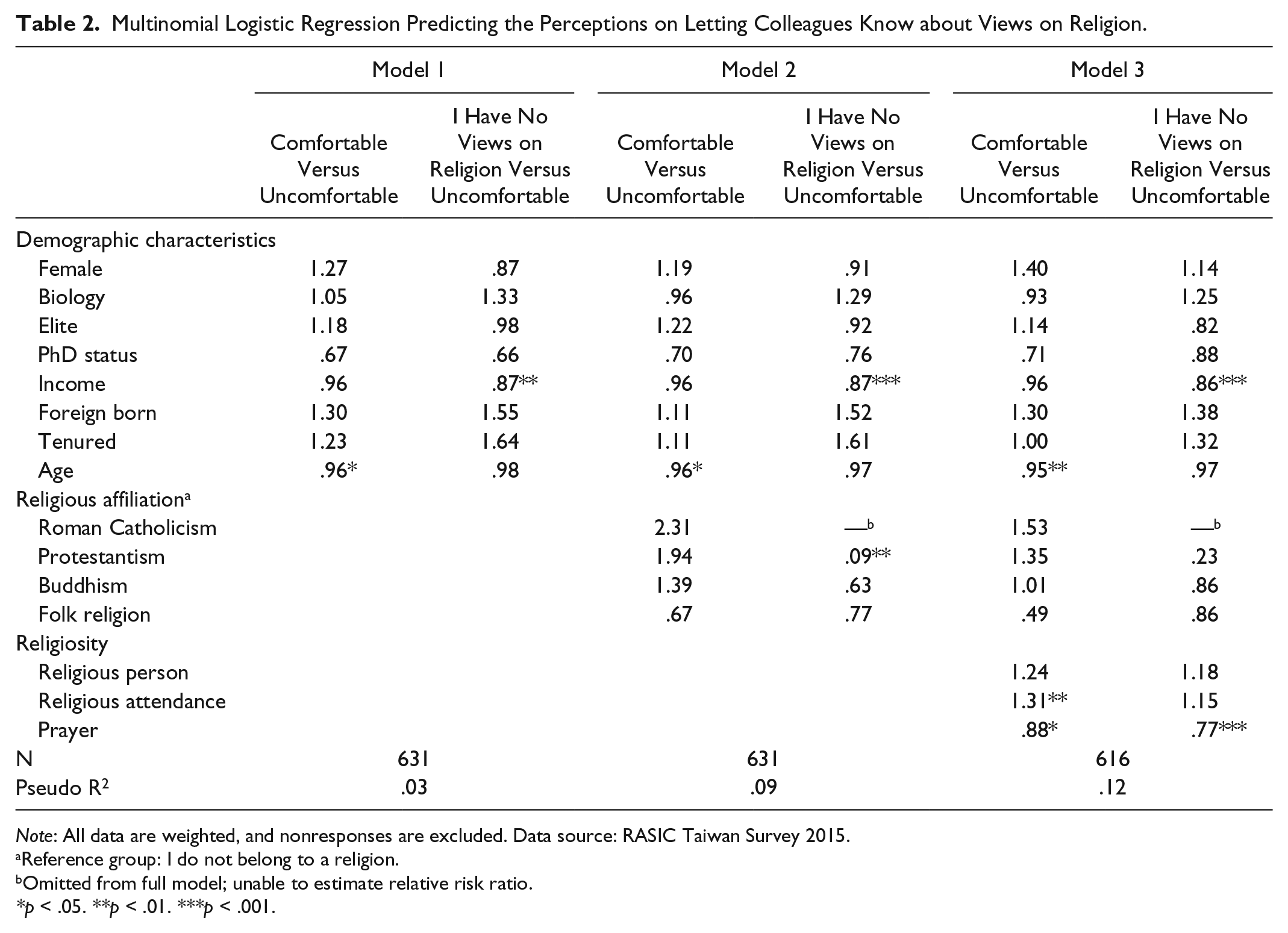
Note: All data are weighted, and nonresponses are excluded. Data source: RASIC Taiwan Survey 2015.
Reference group: I do not belong to a religion.
Omitted from full model; unable to estimate relative risk ratio.
p < .05. **p < .01. ***p < .001.
A baseline was established by estimating the effects of demographic characteristics only (Model 1). As the results show, age was a significant predictor of feeling comfortable letting colleagues know their views on religion; specifically, for each additional year of age, odds of being comfortable when compared to being uncomfortable decreased by 4 percent. Income had a significant negative effect on the odds of reporting no views on religion versus uncomfortable (.87). In Model 2, we added respondents’ religious affiliation, using no affiliation as the reference group. Only Protestants have significantly lower odds (.09) of claiming that they have no views on religion when compared to uncomfortable. The significance of Protestantism indicates that Protestants may have stronger views about religion, and thus, compared to nonaffiliates, they are less likely to claim they have no views on religion than to be uncomfortable sharing them. In our final model (Model 3), we added three measurements of scientists’ religiosity: self-reported religiosity, frequency of religious attendance, and frequency of prayer. Protestantism lost significance, suggesting it was more a function of overall religiosity than a specific religious affiliation. Among the three measurements of religiosity, both religious attendance and prayer were significant. Specifically, for each additional unit of increase in the frequency of religious attendance, the odds of a scientist feeling comfortable versus uncomfortable increased by 3.1 percent. In contrast, for each additional unit of increase in the frequency of prayer, the odds of feeling comfortable decreased by 1.2 percent. Hence, the two measurements of religiosity are both significantly related to the outcome variable, but in opposite directions. We found also that—relative to feeling uncomfortable—prayer significantly reduces the odds of respondents claiming that they have no views on religion in this outcome variable (.77).
Overall, survey results suggest that most Taiwanese scientists perceive religion to be absent from their colleagues’ scientific research but not necessarily the workplace as a whole. The analysis also reveals that religious scientists do not necessarily challenge the norm of secularity in their workplaces. Scientists who pray very frequently, for example, may reinforce the norm of secularity in their workplace by hiding their religious views. In contrast, scientists who attend religious services often may challenge the norm of secularity by disclosing their religious views at work. Further, these attitudes were also structured by age and income. With increasing age, scientists were less comfortable sharing their religious views, and with increasing income, they were less likely to have no views on religion relative to being uncomfortable. We now turn to interviews to gain further understanding as to why these dynamics discovered through quantitative analyses of survey data might exist.
Defending Secularity
Separating Sacredness and Scientific Research
Our survey respondents perceive that most of their colleagues do not infuse religion in their scientific research. Confirming the survey results, interviews show that around half of the interview participants in Taiwan (25 out of 52), both religious and nonreligious, separate religion from their scientific research. According to a nonreligious male research fellow 11 in biology: “I should say that I will not make this connection between religion or the piousness to religion and scientific achievement. Basically, there are no connections.” Similar to his nonreligious colleague, a Buddhist physics professor 12 also contended: “Religion cannot affect my scientific research at all.” Narratives such as “I don’t think they [religion and research] are related” 13 consistently appeared in our conversations with Taiwanese scientists. By saying that religion is not related to scientific research, these respondents indicate that there are almost no ways to introduce sacredness into their scientific explorations. We label these scientists as separators, who distinguish religion from scientific research.
Defending Secularity in the Workplace
By examining the survey question that asks about sharing religious views with colleagues, it is clear that there is still a substantial minority (15 percent) of the survey respondents who feel at least somewhat uncomfortable sharing their religious views. This means that some Taiwanese scientists still perceive the scientific community as a distinctively secular sphere. These scientists are defenders who reinforce the norm of secularity in their scientific workplaces. Interview data illustrate how and why they exclude religion from the workplace.
Sixteen of our 52 interview participants told us they would avoid conversations about religion in the workplace. The extent to which scientists feel comfortable talking about religion is manifested in the narrative of a nonreligious assistant research scientist in physics 14 who said: “I will not be comfortable about it . . . I avoid it as much as possible. I will avoid religion topics.” He then explained that if a student were to talk to him about religion, he would say “stop” because he “wouldn’t feel comfortable.” This respondent appears to be a defender of secularity who actively avoids conversations about religion in his workplace.
Some scientists are very aware that they are situated in what they perceive to be a secular institution and therefore avoid talking about religion. A nonreligious female PhD student in physics
15
explained why she does not talk about religion in her workplace:
I don’t talk about it [religion]. Never talk about it . . . I think the major factor in not talking about it is that basically—with science people [scientists]—because I’m in the science world—conversations with science people carry a very clear purpose.
This physicist clearly realizes that she is “in the science world,” which from her perspective is a sphere that is not permeated by religion. Obeying and reinforcing the norm of secularity in her workplace, she only talks about things that “carry a very clear [scientific] purpose” with her colleagues. By never talking about religion in the workplace, she also defends secularity.
Even scientists who are religious can be defenders of secularity. A male professor in biology, 16 who identifies himself as a very devoted believer in folk religion, told us that he would not talk to his colleagues about his religious beliefs. He provided three reasons to explain his reluctance: the norm of secularity in science, the norm of religious privacy, and the social stigma attached to folk religion in Taiwan. He said, first, scientists “are all busy writing proposals, writing papers, and publishing papers.” Therefore, scientists “seldom talk about things like that [religion].” Furthermore, this respondent said that his protective deities “would not let others know [that they exist]. [The deities] would tell us to stay low profile.” Finally, he is also concerned about the potential stigma attached to being a practitioner of a folk religion. He explained, “There is quite a misunderstanding about the deity and the traditional religions in Taiwan.” According to him, Taiwanese may have a negative impression of folk religion because “a lot of people are [utilizing folk religions] and doing things that are not good.” He then told us that even he—as a devoted believer in folk religions—is hesitant to share his religion with others due to the attached stigma. Despite his strong personal beliefs, this biologist does not want his colleagues discovering his religious views.
Other scientists with faith have the same hesitancies as this biologist. A female physicist, 17 who occasionally integrates her spirituality with her scientific research, said that none of her colleagues are aware of her spirituality. As she explains, “there’s really no need to tell anyone about this kind of mystic experience.” In her interactions and conversations with colleagues in the workplace, she tries to appear to be “really scientific.”
Taiwanese scientists who avoid talking about religion are in fact defending secularity in their workplaces. Defenders could be both scientists with as well as those without faith. Respondents’ narratives help us understand the puzzle in our survey findings: Why do scientists who pray more often also feel more uncomfortable disclosing their religion in the workplace while their counterparts who attend religious services more often are less likely to feel uncomfortable doing so? Based on our interviews, we speculate that scientists who pray more frequently may have similar concerns as the biologist who believes in folk religion and his spiritual colleague. They may perceive religion as a private and personal connection between themselves and deities, and they may be concerned about the stigma that others in the science community might impose on them because of their religious beliefs.
Integrating Sacredness
From our survey, 15 percent of respondents believe that their religious colleagues integrate religion into their research. We need to know how these integrators infuse the sacred in their scientific research given that their integration of religion into their research could be an initial step to challenging the institutional boundary between science and religion, which most of their colleagues perceive as separate institutions.
Integrating Sacredness in Scientific Work through Research Motivations
One way that Taiwanese scientists integrate religion in their scientific research is through their research motivations. The effect is twofold. First, influenced by their religious beliefs, scientists told us that their religiosity might shape them to look beyond utilitarian research reward (money or prestige). Second, by attaching greater meaning to scientific research, religious scientists may choose research projects that “take the interest of the majority of people into consideration,” 18 those who are particularly concerned with issues of justice and helping others.
Some scientists in Taiwan infuse religion in their scientific work through research motivation. A female biologist
19
who identifies as religious without an affiliation described the possible influence of religion and spirituality on scientific research:
It [religion] is more related to your motivation and attitudes to conduct research. Some scientists only want to be famous. . . . However, there are other scientists who want to find out ways to resolve problems. . . . I think they will not intentionally pursue what they want out of their personal interests. It is possible that they will obtain a sense of achievement when they are working. But they will not be lost in this sense of achievement.
This biologist believes that compared to nonreligious scientists, whose motivation to conduct science is mainly to “be famous” or pursue “what he wants out of his personal interest,” religious scientists’ motivations are less utilitarian.
Taiwanese scientists told us that research motivated by their faith not only helps individual scientists potentially cope with stressors related to doing their research, but it also leads to greater contributions to mankind. A Catholic biologist
20
said that her beliefs motivate her to conduct research that is beneficial to minorities and disadvantaged people. She explained:
When I am doing this [research], I discover that although we get funds from the government to do these jobs, our targets are still healthy people. . . . There are a lot of even more disadvantaged groups which are not completely taken care of. . . . This way I will think that if we keep on doing this, we are actually ignoring people who need more help in the society. . . . So when I explore research topics, what I want or do not want to do, I think [religion] has some influence.
This biologist further emphasized that due to her belief in Catholicism, she will continue trying to do research that is helpful to minorities and other disadvantaged groups.
Integrating Sacredness into Scientific Work through Ethics in Research
In addition to research motivation, sacredness may also enter scientific research through ethics. Taiwanese scientists, both religious and nonreligious, informed us that religious scientists are more “disciplined” 21 and have a more “serious standard.” 22 Most existing discussions about science ethics center around fabrication, falsification, and plagiarism (Fanelli 2009; Price 2006). Interviews with scientists, however, show that research ethics should not be discussed so narrowly; the conversation should include how religion is woven into ethics in the scientific workplace. Taiwanese scientists who are religious avoid certain research and sometimes feel tension between a religiously framed ethic and their particular type of scientific research.
For example, a female Taiwanese physicist is one of our integrators who infuses sacredness into scientific research through ethics.
23
This physicist identifies herself as “not a religious person” on the survey. Yet, during the interview, she explicitly told us that occasionally she goes to temples for folk religions to pray. When she was trying to relate her religious practices to her scientific research, she hesitated, then said, “I am uncertain, I am uncertain about whether this is related to religion, but I don’t like doing biology things.” She further explained:
When I think of using them [animals] in biological experiments—although it is for [the benefit of] a bigger number of people, or whatever it is, but I just do not want to do it. It is a very agonizing feeling to me.
This respondent does not have a specific religious affiliation and may not have a strong religious identification. But her engagement with folk religious practices influences her navigation of research ethics. She believes sacrificing animals, even for the benefit of “a bigger number of people,” is unethical. Similarly, a female Buddhist biologist 24 said, “Buddhism is about not killing. When I am designing my research, if I can avoid using animals, I would do so. And that [religion] is related to my research.”
While a majority of survey respondents believe that religious scientists do not bring religion into their scientific research, there are still scientists who introduce religion into research through ethics. To them, science ethics is not limited to research ethics. They navigate and apply the sacred religious ethical framework to what they perceive as their secular scientific work. Thus, some scientists feel tension and avoid certain scientific topics and methods.
Integrating Sacredness into Scientific Work through Perceived Supernatural Power
We also talked with Taiwanese scientists who believe that religion guides their research through supernatural power. A female biology professor 25 who self-identifies as Christian said, “In these times [referring to research difficulties], we can only pray. That’s because those are factors that we cannot deal with.” Through prayer, this respondent hopes to receive supernatural support to tackle seemingly unresolvable scientific problems. Similarly, some of her colleagues who are exposed to folk religions also “go to the temple and make sacrifices” 26 with the expectation of supernatural support for their scientific work.
And some of our participants contend that they have received actual supernatural guidance in their scientific work. A male biologist
27
who believes in folk religion talked about how the deity provides him with specific and supernatural guidance in terms of paper submission, proposal drafting, and recruiting students. He gave a specific example about how the deity in his folk religion helped him in research paper writing:
He (the deity) would take my draft. And as he comes down [from the paradise], he would help me . . . he would take the ink brush and the Cinnabar, and he would make edits. He would be like, look, you wrote this poorly, and there’s something wrong there. And I would have been a little careless, and once I carefully looked into it I would discover that really I did make a mistake.
This biologist firmly believes in the existence of deities, and he told us that deities may convey their thoughts to you through their possession of human bodies and the words of a seemingly normal human. With this firm belief, he relies on supernatural guidance in almost every aspect of his scientific research. For example, the biologist seeks the deity’s opinion about his research proposal for a grant application. He said, “If he (the deity) says it is not going to be accepted, and told me to rewrite the whole thing, it wouldn’t be accepted.” When recruiting students, he also asked the deities to review the list of applicants and tell him which student should be admitted.
Narratives about supernatural guidance in scientific research are not exclusive to believers of folk religions. A female physics graduate student
28
who self-identifies as spiritual talked about the experience of drawing cards before deciding whether she should pursue an academic paper idea:
So when I first started working on this article, my doctoral advisor was very contemptuous. Because he thought it was nothing. He thinks this topic is too cliché. Actually I did it through drawing cards, right. At that time, I asked Lao Tian Ye [the old and knowledgeable man in heaven] whether I should do it. Lao Tian Ye said, “Yes, you should do it.”
Throughout the journal submission process, this graduate student has drawn cards several times to seek supernatural guidance. Her belief in supernatural power therefore directly guides scientific research decisions.
Our interview data illustrate that Taiwanese scientists integrate religion in their scientific work through the perceived guidance provided by supernatural power. Scientists may pray or make sacrifices to some kind of god with the expectation that they receive supernatural help in their scientific research. Some of them think that they have communicated with deities, received supernatural guidance, and incorporated the guidance in their scientific research.
Boundary Negotiation
Producing and Accepting Sacredness in the Scientific Workplace
The emergence of conversations about religion in the workplace becomes a good place to examine the dynamics between the sacred and the secular given that institutional norms are transmitted, created, and reinforced through conversations (Mead 1934). Different from integrators who infuse the sacred in their scientific research without necessarily challenging the institutional norm of secularity, producers of sacredness bring up religion in their conversations with colleagues and students. In other words, they create a sacred space within this seemingly secular sphere (Ammerman 2014a). This narrative from a Protestant female physicist
29
illustrates how producers infuse religion into workplace conversations:
I think I am an instructor, not a missionary. So I would not put teaching and religion together except at the time of individual consultation. When I was doing individual consultation, I may do it as a Christian. . . . [By individual consultation, I mean] just like emotional problems, and working issues. For example, I would ask them if they are willing to go to the church with me after having bad scores on exams . . . I want them to relax and take a break.
This respondent intends to create sacredness in her workplace by talking about religion with her students, but she also realizes the boundary between being an instructor and a missionary. Thus, she does not talk about religion in what she sees as the more public arena of the classroom.
A Buddhist biologist
30
also told us that she has conversations about religion with students outside the classroom and about nonscientific topics. She said:
Often times, it is when they have problems that I make use of my religious concepts or thoughts to talk with them. . . . I would tell them that this is from the Buddhist book. . . . The professors that I know, including myself, most of us would not be the one to tell our students what our religious beliefs are. However, in discussion, since we take up positions as mentors who counsel students, as we talk privately with the students, or when we publicly talk about certain problems, we would deliver to them what we think, and that may be related to our religious beliefs.
Similar to her Protestant colleague, this Buddhist biologist would only infuse Buddhism in private conversations with students when her identity as a mentor is more salient than her identity as a scientist. As represented by these two respondents’ narratives, when scientists are attempting to create sacredness in their workplace, they do it cautiously. Most of them would not talk about religion in the classroom—a scientific realm in their workplace. They would instead bring up conversations about religion in nonscientific realms, such as during their individual meeting with students.
Scientists’ careful production of sacredness is accepted by some of their colleagues. These acceptors of sacredness are usually nonreligious, but with reservation, they engage in religious conversations with their peers. For example, a nonreligious professor of physics
31
said:
Perhaps it’s just an exchange of experiences. I know that my colleagues, some of them are Buddhists, some are, say [practitioners of] Occultism. Some are Christians. They have different religious beliefs and they would share their experience. I would be open to this information. But these are their belief[s], I would probably not be able to go one step further and share my opinions with them, or something like that.
When talking about religion with his colleagues, this respondent tries to establish a boundary within these conversations, limiting them to “an exchange of experiences” without going “one step further.” Similarly, another nonreligious physicist
32
said,
In our everyday interactions, certainly, we seldom talk explicitly about religion in a deeply intellectual context. . . . Of course, if I meet with a colleague then I say, well, what are you doing for Christmas? Are you going to Mass? And so forth and so on, which is not, not this scale.
The emergence of religious conversations in the scientific community reveals how the navigation between sacredness and secularity happens. Some producers of sacredness, most of whom are religious, are creating sacredness in the workplace through conversations in nonscientific spheres. At the same time, other acceptors, while having reservations, engage in conversations about religion with their colleagues.
Discussion and Conclusion
In this study, using a survey and interviews, we interrogated how sacredness enters a seemingly secular sphere—science in Taiwan. Survey data reveal that a vast majority of Taiwanese scientists think religion is largely excluded from their colleagues’ scientific research. Yet, many of them do not regard their workplace as an entirely secular sphere. Whether or not scientists are comfortable divulging their religious views to their colleagues diverges according to specific forms of religious practice. Those who attend religious services most frequently are more likely to feel comfortable letting their colleagues know their views on religion, while engaging in prayer significantly decreases the odds of Taiwanese scientists feeling comfortable. Quantitative analysis therefore leaves unresolved questions: Why is religion excluded from scientific research but not the scientific workplace as a whole? Why do attendance and prayer have opposite effects on scientists’ perceptions of the sacredness and secularity of their workplaces? How will these scientists who claimed that they have no views on religion in response to a survey question about disclosing their views on religion navigate the sacredness in their seemingly secular workplaces?
Allowing for a more interpretively comprehensive picture of the role that religion plays in Taiwanese scientists’ workplaces, our follow-up interviews help us begin to solve these puzzles. In our interviews, we identify five different types of scientists: separators, defenders, integrators, producers, and acceptors. On the side of defending secularity, separators distinguish the sacred from their scientific research. Defenders strongly avoid any religion-related conversations in their workplaces. Both separators and defenders reinforce the norm of secularity in science in Taiwan. On the side of creating sacredness, integrators infuse the sacred in their scientific research but do not necessarily intend to challenge the norm of secularity in their workplaces. Producers and acceptors skillfully navigate the boundary between the sacred and the secular with producers creating sacredness without cautiousness in their workplaces. Their creation of sacredness is embraced by acceptors, who engage in religion-related conversations with certain reservations.
Our interview data therefore reveal why scientists see religion as having no role in scientific research and yet see it as still having a role in the workplace. Previous studies on religion in the workplace focused on how religious professionals integrate the sacred and the secular at work (Ammerman 2014b; Day 2005; Park et al. 2016) and how such forms of integration bring institutional challenges to the supposed boundary between the sacred and the secular (Lindsay and Smith 2010). For scientists who still see science and religion as inherently nonoverlapping spheres of knowledge (Ecklund et al. 2016), navigating between the two becomes complicated.
In our case, Taiwanese scientists negotiate what we conceptualize as two layers of institutional boundaries—one between religion and scientific activities and the other between religion and perceived nonscientific activities in the general scientific workplace. The first-layered boundary—the boundary between religion and scientific activities—is largely reinforced by scientists. Even for integrators, only a small number mildly challenge this boundary. The second-layered boundary—the boundary between religious and the perceived nonscientific aspects of scientific work (like caring for students)—is more permeable. Only firm defenders of secularity avoid all conversations about religion in the workplace. Producers and acceptors, however, engage in a delicate navigation and carefully create a sacred space in their scientific workplaces. The theoretic conceptualization of double-layered institutional boundaries explains why, in our survey, a clear majority of scientists in Taiwan believe that religion is not related to scientific research—although a minority remains uncomfortable revealing their views about religion in the workplace.
This conceptualization of double-layered institutional boundaries also provides us with tools for understanding how scientists who claim no religious views on the survey question about disclosing religious views to colleagues may respond to the integration of sacredness into the scientific community. We speculate that these scientists still abide by the first-layered boundary between religion and scientific research. Their responses to the second-layered boundary—between religion and their workplace in general—depend on whether they are defenders or acceptors. Defenders of secularity may avoid any conversation about religion in the workplace, regardless of whether it occurs in scientific or nonscientific spheres. Yet, acceptors of sacredness may accept talks about religion in casual conversations but not in scientific discussions. This concept of the double-layered institutional boundary is applicable to future research on religion and the scientific workplace, revealing that scholars ought to consider the scientific workplace as having different subspheres rather than as being one homogenous entity.
Furthermore, the interview data may illustrate why prayer and religious attendance exert opposing effects on whether scientists are comfortable letting their colleagues know about their views on religion. From the explanations provided by religious scientists who avoid talking about religion in the workplace, we suggest two possibilities: One is that prayer in Taiwan is similar to Christian prayer, which may be perceived as a private approach to establish personal connections with God (or gods) and other deities. Hence, scientists who pray more often may be willing to keep religion in the private sphere and reluctant to talk about their views of religion with colleagues. Scientists who attend religious services more frequently, in contrast, may view their religious practices as inherently public and therefore feel more comfortable sharing their religion with others, including their colleagues. Raising this possibility, we also acknowledge that the privacy of religious prayer is context specific. In Muslim countries, such as Turkey, prayer may be more public, and people who pray often may be comfortable sharing their religious views in the workplace. The second possibility is that, as alluded to in the narratives from our interview respondents, scientists who pray often are concerned about the perceived stigma that is attached to their religion and hence are somewhat intimidated to release their views on religion in a secular sphere. Regardless of their motivations to hide religion in the workplace, our findings reveal that even scientists with faith, such as those who pray frequently, may reinforce the norm of secularity in their workplaces.
Here we have contributed understanding to the institutional boundaries between the sacred and the secular. But with a specific focus on the small number of integrators, this paper also provides a non–Western centric analysis of the infusion of religion in the workplace at an individual level. Similar to previous studies about religion in the workplace (Cadge and Konieczny 2014; Dik and Duffy 2009; Dik et al. 2009; Wuthnow 1991), but specifically with relationship to scientific work, our research found that individual-level integration of religion in the workplace occurs through a meaning-making process. Building on previous studies, research motivation and science ethics are two common areas where Taiwanese scientists impose sacred meanings on scientific research. Expanding on the Christian-centric perspective of the previous literature, our study further reveals that Taiwanese scientists have a unique and rich religious and spiritual repertoire to engage in the meaning-making process. In addition to compassion, caring, and calling (Ammerman 2014b; Dik and Duffy 2009; Wuthnow 1991), which are the common cultural elements that are utilized by people in Christian countries, Taiwanese scientists, especially those who are exposed to folk religions, use the cultural elements of folk religion, such as not killing and belief in a supernatural power, to understand their scientific research.
These findings have implications for secularization theory at both the individual and institutional levels of analysis. Taiwanese scientists live in a social context where the scientific community is modern and Westernized (Greene 2009) but the religious landscape is uniquely diverse (Clart and Jones 2003; Pew Research Center 2012). Taiwan’s diverse religious landscape exposes scientists to Buddhism, folk religions, and spirituality in addition to Protestantism and Catholicism, providing a rich cultural repertoire to integrate faith in the workplace. Yet, in Taiwan, the Westernized secular scientific community also encourages some scientists to defend workplace secularity. Hence, we have observed a delicate but salient negotiation between Taiwanese scientists who defend secularity and their colleagues who create the sacred. The skillful navigation of these double-layered institutional boundaries may differ between Taiwan and the United States, where the conflict narrative is rejected while the exclusionary boundary between science and religion is reinforced (Ammerman 2014a; Ecklund 2010). We invite future scholars to expand on our study by analyzing faith in the scientific workplace in other Eastern countries, where the religious landscape is diverse and modernization ongoing. By focusing on these countries, we will discover how and to what extent the assumptions of building a secular scientific community are transnational.
Footnotes
Acknowledgements
We are grateful to Hayley Hemstreet and Bob Thompson for their valuable feedback on this manuscript. We would also like to thank fellows in the Religion and Public Life Program at Rice University as well as the editors and anonymous reviewers at Socius.
Funding
The author(s) disclosed receipt of the following financial support for the research, authorship, and/or publication of this article: Funding for this research was provided by Templeton World Charity Foundation, Religion among Scientists in International Context Study (Grant #TWCF0033/AB14), Elaine Howard Ecklund, PI, Kirstin R.W. Matthews and Steven Lewis, Co-PIs.