




Abstract
Gender emerges as a key site of contestation with respect to immigrants’ integration and public presence in Europe. The recent politicization of gender and Islam in immigration debates marks an increasingly salient constructed opposition between egalitarian European values and traditional immigrant cultures. Against this background, this study investigates how gender structures attitudes toward immigrants of different economic and cultural profiles. Prior research finds that women are usually less likely to exhibit anti-immigrant attitudes than are men. Using 2014 European Social Survey data, results show that women are no less likely to hold anti-immigrant attitudes. However, in a significant reversal of traditional gender patterns, women are more likely to hold targeted anti-Muslim attitudes. Further, social trust moderates this gendered anti-Muslim effect. I interpret findings as a shift in how gender structures xenophobia resulting from the increased salience of gender ideology as a boundary-defining feature and growing demonization of Muslims as gender inegalitarian.
Introduction
The growth of Europe’s immigrant communities has sparked debates about the future of European culture, most recently culminating in a nativist backlash sweeping much of the continent. At the same time, progressive values characterize European liberalism. Gender equality in particular has become a salient symbol of Western liberal values (Fekete 2006). The perceived tension between prevailing gender equality norms and immigrant communities that are seen as illiberal—particularly Muslim immigrants—has produced a constructed opposition between natives and nonnatives that permeates European immigration politics. Against this background, the current study investigates gendered attitudes toward immigrants of different economic and cultural profiles.
Research on anti-immigrant attitudes has failed to systematically analyze gender patterns in public attitudes. Typically, studies control for gender while implying that men should exhibit more negative attitudes than women, attributed to the former’s more authoritarian personalities (Adorno et al. 1950). Empirically, results are mixed although the bulk of studies substantiate the positive male effect (see, e.g., Ceobanu and Escandell 2008; Gorodzeisky and Semyonov 2009; Quillian 1995; Semyonov, Raijman, and Gorodzeisky 2006). The recent politicization of gender in immigration debates questions this straightforward relationship between gender and anti-immigrant attitudes. Because of the increased politicization of women in immigrant Muslim cultures (Cesari 2013; Farris 2017; Razack 2008), it is possible that native women are beginning to view certain immigrant groups as a threat to gender equality. Prevailing gender politics and the growing demonization of Muslims in Europe could reconfigure traditional gender patterns by targeting negative attitudes toward particular classes of immigrants.
This is the first study on anti-immigrant attitudes to examine gender as a central theoretical variable. It draws on theories of gendered perceptions of immigration and symbolic boundary theories to examine the public’s attitudes toward a broad range of immigrant groups that represent both economic and cultural threats. The study tests classic theories of gender against a revised expectation that women are more negative toward immigrants who are perceived as gender intolerant in Europe’s current political climate, namely, Muslims. Prior research employing pre-9/11 data finds that females still had overall lower levels of anti-Muslim attitudes than males (Strabac and Listhaug 2008). Further, the study assesses the moderating role of social trust as an intergroup bridging element, given insights that high trust helps individuals see themselves as part of a greater whole. Findings suggest a marked and widespread shift in gendered attitudinal patterns that represents a paradox in Western liberal democracies where gender tolerance is used to reinforce intolerance.
Background: Gender and the Politics of Immigration
Islam and Muslim cultures have been singled out as particularly irreconcilable with the tolerance, equality, and openness that leaders tout as characteristic of European liberal democracy (Cesari 2013). A series of controversies attests to this perception: Public outcry has followed the recognition of Muslim religious holidays, the building of mosques, whether halal butchering should be permitted, and the teaching of religion in public schools (Klausen 2005).
A gendered element is superimposed on this debate. The status of women in Islam emerges as a key site of contestation regarding immigrants’ integration and public presence. In the European imaginary, Islam is an inherently anti-egalitarian and fundamentalist religion that customarily represses women and girls (Goldberg 2006). European intellectuals and politicians have frequently used Islam as a symbol of the civilizational crisis that plagues Europe (Cesari 2013). According to some, gender politics itself has been mobilized specifically for anti-immigrant—namely, anti-Muslim—purposes (Akkerman and Hagelund 2007; Farris 2017; Razack 2008; Towns, Karlsson, and Eyre 2014; Vieten 2016). What is clear is that the politics of gender and immigration in Europe has made for new and strange bedfellows. Now extreme right-wing politicians who typically defend the traditional family are using women’s and gay rights as a rallying cry to strengthen nativist movements against Islam (Farris 2017; Fekete 2006; Spierings, Lubbers, and Zaslove 2017).
The gendered element in immigration controversies is perhaps clearest with the politics of veiling. Opponents of veiling argue that it symbolizes the repression of women and a lack of individualism and self-determination, which contrast sharply with gender-egalitarian norms. Currently, wearing the niqab, which is a full-face covering, is prohibited in France, Austria, Belgium, and the Netherlands, even though the number of wearers is a miniscule proportion of all Muslim women (Brems, Vrielink, and Chaib 2013). In sum, the veil controversy is a gendered political debate that points to deep contradictions in the precepts of Western liberal democracy. As Christian Joppke (2009:4–5) points out, “the headscarf is an affront to liberal values, but its suppression is illiberal also and as such a denial of these same values.”
Literature Review
The public’s anti-immigrant attitudes are shaped by three main categories of influence that are typically referred to as economic or cultural threats. Realistic group conflict theory expects competition over scarce resources to cause conflict between groups, where immigrants are perceived as a threat to resources. Research shows that vulnerable populations, like the unemployed and manual laborers, are more likely to exhibit exclusionary attitudes than other, more secure groups (Schlueter and Wagner 2008; Schneider 2008). Social identity theory suggests that individuals positively identify with their own in-group while forming negative assessments of other, culturally distinct out-groups. Research typically analyzes culture at the macro level by examining structural outgroup size. A larger proportion of non-EU/non-Western foreign-born residents intensifies exclusionary attitudes (Quillian 1995; Scheepers, Gijsberts, and Coenders 2002; Schneider 2008). Intergroup contact theory suggests an easing of tensions between groups with significant contact between them. Research finds that having ethnically different friends or colleagues significantly weakens anti-immigrant attitudes (McLaren 2003; Schlueter and Wagner 2008; Schneider 2008). Living in some diverse neighborhoods also enhances opportunities for contact (Semyonov and Glikman 2009).
No internationally recognized study has analyzed gender as a central theoretical variable. Despite this, results are often reported since gender is included as a control. Classic theories on gender expect that males are more likely to hold anti-immigrant attitudes than are females. Typically, this is attributed to males’ higher propensity for having authoritarian personalities (Adorno et al. 1950; Quillian 1995). Research has partially substantiated this. Table 1 presents gender effects for select cross-national studies of anti-immigrant attitudes. In 10 of the reported effects, males are found to be more likely than females to view immigrants negatively. Notably, Strabac and Listhaug’s (2008) study finds that females are less likely to hold anti-Muslim attitudes than are males. 1 Nevertheless, 6 effects reveal no significant gender differences.
Select Cross-national Studies on Anti-immigrant Attitudes, Gender Effects.

Note: ESS = European Social Survey; EVS = European Values Survey; ISSP = International Social Survey Programme.
Terms used for outcomes and their conceptualizations vary; outcome terms largely adhere to those used in original studies.
Analyzing gender as a key theoretical variable requires a conceptual framework that focuses on gendered variation in attitudes, the components that activate gendered attitudes, and how such attitudes vary according to immigrant type. For this, I draw from theories on gendered perceptions of immigration and symbolic boundary theories. Supporting the gender analysis is a focus on cultural versus economic forms of xenophobia, represented by two sets of outcomes, as expected by the anti-immigrant attitudes literature. Since gender is assumed to be a cultural construct as per the symbolic boundary theories outlined below, gender is not expected to influence attitudes against economic migrants.
Conceptual Framework
Gendered Perceptions of Immigration
The public’s perception of immigrants has been structured by gendered stereotypes of the immigrant “other.” Immigration scholarship has noted a recent shift in the gendered construction of immigrant threat. As late as the early 1990s, immigrant danger derived primarily from racialized female immigrants from the Global South, who were seen as unusually reproductive and a drain on social resources (Golash-Boza and Hondagneu-Sotelo 2013; Hondagneu-Sotelo 2013). “Othered” women are also frequently sexualized within frames of nationalism and nationhood (Nagel 1998). More recently, however, the construction of immigrant danger has shifted to threats from male Muslim terrorists (Hondagneu-Sotelo 2013). The U.S.-led War on Terror has reinvigorated orientalist preoccupations with the oppressive masculinity of Muslim men and the subjugated and silent femininity of Muslim women (Khalid 2011).
At the same time that gendered constructions of immigrant threat shifted, the salience of gender equality increased with the spread of gender-egalitarian ideas in many Western countries (Pampel 2011). Gender equality has come to represent a core component of liberal democratic ideals (Fekete 2006). These simultaneous developments have led to a backlash against culturally different immigrants, perhaps particularly among women, due to the perceived incompatibility of gender value systems, which creates a unique tension in native-immigrant relations. I argue that the salience of gender egalitarianism as a marker of group membership is a fundamental component of the symbolic boundary that separates natives and foreigners in Europe. As a result, we should expect Muslim immigrant groups to elicit strongly gendered attitudes due to both the increased salience of gender-based ideological boundaries and a shift to the intensified demonization of Muslims as a threat to liberal ideals.
Symbolic Boundaries
Foundational statements about symbolic boundaries suggest that groups’ social cohesion and divisions are the product of perceived identity defined against groups of “others” (Barth 1969). These symbolic boundaries create social inequalities along the lines of class, race and ethnicity, and gender and sexuality (Lamont and Molnár 2002). Often, scholarship focuses on boundary-making processes that distinguish ethno-racial groups where important cultural differences become solidified (Wimmer 2013). Less attention has focused on the ideological underpinnings of symbolic boundary processes, particularly when these ideologies sustain perceived intergroup cultural differences that are often conflated with race and ethnicity. I contend that gender ideologies are a crucial part of boundary-making processes in Europe and are often mapped onto racial and ethnic distinctions. Illiberal gender ideologies are frequently attributed to Muslim immigrant groups, for example, and become a salient marker of group membership and, thus, of the boundary that demarcates liberal native and illiberal Muslim foreigner (Brown 2016).
In addition to—and in support of—these ideological distinctions, Muslims in Europe are consistently identified as a distinct ethnic and cultural group despite considerable ethno-racial and national diversity (Brubaker 2013). In symbolic boundary terms, Alba (2005) finds that Islam and Muslim culture in Europe constitute a bright immigrant-native boundary. The religious foundations of many European societies foreground the distinction between Christian Europe and a visible Muslim “other” (Zolberg and Woon 1999), making these boundaries more conspicuous. Natives’ hostility toward Islam and Muslims can further harden this boundary by making group identity even more salient to Muslims (Voas and Fleischmann 2012). Thus, the boundary separating native and Muslim in Europe is a complex and iterative amalgamation of perceived religious, ethno-racial, and ideological difference.
Symbolic boundaries are expected to form the foundation for natives’ attitudes toward immigrants due to basic native-immigrant boundaries. However, gendered attitudes are expected to arise when symbolic boundaries are the brightest—in Europe against Muslim populations—due to the illiberal gender ideologies attributed to this immigrant group. Other immigrant groups may not activate gendered attitudes due to the missing gender ideological component in symbolic boundary processes.
Social Trust: An Intergroup Bridge?
Despite the divisions cultivated by symbolic boundaries, individual social trust could act as a bridge between disparate groups. Research has established that social trust is crucial to cohesion and an important component of social capital (Putnam 1993). Scholars have shown that social trust has a reciprocal relationship with democratic processes (Paxton 2002) and supports institutions like the welfare state (Crepaz 2008). Trust is also associated with prosocial behavior like volunteering, donating, participating in civic organizations, and giving to the needy (Uslaner 2002). High social trust could buffer the gendered effect predicted by symbolic boundary theories by enhancing an individual’s solidarity with members of dissimilar groups.
The relationship between increased diversity and social trust has been widely debated. A now familiar hypothesis maintains that ethnically heterogeneous environments are detrimental to interpersonal trust and the maintenance of social connections (Putnam 2007). This constrict hypothesis predicts troubling social change for most advanced democracies since, in Putnam’s words, people “pull in like a turtle” in the face of diversity (Putnam 2007:149). However, empirical research has produced inconsistent findings. Comparative research produces evidence that diversity suppresses generalized social trust (Delhey and Newton 2005; Paxton 2007), other mixed evidence (Gesthuizen, van der Meer, and Scheepers 2009; Hooghe et al. 2009), and yet additional evidence of no negative relationship (Kesler and Bloemraad 2010).
Despite predictions of social trust constriction, high individual social trust could provide an attitudinal foundation for weakened anti-immigrant attitudes. Because trust is such an important component of solidarity and cohesion, people with high trust are more likely to envision themselves as part of a larger, and perhaps broader, cohesive social unit. As high trust should provide a baseline for embracing social connections with generalized others, it is expected to weaken negative attitudes toward culturally different others, for example, immigrants. Gender effects may be particularly susceptible to social trust moderation since women are generally shown to have higher trust levels than are men (Hooghe et al. 2009).
Hypotheses
Extant literature and the conceptual framework outlined above derive the following hypotheses:
Hypothesis 1: Males are more likely to exhibit anti-immigrant attitudes than are females (classic gender theories).
Hypothesis 2: The increased salience of gender egalitarianism in Western democracies and the growing demonization of Muslims as gender illiberal could cause females to exhibit more negative attitudes toward Muslim immigrants than do males (revised gender theory derived from symbolic boundary theories).
Hypothesis 3: As gender egalitarianism is culturally constructed via symbolic boundaries, gender effects are not expected to emerge against economic migrants (economic versus cultural threat theories).
Hypothesis 4: High social trust is expected to buffer negative gender effects toward immigrants perceived as illiberal and should also weaken anti-immigrant attitudes more generally.
Data and Methods
I use data from the 2014 European Social Survey (ESS), a high-quality, standardized comparative data source. The latest round of ESS provides a range of outcomes for testing attitudes toward both economic and ethnic migrants, including an item on Muslim immigrants. I keep all countries with 2014 data except Israel, which I exclude due to its geographic and cultural distance from Europe and its unique geopolitical situation with the large Palestinian Muslim population. Foreign-born respondents whose parents are also foreign born (i.e., immigrants), are excluded. The ESS design weight accounts for individuals’ varying probabilities of selection and is applied in all analyses. The final sample of 20 countries includes at least 32,352 respondents. 2
Ignoring the hierarchical nature of the data—individuals within countries—can violate the assumption of independent errors and lead to underestimation of standard errors (Snijders and Bosker 2012). Hierarchical modeling has advantages over techniques like standard logistic regression since it allows the simultaneous estimation of individual- and country-level variance components and provides more accurate coefficient estimates. I use hierarchical logistic regression models throughout while checking results against more complex but nonhierarchical multinomial logistic models.
Theoretical and control variables are measured at the individual level. Nevertheless, supplementary models include country-level controls to confirm individual-level results. Caution should be taken in interpreting macro-level estimates since accurate logit coefficients are difficult to obtain with few macro-level country units (Bryan and Jenkins 2016).
Outcomes
An ongoing debate in the literature concerns whether anti-immigrant attitudes are motivated by economic or cultural factors, or both (Ceobanu and Escandell 2010). ESS provides a rich set of outcomes that measures both economic and cultural forms of xenophobia. For economic outcomes, items are specified in terms of migrants’ region of origin. The first asks whether people from poorer countries in Europe should be allowed to live in the country. This item captures attitudes toward Schengen free movement migrants from poorer European countries since EU expansion. The second item asks whether people from poorer countries outside of Europe should be allowed in the country. The item measures attitudes toward Global South migrants entering Europe. Note that poor Global South migrants are also characterized by their cultural distinctiveness as non-Europeans; thus, the latter item also partially captures cultural difference.
For ethnic outcomes, a baseline item asks, “To what extent do you think [country] should allow people of the same race or ethnic group as most [country] people to come and live here?” A second item replaces “same race or ethnic group” with “different race or ethnic group” and measures attitudes toward racially distinct migrants. A third culturally specific item replaces “same race or ethnic group” with “Muslims” and measures attitudes toward migrants who are consistently marginalized as outsiders within existing symbolic boundaries in Europe (Alba 2005). Across migrant categories, the ethnic boundary is assumed to become brighter with the transition from same-race to Muslim migrants.
All five items’ responses include the following: allow many, allow some, allow a few, or allow none. Respondents who answer allow none are coded 1 for each outcome. Original categories are used in supplementary multinomial models presented in the Robustness section below.
Theoretical Variables
Female gender is the key predictor variable. Prior studies control for gender using either a male or a female binary, with an implicit expectation of positive and negative effects, respectively. Revised theories of gender and politics suggest that females could exhibit stronger anti-immigrant attitudes since gender is increasingly politicized in immigration debates. This expectation upends classic theories of gender, which suggest that males are more authoritarian and, thus, more xenophobic.
Social trust is analyzed as a moderator and is measured as a mean index combining three survey items capturing respondents’ trusting view of the generalized other. Items ask whether respondents believe most people “can be trusted or you can’t be too careful,” “try to take advantage of you or try to be fair,” and “are helpful or mostly looking out for themselves.” These items are sufficiently equivalent across countries (Reeskens and Hooghe 2008) and have been used in similar studies of social trust using ESS data (Dinesen and Sønderskov 2015; Hooghe et al. 2009). Factor analysis followed by a varimax orthogonal rotation confirms that the three items measure a common underlying sense of social trust, with a dramatic drop in the eigenvalue after the first factor. The social trust scale ranges from 0 (low) to 10 (high). Respondents answering at least two of the survey questions are retained for all analyses. This is the first study to comprehensively analyze social trust’s role in moderating anti-immigrant attitudes.
Controls
All controls are described in detail in Appendix Table A1a. Several individual-level characteristics are included as controls, following prior literature. These include occupational and employment status, low income, age, religiosity, Right ideology, nationalist sentiment, contact with friends of a different race, and diverse residential area. Respondents with missing income and ideology information are represented separately to retain observations.
In supplementary analyses, I include country-level controls to check results. I construct a country-level gender attitudes variable from a prior ESS 2010 item. Because this item is not available in ESS 2014, country-specific means are calculated to capture gender egalitarianism at the contextual level. I include three measures of contextual diversity that capture migrant presence with varying degrees of ethno-cultural distinctiveness. I also include standard macro-level controls for development and inequality. Finally, I include a binary representing Eastern European countries in the sample.
Results
Are women or men more likely to hold anti-immigrant attitudes, and toward which types of immigrants? Table 2 presents odds ratios (ORs) for the likelihood of holding negative attitudes toward economic migrants from Europe and the Global South (results with controls included in Appendix Table A2). Results show that the gender variable is positive for both outcomes; however, the effect is not statistically significant. Thus, women are no more likely than men to exhibit negative attitudes toward poor migrants, regardless of their origins. Economically motivated animus toward immigrants appears not to be structured by gender, which supports hypothesis 3. Further, results fail to support either a classic (hypothesis 1) or revised (hypothesis 2) gender theory of anti-immigrant attitudes.
Hierarchical Logistic Regressions of Anti-immigrant Attitudes (Economic Outcomes) on Gender and Moderating Effect of Social Trust.

Source: European Social Survey 2014; countries: Austria, Belgium, Switzerland, Czech Republic, Germany, Denmark, Estonia, Spain, Finland, France, Great Britain, Hungary, Ireland, Lithuania, Netherlands, Norway, Poland, Portugal, Sweden, Slovenia.
Note: Values are exponentiated coefficients; models were estimated using weights for probability of selection. Item “poor European” was not fielded in the Czech Republic. All models include controls, not shown to conserve space (see Appendix Table A2 for full models). Z statistics are in parentheses; probabilities are based on two-tailed z tests.
p < .001.
Table 2 shows that the interactions between gender and social trust fail to reach statistical significance. Thus, any potential gender effect is not mediated by social trust. The main effect shows that respondents with higher levels of social trust are significantly less likely to hold negative attitudes toward poor migrants. This xenophobia-diminishing effect is roughly equivalent across both outcomes. With each additional point increase on the social trust scale, negative attitudes toward economic migrants are expected to decrease by a factor of 0.79 to 0.81, holding all other variables constant.
Does gender shape attitudes toward immigrants who are ethnically and culturally different? Table 3 presents ORs for the likelihood of holding negative attitudes toward same-race, different-race, and Muslim immigrants (results with controls are included in Appendix Table A3). Results show that the gender variable is marginally negative for the exclusion of same-race migrants, more in line with what classic gender theories expect, although the effect is not statistically significant. For different race migrants, the gender variable is positive, in line with a revised gender theory. Similarly, however, the variable fails to reach statistical significance. A marked shift in gender effects is detected with anti-Muslim attitudes. Females are significantly more likely to hold negative attitudes toward Muslims compared to males. Female gender increases the likelihood of holding such attitudes by a factor of 1.15, net of other determinants. Results confirm the revised gender hypothesis (hypothesis 2) that women are more likely than men to hold negative attitudes toward immigrants who are perceived to be illiberal. The increased salience of gender egalitarianism in Europe and the growing demonization of Muslims as repressive toward women appear to activate marked gender differences in attitudes. This finding contrasts with prior research that uncovers a negative female effect for anti-Muslim attitudes prior to 9/11 and thus before the recent politicization of gender and immigration (Strabac and Listhaug 2008). I return to this contrast in the discussion.
Hierarchical Logistic Regressions of Anti-immigrant Attitudes (Cultural Outcomes) on Gender and Moderating Effect of Social Trust.
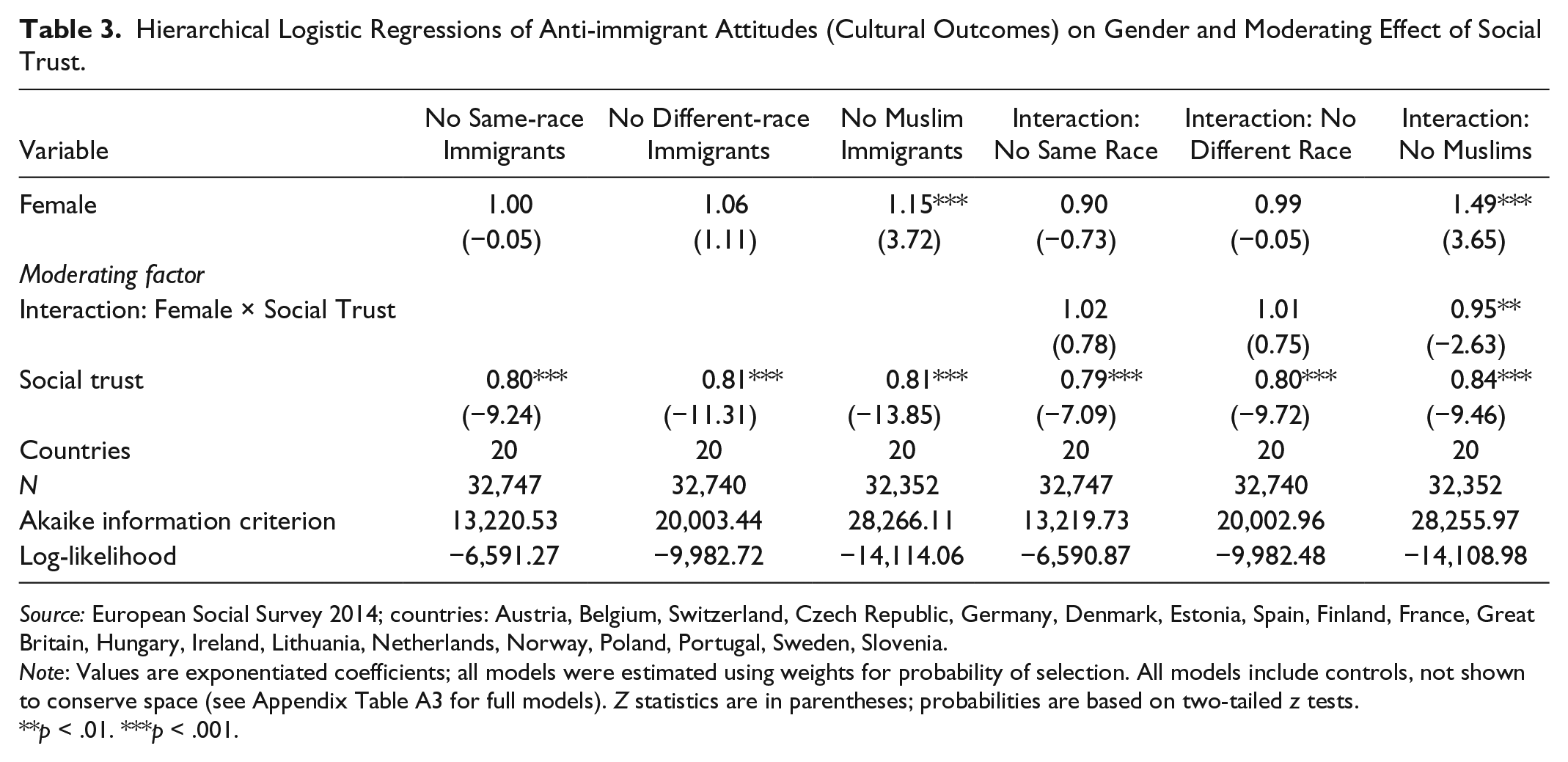
Source: European Social Survey 2014; countries: Austria, Belgium, Switzerland, Czech Republic, Germany, Denmark, Estonia, Spain, Finland, France, Great Britain, Hungary, Ireland, Lithuania, Netherlands, Norway, Poland, Portugal, Sweden, Slovenia.
Note: Values are exponentiated coefficients; all models were estimated using weights for probability of selection. All models include controls, not shown to conserve space (see Appendix Table A3 for full models). Z statistics are in parentheses; probabilities are based on two-tailed z tests.
p < .01. ***p < .001.
Table 3 also uncovers evidence supporting a bright ethnic boundary (Alba 2005). The gradual shift from a negative gender coefficient for same-race migrants, to a positive but nonsignificant coefficient for different-race migrants, to a positive and strongly significant coefficient for attitudes toward Muslims suggests a gradual brightening of boundaries along an ethnic-racial hierarchy. This pattern also suggests that the added gender-ideological component in symbolic boundary-making processes contributes to boundary brightening.
Table 3 shows that the interactions between gender and social trust fail to reach statistical significance for same-race and different-race outcomes. However, for anti-Muslim attitudes, the effect of gender is significantly moderated by levels of trust. The interaction is negative, which suggests that the gender effect diminishes as social trust increases. Stated differently, high social trust buffers the gender effect against immigrants viewed as illiberal, as predicted by hypothesis 4. Results also show that social trust consistently weakens anti-immigrant attitudes more generally. Respondents with higher social trust are significantly less likely to hold negative attitudes toward all groups, regardless of migrants’ cultural profiles. A one-point increase in the social trust scale leads to a decrease in negative attitudes by a factor of 0.80 to 0.81, holding all other variables constant.
Figure 1 represents the conditional effect of gender at differing levels of social trust. Female-male gender differences in anti-Muslim attitudes are not statistically significant at high trust levels. At low trust levels, however, gender effects are great. The gendered change in probability of holding anti-Muslim attitudes is calculated at 7.75 percentage points for those with a 0 social trust score, compared to a 1.74 percentage point difference for those with an average social trust score of 5.39. High social trust thus provides a foundation for intergroup bridging as individuals begin to see themselves as part of a broader, more cohesive whole.

Effect of Gender on Anti-Muslim Attitudes Conditional on Levels of Social Trust.
Interactions between gender and all other control variables are estimated. The significant interaction between gender and social trust is exceptional; the gender effect does not vary by other sociodemographic characteristics. Only the interaction between gender and student status for anti-Muslim attitudes is significant (OR = 0.63; z = −4.34), which reverses the pattern of more negative attitudes among females for students.
Results for control variables (see Appendix Table A3) conform to results from prior studies. Several variables show effects that are amplified or diminished with brighter ethnic boundaries. Low white-collar occupational status shows increasing ORs and significance from same-race exclusionism to anti-Muslim exclusionism. For variables identified by realistic group conflict theory, unemployed status is statistically significant and positive, but only for the exclusion of same-race migrants. Further, the effect associated with low income diminishes as ethnic boundaries become brighter. Taken together, this suggests that negative attitudes toward culturally and ethnically distinct migrants are not predicated on realistic group threat. As additional evidence for this, the effect of Right ideology is greatest for anti-Muslim attitudes, suggesting a politico-cultural basis for animosity targeted toward Muslims. For variables identified by social contact theories, residential diversity is found to decrease negative attitudes, but only toward Muslims.
Robustness
Several steps are taken to ensure that results are robust. Results are checked by including a country-level control for gender attitudes, constructed from ESS 2010 data. Any gender effect could be a function of more egalitarian attitudes. Controlling for gender attitudes has very little effect on results; most presented coefficients remain the same. Gender-egalitarian attitudes are found to suppress all forms of anti-immigrant sentiment, increasingly as ethnic boundaries brighten and most clearly for anti-Muslim attitudes (OR = 0.23; z = −5.34).
Including diversity context controls (total, non-Western, and Muslim foreign born) does not alter substantive results. Of the diversity variables, only Muslim foreign born exerts a significant and negative effect, and only on anti-Muslim attitudes (OR = 0.70; z = −3.47). This provides evidence for a social familiarization process at the contextual level (Schneider 2008). Including development, proxied by gross domestic product per capita, does not significantly alter results. Development diminishes all forms of anti-immigrant attitudes except toward poor European migrants, and the effect increases somewhat as ethnic boundaries brighten (no same race: OR = 0.70; z = −3.04; no Muslims: OR = 0.64; z = −3.61). Including relative inequality as measured by the Gini coefficient does not alter substantive results. Inequality exerts no significant influence on anti-immigrant attitudes. Controlling for the Eastern European countries in the sample does not substantively alter results. Eastern European countries are more likely to hold negative attitudes toward Muslims (OR = 3.29; z = 4.09) and poor Global South migrants (OR = 1.96; z = 1.98).
A series of jackknifed models is estimated that excludes one sample country at a time. Results are substantively equivalent to those presented, with some fluctuation in ORs and z scores. For female gender in noninteracted cultural models, ORs vary between 1.13 and 1.17 and z scores between 3.30 and 4.47. In interacted models, the female OR varies between 1.40 and 1.55 with z scores between 3.10 and 4.24. The gender–social trust interaction retains significance with ORs between 0.94 and 0.96 and z scores between −2.15 and −3.15.
Because outcomes are simplified binary variables, I conduct a series of multinomial logistic regressions to exploit the original categorical data (see Appendix Tables A4 and A5). 3 A Brant test shows that the parallel regression assumption is violated for ordered logit (Long and Freese 2006). Full factor change comparisons between response categories confirm presented results and reveal somewhat stronger effects when comparing allow none and allow many categories. Further, a significant interaction between gender and social trust emerges for the poor Global South outcome (Table A4), which suggests that women with high social trust are less likely than men to exhibit negative attitudes toward economic migrants who are also culturally distinct. Taken together, results show that the hierarchical models present a conservative picture of the relationship between gender and anti-immigrant attitudes.
Finally, all models are reestimated without probability weights. Results are substantively equivalent to those presented.
Conclusion
Are men more likely than women to hold anti-immigrant attitudes, as classic gender theories predict? Results provide no evidence that men are more xenophobic than women. To the contrary, in certain cases, women are found to be more xenophobic than men. Specifically, women are consistently more likely to exhibit negative attitudes toward Muslim immigrants. This female gender effect remains after controlling for a variety of individual- and country-level variables.
Findings represent an unprecedented reversal of the way gender structures anti-immigrant attitudes. This shift materializes in the context of a gender politics in Europe that frequently sets egalitarian European values against traditional immigrant cultures that are viewed as illiberal and gender inegalitarian. Muslim immigrant communities, and their perceived repressive gender relations, serve as a targeted realization of the intolerant and traditional “other.” Findings suggest that as gender egalitarianism becomes a symbol of Western liberal ideals and Muslims become increasingly perceived as an immigrant threat, women are beginning to view Muslim immigrants as a danger to gender equality. While a full analysis of the social implications of this change is beyond the scope of the study, findings illustrate how tolerance itself is employed as a symbolic boundary distinguishing between groups in a way that ultimately reinforces intolerance. This study thus provides empirical evidence for an increasingly notable paradox of liberalism (Joppke 2009).
Interestingly, findings contrast with those from prior research that show the opposite pattern for targeted anti-Muslim attitudes. Strabac and Listhaug (2008) find that women are less likely to hold anti-Muslim attitudes than are men. While contrasting findings could be an artifact of different outcomes (they use a social distance measure), they are more likely a result of different time periods and political climates. The Strabac and Listhaug study uses data predating 9/11 and from an era of expanding multiculturalism in Europe. As evidence, they find that a negative female effect is present only in Western Europe, where multiculturalist ideologies made the greatest inroads. In the current study, a positive female effect is detected universally, even after controlling for Eastern Europe and levels of development. Thus, it appears that the politicization of Islam has been thorough since the early 2000s and can explain both the robustness and reach of new gendered attitudinal patterns.
This study also provides evidence for the importance of symbolic boundaries in shaping anti-immigrant attitudes. In addition to corroborating a bright ethnic boundary (Alba 2005), the study advances the notion that gender ideology constitutes a crucial component of symbolic boundary-making processes in Europe. Native-immigrant boundaries coalesce around the perceived incompatibility of gender value systems. Group membership is thus partly defined through subscription to gender-egalitarian norms. Evidence of this has been documented in a growing number of countries’ civic integration procedures, where Muslim immigrants in particular are made to internalize liberal democratic principles prior to gaining residency or citizenship (Joppke 2009:115–17). The salience of gender ideologies in constructing boundaries, and the targeted nature of anti-Muslim attitudes, may also point to the declining relevance of a more general non-Western immigrant boundary, which both scholarship and policy have previously prioritized.
The study also shows that social trust has the potential to bridge groups as it moderates the gender effect against Muslim immigrants. Male-female differences in anti-Muslim attitudes become nonsignificant among those with the highest trust. This interaction is unique, as gender is not found to interact with other sociodemographic variables like education, occupation, or even political ideology, suggesting a lack of intersectional structures. While prior studies have neglected the role of social trust in shaping anti-immigrant attitudes, future research should investigate this link to track the relationship between diversity, trust, and xenophobia.
If, as findings suggest, new gender patterns are part of a broader realignment of ideologies that are increasingly defined against immigrant groups, this might partially explain the puzzling reconfiguration of politics across the continent. The radical right has taken advantage of the constructed opposition between the “true” European value of gender equality and “backward” immigrant cultures to forge stronger movements. Indeed, recent case-based research has documented this in several contexts (Farris 2017; Towns et al. 2014; Vieten 2016). Most concerning is that the magnitude of this reconfiguration only reinforces a paradox of liberalism, which poses a distinct ideological challenge to the continued vitality of democratic systems in the West.
Despite its current findings, this study leaves open several questions for future research and debate. One of the study’s limitations is its focus on a single time point. Analyses use data collected during a period in which anti-Muslim sentiment was especially severe. Conducting a longitudinal analysis to trace how gender effects change could provide a fuller picture of how tolerance linked to gender and sexuality serve as an ideological boundary in European societies. Further, this study is not an exhaustive analysis of all forms of prejudice or exclusionism. While the selection of outcomes captures attitudes toward both economic and ethnic migrants, it is not possible to fully parse out the role of race-ethnicity, cultural difference, and economic threat, due to both data and theoretical limitations. The weight of the evidence indicates that the gender effect is motivated not by economic threat (since it has no effect on poor outcomes), but by a combination of racial-ethnic and cultural boundaries, which are likely often conflated in the minds of the public. Importantly, these boundaries are partially defined by gender egalitarianism as a culturally specific and politically constructed set of ideas that differentiates between natives and immigrant others. Such insights should stimulate new research to explore how seemingly universal principles become symbolic and boundary defining in their politics. Finally, additional variables should be analyzed at the macro level to determine whether larger-scale gender structures shape the public’s attitudes. Qualitative analyses that examine political rhetoric and party strategies regarding gender and quantitative studies that exploit higher-level data for a greater number of countries could produce additional evidence for a reconfiguration of gender and immigration politics.
Footnotes
Appendix
Descriptive Statistics (Mean, Standard Deviation) by Gender.

| Males |
Females |
|||
|---|---|---|---|---|
| Variable | M | SD | M | SD |
| No same-race immigrants | 0.07 | 0.25 | 0.07 | 0.25 |
| No different-race immigrants | 0.12 | 0.32 | 0.12 | 0.33 |
| No Muslim immigrants | 0.23 | 0.42 | 0.26 | 0.44 |
| No poor European immigrants | 0.12 | 0.33 | 0.13 | 0.34 |
| No poor Global South immigrants | 0.18 | 0.39 | 0.19 | 0.39 |
| Female | 0 | 0 | 1 | 0 |
| Interaction: Female × Social Trust | 0 | 0 | 5.43 | 1.88 |
| Social trust | 5.41 | 1.80 | 5.43 | 1.88 |
| Occupation: Higher white collar | 0.24 | 0.43 | 0.23 | 0.42 |
| Occupation: Lower white collar | 0.25 | 0.43 | 0.44 | 0.50 |
| Occupation: Agricultural | 0.04 | 0.19 | 0.02 | 0.14 |
| Occupation: Blue collar | 0.34 | 0.47 | 0.17 | 0.37 |
| Unemployed | 0.06 | 0.25 | 0.06 | 0.23 |
| Student | 0.11 | 0.31 | 0.10 | 0.30 |
| Other occupation | 0.02 | 0.13 | 0.04 | 0.20 |
| Education: Primary or none | 0.10 | 0.30 | 0.10 | 0.30 |
| Education: Lower secondary | 0.17 | 0.38 | 0.18 | 0.38 |
| Education: Upper secondary | 0.38 | 0.49 | 0.35 | 0.48 |
| Education: Postsecondary | 0.35 | 0.48 | 0.37 | 0.48 |
| Income: Middle to high | 0.64 | 0.48 | 0.56 | 0.50 |
| Income: Lower third | 0.22 | 0.42 | 0.30 | 0.46 |
| Income: Missing | 0.14 | 0.35 | 0.15 | 0.36 |
| Age (standardized) | −0.03 | 1 | 0.02 | 1 |
| Religiosity | 3.71 | 2.96 | 4.65 | 3.01 |
| Ideology: Left to center Right | 0.67 | 0.47 | 0.69 | 0.46 |
| Ideology: Right to far Right | 0.26 | 0.44 | 0.20 | 0.40 |
| Ideology: Missing | 0.08 | 0.26 | 0.11 | 0.31 |
| Nationalist sentiment | 0.53 | 0.50 | 0.51 | 0.50 |
| Friends of different race | 0.49 | 0.50 | 0.46 | 0.50 |
| Diverse residential area | 0.53 | 0.50 | 0.52 | 0.50 |
Source: European Social Survey 2014; countries: Austria, Belgium, Switzerland, Czech Republic, Germany, Denmark, Estonia, Spain, Finland, France, Great Britain, Hungary, Ireland, Lithuania, Netherlands, Norway, Poland, Portugal, Sweden, Slovenia.
Acknowledgements
The author thanks the editors and anonymous reviewers, Kody Steffy, Patricia McManus, and Shiri Noy for their very thoughtful comments and valuable suggestions. All mistakes are the author’s own.
1
For targeted attitudes, the current study updates and extends prior research on anti-Muslim attitudes (Strabac, Aalberg, and Valenta 2014;  ) by using cross-national data collected after 9/11 and since the recent politicization of gender and immigration.
2
Countries include Austria, Belgium, Switzerland, Czech Republic, Germany, Denmark, Estonia, Spain, Finland, France, Great Britain, Hungary, Ireland, Lithuania, Netherlands, Norway, Poland, Portugal, Sweden, Slovenia. The item on “poor European immigrants” was not fielded in Czech Republic (N = 30,732).
3
Multinomial logit models are estimated with country binaries to control for contextual fixed effects.