




Abstract
The authors argue that cultural fragmentation models predict that cultural change is driven primarily by period effects, whereas acquired dispositions models predict that cultural change is driven by cohort effects. To ascertain which model is on the right track, the authors develop a novel method to measure “cultural durability,” namely, the share of over-time variance that is due to either period or cohort effects for 164 variables from the 1972–2014 General Social Surveys. The authors find fairly strong levels of cultural durability across most items, especially those connected to values and morality, but less so for attitudes toward legal and political institutions.
Cultural sociologists have focused a great deal on the issue of “culture in action,” that is, on the question of how culture influences people’s conduct. One (admittedly simplified) way to frame the question is to ask whether people act on the culture they internalize during their formative years (Parsons and Shils 1951) or whether they strategically use cultural “tools” available at any one moment to navigate and make sense of social interactions and institutions independently of whether this cultural has been deeply internalized or not (Swidler 1986, 2001a, 2008). This is essentially a question of the relation between the timing of cultural exposure and the timing cultural influence: can the past make itself felt in the present, or do present contingencies override past cultural influences?
Recently, we have seen convergence around the idea that both of these models of the culture-action linkage carry some validity (Lizardo and Strand 2010; Patterson 2014). More specifically, researchers have proposed that both accounts may be profitably combined under some version of a psychological dual-process theory (Hoffmann 2014; Miles 2015; Srivastava and Banaji 2011; Vaisey and Lizardo 2010). People do internalize beliefs, values, and other cultural constructs that influence their conduct at subsequent time points, but they often do so in an implicit way that cannot readily be articulated. At the same time, people also learn a wide variety of cultural scripts that can be used to make sense of the world to themselves and to others and to navigate the requirements of social institutions at a given point in time (Chan 2012:174–78; Vaisey 2009).
To this point, however, cultural sociologists have been focused on showing how cultural schemes matter (or do not matter) for action at the personal level, but they have not seriously considered the different implications of these debates for understanding cultural change at the aggregate level. Our argument is that considerations about the culture-action linkage do have such implications and that analysts interested in the nature, pacing, and direction of cultural change at the macrosocial level (Caren, Ghoshal, and Ribas 2011; Inglehart and Baker 2000) should be attuned to the implications of these debates. To that end, in this article, we outline two ideal-typical models of cultural internalization informing most research in the field, the cultural fragmentation model and the acquired dispositions model, and consider the predictions each makes with regard to process of cultural change.
The key to our argument is that there are important differences in how these two models portray the relationship between the timing of exposure to cultural influences and its effect on individual behavioral or attitudinal outcomes. In a nutshell, the cultural fragmentation model implies that the contemporaneous effects of the external environment are preponderant in shaping behavioral and attitudinal dispositions, whereas the acquired dispositions model implies a sort of “imprinting” effect (cf. Marquis and Tilcsik 2013) such that contemporaneous responses are primarily a function of previous exposure as historically encoded in persons (cf. Marquis and Tilcsik 2013). We can thus draw a theoretically productive theoretical analogy (Vaughan 2014) between the key empirical implications of the two dominant models of internalization in cultural sociology and how demographers and attitude researchers have traditionally conceptualized the difference between “period” and “cohort” effects in relation to processes of social and cultural change (Ryder 1965).
To concretize the argument, we show that analytic tools for the disambiguation of these mechanisms can be used as a window to test the global empirical validity of the two most prevalent theoretical models in cultural sociology. In a nutshell, cultural fragmentation models predict that social change processes are driven primarily by period effects, and acquired dispositions models predict that social change processes are driven primarily by cohort effects. To evaluate this hypothesis, we analyze 164 time-series variables from the 1972–2014 General Social Surveys (GSS) using a novel, yet simple, technique to deal with the age, period, and cohort identification problem. We find that in the majority of the cases (but not all), the predictions of the acquired dispositions model are better supported, suggesting that when it comes to certain attitudinal and behavioral dispositions, cultural change happens via the slow enculturation of persons early in life and not via contemporaneous exposure to external cultural influences.
Models of Culture in Action
The Classical Socialization Model
Postwar sociology relied on a model of culture as a set of patterned symbolic structures that were deeply internalized by members of a society. Parsons (1964) regarded the idea of cultural internalization, which he considered a landmark joint discovery by both Durkheim and Freud, as one of the pillars of social scientific theory. In Toward a General Theory of Action, Parsons and his collaborators argued that “culture patterns [are] internalized” as “[sets of] cognitive expectations and of cathectic-evaluative selection among possible orientations” and that these were “of crucial significance in the personality system” (Parsons and Shils 1951:7). This model implicitly shaped a great deal of subsequent work in the social sciences, including work in psychological and cultural anthropology, cross-national culture and personality studies, up to Coleman’s influential conceptualization of the macro-to-micro link. The key cultural element in this tradition was “values”: durable internal states held to affect judgment and action across a number of domains (Miles 2015). The key enculturation mechanism was “internalization.” We refer this the classical socialization model.
The Cultural Fragmentation Model
In explicit contrast to the classical socialization model, the most influential scholars in the “cultural turn” of the 1980s and 1990s rejected internalized culture as an important dimension of the motivation of action and challenged the very efficacy of internalization as the most influential channel of cultural acquisition (Patterson 2014). Swidler (1986), one of the earliest and most articulate advocates of this paradigmatic turn, was clear in proposing that culture does not work “via enduring psychological proclivities implanted in individuals by their socialization”; instead, she argued that “publicly available meanings facilitate certain patterns of action, making them readily available, while discouraging others” (Swidler 1986:283; see also Swidler 2001a, 2001b). DiMaggio (1997) reinforced these points a decade later. Drawing on selected research from cognitive and social psychology, he again criticized the internalization model associated with classical socialization theorists. Instead, he argued that the “sources of stability in our beliefs and representations” should not be sought in the internal structure of our minds but rather in external “cues embedded in the physical and social environment.” What both Swidler’s and DiMaggio’s proposals have in common is the idea that culture is not internalized in any structured or durable way, but whatever acquisition takes place does so in a disorganized fashion. This means that for culture to affect action systematically, the structuring influence of an external social environment if required (Lizardo and Strand 2010). We refer to this as the cultural fragmentation model.
The Acquired Dispositions Model
In the past decade, cultural sociologists have begun to question the adequacy of the cultural fragmentation model to account for a wide variety of empirical phenomena. Contra the assertions of cultural fragmentation theorists, moral worldviews and values seem to do a fairly good job of predicting people’s future behavioral and relational choices (Miles 2015; Vaisey 2009; Vaisey and Lizardo 2010). Theoretically, analysts have begun to rethink the picture of the internalization process to move beyond the limitations of classical socialization accounts. Accordingly, there has been an increasing recognition that cultural elements are not obtained simply by “downloading” a society’s “culture” as explicit symbolic structures (as Parsons might have had it). 1 Instead, drawing on practice theory (Bourdieu 1990; Ortner 1984), some analysts hypothesize that differential exposure to social experience early in life leads to the development of certain patterns of judgment, perspective, taste, and action, patterns Bourdieu (1990) referred to as “durable, transposable dispositions” (p. 54).
The term dispositions is important; the basic proposal is not that people “store” ideas or opinions in their brains in a coherent form. Instead, social experience shapes cognition such that people have dispositions to reproduce similar judgments to cultural objects over time (Zaller 1992). 2 That is, a person does not walk around with a settled view of (say) country music in his or her long-term memory but is able to recreate this judgment as needed in response to appropriate external prompts (e.g., Lizardo and Skiles 2016). The key empirical implication is that because these dispositions are formed early in life, they lead to time-delayed effects on contemporaneous responses, similar to those noted in the organizational literature as “imprinting” phenomena (Marquis and Tilcsik 2013). 3 We refer to this as the acquired dispositions model.
Implications for Aggregate Cultural Change
Because of its unrealistic assumptions about psychological processes (e.g. Parsons’s reliance on implausible Freudian mechanisms), the classical socialization model is no longer a serious competitor in sociological theory (see DiMaggio 1997; Lizardo and Strand 2010; Swidler 1986). Contemporary debate centers instead on determining the relative importance of the situational processes associated with the cultural fragmentation model (i.e., “context”) and the dispositional processes (i.e., “habitus,” “worldviews”) associated with the acquired dispositions model (see, e.g., the debate between Jerolmack and Khan [2014] and Vaisey [2014]). These debates have focused primarily on action: the relationship between known cultural elements (scripts, frames, values) and the conduct they do, or do not, motivate. But the assumptions of the two models have very different implications for understanding processes of cultural change at the aggregate level.
The cultural fragmentation model assumes that people “know much more culture than they use” (Swidler 2001a:160) and that the external physical and social environment is the primary factor in determining which “cultural tool” gets used in a particular situation. If, as Swidler (1986:283) and DiMaggio (1997) argued, culture does not work via the implanting of durable dispositions in persons via a deep internalization process but instead functions primarily by making publicly meanings more or less available, it follows that contemporaneous social conditions should play the largest role in accounting for aggregate cultural change. This is because individuals will select the elements of their broad cultural repertoires that are the best suited to the environment created by “public ritual” (Swidler 2001b:92) and common knowledge (Chwe 2001).
In contrast, the acquired dispositions model assumes that people acquire (relatively) enduring dispositions (e.g., to orient themselves toward certain social objects) more readily during earlier phases of the life course. Bourdieu’s habitus (perhaps the acquired dispositions concept par excellence) is defined as “structured structures” of thought and action which reflect “the active presence of the whole past of which it is the product.” 4 These “durable dispositions” are “determined by the past conditions of production” and “can outlive the economic and social conditions in which they were produced” (Bourdieu 1990:61ff). This suggests that past social conditions should play the largest role in driving subsequent cultural shifts (Greve and Rao 2014).
It is, of course, possible to overstate the differences between the cultural fragmentation and acquired dispositions models. It is true that proponents of both approaches agree on many things, such as the importance of cultural repertoires (including cultural capital), public practices, and strategic action, among others (Abramson 2012), but they nonetheless differ pointedly on the question of cultural internalization. 5 For purposes of theoretical clarity (and empirical adjudication), these differences should not be papered over, because in many ways they lead to distinct empirical prediction regarding both the underlying mechanisms and the pacing of cultural change processes.
For example, though appreciative of work emphasizing durable dispositions, cultural fragmentation theorists have drawn explicit contrasts on the importance of the “habitus” concept. For instance, Swidler (2001b) drew on Armstrong’s (2002) work on changes in gay identity to argue that discourses and public practices can explain cultural change without recourse to dispositional mechanisms. After summarizing Armstrong’s case, Swidler (2001b) noted that
this is hardly a matter of a deeply internalized habitus, inscribed in the body. . . . Indeed the whole discourse is only a couple of decades old, and people latched onto its terms immediately, inventing themselves, and elaborating the discourse, as they went along. (pp. 82–83)
Although this is of course a commentary on a particular line of research, Swidler used it to argue more generally that “visible, public enactment[s] of new patterns” are the significant sources of cultural change and that such change does not necessitate “the time or repetition that habits require” (p. 87; see also DiMaggio 1997:268).
The cultural fragmentation and acquired dispositions models, then, lead to quite different predictions about which sort of process is most responsible for the patterns of cultural change we are likely to observe at the aggregate level. This is a rare occasion, as cultural theories seldom lend themselves to this relatively clean level of empirical adjudication. The cultural fragmentation model focuses our attention on the public conditions of the contemporaneous environment, whereas the acquired dispositions model focuses our attention on the time at which a person’s dispositions were acquired. This differentiation, it turns out, has an exact parallel to the distinction between period effects and cohort effects in the demography literature (Glenn 2005). In the next section, we consider this connection in more detail and argue that we can use it to shed light on the relative merits of the cultural fragmentation and acquired dispositions models for understanding cultural change.
Mechanisms of Social and Cultural Change
Social change can come about through a combination of three processes: age effects, period effects, and cohort effects (Ryder 1965). Age effects are individual changes that are the result of developmental processes resulting from social and biological maturation (e.g., people get sicker as they get older). Period effects are influences caused by contemporaneous changes (e.g., the effect of an ongoing foreign conflict on political views). Cohort effects are population changes that result because older cohorts in a population are dying and being replaced by younger cohorts that are different in some way as a result of having made an important social transition (e.g. being born, coming of age, entering the labor force, forming a family) at a given historical time (e.g., those who grew up during the Great Depression were consistently different in many ways from surrounding cohorts over time). Here we are primarily concerned with the relative contribution of period and cohort effects. Does culture change because of a changing public zeitgeist? Or does it change because people are socialized under different conditions and take acquired dispositions with them over the rest of their lives? Put even more simply, if we want to predict (say) a person’s opinion on an issue, or their behavior, would we do better to know what year it is when we ask the question, or what year the person was born?
Even though there is a tight conceptual fit between demographic models of social change and theoretical debates in cultural sociology, we cannot apply a simple statistical technique and “solve” the issue. Although it is possible to conceptualize separate age, period, and cohort effects on changes in some outcome variable, it is impossible to simply directly estimate these effects in a regression model. This is because of the “identification problem”: whenever we know any two of age, period, or cohort, we automatically know the third. For example, if we know that a person is 29 years old and that it is 2015, we also automatically know that she was born in 1986 (perfect collinearity). This makes it impossible to estimate a regression model that simply includes age, period, and cohort as predictors, because one of the variables will be perfectly collinear with the other two. We refer to this as the age-period-cohort (APC) problem.
Researchers have used many different approaches to address the APC problem (see, e.g., Glenn 2005). This is not the place for a comprehensive review of these approaches; the main observation we wish to make is that all must rely on some identifying restriction. For example, assuming that age can be treated as a quadratic function or that cohorts can be grouped into five-year intervals breaks the perfect collinearity between the variables, thus allowing estimation (Yang and Land 2006). Unfortunately, all such restrictions are have an arbitrary component and may affect the resulting estimates (Bell and Jones 2014).
Let us set the APC problem aside for a moment, however, and consider what we would actually want to know if we could. If we could get separate effects for each age, each year, and each cohort, we could compare the variances of these effects to get a sense of the relative importance of each. Given the motivating question of this study—comparing the cultural fragmentation and acquired dispositions models of cultural change—we may want to pose the question in terms of cultural durability. That is, once a person acquires his or her dispositions (a cohort-based process), how robust or durable are those dispositions in the face of changes in the contemporaneous social environment (a period-based process)?
Consider the following: let
Empirical Analysis
So far we have pitched this discussion at a fairly abstract level. Now we turn to a concrete application. To assess the degree to which cultural phenomena show signs of durability, we need data on a set of cultural objects over time and a model that can distinguish between cohort and period effects. Our set of cultural objects consists of 164 variables from the 1972–2014 GSS. We included all variables that were measured in at least 15 separate surveys and for which the first and last measures were taken at least 30 years apart. This ensures enough variability to attempt to estimate separate age, period, and cohort effects.
The choice of statistical model is less straightforward. As we noted above, there is no regression model that can disentangle age, period, and cohort effects. All models must rely on identifying restrictions and those restrictions affect the estimates in nonignorable ways (Bell and Jones 2014).
Instead of relying on a single model, therefore, we adopt a different strategy. Consider the following nonestimable model:

where A, P, and C refer, respectively, to the numbers of distinct age, period, and cohort values in the data set. (This is just a model with dummy variables for each distinct value of age, period, and cohort, less one each for a reference category.)
This model is not estimable, because knowing any two of these values automatically tells us the third, creating a situation of perfect collinearity. But what if we constrain the model such that (say) cohorts are measured in 5-year windows? Now if we know that the year is 2005 and our respondent was born in the 1985–1989 cohort, we do not know her exact age. She might be anywhere between the ages of 26 and 30 years, breaking the perfect collinearity and thus allowing estimation. This specific restriction, of course, will incorporate unknown biases into the estimates (Luo and Hodges 2015). So rather than focusing on one identifying restriction, we consider a whole class of restrictions we call window restrictions. Let WA, WP, and WC refer to the window sizes for age, period, and cohort, respectively. If, say, WA = 3, then we are measuring age in 3-year windows (i.e., 18–20, 21–23, etc.). Combining all possible window restrictions from 1 to 5 on all three dimensions yields 125 different models (53).
Our analytical strategy is based on the intuition that, of these 125 models, only one is not statistically estimable: the model with window size 1 for all three dimensions. The results from the other 124 cells of the 5 × 5 × 5 space include information on how each of the estimates changes in response to specific restrictions. It may be possible, therefore, to extrapolate from trends in the estimable areas of the space to the one corner of the space that is not directly estimable.
On the basis of this intuition, we proceed as follows. For each of the 164 variables in the GSS time series, we execute the following steps:
Estimate 124 regression models on the basis of different window sizes ranging from 1 to 5 (excluding the 1,1,1 cell).
For each of the 124 regressions, calculate δ, the cultural durability index, and save this value in a new data set.
On these 124 results, estimate a model that predicts δ as a function of the three window sizes.
On the basis of this model, predict the expected value of δ for the 1,1,1 cell.
To build intuition, we begin by examining the results for a single (attitudinal) variable. The GSS variable code name is FEFAM, which was asked in most years between 1977 and 2014. The prompt reads, “It is much better for everyone involved if the man is the achiever outside the home and the woman takes care of the home and family (FEFAM),” with answers ranging from strongly agree (1) to strongly disagree (4). Figure 1 shows the range of values of δ across the 124 regressions. It is clear that the constraint used to identify the model has a substantial impact on the estimate of δ, which ranges from 0.54 to 0.68 (µ = 0.60, σ2 = 0.03).

Distribution of estimates of δ for FEFAM over 124 models.
Figure 2 shows the predictions generated from a regression predicting the value of δ as a quadratic function of the A, P, and C window sizes for the same outcome. For visual clarity, we plot the full 1–5 range of cohort windows and set A and P to either 1 or 5 to show contrast. We find that, not surprisingly, different restrictions lead to somewhat different results. In general cultural durability, as indicated by higher values of the δ coefficient, increases as the age and in particular the period windows are expanded. This is not surprising, because loosening the period constraints should leave more variance for cohort to explain. In the same way, as the cohort window is expanded, estimates of cultural durability decline (almost linearly), which is also the expected result. What is most important for our analytic purposes is that on the basis of the patterns in the space identified by the model, we can generate a prediction (δ = 0.69) for the A = 1, P = 1, and C = 1 cell even though this value is not (and cannot be) observed.

Estimates of δ by A, P, and C window size for the General Social Survey variable FEFAM.
With this example in mind, we now present the results from all 164 variables in Figures 3, 4, and 5. Figure 3 shows the distribution of all the estimated values. Figure 4 plots the same information in a way that allows identification of each individual variable. Figure 5 shows the δ1,1,1 estimates (black diamonds) as well as the range of estimates yielded by our windowing procedure (light gray lines), with variables ordered by the magnitude of their cultural durability estimate.
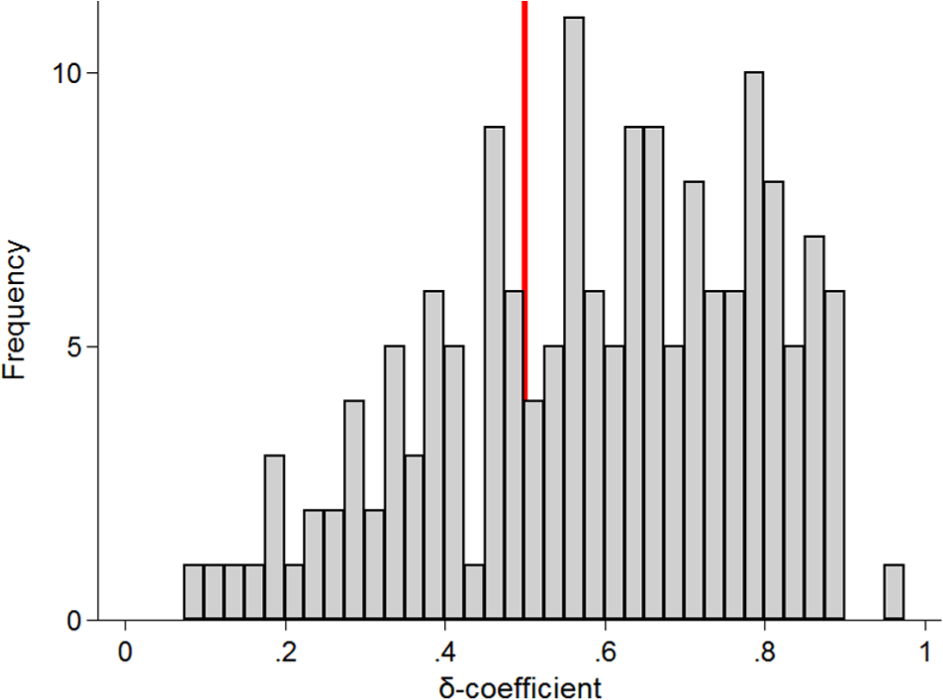
Distribution of δ coefficient across 164 General Social Survey variables.

Estimated δ values for 164 General Social Survey variables.
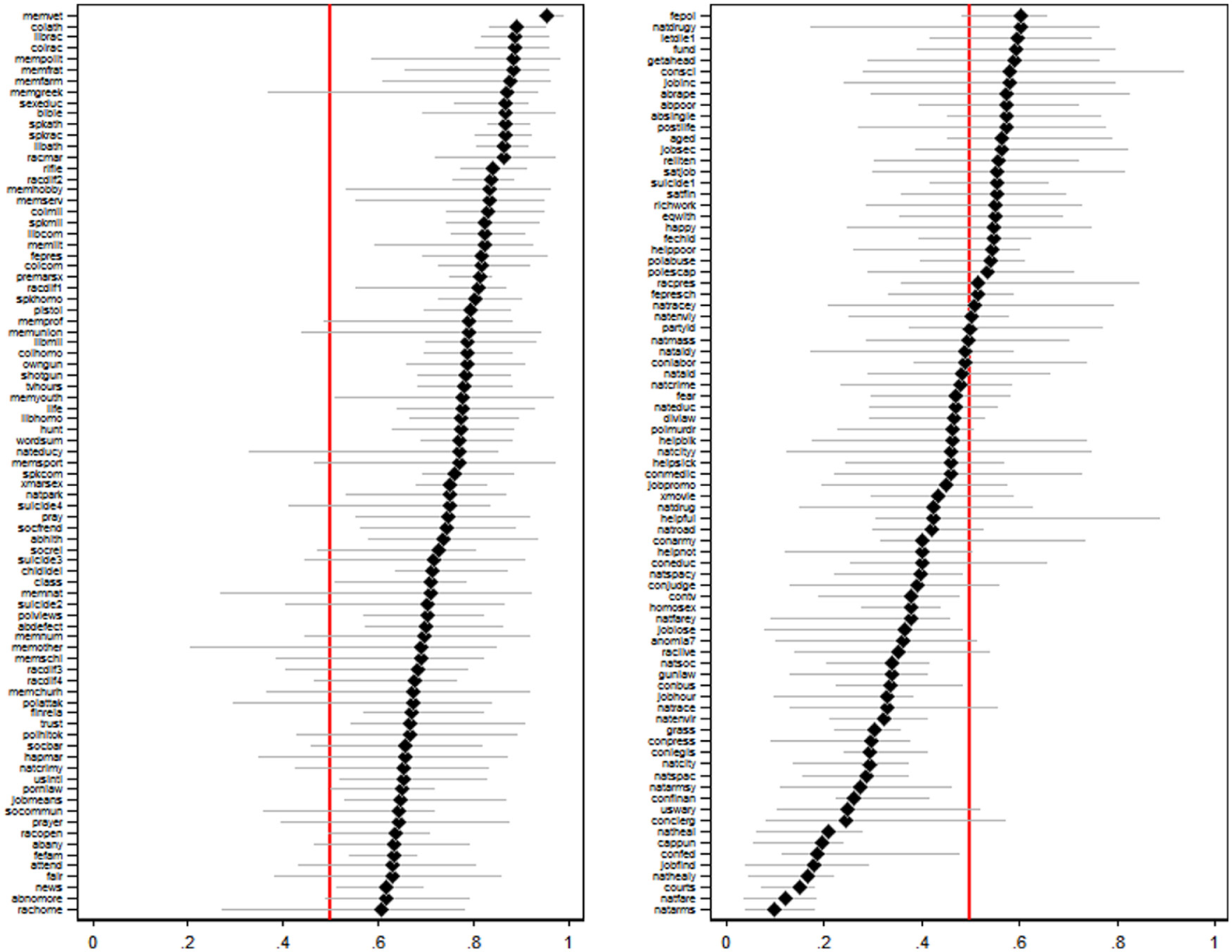
Delta estimate on (1, 1, 1) cell estimate is shown as a black diamond. Range of estimates yielded by the windowing procedure is shown as a light gray horizontal line. Variables are ordered by cultural durability.
Because there are so many variables here, there is no possible way to discuss each one. In any case, what is more important given our theoretical question is the overall distribution of the durability coefficients. These are shown in Figure 3. We observe a wide range of variation of cultural durability across items, with a minimum of 0.10 (attitudes on military spending) and a maximum 0.95 (membership in a veterans’ organization). As the figure shows, the δ distribution across all items is multimodal, but a majority of the values lie to the right of the expected midpoint (δ = 0.50, shown as a red line through the plot). This means that for most items, cohort effects dominate over period effects. The median δ value is 0.61, with 111 of the items (68 percent) having δ values of 0.50 or more. Only 10 of the items (6 percent) have δ values less than 0.25, in comparison with 42 items (25 percent) having δ values of 0.75 or more. In all, it seems that long-term change across most of the cultural objects included in the analysis is driven by the acquired dispositions and not the cultural fragmentation mechanism.
Figures 4 and 5 provide converging evidence for this claim. Looking at the figures, it is clear that the distribution of the items at the low and high ends of the δ distribution is not random. Items with the lowest δ values include political views, subjective class identification, various measures of confidence in legal and political institutions, and opinions about government spending, the legality of capital punishment, and marijuana legalization. It seems that items that induce respondents to orient themselves toward the external political and economic climate tend to behave according to the tenets of the cultural fragmentation model, with the response being largely structured by contemporaneous conditions. In this respect, it is important to note that the political sphere is precisely a type of “shallow but powerful structure” (Sewell 1992) and as such corresponds well with the sort of external structuration process usually postulated by cultural fragmentation theorists.
Note however that for the bulk of the items located north of the δ = 0.50 line, this cultural change mechanism is not applicable. In this area of the figure, with the highest δ scores, we find the core “value” and “morality” items inclusive of attitudes toward civil liberties and tolerance (Bryson 1996), various opinions regarding sexuality and gender roles (Baker 2010), attitudes toward racial minorities and interracial marriage (Firebaugh and Davis 1988), ideas as to whether the bible is the word of God, along with membership in traditional organizations such as veteran associations and fraternal groups (Putnam 2001), and gun ownership (Cohen and Nisbett 1994). These are precisely the “value-laden” cultural objects recent work predicts should be structured by internalized dispositions developed early in life. This is precisely the cultural change mechanism proposed by acquired dispositions theorists. Given their durability, these dispositions should be relatively impervious to the external structuration mechanisms (and presumed fluctuation) postulated by cultural fragmentation theorists (e.g., Cohen and Leung 2009; Miles 2015; Vaisey 2009).
Discussion
Summary of the Argument and Results
Motivated by the main lines of theoretical debate in cultural sociology today, our goal in this article was to assess the relative empirical merits of the cultural fragmentation and acquired dispositions models for understanding patterns of cultural and social change in the United States for the past four decades. We argue that the cultural fragmentation model, with its emphasis on common knowledge, public meaning, and externalized cultural influences, leads to the empirical implication that period effects should be primarily responsible for cultural change (Swidler 2001b). The acquired dispositions model, on the other hand, because of its emphasis on the past in the present in the form of the “imprinting” effect of early socialization, leads to the hypothesis that cohort effects should be a stronger predictor. The results are fairly clear in revealing that cohort-based processes are dominant in relation to period-based mechanisms in accounting for cultural change across a wide variety of attitudinal and behavioral outcomes. Put another way, if we want to make our best guess (net of age) about what a person thinks or what kinds of practices he or she engages in, we would be better off knowing what year the person was born than what year we are observing them.
Implications for Cultural Analysis
We take this pattern of results as evidence that, despite the failings and limitations of the postwar classical socialization model, sociologists after the “cultural turn” of the 1980s and 1990s might have be too hasty in rejecting the importance of cultural internalization in favor of external structuration by public forms of culture (Patterson 2014; Quinn 2016; Strauss and Quinn 1997). An acquired dispositions account that retains a notion of durable cultural internalization but rejects the cognitively implausible Freudian mechanisms proposed in classical socialization models thus emerges as the most defensible alternative.
Durable cultural internalization can be theorized from an acquired dispositions perspective using empirically specifiable processes of cognitive internalization characterized by early dispositional learning with lock-in and conservation (Bargh and Morsella 2008; Bourdieu 1990; Cohen and Leung 2009). Although it would certainly be an exaggeration to say that culture matters primarily via the classical socialization mechanism of deep internalization, people do appear to acquire durable dispositions in their formative years. These dispositions, in their turn, make them more likely to display certain beliefs and engage in certain practices over their entire life course, in partial independence from contemporaneous cultural influences (Marquis and Tilcsik 2013).
These findings are difficult to square with the predictions of cultural fragmentation–style models prioritizing the causal influence of contemporaneous conditions. It does not matter whether this external structuration is produced by “context,” changing institutional conditions, cultural codes, or framing effects (DiMaggio 1997; Swidler 2001b). If external structuration were the most important mechanism influencing (say) judgments, we would not expect period effects to be less relevant than cohort effects across such a wide range of cultural outcomes. In this respect, both the scope conditions and the range of explanatory phenomena that cultural fragmentation models are equipped to handle need to be better specified (Lizardo and Strand 2010; Patterson 2014; Vaisey and Lizardo 2010). One thing that is surely the case is that the cultural fragmentation model cannot serve as an overarching organizing framework in cultural analysis but must be supplemented by theoretical frameworks that allow the coherent conceptualization of the structuring effects of durably incorporated dispositions at the personal level (cf. Strauss and Quinn 1997).
Implications for Understanding the Role of Culture in Social Change
It is vital to note here, however, that the public mechanisms emphasized by cultural fragmentation theorists likely play a key role in some kinds of “punctuated” social change, even though they may (on average) exert little influence on the type of cultural change that is tracked by aggregate changes in attitudes and practices. Although the distribution of personal opinions may be changing slowly and steadily as the result of cohort replacement, public rituals and displays are essential for the generation of “common knowledge” (Chwe 2001:6–9) allowing “everyone [to] see that everyone else has seen that things have changed” (Swidler 2001b:87).
Nevertheless, although cultural fragmentation theorists such as Sewell (1996) and Swidler (2001a, 2001b) tend to emphasize “public enactment[s]” as both the cause and the signal of social change, we would argue that public rituals matter primarily because they signal a tipping point in new consolidated (and thus potentially durable) dispositions. As Pierson (2004:83) argued, a relatively “slow moving” causal processes (in our case the gradual shift in acquired dispositions in the population) does not have to result in a “gradual” change outcome; instead, through a threshold mechanism, acquired dispositions processes may combine with cultural fragmentation externalization and public knowledge mechanisms to generate punctuated patterns of social change. For instance, public rituals may allow already developed dispositions to become “public opinion,” changing norms, public accounts, and styles of justification and legitimation while creating opportunities for coordination among the like-minded (Chwe 2001). The GSS data used here do not permit disentangling perceptions of others’ attitudes—so-called third-order inference (Correll et al. 2012)—from one’s own attitudes, but it is likely that perceptions of others attitudes (or the “generalized attitude”) would exhibit much stronger period effects than the first-order attitudes themselves.
Implications for Other Lines of Inquiry on Social and Cultural Change
Even though shedding light on particular substantive areas was not the main goal of this article, the empirical findings we report have implications for research in different subfields concerned with aggregate-level social change. We find that changes in attitudes about family, gender, race, sexuality, and patterns of organizational membership change almost entirely because of cohort succession, suggesting that these are attitudes and practices that may be driven by coherent acquired dispositions, not fragmentary cultural toolkits. On the other hand, many political and policy issues, such as one’s degree of “confidence” in the various branches of government, or opinion about the appropriateness of capital punishment or marijuana legalization, do not seem to trigger consistent reactions and are thus subject to the effects of contemporaneous external factors. These may include the cultural and media construction of crime waves, other moral panics (Garland 2008), and the particularities of the contemporaneous political climate including which issues are being discussed when (Hilgartner and Bosk 1988).
Our approach also adds new explanatory dimensions to previous attempts to account for large-scale patterns of social change that, as above, attempt to disambiguate period from cohort processes. Take for instance the well-established finding of a secular increase in the percentage of Americans who report participating in public protests (Caren et al. 2011). According to the most prevalent explanatory account—the so-called social movement society (SMS) thesis—this phenomenon has little to do with enculturation and acquired dispositions. Instead, the SMS thesis points to the standard external structuration mechanisms preferred by proponents of cultural fragmentation–type accounts, such as the institutionalization of challenger-state interactions, the decreasing disruptiveness of protest events, and the decreasing likelihood of repression (and associated drop in perceived risk by potential participants) on the part of police and other representatives of the repressive arm of the state.
Following a logic similar to the one we developed more generally above, the main test implication of the SMS thesis is that given availability of data on a repeated cross-section of Americans, the bulk of the over-time change in the likelihood of protest participation should primarily be a product of period effects, not generational or compositional changes in the American population. Although not elaborated in these terms in the original study, an acquired dispositions account would point to the importance of generation-specific enculturation dynamics: protests, like other forms of motivated action, should be driven by generation-specific experiences that allow the selective acquisition of the relevant dispositions. Although not part of Caren et al.’s (2011) original argument, we would suggest that the acquired dispositions model is able to account for both the dominance of generational over-period mechanisms in the creation of a “social movement society” (in contradiction to the dominant cultural fragmentation account in social movement theory) and for the selectivity of the generational effect across deep and shallow forms of movement participation in a way that cultural fragmentation or traditional classical socialization approaches would not be able to. 7
Methodological Implications
Finally, our approach also suggests some methodological principles that may be of use for future studies of cultural and social change. First, assessments of variability in cultural durability can benefit greatly from measuring cultural phenomena over time, although they do not, of course, require identical methods to the ones used here. But even when the temporal dimension is included, it is important to either incorporate strategies for disentangling period and cohort effects (or effects of external culture and internalized culture) or at least to acknowledge that such effects are confounded in any observational design.
In addition, the occurrence of rapid change in itself is not to be taken as supporting the theses of external structuration and shallow socialization that have been the stock in trade of cultural fragmentation theorists. Because of our imperfect perceptions of others’ views, analysts of social change most likely have a tendency to overestimate the extent to which social change reflects sudden period effects rather than cumulative cohort change. Finally, the specific methods used in this article can be used outside the realm of survey data. For example, period-cohort models of the type used here could be used to model changes in fashions such as baby naming (Lieberson and Mikelson 1995), product adoptions (Rossman 2012), or the relative stickiness of certain tastes and practices (Schindler and Holbrook 2003), among other phenomena.
Footnotes
Appendix
In this article, we propose δ as an estimate of cultural durability. This value depends on correct estimates of two quantities: the variability in an outcome attributable due to periods and the variability in an outcome attributable to cohorts. In this appendix, we consider and evaluate potential bias in our estimates given the limitations, in terms of temporal scope, of the cumulative GSS data.
With any repeated cross-section design, there will always be a greater range of cohorts than of periods. The 1972 GSS cross-section alone, for instance, contains respondents from one period (1972) and 68 birth cohorts. 8 Together, the 1972 and 1973 GSS contain respondents from two periods and 69 birth cohorts. Assuming a relatively constant human life span, each new year of data collection brings one new period and one new birth cohort, meaning that the ratio of the cohort range to the period range will be [(67 + t)/t], where t is years of data collection. Using the 1972–2014 GSS means that we are dealing with a span of birth cohorts about 2.7 times wide as the span of periods. 9
Because δ depends on decomposing variance, its accuracy depends on the variance observed in both period and cohort. With any repeated cross-sectional survey, cohort will always have a larger variance than period. (The ratio of cohort variance to period variance will approach 1 as t goes to infinity.) We must therefore consider the conditions under which this imbalance biases our estimates of δ in favor of overestimating the influence of cohort over that of period.
To begin, consider a situation in which both period and cohort have linear and monotonic effects on some outcome, Y, which is measured in the 1972–2014 GSS. For the sake of simplicity, let each increment to birth cohort cause a 0.01 increase in E[Y], each increment to year cause a 0.01 increase in E[Y], and age have no effect. In such a case, we would like δ to be 0.5 because both cohort and period have the same effect on the outcome. However, given the distributions of cohort and period in the GSS, the estimated value will be about 0.74. This is because we observe a 109-year span of cohorts (and thus a ΔE[Y] of 1.09) and only a 42-year span of periods (with a ΔE[Y] of 0.42). The value of δ will only approach 0.5 as the span of data collection approaches infinity. To the extent that the relationships in our data look like this, the empirical estimates of δ in this article would be systematically (and strongly) biased in favor of cohort and thus the prediction of the acquired dispositions model.
Now consider a different case in which both period and cohort effects are cyclical and periodic. For simplicity, let periods in odd decades (e.g., 1970–1979, 1990–1999) cause a 1-unit increase in E[Y] compared with even decades, let cohorts born in odd decades (e.g., 1910–1919, 1950–1959) have an E[Y] 1 unit higher than cohorts born in even decades, and let age have no effect. 10 In this scenario, we want δ to be 0.5 because both period and cohort have effects of exactly the same magnitude. It turns out that in this case, even given data with the structure of the 1972–2014 GSS, we obtain the correct estimate of δ. The fact that our span of years is limited compared with our span of cohorts is not relevant because our data contain the full range of possible period effects. In this case, the expected value of δ would not change no matter how much longer we collected data. To the extent that the relationships in our data look like this, our empirical estimates of δ in this article would be unbiased.
With these pure cases in mind, we can cross the two scenarios and consider how various combinations would affect the estimates of δ. A combination of cyclical cohort effects and linear and monotonic period effects would lead to the most upwardly biased estimates of cultural durability because our data would contain the full range of cohort effects but only a limited range of period effects. A combination of monotonic cohort effects and cyclical period effects, however, would actually lead to negatively biased estimates of cultural durability (thus providing spurious evidence for a fragmentation model) because we would have observed the full range of period effects in our data but not the full range of cohort effects. Thus, in this last case, despite the fact that we observe many more cohorts than periods, our estimates of δ would still understate the effect of cohort. Table A1 summarizes these four possibilities.
Of course, in real life, neither period nor cohort effects are likely to be perfectly monotonic or perfectly cyclical. So we can simplify the pattern even further with these two statements:
Because these statements rely on knowledge about the future, we cannot strictly test whether our current estimates are biased. However, we can examine the robustness of our measure of durability by asking whether limiting the end of data collection to an earlier time period would have yielded even larger δ values than we currently observe. If we see a decline in δ as we increase the span of data collection, we might suspect that this pattern would continue and is perhaps due to relationships consistent with cells (1) and (2) of Table A1. If we do not observe such a decline, this would suggest that we might have already observed the full range of period effects over the limited time period. And if we see an increase in δ, this implies that the effects for new cohorts are outside the previously observed range and that continued data collection may increase δ even further.
We proceed by estimating δ for all possible right-censorings of the GSS data ranging from 2000–2014 for all 164 variables we analyzed in the main article. (To simplify the analysis, we identified the models by imposing a two-year window restriction on age only.) Because new data for all variables is not collected each year, this results in 1,154 variable/year observations. By estimating a regression model that predicts δ as a nonlinear function of the right-censoring date and allowing each variable its own constant, we can get a predicted value of δ for each year that is not influenced by changing variable composition. Table A2 shows the predicted values for each year.
We see small differences in overall predicted δ between 2000 and 2014 as we introduce more data. The change is not uniform, however, and does not imply a monotonic shift across variables. To disaggregate this overall pattern, we can also estimate a linear slope for each of the 164 variables. Figures A1 to A4 show the δ values for all of the variables by time sorted by this slope.
We find that 81 of the variables have a positive slope over time for δ, and 83 of the variables have a negative slope. These patterns can be interpreted substantively: if δ is increasing, it means that new cohorts are bringing with them new variation outside the previously observed range. And if δ is decreasing, then it means that new periods are bringing in variation outside the previously observed range. These sorts of patterns may be worth studying in their own right for individual variables. But the analysis of individual variables is beyond the scope of what we intend to accomplish in this article. These supplemental analyses do, however, indicate that the patterns we observed in the main paper cannot be understood as an artifact of the ratio of cohort variance to period variance imposed by the repeated cross-section structure of the GSS.
Acknowledgements
We would like to thank Jason Beckfield, Kyle Longest, Andy Perrin, and Matt Desmond for very helpful comments and suggestions on previous drafts and the Socius reviewers and editors for incisive comments and suggestions that helped improve the article.
Authors’ Note
This work was presented at seminars in the departments of sociology at Harvard University and Yale University.
1
2
 definition of “predispositions” in the political opinion research context is consistent with this conceptualization of dispositions. Zaller defined predispositions as “stable, individual-level traits that regulate the acceptance or non-acceptance of the political communication the person receives” (p. 22).
3
The imprinting hypothesis was first developed for the case of organizations by Stinchcombe (1965) in his classic essay. However, :217–20) showed that the general mechanism can be shown (theoretically and empirically) to also be applicable to individuals. Although not all imprinting effects necessarily lead to cohort effects, the sort of early socialization effects that lead to durable dispositions that we discuss do.
4
6
Age effects are not of substantive interest in this article. But these effects must of course be properly estimated to obtain unbiased estimates of the other effects.
7
To assess the SMS thesis, Caren et al. fitted Yang and Land’s (2006) APC decomposition models to a pooled sample of every major national survey that has ever collected data on protest event participation. Their results are fully consistent with an acquired dispositions interpretation: the rise in protest participation is largely a result of generational (cohort) effects (δ = 0.92; our calculation from model 3 in Table 2 in :140) and is only minimally affected by period effects. Most important, this pattern of results is different when it comes to low-risk, highly institutionalized forms of movement participation (such as signing a petition). In this case, period effects dominate over cohort effects (δ = 0.18; our calculation from model 9 in Table 3 in Caren et al. 2011:142).
8
This assumes for the sake of illustration that we limit the sample to those between the ages of 18 and 85 years.
9
This is made slightly more complicated by the fact that the GSS eventually became a biennial survey. But this does not affect the logic of the reasoning here.
10
The same logic applies to more complex periodic functions (e.g., the sine function).