




Abstract
Although researchers routinely find a positive association between education and sense of control, it is unclear whether this association represents a causal connection or rather reflects correlations with unobserved factors related to family background and genetics. Using data on monozygotic twin pairs (n = 231) from the National Longitudinal Study of Adolescent to Adult Health, the authors employ a twin-pair fixed-effects design that accounts for all unobserved shared factors between twin pairs. The results show that possessing a college degree was associated with a 0.79 standard deviation increase in sense of control relative to those with a high school degree or less. By providing the most conservative test of this causal pathway to date, the authors provide empirical support to theoretical arguments positing that educational effects on health are realized in part through increasing individual sense of control.
People who receive more education tend to make more money, are less likely to experience depressive symptoms, are happier, and are healthier and live longer than their less educated counterparts (Behrman and Stacey 1997; Hout 2012; McFarland and Wagner 2015; Schnittker and Behrman 2012). As pointed out by Hout (2012), although the evidence overwhelmingly shows that education leads to better life outcomes, researchers have only a vague understanding of why this is the case. Sense of control, the learned generalized expectation that the future is dependent on one’s choices and actions, may represent a key linchpin mechanism by which education translates into better life outcomes. A higher sense of control is thought to lead to better social, emotional, and physical well-being across the life course (Pudrovska et al. 2005), potentially through promotion of active and preemptive problem solving, which allows the possessor to exercise more effective personal agency in navigating the counters of life (Thoits 2006). Indeed, sense of control accounts for a substantial part of the well-documented education and health relationship (Lachman and Weaver 1998; Marmot et al. 1997; Mirowsky and Ross 2003; Pudrovska et al. 2005; Schnittker and McLeod 2005).
Despite the ubiquity of the education–sense of control connection in sociological frameworks and the voluminous literatures connecting both education and sense of control with social, economic, and physical well-being (e.g., Kraus, Piff, and Keltner 2009; McLanahan 2004; Mirowsky 1995; Reynolds and Ross 1998; Schieman 2001; Seeman and Seeman 1983), researchers do not know the extent that education fosters a higher sense of control, in a causal sense. Although a consistent body of work finds a positive association between education and sense of control (e.g., Avison and Cairney 2003; Pearlin et al. 2007; Ross and Wu 1995; Schieman and Plickert 2008; Specht, Egloff, and Schmukle 2013), little empirical evidence is available to suggest that something about education fosters a higher sense of control. Although several mechanisms connecting education and sense of control have been proposed (e.g., Avison and Cairney 2003), such as learned effectiveness (Mirowsky and Ross 2005) and autonomy at work (Schieman and Plickert 2008), there are currently no studies using causally informative research designs (e.g., instrumental variables, twin-sibling design, randomly assigned intervention).
Although past research has commonly used routine controls, the threat of omitted variables to causal interpretations of the association between education and sense of control remains. That unaccounted-for individual variation may potentially influence both educational attainment and sense of control means that estimates from existing studies may be capturing spurious associations. And researchers have reason to believe that a host of unmeasured factors are associated with both educational attainment and sense of control. For example, many of the same genes associated with educational attainment are also known to be associated with depression (Boardman, Domingue, and Daw 2015) and possibly sense of control. Furthermore, personality characteristics are known to be influence both educational attainment and sense of control (Shanahan et al. 2014; De Feyter et al. 2012). Because sense of control plays such an essential role in our models of how education leads to better life chances, a high priority should be placed on work than can make stronger claims regarding causality. Modeling that better addresses known omitted variable bias is positioned to better answer these questions concerning the effect of educational attainment on sense of control.
The goal of this study is to assess the relationship between educational attainment and sense of control using a discordant twin-pair research design. The occurrence of identical twins in society represents a naturally occurring phenomenon that can be exploited to gain a better handle on problems of causal inference (Kawachi, Adler, and Dow 2010). By analyzing a sample of identical twins, we were able to account for a wider array of unobserved confounding factors than any work on this topic to date, such as genetic predisposition, shared early household environment, and shared childhood and adolescent school environment. Moreover, we were also able to account for a number of observed potential confounders that vary between twins such as personality characteristics, cognitive ability, history of mental health problems, self-reported health during adolescence, and self-esteem during adolescence.
Conceptual Models Linking Education and Sense of Control
One’s perceived sense of control over one’s life represents a link between objective lived conditions and subjective inner experiences that reflect those conditions (Mirowsky and Ross 1998). Efforts that repeatedly lead to failure tend to reduce problem-solving behavior by way of perceived powerlessness, where perceived control represents one side of a continuum and powerlessness the other. Successful efforts lead to the attribution that self-directed actions produces one’s desired ends. In other words, a sense of control is the belief that one can control, master, and shape the direction of one’s life. Sense of control shares substantial conceptual and empirical terrain with other control-related perceptions, such as mastery, personal autonomy, personal efficacy, self-directedness, instrumentalism, and agency (Ross and Mirowsky 2014).
Beliefs about the extent to which people have personal control over their lives are frequently realistic assessments of their objective social conditions. For this reason, sense of control is thought to be at least partially attributable to an individual’s position in society’s hierarchical distribution of social and economic resources (Ross and Mirowsky 2014). For instance, individuals without a high school degree may learn through social interactions and personal observations that their opportunities for occupational advancement are limited (Wheaton 1980), which may diminish the perception that they control their environment more broadly. Indeed, education is one key dimension of social life that may have a large influence over the development of sense of control.
Two theoretical perspectives, status allocation and learned effectiveness, suggest that education will lead to higher levels of sense of control. Allocation theory details how education allocates resources, which in turn influence sense of control (Schieman and Plickert 2008), while the human capital theory of learned effectiveness identifies how people gain the skills necessary to meet problems or potential problems with effective agency (Mirowsky and Ross 2003). These theories are not mutually exclusive and may even work in concert. For instance, those with higher levels of education are allocated higher incomes (Hout 2012) and better use financial resources than their counterparts with lower levels of education (Mirowsky and Ross 2003).
The allocation theory of education and sense of control asserts that education sorts individuals into different social, economic, and occupational environments that vary in how they foster, erode, or maintain one’s sense of control (Pearlin et al. 2007). Whereas environments that are taxing, repetitive, and stressful can deteriorate one’s sense of control, environments that are complex, stimulating, and challenging may do the opposite (Schieman and Plickert 2008). For instance, individuals with higher levels of education are more likely to be employed in the workforce than their less educated counterparts, and workforce participation confers opportunities for creativity, most especially in the workplaces of the highly educated (Hout 2012; Mirowsky 2011). Those with outlets for nonroutine creative work are, in turn, more likely to report a higher sense of control (Ross and Bird 1994).
Education is central to status allocation because it leads to differential levels of exposure to social, economic, and occupational inequality over the life course (Hout 2012; Pallas 2003; Ross and Wright 1998). For instance, because individuals are more likely to marry others with levels of education similar to their own, financial resources are concentrated among highly educated households (Schwartz and Mare 2005). The presence of financial resources, in turn, helps maintain or cultivate one’s sense of control (Mirowsky and Ross 2003). The well-educated are also more likely to have higher levels of occupational prestige, achieve higher earnings and wealth, and attain greater upward mobility within occupations (Grusky and DiPrete 1990). Overall, these advantages should translate, according to this perspective, into environments that foster a sense that one can control the direction of one’s life.
The theory of human capital and learned effectiveness is predicated on the idea that during formal schooling, people develop non-area-specific cognitive resources that foster learned effectiveness and, in turn, a higher sense of control (Mirowsky and Ross 2003). Education may increase one’s objective effectiveness in solving problems and achieving goals and may facilitate the development of habits and skills useful for communication, such as reading, writing, inquiring, looking things up, and so on (Baker, Salinas, and Eslinger 2012). In general, schooling may confer the ability to gather and interpret information and to formulate and implement problem solving strategies (Mirowsky and Ross 2005). Moreover, the confidence in one’s ability to solve problems may grow during schooling as one begins solving progressively difficult problems. Schooling may instill the habits of meeting problems with attention, thought, and action as people learn to plan, be self-motivated, and be responsible. It has been speculated, from this perspective, that even if the substantive knowledge taught had no practical value, the process of learning would still build the confidence and motivation needed to solve problems (Mirowsky and Ross 2005). In other words, the schooling process may provide the skills, abilities, and resources necessary to objectively increase control over events and shape how effectively someone can achieve desired ends. The key idea to this human capital perspective is that education confers indelible skills and resources that are not dependent on wider social contexts, such as marriage and labor markets, like the status allocation perspective.
Despite a strong theoretical rationale for the causal role of education for sense of control (e.g., Mirowsky and Ross 2003; Schieman and Plickert 2008) and a plethora of studies showing an association between education and sense of control (e.g., Hill, Cook, and Whitfield 2014; Lachman and Weaver 1998; Pearlin et al. 2007; Pudrovska et al. 2005; Schieman 2001; Turiano et al. 2014), we could not identify any studies that examined the topic with designs suitable for causal inference. Although previous work has been able to find associations between appropriately temporally ordered measures of education and sense of control, the absence of spuriousness, the third criterion of causality (Gangl 2010), continues to be in question.
Evidence Linking Education to Sense of Control
The best evidence for a causal relationship comes from longitudinal studies that assessed one’s sense of control and education at multiple points in time so that the effect of changes in education on sense of control, net of sense of control prior to achieving one’s highest level of education, could be determined (Lewis, Ross, and Mirowsky 1999; Mirowsky and Ross 2007). Lewis et al. (1999) used National Longitudinal Survey of Youth data from youth 14 to 22 years of age in 1979 who were followed up in 1992 at ages 27 to 35 to assess how dropping out of high school was associated with sense of control in young adulthood. They showed that one’s sense of control generally increases from adolescence to young adulthood, but this increase was less pronounced for those who dropped out of high school between interviews. They also found that one’s initial sense of control was unrelated to dropping out of high school, indicating that reverse causality was not causing the observed association between educational exit and sense of control.
Mirowsky and Ross (2007) used nationally representative data from adults to assess how changes in education influenced one’s sense of control over a six-year window. They found each year of added education to be positively associated with sense of control. This study addressed time-invariant individual-level effects (i.e., fixed individual characteristics associated with both educational attainment and sense of control) by exploring how changes in sense of control occurred with changes in educational attainment. Despite this advance, the design, in not accounting for selection factors that influence changes in education and sense of control, was unable to disregard the potential of a spurious relationship. Changes in education may have been due to individual characteristics that exerted their influence at different points in time. Moreover, their strategy of examining changes in education on sense of control is limited by the age composition of the sample. Because their sample was disproportionately composed of individuals older than 25 years, an age by which most people have completed their education (Spreen 2013), change in educational status was likely limited to a very select and nonrepresentative group. As such, these individuals may not be comparable with those who achieved the same level of education at more normative times in the life course. This study could not rule out, for instance, that these people were especially conscientious and had a tendency to show self-discipline and aim for achievement, which helped facilitate educational attainment, but would have experienced the same level of increase in sense of control if they pursued other life choices.
Unaddressed Potential Sources of Spuriousness
Separate literatures provide evidence that the relationship between educational attainment and sense of control may be driven by myriad underlying factors that are rarely measured in population-level studies. Foremost among these important, but often omitted, factors are genetic endowment, early life social exposures, personality characteristics, and cognitive ability.
Sense of control and other related concepts, such as self-efficacy, are known to be heritable, and genetic endowments have been shown to affect academic achievement (Felson 2014; Kessler et al. 2004; Littvay, Weith, and Dawes 2011; Mosing et al. 2012). Educational attainment itself has a heritable component (Branigan, McCallum, and Freese 2013; Nielsen 2006). However, despite the importance of genetic endowments for both educational attainment and sense of control, no research, to our knowledge, has tested whether educational attainment increases sense of control independent of genetic endowments, meaning that researchers cannot rule out genetic endowment as a source of confounding.
The timing and duration of social exposures across the early life course, including one’s family structure, socioeconomic status, school, and neighborhood, can influence both educational achievement and sense of control (Lewis et al. 1999; McLeod and Kaiser 2004; McLeod and Nonnemaker 2000; Wagmiller et al. 2006). The timing of social exposures during sensitive periods, such as infancy, may be particularly relevant, as they have been shown to be important for development (McFarland and Hayward 2015) and are rarely included in population-level studies. Personality characteristics also share pronounced relationships with educational attainment and sense of control, such as one’s openness to new experiences (Caprara et al. 2011; Mak and Tran 2001; Vecchione and Caprara 2009). Moreover, personality characteristics develop early and are relatively constant over time and are strongly associated with educational attainment (Caspi and Roberts 2001; Shanahan et al. 2014). Furthermore, there are strong empirical and theoretical reasons to suspect that cognitive ability may bolster both sense of control and educational attainment, as enhanced cognitive ability in childhood may facilitate the obtainment of a college degree and a high sense of control (Lewis et al. 1999; Lleras 2008).
Each of these factors—genetic endowment, early life social experiences, personality characteristics, and cognitive ability—poses a major challenge to isolating the effect of education on sense of control. Although numerous factors that influence one’s likelihood to pursue formal schooling and therefore cause changes in sense of control have been seen in the past literature, by failing to address these components in prior work, researchers have left unaddressed the potential for spuriousness. Improving our understanding of the possible causal linkage between education and sense of control requires methodologies and data able to address these outstanding concerns.
The Discordant-twin Design
The twin-pair fixed-effects research design is better suited to account for potential sources of spuriousness than conventional models (McGue, Osler, and Christensen 2010). This design leverages the facts that monozygotic (MZ) twins are genetically identical at conception and typically share a rearing environment to evaluate whether some discordant factors are related to an outcome. Focusing on MZ twins raised in the same household accounts for unobservable common potential causes of the outcome of interest, such as home environment and neighborhood characteristics over the early life course. The ability to account for all shared factors by design is particularly important because knowledge of factors that can potentially influence both educational attainment and outcomes of interest is developing at a pace that may surpass the measurement capacity of survey-based research (Schnittker and Behrman 2012).
This method can also account for any nonshared observed factors, such as cognitive ability or personality characteristics. Identical twins, while sharing large components of their environment growing up, do experience nonshared environments as well (McGue et al. 2010), and these nonshared environments could influence social and psychological development for one twin but not the other. For example, one twin could invest more heavily in school because he or she had a particularly inspiring teacher. Similarly, nonshared environments could potentially produce dispositions that influence both educational attainment and sense of control in adulthood. For instance, MZ twins often report different levels of personality traits, such as conscientiousness. Those with higher levels of conscientiousness do better in school and have better mental health than their less conscientious counterparts (Shanahan et al. 2012; Stanek, Iacono, and McGue 2011). For this reason, twin-discordant studies that account for relevant nonshared factors are especially suited to address potential spuriousness (Stanek et al. 2011).
By using this method to take into account all shared factors in conjunction with the National Longitudinal Study of Adolescent to Adult Health (Add Health) twin sample, which is rich in measures of potentially nonshared factors, we move closer to an answer to whether the attainment of higher education increases one’s sense of control.
Data
We use data from Add Health. This study used a school-based stratified cluster design to construct a nationally representative sample of adolescents in grades 7 to 12 in the 1994–1995 school year and interviewed the adolescents and a parent in an in-home Wave I interview (n = 20,745). Original respondents have been followed over time with three follow-up in-home interviews: 1996 (Wave II), 2001–2002 (Wave III), and most recently 2008–2009 (Wave IV). For more information on the study design and implementation, see Harris et al. (2009).
Our analytic sample is drawn from Add Health’s embedded genetic subsample, a supplemental sample based on the genetic relatedness of pairs (see Harris et al. 2006 for details on this sample). The embedded genetic subsample includes individuals in the same household but with varying levels of genetic similarity, ranging from theoretically identical (MZ twins) to completely unrelated (adopted siblings). Paired respondents share a home, neighborhood, and, in most cases, school environment. In subsequent waves of in-home data collection, high priority was placed on locating and interviewing respondents from the genetic subsample.
In the current article, we focus exclusively on MZ twins from this sample. Zygosity status was assessed using a panel of 11 polymorphisms. The criterion used to assign monozygosity to a twin pair was 100 percent concordance of all genotypes (Harris et al. 2006). Originally, 307 twin pairs were enrolled in the study at Wave I. In 75 of the original pairs, at least one twin was lost to attrition between Waves I and IV. Additionally, in two twin pairs, despite both twins being in the Wave IV sample, one twin was missing data on sense of control, so we excluded this pair from the analysis. Because of the small sample size, we used a regression-based imputation procedure that substituted predicted values from linear regression equations for missing values on control variables (Landerman, Land, and Pieper 1997). The highest imputation rate was for cognitive ability (12 percent). Rates of missingness did not exceed 10 percent on any other measure. The final sample consisted of 462 twins from 231 complete twin pairs. Our final sample was relatively diverse, as 57 percent were white, 20 percent black, and 7 percent of other races/ethnicities, with an average age of 28.9 years.
Variables
Our measure of sense of control was based on five items measured at Wave IV. These items asked respondents their levels of agreement with the following statements: “There is little I can do to change the important things in my life,” “Other people determine most of what I can and cannot do,” “There are many things that interfere with what I want to do,” “I have little control over the things that happen to me,” and “There is really no way I can solve the problems I have.” Response ranged from 1 (“strongly agree”) to 5 (“strongly disagree”). Statements asking about a lack of control were reverse-coded and answers were averaged together (α = .76). A confirmatory factor analysis found that the best-fitting model occurred when all items were included (results available upon request).
Educational Attainment
Highest level of education was obtained with an item from Wave IV that asked “What is the highest level of education that you have achieved to date?” Responses were coded to give three categories: high school or less, some college, and college degree or higher.
Controls
Twin-discordant studies provide more accurate estimates of the returns to education when potentially nonshared factors that vary between twin pairs are included (Stanek et al. 2011). The analysis assesses the Big Five dimensions of personality as potential confounders between education and sense of control. Wave IV of Add Health includes the Mini-IPIP (see Shanahan et al. 2014 for a complete list of items), which is a 20-item short-form version of the International Personality Item Pool designed to measure the Big Five factors of personality (Donnellan et al. 2006). Respondents were read a series of statements and asked to identify to what degree they agreed with the statement with statements ranging from 1 (“strongly agree”) to 5 (“strongly disagree”). Answers were summed together to give five measures of personality: neuroticism, agreeableness, conscientiousness, extraversion, and openness.
Other controls indicated whether the respondent had been diagnosed with an anxiety disorder, depression, post-traumatic stress disorder, or attention deficit disorder prior to the completion of Wave III. These measures came from a series of items at Wave IV that asked “Has a doctor, nurse or other health care provider ever told you that you have or had: anxiety or panic disorder, depression, post-traumatic stress disorder or PTSD, attention problems or ADD or ADHD?” Follow up questions asked what year respondents were diagnosed. Because the majority of respondents had completed their highest level of schooling by Wave III, those who were diagnosed within the past six years were assigned a zero. Ancillary analyses revealed that excluding those diagnosed in the past five and seven years, respectively, gave parallel results to those reported here. An abbreviated, five-item (inability to shake the blues, feeling depressed, unhappiness, feeling sad, and life is not worth living) version of the Center for Epidemiologic Studies Depression Scale (range = 0–15) was available at Wave I and was used to measure depressive symptoms during adolescence.
The Peabody Picture Vocabulary Test–Revised (PPVT-R) was designed to measure hearing vocabulary for Standard American English and is used here as a control for cognitive ability. A computerized, abridged version of the PPVT-R (Add Health Picture Vocabulary Test [AHPVT]) was used. In the AHPVT, as in standard PPVT-R administration, the interviewer reads a word, and the respondents selects, from among four illustrations, the picture that best matches the meaning of the word. Illustrations in the AHPVT were the same as those used in the PPVT-R. The AHPVT includes 78 items, and raw scores have been standardized by age on the basis of the Add Health sample.
Self-reported health was measured at Wave I by an item that asked “In general, how is your health?” Responses ranged from 1 (“excellent”) to 5 (“poor”). A measure of low self-rated health was constructed by creating a dichotomous variable that identified those that responded with 4 (“fair”) or 5 (“poor”). A control for missing school because of health or emotional problems was created on the basis of an item from Wave I that asked the respondent “In the last month, how often did a health or emotional problem cause you to miss a day of school?” Responses ranged from 0 (“never”) to 4 (“every day”).
A measure of adolescent delinquency was assessed using 14 questions that asked adolescents to report how often during the past 12 months they engaged in various delinquent activities, such as stealing, fighting, or damaging property (α = .84). A full list of items can be found in Hagan and Foster (2003). To account for individual variation in educational aspirations, we include responses to the Wave I question asking respondents “On a scale of 1 to 5, where 1 is low and 5 is high, how likely is it that you will go to college?” The importance of the respondent’s religious beliefs and his or her frequency of religious attendance were also measured in adolescence with answers ranging from 1 (“very unimportant”) to 5 (“very important”) for importance of beliefs and from 1 (“never”) to 4 (“more than once a week”) for frequency of attendance. Self-esteem during adolescence was assessed using a modified version of the Rosenberg Self-Esteem Inventory. It includes degree of agreement with the following six items: (1) “You have a lot of good qualities,” (2) “You have a lot to be proud of,” (3) “You like yourself just the way you are,” (4) “You feel like you are doing everything just about right,” (5) “You feel socially accepted,” and (6) “You feel loved and wanted” (α = .84). A measure of perceived intelligence was assessed from a question that asked respondents at Wave I to rate their intelligence relative to others their age. Response ranged from 1 (“moderately below average”) to 5 (“extremely above average”).
Analytical Strategy
We use a two-pronged strategy. First, we investigate the relationship between education and sense of control using an ordinary least squares (OLS) regression. This type of model, except for being composed of twins, is what has been represented in the prior literature (e.g., Schieman and Plickert 2008) and represents a point of comparison for this study.
Next, the relationship between education and sense of control was reanalyzed using the discordant twin-pair fixed-effects approach. This approach is also termed a difference-in-difference estimation (Gangl 2010). By design, this model eliminates all factors twin pairs have in common (e.g., early socioeconomic status, neighborhood, school environment, genetic endowment). Covariates for education will estimate the effect of having obtained some college or a college degree or higher on one’s sense of control compared to those with a high school degree or less.
The twin-discordant approach can easily be understood by representing the association between sense of control and education for each pair of twins. The first subscript, i, represents the twin pair, and the second subscript represents either twin 1 or 2 in the pair:

and

where y is sense of control; x is a dichotomous measure that indicates whether the twin completed a discrete level of schooling (e.g., college degree); g and f represent unmeasured factors including genetic endowment and early family environment, respectively;

Overall, we estimate four models of sense of control using the twin sample. The first model establishes the baseline relationship between education and sense of control using OLS regression, and the second incorporates control variables. Although these two models do not address the potential omitted variable bias, they represent important grounds for comparing the results of the preseent study with existing work on education and sense of control. The third uses a baseline twin-discordant model. The final model adds covariates to the twin-discordant model that account for observed within-pair twin differences as represented by equation 3.
Results
Descriptive statistics of our MZ twin sample stratified by discordancy on educational attainment are shown in Table 1. In the analytic sample (n = 462), the average sense of control is 19.56 (SD = 2.93) and does not vary by twin pairs with discordant levels of education. Twin pairs with discordant levels of education achieved lower levels of educational attainment than twin pairs with equivalent levels of education (p < .001). Twin pairs with discordant levels of education reported higher levels of low self-rated health and perceived intelligence during adolescence (p < .05).
Descriptive Statistics of Monozygotic Twin Pairs.

Group differences by educational attainment were tested by means of a global χ2 test, which revealed group differences; otherwise t tests were used.
History of diagnosis in the past six years was excluded. This represents diagnosis prior to likelihood of highest level of education obtained.
p < .05 (one tailed).
Main Models
Table 2 presents the effects of educational attainment on sense of control among MZ twins (n = 462). In model 1, individuals with some college (β = 1.10, p < .001) and a college degree or higher (β = 2.32, p < .001) had significantly higher levels of sense of control relative to individuals with a high school degree or less. This relationship manifested in a graded fashion such that each additional level of educational attainment was associated with roughly a one-unit increase in sense of control. For instance, those with a high school education reported a sense of control 2.3 units lower than those with a college degree or more and 1.1 units lower than with those with some college. Model 2 incorporated control variables, which decreased the magnitude of these associations by approximately one half but did not change the graded nature of this relationship. This decrease in the magnitude of the education variables was due to the inclusion of neuroticism (β = −0.18, p < .01), agreeableness (β = 0.11, p < .05), conscientiousness (β = 0.15, p < .01), and openness (β = 0.16, p < .05) into the model (see Table A1 in the Appendix). None of the other variables were significantly associated with sense of control.
Effects of College Education on Sense of Control among Monozygotic Twins (n = 462).
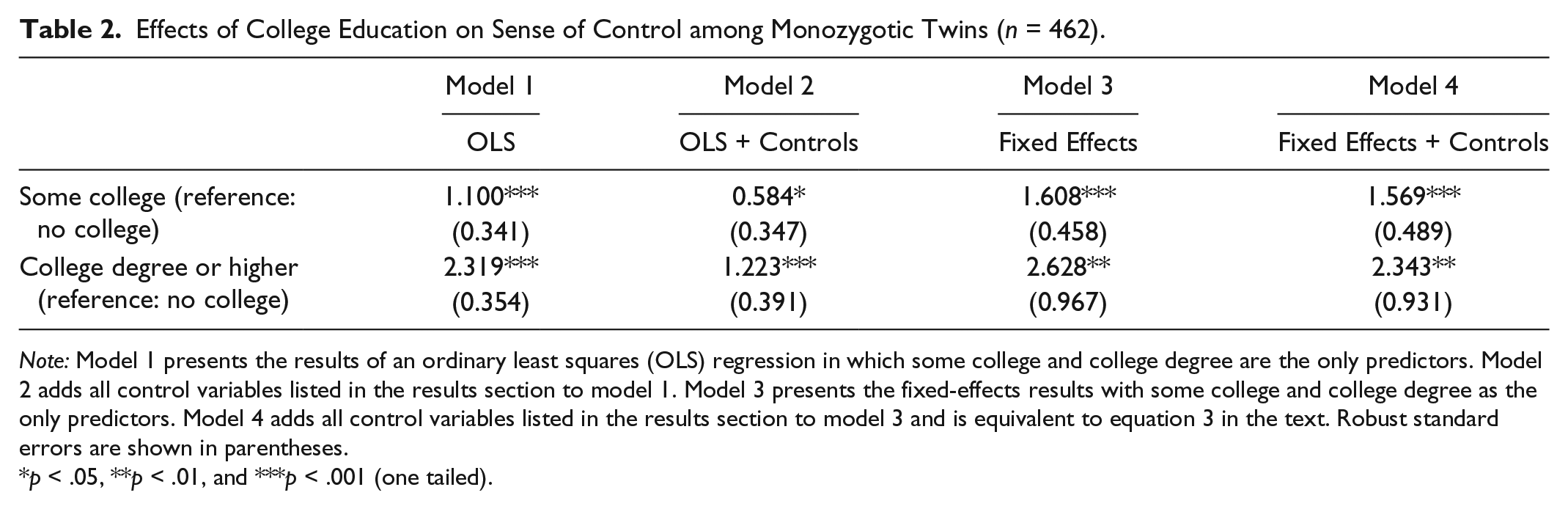
Note: Model 1 presents the results of an ordinary least squares (OLS) regression in which some college and college degree are the only predictors. Model 2 adds all control variables listed in the results section to model 1. Model 3 presents the fixed-effects results with some college and college degree as the only predictors. Model 4 adds all control variables listed in the results section to model 3 and is equivalent to equation 3 in the text. Robust standard errors are shown in parentheses.
p < .05, **p < .01, and ***p < .001 (one tailed).
Model 3 incorporates the fixed-effects model and shows a pattern very similar to what was witnessed with the OLS model; educational attainment was positively associated with sense of control in a graded fashion. For instance, those with some college reported a sense of control 1.6 units higher than those with a high school degree or less, while those with a college degree or higher reported 2.6 units higher. Those with a college degree did have statistically significant higher levels of sense of control than those with some college, however. Model 4 incorporates the controls into the model to account for nonshared factors in twin pairs and shows the same associations between education and sense of control. The magnitude of this relationship was relatively large. For instance, someone with a college degree reported a sense of control 2.3 units higher than someone with a high school degree or less. This association corresponded to a 0.79 standard deviation increase in sense of control. Those with some college possessed a sense of control that was roughly one half of a standard deviation higher than someone with a high school degree or lower. Although the inclusion of nonshared factors did not influence the relationship between education and sense of control, neuroticism was negatively associated with sense of control (β = −1.71, p < .05). No other covariates were predictive of sense of control (see Table A1 in the Appendix).
Tests for Robustness
For this analysis to be potentially relevant to analysis of the effects of education, an essential assumption is that differences in educational attainment between twins are due to exogenous events that affected the amount of schooling but not their sense of control, except through education. If schooling attainment differs between the twins because of such events as the random assignment of teachers (e.g., one twin’s school teacher inspired her to pursue higher education while the other twin had less inspiring teachers), this assumption may be realistic. If the assumption does not hold, then the schooling coefficient in within-MZ-twins estimates will be biased.
A plausible and widely discussed violation of this assumption is that the parents of twin pairs favor one twin over another, and the favored twin receives extra instrumental and emotional resources from the parents (Felson 2014) that lead to higher levels of educational attainment and sense of control. We were partially able to account for this possibility because of interviews that took place with the mothers of the twins during the initial wave of Add Health data collection. In ancillary models, we controlled for twin differences for the mother’s perception of her relationship with each child as well as each twin’s perception that his or her counterpart received more love and attention from their parents. The twins’ perception that they were equally loved by their parents was constructed using a question from the initial wave. The twins were asked to think about all the things their parents do for them. Each was consequently asked if he or she thought his or her twin received more attention and love from their parents. Responses ranged from 1 (“a lot more”) to 5 (“a lot less”). A measure of the mother’s perception of her relationship with each twin was assessed using a series of questions. The mothers were asked, “How often would it be true for you to make each of the following statements about [name].” Statements included getting along well with them, making decisions together, not understanding them, and feeling they could trust them. Responses ranged from 1 (“always”) to 4 (“seldom”). The inclusion of these variables in ancillary models did not affect any of the substantive conclusions.
At least two other scenarios could bias this analysis. First, twins who initially perceived a stronger linking between hard work and success would choose to invest in education and also have a high sense of control because they believed hard work produces success. Second, twin pairs differ markedly in birthweight and low birthweight may influence educational attainment and perhaps one’s sense of control. For these reasons, we also included measures for the perception that hard work and success are connected and mother-reported birth weight in ancillary models (available upon request). The inclusion of these variables did not influence any of the substantive conclusions reported here. Supplementary models that stratified male and female twin pairs revealed that there was no evidence that the influence of education on sense of control varied by gender.
Discussion
In this study we tested the relationship between educational attainment and sense of control using a discordant twin-pair fixed-effects approach. Consistent with previous work (Lewis et al. 1999; Mirowsky and Ross 2003; Pearlin et al. 2007; Schieman 2001; Schieman and Plickert 2008), we document a positive association between education and sense of control net of all factors shared by twin pairs, such as an early environment and genetic endowment, as well as a number of observed factors that vary between twin pairs.
Overall, our results are consistent with higher levels of education fostering a higher sense of control over life. The sociological conceptual models linking educational attainment and sense of control are largely causal, yet past research was severely limited in making empirically causal claims. By using a causally informed study design, we have provided empirical evidence that better matches the causal claims made in conceptual models (Mirowsky and Ross 2003; Schieman and Plickert 2008).
Although none of the past literature on education and sense of control accounted for personality characteristics, our results suggested that neuroticism, agreeableness, conscientiousness, and openness were sources of partial spuriousness. In other words, these personality characteristics may have influenced both one’s educational attainment and their sense of control. Moreover, neuroticism was associated with sense of control, even after factoring out all shared factors between twin pairs. In other words, neuroticism was not simply a maker for genes or shared environments but rather may have reflected past exposures to nonshared environmental influences (Caspi and Roberts 2001). In contrast, although those with high levels of agreeableness, conscientiousness, and openness tended to report higher sense of control, these associations were explained by unobserved shared factors. Overall, these findings highlight the important role of personality characteristics and should draw consideration in future research as potential sources of spuriousness in the education and sense of control relationship.
This study had several limitations that should be acknowledged. First, sense of control was available only in the final wave, and reverse causation cannot be ruled out. Nonshared differences in sense of control among twin pairs during adolescence or early adulthood could create educational differences and potentially explain the observed association between education and sense of control. Although this explanation cannot be discounted, we find it somewhat unlikely. Past research has been able to account for sense of control prior to achieving one’s highest level of education, and in no case did this account for the relationship between education and sense of control (e.g., Lewis et al. 1999). Also, we were able to account for several factors strongly associated with sense of control during adolescence, such as depressive symptoms, educational expectations, self-esteem, delinquency, religiosity, and perceived intelligence (Ellison and Burdette 2011; Grabowski et al. 2001; Thoits 2006), and the inclusion of these variables did not influence the effect of educational attainment.
A second limitation to the present study is the generalization of the findings. Although using a sample of MZ twins has many advantages, identical twins may not be reflective of individuals in the general population. For instance, they may be treated differently by their families, teachers, and society more generally than singletons (Freese 2008). Furthermore, the demographics of twins tend to differ from the broader population. In other words, by using a sample of MZ twins, we gained internal validity at the cost of external validity. Although external validity remains a concern, it should be emphasized that our results before using the discordant approach closely align with studies that used nationally representative samples (Mirowsky and Ross 2007; Schieman and Plickert 2008).
Third, new work suggests that although MZ twins have identical genotypes, fixing genotype does not necessarily eliminate all genetic influences (Boardman and Fletcher 2014). Experimental animal models have shown that even when genotype is fixed (i.e., all animals are identical at the genomic level) and the environment is held strictly constant, genetic influences can still manifest because of stochastic processes in epigenetic responses to the environment (Raj et al. 2010). Although we cannot rule out epigenetic mechanisms biasing our results, epigenetic interactions with environments will bias our estimates only if such interactions directly affect both schooling and sense of control (Amin et al. 2015).
Finally, we cannot rule out there are other factors that vary between twin pairs that account for the relationship between education and sense of control. As previously mentioned, the key assumption for this study design is that between-twin differences in educational attainment are due to exogenous events that affect the amount of schooling obtained, but not directly one’s sense of control. Although we cannot control (or even identify) all possible reasons why differences between discordant levels of education may also be related to one’s later sense of control, we were able to account for several key differences between individuals, including previously understudied personality characteristics.
The results of this study are consistent with the idea that education fostered a sense of control among one cohort. With recent attention given to education as a potential policy lever (Montez 2015), it is imperative that future work consider the broader societal contexts that allow education to have a causal influence over one’s sense of control. Similar to the work on education and mortality, the relationship between education and sense of control likely depends on the time, place, and environment in which individuals live their lives (Hayward, Hummer, and Sasson 2015). Future work should look at differences in this relationship by cohort. Doing so may help elucidate the underlying macro-level contextual factors that must be present in order for higher levels of educational attainment to increase one’s sense of control. For instance, if the relationship between educational attainment and future income changes across cohort, we may also expect a change in the relationship between education and sense of control.
This study provides evidence that educational attainment fosters a greater sense of control. By providing the most conservative test of this causal pathway to date, we provide empirical support to theoretical arguments which posit that educational effects on health are realized in part through increasing individual sense of control (e.g. Mirowsky and Ross 1998, 2003). With recent calls for educational attainment as health policy (House et al. 2009), understanding the causal benefits of educational attainment and the mechanisms by which such benefits are realized remains a crucial area of research.
Footnotes
Appendix
Effects of College Education on Sense of Control among Monozygotic Twins with Controls (n = 462).

| Model 1 | Model 2 | Model 3 | Model 4 | |
|---|---|---|---|---|
| Some college (reference: no college) | 1.100*** | 0.584* | 1.608*** | 1.569*** |
| (0.341) | (0.347) | (0.458) | (0.489) | |
| College degree or higher (reference: no college) | 2.319*** | 1.223*** | 2.628** | 2.343** |
| (0.354) | (0.391) | (0.967) | (0.931) | |
| Neuroticism | −0.181** | −0.171* | ||
| (0.064) | (0.073) | |||
| Agreeableness | 0.111* | −0.092 | ||
| (0.062) | (0.108) | |||
| Conscientiousness | 0.153** | 0.110 | ||
| (0.055) | (0.087) | |||
| Extraversion | 0.063 | 0.031 | ||
| (0.041) | (0.069) | |||
| Openness | 0.160* | 0.155 | ||
| (0.070) | (0.113) | |||
| Diagnosed with depression a | −0.529 | −0.768 | ||
| (0.570) | (0.813) | |||
| Drinking ever interfere with home or school | −0.235 | −0.078 | ||
| (0.386) | (0.601) | |||
| Diagnosed with PTSD or anxiety disorder a | −0.136 | 0.597 | ||
| (0.736) | (0.873) | |||
| Diagnosed with attention deficit disorder a | −0.329 | −0.685 | ||
| (0.627) | (1.174) | |||
| Depressive symptoms during adolescence | −0.081 | −0.047 | ||
| (0.078) | (0.143) | |||
| Cognitive ability | −0.003 | −0.006 | ||
| (0.011) | (0.022) | |||
| Low self-reported health during adolescence | 0.243 | 0.403 | ||
| (0.291) | (0.420) | |||
| Missed school because of health during adolescence | 0.209 | −0.055 | ||
| (0.227) | (0.414) | |||
| Delinquency during adolescence | 0.059 | −0.504 | ||
| (0.392) | (0.513) | |||
| Importance of religion during adolescence | −0.215 | 0.123 | ||
| (0.184) | (0.281) | |||
| Religious attendance during adolescence | 0.131 | −0.191 | ||
| (0.166) | (0.335) | |||
| Likelihood of attending college during adolescence | 0.156 | −0.003 | ||
| (0.116) | (0.206) | |||
| Self-esteem during adolescence | 0.411 | 0.371 | ||
| (0.260) | (0.388) | |||
| Perceived intelligence during adolescence | −0.037 | 0.147 | ||
| (0.115) | (0.193) | |||
| Constant | 18.322*** | 12.167*** | 18.013*** | 15.770*** |
| (0.277) | (1.864) | (0.409) | (3.554) |
Note: Model 1 presents the results of an ordinary least squares regression in which some college and college degree are the only predictors. Model 2 adds all control variables listed in the results section to model 1. Model 3 presents the fixed-effects results with some college and college degree as the only predictors. Model 4 adds all control variables listed in the results section to model 3 and is equivalent to equation 3 in the text. Robust standard errors are shown in parentheses.
History of diagnosis in the past six years was excluded. This represents diagnosis prior to highest level of education obtained.
p < .05, **p < .01, and ***p < .001 (one tailed).
Funding
The author(s) disclosed receipt of the following financial support for the research, authorship, and/or publication of this article: This study was supported by training grant T32HDOO1763 to the Bendheim-Thoman Center for Research on Child Wellbeing at Princeton University by the Eunice Kennedy Shriver National Institute of Child Health and Human Development.