




Abstract
The hypothesis that cultural likes and dislikes are driven by the perceived connections between genres and their audiences is a foundational premise of sociological studies of cultural taste. However, to date the operation of this mechanism has been only indirectly inferred but never directly assessed empirically. To address this gap, the authors leverage unique data on the cultural tastes of a representative sample of Americans containing information on the subjective perceptions of the audience composition for 20 musical genres along 15 social dimensions. The authors find that subjective perceptions of the sociodemographic composition of genre categories modulate negative taste judgments in predictable ways, with markers of low status standing out as universal generators of symbolic exclusion. The authors also find that these effects are mediated by respondents’ own social positions in equally patterned ways, generating both symmetric effects (mutual rejection) along gender, racial, and generational lines and asymmetric effects (unilateral rejection) along lines of class and status.
A key premise in sociological studies of culture and taste is that patterns of acceptance, rejection, and engagement with cultural goods are not exclusively driven by their intrinsic features but also by collectively shared perceptions of the association between cultural goods and the groups that are perceived to be their primary consumers (Bourdieu 1984; Bryson 1996, 1997; Tampubolon 2008). This allows analysts to link seemingly individual acts of aesthetic judgment to collective patterns of symbolic inclusion and exclusion (Bourdieu 1984). The basic idea is that there is a duality between the category labels used to classify cultural genres and the categories labels used to classify social groups (DiMaggio 1987), such that heavy metal might be to “male” as blues/rhythm and blues (R&B) is to “black” (Bryson 1996). These shared categorical linkages help to partially constitute the cultural and social meaning of the genre in question (DiMaggio 1997; Goldberg 2011). This is especially likely if persons come to modulate their patterns of engagement with goods classified by given labels in a manner that makes the linkage into a self-fulfilling prophecy. This results in (self) selection into or out of engagement with cultural goods that are perceived as consistent or inconsistent (respectively) with salient social identities.
Studies of the production of culture show that as the meanings of shared links between genre labels and social labels undergo historical change, audiences modify their patterns of engagement with cultural offerings. For instance, the consumption of art forms traditionally classified as “high culture,” such as classical music, the fine arts, and literature, has undergone a dramatic feminization in the United States since the middle of the twentieth century, such that women outnumber men in the consumption of these types of cultural goods in every recent arts participation survey fielded (Christin 2012; DiMaggio and Mohr 1985; DiMaggio and Mukhtar 2004; Katz-Gerro and Sullivan 2004). In the same way, while in the early 20th century jazz music was thought of primarily as a “black” genre, the gradual incorporation of jazz into the “high culture” canon has been accompanied by a perceived (and actual) whitening of its audience (Lopes 2002). Similar stories can be told for rockabilly and early rock and roll (Peterson 1990), or for the ethnoracial and class-based transformation experienced by the hip hop and rap audience from its beginning as an African American urban music in the late 1970s and early 1980s to its emergence as a full-blown industry genre, consumed by young audiences of all ethnoracial backgrounds from the 1990s until today (Lena 2013). In all, work done from both production and audience perspectives points both to the consequential constitution of the meaning of symbolic goods via the drawing of structured linkages between categories pertaining to the field of cultural production and categories pertaining to divisions (premised on race, gender, class, and other bases of association) in the social space (Bourdieu 1993).
In this article, we take up the question of the extent to which individuals associate category labels pertaining to social groups with genre labels pertaining to cultural goods and the extent to which dislikes are modulated by these associations. These twin claims stand as foundational premises in the sociology of culture and taste (Bourdieu 1984). Thus, although the hypothesis that cultural likes and dislikes are driven by the presumed connections between genres and their audiences seems like an eminently reasonable proposal (e.g. DiMaggio 1987; Bryson 1996), it has largely been indirectly inferred but has never before been empirically assessed directly (but see Reeves, Gilbert, and Holman 2015 for a first step in this direction). To address this gap in the literature, we collected a unique data set containing information on cultural tastes (likes and dislikes) of a representative sample of Americans (along 20 musical styles) and information on the subjective perceptions of the audience composition for each style along a wide range of social category labels (e.g., race, age, gender, class, and education). We find that subjective perceptions of the sociodemographic composition of the audience of musical styles modulate the likelihood that a person will dislike each genre in predictable ways. We also find that these audience perception effects are mediated by respondents’ own social positions in equally patterned ways.
The rest of the article is organized as follows. In the next section, we review extant approaches (arrayed by the complexity of the theoretical assumptions they make) currently used by analysts to understand how lay taste judgments are modulated by social position, perceptions of genre audiences, and the interaction between the two. We then describe our data source and our measuring instrument. We follow by presenting the basic set of results, and we close by outlining their substantive and theoretical implications for future research in the sociology of taste and culture consumption.
Mechanisms for the Generation of Cultural Dislikes
In examining the question of the relationship between social position and cultural choice, we focus on cultural dislikes, as these are key empirical indicators of the phenomenon Bryson (1996) referred to as symbolic exclusion. In this sense, refusals (dislikes), especially in the domain of musical genres (Bennett et al. 2009), are the most informative and revelatory of the patterns of lay aesthetic judgment (Bourdieu 1984; Goldberg 2011; Tampubolon 2008; Warde, Wright, and Gayo-Cal 2008). Although in what follows we review literature that pertains to both consumption and taste, our ultimate aim is to develop intuition about the ways that analysts have approached the question of the determinants and modulators of lay aesthetic judgment. As we noted above, most analysts depart (implicitly or explicitly) from some version of the duality principle according to which categories of persons are defined by the cultural objects they choose, and categories of cultural goods are defined by the categories of persons who choose them (DiMaggio 1987). Note that our exposition strategy is primarily conceptual, going from simple to complex, rather than chronological.
The Audience Segmentation Model
The audience segmentation model of aesthetic choice is the workhorse approach of most analysts in the culture and consumption literature (Katz-Gerro 2004). According to this model, judgments of likes and dislikes are primarily driven by the social category attributes of persons in relation to certain genre categories. For instance, an audience segmentation analyst may postulate that “high-status” persons are attracted to the legitimate or institutionally prescribed arts while shunning or disliking everything else, while reasoning that “low-status” persons are attracted to popular culture and kitsch (Peterson 1992). The reasoning here is “substantialist” in the sense that the analyst must trade on exogenous knowledge about the valuation of social categories and the institutional construction of value (or lack thereof) of genre categories in order to develop testable hypotheses (Sharkey 2014). The substantialist reasoning of the audience segmentation approach model contrasts with the “relationist” (e.g., Emirbayer 1997) understandings of the symbolic exclusion models we consider later. Audience segmentation theorists are thus forced to draw direct links between presumed properties of genres and presumed characteristics of social category members at a given point in time (Wacquant 2001:115; see Goldberg 2011:1398).
Early “conspicuous consumption” models in classical social theory, and more recent audience segmentation models in sociology and marketing (Chan and Goldthorpe 2007; Peterson 1992), as well as “social influence” and “sociodemographic niche” models in network theory belong to this category (e.g., Mark 2003). Although usually dismissed as limited or naive from the point of view of more sophisticated approaches (e.g., Bourdieu 1984:22), it is important to note that the audience segmentation perspective is not explanatorily powerless. For instance, there are strong and persistent correlations between sociodemographic markers of status and engagement with the arts that persist to this day, as do preferences for certain cultural goods premised on region, race, and gender (Katz-Gerro 2004; Tomlinson 2003).
However, it is in their inability to accurately predict the patterns of refusal of certain sociodemographic groups that audience segmentation models meet their stiffest challenges. In particular, beginning with the seminal papers by Bryson (1996) and Peterson and Kern (1996), researchers began to notice that there was asymmetry between likes and dislikes, such that even though persons seemed to have (on average) the sorts of likes that were predicted by audience segmentation theory, their refusal patterns did not seem to be accurately predicted by this approach. This was especially the case for members of high-status groups, who seemed not to express dislike for some of the “low-status” genres that they should have rejected. Members of low-status groups, on the other hand, seemed to be endowed a more liberal (“excessive,” from the point of view of the model) tendency to express dislikes, not only rejecting the highbrow fare of high-status classes but also directing dislikes “laterally” to a wide swath of cultural goods traditionally classified as folk and popular cultures (Bryson 1997; Rossman and Peterson 2015).
Symbolic Exclusion Models
This set of anomalies within the audience segmentation approach when it came to dealing with dislikes led Bryson (1996) to formulate a symbolic exclusion model. In contrast to the standard audience segmentation model, the symbolic exclusion model posits that dislikes are driven by the linkages between genre categories and social categories at the collective level. As such, persons use lay judgments of taste as an indirect means to define, reinforce and draw symbolic boundaries in relation to outgroups as well as to reinforce solidarity in relation to (perceived) in-groups (Bryson 1997). From this perspective, social categories acquire different levels of status (see, e.g., Sharkey 2014 for a process model of this outcome), worth, and affective valence in relation to other social categories (e.g., working class ↔ middle class, black ↔ white). Cultural genres associated with clusters of negatively valued social categories (e.g. “young working class”) will be more likely to be rejected than will be cultural genres associated with clusters of positively valued social categories (“white middle class”). The symbolic exclusion model predicts that cultural dislikes are generated not only by the sociodemographic attributes of the person but by the (presumed) “sociodemographic attributes” (e.g., perceived audience composition) of the genre. Genres associated with largely devalued social categories will thus experience the “anything but heavy metal” effect (being disliked across the board), while genres associated with positively valued social categories will experience the “classical music halo effect” (being less likely to be disliked).
The model developed by Bourdieu (1984) in Distinction can be seen as a generalization of this approach. Here people not only dislike the culture that is linked to stigmatized social categories but are actually more likely to dislike the culture that is associated with “out-groups” whose source of social worth is different than their own. Thus, the working class and upper middle class reject the presumed culture of each other at the same rate (Tampubolon 2008). Dislikes thus serve to reveal the struggle for differentiation and dominance of different groups in social space. From this last perspective, dislikes emerge from (1) worth and evaluation of genre categories (as given by the presumed audiences that consume those genres), (2) worth and evaluation of social categories (as given by the collective valuation of different audience categories in the social field), and (3) the link between a person’s perception of the audience categories that engage a given genre category and his or her own classification in a given social category. The empirical implication is that working-class persons will dislike perceived middle-class cultures, in the same way that middle-class persons will dislike perceived working-class cultures. In this respect, the symbolic exclusion model shares the process-based imagery of how certain genres come to acquire status value (or are devalued) by their association with certain social categories (Sharkey 2014). However, symbolic exclusion models in the sociology of taste add an agonistic, “field theoretic” imagery in which oppositional relations between categories in social space are revealed by the way in which a person’s classification of genres interacts with his or her own social categories (Goldberg 2011; Lizardo and Skiles 2015; Tampubolon 2008).
Existing Evidence of Symbolic Exclusion Processes
There is some evidence that the dynamics described by symbolic exclusion models are on the right track. 1 First, as Bryson (1996) found in her original study, the highly educated express fewer dislikes than the less educated. Conditional on expressing a dislike, however, this is more likely to be directed at genres that preferred by the less educated. Tampubolon (2008:260), reanalyzing the same data using more sophisticated latent class analysis techniques, found evidence for a more complex pattern of differentiation based on dislikes. The basic takeaway from this study is one that is thoroughly consonant with the symbolic exclusion imagery; distinct clusters of high-status respondents seem to reject (mirror-image-like) the same set of “legitimate” genres that the other group likes (see also Goldberg 2011; Lamont 1992).
Recent qualitative and mixed-methods studies of taste outside of the United States have borne out Bryson’s original proposal that the tendency of high-status people to express fewer dislikes than their low-status counterparts may have been inflated. This work shows that culturally privileged individuals, as given by both external qualifications and overall cultural knowledge, are not shy about rejecting the sort of culture they see as excessively commercialized, insufficiently challenging, or associated with social groups and ideological themes that they perceive to localistic, xenophobic, or otherwise not expressive of the type of cosmopolitanism they identify with (Atkinson 2011; Ollivier 2008; Prieur and Savage 2011). In the same way, working-class people refuse culture that they see as endowed with too much artifice and unnecessary complexity, overflowing with gratuitous sexuality or otherwise morally offensive themes, or irrelevant to practical and functional concerns (Bourdieu 1984; Holt 1998; Ollivier 2008; Warde et al. 2008). It is possible that similar symbolic exclusion processes operate alongside other axes of difference beyond class and education (e.g., age, race, gender), although research pursuing these questions is scarce (but see Bryson 1997).
Limitations of Existing Research on Symbolic Exclusion Processes
Despite its centrality for our understanding of the link between cultural taste and social stratification and symbolic boundary drawing dynamics, it is important to note that most of the research on symbolic exclusion processes has to date provided only indirect evidence for its base premise. Quantitative studies naturally collect data on both respondent membership in given sociodemographic categories and respondents’ evaluations of and/or engagement with genre categories, yet information on the key intervening mechanism, namely, respondents’ perceptions of the sociodemographic composition of the audiences for these genre categories, is missing. Most analysts, including Bryson (1996), Tampubolon (2008), Warde et al. (2008), and Goldberg (2011), infer a symbolic exclusion process from the linkage between a person’s refusal pattern and a given set of genres, in essence coasting on their own perceived association between genre and social categories or estimating summary estimates of this association from the data (Bryson 1996).
The disadvantage of this approach is that the “average” sociodemographic genre profile must be imputed to each respondent. This does violence to the logic of the symbolic exclusion model, which presumes that the practical classification happens at the level of the cultural schemas held by the individual (Bourdieu 1984; DiMaggio 1997; Goldberg 2011). This implies that different persons will have different perceptions of the linkage between genre and social categories, perceptions that themselves should vary in tandem with the person’s own position in social space (Martin 2003). Recent mixed-methods studies do contain rich information on respondents’ perceptions of the likely consumers of the genres they like and dislike (e.g., Bennett et al. 2009). However, this information is usually available for a small subset of respondents in unstructured discursive form and thus less likely to access the underlying schemes driving choice and evaluation behavior (Vaisey 2009). This precludes systematic investigations of the linkage between genre-audience perceptions and symbolic exclusion processes.
Another limitation of current studies of symbolic exclusion processes is their focus on class and education (and to a lesser extent age). The basic assumption is that these are the most relevant social categories. Other axes of social differentiation (e.g., ethnoracial status, gender) thus recede into the background. Yet it is clear even in Bourdieu’s (1984) original work that gender and generational status are social categories in which we should observe symbolic exclusion effects (e.g., the young rejecting cultural genres they associate with the “old” and vice versa) of equal or perhaps greater substantive magnitude as those associated with education and class. Although not applicable to the French context of the 1960s, it is clear that in the United States, shared associations between cultural genres and folk ethnoracial category labels (e.g., “black music”) are important modulators of patterns of cultural choice and aesthetic refusal. Applying a symbolic exclusion imagery to this process can be useful in revealing the ways in which ethnoracial boundaries are dynamically constructed and reconstructed via expressions of cultural taste (Wimmer and Lewis 2010).
Symmetry versus Asymmetry in Symbolic Exclusion Effects
Note that although certain analysts do impose (or interpret other analysts as having imposed) “asymmetries” in symbolic exclusion effects, there is no logical constraint to expect asymmetric versus symmetric exclusion processes. Instead, the question of symmetry or asymmetry should be left as an empirical question rather than being settled a priori. For instance, most analysts interpret Bourdieu (1984) as having offered an asymmetric “symbolic power” model of symbolic exclusion when it came to class. In this model, high-status classes reject low-status cultures, but the working and middle classes internalize the standards of the privileged and thus fail to reject elite culture. However, Bourdieu himself and subsequent analysts have provided evidence for symmetry in class-based symbolic exclusion processes, with working-class people being as put off by the perceived culture of high-status classes as the reverse (e.g., Holt 1998). In that respect, a model of the sort proposed by Tampubolon (2008) in which there is “mutually assured rejection” both across and within broadly defined classes (e.g., depending on whether class is defined in terms of cultural or economic capital) seems to be more consistent with previous work.
Table 1 provides a summary statement of the various propositions put forth in the literature and how they contrast in terms of key predictions. The contrast can be summarized as follows: standard “audience segmentation” models focus on the main effects of sociodemographic attributes on the likelihood of expressing likes and dislikes. Bryson’s (1996) version of the symbolic exclusion model, on the other hand, focuses on the (unobserved) effects of subjective linkages between cultural object categories and the social categories of persons that are presumed to engage them. They thus predict a main effect of social category labels on the probability of expressing likes and dislikes. Versions of the symbolic exclusion model that focus on the relational nature of judgments on the other hand, posit an interaction effect between these two factors. This interaction may be symmetric, as in Goldberg’s (2001) and Tampubolon’s (2011) notion of mutual rejection at the level of group cultures, or it may be asymmetric, with one group rejecting the culture associated with an opposed (racial, class, gender, etc.) group but not the reverse (as in Bourdieu’s symbolic power model).
Summary Statement of Key Theoretical Models and Their Main Analytic Predictions.

Because of the dearth of research on these issues, and given that this is the first study to collect data on the relevant intervening mechanism, it is impossible to provide determinate hypotheses as to how questions of symmetry and asymmetry will play out in the case of key social categories. However, common sense and previous research suggest that age is likely to display symmetric exclusion effects, with the old disliking the culture they associate with the young and vice versa (Lizardo and Skiles 2015). Gender theorists positing distinct processes in the construction of masculinity and femininity, in particular those who see masculinity as a more rigid (and also more brittle and subject to threat) category (see, e.g., Archer 1992) may surmise that men are more likely than women to dislike “feminine” genres but that women may not be necessarily negatively predisposed toward cultural goods associated with men (Willer et al. 2013). The same set of asymmetries may be found with respect to ethnoracial boundaries. Ethnoracial groups that emphasize in-group “authenticity” in the linkage between ethnoracial identity and patterns of culture consumption, as in the case of young African Americans and Hispanics in the United States (Carter 2006), will be expected to reject genre categories associated with the white majority. However, whites who enjoy the privilege of not being strongly typed as having a “race” may be free to not reject minority group cultures. This will generate asymmetric exclusion effects, with blacks rejecting cultural genres perceived to be “white,” but not the reverse. Finally, we may suspect that if asymmetric symbolic power effects exist, they should be found in the realm of class and socioeconomic status and should be in the direction presumably predicted by Bourdieu (1984): high-status classes reject cultures associated with less privileged groups, but this favor is not necessarily returned by members of the same groups in relation to what they perceive to be high-status culture.
Data
In the summer of 2012, we fielded a survey that was (partially) designed to replicate the General Social Survey (GSS) 1993 Culture Module (hereafter “GSS 1993”). This is now a canonical data set providing the empirical basis for a variety of analyses (and reanalyses) in the sociology of taste (e.g., Bryson 1996, 1997; Goldberg 2011; Tampubolon 2008). The data were collected by Survey Sample International (SSI), a private firm that specializes in sampling, data collection, and analysis. SSI managed recruitment and participation invitation tasks to generate a panel of adults from which our working sample was drawn (hereafter “SSI 2012”). Survey respondents were selected from the panel for participation on the basis of age, gender, race, education, and geographic region to approximate a sample representative of the U.S. population (n = 2,250). Like GSS 1993, SSI 2012 included items assessing respondents’ likes and dislikes (as well as a middle category of “mixed feelings”) for 20 categories of musical style: classical/symphony and chamber, opera/operetta, jazz, Broadway musicals/show tunes, mood/easy listening, big band/swing, classic rock/oldies, country, bluegrass, folk, hymns/gospel, Latin/Spanish/salsa, rap/hip hop, blues/R&B, reggae, top 40/pop music, contemporary rock, indie/alternative rock, dance/club/electronic, and hard rock/heavy metal.
What is different about SSI 2012 in relation to GSS 1993 is the inclusion of a unique “perceptual” module. Respondents were presented with a matrix that arrayed each of the 20 musical genres on the rows and a series of 15 category labels for social groups in the columns. They were asked to check each box if they associated the social category label with the “typical fan” of that genre:
Which of these characteristics describe the typical fans of [genre category] music? Choose all that apply.
Respondents were allowed to choose as many or as few social category labels as they thought appropriate for each genre. The social category labels we selected are male, female, young, middle-aged, old, college educated, no college degree, Asian, black, Hispanic, white, lower class, working class, middle class, and upper class. These constitute two gender categories, four ethnoracial categories, four class and education categories, and three age and generation categories. Our intent was to use the most commonly used (folk) terms for each sociodemographic label, rather than technical or social science modifications of folk categories.
Results
Distribution of Likes and Dislikes across Genres
Table 2 shows the distribution of judgments of likes and dislikes (along with mixed feelings and unfamiliarity claims) in the columns across the 20 genre categories in the rows. Boldface values indicate that that genre is more likely than expected (as given by the average likelihood with which respondents used that evaluation across all genres) to receive the corresponding judgment.
Distribution of Judgments of Taste across Genres.
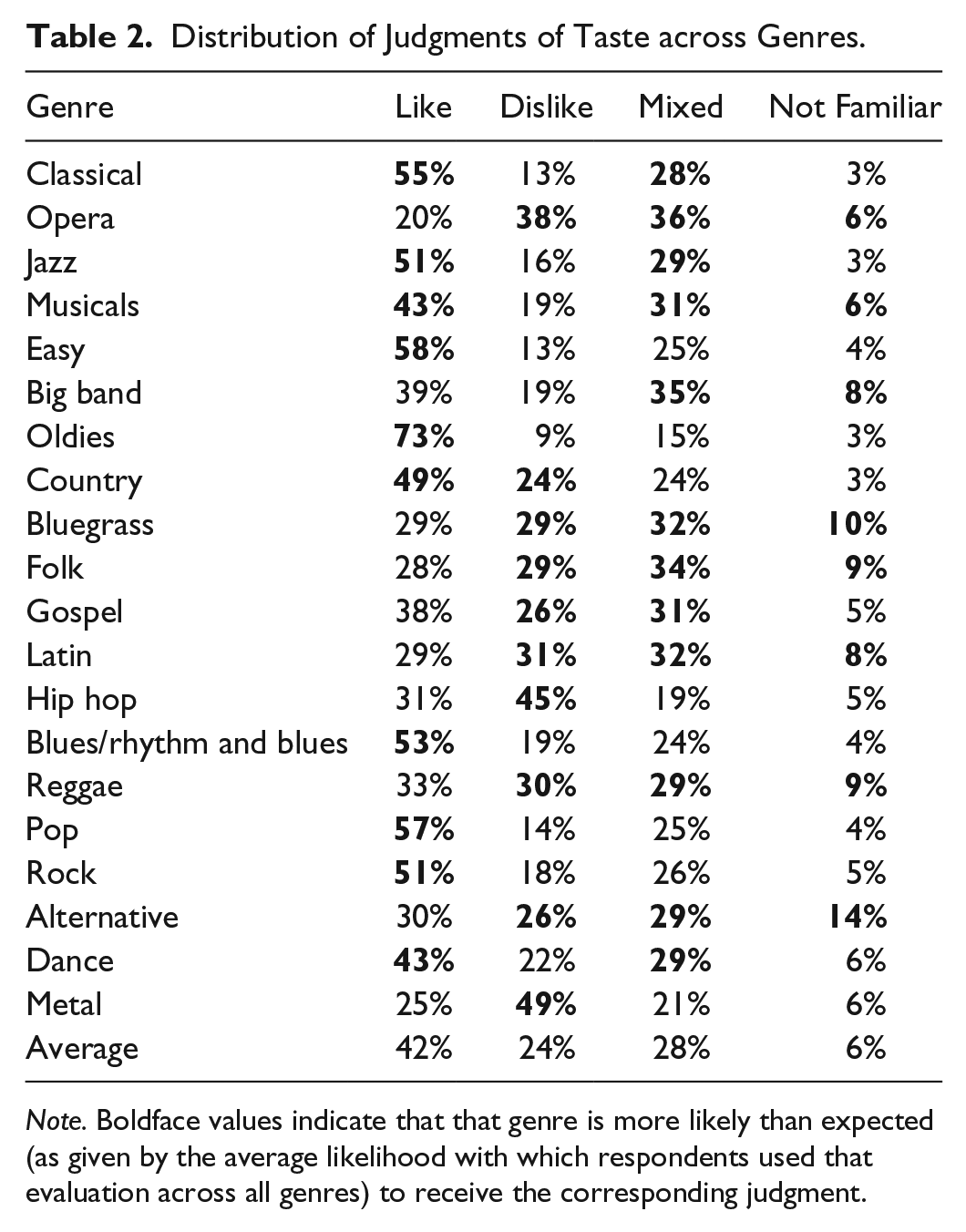
Note. Boldface values indicate that that genre is more likely than expected (as given by the average likelihood with which respondents used that evaluation across all genres) to receive the corresponding judgment.
As with previous work using the GSS 1993 data, we find that Americans tend to distribute aesthetic judgments of “like” and “dislike” unequally across genre category labels (Bryson 1996). Some set of genres, especially genre labels typically associated with markers of high status such as classical music, jazz, and Broadway musicals tend to attract either positive or mixed feelings but relatively few dislikes (except for opera). Other genre categories, composed mainly of a variety of musical category labels typically associated with markers of low status (primarily class and ethnoracial markers but also including “low” generational status such as youth cultures), tend to attract a disproportionate number of dislikes (except for blues and R&B). These include country, folk, gospel, hip hop, and Latin, but as with Bryson’s eponymous study, heavy metal leads the way (almost half of Americans in 2012 disliked it, and another fifth had mixed feelings). Pop or “industry” genre labels such as contemporary rock and dance/club music are less likely to receive negative evaluations; however, the category of classic rock/oldies leads the way in the likes department, with less than 10 percent of Americans expressing dislike for the genre (suggesting a nostalgic, age-specific interpretation of what belongs in that category). Finally, some recently or only partially institutionalized genre categories (e.g., alternative) tend to elicit feelings of unfamiliarity, which might complicate patterns of evaluation.
Social Category Label Use by Musical Genre
Table 3 displays the 20 musical genre categories (i) as the rows and the 15 social categories as the columns (j). The ijth cell in the table shows the percentage of respondents who thought that a person belonging to the jth social category was a “typical” fan of the ith musical style. Reading across the rows, we can get a sense of selected features included in the collective “prototype” held by Americans as to what the typical fan of each music is. Reading across the columns gives us a sense of the perceived distribution of social categories (e.g., blacks, males, college graduates) across the different genre categories. Percentages are in boldface if they exceed the average rate at which the label for that social category was used across all 20 musical genres.
Sociodemographic Label Use by Musical Genre Category.

Note. Percentages are in boldface if they exceed the average rate at which the label for that social category was used across all 20 musical genres.
The linkages between genre categories and social categories appear to be intuitive in capturing what we would expect are the folk (stereotypical) representations of genre audiences in the United States. For instance, the typical “opera fanatic” in the United States is seen as primarily female, white, college educated, older, and upper class; this is distinct from the prototypical opera fan found in different cultural and national contexts (Benzecry 2011). The typical fan of bluegrass music, on the other hand, is seen as primarily male, white, high school educated, older, and either lower or working class. Compare both with what is perceived to be the typical hip hop and rap music fan. This is a young, male, black (or nonwhite) person with a high school education and a working-class background. Note that if these typical fan prototypes are read as “stereotypes” of the fans of each style of music (which may or may not correspond to the actual distribution of cultural choices by social category), this is precisely as intended, because symbolic exclusion models postulate that it is precisely the perceived rather than the actual linkages between social and genre categories that generate patterns of likes and dislikes. 2
In addition, it is clear that some sets of genre categories are seen as systematically linked with either a narrow or a wide swath of social category labels. Thus, “typical” fans of pop music do not seem to be particularly distinct in terms of gender, race, and education, except that they are not likely to be old or upper class. The same goes for typical fans of “oldies,” who tend to be equally linked to all social category labels except being black, young, or upper class. Compare that with folk music, which is perceived to be a music that appeals almost exclusively to people who are white and old, or to “alternative” music, which is seen as primarily Asian and young, but nothing else.
Just in the same way that certain genre labels have either narrow or wide distributions across social categories, some social categories tend to have narrower or looser profiles in relation to genre categories. This is reflected in both their average rates of usage across genre labels (shown in the next to last row of Table 2) and in dispersion across genre categories in the likelihood of using those labels to refer to typical fans of the genres. An indicator of this last tendency is given in the last row of Table 3, which shows the coefficient of variation (Cv) for the respective social category label. 3 The larger the value of Cv, the more inequality we observe in the percentage usage distribution for that category. 4 Reading down the rows, for instance, reveals that gender categories seem to not be particularly useful in differentiating across genres (Cv for male = 0.14, Cv for female = 0.11). This is different from the ethnoracial categories of black (Cv = 0.53) and Hispanic (Cv = 0.69), which tend to be used preferentially to think of the typical fans of a select number of genres (e.g., jazz, blues, Latin music, hip hop, gospel). The same can be said of certain generational and class category labels, especially those referring to the extreme ends of a given continuum (e.g., young and old, lower class and upper class). “Middle” categories (e.g., middle class, middle age) tend to be naturally less distinctive in this respect.
Modeling Dislikes as a Function of Genre and Social Category Labels and Individual Demographics
As noted above, previous empirical applications of the symbolic exclusion model are deficient because they do not directly include empirical specifications of the main intervening mechanism (individual perception of audience composition). In what follows we take advantage of two features of the data to estimate a symbolic exclusion model that includes estimates of all of the substantive effects of interest.
Rather than estimating a separate model for each genre category, we take advantage of the fact that individuals provide identically coded (like, dislike, mixed feelings, unfamiliar) judgments for each of the 20 genres. This type of repeated response data structure can be efficiently analyzed using random-effects regression models (Agresti 2002). Accordingly, we pool all responses within persons, generating a “long” data set containing 20 observations per individual, and select “dislike” as the (binary) response variable.
The “full” symbolic exclusion model specification has the form

where Yij = 1 if individual i reports disliking genre j, α
i
is a random effect for the ith individual accounting for the clustering of responses within persons (assumed to be normally distributed with mean
Of most substantive importance for our purposes are the γ
l
effects. These index the (“cross-level”) interactions between a perceived social category label (
Results
Main Effect of Social Category Labels
We first present results of a reduced model incorporating only genre (θ
j
) and social category label (
Of more substantive interest are the coefficient estimates for the main effect of social category labels on the probability of being disliked, as these provide direct estimates of the missing mechanism of symbolic exclusion models. These are shown in Figure 1, which presents a regression plot of those estimates. 5 In the figure, the diamond-shaped marker corresponds to the coefficient estimate, and the horizontal hash mark corresponds to the 95% confidence interval around that estimate. Social category labels with estimates on the positive (right-hand) side of the vertical zero line indicate that assigning that label to a given genre increases the chances of disliking the genre, whereas social category labels with estimates on the negative (left-hand) side of the vertical zero line indicate that assigning that label to a given genre decreases the chances of disliking the genre. It is important to understand how to interpret these effects. In the multilevel specification, the social category label estimate (partially) captures the within person effect of label use averaged across all genres for each individual, with the main effect (captured in the genre-specific fixed effect) of genre level held constant. In this sense, these estimates get at the key mechanism of the symbolic exclusion model, independent of the confounding effect of particular associations generated by the genre category label itself.

Regression plot of typical fan sociodemographic label effects on the probability of expressing a dislike.
The results show that there is substantively significant heterogeneity across the different category labels in the probability of generating cultural dislikes. The key contrast that stands out is that between the two class-based labels signaling low status (high school educated and lower class), as these are the only labels that consistently generate an increase in the probability of disliking a given genre. Of particular interest is the contrast between the working class and the lower class social category labels, as the former has the opposite effect (reducing the dislike probability) as the latter, possibly indicating a specific “romanticization” of working-class status in the United States (Malin 2005:78–82; Weir 2007). That said, it is clear that fairly straightforward status effects are operating here, as social category labels associated with markers of high status (e.g., middle class, college educated, middle-aged) have a strong substantively significant effect in reducing the likelihood of disliking any given cultural genre. In fact, association with middle-class status (along with association with middle age) have the largest (in terms of magnitude) dampening effects on expressing a dislike. These results not only provide support for the more generic version of the symbolic exclusion model but also one in which symbolic associations between cultural genres and negatively valued audiences in terms of class and status are key to generating cultural dislikes (Bourdieu 1984; Bryson 1996; Sharkey 2014).
Gender and ethnoracial social category labels generate effects of smaller substantive magnitude than those of age and class. Associating cultural genres with either men or women decreases the likelihood of expressing a dislike at a similar rate. When it comes to ethnoracial status, we can see some partial evidence of hierarchy: linking the social category label of white or Asian decreases the likelihood of disliking the genre, while thinking of a genre’s typical fan as black displays no effect, and using the category label Hispanic has a smaller negative effect. The magnitude order of effects in the ethnoracial case thus seems to recover an implicit “triracial” pattern emphasized in recent approaches to ethnoracial stratification in the United States (Bonilla-Silva 2004).
Main Effects of Individual Sociodemographic Covariates
Figure 2 shows the coefficient estimates for the effects of person-level sociodemographic covariates on the probability of expressing a dislike. We show two versions of the estimates adjusted corresponding to two different model specifications. The first (middle panel) shows the estimates for a model that adjusts for the genre-label fixed effects, and the second (right-hand panel) shows the results for a model that adjusts for social category labels associated with each genre.

Regression plot of main effects of person-level sociodemographic factors on the probability of expressing a dislike.
Looking at the middle panel, the adjusted effects of sociodemographic covariates are relatively small (in terms of substantive magnitude). This is to be expected, because all of these models hold constant the effect of genre label. This last should be the main generator of sociodemographic differences in the probability of expressing dislikes, which is the basic substantive tenet of the first version of the symbolic exclusion model (Bryson 1996). For instance, we find relatively little education-based heterogeneity (little that is statistically significant) in the likelihood of expressing a dislike once genre labels are held constant. We do find ethnoracial differences in overall dislike expression, with nonwhites being less likely to express dislikes than whites. We also find age-based differences, with the middle-aged and older respondents being less likely to express dislikes than respondents in the youngest age category (18–24 years). Finally, we find some relatively small residual class- and income-based differences. Respondents who self-identify as “middle class” are less likely to express dislikes (in relation to self-identified “lower class” respondents), which is consistent with previous work by Bryson (1997) on the relatively exclusionary aesthetic orientations of class-disadvantaged persons. We also find some evidence of gender effects, with women being less likely to express dislikes than men. Finally, we find some income effects, with respondents in the third income quartile being more likely to express dislikes in comparison to respondents in the lowest income quartile. The coefficient estimate for respondents in the highest income quartile is also positive in magnitude, although it does not reach conventional levels of statistical significance.
How do the baseline sociodemographic effects fare after we adjust for genre-label fixed effects and cross-genre associations with social category labels (see the right-hand panel of Figure 2)? Some of the coefficient estimates are driven downward once we adjust for the way in which respondents associate genres with social categories. In particular, we find that both the gender effect and the age effect disappear in this specification. The ethnoracial and class effects, on the other hand, either remain the same or become more pronounced once social category label associations are accounted for.
Symbolic Exclusion and Affinity Effects
In this section we present results concerning the interaction between individual-level sociodemographic covariates and the response-level social categories that each individual associates with a given genre. We divided the effects into five categories corresponding to the grouping of sociodemographic covariates that matched the social category labels associated with each genre: gender, race, age, education, and class (subjective and education-based indices). For each set of covariates we estimated a model including the cross-level interaction between the between-person (individual-level) sociodemographic covariate (e.g., respondent’s gender) and the within-person (response-level) social category label assignment (e.g., the binary indicator indexing whether that individual thought of the typical fan a given genre as “male” or “female”).
Gender
Recall from Figure 1 that the use of gender categories had unconditional negative effects on the probability of disliking any one genre. We specified a model in which this effect was allowed to vary by the respondent’s own gender identification. Results in Figure 3 show that the negative effect of associating the typical fan of a given music with a gender label is in fact better thought of as a same-gender affinity effect and was masking (symmetric) cross-gender symbolic exclusion effects. As shown in Figure 3, men are less likely to dislike cultural genres they associate with men, and women are less likely to dislike cultural genres they associate with women. Conversely, both men and women have a higher probability of disliking a genre they associate with the other gender. These symbolic exclusion effects, however, although symmetric in terms of statistical significance, are not symmetric in terms of substantive magnitude: as demonstrated by the nonoverlapping confidence intervals corresponding to the coefficient estimates for disliking a genre associated with the other gender, women have a stronger aversion to genres associated with men than vice versa. This is a surprising result, given the lower overall likelihood of women to express dislikes uncovered in previous work (Bryson 1996).

Regression plot of interaction effects of person-level sociodemographic factors and genre label typical fan associations on the probability of expressing a dislike (gender model).
Ethnoracial status
Figure 4 shows the results of models specifying a cross-level interaction between ethnoracial labels associated with the typical fan of each genre and the respondent’s own ethnoracial identification. First, and not surprisingly, looking across all four panels, we find strong in-group affinity effects, such that persons are substantially less likely to express dislikes for cultural genres associated with the racial categories with which they identify. Second, we find a strong white/nonwhite divide expressed by patterns of mutual symbolic exclusion. All nonwhite groups are more likely to reject cultural genres associated with the white majority (left-hand upper panel), and for all nonwhite groups, dislike is stronger for music associated with whites than music associated with any other racial group. 6 Meanwhile, whites are more likely to dislike genres associated with blacks and Hispanics but not those associated with Asians. Finally, blacks display an asymmetric affinity effect in relation to Hispanics, being statistically less likely to reject genres associated with this social category (association with blacks has a null effect on dislikes among Hispanics by way of contrast). These patterns of white/Asian and black/Hispanic affinity at the level of cultural dislikes and symbolic associations seem to be partially consistent with recent work on triracial order theory (Bonilla-Silva 2004).

Regression plot of interaction effects of person-level sociodemographic factors and genre label typical fan associations on the probability of expressing a dislike (race model).
Age
As shown in Figure 5, the results corresponding to the age interactions are straightforward. These effects evince the clearest pattern of symmetric in-group affinity and out-group symbolic exclusion in the data. In essence, the old and middle-aged reject the musical genres associated with young fans, and young people reject musical genres they associate with middle-aged and old people. In the same way, each generational cluster displays affinity (lower likelihood of rejection) with cultures associated with their own generational category. This is consistent with both classic and recent work pointing to generational distinctions as a powerful, if often overlooked, axis of distinction in the cultural field (e.g., Bourdieu 1984; Lizardo and Skiles 2015). However, note that the mutual rejection effects are not symmetric in terms of magnitude. The symbolic exclusion effect going from old people to genres perceived as “young” is much stronger than the corresponding rejection of “old” culture on the part of young people.

Regression plot of interaction effects of person-level sociodemographic factors and genre label typical fan associations on the probability of expressing a dislike (age model).
Class and education
The top four panels of Figure 6 show the coefficient estimates corresponding to the interaction between the respondent’s subjective class identification and his or her corresponding perception of each genre’s typical fan membership in that same class label. We find evidence for class-based symbolic exclusion effects whereby persons who identify with more privileged class categories (e.g., middle class, upper class) reject the cultures associated with relatively devalued class categories (working class, lower class) to a greater extent than the reverse. As shown in the upper left-hand panel, assigning the label “lower class” to a genre increases the likelihood of its being disliked fairly substantially (as we saw in Figure 1), but only among persons who identify as middle or upper class. Looking at the upper right-hand panel of Figure 6, we see that middle-class respondents reject what they perceive to be working-class genres, but those who identify as “lower class” are less likely to reject them. Identification as either working class or upper class has statistically nonsignificant effects on the likelihood of disliking perceived working-class genres, although the effects of both these factors are in the expected direction (negative and positive, respectively).

Regression plot of interaction effects of person-level sociodemographic factors and genre label typical fan associations on the probability of expressing a dislike (class and education models).
Overall, the class-based symbolic exclusion effects we observe are mostly asymmetric, providing support for a “symbolic power” model (e.g., Bourdieu 1984) over a “mutually assured rejection” (e.g., Goldberg 2011; Tampubolon 2008) account in this case. In essence, whereas middle- and upper-class people reject lower and working-class culture, lower and working-class people, for the most part, refuse to reject middle-and upper-class culture. As shown in the second row of Figure 6, assigning the label “middle class” to a genre decreases the likelihood of disliking it, but this effect is actually statistically significant only among persons who identify as “lower class” and “middle class,” and it goes in the opposite direction (although it does not reach conventional levels of statistical significance) among self-identified upper-class people. In the same way, perceiving a musical style to be “upper class” reduces the chances of its being disliked among people who identify as middle and working class (right-hand panel of second row). Thus, when it comes to middle-class status, persons who identify as lower class do not return the favor of rejecting what they perceive to be middle-class culture in the same way that self-identified middle-class persons reject what they perceive to be lower-class culture. Note, however, that this panel also shows the only piece of evidence consistent with a symmetric mutual rejection model. Respondents who self-identify as lower class are more likely to reject a genre if they associate it with the “upper class,” returning the rejection of self-identified upper-class people (upper left-hand panel) of what they perceive to be “lower-class” cultures.
The bottom two rows of Figure 6 shows the results for the cross-level interaction between respondent’s education and the education- and class-based labels that the person associates with the typical fan of each genre. The results provide further evidence for a top-down asymmetric exclusion effect consistent with a symbolic power imagery. As we saw in Figure 1, the low education (high school graduate) label was one of the two labels (lower class being the other) that had an unconditional positive effect on the likelihood of expressing a dislike. The cross-level interaction analyses reveal, however, that this effect is null for low-education respondents and is concentrated among high-education persons (see the left side of the third row of Figure 6). Conversely, whereas Figure 1 suggested that association with a high education social category label (college graduate) decreased the chances of any one genre being disliked, we find that this effect does not seem to be vary by the respondent’s educational attainment (as seen on the right side of the third row in Figure 6). This indicates that although persons with college and advanced degrees reject the culture they associate with those with lower levels of education, the effect is not reciprocal.
To explore the possibility that the education social category labels may be functioning as folk class markers, we specified a model including a cross-level interaction between a respondent’s subjective class identification and the genre’s education-based social category labels associated with the typical fan of each genre. The results are shown in the bottom row of Figure 6. The bottom left-hand panel of the figure reproduces the asymmetric symbolic exclusion effect obtained using respondent’s educational attainment as the stratifying covariate: the propensity to dislike genres perceived to appeal to low-education persons is concentrated among self-identified middle-class and upper-class respondents. The bottom right-hand panel shows that the “college graduate” label functions as a folk class label for middle-class respondents, generating a symbolic inclusion (affinity) effect. This demonstrates that the strong refusal of people to express dislike for genres they associate with the middle class (shown in Figure 1) is concentrated among self-identified middle-class respondents and null for respondents choosing other subjective class identifications.
Conclusions and Implications
The contributions of our study can be highlighted in relation to contemporary understandings of how cultural dislikes function as resources for symbolic exclusion. We examined how differences in social position interact with the social characteristics imputed to genre audiences to generate dislikes. Our modeling strategy thus captures the intuition, central to our most sophisticated understandings of the process, that a young, high school–educated Asian man will likely have a different perception of the characteristics of the typical audience of R&B music than would a middle-class, college-educated white woman, and as a result, they will each interact with and evaluate this and other genres in distinct ways. Our approach thus concretizes a key insight of approaches to aesthetic judgment that take seriously the conceptualization of social space as a “field” of position-takings coupled to situated judgments (Lizardo and Skiles 2015; Martin 2003).
This version of the symbolic exclusion model has been an underlying premise of much of the research investigating patterns of cultural taste over the past two decades. This research relies on inferred (by the analyst) connections between genres and the social characteristics they are perceived to have, on the basis of sociodemographic patterns in taste expressions at the group level (gender, race, education level). What is missing are direct, person-level indices of how characteristics of individuals interact with their own perceptions of audience segmentation and the resulting social characteristics of particular genres.
Leveraging data that contain the full-range of information, we find that dislikes are used to construct boundaries primarily around markers of disadvantaged class status, and those most likely to draw such boundaries are those with greater social status: those with college degrees who identify as middle or upper class (Bourdieu 1984). These results are in line with previous studies (e.g., Bryson 1996) that found (indirect) evidence for symbolic exclusion along class and status lines. Our analysis goes beyond this work by estimating symbolic exclusion effects while adjusting, using genre-level fixed effects, for person-level idiosyncrasies regarding the content of those genres.
When examining the combined, “interactive” effect of audience and genre characteristics, we find additional support for the symbolic exclusion model, primarily in in its symmetric (when it comes to gender and age) but also in its asymmetric (primarily around education and class) forms. These findings provide further evidence that genres themselves acquire and communicate status via imputed audience characteristics. Individuals will reject genres that fail to link to those social positions with which they want to be associated or communicate those with which they do not want to be associated (Carter 2006). In this respect, our results support the proposition that an important component of the cultural schema for cultural objects (DiMaggio 1997) includes the audiences that are presumed to be attracted to those objects.
Our findings are also in line with classic arguments suggesting that individuals use taste expressions as boundary markers (Bryson 1996) and to make identity claims (Bryson 1997). In many cases, we find evidence of mutual rejection—of groups’ rejecting the tastes of one another while refusing to reject the tastes of their own groups in order to reinforce in-group boundaries (Tampubolon 2008). Such is the case for gender, race, and age. This suggests that individuals use taste expressions to shore up identity claims by communicating their alignment with others with whom they (believe) share similar characteristics and vice versa. For instance, a black woman might work into a conversation her affinity for the music of Beyoncé and distaste for that of Dierks Bentley not simply to start a conversation about popular culture but also to communicate to those she is with using her taste expression the type of person she is and wants to be known as with regard to the racial, gender, and age categories with which she identifies, as well as the type of person she is not, or is not like.
This pattern of mutual rejection fails to describe the pattern of rejections observed when class and education, as indices of social position, are the markers at stake. Whereas individuals without college degrees and/or who describe themselves as lower or working class, for the most part, refuse to reject the cultural tastes they associate with people of higher status, the reverse is not true. We find, instead, evidence for a pattern of symbolic power, in which one group (in this case, low-status individuals) extends its boundaries to include the cultural objects its members associate with higher status others, but this inclusiveness is not returned by the cultural elite. The fact that status-disadvantaged persons do not reciprocate in their rejection of higher status culture, exhibiting instead a form of “cultural goodwill” (Bourdieu 1984:319), allows the reproduction of privilege that results from stricter boundaries going from the top down than from the bottom up (Atkinson 2011). This results in a reification of the social hierarchy, even in an institutional context in which “multiculturalism” and “tolerance” are seen as hegemonic (Ollivier 2008). Individuals with relatively low social standing refuse to reject the cultural tastes of those with high status, whereas elites deal in diversity and a “common cultural currency” (DiMaggio 1987), allowing them to selectively form and navigate relationships in a wide array of social experiences and situations, all the while maintaining the boundaries that mark elite status (Espiritu 2001; Khan 2012; Prieur and Savage 2011).
In conclusion, our study provides positive evidence for the operation of the key mechanism postulated in symbolic exclusion models, namely, personal schemas regarding the audience compositions of genre labels as a key driver of aesthetic judgments. We also show that although it is important to extend the symbolic exclusion imagery to categorical realms beyond class and status, it is also important to distinguish between broad types of social markers. Such markers as age, gender, and to a lesser extent race seem to function primarily as sources of identity (Bryson 1997; Carter 2006). They are thus more likely to generate symmetric exclusion effects and largely horizontal patterns of division. Class and education, on the other hand, continue to function, in the contemporary United States, as sources of status rank (Bourdieu 1984). They are thus more likely to generate asymmetric patterns of symbolic exclusion. This is consistent with long-standing conceptualizations of the way status construction processes operate taken from studies of group processes (Ridgeway 1991). A key feature of these models is the presupposition that stable status systems require consensus on the status value of hierarchical distinctions among both the advantaged and the disadvantaged (e.g., Sharkey 2014). This suggests that a theoretical convergence between lines in the cultural sociology of taste and the social psychological micro-mechanisms of the generation and reproduction of status orders (see, e.g., Rivera 2010) may be a productive line of investigation in future research.
Footnotes
Authors’ Note
Earlier versions of this article were presented by the first author at the spring 2014 Culture and Inequality Workshop of the Department of Sociology at Princeton University; the fall 2014 seminar series at the Haas Business School at the University of California, Berkeley; the 2014 annual meeting of the Social Science History Association in Toronto; and the spring 2015 Arizona Sociology Brown Bag Series. In these venues, we received helpful feedback from Andreas Wimmer, Heather Haveman, Clayton Childress, Jo-Ellen Pozner, Ming Leung, Louise Roth, Erin Leahey, Tina Fetner, Sharon Koppman, and Jennifer Lena. Any remaining errors and omissions are our responsibility.
Funding
The data discussed in this article were collected with support from the National Science Foundation Doctoral Dissertation Improvement Grant under grant SES-1203426 to the second author, with the first author as principal investigator, as well as funding from the University of Notre Dame Institute for Scholarship in Liberal Arts Graduate Student Research Award to the second author.