




Abstract
The authors investigate how well peer reviews of articles published in the journal American Sociological Review between 1978 and 1982 predict the articles’ citation impact in the following 32 years. The authors find no evidence of a relationship between review outcomes and citation impact at any time after publication, even when citations are normalized by subfield. Qualitative analysis of the review texts rules out the interpretation that reviewers focused on potential impact but failed to predict it. Instead, reviewers focused on the soundness of the manuscripts’ arguments. The authors discuss how organizational characteristics of review can decouple reviewers’ judgments from impact.
Peer review is a crucial mechanism of resource allocation in science. Scientists and institutions depend on the judgments of peer reviewers to distribute billions of dollars and the limited pages of academic journals. It is thus important to understand how reviewers reach their decisions and whether the decisions are reliable and valid. Although the typical confidentiality of peer review has greatly constrained research, the literature has nonetheless grown to include hundreds of studies (Bornmann 2011 reviewed recent advances). The great majority of these studies focus on reliability: to what extent reviewers agree with one another (Bornmann, Mutz, and Daniel 2010; Cicchetti 1991; Cole, Cole, and Simon 1981). Validity of the decisions has proven a much more difficult target. Here we focus on the validity of manuscript review decisions in sociology.
Peer review is commonly conceptualized as the statistical problem of inferring the true value of a scientific claim from a noisy signal (Lee et al. 2013; Mervis 2015). To assess the validity of decisions regarding a claim, one must then identify a claim’s true value, or at least to define the characteristics of the evaluation process that produces unbiased value judgments (Lee et al. 2013). Yet in the social sciences and humanities, “value” may take on a variety of meanings. For instance, good work may be that which is competently conducted, or uses data creatively, or asks a novel question (Guetzkow, Lamont, and Mallard 2004; Lamont 2009). In interpretive disciplines scholars may define good work as that which influences a conversation (Lamont 2009:61, 72). True value may thus be a multidimensional concept, and evaluating whether peer reviewers “get it right” necessitates specifying a dimension of interest, or at least how the various dimensions are to be made commensurable (Lee 2015).
One dimension of value, a claim’s potential for impact, is of special interest. First, it is often explicitly desired by funders and publishers of science. For example, Michael Lauer, a director with the National Heart, Lung, and Blood Institute, “explicitly tell[s] scientists [that potential for impact] is one of the main criteria for review” (quoted in Mervis 2014:596). Second, impact is a unique dimension of value in that it is also a reward and can thus promote a virtuous cycle. In settings in which rewards are reputational, such as academia (Bourdieu 1975), an excellent reputation requires visibility, which is shaped largely by academic journals (Clemens et al. 1995). Journals bring work to the attention of peers, and if peers cite the work, they make it yet more visible, incentivizing more such work in the future. It is thus desirable that the several dimensions of value correlate (are rewarded) with impact. Third, impact is plausibly and easily measured by the classic, if beleaguered, metric of citations. Although scientists’ motivations for citing the existing literature vary (Bornmann and Daniel 2008; Nicolaisen 2007), citations are widely considered a measure of academic impact (Mingers and Leydesdorff 2015; van Raan 1996).
A number of studies in the life and natural sciences have used citation impact to evaluate review decisions. 1 The logic is attractive: for many tasks, decisions of a crowd are more accurate than decisions of a few individuals, so perhaps citing decisions of a crowd of scientists represent a suitable gold standard against which to evaluate (the few) reviewers’ decisions (Bornmann and Marx 2014; Lee et al. 2013). The present study extends this line of research for the first time to sociology, in which evaluation is among the least understood steps of the research process (Leahey 2008). We begin with the following question:
Research question 1: Do reviews of published articles predict citations?
To answer this question we use the review files of American Sociological Review (ASR), the flagship journal of American sociology, and focus on 167 research articles published between 1978 and 1982 (Bakanic, McPhail, and Simon 1987). The age of the data allows us to evaluate how well peer reviews predicted citations over virtually the articles’ entire lifetimes: 32 years following publication.
Although impact is an appealing gold standard of quality, in settings in which value is multidimensional, it is important to understand the criteria that motivate citers’ and reviewers’ decisions. In practice, analysts do not measure these criteria and assume them instead. For instance, it is often assumed that the audience of potential citers and reviewers decides whether to cite or to review positively, respectively, using identical criteria; in contrast, we focus on the outcome of citers’ behavior, regardless of motivations, and measure reviewers’ criteria. We ask the following questions:
Research question 2: What dimension of quality do reviewers focus on? Do they prioritize potential impact?
To answer these questions we turn to the texts of the reviews, analyzed previously by Bakanic, McPhail, and Simon (1989). By assessing whether reviewers focus on impact or other dimensions of value, we are better able to interpret the relationship between reviews and citations. In particular, if reviewers fail to predict impact, we can adjudicate whether they prioritize impact but fail to predict it, or if they focus on dimensions of value that are uncorrelated with impact. 2
The rest of this article is structured as follows. First, we review existing studies that use citations to evaluate peer review validity. Second, we describe our data and method. Third, we present our results and discuss the possible interpretations. We finish with a discussion of policy implications.
Peer Review, Validity, and Citations
Reliability and Validity
Despite the common metaphor of peer review as a “black box,” hundreds of studies have followed Robert Merton and colleagues’ pioneering effort to investigate peer review processes (Merton and Zuckerman 1971). 3 The majority of this literature focuses on reliability: how much reviewers of a particular manuscript or grant application agree with one another (Bornmann et al. 2010; Cicchetti 1991). Studies of the validity of peer review are rarer, nearly absent in social science. For instance, of the 18 studies of grant review identified by van den Besselaar and Sandström (2015), nearly all focused on the life and natural sciences. The rarity is unsurprising: evaluations of validity require not only the reviewers’ decisions but also a metric against which these decisions can be compared.
Methodological Trade-offs
Accepted versus Rejected
Using citations as the gold standard of article quality requires trade-offs. In the case of academic journals, citations are usually observed only for the manuscripts judged publication worthy. Negatively judged manuscripts either disappear from purview altogether or reappear as articles published in other (usually lower impact) journals (Bornmann 2011:219). If initially rejected articles accrue fewer citations after being published elsewhere, is the cause their lower quality or the publishing journal’s lower status? Or, if citations increase after publication elsewhere, perhaps the articles were revised in a way that increased citability? 4
In his review of the scientific peer review literature, Lutz Bornmann (2011:218–25) found only five studies that compared citations received by manuscripts published and rejected by particular journals and six studies comparing citations to papers from funded and rejected grant proposals. These five journal-based studies all found that rejected manuscripts receive fewer citations than accepted ones (p. 222). However, none 5 of these studies took into account that rejected manuscripts, if ultimately published, are generally published in lower impact journals. The findings from the grant and fellowship competitions were contradictory, which Bornmann speculated is due to the more prospective nature of these competitions (p. 230). Calcagno et al. (2012) surveyed a population of authors regarding submission patters and obtained data on 80,748 articles published in 923 biomedical journals. They found that rejected articles ultimately published elsewhere received significantly more citations than articles accepted by the first journal. It is unclear if these results were biased by a low response rate (37 percent). In another study, Siler et al. (2015) found that articles desk-rejected at top biomedical journals and published elsewhere received fewer citations than articles rejected after review and published elsewhere. 6
Accepted versus Accepted
The approach taken here focuses only on the accepted manuscripts. This approach avoids the problem of variable journal prominence but suffers from limited variation in review scores: only high-scoring items are published or awarded. Figure 1 illustrates the consequences of limited variation.

A data sample consisting of only published manuscripts may undermine estimates of the relationship between review score and citations. Observed data (accepted manuscripts) are in dark red, while hypothetical data (rejected manuscripts) are in light red. The dark red regression line, the one observed, suggests no relationship, whereas the light red regression line suggests a substantial positive relationship.
In a setting ideal for evaluating journal review decisions, articles judged above and below a publishability threshold would both be published. Articles below the threshold, the light red dots in Figure 1, would then generate citation counts just like articles above the review score threshold, the dark red dots. Of course, in practice, the analyst observes only the dark red dots. A regression line among these (the black line) may or may not indicate a relationship. However, if all articles were observable, that is if the observed and hypothetical counts were considered together, a relationship between their scores and citations could be quite pronounced (the dark gray line). This could be the case if expert reviewers can make only gross distinctions in quality but fail to make finely grained ones, as is commonly believed (Mervis 2014). Furthermore, the true relationship could be nonlinear: below a (high) publishability threshold, review scores are associated with citations, but above the threshold, gradations in reviews are of no import.
Considering only published articles can nevertheless yield a valuable and valid interpretation for articles exceeding a minimum threshold of judged quality. The generalizability of conclusions to the review process as a whole naturally depends on the variation in review scores observed: the higher the variation in quality among accepted manuscripts, the better the results should generalize to all reviewed manuscripts.
The evidence from “accepted versus accepted” studies has been mixed. Siler et al. (2015) used data from elite medical journals and found no statistically significant association between review scores and citations of published articles. Danthi et al. (2014) examined the relationship between percentile rankings of 1491 National Heart, Lung, and Blood Institute grants and 16,793 publications resulting from these grants. The authors found no relationship between grant percentile and citation metrics; however, a machine-learning algorithm was able to identify citation “hits” from review scores.
In perhaps the largest study of its kind, Li and Agha (2015) found that among publications generated from the 137,215 National Institutes of Health (NIH) grants, an increase of 1 standard deviation in percentile ranking was associated with 17 percent more citations. In another study of the NIH, Park, Lee, and Kim (2015) used as a natural experiment the unexpected federal stimulus funds in 2009 that enabled the NIH to fund some proposals that had been initially rejected. They found that initially rejected proposals produced 6.8 percent fewer citations per month than initially funded (higher rated) proposals. In sum, results from studies of peer review validity are mixed. In most cases, initially rejected articles receive fewer citations than accepted ones, but the impact of the publishing journal on citations is generally not taken into account. In some cases, there is not a relationship between citations and the review scores of accepted articles or grants, but in two important studies, there were statistically significant, albeit small, relationships.
By and large, the aforementioned studies have assumed away the motivations of reviewers and citers and interpreted the association between review scores and citations as an unproblematic referendum on the effectiveness of peer review as a whole. In contrast, we take into account the criteria used by the reviewers and develop additional interpretations. We argue that the extent to which reviewers are representative of the audience and what the reviewers take as their mandate can both mediate the relationship between reviews and citations.
Data and Methods
Between 1971 and 1981, 2,337 manuscripts were submitted to ASR. 7 A sample of these manuscripts and their review data were originally used to evaluate several aspects of ASR’s review process, including fairness and reliability (Bakanic et al. 1987, 1989; Simon, Bakanic, and McPhail 1986). Details of the data collection and coding process may be found in Bakanic et al. (1987:634–35). Here we focus on the 167 published full-length articles. 8 Additionally, Bakanic et al. (1989) analyzed the content of the reviews of 323 published and rejected manuscripts. We return to these content analyses here to assess to what extent reviewers focus on the potential for impact.
Reviewer Selection and Instructions
To select reviewers, the editorial staff considered three primary criteria. The staff first looked for reviewers whose work was in the same substantive area and, upon identifying suitable individuals, took into account the quality of their previous reviews (if any) and turnaround time. They excluded people who were known coauthors with or students of the author(s). They avoided (if possible) sending a review to a colleague in the same department and/or institution (C. McPhail, personal communication, January 7, 2016).
Reviewers were mailed a cover letter from the editor’s office, a copy of the manuscript, and a review form with instructions and a list of possible recommendation (reject, revise and resubmit, accept conditional, and accept). The instructions requested reviewers to comment on the appropriateness of the manuscript for ASR, as well as the quality of the literature review, theory, methods, analysis, conclusions, organization, writing, and any other aspect of the paper they though appropriate. The editorial staff met weekly to consider the manuscripts with completed reviews. They also discussed manuscripts that for which they had trouble finding reviewers (C. McPhail, personal communication, January 7, 2016).
Review Outcomes: Consensus and Average Review Score
Reviewers’ recommendations in a particular round were dichotomized as the consensus variable, taking on the value “consensus accept” when all reviewers chose “accept” or “conditional accept” on their referee forms and “no consensus” when at least one reviewer chose “revise and resubmit” or “reject.” In one case, the editor overrode reviewers’ unanimous decision in the last round of “revise and resubmit.” We also converted reviewers’ recommendations into numerical scores using the scale 1 = reject or refer, 2 = revise and resubmit, 3 = conditional accept, and 4 = accept. Each article’s average review score is the mean (numerical) recommendations made by reviewers in the last round of review.
First versus Last Round
Most manuscripts underwent two or more rounds of review, with review scores assigned in each round. 9 Consequently, the analyst faces a choice between using scores assigned in the initial round of review or those given in a later round. Authors revise manuscripts between rounds, and it is not unusual for the changes to be substantial (Teplitskiy 2015). Reviewers’ opinions of the final manuscript may have little to do with their opinions of its initial form, and it is the final version that accrues citations. Consequently we chose to focus on reviewers’ scores from the last round (an analysis of citations vs. first-round review scores may be found in Appendix Figure A1). On the other hand, scores given by a particular reviewer across rounds are generally constrained to increase. A reviewer who realized that his or her initial score was mistakenly favorable would find it very awkward indeed to explain to the editor and authors why, after the authors undertook revisions, a score worsened (and why the reviewer was not thorough enough the first time). In sum, last-round scores have the merit of a tighter connection with the final article and the demerit of smaller variation (biased upward) in scores.
Figure 2 summarizes the distributions of review outcomes.

(Left) Review outcomes of published articles, by round and consensus. (Right) Review outcomes of published articles by average review score in the last round.
In the left panel of Figure 2 is the number of (published) articles in each round and consensus type. In the right panel of the figure is the distribution of (published articles’) average review scores.
Total Citations
Citations received by each manuscript in each year after publication were obtained from the Thompson Reuters Web of Science 10 database between May 23, 2014, and February 17, 2015. Total citation counts include citations received by each article within the first 32 years after publication. Figure 3 displays a histogram of total citations.
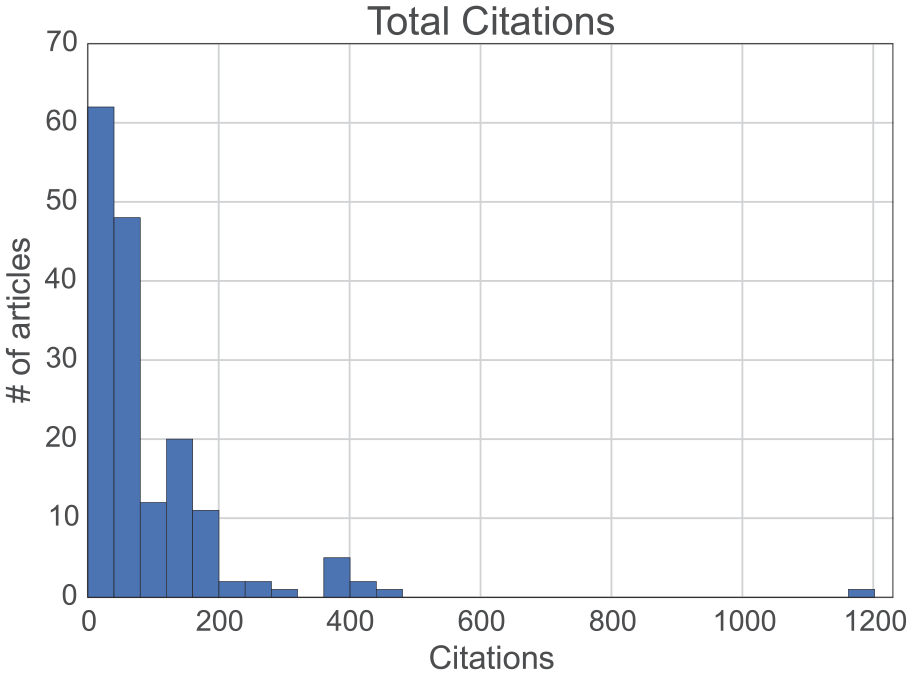
Total citations for published manuscripts 32 years after publication.
The histograms of total citation counts are greatly left skewed; the obvious outlier, with 1,204 citations, is Cohen and Felson’s (1979) article “Social Change and Crime Rate Trends: A Routine Activity Approach.” Tables A1 and A2 in the Appendix list the 10 most and least cited articles in the data sample. We address the skew of citations in the following analyses by log-transforming counts or using nonparametric measures (i.e., ranks) and statistical tests (i.e., Kolmogorov-Smirnov [KS]).
Subfield-normalized Citations
Research fields vary in how frequently typical items are cited. It is thus one of the “key principles of citation analysis that citation counts from different fields should not be directly compared with each other” (Waltman 2015:21). Sociology is a notoriously heterogeneous discipline (Smelser 2015), and ASR welcomes and publishes material from all of its subfields. To compare citations across these various subfields, we normalize citations by subfield in two ways. First, following common the bibliometric practice (Waltman 2015), we define for each article a reference set that consists of other articles on the same substantive topic. The topics consisted of the 54 sections of the American Sociological Association (ASA) and 9 additional topics. 11 Coders classified each manuscript as belonging to up to 3 of these topics (e.g., “medical” or “theory”). All manuscripts sharing at least one of these subfields were included in the reference set.
Normalized citations carry information not present in the raw citations: the two quantities correlate weakly (0.13), as is apparent in Figure 4, which displays their scatterplot.
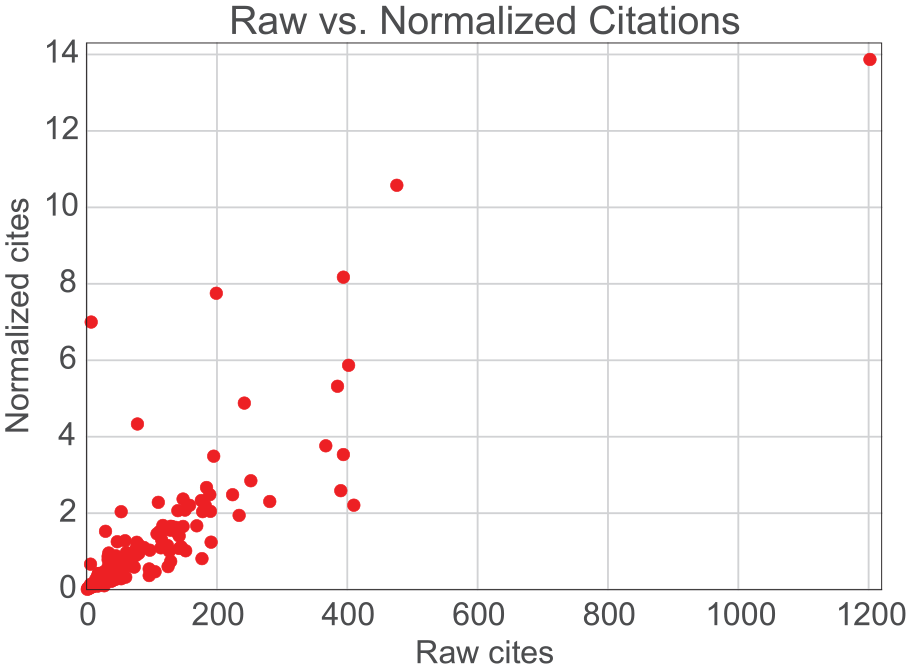
Scatterplot of raw versus normalized citations 32 years after publication. Each dot represents an article. Normalized citations were obtained by dividing raw citations by the mean citations of articles in the reference groups: all those substantively oriented to the same American Sociological Association section. The correlation between the two quantities is 0.13.
Results
In this section we examine the relationship between reviews and (un-normalized) citations first and then use normalized citations. Next, two analyses probe whether especially high citations are associated with the highest scores. Finally, review texts are used to argue that reviewers focus on the soundness of manuscripts’ arguments rather than their potential for impact.
Review Scores and Citations
Figure 5 presents a scatterplot of citations versus average review score (in the last round) with a line of best fit. (A similar scatterplot with review scores from the first round of review may be found in Appendix Figure A1).
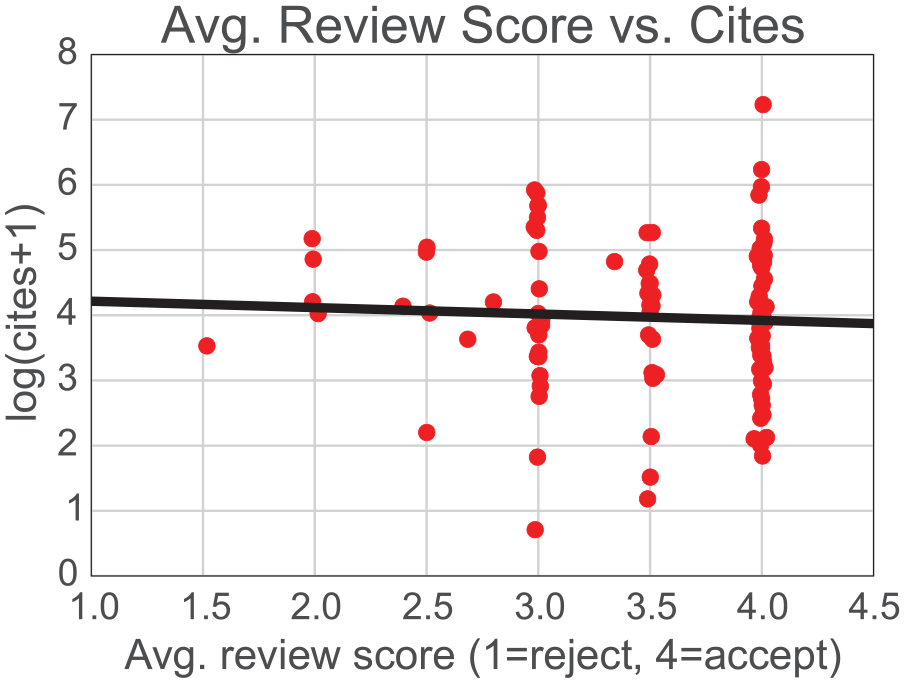
A scatterplot of citations versus average review score for each manuscript (red dot) and a line of best fit (black). The correlation is −0.051. The slope is −0.098 and is statistically insignificant at the .05 level. The dots are jittered to improve visibility.
No relationship is apparent visually or statistically between the reviews and citations: the slope of the regression line is −0.098 (SE = 0.187, p = .601).
Review Scores and Normalized Citations
Does the apparent lack of a relationship between reviews and citations reveal a null relationship, or is a small but significant true relationship swamped by other determinants of citations, particularly target audience size? After all, an outstanding article (high review scores) targeted at a relatively small community may receive fewer citations than a mediocre article (low review scores) targeted at a relatively large community. Unmeasured variation in audience sizes may introduce a large amount of noise in citation counts and make all but the strongest relationships appear null. To take into account audience size, citation counts were subfield normalized by dividing citations by the mean citations received by other articles on the same substantive topic. Figure 6 displays a scatterplot and line of best fit for these (total) normalized citations versus review scores.

A scatterplot of normalized citations versus average review score for each manuscript (red dot) and a line of best fit (black). The correlation is 0.040. Citations were normalized by dividing each article’s citations by the mean citations received by all other articles on the same substantive topic. The slope is 0.14 and is statistically insignificant at the .05 level. The dots are jittered to improve visibility.
The relationship in Figure 6 echoes that of the previous figure: no relationship is apparent between review scores and normalized citation counts.
Multivariate Analysis
Bivariate analyses displayed in Figures 5 and 6 show no evidence of a relationship between review scores and citations. However, the bivariate relationships did not control for important predictors of citations identified or posited by the literature. These predictors include the number of coauthors (Wuchty, Jones, and Uzzi 2007), institutional prestige (Leimu and Koricheva 2005; Long 1978), and subfield spanning (Leahey and Moody 2014). To control for these covariates, we estimated the following regression 12 :

NORM.CITES (normalized citations) and REV.SCORE (average review score) were defined earlier. AUTH.PRESTIGE (first author prestige) was measured as the prestige of the first author’s current institution (1 = high school, 5 = MA-granting institution, 10 = PhD-granting institution with an American Council on Education ranking of 60 or higher. AUTH.RANK (first author rank) was measured as the first author’s professional rank (1 = undergraduate, 5 = research associate, 9 = professor emeritus). SUBFIELDS was measured as the number of substantive research areas the manuscript addressed (see note 11).
Table 1 displays estimates of this regression.
Coefficient Estimates from the Regression of Normalized Citations on Manuscript Covariates.

Note: Number of complete cases = 106, R2 = 0.16.
p < .05. ***p < .01.
The central quantity of interest—the regression coefficient of the average review score—is statistically insignificant. Meanwhile, the number of coauthors is the strongest and most reliable predictor of citations. This multivariate analysis provides further support to the earlier bivariate analyses: even when controlling for important covariates, the data do not provide evidence of a relationship between review scores and citations.
Do Peer Reviewers Identify Citation “Hits?”
If reviewers do not predict the impact of accepted articles overall, perhaps they do successfully identify citation “hits”: the articles that accrue an uncommonly large number of citations (Danthi et al. 2014). If reviewers and editors recognize that an article with great potential is before them, they may wish to make its path to publication as quick as possible and accept it after the first round of review. In our data, there are 18 such “first-round consensus-accept” articles. Comparing citations received by this group—the “cream of the crop”—with citations received by the 149 articles taking other paths to publication would then indicate whether unusually favorable review outcomes correspond to unusually high citations.
The distribution of citations is skewed, as noted previously. To ensure that results are not unduly influenced by one or two outliers, we convert articles’ raw citation counts into ranks: the article receiving the least citations is ranked 1 and the article receiving the most is ranked 167. It is then possible to observe whether one of the two article groups—first-round consensus-accept articles versus all other articles—is overrepresented in the low or high article ranks. Figure 7 displays these densities using kernel density estimates plots. 13

Articles are split into two groups on the basis of review outcome—first-round consensus-accept articles versus all others—and the presence of each group across the range of ranked citations is plotted. The densities shown are kernel density estimates.
Figure 7 demonstrates that that first-round consensus-accept articles are not overwhelmingly represented among the high article ranks. In fact, the small overrepresentation among the most highly cited articles is balanced by a small overrepresentation among the least cited articles.
A statistical test confirms the visual evidence. The KS test is a nonparametric (unaffected by skew) test of whether two probability distributions differ in any part of the distribution. A KS test of whether the distribution of (1) first-round consensus-accept articles’ citations differs anywhere along the distribution from (2) all other articles’ citations does not reject the null hypothesis of no difference (KS statistic = 0.17, p = .73). 14 We thus find no evidence that review “hits” are associated with citation “hits.”
Impact at Each Year after Publication
The age of the data invites an analysis of whether review scores predict not only accepted manuscripts’ total citations but also citations at each year after publication. The manuscript were divided into two groups: consensus-accept manuscripts are those that all reviewers recommended for acceptance, while no-consensus manuscripts are those at least one reviewer recommended be rejected or revised and resubmitted. Citations were obtained for each year after publication. Medians were used instead of means to limit the influence of one outlier (using means does not qualitatively affect the conclusions). Figure 8 displays the median citation trajectories of these consensus-accept and no-consensus groups.

Solid lines indicate cumulative median citation trajectories of consensus-accept and no-consensus articles. Review decisions are from the last round of review. Shaded areas represent 25th- to 75th-percentile trajectories of each group.
The visual evidence is clear: the two groups of articles, one with superior reviews and one with inferior reviews, have nearly indistinguishable citation trajectories over the entire 32-year period. 15 The variance of both groups dominates the minor (and unstable) differences in their medians. Thus, the apparent independence of reviews and citations 32 years after publication established earlier holds throughout the observation period.
Do Reviewers Value Citation Impact but Fail to Predict It?
All of the results above point unanimously to the conclusion that review outcomes of accepted articles do not predict their citation impact. The lack of a relationship raises a question: do reviewers value citation impact but fail to predict it, or do they privilege other manuscript characteristics, such as soundness of argument? The review instructions offer little guidance; as discussed in the “Data and Methods” section, reviewers were asked to comment on the “appropriateness” and “quality” of the manuscripts. These rather open-ended reviewer instructions are not unusual for sociology. Furthermore, sociologists’ formal training rarely includes review instruction, making reviews practices difficult to deduce from the instructions and potentially nonuniform. As one sociologist put it, “Manuscript reviewing must be one of the most important, least formally trained professional functions that we serve” (Brunsma, Prasad, and Zuckerman 2013).
The focus of reviewers’ attention has usually been elicited with surveys and interviews (e.g., Bornmann, Nast, and Daniel 2008; Brunsma et al. 2013; Chase 1970; Lamont 2009). A chief problem with eliciting by asking, in addition to desirability effects, is that the reviewers are not forced to compromise between criteria in the way they must when actually reviewing. There is no realistic constraint forcing respondents to trade off among criteria: they may simply respond that they value them all. These considerations motivate our choice to deduce reviewers’ foci of attention from the actual review texts. But before we turn to these texts, consider what reviews would focus on if citations truly were of utmost importance.
Expert reviewers are likely to have in mind mechanisms that generate citations in their field. Indeed, impact in the field is to some extent a prerequisite of being the type of reviewer ASR would call upon. Some reviewers may even be familiar with the voluminous scholarly literature on the predictors of impact. If mandated to predict citations, reviewers would likely use all this knowledge in evaluating a manuscript. They would hesitate to accept a well-executed piece of scholarship if it were unlikely to generate citations, perhaps because an earlier article solidified the first-mover citation advantage (Newman 2009) or because it did not address several audiences (Leahey and Moody 2014). A manuscript from poorly positioned authors or research areas could also drag citations down (Bornmann et al. 2012) and would thus be a legitimate cause for rejection. Articles presenting useful methods, which are overrepresented among the most cited articles, would win praise easily (Van Noorden, Maher, and Nuzzo 2014). And of course reviewers could write directly, “I am afraid this manuscript will not be cited.”
The contents of the ASR review reports did not mention citations explicitly, and even implicit mentions were exceedingly rare. The vast majority of review text in these data, whether comments to the author or editor, whether praise or criticism, is devoted to general impressions and to concerns about the soundness of a manuscript’s argument (Bakanic et al. 1989).
Positive comments were relatively rare and, when made, were most often generic (36.8 percent of all positive comments) (Bakanic et al. 1989, Figure 2). For example, reviewers praised manuscripts by calling them “interesting” (Bakanic et al. 1989:644) or writing “On the whole this is a nice article” (p. 645). Reviewers did often (19.9 percent) praise a manuscript’s topic. For example, one reviewer wrote, “This is an important topic for studies of subjective class identification” (p. 645). Such comments on topic may be indirect endorsements of the manuscript’s citability. 16 In sum, even if style (9.7 percent) and topic (19.9 percent) are taken to be endorsements of citations, nearly 70 percent of reviewers’ positive comments focused on either very general impressions or the argument’s soundness.
Reviewers’ negative comments to the editor were most often general (31 percent of all criticisms). These included statements such as “This is not sociology,” “I wasn’t convinced by this research,” even “Yuk!” (Bakanic et al. 1989:646). Reviewers provided to the authors offered more concrete criticisms, focusing on problems of theory (13.2 percent), analysis (12.3 percent), and results (11.7 percent) (p. 647). Criticisms of the manuscript’s importance to the field, which may be construed as related to its citability, are relatively rare: 6.4 percent of comments to the author and 6 percent of comments to the editor criticized the manuscript’s topic. Similarly, criticisms of style, perhaps also related to citations, constitute 10.8 percent and 11.9 percent of comments to the author and editor, respectively.
The texts of reviewers’ reports thus indicate that reviewers do not focus on impact. They do not mention citations or other measures of impact explicitly at all; and if impact were understood to be part of their mandate, how could they not? Furthermore, comments that may implicitly relate to citations (i.e., regarding a manuscript’s topic) are much rarer than comments regarding the soundness of argument. Instead, reviewers take as their chief mandate to evaluate the soundness of a manuscript’s argument, addressing most comments to matters of theory, measurement, and analysis.
In summary, ASR reviewers did not make invalid predictions of impact. Instead, reviewers assessed the soundness of manuscript, and for accepted manuscripts, these judgments are unrelated to citations.
Discussion
In this study we explored the relationship between accepted manuscripts’ peer review scores and citation impact. In addition to a possible linear relationship between scores and raw citations, we examined citations normalized by subfield, citation “hits,” and citations at each year in the 32-year span after publication. In none of these specifications did the data manifest a relationship. Did reviewers value potential impact but fail to predict it? Nearly all previous studies did not measure reviewers’ motivations directly and interpreted reviewers’ ability or inability to predict citations as a referendum on the validity of peer review (Bornmann 2011; Mervis 2015). In contrast, in this study we used the texts of the reviewers’ reports to deduce the foci of their attention. The texts show that reviewers did not prioritize potential impact directly or indirectly; instead they focused on the soundness of arguments. Reviewers’ judgments of soundness, not potential impact, are unrelated to citations.
Although this study helps rule out one interpretation of the absence of a relationship between scores and citations, several interpretations remain. First and foremost, the true relationship between review scores and citations may be nonlinear: there may be a threshold of quality below which a strong relationship exists but above which it disappears. This may be the case where the chief distinction (threshold) in quality lays between rejected and accepted (whether immediately or after revisions) manuscripts, while gradations in quality among the accepted articles are inconsequential (Mervis 2015). Two additional interpretations have been largely overlooked by the literature and are discussed below.
Nonrandom Reviewer Selection
Reviewers are not selected randomly from a population of potential citers, so their judgments may fail to generalize to this population. Both reviewer solicitation and agreement to review predispose the final reviewer panel to consist of individuals who find the manuscript’s research area valuable. First, editors at ASR and likely in other settings solicit reviews from experts in the field from which the manuscript comes. These experts would not have made the enormous investments required to master their specialties if they did not find the specialties valuable. Second, research on motivations of volunteers in crowd-sourcing settings emphasizes that volunteers donate time in order to learn and be creative (Lakhani and von Hippel 2003; Lakhani and Wolf 2003). We suspect that in scientific peer review, these motivations are equally crucial: experts agree to perform the time-consuming and uncompensated task based, in part, on interest in the research area. In sum, reviews come from individuals uncommonly interested in the manuscript’s research area. Even superlative assessments from reviewers may thus fail to translate into citations from the broader population if it has no interest in the manuscript’s topic.
Implicit Division of Labor between Reviewers and Editors
Conspicuously absent in our discussion and others in the literature are the editors. Editors may play a crucial role in mediating the relationship between reviews and citations not only because they select reviewers but because the reviewers may rely on an implicit division of labor between themselves and the editors. In particular, some reviewers may take it as their mandate to evaluate manuscripts for soundness and leave judgments of whether it is interesting, judgments that may be strongly related to citations, to the editors. This implicit division of labor is apparent when one experienced sociological reviewer, in a survey of ASA reviewers, wrote, “a fourth test [of the manuscript under review] is whether the point is interesting or innovative, but I feel that this can be left for the editor to decide so I don’t make a big deal of it” (Brunsma et al. 2013:2). However, in the absence of formal reviewer training or explicit instructions, it is not surprising that reviewers vary in what they take to be their task. For example, in the same ASA survey, another reviewer wrote, “I simply read [the manuscript] from the perspective of a potential reader. The standard and maybe only thing I look for is this: Is this paper interesting? That is my prime criterion” (p. 9). In sum, reviewers differ in their evaluative criteria and in how they divide the evaluation task between themselves and the editors. To the extent that reviewers expect editors to judge a manuscript’s interestingness, the absence of a relationship between accepted manuscripts’ reviewer scores and citations is unsurprising: the crucial relationship to evaluate is between citations and editors’ decisions.
Conclusion
In this study we focused on the evaluation of sociological manuscripts, a crucial and understudied research practice (Leahey 2008). We returned to the decisions made by ASR reviewers and editors more than three decades ago to assess whether the decisions predicted the published manuscripts’ citation impact over what is essentially their entire lifetimes. The chief empirical finding is a null one: reviews do not predict citations in a number of plausible specifications. In addition to extending the empirical base of the literature to sociology, the study developed a number of interpretations of the relationship especially relevant to social science, where the value of manuscript excellence can be multidimensional. By combining bibliometric and qualitative data, the number of these interpretations of sociological peer review was reduced. In particular, ruled out is the interpretation that reviewers prioritize impact but fail to predict it. Yet several interpretations remain. The relationship between review scores and impact may be nonlinear, with an association at lower levels of quality and no association above a publishability threshold. Additionally, reviews may fail to predict citation because of nonrandom reviewer selection or because an implicit division of labor assigns the difficult task of predicting citations to the editors.
The age of these data enabled us to trace the fate of manuscripts through an unprecedented length of time: 32 years, virtually the articles’ entire lifetimes. Yet the age may limit applicability to contemporary academic publishing. It is possible that the bibliometric conception of impact prevalent today would have been distasteful or foreign to reviewers 35 years ago. The standardization and quantification literature suggests that rating and ranking systems do not simply quantify existing reality; they also induce evaluated and evaluating persons to behave in ways that fall in line with the system of valuation undergirding those systems (Espeland and Sauder 2007; Espeland and Stevens 2008). The increased prevalence and ease of using bibliometrics to measure impact may have changed scholarly norms for assessing the value of work. It is thus plausible that reviewers today, more conditioned to think and evaluate in terms of bibliometrics, may be more successful forecasters.
Despite the limitations above, this study contributes to our understanding of peer review and policies that may improve it. One direction for improvement concerns reviewer instructions. If a journal prioritizes citation impact, reviewers should be explicitly instructed to evaluate on this dimension. Another direction concerns reviewer selection. In the case of ASR, the two types of a manuscript’s “evaluation,” that by expert reviewers and that by a more general citing audience, appear decoupled. It is plausible that more representative review panels will result in higher associations between review outcomes and citations. To the extent that citation impact is valued, editors may need to trade domain expertise for representativeness.
Footnotes
Appendix
Pairwise Correlations between the Variables Used in the Multivariate Regression.

| Total Citations | Normalized Total Citations | Average Review Score | Number of Authors | Number of Subfields | First Author Prestige | First Author Rank | |
|---|---|---|---|---|---|---|---|
| Total citations | 1.000 | ||||||
| Normalized total citations | 0.128 | 1.000 | |||||
| Average review score | 0.034 | 0.040 | 1.000 | ||||
| Number of authors | 0.211 | 0.013 | 0.013 | 1.000 | |||
| Number of subfields | −0.077 | −0.202 | 0.052 | −0.195 | 1.000 | ||
| First author prestige | −0.016 | 0.002 | 0.100 | 0.067 | −0.013 | 1.000 | |
| First author rank | 0.003 | 0.007 | −0.011 | 0.073 | −0.090 | 0.489 | 1.000 |
Acknowledgements
We thank the participants of the Social Theory and Evidence Workshop (University of Chicago) and the Skat25 Conference (Chicago) for helpful comments on previous versions of this research. We also thank the anonymous reviewers, Ben Merriman, and Clark McPhail for their input. All errors are our own.