




Abstract
Introduction
Night-shift work is essential to hospital continuity but may disrupt circadian rhythms, impair recovery, and reduce nurses’ well-being, particularly in resource-limited health systems. Evidence from Palestine remains limited.
Objective(s)
To examine the association between night-shift frequency and job satisfaction, assess differences in quality of life (QoL) domains by night-shift exposure, and identify predictors of QoL among Palestinian nurses using a Job-Demands–Resources perspective.
Methods
A cross-sectional correlational study was conducted among registered nurses (N = 186) recruited from three public hospitals (Al-Watani Hospital, Rafidia Hospital, and Tubas Hospital; April–May 2025). Participants completed the Job Satisfaction Survey and WHOQOL-BREF. Night shift frequency was categorized as <6 versus ≥6 night shifts/month. Group differences were tested using independent t-tests, and multiple linear regression examined predictors of overall QoL (sleep disturbance, perceived workload, age, and gender).
Results
Nurses working ≥6 night shifts/month reported lower job satisfaction (3.34 ± 0.58 vs. 3.89 ± 0.45; p < .001) and poorer QoL across physical, psychological, social, and environmental domains (all p ≤ .006). In regression analysis, sleep disturbance (β = −0.47, p < .001) and perceived workload (β = −0.31, p < .001) were significant predictors and explained 42% of the variance in overall QoL; age and gender were not significant.
Conclusion
Frequent night-shift exposure among Palestinian nurses is associated with lower job satisfaction and reduced QoL. Interventions targeting sleep disruption and workload—such as ergonomic scheduling, adequate recovery time, and fatigue-risk management—may improve nurse well-being and retention.
Introduction
Nursing is essential for continuous patient care; however, round-the-clock staffing exposes nurses to biological and psychosocial strain associated with night work. Circadian disruption and sleep deprivation contribute to impaired functioning and reduced well-being among nurses (Chiang et al., 2022; Zhang et al., 2023). Evidence also links night work to poorer health-related quality of life (QoL) and reduced professional satisfaction across multiple occupational groups (Lim et al., 2020; Turchi et al., 2019).
In Middle Eastern and low-resource health systems, staffing shortages may intensify these effects because nurses often shoulder frequent night rotations with limited recovery time. In Palestine, workforce constraints, high patient-to-nurse ratios, and inconsistent occupational-health policies may magnify the adverse impact of night shifts on both job satisfaction and QoL (Al-Hrinat et al., 2024). Despite the importance of this issue, empirical evidence addressing Palestinian nurses remains limited.
Literature Review
Night Shifts and Nurse Well-Being
Research consistently indicates that night shifts are associated with reduced QoL and increased fatigue, sleep problems, and psychosocial strain among nurses and other healthcare professionals (Qanash et al., 2021; Turchi et al., 2019). Sleep quality appears central: nurses with poorer sleep frequently report lower job satisfaction and worse well-being (Chang & Chang, 2019).
International and Regional Evidence
International studies from diverse contexts, including Iraq, Jordan, Saudi Arabia, Ethiopia, India, and Nepal, report similar patterns, suggesting that the negative consequences of night work are widespread and may be amplified where staffing and recovery resources are limited (Al-Ameri, 2017; Alsharari, 2019; Chalise & Chaudhary, 2024; Dires et al., 2023; Hamdan et al., 2024; Nirupama et al., 2024).
Additional evidence highlights associations between night-shift exposure, sleep problems, and health risks, including metabolic abnormalities among nurses (Zhang et al., 2023). Night work is also linked to reduced QoL through psychosocial functioning and strain mechanisms (Ljevak et al., 2020; Turchi et al., 2019). Collectively, the literature supports the need for context-specific research examining how night-shift intensity relates to job satisfaction and QoL among nurses in Palestine.
Theoretical Framework
This study is guided by the Job-Demands-Resources (JD-R) Model, which proposes that high job demands (e.g., workload, time pressure, and night-shift fatigue) contribute to strain and poorer outcomes unless buffered by job resources (e.g., managerial support and adequate recovery opportunities). In the present study, night-shift frequency and perceived workload are conceptualized as job demands, while recovery opportunities and organizational support represent potential resources influencing job satisfaction and QoL.
Figure 1 illustrates the proposed relationships, positioning night-shift frequency and workload as key demands that, when resources are insufficient, lead to decreased job satisfaction and poorer QoL.

Schematic of the job demands-resources (JD-R) model as applied in the current study.
Purpose and Objectives
Examine the association between night-shift frequency and job satisfaction among Palestinian nurses.
Assess how night-shift work influences QoL domains (physical, psychological, social, and environmental).
Identify predictors of QoL decline, guided by the JD-R framework.
Methods
Design and Setting
A cross-sectional correlational design was used. Data were collected from 1 April 2025 to 1 May 2025 in three large public hospitals (Al-Watani Hospital, Rafidia Hospital, and Tubas Hospital), each operating rotating shift systems.
Participants and Sampling
Using stratified random sampling, 186 registered nurses were selected from an accessible population of approximately 320 nurses. Strata were defined by department (medical, surgical, and intensive care) to ensure proportional representation. Department rosters served as sampling frames. Within each stratum, nurses were assigned sequential IDs and selected using computer-generated random numbers via SPSS v27.
Inclusion criteria:
Full-time employment ≥6 months Participation in ≥1 night-shift rotation per month Consent to participate
Exclusion criteria:
Nurses in purely administrative/nonclinical positions
Power analysis (G*Power 3.1) estimated a minimum of 170 participants for a medium effect size (f2 = 0.15), α = 0.05, power = 0.80; the achieved sample (n = 186) was adequate.
Participant Flow and Missing Data
Of 200 nurses approached, 192 met eligibility criteria; 186 completed the questionnaire (response rate 93%). Fourteen were excluded (8 ineligible; 6 declined). There were no missing data for night-shift frequency, job satisfaction, or QoL scores. Demographic variables had <2% missingness and were handled using pairwise deletion.
Instrumentation
Job Satisfaction Survey (Spector, 1985): 20 items, 5-point Likert scale; α = 0.89.
WHOQOL-BREF: 26 items across physical, psychological, social, and environmental domains; α = 0.91. An established Arabic version was used with forward–backward translation procedures.
Supplementary single-item measures (JD-R related):
Perceived workload: 1 (very light) to 5 (very heavy) Sleep disturbance: 1 (never) to 5 (always)
These items were face-validated by an expert panel.
Content validity was evaluated by seven nursing and occupational-health experts (content validity index = 0.92). A pilot test (n = 20) supported clarity and reliability (test–retest r = 0.88).
Operational Definition of Night-Shift Frequency
Night-shift exposure was categorized as
Procedure
After institutional permissions, questionnaires were distributed in sealed envelopes. Participation was voluntary and anonymous; average completion time was ∼20 min.
Ethical Considerations
The study was conducted in accordance with the Declaration of Helsinki. Ethical approval was obtained from the relevant Institutional Review Board (IRB) of Ibn Sina College for Health Professions, Nablus University for Vocational and Technical Education (Ref. No: Nrs.March 22,2025/5). Written informed consent was obtained from all participants. Confidentiality and the right to withdraw at any time were ensured.
Data Analysis
Analyses were conducted using SPSS v27 with α = 0.05 (two-tailed). Descriptive statistics summarized sample characteristics. Independent t-tests compared job satisfaction and QoL between shift-frequency groups. Pearson correlations examined associations. Multiple linear regression identified predictors of QoL (sleep disturbance, workload, age, and gender). Assumptions were assessed using Shapiro–Wilk tests, Q–Q plots, residual plots, and variance inflation factor (<2.0).
Results
A total of 186 valid responses were analyzed.
Demographic Characteristics
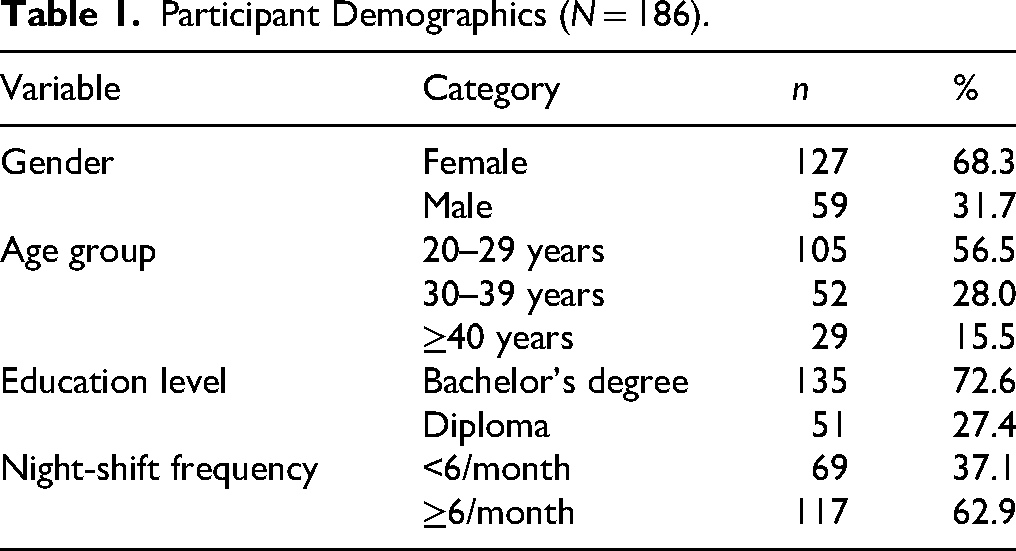
The sample was predominantly female (68.3%) and young (56.5% aged 20–29). Most held bachelor's degrees (72.6%). Over 60% reported ≥6 night shifts/month (62.9%; Table 1).
Participant Demographics (N = 186).
Job Satisfaction by Night-Shift Frequency
Nurses working ≥6 nights/month reported significantly lower job satisfaction (Table 2).
Job Satisfaction by Night-Shift Frequency.

QoL by Night-Shift Frequency
All QoL domains were significantly lower among nurses working ≥6 nights/month (Table 3).
Quality of Life (QoL) Domain Scores by Night-Shift Frequency.

Predictors of QoL Decline
Regression explained 42% of QoL variance; sleep disturbance and workload were significant predictors (Table 4).
Multiple Regression Analysis Predicting Quality of Life (QoL).

Note. R2 = .42, adjusted R2 = .41, F(4, 181) = 32.75, p < .001. Dependent variable: overall quality of life score (composite).
Discussion
This study examined the association between night-shift frequency, job satisfaction, and QoL among Palestinian nurses. Nurses working ≥6 night shifts per month reported significantly lower job satisfaction and poorer QoL across all domains compared with those working fewer night shifts. In addition, sleep disturbance and perceived workload were the strongest predictors of overall QoL, explaining a substantial proportion of variance. Collectively, these findings indicate that higher night shift exposure is linked to compromised well-being and professional satisfaction in this resource-limited context.
Physiological and Psychosocial Interpretation
The observed associations are consistent with evidence that night shift schedules disrupt circadian alignment and sleep, which may negatively influence physical and psychological well-being (Çolak & Esin, 2024; Zhang et al., 2023). In the present study, sleep disturbance emerged as the strongest predictor of QoL, supporting the view that impaired sleep is a key pathway through which night work contributes to reduced QoL (Zhang et al., 2023). Prior research similarly links night-shift exposure with adverse health- and mood-related outcomes and diminished well-being, which may help explain the QoL differences observed between nurses with higher versus lower night shift frequency (Dires et al., 2023; Nirupama et al., 2024). In parallel, perceived workload was independently associated with lower QoL, suggesting that both recovery disruption (sleep) and elevated work demands contribute to reduced well-being.
JD-R Model Explanation
The findings align with the JD-R model, where frequent night shifts and higher perceived workload represent elevated job demands that can impair well-being and satisfaction when compensatory resources, such as adequate rest opportunities, staffing support, and recovery time, are limited. This interpretation is consistent with regional evidence linking work strain and reduced professional QoL among nurses (Hamdan et al., 2024).
Contextual Considerations and Comparison With Prior Studies
The pattern observed in this study is consistent with reports from multiple settings showing that shift work is associated with reduced sleep quality, lower QoL, and diminished job satisfaction (Chang & Chang, 2019; Lim et al., 2020; Ljevak et al., 2020; Turchi et al., 2019). Similar relationships have been documented in Middle Eastern contexts, where staffing constraints and scheduling intensity may exacerbate the impact of night work (Alsharari, 2019; Qanash et al., 2021). Furthermore, Palestinian evidence indicates that night-shift stress and sleep disturbance may be particularly relevant to nurses’ QoL (Al-Hrinat et al., 2024), supporting the plausibility of the pathways identified in the present analysis. Although the current design does not permit causal inference, consistency with international and regional literature strengthens confidence that night-shift frequency is an important occupational correlate of nurses’ well-being. Comparable associations between night-shift schedules and poorer QoL have also been reported in other settings (Chalise & Chaudhary, 2024).
Implications for Practice
Nursing Implications
Hospitals should consider limiting excessive night shift rotations and ensuring adequate recovery time. Fatigue risk management approaches—including rest breaks, designated rest areas, scheduling standards, and sleep-health education—may reduce negative outcomes. Supporting nurse well-being is likely to improve retention and care quality.
Nurse administrators should implement scheduling reforms that limit consecutive night shifts and provide adequate recovery days between rotations. Staffing ratios should be evaluated to ensure manageable workloads during night shifts. Occupational health programs should include regular screening for sleep disturbance and fatigue among night-shift nurses.
Clinical Implications
Nurses working night shifts should be educated about sleep hygiene strategies and encouraged to prioritize recovery time. Peer support programs may help mitigate the psychosocial strain associated with night work. Healthcare organizations should consider providing access to counseling services for nurses experiencing sleep disturbance or reduced QoL related to shift work.
Policy Implications
Healthcare policymakers in Palestine should develop evidence-based guidelines for night-shift scheduling that prioritize worker well-being. Minimum standards for rest periods between shifts and maximum limits on monthly night shifts should be established. Future research should employ longitudinal designs to clarify causal pathways and evaluate the effectiveness of scheduling interventions.
Strengths and Limitations
Strengths include a stratified random sampling approach, a high response rate, the use of validated instruments, and theory-guided interpretation.
Limitations include the cross-sectional design (no causal inference), reliance on self-report measures (possible reporting bias), restriction to three hospitals (generalizability limitations), and the use of single-item measures for workload and sleep disturbance, which may not capture the full construct depth.
Conclusion
Frequent night-shift work is associated with lower job satisfaction and poorer QoL among Palestinian nurses. Sleep disturbance and perceived workload are key predictors of QoL decline. Implementing scheduling reforms and fatigue-management policies may reduce harm and support nurse retention and patient safety.
Footnotes
Acknowledgements
The authors would like to express their sincere appreciation to all the nurses who participated in this study. They also extend their gratitude to the administrations of the participating hospitals in both the governmental and nongovernmental sectors for their cooperation and support. The authors further acknowledge Nablus University for Vocational and Technical Education for its academic support.

Author Contributions
MS conceived and designed the study. KS, RS, TB, HA, and RB collected and curated the data. MS supervised the project administration and conducted the statistical analysis. MS and KS contributed to data interpretation and validation. MS and RS prepared the original draft. All authors provided critical revisions, intellectual content, and approved the final manuscript.
Ethical Considerations
Ethical approval for this study was obtained from the IRB of Ibn Sina College for Health Professions, Nablus University for Vocational and Technical Education (Ref. No: Nrs.March 22,2025/5). The study was conducted in accordance with the ethical principles of the Declaration of Helsinki. Confidentiality, anonymity, and the right to withdraw at any time without penalty were ensured for all participants. Voluntary participation was emphasized through informed consent.
Funding
The authors received no financial support for the research, authorship, and/or publication of this article.
Declaration of Conflicting Interests
The authors declared no potential conflicts of interest with respect to the research, authorship, and/or publication of this article.
Availability of Data and Materials
The datasets generated and analyzed during the current study are available from the corresponding author upon reasonable request.