



Abstract
Introduction
Poland has the largest shortage of nurses in Europe, as well as a low percentage of male nurses. Information relating to emotional intelligence has been explored to determine whether it predicts the characteristics and outcomes of qualified health professionals during their academic training and practice.
Objective
This study aimed to measure differences in emotional intelligence between male and female nursing students.
Participants and methods
In this cross-sectional study, emotional intelligence was measured using the Schutte Self-Report Emotional Intelligence Test (SSEIT) in 21 male and 127 female nursing students from John Paul II University in Biała Podlaska, Poland.
Results
The raw overall scores of emotional intelligence in male and female students were similar. Differences were observed after the conversion of raw scores into normalized (sten) scores. High normalized scores (sten 8–10) of emotional intelligence had every third of male students and only 14.2% of female students. The lowest sten values of emotional intelligence in male and female students were 3 and 1, respectively. Less than 10% of male students and over 20% of female students had low normalized scores (sten ≤3) for emotional intelligence and an isolated ability to recognize emotions (factor II).
Conclusions
The emotional intelligence expressed in normalized scores was higher in male nursing students than in female nursing students. This evidence may suggest that, at the stage of choosing a field of study, Polish male nursing students self-select for the nursing profession, at least in terms of emotional intelligence. The influx of men into the profession should be considered as a positive trend.
Introduction
In the last decade of the twentieth century, the term emotional intelligence (EI) was originally defined in the scientific literature as “the ability to monitor one's own and others’ emotions, to discriminate among them, and to use the information to guide one's thinking and actions” (Salovey & Mayer, 1990). The public's attention was drawn to the concept of emotional component of social intelligence with the realization of two books by Goleman: Emotional Intelligence: Why It Can Matter More Than IQ? (1995) and Working with Emotional Intelligence (1998). EI, empathy, and problem-solving abilities have become essential qualities for modern nurses (Deng et al., 2023).
Review of Literature
Some experts believe that students with a higher EI level have a better chance of succeeding in the nursing study program and are more fully prepared for professional practice, which is currently characterized by creating a holistic therapeutic relationship with the patient and their family that takes into account social, emotional, and spiritual needs (Christodoulakis et al., 2023; Pienimaa et al., 2021; Sharon & Grinberg, 2018). Volatile, uncertain, changing, and ambiguous (VUCA) times in healthcare, the global economy, and politics have made it necessary to care for psychological safety (Foster, 2022). If EI is imperative to educate nurses who are effective leaders who work well in the presence of stress and are oriented toward nurse–nurse collaboration, as well as have a high rate of retention in the profession and resistance to burnout, it can be argued that the development of a recruitment system for candidates with such predispositions would be beneficial (Al-Hamdan et al., 2021; Hwang & Park, 2022; Nightingale et al., 2018; Sharon & Grinberg, 2018; Talman et al., 2020; Younas et al., 2019). In relation to gender, many studies conducted among nursing students found that being female was associated with a significant increase in EI (Deng et al., 2023; Talman et al., 2020; Younas et al., 2019). In some countries, men's ability to care is continually being questioned because caring is seen as a female-only characteristic (Nerges et al., 2022). These are common findings in the literature, but their practical benefits for nursing recruitment are less obvious (Cerit & Beser, 2014; Deng et al., 2023; Snowden et al., 2015). Moreover, the generalizability of these findings to all countries and cultures is unknown. The approximate percentage of male nurses is reported to be 1% in China, 5% to 8% in North America, 5% to 21% in European countries, and 32% in Saudi Arabia (Hwang & Park, 2022). In Poland, 2% of male nurses and many gender-related stereotypes surround this profession (Kluczyńska, 2012). Male nurses are viewed as those who become nurses because of a lack of other career prospects, without considering that it could have resulted from predispositions (Kowalczuk et al., 2018). The stereotype of the nursing profession as suitable only for women is ingrained even among Polish female nurses, emphasizing the role of the traditionally understood home atmosphere, which women are more predisposed to creating than men (Marcinowicz et al., 2016). There is a popular opinion that women choose a career in nursing because they think their personality is suitable for the profession, while men choose it more for economic security, as quoted in many publications (Kluczyńska, 2017; Tong et al., 2023). However, a recent study by Tong et al. (2023) showed that nurses of different genders mostly have similar perceptions of caring, and the biggest differences lie in the relationship between nurses and themselves.
In Poland, the nurse rate is among the lowest in Europe (5.3 per 1000 of population) (Kluczyńska, 2017). The improvement in the situation is believed to be an increase in recruitment for nursing studies, including men, but stereotypes prevailing in societies are indicated as the main barrier to undertaking the nursing profession by men (Kowalczuk et al., 2018). The question arises whether the increased influx of men into nursing studies is related to the need to develop modules that improve competencies in the area of EI (Deng et al., 2023).
This study aimed to analyze the EI of male and female nursing students in Poland.
Methods and Material
Study Design, Sample, and Setting
A cross-sectional survey was conducted in June 2022 among nursing students at the John Paul II University in Biała Podlaska, Poland.
Inclusion/Exclusion Criteria
The inclusion criterion was that the students were enrolled in an undergraduate nursing program. The exclusion criterion was foreign students, as they may not have sufficient language competence when answering nuanced questions (Dörnyei & Taguchi, 2009). Subjects under the age of 18 years were excluded from the study, as only adults were permitted to participate.
Data Collection and Main Instrument
All first-cycle nursing students had been informed about the study. From recruited students data were collected using a battery of questionnaires, including a sociodemographic questionnaire that included questions about age, gender, nationality, socioeconomic status, etc. and psychological instruments via the paper-and-pencil mode. All data collected on paper were transcribed to electronic databases for analysis. No participants dropped out of the study.
The validated Polish version of the Emotional Intelligence Questionnaire (Schutte Self-Report Emotional Intelligence Test, SSEIT), developed by Schutte et al. (1998) and adapted to Polish conditions by Jaworowska and Matczak (2008) with very good validation results (Tsirigotis, 2016), was used to measure EI, understood as the ability to recognize, understand, and control one's own emotions, and the emotions of others, as well as the ability to effectively use emotions to influence one's own and others actions. The questionnaire consisted of 33 items of self-descriptive character, with five-point Likert responses (from 1: I strongly disagree to 5: I strongly agree; questions 5, 28, and 33 were scored in reverse). Sample items included “I have control over my emotions,” “I know what other people are feeling just by looking at them,” “When I experience a positive emotion, I know how to make it last,” and “I help other people feel better when they are down.” The possible scores ranged from 33 to 165 points. The higher the score, the higher the EI level of EI. In addition to the overall score (OS, the general EI score), two separate factor scores were obtained: the ability to use emotions to support thinking and actions (factor I) and the ability to recognize emotions (factor II). The possible results ranged from 16 to 80 points and from 12 to 60 points for factors I and II, respectively. The overall score of EI is not the sum of factors I and II because the three items are included in both factor scores and eight items are not included in either factor component. Row scores can be converted into normalized sten scores developed for the separate female and male student populations, where sten 1 to 3 indicate low EI, 4 to 7 is average, and 8 to 10 is high, according to SSEIT interpretation guidelines (Jaworowska & Matczak, 2008). Both the American and Polish versions are characterized by high reliability and validity (Jaworowska & Matczak, 2008). SSEIT has been used in many studies, but often under different names (“Emotional Intelligence Scale, EIS,” “Assessing Emotions Scale, AES,” “the Emotional Intelligence Questionnaire INTE,” “Schutte Emotional Intelligence Scale, SEIS”) (Talman et al., 2020; Tsirigotis, 2016).
Ethical Considerations
Permission to perform this research was obtained from the local ethics committee. Before conducting the research, participants were introduced to the purpose of the research and their rights and obligations. They were also informed of their voluntary participation, anonymity, and ability to leave at any time. The collected electronic data could only be assessed by the researchers involved.
Statistical Analysis
Statistical analysis was performed using the Polish version of the TIBCO Software Inc., USA (2017). The compliance of the data with the normal distribution was assessed using the Shapiro-Wilk test. Categorical data were compared using the chi-squared or Fisher's exact test. The comparison of proportions between the groups was performed using the Mann–Whitney U test. Correlation between continuous variables was performed using Spearman's rho test. Statistical significance was set at p < .05.
Results
Sample Characteristics
Of the 175 students studying their first 3 years of nursing at the John Paul II University in Biała Podlaska, 148 participated in the study. The demographic characteristics of the 21 male and 127 female participants are presented in Table 1. The male students were slightly older than the female students. The students lived as often in the countryside, as in the city.
Main Characteristics of Study Group.

Research Question Results
Raw Overall EI, Factor I, and Factor II
The median (inter quartile range, IQR) scores for the raw overall EI were 129.0 (118.0–142.0) and 129.0 (121.0–127.0) for men and women, respectively (Table 2). The male student with the lowest raw overall EI had a 9.6% higher score than the female student with the lowest EI. The score of the male students with the highest EI was only 3.7% lower than that of the female students with the highest score. Only in female students the level of the raw overall EI correlated with the age of respondents and the status of a parent having a child (Table 3). Older female students and those having children had higher EI levels. The year of study had no relationship with EI level in either male or female students. Factors I and II were highly correlated with having children only among female students.
Emotional Intelligence of Studied Groups of Polish Nursing Students.
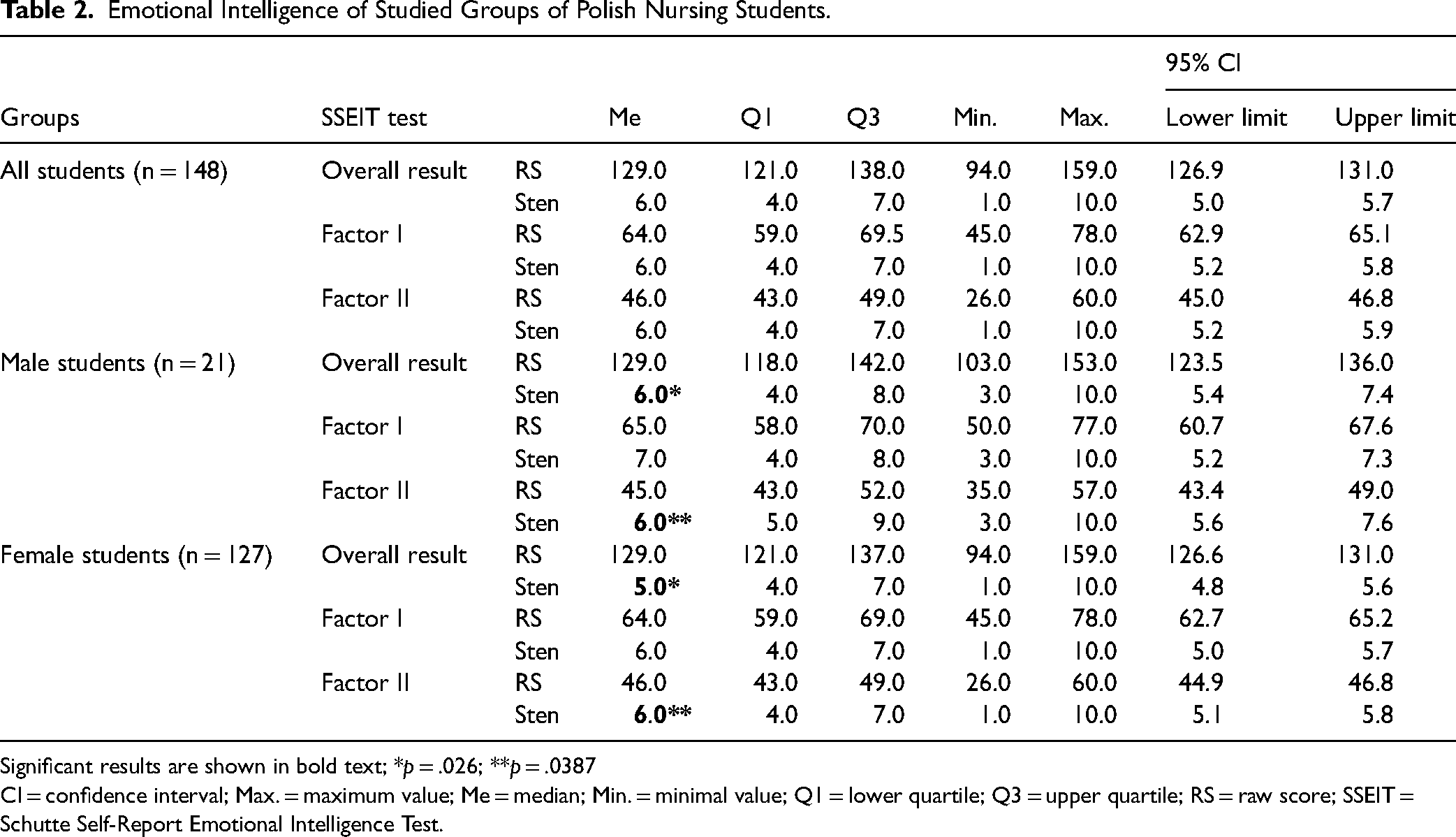
Significant results are shown in bold text; *p = .026; **p = .0387
CI = confidence interval; Max. = maximum value; Me = median; Min. = minimal value; Q1 = lower quartile; Q3 = upper quartile; RS = raw score; SSEIT = Schutte Self-Report Emotional Intelligence Test.
Correlations of Emotional Intelligence With Age, Year of Study, and Having Children of One's Own.

Significant results are highlighted in bold text.
SSEIT= Schutte Self-Report Emotional Intelligence Test.
Normalized (sten) Scores of EI and Factors I and II
The median normalized scores for EI and factor II were significantly higher in male students than in female students (Table 2). Low EI and factor II scores were twice as likely to be found among women than among men (Table 4). Every third of the male students had high EI scores, but only 14.2% of the female students. Nearly 40% of the male students had high factor I and II scores. Of the female students, 11.8% and 13.4% had high factor I and II scores, respectively.
Percentage Distribution of Emotional Intelligence Test Scores.

Significant results are highlighted in bold text.
SSEIT= Schutte Self-Report Emotional Intelligence Test.
Discussion
In recent decades, the role of nursing has been widely recognized. According to healthcare experts, the present nursing shortage is going to extend, and the value of nurses has become inherently clear. Men in nursing have a rich history in nursing, dating back hundreds of years BC and contributing to the development of the profession (Younas et al., 2019). Many historians highly appreciate Nightingale's contribution to the development of modern nursing, but some blame her for the demise of men (DeVito, 2016; Younas et al., 2019). In our study, the level of EI using the most general approach, such as the raw overall score, did not differ between male and female nursing students. Analysis of the results using normalized values led to interesting observations. At a university located in a medium-sized city in an agricultural area far from the climate of progressiveness in prosperous metropolitan centers, men were admitted to the nursing field of study and had higher EI expressed in normalized scores than female nursing students. It is worth noting that the increased proportion of high normalized scores of factors I and II and the decreased proportion of low normalized scores of factors I and II in males in comparison to female nursing students reached the level of high statistical significance (0.007 and 0.016, respectively, for factors I and II). Our study showed that, in the case of male nursing students in Poland, self-selection for the profession presumably takes place, at least in terms of EI. Emotions are vital to the nursing profession as nurses work in emotionally charged environments, and some studies have indicated that applicants who have a realistic image of the nursing profession are also able to better recognize whether their personal qualities match the demands of the chosen profession (Louwen et al., 2023; Pike, 2006; Talman et al., 2020). In most studies, including those using SSEIT as a tool, the level of EI in female nursing students was equal to or higher than that of male nursing students (Deng et al., 2023; Stiglic et al., 2018). In studies using the Polish version of SSEIT (Jaworowska & Matczak, 2008), raw overall EI was lower among students of physiotherapy, physical education, tourism, and recreation (Romanowska-Tołłoczko & Kołodziej, 2018; Romanowska-Tołłoczko & Lewandowska, 2014), and military and civilian students of the Polish Air Force Academy in Dęblin (Ślusarski et al., 2017) in comparison to our sample of nursing students. Fifth-year dentistry students from a highly ranked Jagiellonian University in Krakow had slightly higher EI scores (mean 132.0 ± 13.2) than nursing students (Bereziewicz et al., 2010). In dentistry, high normalized scores of EI were three times more common among women than among men (60% vs. 17%). Interestingly, male physiotherapy and physical education students who did not plan to join the teaching profession (126.7 vs. 121.9 and 127.2 vs.124.2, respectively), as well as those from military fields (126.5 vs. 122.1), had higher mean EI than female students. Male military students from the Air Force Academy had higher Factors I and II than female military students and lower than nursing students (factor I: 61.9, 58.9, 64.0; factor II 44.1, 43.3, 46.0; respectively) (Ślusarski et al., 2017). In selected groups of students, the higher level of EI in male students compared to female students is not an exceptional observation (Romanowska-Tołłoczko & Kołodziej, 2018; Ślusarski et al., 2017). Findings from a systematic review of 46 EI intervention studies suggest that it is possible to improve various aspects of EI competencies (Kotsou et al., 2018). However, our results on nursing students’ EI did not show any gender differences that would increase the likelihood of the need for intervention in male students.
There is controversy regarding the relationship between empathy and the individual characteristics of nursing students (Juniarta & Ferawati Sitanggang, 2023). Deng et al. (2023) showed that female Chinese nursing students’ EI was significantly correlated with empathy. Male students had less EI, which was not correlated with empathy. High emotional empathy may predispose professionals to emotional exhaustion and personal accomplishment (Hunt et al., 2017; Topcu et al., 2023). Emotionally related burnout was more common in male nurses than in female nurses both before and during the COVID-19 pandemic (Dos Santos, 2023; Hsu et al., 2010; Hur et al., 2022). More research is needed to understand the relationship between EI and empathy among nursing students, taking into account gender differences and possible interventions (Deng et al., 2023). There are differences in both mental health and psychosocial risks in the nursing workplace between women and men (Berdida, 2023; Kowalczuk et al., 2018). In-depth knowledge of the psychological characteristics of trainees and their evolution during professional work provides hope for mental health assistance programs (Saleh et al., 2022).
DeVito (2016) reported in her study that male nursing students want to be known as “nurses, not male nurses,” which shows the male students’ strong belief in the multi-aspect equal rights for men to perform this profession. Moreover, the gender imbalance in nursing can be considered a problem. Heterogeneous teams are more innovative and productive, resulting in improved outcomes, and a gender-diverse workforce can positively influence various work environment factors of a nursing unit (Nerges et al., 2022; Younas et al., 2019). Moreover, gender diversity promotes culturally appropriate care and boosts provider satisfaction (Berdida, 2023). In some units, the technical interests of some male nurses may be an advantage (Berdida, 2023; Nerges et al., 2022). We must also remember that some male patients prefer to receive care from male nurses because they feel more comfortable with them (Rabie et al., 2020). In Poland, there are strong stereotypes regarding the division of professions based on gender (Byczkowska, 2010). It can be assumed that choosing the nursing profession by a man in a society with an extremely low percentage of men practising this profession requires courage and a leader's desire for self-determination. High EI can help make choices regarding professional self-determination (Alston et al., 2010; Walter et al., 2011). It is worth noting that courage and the ability to make bold choices may be valuable in various areas of the nursing profession (Ebrahimi Ghassemi et al., 2019; Pajakoski et al., 2021).
Limitations and Recommendations
Although the results of the present study show important directions for the understanding of EI in nursing students, they are not free from limitations. The small number of male nursing students limits the general ability of the results. An additional limitation is that participant characteristics such as volunteering practice, experience of chronic illness in loved ones, and communication skills were not assessed (Snowden et al., 2015). The research tools used were self-reported measures; therefore, only the subjective perceptions of participants were examined. On the one hand, self-report questionnaires are inexpensive and easy to administer, but on the other hand, we have limitations in that participants may be poor judges of their own abilities. Future studies should consider more aspects of emotional functioning. One solution may be to combine qualitative and quantitative methods within the study. The inclusion of other healthcare disciplines, such as midwifery and paramedic female and male students, may have provided a more in-depth view of their EI (Louwen et al., 2023; Shahin, 2020). This study has some notable strengths. The investigated population was ethnically homogenous and was from a slightly diversified rural area. The participants were homogeneously recruited from only one higher education institution, with a high response rate (84.6%). It is noteworthy that the EI assessment test used in our study is recommended to assess the formative feedback effectiveness of EI training programs (Chandrapal et al., 2022), which means that the presented results may be useful in planned intervention studies with the participation of nursing students.
Implications for Research and Practice
This study is both theoretically and practically important. In a country where there is a strong stereotype of nursing as a profession exclusively for women, men, with high competencies in the area of emotions, study nursing. Due to the lack of a psychological test of aptitude for a profession during recruitment for nursing studies in Poland, there is probably a favorable self-selection of men as candidates for the profession (Pike, 2006). On the one hand, it would be valuable to further research men's motivation to study nursing and, on the other hand, to popularize the idea of studying nursing among males choosing their field of study, especially in countries with a low percentage of male nurses.
Conclusions
EI expressed in normalized scores was higher in male nursing students than in female nursing students. This evidence may suggest that, at the stage of choosing a field of study, Polish male nursing students self-select for the nursing profession, at least in terms of EI. In our sample from a population with a low percentage of male nurses nursing students’ EI did not show any gender differences that would increase the likelihood of the need for intervention in male students. The influx of men into the profession should be considered as a positive trend.
Footnotes
Acknowledgment
The authors appreciate the editor and the reviewers for their insightful and helpful comments and remarks.
Authors’ Contributions
KL, JP, and KKH conceived and designed the study, wrote the initial draft of the manuscript, and acquired funding. KL and JP collected the data. KL, JP, and AS analyzed and interpreted the data. KKH supervised the project. All the authors contributed to the manuscript revision, read, and approved the final submitted version.
Availability of Data and Material
The datasets generated during during the current study are available from the corresponding author on reasonable request.
Declaration of Conflicting Interests
The authors declared no potential conflicts of interest with respect to the research, authorship, and/or publication of this article.
Funding
The authors disclosed receipt of the following financial support for the research and publication this article: This work was supported by the Akademia Bialska grant No: PB/3/2021.
Informed Consent
Informed consent was obtained from all individual participants included in the study.
Statement of Ethics
Permission to perform this research was obtained from the local ethics committee (Komisja Bioetyczna przy Akademii Bialskiej im. Jana Pawła II) no. 14/2022.
