




Abstract
Background
Metaverse-based education is emerging in nursing; this review maps its characteristics and effects. The aim was to systematically review metaverse-based nursing education programs to identify their effectiveness, current status, and characteristics.
Method
A systematic review was conducted following Preferred Reporting Items for Systematic Reviews and Meta-Analyses guidelines. Literature was searched in eight electronic databases (four Korean: Research Information Sharing Service, Korean Studies Information Service System, Database Periodical Information Academic, Korean Medical Database; four international: PubMed, CINAHL, EMBASE, MEDLINE). Of the 41 retrieved records, only four quasi-experimental studies met the inclusion criteria, highlighting evidence sparsity. The Risk of Bias Assessment Tool for Nonrandomized Studies was used to evaluate methodological rigor and quality of evidence.
Results
The four studies (sample size range: 57–72; all conducted in Korea) applied metaverse programs to nursing skills, major courses, or simulation-based clinical practice. Reported outcomes included improvements in self-efficacy, knowledge, confidence, and critical thinking ability. However, considerable heterogeneity was noted across interventions and outcome measures, limiting the comparability of the findings.
Conclusions
The evidence suggests that metaverse-based education has the potential to supplement or replace traditional nursing practice education in situations with limited access, such as pandemics. All included studies were Korean quasi-experiments with small sample sizes; thus, the certainty of the evidence is very low. Future research should employ multisite randomized controlled trials, optimize the frequency and intensity of interventions, and assess long-term outcomes to inform future strategies.
Introduction
The metaverse is a persistent, networked three-dimensional virtual environment that supports copresence, identity via avatars, and synchronous interaction in shared spaces (Fan et al., 2024). Although virtual reality (VR) and augmented reality (AR) can enable immersive learning, they are conceptually distinct from the metaverse: VR typically provides an application-bounded, fully immersive experience for an individual user, and AR overlays digital elements onto the physical world. By contrast, metaverse platforms emphasize social persistence, world continuity, and user-generated environments that learners can repeatedly enter and re-enter over time (De Gagne et al., 2023; Kye et al., 2021; Mystakidis, 2022).
In nursing education, these affordances can mitigate constraints on clinical access and support team communication and scenario-based decision-making aligned with curricular competencies (De Gagne et al., 2023). The COVID-19 pandemic further accelerated the adoption of virtual modalities in health professions education, highlighting the potential value of metaverse-based approaches (Garavand & Aslani, 2022). Consistent with this trajectory, the World Health Organization's Global strategy on digital health 2020–2025 and the 2023 Global Initiative on Digital Health identify digital transformation as a global priority, providing policy context for the educational use of immersive technologies in nursing (World Health Organization, 2021, 2023).
Notably, there has been an increasing interest in metaverse-based education within higher education settings (Kye et al., 2021) as these lessons enhance learning through interactive and immersive experiences, fostering a sense of presence (Ahn, 2022). While conventional remote learning offers advantages such as connectivity, accessibility, convenience, and reduced physical space requirements and operational costs, it falls short in terms of interactivity and presence (Garrison, 2011). Metaverse-based platforms address these limitations by virtually recreating environments that may not be feasible in the physical realm, thereby extending learners’ opportunities for practice (Ahn, 2022; Garrison, 2011). Recent evidence further supports their educational efficacy; for example, De Gagne et al. (2023) conducted an umbrella review, confirming that metaverse-based approaches in nursing education improve learning outcomes and student engagement. Moreover, immersive digital technologies have been recognized as a global priority, as emphasized in the World Health Organization's Global Digital Health Strategy (2023), which highlights their potential to transform health education and training worldwide.
Notably, in nursing education, attempts to utilize metaverse-based education have been on the rise (Foronda et al., 2017). At the onset of the pandemic, 78.2% of programs transitioned to 100% online education, and 97.5% reported that their clinical practices were affected by COVID-19 (Spector & Silvestre, 2014). In response to this situation, the use of metaverses has grown as nursing students seek effective learning methods to maintain competency (Garavand & Aslani, 2022). As a novel social communication space, metaverses can connect students beyond the constraints of reality, particularly when clinical practice is challenging due to pandemics, such as the COVID-19 pandemic. They can also enhance student interest and engagement by offering experiences that transcend traditional boundaries of time and space, thereby promoting active participation and autonomy among students (Frith, 2022). Additionally, while nursing students need to adapt to VR practice, they report that it is convenient for honing skills and provides a stress-free learning environment (Chang & Lai, 2021).
Previous studies have reported on nursing education programs utilizing VR within the metaverse platforms for the short term (Ahn, 2022; Cho et al., 2024; Kang & Moon, 2023; Yang & Kang, 2023). However, these studies are limited in their ability to identify the current status and characteristics of this emerging pedagogy. Although evidence on the use of extended reality (XR) technologies in nursing education has been synthesized (De Gagne et al., 2023), previous reviews have not focused exclusively on undergraduate nursing students, metaverse-based education, or specific educational outcomes. To the best of our knowledge, no systematic review has yet addressed this more specific area. Therefore, by concentrating on metaverse-based educational programs for undergraduate nursing students, this study provides foundational evidence to support the development of effective intervention programs. Accordingly, this review systematically identifies and synthesizes the effectiveness and characteristics of metaverse-based nursing education programs for nursing students published between 2013 and 2023. Given that only four eligible studies—all conducted in Korea—were identified, the generalizability of the conclusions is limited. These findings are intended to inform the design and implementation of future nursing education programs.
Method
Research Purpose
This study aims to conduct a systematic review of the literature on the application of a nursing education program that utilizes the metaverse for nursing students. The review examines the current status, characteristics, and effects of interventions in this area.
Data Collection
Literature Search Strategy
This study adhered to the guidelines for systematic reviews outlined by the Cochrane Collaboration's Preferred Reporting Items for Systematic Reviews and Meta-Analyses (Moher et al., 2010).
Key Questions
Following the descriptive format of systematic reviews, participants, intervention, comparisons, outcomes, timing, setting, and study design, this study was organized as follows: (a) participants were nursing students; (b) intervention involved educational programs utilizing a metaverse; (c) comparisons were made with no intervention or traditional intervention contexts; (d) primary—knowledge/competence, self-efficacy, communication, critical thinking; secondary—learner satisfaction, perceived realism/presence, teamwork/collaboration, problem-solving, intention to use; (e) timing included pre- and postprogram evaluations; (f) setting for the study was on campus; (g) for study design, randomized controlled trials (RCTs), and quasi-experimental designs were considered.
Operational Definition and Screening Rules
For this review, we defined a metaverse-based education program as an intervention that self-identified as “metaverse” and satisfied at least three of five platform features: (a) user-controlled avatars; (b) a navigable 3D (or pseudo-3D) shared space; (c) synchronous multiuser copresence (voice/text); (d) social/world persistence across sessions; and (e) user-generated or configurable environments. Platforms could be commercial (e.g., Zepeto, GatherTown) or proprietary (institution-developed), provided these criteria were met. Two reviewers independently applied the rules using a piloted form, with disagreements resolved through discussion.
Databases and Search Terms
The data search focused on major web-based databases. For Korean literature, searches were conducted using the Research Information Sharing Service, Korean Studies Information Service System, Database Periodical Information Academic (DBPia), and Korean Medical Database. For internationally published literature, searches were performed using CINAHL, EMBASE, MEDLINE, and PubMed. Registration and protocol. This review was retrospectively registered with the International Platform of Registered Systematic Review and Meta-analysis Protocols (INPLASY) on August 28, 2025 (Registration [INPLASY202580082]). The review was not prospectively registered due to its exploratory scope and project timeline; full methods are reported here to enhance transparency. The search was restricted to peer-reviewed journal articles indexed in the databases listed above; grey literature (e.g., dissertations, conference abstracts, preprints) and trial registries were not included in the search.
The search terms included (a) “metaverse,” “metaverse simulation,” or “metaverse platform”; (b) “nursing,” “nursing student,” or “nursing education”; and (c) combinations of “simulation,” “intervention,” or “program.” The full reproducible search strategies (e.g., database-specific syntax, Boolean operators, truncation), date limits (January 1, 2013–December 31, 2023), language limits (English/Korean), publication-type limits (Journal articles), and the date last searched for each database are provided in Supplemental Table S1.
Literature Selection and Exclusion Criteria
Studies that included research findings and for which full-text access was available were selected among single-group pre–post studies, RCTs, or quasi-experimental designs that applied educational programs using metaverses exclusively to undergraduate nursing students. The study excluded research not presented in Korean or English, dissertations, studies lacking full-text availability, those not employing experimental trials or quasi-experimental designs, conference papers, and studies with unknown authors. At the outset, we note that only four studies met the inclusion criteria across the 2013–2023 period, all from Korea. This small and geographically concentrated corpus limits generalizability, which informed our choice of narrative synthesis rather than meta-analysis.
Literature Selection Process
This study focused on research articles published in academic journals between January 2013 and December 2023. Six journal articles were retrieved from the four domestic databases, 39 were retrieved from the four web-based databases, and two articles were obtained manually. Following retrieval, a duplicate check was conducted on the 41 articles, resulting in the removal of 31 duplicate articles. Subsequently, the titles and abstracts of the remaining 10 articles were reviewed, and the inclusion and exclusion criteria were applied. Four articles relevant to the topic of the current study were identified and included in the literature analysis (Figure 1). For literature selection, one researcher initially reviewed the titles of the studies to exclude ineligible articles. Thereafter, two researchers independently screened the remaining records at both the abstract and full-text stages; discrepancies were resolved through discussion to reach a consensus. Following prior methodological practice (Belur et al., 2021), we prespecified a two-stage agreement target for the dual-screened stages: ≥ 80% agreement at the abstract stage (after which discordances were re-reviewed) and ≥90% agreement at the full-text stage before final decisions.
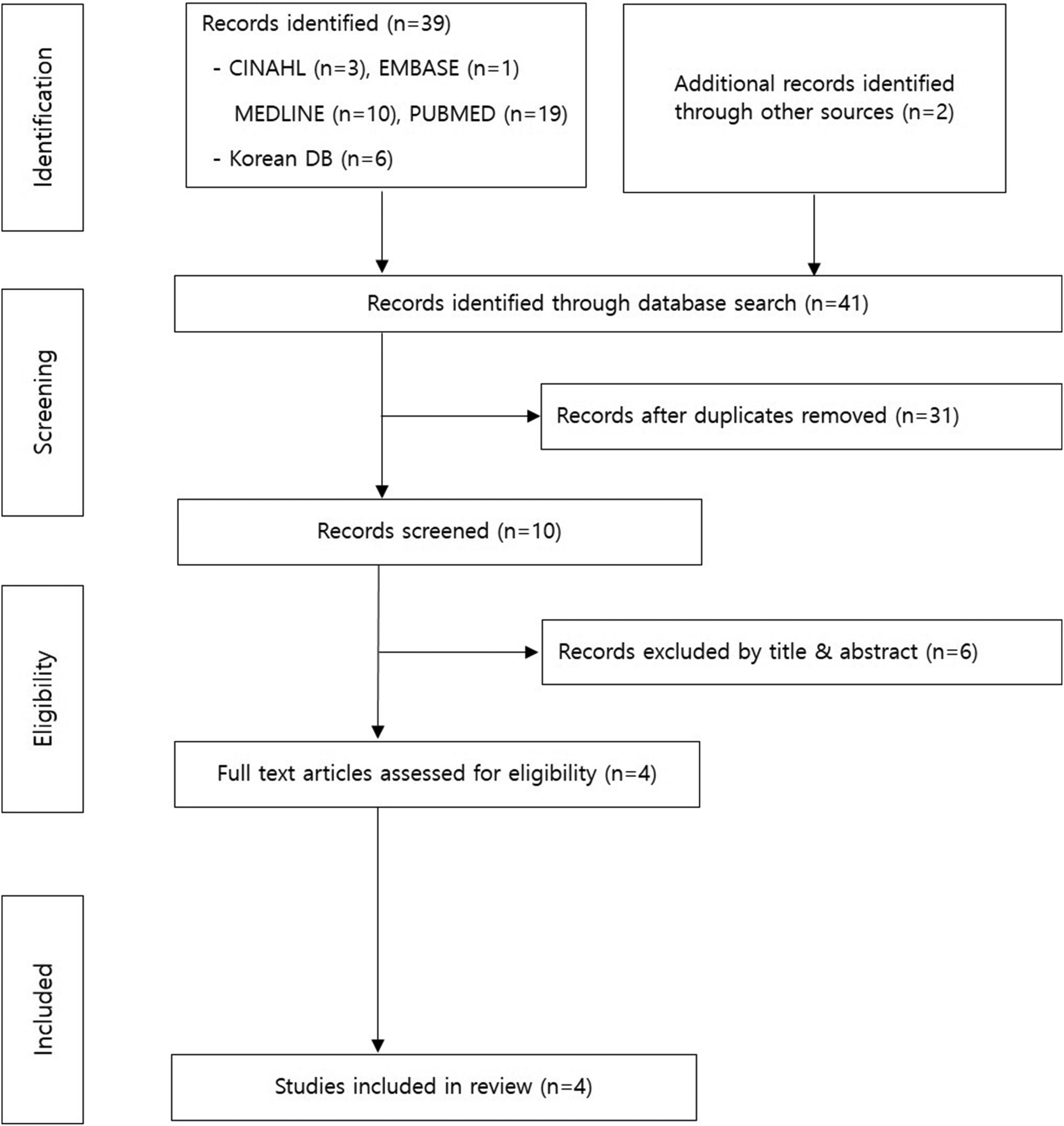
Flow diagram of study selection process.
Data Analysis
Two researchers independently read and analyzed the four final selected articles. Furthermore, they recorded and took notes on the analysis of each article, checking them repeatedly. The researchers analyzed the study design, intervention methods, and intervention effects by reaching a consensus through discussion. The process of reviewing the papers was repeated in case of disagreement.
Literature Assessment
A critical review of the literature was conducted using the Risk of Bias Assessment tool for Nonrandomized Studies (RoBANS) to assess the quality of the selected articles. The RoBANS tool assesses the risk of bias across six categories: participant selection, confounding variables, measurement of the intervention, blinding of outcome assessment, incomplete outcome data, and selective outcome reporting, categorizing the risk as low, high, or uncertain. In this study, two researchers independently performed the quality assessment. In the event of disagreement between the two researchers, the final bias risk results were determined through a thorough discussion until a consensus was reached. Before conducting narrative synthesis, we also assessed the overall certainty of evidence by outcome domain using a GRADE-informed approach, considering the risk of bias, inconsistency, indirectness, imprecision, and publication bias. Given the predominantly nonrandomized evidence, the starting level was Low, with domain-based downgrades applied as warranted; no upgrading criteria were met. Full outcome-level ratings are summarized in Supplemental Table S2.
Results
General Characteristics of the Literature
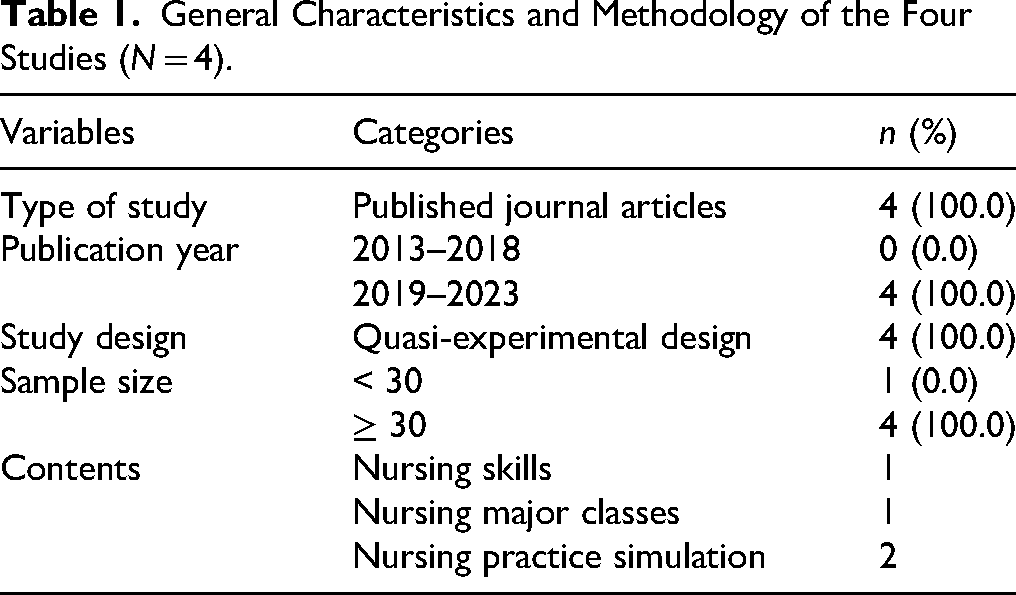
To assess the effectiveness of metaverse-based nursing education, the general characteristics of the four articles meeting the selection criteria were categorized (Table 1). The publication year of all four studies was 2022 or later (Ahn, 2022; Cho et al., 2024; Kang & Moon, 2023; Yang & Kang, 2023), and the study design for each study was quasi-experimental. One study (25.0%) (Yang & Kang, 2023) involved fewer than 30 subjects per group, while three studies (50.0%) (Ahn, 2022; Cho et al., 2024; Kang & Moon, 2023) involved more than 50 subjects per group. The applied metaverse content varied, with one study focusing on nursing skills (Ahn, 2022), another on nursing major classes (Kang & Moon, 2023), and two on nursing practice simulation (Cho et al., 2024; Yang & Kang, 2023).
General Characteristics and Methodology of the Four Studies (N = 4).
Quality Assessment of Studies
The RoBANS ratings were generally low risk across several domains. However, the blinding of outcome assessment was frequently unclear due to limited reporting and the use of self-administered measures. The risk of bias in the selection of participants, as assessed by the RoBANS tool, was rated as “low” in three studies because the participants were clearly described (Cho et al., 2024; Kang & Moon, 2023; Yang & Kang, 2023), and “uncertain” in one study due to unclear participant characteristics (Ahn, 2022). The risk of bias from confounding variables was assessed as “low” in all four studies, as explicit inclusion and exclusion criteria were established to minimize the impact of confounding variables. The risk of bias in the intervention measure was rated as “low” for all four studies, as they detailed measures to prevent measurement error during data collection. The blinding of outcome assessment was evaluated as “uncertain” in two studies due to a lack of mention of the blinding process (Ahn, 2022; Kang & Moon, 2023), and “low” in the other two studies, as efforts to blind assessors were clearly described. Finally, the risk of bias from incomplete outcome data and selective outcome reporting was assessed as “low” in all four studies, as they provided descriptions of missing values in intervention and control groups and included expected outcomes (Table 2; Supplemental Figure S1).
Quality Assessment of all Four Studies (N = 4).

Note. L = low risk of bias; H = high risk of bias; U = unclear risk of bias; (1) = selection of participants; (2) = confounding variables; (3) = measurement of intervention; (4) = blinding of outcome assessment; (5) = incomplete outcome data; (6) = selective outcome reporting.3.3. Training content and outcomes.
Unclear risk of bias: Assessor blinding not reported; outcomes were self-administered questionnaires—potential detection bias cannot be excluded. High risk of bias: Instructors who delivered the intervention also rated performance; no blinding reported—high risk of detection bias. Low risk of bias: Outcomes were assessed using machine-scored multiple-choice tests, which were administered through an automated system masked to group allocation, with no reported assessor involvement.
Effectiveness of Metaverse-Based Nursing Education
The training methods and outcomes of the selected studies are summarized in Table 3. All four studies were conducted in Korea and reported after 2022 (Ahn, 2022; Cho et al., 2024; Kang & Moon, 2023; Yang & Kang, 2023). In all four studies, the participants were students enrolled in nursing programs, with one study lacking a control group (Kang & Moon, 2023). Only Yang and Kang's (2023) study developed and implemented a self-developed metaverse platform, while the other studies utilized existing platforms. No study targeted first-year students, and all four studies provided interventions to second-year or higher nursing students. Across studies, all outcomes were assessed at immediate posttest; no long-term follow-up was reported. In one study, the intervention was delivered as a clinical-placement adjunct (Yang & Kang, 2023), whereas the remaining studies involved on-campus courses or simulation activities. Examining the content and outcomes of metaverse-based education programs, Ahn (2022) focused on vital signs and subcutaneous injection as nursing skills, using the Analyze learners, State Objectives, Select method, media, and materials, Utilize media and materials, Require learners’ participation, Evaluate and revise model, which comprises the following steps: Analyze learners, State Objectives, Select method, media, and materials, Require learners’ participation, and Evaluate and revise. The intervention was applied to second-year nursing students using a proprietary, institution-developed metaverse program over two weeks. The experimental group received two skills sessions, each lasting an average of 15 min, covering specific nursing skills, while the control group received traditional education. Results showed significant improvements in the knowledge, confidence, and clinical competency of the experimental group. In Kang and Moon (2023), a metaverse-based emergency nursing simulation was provided in a nursing major course without a control group. The intervention was applied to third-year nursing students over 1 week, and no explicit theoretical framework was reported. The simulation comprised a 20-min prebriefing and 50 min of simulation learning. Pre–poststatistical analysis revealed no significant difference in subjects’ communication, problem-solving process, and learning self-efficacy after the simulation; however, significant improvements were observed in subfactors of communication (i.e., connecting and rapport building). Yang and Kang (2023) offered 100 min of metaverse-based schizophrenia nursing learning content alongside 100 min of online lectures to the experimental group during psychiatric clinical practice, while the control group received only online lectures. This intervention was based on Lindsey and Berger's (2009) experiential approach to instruction and was applied to third-year nursing students using a self-developed metaverse intervention. Results showed that the experimental group exhibited improved knowledge, critical thinking ability, and communication compared to the control group, with no differences in learning self-efficacy, learning satisfaction, and confidence. Cho et al. (2024) implemented a metaverse-based pediatric intensive care unit to deliver a family-centered handoff education program, while the control group received only online lectures. This intervention was structured based on Kolb's Experiential Learning Theory (1984) and was applied, using the ZEPETO platform, to students who had completed the pediatric nursing course; the year of study was not specified. The results indicated an increase in handoff self-efficacy in the experimental group compared to the control group, with no differences in handoff competency, learning realism, and learning satisfaction. Across the evidence base, all four included studies were conducted in Korea, employed quasi-experimental designs, and had small sample sizes; accordingly, our GRADE-informed assessment indicates very low certainty across the assessed outcome domains, and the findings should be interpreted with caution (Supplemental Table S2).
Effectiveness of Metaverse-Based Nursing Education (N = 4).

Note. ASSURE: Analyze learners, State Objectives, Select method, media, and materials, Utilize media and materials, Require learners’ participation, Evaluate and revise; ELT: experiential learning theory; Exp.: experiment group; Cont.: control group; RCT: randomized controlled trial; PICU: pediatric intensive care unit.
Discussion
Interest in various educational methods in nursing education has continued to increase in the aftermath of the COVID-19 pandemic. Therefore, this study investigated the current status of metaverse-based nursing education by systematically analyzing studies conducted both in Korea and internationally, providing objective evidence for future metaverse-based nursing education programs. While several outcomes favored metaverse-based interventions, the body of evidence is small, heterogeneous, and at risk of bias. Using a GRADE-informed assessment, we judged the overall certainty to be very low, precluding firm conclusions about effectiveness. Therefore, the findings should be interpreted with caution.
A total of 41 studies on metaverse-based nursing education programs for nursing students were retrieved from nine web-based databases. After applying the inclusion and exclusion criteria, only four studies were deemed suitable for analysis. Although the search encompassed literature published from 2013 to 2023, all four studies were published after 2022, indicating a recent increase in studies providing metaverse-based nursing education. Notably, all four studies selected for our analysis were conducted in Korea, indicating a high level of interest in nursing education in the country in the post-COVID-19 era—additionally, all four studies employed a quasi-experimental design. Meanwhile, RCTs can minimize the risk of bias that may occur due to randomization, as they eliminate the subjectivity of the researcher and assign subjects through objective probability (Lee & Kang, 2015). Therefore, it is imperative to implement programs with a RCT pre–post design in future studies, thereby improving the quality of nursing education by establishing a scientific basis for nursing education based on high-quality research results.
The risk of bias was relatively high for blinding, with two studies not mentioning double-blinding of participants and researchers (Ahn, 2022; Kang & Moon, 2023), while two studies showed good blinding of assessors (Cho et al., 2024; Yang & Kang, 2023). Double blinding may not be possible for all interventions. Nonetheless, when it is applied, it should be implemented broadly, including the researcher, participants, data collectors, and testers (Choi & Bae, 2021). In future research, double blinding should be strictly applied in the study design and clearly described to reduce the influence of bias on the results.
Meanwhile, metaverse-based educational programs have been utilized to hone nursing skills (Ahn, 2022), apply teaching methods in major courses (Kang & Moon, 2023), and enhance clinical practice (Cho et al., 2024; Yang & Kang, 2023). Previous studies have examined the effects of various methods, such as video recording and application development (Choi & Bae, 2021; Seo & Kang, 2020), on improving nursing skills, but there have been few reports on metaverse-based content. Meanwhile, metaverse-based nursing content scenarios have been effective in increasing nursing students’ confidence in performing nursing skills, as they contain detailed information on various situations and procedures. Notably, nursing students reported higher comprehension and confidence when immersed in scenarios in their native language than when immersed in scenarios in a foreign language (Ahn, 2022).
To enhance engagement in simulation training, it is crucial to increase physical fidelity, including environments that closely resemble real-world settings (De Gagne et al., 2023; Watts et al., 2021). Kang and Moon (2023) simulated an emergency department on a metaverse platform to bridge the gap in clinical practice experience. Students were able to explore spaces that are typically challenging to access in clinical practice, such as resuscitation areas, triage rooms, and negative-pressure isolation rooms, and observe equipment without space constraints. However, communication through avatars within the created platform proved challenging due to extended periods of silence and a lack of nonverbal communication, which was consistent with findings from the other two selected studies (Cho et al., 2024; Kang & Moon, 2023). In contrast, Yang and Kang (2023) differed from the other three studies as they focused on improving communication skills by fully utilizing therapeutic communication within the scenario. In metaverse settings, multiuser, avatar-mediated interaction enables team training without spatiotemporal constraints, providing a safe and low-stakes space to practice therapeutic communication, and can reduce tension, thereby encouraging participation (Kalisch et al., 2015). Future programs should deliberately leverage these affordances (e.g., scalable small-group work, repeatable scenarios, low-anxiety interviewing) to strengthen communication outcomes. At the same time, metaverse-based education can face communication barriers in student-student and student-instructor exchanges (Ryu et al., 2023; Yang & Kang, 2023), underscoring the need to plan measures to mitigate these obstacles.
During the COVID-19 pandemic, children and psychiatric patients became especially vulnerable and required protection, posing challenges to clinical practice. This reality was reflected in two selected articles: one, focused on conducting simulations to care for patients with schizophrenia in psychiatric nursing clinical practice (Yang & Kang, 2023), and the other, which applied metaverse-based simulation in pediatric nursing clinical practice (Yang & Kang, 2023). Nursing students were able to enhance their engagement in practice by immersing themselves in virtual yet realistic clinical scenarios, thereby gaining experience in specific situations (De Gagne et al., 2023; Kim et al., 2021). Additionally, two studies included explanations of the metaverse platforms in the pre-briefing (Cho et al., 2024; Yang & Kang, 2023). Furthermore, researchers emphasized the importance of instructors anticipating and addressing issues such as internet disconnection and unfamiliarity with the platform during simulations, highlighting the significance of thorough pre-checks and orientation. Therefore, it is essential to assess learners’ comprehension, needs, and proficiency with the metaverse platform before implementing metaverse-based educational programs and providing tailored training accordingly.
Positioning our findings alongside related syntheses of VR/XR in nursing education suggests an incremental, rather than revolutionary, trajectory. A broad review of virtual simulation (1996–2018) reported generally positive effects but emphasized definitional ambiguity, heterogeneity, and the need for stronger designs—patterns consistent with our evidence base (Fronda et al., 2000). More recent meta-analytic work on immersive technologies (VR/AR/XR) also reports advantages over traditional methods but notes substantial heterogeneity and downgrades in certainty, aligning with our very low GRADE assessment (Park et al., 2024). Complementary cross-sectional studies show favorable student perceptions, underscoring acceptability rather than causal effectiveness (Bodur et al., 2024). Taken together, these literatures indicate that metaverse platforms likely extend established immersive pedagogy rather than transform it; any added value may depend on copresence, persistence, sound instructional design, and adequate exposure. Accordingly, adequately powered RCTs with standardized outcomes and longer follow-up are needed.
Overall, metaverse-based nursing education may help mitigate practice constraints and improve selected education-related outcomes; however, the overall certainty of evidence is very low (GRADE), so conclusions should remain tentative. This study may help lay the groundwork for alternative education methods for nursing students in response to events such as pandemics and contribute to the advancement of nursing education in Korea and abroad. However, this study did not include terms such as VR, AR, and XR in the search formula, potentially resulting in the overlooking of metaverse-related literature that utilized these technologies. Moreover, as the final selected articles used different intervention programs, it was challenging to verify the effectiveness of the same educational program. Future research should consider incorporating the intervention type into the search formula based on the findings of this study, and follow-up research is warranted to validate the effectiveness of consistent educational programs.
Strengths and Limitations
This review holds meaningful academic and practical significance. It provides an integrative understanding of how metaverse-based education is positioned within contemporary nursing curricula, highlighting its potential as a transformative learning environment that bridges theoretical knowledge and clinical practice. By synthesizing evidence across diverse educational contexts, this study offers conceptual insights into how immersive digital environments can promote learner engagement, self-directed learning, and collaborative competencies in nursing education. Furthermore, the findings contribute to the ongoing discourse on digital transformation in nursing by identifying essential directions for incorporating metaverse technologies into competency-based education. This review thus informs educators and policymakers seeking to design innovative, future-oriented teaching strategies aligned with the evolving digital health landscape.
However, several limitations should be acknowledged. Only four studies were included, all conducted in Korea, which constrains generalizability; no RCTs were identified, weakening the overall strength of evidence; studies focusing solely on related immersive technologies (VR/AR/XR) were excluded, narrowing the scope; and substantial heterogeneity in intervention content, program duration/dose, and outcome measures—together with incomplete reporting—precluded meta-analysis and the consistent calculation of standardized effect sizes; some included studies employed single-group designs without a control group, precluding the calculation of relative effect sizes and limiting comparability of findings. Moreover, grey literature (e.g., dissertations, conference papers, trial registries) was not searched, which may increase the risk of publication bias. In addition, the review was not prospectively registered; to enhance transparency, it has been retrospectively registered with INPLASY (Registration [INPLASY202580082], [August 28, 2025]). Even so, the review synthesizes early evidence on metaverse-based nursing education and indicates priorities for future, more rigorous trials.
Future Research
To strengthen the evidence base, future studies should conduct multisite RCTs with standardized outcome sets (e.g., NLN Jeffries Framework) and include follow-up assessments to evaluate knowledge retention. In addition, research should address cost-effectiveness and accessibility, as hardware requirements may exacerbate the digital divide in low-resource nursing schools. These directions will enhance both the methodological rigor and the practical feasibility of metaverse-based nursing education.
Implications for Practice
This review suggests that metaverse-based nursing education can provide alternative learning opportunities when clinical practice is constrained. To maximize effectiveness, programs should incorporate practical elements, such as thorough prebriefing and an assessment of students’ digital competence and platform readiness, before participation. Additionally, reliable technical support and high-quality debriefing are crucial, as both are well-established determinants of simulation effectiveness. For metaverse-based programs, fidelity encompasses environmental realism, task/interaction fidelity, communication fidelity, and social presence. Aligning scenarios with these elements, together with structured prebriefing and debriefing, small-group copresence, and adequate exposure, reflects established virtual-simulation practices and addresses known limitations in avatar expressivity and audio stability. Furthermore, the design and delivery of metaverse-based programs should explicitly align with internationally recognized simulation standards (e.g., INACSL Standards of Best Practice, Society for Simulation in Healthcare accreditation guidelines) to ensure fidelity, learner engagement, and rigorous debriefing. By embedding these practices, educators can enhance the acceptability, consistency, and impact of metaverse-based nursing education while the field accumulates stronger empirical evidence.
Conclusions
This study aimed to analyze the current status and characteristics of metaverse-based nursing education programs and assess their effectiveness. Regarding intervention effectiveness, despite variations in the implementation of each intervention, metaverse-based educational programs have demonstrated a significant positive impact on nursing education, providing alternatives to traditional high-quality nursing education. However, given that most studies employed a quasi-experimental design, there is a clear need for using RCTs in future research. Moreover, the findings are tentative; educators should pilot small-scale implementations while awaiting more substantial evidence. Additionally, for effective implementation of metaverse-based education, it is crucial to assess nursing students’ needs and abilities to tailor the educational programs to meet their specific requirements.
Supplemental Material
sj-png-1-son-10.1177_23779608251404133 - Supplemental material for The Effectiveness and Characteristics of Metaverse-Based Nursing Education for Students: A Systematic Review
Supplemental material, sj-png-1-son-10.1177_23779608251404133 for The Effectiveness and Characteristics of Metaverse-Based Nursing Education for Students: A Systematic Review by Jooyeon Park and Jeeyeon Park in SAGE Open Nursing
Supplemental Material
sj-docx-2-son-10.1177_23779608251404133 - Supplemental material for The Effectiveness and Characteristics of Metaverse-Based Nursing Education for Students: A Systematic Review
Supplemental material, sj-docx-2-son-10.1177_23779608251404133 for The Effectiveness and Characteristics of Metaverse-Based Nursing Education for Students: A Systematic Review by Jooyeon Park and Jeeyeon Park in SAGE Open Nursing
Footnotes

Author Contributions
Jooyeon P: conceptualization, validation, investigation, writing—original draft preparation, visualization, and funding acquisition; Jeeyeon P: formal analysis, investigation, supervision, and writing—review and editing. Both authors have read and agreed to the submitted version of the manuscript.
Funding
The authors disclosed receipt of the following financial support for the research, authorship, and/or publication of this article: This work was supported by the National Research Foundation of Korea (NRF) grant funded by the Korea government (MSIT) (RS-2022-NR074406).
Conflict of Interest
The authors declare no conflicts of interest.
Data Availability
Research data are available from the corresponding author upon reasonable request.
Supplemental Material
Supplemental material for this article is available online.
References
Supplementary Material
Please find the following supplemental material available below.
For Open Access articles published under a Creative Commons License, all supplemental material carries the same license as the article it is associated with.
For non-Open Access articles published, all supplemental material carries a non-exclusive license, and permission requests for re-use of supplemental material or any part of supplemental material shall be sent directly to the copyright owner as specified in the copyright notice associated with the article.

