




Abstract
Introduction
Scenario-based training (SBT) is a modern, innovative teaching approach that facilitates structured discussions among nurse interns. Well-crafted scenarios are vital for educators to effectively incorporate learning objectives into the training experiences of nurse interns.
Objective
This study examined the impact of scenario-based training on nurse interns’ critical thinking dispositions.
Methods
A true experimental design, including the study & control groups, was utilized. The study included 120 nurse interns who were selected randomly and classified into two groups: a study group (60 NIs) and a control group (60 NIs). Data were collected using three instruments: a scenario-based knowledge instrument, a critical thinking dispositions scale, and a satisfaction tool.
Results
The study results showed that there was statistically significant improvement among the study group, as 13.3% of them had a satisfactory knowledge level at preprogram (χ² = 0.323, p = .389; Cramér's V = 0.052, negligible effect). However, a very strong and statistically significant association was found both immediately after the program at 100% (χ² = 101.538, p < .001; Cramér's V = 0.920) and at the follow-up program at 98.3% (χ² = 97.634, p < .001; Cramér's V = 0.902), reflecting a large intervention effect on knowledge level. There was significant improvement postprogram in enhancing critical thinking dispositions, ranging from medium to large (Cramér's V: 0.321–0.527), as well as higher satisfaction with a percentage of 93.3%, whereas the control group did not exhibit similar increases. These gains were evident immediately after the training and were sustained at follow up, highlighting the effectiveness of SBT.
Conclusion
The study determined that there was a positive correlation between SBT and the development of critical thinking dispositions in the study group postprogram implementation. The study recommended continuous assessment of teaching strategies to increase the effectiveness and efficiency of nursing education.
Introduction
The rapid advancement of information technologies and communication has transformed education and teaching strategies (Budiarto et al., 2024; Hursen & Fasli, 2017). Scenario-based learning (SBL) has emerged as a dynamic and interactive approach to enhance nursing students’ skills and abilities (Alirezaei et al., 2024). This strategy enriches nursing students with various learning objectives to help them bridge the theory–practical gap (Okolie et al., 2021; Rahmani et al., 2016). Scenario-based training (SBT) is particularly valuable in nursing education, as it simulates real-world problems and fosters critical thinking, decision-making, and problem-solving skills (Başer et al., 2024; Yeh, 2016).
Despite the growing interest in SBT, there is limited research on its specific impact on nurse interns’ critical thinking dispositions. This study aims to investigate the effect of SBT on nurse interns’ critical thinking dispositions, addressing a gap in the existing literature. By exploring the relationship between SBT and critical thinking, this study seeks to contribute to the development of effective teaching strategies in nursing education.
Nursing teachers have great challenges to develop students’ thinking abilities and to transform their knowledge into nursing interventions. The lack of learning chances among critical care nursing students in both lectures and clinical training is the biggest issue that needs unusual approaches or strategies. SBT in critical care nursing education delivers an alternative approach to the traditional style that focuses on students’ learning needs and favorites (D'Souza et al., 2017). This strategy can encourage students to disclose their learning experiences. There are many studies that examined other learning and teaching strategies, such as problem-based learning, in many other nursing courses. On the contrary, SBT research studies in critical care nursing are scarce, especially in Egypt (Bahig Anwr Akl et al., 2021). Thus, this study aims to assess the effectiveness of SBT on critical thinking dispositions of nurse interns.
Review of Literature
SBT has recently gained substantial attention from both educators and students, particularly in nursing (Alirezaei et al., 2024; Başer et al., 2024). The contemporary and innovative teaching methods significantly enhance nursing students’ learning experiences by presenting uniform problems that offer multiple solutions (Al-Omari et al., 2024). SBT incorporates various scenario types, including proficient discussion scenarios, hypothetical proficient scenarios, scenarios that convey skills and knowledge, and scenarios designed to investigate issues (D'Souza et al., 2017).
The competency of beginner nurses as a direct outcome of professional nursing education is crucial for ensuring safe patient care in a composite hospital climate (Zhang et al., 2021). However, research shows that undergraduate nursing education often falls short, leaving novice nurses inadequately prepared for real-world care (Maria et al., 2020). Core competencies in nursing, including critical thinking, practical skills, fundamental health sciences, communication, care, beliefs, obligations, and constant learning, are crucial. Critical thinking decreases self-measured competency among newly graduated nurses (Willman et al., 2020). Beginner nurses also face significant challenges in clinical settings, such as difficulties in understanding colleagues’ expectations and effectively managing real-world issues (Sahay & Willis, 2022).
Critical thinking in nursing is the skill and ability to use risk-taking creativity to make a decision and knowledge as a result of analysis and synthesis and evaluation to acquire and develop thinking as an individual aware of his own thinking (Ali El Sayed Ibrahim et al., 2020). Barriers to critical thinking among nursing students include impulsive reactions, difficulties in cause-and-effect relationships, inflexibility, and perceiving critical thinking as a time-consuming task. Effective thinking is integral to learning and gaining knowledge, necessitating enhanced awareness of cognitive processes (Iyer, 2019).
Nurse interns, either unlicensed nursing students or recent graduates, play a critical role in promoting, maintaining, and restoring patient health while adhering to hospital procedures (Zou et al., 2024). Owing to the limited scope of their practice, nurse interns often require approval before administering patient care. Clinical internships, which are typically conducted during the final 12 months of undergraduate education, are designed to develop clinical competence through supervised professional activities in teaching hospitals. These internships provide valuable educational experiences, bridge the gap between theoretical knowledge and practice, and often introduce new areas or aspects of the profession that can influence career directions (Hembrey, 2024; Pitkänen et al., 2018). Consequently, the current study aims to assess the effectiveness of SBT on critical thinking dispositions of nurse interns.
Operational Definition of Nurse Interns
“Nurse Interns” are defined as nursing graduates who have completed their undergraduate degree in nursing and are participating in a structured clinical internship program aimed at developing their clinical skills and competencies (El Shahat Abdel Wahab Ghazy et al., 2021). According to Almadani et al. (2024), nurse interns are expected to possess scientific/theoretical knowledge, technical psychomotor abilities, communication skills, professional values, and ethical behavior to provide quality patient care and contribute to positive health outcomes.
Materials and Methods
Study Design, Period, and Setting
A true experimental design with two groups (control and study) and pre- and post-test measures was conducted among nurse interns who underwent their training year in five hospitals affiliated with Ain Shams University Hospitals, Cairo, Egypt. The selection of these hospitals provided a diverse and representative sample of nurse interns, allowing for a comprehensive examination of the effect of SBT on their critical thinking dispositions from February to September 2024.
Study Participants and Sampling Method
The study involved 120 nurse interns undergoing training at Ain Shams University Hospitals, Cairo, Egypt. The interns were divided into two groups: a study group comprising 60 nurse interns and a control group comprising 60 nurse interns. Both groups were selected using simple random sampling.
Randomization Process
Participants were randomly allocated to either the control group or the study group using a computer-generated randomization list. The list was generated prior to the start of the study by an independent researcher who was not involved in the recruitment or data collection process. The randomization process was designed to ensure allocation concealment. An informed consent option was displayed on the first page of the questionnaire, explaining the objectives and significance of the study. Nurse interns were informed that participation in the study was voluntary and that the anonymity of the information was confirmed.
Inclusion and Exclusion Criteria
Eligible participants were nurse interns undergoing clinical training at five university-affiliated hospitals in Ain Shams University, Cairo, Egypt, during the academic year 2023–2024. Inclusion criteria required interns to have successfully completed their fourth academic year and to be available for the entire study period, February 05 to September 05, 2024. Willingness to participate was confirmed through written informed consent. Nurse interns who did not meet these criteria were excluded from the study.
Study Instruments
Data were collected using three instruments.
1. Scenario-Based Knowledge Questionnaire
This tool was designed to assess nurse interns’ knowledge regarding SBT and comprised two sections:
Section 1: Collected personal characteristics of participants, including age, gender, marital status, and training area.
Section 2: Formulated by the researchers based on analysis of the relevant literature. (Ahmed, 2019; Dang et al., 2021; Hsu et al., 2015; McBride et al., 2002; Sadeghi et al., 2023), this section included multiple-choice questions (MCQs) focused on advanced teaching strategies, SBT, types of scenarios, the scenario-planning process, and phases of scenario management. The scenario-based knowledge questionnaire demonstrated a high reliability test in this study with a Cronbach's alpha coefficient of 0.966.
Scoring System
Each response was scored “1” for a right response and “0” for an incorrect response. The scores for each knowledge area were aggregated, and the total score was classified by the number of items used to determine the average score for that section. The average was then converted into a percentage. A knowledge score was deemed satisfactory if it was 60% or higher and unsatisfactory if it was below 60%.
2. California Critical Thinking Disposition Inventory (CCTDI)
Formulated by Facione (2000) and guided by Noone and Seery (2018) and Profetto-McGrath (2003), it has been adopted by the researchers for this study. As an internationally standardized tool, the CCTDI has demonstrated good reliability across various studies (Facione, 2000; Yeh, 2002). In this study, the CCTDI demonstrated high internal consistency, with a Cronbach's alpha coefficient of 0.931. This finding is consistent with the tool's established reliability, supporting its use in assessing critical thinking dispositions. This supports the use of the CCTDI in assessing the critical thinking dispositions of nurse interns during their internship programs. It comprised two sections:
Section 1: Personal Characteristics
This section collects personal data from participants, including age, gender, training area, and previous education.
Section 2: California Critical Thinking Disposition Inventory Questionnaire
This section includes 75 items categorized into seven dispositional characteristics, including truth seeking, open-mindedness, analyticity, systematicity, self-confidence, and inquisitiveness.
Scoring System
Responses are rated on a five-point Likert scale, with values ranging from 1 (“strongly disagree”) to 5 (“strongly agree”). The individual item scores were totaled and divided by the number of items to determine the average score for the section. The average score was transformed into a percentage. Critical thinking dispositions were classified as high if the percentage exceeded 75%, average if the percentage was between 60% and 75%, and low if the percentage was below 60%.
3. Nurse Interns’ Satisfaction Questionnaire with SBT
The purpose of this tool was to measure nurse interns’ satisfaction with the effects of SBT. It was developed based on relevant literature (Ahmed, 2019; HSU et al., 2015; Sadeghi et al., 2023). The questionnaire consisted of 28 statements reflecting the nurse interns’ satisfaction, with responses recorded on a five-point Likert scale ranging from 1 (“strongly disagree”) to 5 (“strongly agree”). The nurse interns’ satisfaction questionnaire with SBT demonstrated a high reliability test in this study with a Cronbach's alpha coefficient of 0.967. The individual item scores were totaled, and this sum was classified by the number of items to determine the average score for the section. The average score was converted into a percentage. Satisfaction with the effects of SBT was classified as high if the percentage exceeded 75%, average if the percentage was between 60% and 75%, or low if the percentage was below 60%.
Intervention
The fieldwork commenced in February 2024 and continued until September 2024. It comprises four stages: assessment, planning, implementation, and evaluation.
Assessment stage: This stage occurred over one month in February 2024. After finalizing the data collection instruments based on pilot results, data were gathered from both the study and control groups. Nurse interns who consented to participate were provided with questionnaire forms during their work hours before the program began. Data collection was scheduled 4 days a week during the day shift, with each day classified into two meetings. The researchers were present to address any questions and to prevent knowledge contamination. Between 10 and 14 sheets were gathered each day and reviewed to verify their completeness. Each nurse intern spent 20 and 30 min completing the questionnaire. This process was carried out again immediately after the intervention and after three months of follow up, with completed procedures returned to the researchers on the same day.
Planning phase: Taking place over one month in March 2024, this phase involved analyzing data from the assessment phase to identify the nurse interns’ needs concerning teaching strategies, particularly SBT. Based on this analysis and a review of relevant literature, the researchers developed a training program for the study group. The objectives were set, and a program plan and content were developed. Teaching methods were determined, and the locations of the sessions were arranged. The study group was divided into two groups before program implementation.
Implementation Phase: In April 2024, the researchers began implementing the program with the study group. The program lasted for ten hours, spread over six sessions across 3 weeks (two sessions per week), with each session lasting 1 to 2 h. The sessions were held in a training area where the nurse interns were stationed. The first session included an explanation of the program's aim, plan, content, outline, and evaluation methods. Daily verbal feedback was provided regarding content, instructional methods, and understanding levels.
Various teaching methods were employed during the program, including lectures, small-group discussions, role-plays, small-group activities, assignments, and real-life examples. Audiovisual media, such as data projectors, whiteboards, and flipcharts, were utilized. Handouts and brochures summarizing the program content were distributed to all interns for future reference.
The researchers provided the participants with scenarios at the end of the training program after completing training sessions to assess the application of critical thinking skills learned during the program; participants can be provided with scenarios that require them to think critically and make decisions. The scenario content used in the training was developed based on current clinical guidelines and literature relevant to nursing practice and validated by a panel of experts in nursing education and clinical practice to ensure accuracy, relevance, and effectiveness. The scenarios, derived from actual clinical cases, covered a range of topics relevant to nursing practice (Marquis & Huston, 2017; Neal-Boylan, 2011) and were tailored to meet the learning objectives of the training program. The knowledge assessment tool demonstrated good internal consistency (Cronbach's alpha = 0.85), and content validity was established through expert review, confirming its effectiveness in measuring knowledge and critical thinking skills of nurse interns.
Evaluation phase: This phase occurred over one month in May 2024. Post-testing was conducted for all participants in the study and control groups using the same data collection tools. A follow-up evaluation was performed 3 months after the program in September 2024. The daily schedules were arranged according to the number of participants at each hospital. Between 10 and 15 were collected daily and reviewed by the researchers for completeness. Each nurse intern took 20 to 30 min to complete the instruments, and the forms were collected by the investigator on the same day.
Ethics Approval
Ethical approvals were obtained from the Scientific Research Ethical Committee of the Faculty of Nursing, Ain Shams University, Cairo, Egypt, before starting the study work. This study was approved by the Review Ethics Boards of Ain Shams University (Code No: 24.08/346). In addition, written informed consent was obtained from each of the nurse interns prior to the study.
Statistical Analysis
After data collection, the responses were coded according to the questions to facilitate statistical analyses. The Statistical Package for Social Sciences (SPSS) software, version 22, was used. Qualitative variables were presented as frequencies and percentages, while quantitative variables were summarized as means and standard deviations. The chi-square (χ2) test was used to test to compare qualitative variables, and the paired student's t-test was used to compare quantitative data between the two groups, and the reliability of the scenario-based knowledge, critical thinking dispositions and satisfaction tools was assessed using a Cronbach's alpha coefficient. Furthermore, the researchers used Pearson's correlation to establish the correlation between nurse interns’ knowledge scores and critical thinking dispositions following program implementation, with a significance level of p < .01 as highly significant. A p value <.05 was considered statistically significant. Additionally, the researchers used Cramér's V to calculate the effect size interpretation in knowledge level and critical thinking dispositions following the program and at follow up compared to preprogram.
Results
Table 1 illustrates the demographic characteristics of the nursing interns in the study, classified into the study and control groups (n = 120). The age distribution was similar across both the groups, with the study group being slightly younger. There were fewer males in the study group than in the control group because the number of females was larger than the number of males this year, while the marital status and graduation grades were comparable. The intervention group was exclusively trained at Ain Shams University Hospital and Martyr Ahmed Shawqi Hospital for Geriatrics unlike the control group, which received training at multiple locations. Both groups predominantly had technical preuniversity education, and a higher percentage of the study group chose nursing of their own will compared to the control group. Notably, the intervention group reported no chronic diseases or disabilities, whereas the control group included some participants with these conditions. None of the groups had prior critical thinking training.
Number and Percentage Distribution of Personal Characteristics Among Studied Nurse Interns (n = 120).

Data are expressed as means ± SD for continuous variables and as percentages (%) for different categorical variables. SD: standard deviation.
Figure 1 shows that there was statistically significant improvement among the study group, as 13.3% of them had a satisfactory knowledge level at preprogram that improved to 100% and 98.3% postprogram and follow-up program, respectively. While there was no improvement in the control group's knowledge level through program phases.
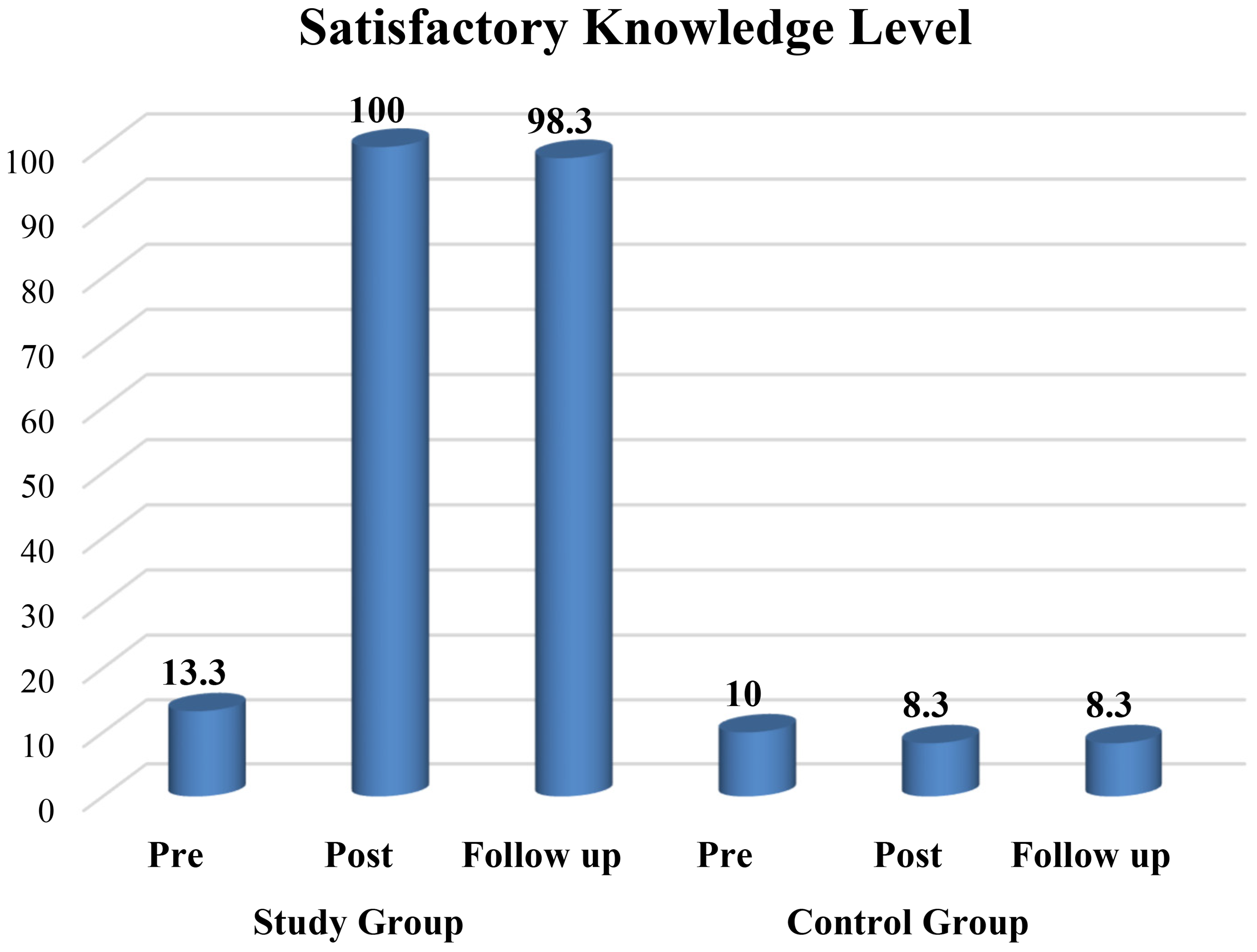
Distribution of Total Satisfactory Knowledge Levels Among Nurse Interns Under Study.
Concerning total critical thinking dispositions Figure 2 illustrates that nurse interns’ critical thinking dispositions increased after the program to 61.6% compared with before the program (33.3%) and follow up (55%) among the study group. Meanwhile, nurse interns’ critical thinking disposition scores were constant in the pre–post follow-up phases through the program.

Frequency Distribution of Total Critical Thinking Dispositions Among Nurse Interns Throughout Study Phases.
Table 2 shows that the intervention group of nurse interns was satisfied with SBT as a teaching method postprogram, with a percentage of 93.3%.
Frequency and Percentage of Nurse Interns’ Satisfaction With SBL/SBT in the Post-Phase (n = 60).
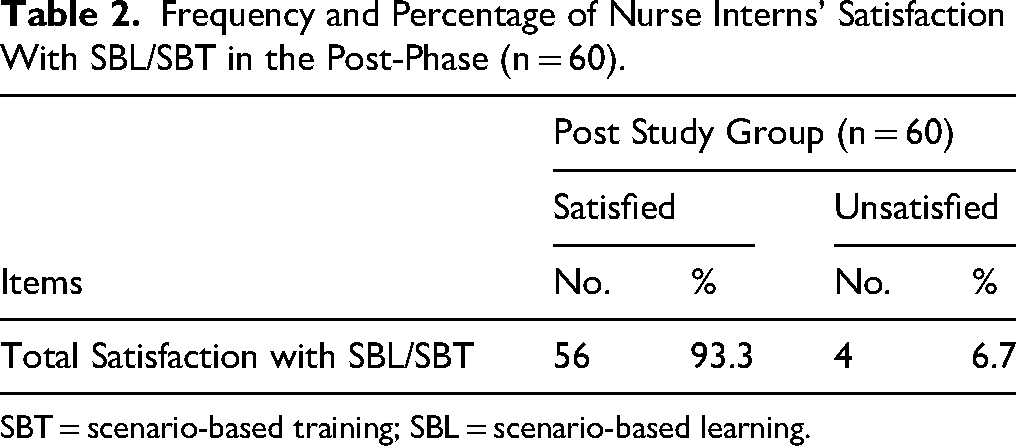
SBT = scenario-based training; SBL = scenario-based learning.
Table 3 indicated that the chi-square test showed no significant association in knowledge levels between groups before the intervention (χ² = 0.323, p = .389; Cramér's V = 0.052, negligible effect). However, a very strong and statistically significant association was found both immediately after (χ² = 101.538, p < .001; Cramér's V = 0.920) and at follow up (χ² = 97.634, p < .001; Cramér's V = 0.902), reflecting a large intervention effect on knowledge.
Effect Size Interpretation of Knowledge Levels Pre–Post and Follow-Up Training Program.
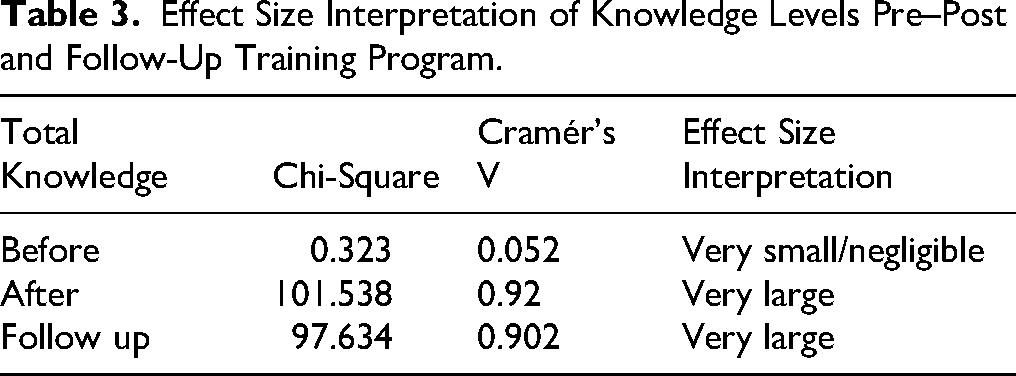
Table 4 indicated that the chi-square test was conducted to assess the association between group assignment (study vs. control) and levels of critical thinking dispositions across three phases: before, immediately after, and at the follow up. The results demonstrated no significant association before the intervention for most dimensions, with small effect sizes (Cramér's V ranged from 0.151 to 0.309).
Effect Size Interpretation of Critical Thinking Dispositions Pre–Post and Follow-Up Training Program.
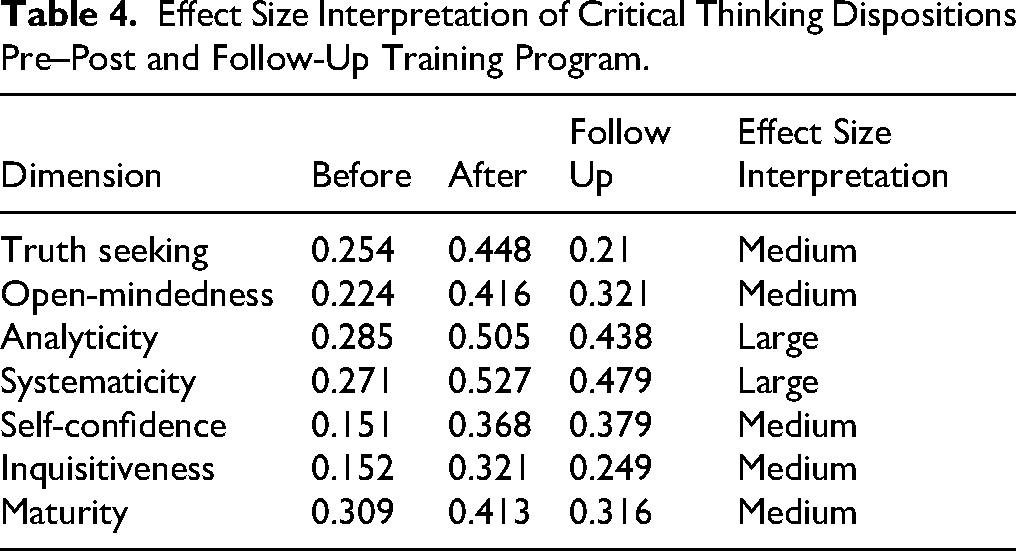
However, statistically significant associations were observed immediately after the intervention and at follow up across all dimensions. Notably, the effect sizes postintervention ranged from medium to large (Cramér's V: 0.321–0.527), indicating a practically meaningful impact of the intervention on enhancing critical thinking dispositions. The strongest effects were observed in systematicity (V = 0.527) and analyticity (V = 0.505), both indicating large effect sizes, while truth-seeking (V = 0.448) and maturity (V = 0.413) showed moderate effects. At the follow-up phase, all dimensions maintained statistical significance with moderate to strong effect sizes (V range: 0.210–0.479).
Table 5, regarding the study group, reveals a highly statistically significant positive correlation between nurse interns’ knowledge scores and critical thinking dispositions following program implementation, at the 0.01 level. Additionally, there is a moderate correlation between knowledge and critical thinking dispositions after a program and satisfaction with SBT. However, no other significant correlations were found between knowledge and critical thinking dispositions across different program phases.
Correlation Matrix of Study Variables Across Program Phases.
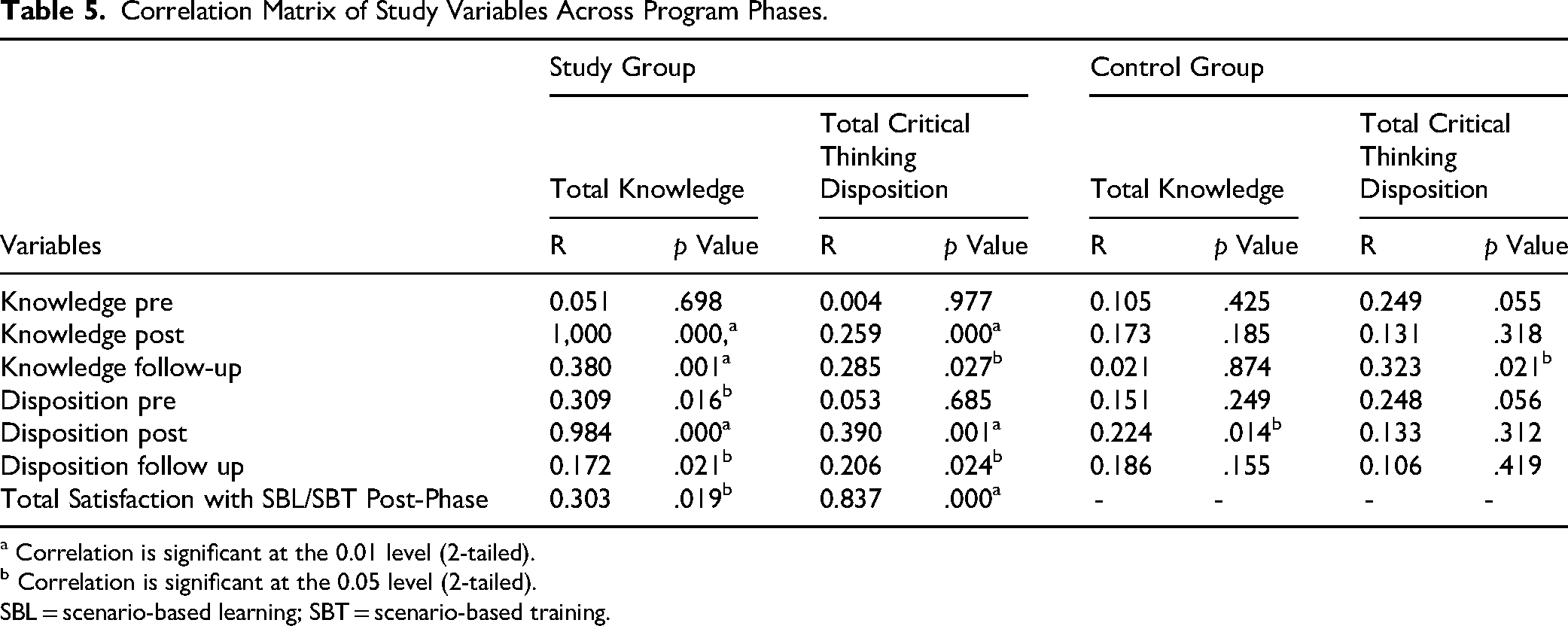
a Correlation is significant at the 0.01 level (2-tailed).
b Correlation is significant at the 0.05 level (2-tailed).
SBL = scenario-based learning; SBT = scenario-based training.
Discussion
The internship program begins after successfully completing the study years of the undergraduate bachelor's nursing degree, during which nursing students must employ 12 months of internships in different hospitals that can deliver suitable drills that fit the goals of the internship program. SBT is extremely valuable and is widely encouraged in nursing education and practice. It also donates to education by allowing the student to analyze and criticize the fundamental considerations established through the recurrent practices of a specialized practice, as well as develop a fresh sense of the situations that the practice has created. SBT has several advantages for nurses, including boosting self-confidence. Saragih et al. (2024) combines philosophy with practice (Sherwood, 2024) allows nursing students to inspect practical problems from many perspectives, enhances decision making (Abeje et al., 2025), and fosters critical thinking (Facione & Facione, 2008; Mslm et al., 2020). This research aimed to assess the impact of SBT on the critical thinking dispositions of nurse interns.
The results of this research indicated that nurse interns in both the study and control groups had inadequate knowledge of SBT before applying the training program. This lack of knowledge is anticipated given the traditional educational approach in nursing faculties in Egypt, which emphasizes rote memorization over critical thinking and content appraisal. In addition, the absence of prior exposure to SBT may have contributed to this gap. When asked about their previous experiences with scenario-based learning during their undergraduate studies, the interns expressed a lack of interest because of insufficient information and explanations, which hindered their ability to understand and effectively apply the method in virtual labs.
These results align with the findings of Sadeghi et al. (2023), who reported a similar lack of knowledge among nursing students regarding the SBT method in their study titled “The Effect of SBT on the Core Competencies of Nursing Students: A Semi-Experimental Study.” Furthermore, the study found that both the study and control groups were comparable in relation to personal constraints such as age, gender, marital status, graduation grade, preuniversity education, choice of nursing study, and chronic disease status. A significant proportion of the nurse interns were female, which is consistent with Abdelwahid and Attia (2020), who noted that nearly half of their study sample was female.
The total satisfactory knowledge level markedly improved in the study group and increased to become satisfactory, while the control group still had an unsatisfactory knowledge level in both the post-training and follow-up phases. The possible reasons for the increased total satisfactory knowledge level among the intervention group could be their enthusiasm for learning and acquiring new knowledge from the current program. This enthusiasm helped them enhance their professional practice, integrate theory with clinical practices during the internship year and postgraduation, and open their minds to discover new ways of handling their work and learning new things that are important for improving quality in their field (Alsaqer et al., 2025).
In agreement with the present study's findings, Pinar et al. (2016) reported a change in knowledge levels before and after interventions. Shortly after completing the training program, there was noticeable improvement in knowledge, with most participants exhibiting satisfactory knowledge. This study assessed the impact of scenario-based simulation training on nursing students’ knowledge. The results showed that the knowledge and skills of students in the study group were enhanced.
Regarding nurse interns’ critical thinking dispositions throughout program phases, the results show significant improvements in most critical thinking subscales, including open-mindedness, analyticity, systematicity, self-confidence, inquisitiveness, and maturity. However, truth-seeking did not show the same level of improvement, with a relatively high percentage of participants scoring low on this subscale both before and after the intervention, so self-confidence had the highest score in the study group, while truth-seeking had the lowest.
From the researcher's point of view, there were several factors that might contribute to the limited improvement in truth-seeking. One possible reason is that truth-seeking requires a deeper level of critical thinking and reflection, which may not have been adequately addressed in the intervention. Additionally, cultural or institutional factors might influence the development of truth-seeking skills, such as an emphasis on authority or tradition over critical inquiry. The study's findings might be influenced by cultural or institutional factors that affect the development of critical thinking skills. For example, the educational system or cultural context might prioritize other aspects of critical thinking over truth-seeking. Furthermore, the intervention might not have been tailored to address the specific needs and challenges of the participants in developing truth-seeking skills.
The control group did not experience significant changes in any critical thinking dimension from the pre- to post-training and follow-up phases. On the other hand, the study group showed considerable improvements in all dimensions of critical thinking from pretraining to both the post- and follow-up phases, with these enhancements being highly statistically significant (p ≤ .001).
From the researcher's opinions, the mean scores of critical thinking dispositions (CTDs) in the study and control groups were similar because most nurse interns in both groups had graduated from technical nursing institutes. According to Mahmoud et al. (2023), this similarity might be due to Egypt's educational policy, which allows students from technical nursing institutes to join nursing faculties in their second academic year. Preuniversity education in these institutes provides students with practical experience, experimentation opportunities, diverse learning strategies, problem-solving skills, decision-making abilities, and critical thinking skills.
In agreement with the present study's findings, Elsaied Ahmad El Bardeny et al. (2023) reported that the subjects’ critical thinking disposition scores varied across the program phases. Self-confidence had the highest score in the study group, while truth-seeking had the lowest. The control group did not experience significant changes in any of the critical thinking dimensions during the pre-, post-, and follow-up phases. This result contradicts the findings of Mslm et al. (2020) and Shirazi and Heidari (2019), who found that the critical thinking disposition scores of the studied participants varied between program phases. In the study group, open-mindedness received the highest score in the pre-learning techniques phase, with no statistically significant difference between the two groups.
The frequency and percentage of nurse interns’ satisfaction with SBT in the post-phase indicated that 93.3% of the study group was satisfied with SBL/SBT as a teaching method after the program. This high level of satisfaction was attributed to improvements in both practical and nonpractical skills. These findings are consistent with recent studies (Abdou & Dogham, 2016; AlFozan et al., 2015; Ali El Sayed Ibrahim et al., 2020; Jung et al., 2017; Oh et al., 2015), which have revealed that simulation scenarios effectively motivate most nursing students in the study group, providing them with valuable learning experiences and enhancing their practical skills.
Previous and recent studies have highlighted that the majority of students reported overall satisfaction with the use of simulation-based learning (SBL) strategies, as well as with the guidance and support provided by teachers (AlFozan et al., 2015; D'souza et al., 2017; Hsu et al., 2015; Jeffries & Rizzolo, 2006). Furthermore, Seybert et al. (2006) observed high levels of satisfaction and confidence in the studied sample following the implementation of a simulation scenario exercise.
The study group revealed a highly statistically significant positive correlation between nurse interns’ knowledge scores and critical thinking dispositions following program implementation at the 0.01 level. Additionally, there was a moderate correlation between knowledge and critical thinking dispositions after the program and satisfaction with the SBT. However, no other significant correlations were found between knowledge and critical thinking disposition across different program phases. This result may be because active learning strategies, such as SBT, encourage deeper engagement with content, which not only boosts knowledge retention but also promotes the development of critical thinking dispositions. The structured scenarios likely provided opportunities for interns to apply theoretical knowledge in practical settings, helping them think critically and solve complex clinical problems.
The moderate correlation between knowledge, critical thinking dispositions, and satisfaction with SBT further supported this interpretation. Students who were more satisfied with the training may have been more engaged, leading to higher knowledge gains and improved critical thinking abilities. This is consistent with Ar-yuwat et al. (2019) and Gholami et al. (2016), who reported that problem-based learning positively impacts critical thinking skills. Moreover, the moderate correlation between knowledge, critical thinking disposition, and satisfaction with SBT suggests that engaging in active learning techniques, such as scenario-based exercises, enhances both knowledge and critical thinking abilities.
Liu et al. (2019) investigated the impact of scenario simulation training combined with an advanced teaching model and found that the intervention group outperformed the control group in performance evaluation scores, fundamental knowledge, nurse–patient interaction, critical thinking, and overall comprehensive evaluation. Likewise, Sadeghi et al. (2023) demonstrated that a scenario-based approach significantly improved nursing students’ core competencies, especially in practical skills, basic sciences, and continuous learning, although no notable improvement was observed in critical thinking.
In conclusion, the SBT program significantly improved nurses’ critical thinking dispositions. Additionally, SBT increased nurse interns’ satisfaction with clinical practice and enhanced their knowledge of SBT. This result aligns with Castronovo et al. (2022), who reported that situational scenario games inspire students’ metacognition, encouraging the enhancement of high-level and critical thinking while integrating new and existing knowledge. Similarly, Chang et al. (2024) reported that nursing students in a study group, when placed in game-based scenarios, were able to effectively handle various cases in the delivery room and apply critical thinking in the form of clinical decision making.
Strengths and Limitations
Based on the study's findings, the strengths of this study include the effectiveness of SBT in enhancing nurse interns’ knowledge, critical thinking dispositions, and satisfaction with clinical practice. The study's findings support the integration of SBT into nursing education, which could have practical implications for improving nursing practice and patient care. The study identifies areas for future research, such as assessing the long-term impact of SBT and exploring its application in various clinical settings. Several limitations should be considered when interpreting the findings of this study. Firstly, the risk of contamination between the control and intervention groups cannot be ruled out, as participants were recruited from the same hospital and may have shared information about the intervention. Secondly, the relatively small sample size may limit the generalizability of the findings and reduce the statistical power to detect significant differences between groups. Additionally, the study's reliance on self-reported measures may introduce bias and affect the accuracy of the results. The scenarios in the final session did not cover actual cases in obstetrics and psychiatry because nurse interns did not train in these hospitals.
Implications of Practice
This study supports the use of SBT as an advanced and innovative teaching method that can improve the cognitive skills of nursing students. SBT can be used to develop critical thinking skills in nursing students, enabling them to make informed decisions and provide high-quality patient care. By incorporating SBT into nursing curricula, educators can foster a culture of critical thinking, analysis, and problem-solving. By enhancing critical thinking skills, SBT can ultimately contribute to better patient outcomes, reduced medical errors, and improved healthcare quality. Educators can use SBT to create realistic and immersive learning experiences that prepare students for the challenges of clinical practice.
Conclusions
Our study demonstrates the effectiveness of SBT in enhancing nurse interns’ knowledge, critical thinking dispositions, and clinical practice satisfaction with SBT. The significant improvements in the study group's knowledge levels and critical thinking scores, along with high satisfaction rates, support the integration of SBT into nursing education. Future research should assess the long-term impact of SBT on critical thinking tendencies and explore its application in various clinical settings.
Supplemental Material
sj-docx-1-son-10.1177_23779608251383419 - Supplemental material for Effect of Scenario-Based Training on Nurse Interns’ Critical Thinking Dispositions
Supplemental material, sj-docx-1-son-10.1177_23779608251383419 for Effect of Scenario-Based Training on Nurse Interns’ Critical Thinking Dispositions by Samar Hussein Abdel Fattah, Mona Mostafa Shazly and Nema Fathy Saad in SAGE Open Nursing
Supplemental Material
sj-docx-2-son-10.1177_23779608251383419 - Supplemental material for Effect of Scenario-Based Training on Nurse Interns’ Critical Thinking Dispositions
Supplemental material, sj-docx-2-son-10.1177_23779608251383419 for Effect of Scenario-Based Training on Nurse Interns’ Critical Thinking Dispositions by Samar Hussein Abdel Fattah, Mona Mostafa Shazly and Nema Fathy Saad in SAGE Open Nursing
Footnotes
Acknowledgments
The researchers wish to convey their gratefulness to the nurse interns who joined in a study for their valuable contributions and cooperation. Additionally, they extend their heartfelt thanks to everyone who directly or indirectly supported them in completing this work.

Ethical Approval
Approval was obtained from the scientific research ethics committee of the faculty of nursing, Ain shams university, Cairo, Egypt (code number: 24.08/346). In addition, the researcher obtained written informed consent from all study subjects. They were assured about maintaining their anonymity and confidentiality of any collected data. Furthermore, they were informed that participation in the study was voluntary, and they had the right to withdraw at any time.
Authors’ Contribution
All authors (SHA, MMS, and NFS) were participated in the conception and design of the research, data analysis, along with the preparation and review of the manuscript.
Funding
The authors received no financial support for the research, authorship, and/or publication of this article.
Declaration of Conflicting Interests
The authors declared no potential conflicts of interest with respect to the research, authorship, and/or publication of this article.
Use of AI Software
The authors declare that there is no AI used in the study.
Supplemental Material
Supplemental material for this article is available online.
References
Supplementary Material
Please find the following supplemental material available below.
For Open Access articles published under a Creative Commons License, all supplemental material carries the same license as the article it is associated with.
For non-Open Access articles published, all supplemental material carries a non-exclusive license, and permission requests for re-use of supplemental material or any part of supplemental material shall be sent directly to the copyright owner as specified in the copyright notice associated with the article.
