



Abstract
Background
Artificial intelligence (AI) is significantly transforming the nursing profession, enhancing patient care, and shaping future nursing practice. Understanding nursing students’ attitudes toward AI applications is crucial for its effective integration into clinical practice and education.
Aim
To evaluate nursing students’ attitudes toward AI in Palestine.
Methods
A cross-sectional design was conducted among 325 nursing students. Due to logistical constraints, data were gathered via online surveys using the AI attitude scale. The research was conducted between February and March 2024 at Arab American University in Palestine.
Results
The results showed that the average attitudes toward using AI in nursing practice scores (M = 61.81; SD = 9.74) were significantly greater than the neutral score (p = .001). Nursing students have a positive attitude toward AI in terms of benefits and willingness to use it in nursing practice. However, nursing students have a neutral attitude toward the practical advantages of AI and exhibit a negative attitude toward the dangers of AI in nursing. Furthermore, gender, academic year, and purpose of AI had statistically significant differences in nursing students’ attitudes toward AI (p = .034, .039, and 0.042 respectively). Female students showed higher levels of attitudes toward AI usage, while participants with master's degree participants had the lowest level of attitudes toward AI.
Conclusion
Our findings demonstrate that nursing students have a positive attitude toward the integration of AI into nursing and healthcare practice, along with significant intentions to utilize the technology. The results highlight the need for AI-focused training within nursing curricula.
Background
Artificial intelligence (AI) entails creating a computer system capable of performing tasks typically associated with human intelligence. A key branch, machine learning (ML), enables computers to identify patterns in data, while a subcategory, deep learning (DL), uses multiple-layered neural networks to achieve tasks (Ronquillo et al., 2021). AI has the capacity to transform nursing across various domains (Buchanan et al., 2021). It represents a transformative force, especially in healthcare, bringing significant advancements from operating rooms to clinical trials and the pharmaceutical sector. AI not only advances the health industry but also reduces costs for patients and facilities (Bini, 2018). In nursing, AI is transforming practice by improving care delivery and educating nurses for future challenges. For example, AI-driven telehealth and robotics technologies expand the scope of nursing care, enhancing patient access, and remote monitoring (Rony et al., 2024; Tuohy, 2019). By integrating relevant data, AI supports nurses in delivering individualized, evidence-based care, ultimately leading to better patient outcomes (Abuzaid et al., 2022; Ronquillo et al., 2021). Furthermore, AI-based training is being developed to help medical students efficiently solve clinical problems using AI technologies (Ahuja, 2019).
It is anticipated that AI will be a key feature in medical and nursing disciplines in the coming years. In order for healthcare professionals to be well-prepared, the use of AI in medical and nursing school curricula is recommended (Briganti & Le Moine, 2020; Dermody & Fritz, 2019; Hegde et al., 2022). Integration of Innovative technology into nursing education is particularly beneficial in situations with limited clinical coaching, as it provides effective training and professional skill development (Chang et al., 2018).
Review of Literature
According to Labrague et al. (2023), how student nurses perceive AI in nursing practice can affect their attitudes and intentions toward its adoption. In order to integrate AI into clinical practice, it is important to first appreciate and understand the nurses’ attitudes and behaviors toward the present and future uses of AI. Evaluating their present degree of knowledge in AI is very important in assessing their future training needs (Abuzaid et al., 2022). However, despite the significance of nursing attitudes in AI acceptance, this area has received limited attention (Labrague et al., 2023). Additionally, recent systematic review and meta-analysis suggest that while many healthcare students hold generally positive attitudes toward AI, significant knowledge disparities persist across different educational and clinical settings. These gaps are particularly pronounced in low-resource environments where access to AI training and technology may be limited. Furthermore, existing studies have paid insufficient attention to regional variations in AI acceptance and preparedness, leaving critical gaps in our understanding of context-specific challenges (Amiri et al., 2024). This is especially true for Palestine, where the intersection of healthcare education and emerging technologies remains understudied despite the region's unique healthcare challenges and educational infrastructure.
Accordingly, understanding student nurses’ attitudes toward AI and addressing barriers to its adoption is crucial. As such, nurse educators can be instrumental in improving technological skills, and increasing knowledge on AI and its applications through practice, thus equipping future nurses to an AI-centered healthcare setting and enhancing patient care provided by them (Labrague et al., 2023). This study focuses on Palestinian nursing students, an underrepresented group in AI research. In Palestine, AI integration in healthcare and nursing education is hindered by limited infrastructure, restricted access to technology, and the absence of supportive institutional policies (Khlaif et al., 2025). As a result, students have minimal exposure to AI tools compared to peers in more advanced regions.
Therefore, this study aims to evaluate nursing students’ attitudes regarding AI in the nursing profession. By investigating these attitudes, we can inform teaching techniques and targeted interventions, gaining important insights into the underlying issues influencing nursing students’ attitudes toward AI. Furthermore, while studies on attitudes toward AI in nursing education are limited internationally, there is a knowledge gap in the Palestinian healthcare system. Closing this gap is essential for aligning with global trends and best practices in healthcare technology integration. Ultimately, we hope that our research will inspire curricular improvements and professional development initiatives, empowering future nurses to leverage the advantages of AI to improve the quality of patient care.
Research Questions
What are nursing students’ attitudes toward the use of AI in the nursing profession? Is there a statistically significant difference in nursing students’ attitudes toward using AI based on their demographic characteristics?
Methods
Sample and Sampling Method
A cross-sectional study data was collected among nursing students to evaluate their attitudes toward AI at the Faculty of Nursing, Arab American University. Due to the 7 October war on Gaza and the majority of learning was conducted online, data was distributed to the students via the university platform using Google Forms.
The study involved approximately 500 nursing students from the Faculty of Nursing at Arab American University, Palestine. The actual sample consisted of 325 undergraduate nursing students who consented to participate in the study and returned a completed questionnaire. The Raosoft online sample size calculator (http://www.raosoft.com/samplesize.html) was utilized to determine the minimum required sample size, which was calculated to be 218 (RAOSOFTCOM, 2022). This calculation was based on a 95% confidence level, a 5% margin of error, a population of 500, and a 50% response distribution (population proportion).
Inclusion and Exclusion Criteria
The inclusion criteria were: (1) enrollment in either undergraduate students willing to participate in the study and Participants from graduate students and undergraduate (first to fourth academic year) or graduate nursing program, and (2) willingness to participate in the study. This ensured comprehensive representation across different academic levels. The exclusion criteria were enrollment in a non-nursing major. Recognizing the limitations of online data collection; particularly the potential exclusion of students with limited internet access; efforts were made to enhance accessibility by allowing survey submission via mobile phones. Additionally, reminders were sent through the university platform and class group chats to encourage broad participation. Data were collected over 2 months, from February 1 to March 31, 2024. To ensure data quality and accuracy during the data collection procedure, an explanatory letter outlining the objectives and purpose of the study was included in the online survey. In the explanatory letter, the researchers also provided a cell phone number in case the participants had any further queries or concerns.
Instruments
The study tool consisted of the following sections:
Sociodemographic characteristics: age, gender; AI experience, source, and concerns: Previous AI experience (Yes/No), Sources of information on AI (family, media, social media, university, web browsing), Concerns on AI (data privacy, fear of job replacement, hacking & cyber security attacks, less human patient interaction); Internet duration use and purposes (duration of internet usage :<3 h /day; 3–6 h /day; > 6 h /day); purpose of using the Internet: gather information, play games, messenger/SNW, movies/TV/videos; Nursing students’ attitudes toward AI.
The instrument comprised five-point Likert-type items with neutral and strongly/somewhat (dis)agree anchors. The original tool was developed by Schepman and Rodway (2020). Subsequently, Lukić et al. (2023), contextualized and adapted the tool specifically for nursing, with approval granted. The tool consisted of 20 items which are divided into four subscales including Principal factor I (factor subscale titled “positive aspects of artificial intelligence in nursing” has a score range from 5 to 30); Principal factor II (factor subscale titled “negative aspects of artificial intelligence” has a score range of 8–40); Principal factor III (factor subscale titled “positive practical implications of artificial intelligence” has a score range of 4–20); Principal factor IV (factor subscale titled “intent to implement artificial intelligence in nursing” has a score range of 2 to 10; Lukić et al., 2023).
The scoring system for each subscale involves summing the scores of the items in each subscale. Additionally, the neutral score is calculated by summing the total scores of the items * 3 (neutral score on each item) in each subscale, providing a reference for evaluating participants’ general attitudes regarding the relevant aspect of AI in the nursing field. Additionally, Principal factor II, which consists of 8 items, was reversed before the analysis to ensure consistency in interpretation.
The reliability of the original scale was assessed using Cronbach's α, with subscale values ranging from 0.86 to 0.91 (Lukić et al., 2023). In the present study, the reliability of each subscale was also determined using Cronbach's α: Benefits of AI in nursing (6 items, α = 0.60), Dangers of AI (8 items, α = 0.84), Practical advantages of AI (4 items, α = 0.76), and Willingness to use AI in nursing practice (2 items, α = 0.84).
The survey was translated into Arabic and then back-translated to ensure clarity for all nursing students. Five PhD-holding educators were consulted to assess the tool's validity. They were asked to evaluate and validate its accuracy, provide recommendations for improving clarity, and determine whether the items accurately reflected the study's main objectives. Any necessary changes were made exclusively to the Arabic translation based on their feedback.
Moreover, to confirm the AI attitude scale subscale structure and cultural adaptations for validity within the Palestinian context, Exploratory Factor Analysis was conducted. The analysis resulted in four components that have a Total Initial Eigenvalues greater than 1. Those four components explain 59.0% of the variance. Therefore, we end with four factors that had a high positive correlation with the original tool factors (r = between 0.607 to 0.911). “Factor 1 was comprised of 6 items reported on a 5-point Likert scale that explained 24.55% of the variance with factor loadings from .430 to .900.” “Factor 2 was comprised of eight items reported on a five-point Likert scale that explained 19.83% of the variance with factor loadings from .614 to .764.” “Factor 3 was comprised of four items reported on a five-point Likert scale that explained 8.61% of the variance with factor loadings from .481 to .840.” “Factor 4 was comprised of six items reported on a five-point Likert scale that explained 6.00% of the variance with factor loadings from .523 to .591.”
Pilot Study
Thirty nursing students pretested the questionnaire before the actual data collection procedure. This pretest allowed for the estimation of the time required to complete the questionnaire, the identification of any confusing sections, and the assessment of the questionnaire's validity and utility. The average time to finish the surveys was 10 to 15 min.
Ethical Approval
The Faculty of Nursing at Arab American University approved the study, and ethical approval was obtained from Al-Najah University's nursing faculties (IRB: Nsg.Feb.2024/18). Participation was entirely voluntary, with no penalties or grade impacts for nonparticipation. Participant anonymity was ensured by not disclosing names or any other personally identifying information, and all data was securely stored for study-related purposes only. All participants provided informed consent.
Data Analysis
Boxplots and normal probability plots were used to graphically analyze the distributions of the total AI scores. The data's boxplots revealed no extreme values, and the normal probability plots showed no significant departures from normalcy. As a result, we used a parametric statistical method to analyze the data. Following data collection, the data was tabulated and analyzed using the Statistical Package for the Social Sciences (SPSS) version 27. As applicable, frequency, percentage, means, and standard deviations were used to report the quantitative data.
One sample t-test was conducted to identify whether there is a difference between the results on the four subscales of a Questionnaire used to evaluate nursing students’ attitudes regarding AI based on the proposed neutral score. Analysis of variance (ANOVA) test is used to compare differences between two or more of an independent group as the dependent variable (attitudes) is continuous.
Results
Out of a total of 325 nursing students, 178 (54.8%) were female and in the fourth academic year (57.2%) with no AI previous experience (64.3%). Social media was the main source of nurses’ information about AI (53.2%), followed by university (16.6%), and web browsing (14.2%), while the least other sources were friends (8.0%) and media (8.0%). The main concerns of nursing students on AI were data privacy (47.5%), followed by hacking (25.3%), and less human–patient interaction (20.0%; see Table 1).
Study Nursing Students' Participants’ Characteristics.

AI: artificial intelligence.
It's clear that nursing students have positive attitudes regarding the benefits of AI in nursing as their average (22.4) exceeded the neutral score (18), especially in their attitudes toward the beneficial applications of AI in nursing (4.17 out of 5) and by their impressed by what AI can do (4.02 out of 5), but little by ability of AI to provide new opportunities for nursing professionals (2.06 out of 5). Also, nursing students have a positive attitude regarding the willingness to use AI in nursing practice as their average (6.96) exceeded the neutral score (6). However, nursing students have a neutral attitude toward the practical advantages of AI in nursing as their average (12) is equal to the neutral score (12.28).
On the other hand, nursing students have a positive attitude regarding the Dangers of AI in nursing as their average (20.51) is lower than the neutral score (24) as they believe that AI might take control of people (2.27/5) and they think that artificially intelligent systems can make many errors (2.39/5; see Table 2).
Item Statistics of Nursing Students’ Attitudes Regarding AI.
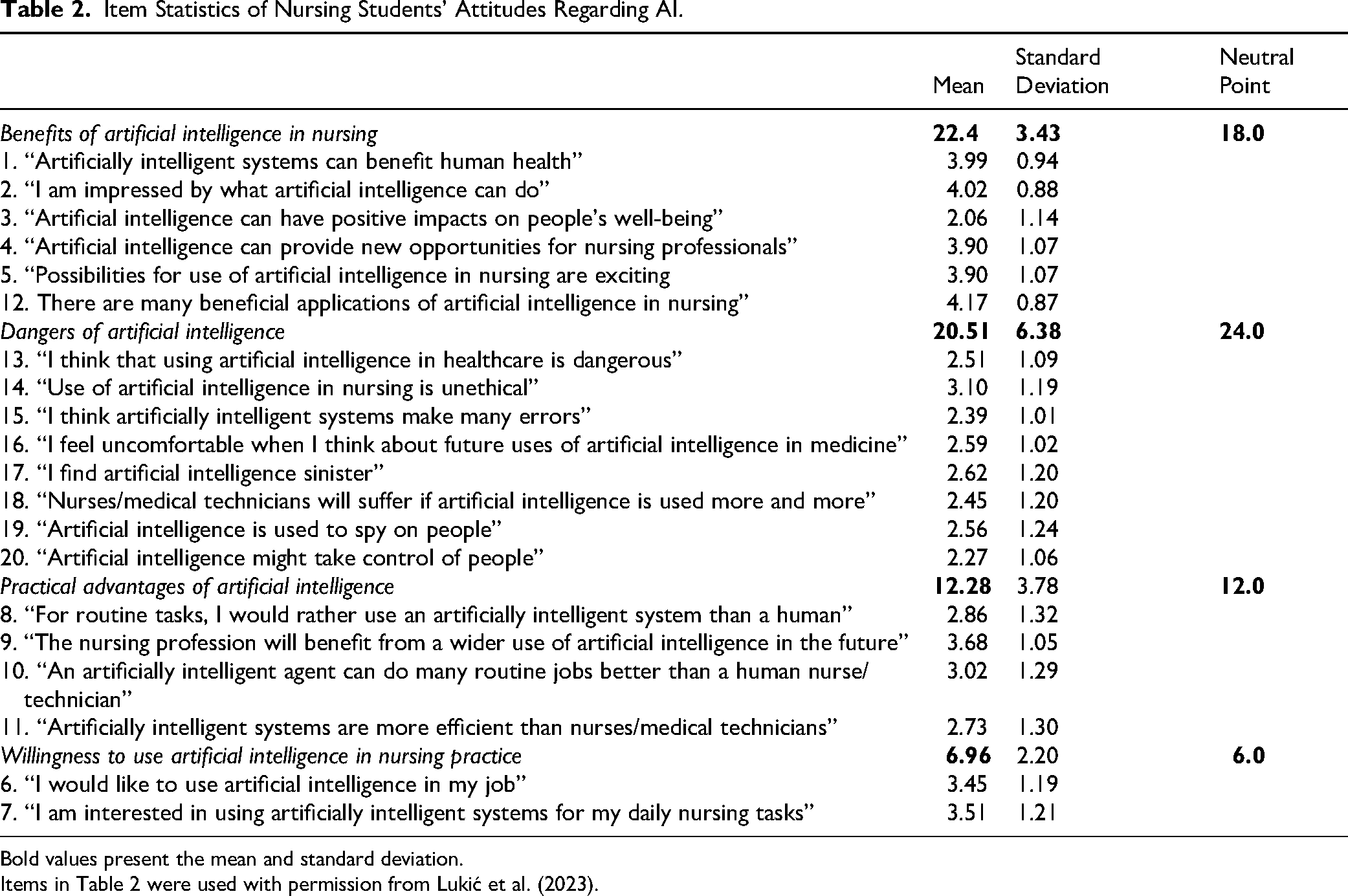
Bold values present the mean and standard deviation.
Items in Table 2 were used with permission from Lukić et al. (2023).
To ascertain whether the results on the attitudes of nursing students regarding AI, as measured against the proposed neutral score of 60 out of 100, were statistically significant, a one-sample t-test was performed. The results indicate a significant difference between the neutral scores and nursing students’ attitudes regarding using AI in nursing practice (M = 61.81; SD = 9.74, p = . 001; see Table 3).
One-Sample t-Test to Evaluate Nursing Students' Attitudes Regarding AI.

AI: artificial intelligence.
To establish whether the responses provided on the four subscales of a Questionnaire meant to evaluate the attitudes of nursing students regarding AI differ based on the assumed average score, a one-sample t-test was performed. The results indicate a significant difference between the neutral scores of the Benefits of AI (18) and a neutral score of Willingness to use AI (6) (M = 22.04, 6.96; SD = 3.43, 2.20, p < . 001, respectively). Additionally, the results indicate a significant difference between the neutral scores of the Dangers of AI in nursing (20.51) and nursing students’ Dangers of AI in nursing scores (M = 27.48; SD = 6.38, p < . 001). On the other side, the results indicate a nonsignificant difference between the neutral scores of the Practical advantages of AI in nursing (12) and nursing students’ Practical advantages of AI in nursing scores (M = 12.28; SD = 3.78, p = . 179; see Table 4).
Evaluation of Nursing Students’ Attitudes Regarding AI Using Four Key Subscales.

AI: artificial intelligence.
Gender, academic year, and purpose of AI had a statistically significant difference in nursing students’ attitudes toward AI in nursing (p = .034, .039, and 0.042, respectively). Female and messenger purpose had a higher level of attitudes toward AI usage in nursing while master nursing academic degree participants had the lowest level of attitudes toward AI usage in nursing. Although there were some variations based on their other characteristics, such as previous experience, concerns, source, and duration, none of them had any significant difference as seen in Table 5.
The Nursing Students’ Characteristics and Their Attitudes Toward Using AI in Nursing.
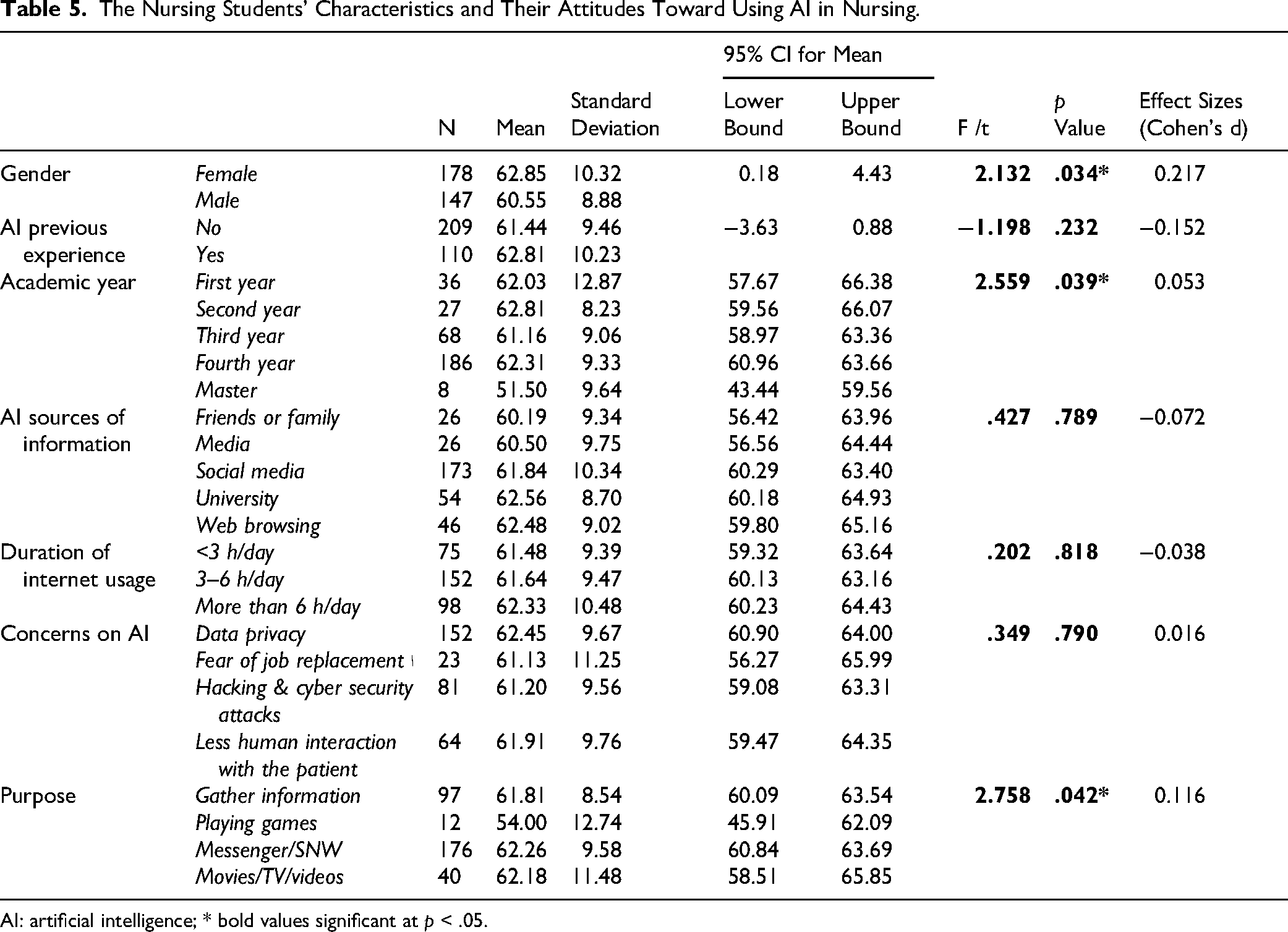
AI: artificial intelligence; * bold values significant at p < .05.
Discussion
To our knowledge, this study stands as the first of its kind among Palestinian undergraduate nursing students, aiming to provide significant insights into nursing students’ attitudes toward AI in the nursing field. The study also examines how these attitudes vary based on student characteristics. A study conducted in Korea highlighted the importance of understanding how nursing students perceive AI (Kwak et al., 2022). One key aspect they investigated was the impact of attitudes toward AI on the behavioral intentions of nursing students, utilizing the General Attitudes Towards Artificial Intelligence Scale (GAAIS) developed by Schepman and Rodway (2020). However, in our study, we adopted the scale's components and further contextualized them into subscales to evaluate nursing students’ attitudes specifically toward AI in the context of nursing, rather than AI in general (Lukić et al., 2023).
The results of our study showed that female students were predominant among our participants, which is consistent with trends seen in undergraduate nursing programs (Kwak et al., 2022; Labrague et al., 2023; Lukić et al., 2023; Salameh & Salameh, 2017; Salameh et al., 2023). Comparing male and female participants in terms of positive attitudes toward using AI in nursing, a statistically significant difference in their positive attitudes toward using AI in nursing was found. Female nursing students had a higher positive attitude toward using AI in nursing than male students. This disparity underscores the varied exposure to AI technology in healthcare among nursing students based on gender, necessitating further study and consideration in nursing curricula.
The main concerns of nursing students regarding AI were data privacy, followed by concerns about hacking human–patient interaction, with the least concern being Fear of job replacement. These results were consistent with a previous study conducted on medical students, which suggested that human radiologist won't be replaced by AI (Pinto et al., 2019). Concerns regarding the potential replacement of human teachers must be addressed alongside the technological aspects of AI education. Promoting a balanced perspective on the role of AI in healthcare should be a paramount concern for educational institutions, emphasizing how AI may complement human expertise rather than supplant it (Al-Qerem et al., 2023).
Our findings revealed that undergraduate nursing students have slightly positive attitudes toward AI. The results were slightly lower than a previous study conducted in Croatia (Lukić et al., 2023). The difference may be attributed to differences in the academic level of the participants. In particular, our study encompassed nursing students from all academic levels (first through fourth) as well as graduate-level students, providing a more comprehensive view across different degrees of exposure to both clinical practice and technology integration in healthcare. In contrast, Lukić et al. (2023) limited their sample to first-year students enrolled in four Croatian universities. Compared to their study, these students had minimal clinical experience and limited formal education on AI-related technologies, which could influence their attitudes differently compared to more senior students. Future studies could further examine how attitudes toward AI evolve as students advance in their education to validate this hypothesis.
A deeper understanding of students’ awareness regarding AI was achieved through subscale analysis. Our findings demonstrated that undergraduate nursing students generally have positive attitudes toward the benefits of AI and a willingness to use it. This suggests that students recognize the potential advantages of using AI in nursing programs and incorporate it in their daily tasks (Salameh et al., 2020). However, the majority of nursing students reported no previous experience with AI. This gap may be explained by the fact that, in Palestine, the integration of AI in healthcare and nursing education is hindered by limited infrastructure, restricted access to technology, and the absence of supportive institutional policies, compared to other countries (Khlaif et al., 2025).
However, regarding the dangers associated with AI, there was a moderate level of concern among nursing students. Notably, fear of AI making errors and ethical concerns were prevalent. These results indicate that although students acknowledge the benefit of AI, they also have issues regarding its accuracy, potential negative impacts, and ethical considerations. Similarly, a study conducted in the Philippines identified time constraints, lack of knowledge, awareness, and computer skills as the main barriers to accessing AI (Labrague et al., 2023).
Gender, academic year, and purpose of AI showed statistically significant differences in nursing students’ attitudes regarding AI. Female students exhibited more positive attitudes toward AI compared to male students. This contrasts with previous studies that found males to have more favorable attitudes toward AI (Lukić et al., 2023; O'Shaughnessy et al., 2023). One possible explanation for this discrepancy is the higher reported internet usage among female nursing students in our sample. Increased internet engagement may enhance familiarity with digital tools, online platforms, and emerging technologies, including AI applications in healthcare (Nipo et al., 2020). This heightened exposure could foster greater comfort, confidence, and curiosity toward AI, contributing to more positive attitudes. Additionally, internet use may facilitate access to educational content, social media discussions, and digital simulations that portray AI in a favorable light. Moreover, further studies are warranted to explore the gender-based variations, we can inform teaching techniques and targeted interventions, gaining important insights into the underlying issues influencing nursing students’ attitudes toward AI. Additionally, master's students exhibited lower attitudes toward AI compared to undergraduate nursing students. This could be explained that younger students were more exposed to AI, especially during the COVID-19 pandemic when education was rapidly transitioned to online platforms (Reshia et al., 2024). The results showed that nursing students’ attitudes toward AI are strongly influenced by its intended usage. In contrast to those who use AI solely for playing games, students who use it for educational and communication purposes (gathering information, messenger/SNW, movies/TV/videos) have more positive attitudes toward its usage. This indicates that positive attitudes are fostered by exposure to the practical and professional applications of AI. Therefore, emphasizing AI's professional benefits and incorporating AI-related tasks and activities into nursing curricula may improve students’ attitudes toward and preparedness for using AI in their future daily activities.
This underscores the importance of understanding both the potential benefits and dangers of adopting AI in healthcare, along with the factors influencing nursing students’ attitudes and their readiness for adopting it in their clinical practice. Since, the incorporation of AI into the nursing field is paving the way for advancement in patient care (Pepito & Locsin, 2019).
Limitations
The study exhibits certain limitations. Primary, its reliance on a single-university design may impinge on the generalizability of the findings to broader populations. Furthermore, although master's students were included in the study, their number is quite modest. Additionally, this is not a longitudinal study, so caution is necessary when interpreting changes in attitudes between students of different classes or along the course of their studies. Also, responder bias is another limitation, as students who volunteered to participate in the study might have held more favorable attitudes toward AI.
Recommendations and Implications for Practice
The study findings highlight the need for integrating AI education more intentionally within nursing curricula to adequately prepare future nurses for technology-enhanced healthcare environments. Nursing programs should embed foundational knowledge of AI; including its applications, limitations, and ethical considerations; into both theoretical and clinical education. Practical strategies such as AI-focused simulation exercises, interactive online modules, and virtual case studies can help improve students’ understanding and confidence in using AI technologies. These tools not only promote technical competence but also promote critical thinking regarding AI's role in patient care. Curricula should also incorporate specific material on digital ethics, patient data protection, and responsible AI use to help alleviate worries about privacy, data security, and ethical issues. Involving students in discussions and reflective exercises around these topics can increase their awareness and promote ethically sound decision making. These curriculum changes can, finally, promote AI preparedness and guarantee that nursing graduates are prepared to safely and efficiently negotiate the changing terrain of digital healthcare.
Conclusion
Our results reveal that undergraduate nursing students exhibited high motivation to use AI technology, coupled with positive attitudes regarding its integration into nursing and healthcare practice. The implications of the study highlight the importance of incorporating AI-focused coursework, training, and practical learning opportunities within nursing school programs, considering gender variations. By doing so, students can better equip themselves with the essential skills and proficiency to competently utilize AI technology in their future careers. Furthermore, healthcare organizations should create a conducive environment that fosters the learning and application of AI among nursing students. This will ensure that they do not only adapt to the dynamic, AI-driven healthcare environment but also contribute to enhancing patient outcomes.
Supplemental Material
sj-docx-1-son-10.1177_23779608251343297 - Supplemental material for Nursing Students’ Attitudes Toward Artificial Intelligence: Palestinian Perspectives
Supplemental material, sj-docx-1-son-10.1177_23779608251343297 for Nursing Students’ Attitudes Toward Artificial Intelligence: Palestinian Perspectives by Basma Salameh, Jamal Qaddumi, Bahaaeddin Hammad, Faida Eqtit, Ahmad Juma Ibraheem Ayed, Imad Fashafsheh, Mohammed ALBashtawy, Fadia Reshia and Ivan Lukic in SAGE Open Nursing
Supplemental Material
sj-doc-2-son-10.1177_23779608251343297 - Supplemental material for Nursing Students’ Attitudes Toward Artificial Intelligence: Palestinian Perspectives
Supplemental material, sj-doc-2-son-10.1177_23779608251343297 for Nursing Students’ Attitudes Toward Artificial Intelligence: Palestinian Perspectives by Basma Salameh, Jamal Qaddumi, Bahaaeddin Hammad, Faida Eqtit, Ahmad Juma Ibraheem Ayed, Imad Fashafsheh, Mohammed ALBashtawy, Fadia Reshia and Ivan Lukic in SAGE Open Nursing
Footnotes
Acknowledgment

Ethical Considerations and Consent to Participate
The study was approved by the Faculty of Nursing at Arab American University, and ethical approval was obtained from Al-Najah University's nursing faculties (IRB: Nsg.Feb.2024/18). Participation was entirely voluntary, with no penalties or grade impacts for nonparticipation. Participant anonymity was ensured by not disclosing names or any other personally identifying information, and all data was securely stored for study-related purposes only. All participants provided written informed consent.
Author Contributions
BS, JQ, BH, and LK designed the study. BS, BH, FE, A A, and IF collected the data. BS and JQ analyzed the data. All authors prepared the manuscript and approved the final version for submission.
Funding
The authors received no financial support for the research, authorship, and/or publication of this article.
Declaration of Conflicting Interests
The authors declared no potential conflicts of interest with respect to the research, authorship, and/or publication of this article.
Supplemental Material
Supplemental material for this article is available online.
References
Supplementary Material
Please find the following supplemental material available below.
For Open Access articles published under a Creative Commons License, all supplemental material carries the same license as the article it is associated with.
For non-Open Access articles published, all supplemental material carries a non-exclusive license, and permission requests for re-use of supplemental material or any part of supplemental material shall be sent directly to the copyright owner as specified in the copyright notice associated with the article.
