




Abstract
Introduction
The neonatal intensive care unit (NICU) is recognized as a highly stressful environment for both parents and health care providers, with burnout rates significantly higher among NICU nurses and physicians.
Objective
The purpose of this study was to examine the relationship between emotional intelligence and coping behaviors among NICU nurses.
Methods
This cross-sectional study was conducted between March 5 and August 10, 2024, focusing on a sample of 182 NICU nurses selected through systematic sampling techniques. Data collection involved the Schutte Self-Report Emotional Intelligence Test and the Coping Behavior Inventory. Data analysis was performed using SPSS Version 26.0, employing descriptive statistics and Pearson correlation analysis.
Results
The findings revealed an average emotional intelligence score (M ± SD = 151 ± 33.0), while the coping behavior score was (M ± SD = 41.0 ± 13.4, ranging from 0 to 76). Additionally, a significant positive correlation was found between emotional intelligence and coping behaviors (r = .565, p < .01).
Conclusion
Nurses exhibited high levels of emotional intelligence and moderate coping behaviors. The findings underscore the need for targeted strategies to enhance coping mechanisms and emotional intelligence among NICU nurses. The researchers recommend the integration of emotional intelligence training and problem-solving strategies into professional development programs to improve both workplace conditions and outcomes for beneficiaries.
Introduction
The neonatal intensive care unit (NICU) is recognized as a high-pressure environment that poses significant challenges for healthcare workers, particularly nurses, and parents. Burnout rates are notably elevated among NICU nurses and physicians as they contend with the dual demands of providing critical care to vulnerable patients and managing emotionally taxing situations (Basset et al., 2022; Carletto et al., 2022). Developing wellness strategies and coping mechanisms is critical to mitigating burnout and enhancing mental health (Burns et al., 2022; Woo et al., 2020). The stress experienced in the workplace can greatly impact nurses’ quality of life, which, in turn, influences the standard of care they provide. Given their pivotal role in patient care, the well-being of nurses is essential—healthier nurses are better positioned to deliver effective, high-quality care (Layali et al., 2019).
Palestinian NICU nurses face unique stressors, including resource limitations, frequent shortages of essential medical supplies, and high workloads due to limited staffing (Jawabreh, 2024; Khraisat et al., 2021). Cultural expectations, such as navigating familial and societal dynamics, further complicate their roles and may influence their emotional intelligence (EI) and coping strategies (Jawabreh, 2024). These contextual factors heighten the importance of exploring EI and coping behaviors in this specific group.
EI is a critical factor that influences nurses’ ability to manage stress, maintain effective communication, and deliver high-quality care in NICUs. EI equips nurses with essential skills that enhance coping and improve job performance (Stoller, 2021). Core competencies of EI include self-awareness, building positive relationships, and finding practical solutions to challenges while remaining adaptable (Ordu et al., 2022). Nurses with high EI are more attuned to the emotions and concerns of their patients, which fosters patient-centered care (Khademi et al., 2021). Additionally, EI enhances nurses’ communication skills, allowing them to adjust their interactions based on the situation (Giménez-Espert et al., 2023).
Given the critical role of NICU nurses in ensuring the well-being of newborns and their families, understanding the interplay between EI and coping behaviors is essential. This study aims to explore this relationship, providing actionable insights to develop targeted interventions such as EI training and coping strategies. These interventions are expected to enhance nurses’ resilience, well-being, and ability to provide optimal care.
Review of Literature
Nurses face a variety of challenges, such as demanding working conditions, emotional fatigue, and communication obstacles (Aqtam et al., 2023). EI is critical for nurses to provide holistic care and address workplace challenges effectively (Shahin, 2020). In high-pressure situations, poor emotional regulation can impair a nurse's ability to stay calm during patient interactions. By utilizing EI, nurses can build resilience to stress and improve their adaptability in difficult environments (Tih & Hamid, 2021).
Improving EI equips nurses with the tools to handle stress more efficiently and meet the demands of their high-stress roles (Kikanloo et al., 2019). Nurses who can cope effectively under pressure are more likely to prevent burnout and maintain their overall well-being (Liu et al., 2023). Coping strategies, such as seeking information, help alleviate negative emotions linked to perceived threats or challenges (Al-Ruzzieh & Ayaad, 2021). Coping is a complex, multifaceted process that involves various behaviors and attitudes, influenced by how an individual chooses to confront or avoid problems.
Constructive coping mechanisms enhance mental well-being, promote positive emotions, increase job satisfaction, and reduce burnout (Sacgaca et al., 2023). They also help reduce feelings of sadness and build confidence, support, and competence in the workplace (Hennekam et al., 2020). On the other hand, passive coping strategies—like emotional avoidance—can exacerbate mental health problems, lower self-esteem, and negatively affect overall well-being (Al-Ruzzieh & Ayaad, 2021). The development of skills and resources to improve EI fosters resilience and growth, helping nurses overcome challenges and continue their professional development.
By enhancing EI, nurses become better advocates for their patients by addressing the social and emotional dimensions of healthcare. Effective advocacy requires a deep understanding of patients’ emotional and psychological states (Al-Ruzzieh & Ayaad, 2021). Promoting EI among nurses can lead to improved patient care, higher patient satisfaction, and greater healthcare efficiency (Khademi et al., 2021). Therefore, nurturing EI in nurses can have a far-reaching impact on healthcare quality and delivery.
Methods
Study Design
This study employed a cross-sectional design, conducted across multiple NICUs in hospitals between March 5 and August 10, 2024.
Population and Sampling
From a total population of 320 nurses working in NICUs across Palestine, a sample size was calculated using the RaoSoft tool. The tool estimated the sample based on a 50% response rate, with a 5% margin of error, resulting in an initial sample size of 175. To account for possible dropouts, an additional 20% was included, bringing the target sample size to 205. Ultimately, 182 nurses completed the study. A systematic sampling method was used, where participants were selected from the nursing staff lists provided by hospitals. This method enhances the generalizability of the findings while reducing potential selection bias. The sample size determination process followed recommendations by Cochran (1977).
Objective
The purpose of this study was to examine the relationship between EI and coping behaviors among NICU nurses.
The research hypothesis: There is a relationship between EI and coping behaviors among nurses in the NICUs.
Inclusion and Exclusion Criteria
Inclusion Criteria
Nurses currently employed in NICUs across Palestine. Nurses with a minimum of 6 months of clinical experience in NICUs.
Exclusion Criteria
Nurses who were on extended leave or unavailable during the data collection period and those who declined to provide informed consent.
Data Collection Instruments
Part 1: Demographic Characteristics
This section, developed based on relevant literature (Doe et al., 2015; Peacock et al., 2024), collected key demographic variables such as age, gender, marital status, educational attainment, and years of nursing experience.
Part 2: EI Measurement
EI was assessed using the Schutte Self-Report Emotional Intelligence Test (SSEIT) (Schutte et al., 1998). This instrument comprises 33 items grouped into four domains: social skills/managing others’ emotions, perception of emotions, managing personal emotions, and utilization of emotions. Participants rate their agreement with each item on a 5-point Likert scale (1 = strongly disagree to 5 = strongly agree). The total possible scores range from 33 to 165, with scores under 111 considered low, between 111 and 132 categorized as moderate, and scores above 132 classified as high. The scale is public and no need for permission to use it. The SSEIT has been widely validated in healthcare settings, showing Cronbach's alpha reliability coefficients ranging from 0.87 to 0.90 (Petrides et al., 2004; Schutte et al., 1998). The scale was used in the Palestinian context in several previous studies and a reported Cronbach's alpha was 0.84 and 0.86 (Batran, 2024; Jawabreh, 2024), so it is valid for Palestinian culture and context.
Part 3: Coping Behavior Measurement
Coping behaviors were measured using the coping behavior inventory (CBI). This instrument assesses coping across four subscales: avoidance, problem-solving, optimism, and transference. Participants respond to 19 items on a 5-point Likert scale (1 = never to 5 = always). Scores for each subscale are calculated by summing item responses, with higher scores indicating greater utilization of that coping strategy. The CBI has demonstrated adequate reliability and validity, with Cronbach's alpha values exceeding 0.80 for all subscales in previous studies (Sheu et al., 2002). The scale is public and no need for permission to use it. The scale was used in the Palestinian context in several previous studies (Ayed & Amoudi, 2020; Toqan et al., 2023), so it is valid for Palestinian culture and context.
Also, in the current study, the reliability of the instruments was confirmed by calculating Cronbach's alpha for the EI and coping behavior scales with 0.85 and 0.88, respectively.
Data Collection and Ethical Considerations
Ethical clearance for the study was obtained from the Arab American University (Approval No. R-2024/A/169/N). The research adhered to the principles outlined in the Declaration of Helsinki, ensuring participants’ rights and welfare was protected. Informed consent forms were distributed and signed by all participants before data collection, outlining the study's objectives, procedures, potential risks, and benefits. Participants were informed of their right to withdraw from the study at any time without any consequences. Anonymity was ensured by assigning unique codes to each participant instead of using identifying information, and no names or personal details were linked to the survey responses. Data were stored securely on a password-protected computer accessible only to the research team. Data protection measures were implemented in compliance with international ethical standards, with all hard copy materials kept in a locked cabinet and digital data encrypted to prevent unauthorized access. Data will be retained for a maximum of 5 years and then securely destroyed. The researcher personally visited each hospital to liaise with nurse managers and explain the study objectives, ensuring participants fully understood the study before agreeing to participate. By adhering to these procedures, the study ensured that participants’ privacy, dignity, and autonomy were respected throughout the research process.
The English version of the SSEIT was administered directly to participants during their shifts to accommodate their schedules and ensure a high response rate. Nurses were encouraged to seek clarification from the researcher if any questions arose, ensuring a consistent understanding of the instrument's items.
Statistical Analysis
Data were analyzed using SPSS Version 26.0. Descriptive statistics, including means, standard deviations, frequencies, and percentages, were used to summarize demographic and study variables. For inferential statistics, Pearson correlation coefficients were calculated to examine the relationships between EI and coping behaviors.
Results
Participants’ Characteristics
Of the 288 eligible nurses, 182 participated in the study, yielding a response rate of 88.8%. The majority (119, or 65.4%) were between 25 and 45 years old. Most participants were female, representing 91.2% (166), and over half (55.5%, or 101) were married. A significant portion held a bachelor's degree, with 73.6% (134) having attained this level of education. Additionally, 41.2% (75) had 1 to 5 years of nursing experience, as shown in Table 1.
Demographic Characteristics of the Participants (N = 182).

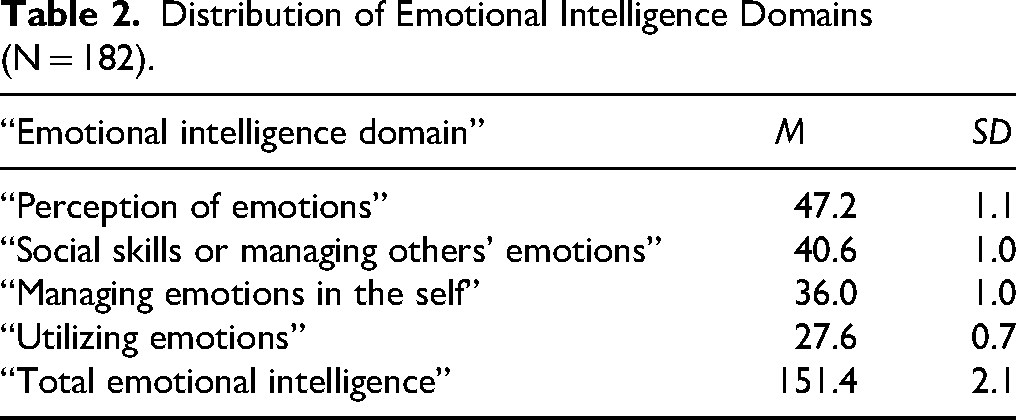
The analysis revealed that EI levels were predominantly high, with a mean score of 151.4 (SD = 33) out of a possible 165, as shown in Table 2.
Distribution of Emotional Intelligence Domains (N = 182).
The findings indicated a moderate level of coping behavior among participants, with a mean score of 41.0 (SD = 13.4), within a range of 0 to 76. The most commonly used coping strategy was problem-solving, which had a mean of 13.5 (SD = 4.6), as presented in Table 3.
Coping Behaviors Nurses Utilized (N = 182).

Overall, total EI was strongly positively correlated with coping behavior (r = .565, p < 0.01), suggesting that higher EI is linked to more effective coping strategies, as shown in Table 4.
The Relationship Between Emotional Intelligence and Coping Behavior (N = 182).

“
“**Correlation is significant at the level of .01.”
Discussion
This study found that NICU nurses exhibited high EI and moderate coping behaviors, with a strong positive correlation between EI and problem-solving strategies. These findings align with literature emphasizing EI's role in enhancing resilience, adaptability, and coping mechanisms among healthcare professionals (Hua et al., 2019; Jawabreh, 2024). The association between EI and coping mechanisms observed in this study is consistent with findings from research on administrative staff at the Kerman University of Medical Sciences, where EI correlated positively with self-efficacy (Sarani et al., 2020). Key components of EI, such as self-awareness, self-regulation, and social skills, were linked to improved self-efficacy, similar to the current study's finding that higher EI enhances nurses’ coping strategies. This highlights EI as a crucial factor influencing performance across healthcare and administrative settings.
The study found moderate coping behavior levels among NICU nurses, aligning with results from Abou Hashish and Ghanem Atalla (2023). Additionally, research on family caregivers of COVID-19 patients in Iran indicated that coping behaviors were shaped by emotional, social, and physical stressors (Sheikhbardsiri et al., 2022). These parallels suggest that effective stress management is dependent on the development and application of EI, regardless of the caregiving context.
Problem-solving emerged as the primary coping strategy among NICU nurses, aligning with Larijani et al. (2017), who observed a preference for problem-focused coping in high-pressure environments. Moreover, barriers to family centered care in pediatric departments in Iran were attributed to communication and collaboration challenges between health care providers and families (Farokhzadian et al., 2021). This further underscores EI's significance in enhancing teamwork, overcoming systemic barriers, and fostering problem-solving in clinical settings.
The moderate coping levels reported may reflect Palestine's challenging healthcare landscape, characterized by resource constraints, high workloads, and emotional demands. Previous studies emphasize the need for institutional support to strengthen nurses’ coping mechanisms and well-being. Implementing EI training within organizational policies could help nurses navigate these challenges more effectively.
This study successfully established the relationship between EI and coping behaviors among NICU nurses, identified problem-solving as the most commonly used strategy, and confirmed the influence of EI dimensions on coping mechanisms. These findings contribute to the growing body of evidence demonstrating EI's impact on professional success, mental health, and patient care outcomes. Enhancing nurses’ EI can promote resilience, improve workplace satisfaction, and ultimately elevate the quality of care.
Limitations of the Study
The study's cross-sectional design limits its ability to infer causality between EI and coping behaviors. Additionally, the reliance on self-reported data introduces the possibility of response bias, as participants may have provided socially desirable answers rather than reflecting their true experiences. The study sample was confined to NICU nurses in Palestine, which may limit the generalizability of the findings to nurses in other cultural or healthcare settings. Future research should consider longitudinal designs to explore these relationships over time and the use of instruments validated in the participants’ primary language to enhance accuracy.
Implications for Practice
The findings suggest a need to cultivate EI within nursing practice. Hospitals and nursing schools should implement training programs focusing on EI skills like self-awareness and emotional regulation to enhance coping abilities and improve care quality. Integrating coping strategies, particularly problem-solving, into nursing education is essential. Scenario-based training and supportive workplace cultures, including peer support and mentorship programs, can reduce burnout and promote well-being. Nurse managers should tailor interventions to strengthen the link between EI and effective coping.
Conclusion
EI positively influences coping behaviors, with a strong association with problem-solving strategies. Training in EI can improve nurses’ personal and professional outcomes, reduce emotional exhaustion, enhance performance, and foster growth in challenging environments. Future research should focus on longitudinal studies to examine how EI and coping behaviors evolve over time. Additionally, intervention-based studies could explore the effectiveness of tailored emotional intelligence training programs in improving resilience, job satisfaction, and patient care outcomes.
Supplemental Material
sj-docx-1-son-10.1177_23779608251330097 - Supplemental material for The Relationship Between Emotional Intelligence and Coping Behaviors Among Nurses in the Neonatal Intensive Care Unit
Supplemental material, sj-docx-1-son-10.1177_23779608251330097 for The Relationship Between Emotional Intelligence and Coping Behaviors Among Nurses in the Neonatal Intensive Care Unit by Ahmad Ayed in SAGE Open Nursing
Supplemental Material
sj-doc-2-son-10.1177_23779608251330097 - Supplemental material for The Relationship Between Emotional Intelligence and Coping Behaviors Among Nurses in the Neonatal Intensive Care Unit
Supplemental material, sj-doc-2-son-10.1177_23779608251330097 for The Relationship Between Emotional Intelligence and Coping Behaviors Among Nurses in the Neonatal Intensive Care Unit by Ahmad Ayed in SAGE Open Nursing
Footnotes
Acknowledgments
The author would like to express their thanks to the nurses who participated in the study.
Author's Contribution
The author solely conceptualized, designed, conducted, and analyzed the study, as well as prepared and revised the manuscript.
Consent for Publication
I affirm that this work is original and has not been published elsewhere, except as noted in the article.
Data Availability Statement
The datasets generated during and/or analyzed during the current study are available from the corresponding author upon reasonable request.
Declaration of Conflicting Interests
The author declared no potential conflicts of interest with respect to the research, authorship, and/or publication of this article.
Ethics Approval and Consent to Participate
Ethical approval was obtained from the Arab American University (R-2024/A/169/N). Written informed consent was obtained from all subjects before the study.
Funding
The author received no financial support for the research, authorship, and/or publication of this article.

Supplemental Material
Supplemental material for this article is available online.
References
Supplementary Material
Please find the following supplemental material available below.
For Open Access articles published under a Creative Commons License, all supplemental material carries the same license as the article it is associated with.
For non-Open Access articles published, all supplemental material carries a non-exclusive license, and permission requests for re-use of supplemental material or any part of supplemental material shall be sent directly to the copyright owner as specified in the copyright notice associated with the article.
