




Abstract
Background
Predicted nursing deficits and low nursing student retention rates highlighted the need to investigate cultivation of grit, a malleable trait involving perseverance and passion to achieve long-term goals amidst challenges and difficulties.
Objective
The objective of this study was to identify how cultivation of grit and additional academic and non-academic strategies aided gritty second-year associate degree-seeking nursing students in addressing nursing program challenges and completing their nursing program.
Methods
Twenty-two second-year associate degree-seeking nursing students in rural central Arizona completed demographic and Grit-O Scale questions using Survey Monkey™ and participated in semi-structured interviews or focus group discussions held from September through December 2022. Research questions provided study foundation: RQ1: How do second-year nursing students with high levels of self-perceived grit of greater than 3.5 out of 5 as measured on the Grit-O Scale describe how grit was cultivated during their associate degree-seeking nursing program? RQ2: How do second-year nursing students with high levels of self-perceived grit describe how additional academic and non-academic strategies added to them in dealing with the challenges of their associate degree-seeking nursing program?
Design
Qualitative Descriptive Research
Results
Inductive thematic analysis revealed six themes: importance of perseverance and passion, facets of grit; identification of program challenges and strategies used to deal with challenges; and the significance of support from nursing cohort, family, and friends, and nursing instructors.
Conclusions
Effective strategies for participating nursing student retention and program completion involved cultivation of grit and its facets of perseverance and passion and additional academic and non-academic strategies of nursing cohort and instructor support aided students in dealing with challenges faced during their associate degree-seeking nursing program at a rural, central Arizonan community college.
Introduction
As indicated in the abstract, shortages of 2.5 to 6 million nurses worldwide and 1.8 million within the USA were predicted to occur by 2030 (Ferguson & Williams, 2020; Scheffler & Arnold, 2019). Deficits were attributed to ageing global and national populations, retirement or resignation of nurses currently employed in the workforce (Scheffler & Arnold, 2019) and workplace stressors (Foster et al., 2024); 25% of nurses were predicted to leave practice within 5 years, often within the first or second year (Scheffler & Arnold, 2019). Shortages have also been ascribed to high rates of nursing student attrition; national rates vary from 18% (Eudy & Brooks, 2022) to 50% (Everett, 2020). In addition, the worldwide COVID-19 pandemic aggravated insufficient numbers of trained nurses, leading to decreased staffing and elevated levels of burnout (Humphreys & Woody, 2020). These factors revealed the importance of investigating effective strategies successful nursing students developed to deal with challenges encountered during rigorous nursing programs (Eudy & Brooks, 2022).
Cultivation of grit offers a potentially effective strategy for reducing predicted nursing deficits (Eudy & Brooks, 2022; Meyer et al., 2020; Terry & Peck, 2020b). Grit, a non-cognitive personality trait, identified as perseverance and passion to successfully complete long-term goals while enduring challenges (Duckworth et al., 2007), was positively associated with academic success and retention in a variety of domains (Duckworth et al., 2007; Duckworth & Quinn, 2009; Robertson-Kraft & Duckworth, 2014). Although detailed strategies for cultivation of grit have yet to be identified, seminal grit research indicated individual grit levels were malleable, increasing with age and higher levels of education (Duckworth et al., 2007). In addition, cultivation of grit flourished within gritty cultures (Chu et al., 2021; Meyer et al., 2020; O’Neal, 2018; Seguin, 2019; Terry & Peck, 2020a) and was enhanced in individuals displaying a growth mindset (Park et al., 2020).
Early grit research revealed grit levels were higher when individuals encountered challenges and difficulties while in pursuit of long-term goals (Duckworth et al., 2007). Later research revealed increasing grit levels and perceived academic and clinical performance were correlated with each increasing year Australian nursing students were enrolled in a three-year Bachelor degree-seeking nursing program (Terry & Peck, 2020a). Further research indicated nursing students who struggled with difficulties during their program benefited from developing effective strategies for dealing with challenges, such as cultivation of grit; these contributed to reduction in student attrition (Eudy & Brooks, 2022).
Minimal investigations addressing the role of cultivation of grit have been conducted in associate degree-seeking community college nursing programs. Research conducted by the author contributed to the existing body of knowledge about the role of grit in nursing student academic success by revealing the importance of the following themes: facets of grit, perseverance and passion; identifying nursing program challenges and strategies used to deal with program challenges; and the significance of support from nursing cohort, family and friends, and nursing instructors. Further research is needed to gain additional understanding about how strategies such as grit promote nursing student success in both associate degree-seeking and Bachelor degree-seeking nursing students.
Review of Literature
Nursing Shortages
Predicted worldwide nursing shortages of 2.5 to 6 million nurses by 2030 (Ferguson & Williams, 2020; Scheffler & Arnold, 2019) are exacerbated by an estimated 25% of nursing students projected to leave practice within five years of completing nursing school (Scheffler & Arnold, 2019) and by national nursing student attrition rates ranging from 18% (Eudy & Brooks, 2022) to 50% (Everett, 2020). Projected deficits highlighted the importance of gaining further understanding about the cultivation of grit in nursing students and about strategies nursing students developed to successfully deal with the many challenges they faced during their rigorous nursing programs (Eudy & Brooks, 2022). Although nursing colleges have investigated programs to encourage student retention, nursing student retention rates of approximately 50% reveal these attempts have not yet been fully successful (Eudy & Brooks, 2022; Everett, 2020).
Cultivation of Grit
Research conducted by the author utilized Grit Theory for its theoretical foundation. Proposed by Duckworth et al. (2007), Grit Theory involved the non-cognitive construct of grit comprised of two facets, perseverance and passion, which together produced successful achievement of long-term goals. Perseverance referred to effort in pursuit of long-term goals amidst difficulties and challenges; passion reflected consistent commitment to specific goals over an extended time period. Seminal grit research examined the role of cognitive and non-cognitive constructs in achievement and determined high levels of grit and its components of perseverance and passion predicted academic success and retention (Duckworth et al., 2007; Duckworth et al., 2009; Robertson-Kraft & Duckworth, 2014). Individuals possessing high levels of grit achieved long-term goals despite adversity or failure, demonstrating perseverance and passion during the process (Duckworth et al., 2007). Research findings discussed in this article revealed participant descriptions of robust individual perseverance. Participants also shared a strongly held passion to achieve the long-term goal of becoming registered nurses. They intentionally encouraged one another to successfully complete their nursing program.
Seminal grit research revealed grit levels were malleable and increased with age and higher education levels (Duckworth et al., 2007). Grit levels were also enhanced in individuals demonstrating growth mindset (Park et al., 2020). Gritty academic cultures heightened development of grit (Chu et al., 2021; Meyer et al., 2020; O’Neal, 2018; Seguin, 2019; Terry & Peck, 2020a). Potentially, cultivation of grit offered an effective strategy for academic success in nursing students.
Investigations examining grit in health care education revealed grit was associated with academic success and retention in multiple medical arenas (Calo et al., 2022; Costello et al., 2022; Gruenberg et al., 2019; Kurian et al., 2019). High grit levels effectively predicted achievement (Fernandez-Martin et al., 2020) and retention within various academic programs (Fernandez-Martin et al., 2020). Grit was predictive of academic success in nursing students (Halperin & Regev, 2021) and successful completion of nursing programs (Terry & Peck, 2020a) and played a significant role in academic and clinical training of nursing students (Meyer et al., 2020; Munro & Hope, 2019; Terry & Peck, 2020b).
Higher grit levels were also associated with successful nursing students (Meyer et al., 2020; Terry & Peck, 2020a), nurses (Chu et al., 2021), and nurse leaders (Seguin, 2019). Grit in pediatric nurses enhanced performance during the Covid pandemic (Chu et al., 2021). Gritty nursing cultures improved grit levels among nursing cohort members and encouraged students to continue to pursue the long-term goal of nursing education completion (Meyer et al., 2020). Average peer grit was twice as effective in predicting individual literacy than individual grit in a longitudinal study that examined individual versus classroom peer effects of grit on individual literacy in 142 Latinx elementary students (O’Neal, 2018).
Educators who wished to nurture grit encouraged students to associate with groups of individuals with high grit levels (Duckworth, 2016; Meyer et al., 2020; Terry & Peck, 2020a). Results of the examination of grit levels of 400 U.S. nursing healthcare leaders highlighted the importance of role models in cultivating grit (Seguin, 2019). A cross-sectional study of 2349 nursing students revealed students demonstrated increasing levels of grit as students progressed through their nursing program, suggesting student cohorts potentially encouraged cultivation of grit in one another (Terry & Peck, 2020a).
Non-Cognitive Skills in Education
Seminal grit research discussed how successful achievement utilized non-cognitive traits reflecting individual motivation or attitude in addition to cognitive intelligence and innate talent (Duckworth et al., 2007). The non-cognitive trait of grit predicted academic success more effectively than traditional cognitive measures of intelligence such as IQ (Duckworth et al., 2007). Individuals who exhibited high levels of grit exerted extended effort and practice, enhancing their skills and talent (Duckworth, 2016).
Although grit and resilience are often thought of as synonyms, grit refers to perseverance and passion to achieve long-term goals amidst challenges and difficulties (Duckworth et al., 2007). Resilience is an aspect of grit that involves an ability to maintain mental health amidst difficulties (Stoffel & Cain, 2018).
Investigations involving cultivation of the non-cognitive trait of resilience revealed resilience promotion in nurses improved mental health (Foster et al., 2024). During the COVID-19 pandemic, resilience-producing interventions enhanced nurse mental health; mental health nurses with higher levels of resilience who worked in environments involving substantial challenges had heightened levels of mental health and adjusted more successfully (Hasan & Alsulami, 2024). Further investigations are needed to understand cultivation of non-cognitive traits of grit and resilience and how they benefit nursing mental health (Stoffel & Cain, 2018).
Grit Research in Western and Non-Western Cultures
Grit research identified cultural differences in understanding of grit. Individualistic or independent cultures, such as Oceania, Australia, Canada, New Zealand, United Kingdom, United States, Northern Europe, former USSR, Eastern Europe, and Southern Europe, stressed individual goals, while collectivist or interdependent cultures, such as Latin America and Southern and Eastern Asia, stressed importance of family and community values (Datu, 2021). Results of an online survey conducted with 7,617 participants from six of seven continents using the Grit-O Scale (Duckworth et al., 2007) revealed the scale reliably measured both components of grit, perseverance and passion; however, evaluation of validity showed stronger correlations with perseverance of effort and weaker ones with passion or consistency of interest (Disabato et al., 2018). These findings revealed the perseverance aspect of grit was similar between collective and individualistic cultures but the passion aspect was not as important in collective cultures (Datu, 2021; Disabato et al., 2018).
One explanation offered for cultural differences in grit levels involved the concept of self-construal. This concept addressed how individuals experienced motivation, emotion, and cognition, and traits such as grit in ways that reflected cultural understanding of self, others, and relationships between self and other (Halperin & Regev, 2021). Views of self were different between individuals from individualistic cultures that prioritized individual inner self and individuals from interdependent cultures that emphasized importance of interpersonal relationships. The role of others in individualistic cultures primarily offered affirmation of another's inner self while in collectivist cultures the view of self finds the most meaning when relating to others; the latter reflected interconnectedness between individuals.
Effective Academic and Non-Academic Strategies
Strategies nursing students utilized to successfully complete nursing education were multifactorial (Eudy & Brooks, 2022; Mitchell et al., 2021). Nursing students and educators benefited from being provided with clearly articulated descriptions of nursing education rigors (Gerdes, 2019) and development of critical thinking (Karsten & DiCicco-Bloom, 2014). One potential way to maintain greater student retention in nursing programs and successful program completion involved the strategy of cultivation of grit in nursing students (Halperin & Regev, 2021; Meyer et al., 2020; Terry & Peck, 2020a).
In addition to cultivation of grit, effective strategies included growth mindset intervention (Williams, 2021; Lewis et al., 2020), academic and social belonging (Mitchell et al., 2021), providing successful clinical experiences for nursing students (Bakker et al., 2019; Duprez et al., 2021; Gomez-Moreno et al., 2022; Velarde-Garcia et al., 2021), and student mentoring (Fard et al., 2020; Lewis, 2021). Growth mindset, along with grit, flourished in students facing challenges rather than less difficult learning environments; both constructs view individual intelligence and skills as malleable, able to be developed and nurtured, and involving achievement, despite challenges and apparent failures (Duckworth, 2016; Dweck et al., 2014; Park et al., 2020).
The importance of academic and social belonging in nursing student retention was identified in a comprehensive literature review discussing 13 qualitative investigations (Mitchell et al., 2021). Mediating effects of social support and reduction of burnout were found in students with increased nursing grit levels (Kim & Lee, 2022). The importance of engaging nursing students in meaningful clinical learning experiences was revealed in multiple studies (Bakker et al., 2019; Duprez et al., 2021; Gomez-Moreno et al., 2022; Velarde-Garcia et al., 2021). Student mentoring played also a crucial role in nursing student learning experiences (Canzan et al., 2022; Edwards et al., 2022; Heinonen et al., 2019; Joung et al., 2020; Kobayashi et al., 2023) and perception of clinical studies (Ivana et al., 2020) with peer-led mentoring offering an alternative to faculty-led mentoring (Fard et al., 2020; Lewis, 2021).
Methods
Study Design
The study used a qualitative descriptive design. This design elicited detailed descriptions from study participants from their own perspectives using their own words without requiring the researcher to provide further interpretation (Sandelowski, 2000). Philosophically, the use of qualitative descriptive research design allowed the researcher to examine the subjective experiences of nursing students within the context of their nursing programs (Doyle et al., 2020). The use of this design provided information about cultivation of grit, a poorly understood, complex phenomenon that benefitted from additional research (Meyer et al., 2020; Terry & Peck, 2020b). This design offered the researcher insights about strategies or relationships that enabled students to cultivate grit (Meyer et al., 2020; Terry & Peck, 2020b). Also revealed were academic and non-academic challenges nursing students experienced during their nursing program and strategies, such as perseverance and passion, used to successfully deal with challenges (Eudy & Brooks, 2022; Mitchell et al., 2021).
Study Purpose
The purpose of this qualitative descriptive study was to investigate how second-year nursing students with high levels of self-perceived grit describe how grit was cultivated during their associate degree-seeking nursing program and how additional academic and non-academic strategies aided them in dealing with challenges during their associate degree-seeking nursing program at a rural, central Arizonan community college. The study research questions provided below addressed the purpose of the study.
Study Research Questions
RQ1: How do second-year nursing students with high levels of self-perceived grit of greater than 3.5 out of 5 as measured on the Grit-O Scale (Duckworth et al., 2007) describe how grit was cultivated during their associate degree-seeking nursing program? RQ2: How do second year nursing students with high levels of self-perceived grit describe how additional academic and non-academic strategies added them in dealing with the challenges of their associate degree-seeking nursing program?
Sample
Purposive sampling was utilized to select study participants who met criteria of: (1) second-year community college associate degree-seeking nursing students in rural, central Arizona, and (2) high levels of self-perceived grit of greater than 3.5 out of 5 as measured on the Grit-O Scale (Duckworth et al., 2007). The research study took place with nursing students who were attending a community college nursing program based at a rural, central Arizonan community college. The population of interest for this study involved all community college associate degree-seeking nursing students in the USA. The study sample consisted of second-year community college associate degree-seeking nursing students in rural, central Arizona with high levels of self-perceived grit of greater than 3.5 out of 5 as measured on the Grit-O Scale (Duckworth et al., 2007). The study sample was drawn from the target population which consisted of all community college associate degree-seeking nursing students in rural, central Arizona participated in either semi-structured interviews or a focus group and completed a demographic questionnaire. Subjects participated voluntarily without coercion; no participants dropped out of the study.
Data Collection
Data collection began with site authorization which involved completion of the community college Human Services Review application and obtaining research institution and community college IRB approval. After site authorization was granted, the community college Director of Nursing sent out a recruitment email designed by the researcher that all enrolled community college nursing students were asked to participate in the study. This email provided students with a brief explanation of the study, purpose, and importance of the study; how the study benefitted participants; and expectations for study participation, and included a Survey Monkey link™ containing informed consent which was required prior to participation. The link also included a demographic questionnaire and the Grit-O Scale (Duckworth et al., 2007). At the request of the nursing program director, all nursing students currently enrolled in the nursing program at both community college branches received the recruitment email.
An additional question asked willing second-year nursing students to contact the researcher about participating in either semi-structure interview or focus groups. Interested students were encouraged to contact the researcher with questions about the study via email or phone prior to participation. The researcher contacted willing second-year students by email or phone. Only the author participated in collecting data. Prior to the onset of data collection, participants had no contact with the researcher. No repeat interviews or focus groups were conducted as the length of interviews met the research institution's requirement of 60 or more minutes in duration.
Data collection was conducted by the author as part of completion of a doctoral program. As a novice qualitative researcher, the author provided access to field trials, interview and focus group questions, and data collection and analysis to dissertation committee members. Suggested revisions requested by committee members were addressed by the author and approved by committee members.
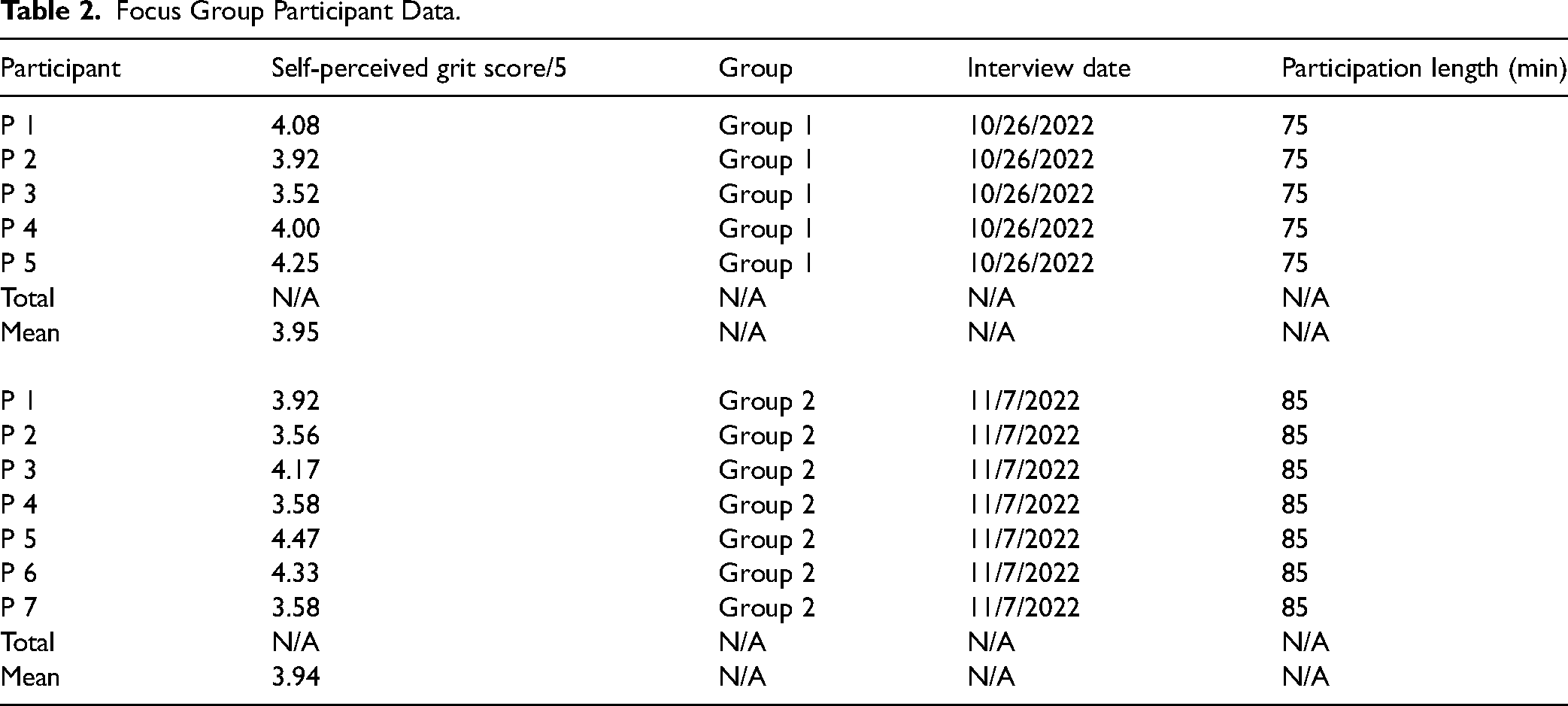
Data collection involved one researcher and 22 participants engaged in 10 semi-structured interviews and two focus groups. The latter consisted of 12 participants, 5 and 7 individuals, respectively. Semi-structured interviews were conducted, recorded, and transcribed using Zoom™ technology. Ten individual interviews took place between September 17, 2022, and December 1, 2022. Each interview participant was given one week to member-check individual transcripts for transcription errors. Three out of 10 interview participants responded with positive feedback; the remainder did not respond within the allotted time. Table 1 provides interview participant data.
Interview Participant Data.

Two focus groups were conducted, recorded, and transcribed using Zoom™ technology on October 26, 2022, and November 7, 2022, respectively. Focus groups began after the researcher observed data saturation taking place during interviews. All data analysis including coding was performed solely by the author. Focus group participants were not asked to member-check transcripts for transcription errors to maintain participant confidentiality. Table 2 provides focus group participant data.
Focus Group Participant Data.
Development of Interview and Focus Group Questions
Initial preparation of interview and focus group questions took place prior to data collection during meetings involving the researcher and dissertation committee members. Field testing evaluated research protocol and questions. The first field test was conducted, recorded, and transcribed on May 5, 2022, using Zoom ™ technology, and involved a target population member preparing to successfully graduate from the nursing program. Results revealed 58 min of recorded conversation and 37 double-spaced transcribed pages. Modification of interview questions and addition of prompts were developed by the researcher and dissertation chair to further elicit detailed descriptions for each question. A second field test utilized revised interview questions and added prompts and conducted on May 7, 2022, resulting in 67 min of recorded conversation.
Data Analysis and Development of Themes
Themes were developed by the author following six steps of inductive thematic analysis developed by Braun and Clarke (2006). These steps involved: (1) familiarization with data; (2) initial coding; (3) searching for initial themes; (4) reviewing potential themes; (5) defining and renaming themes; and (6) writing-up results. Analysis was conducted one interview at a time, allowing the researcher to identify similar themes in each interview, verifying data saturation. First, familiarization with data involved rereading transcripts and identifying errors. Member checking was conducted with interview participants. Second, initial coding was conducted by identifying short, descriptive segments of information applicable to study research questions within the text (Byrne, 2021). Each transcript was entered into MAXQDA software, in which codes were identified, color-coded, and listed in the side margin of the transcript and compiled in a codebook. Third, searching for initial themes took place using axial coding. Larger themes addressing research questions were developed by integrating shorter segments. Fourth, five potential themes: High Levels of Perseverance; Individual and Shared Passion; Various Challenges; Effective Strategies; Supportive Relationships, were prepared by comparing codes with initial themes. Themes that addressed research questions or could be modified to address study research questions were selected. Fifth, defining and renaming themes took place during which the researcher determined a six theme, Instructor Support, should be its own specific theme, distinct from the previously discussed theme of Supportive Relationships. Sixth, writing-up results took place. Each theme was aligned with the research questions.
Ethical Considerations
Ethical considerations were considered and implemented throughout the study. All aspects of the investigation complied with Belmont principles requiring scientific research show respect, beneficence, and justice to all persons (Office for Human Research Protections, 2022). International Review Board (IRB) approval was obtained from the research institution and the nursing program community college. The study was assigned exempt status by the research institution when given approval. Participants were required to provide informed consent prior to participation in the Survey Monkey™ questionnaire and again prior to interview or focus group participation as mandated by the research institution. Participation in the study was voluntary and confidential with participants given the right to withdraw from the study at any point; no participants chose to withdraw. Study purpose was provided in a recruitment email sent by the nursing program director to all students currently enrolled in the nursing program, both first- and second-year students attending both branch locations of the rural, central Arizonan community college nursing program. This approach was taken at the request of the nursing program director who indicated it simplified the role of the director in the recruitment process.
Study participants were reassured of confidentiality at the onset of each interview and focus group meeting. As stated in informed consent documents, only the researcher and dissertation committee had access to interview and focus group transcripts, preventing nursing program instructors or administrators from identifying sources of negative comments. As a result, participants provided detailed and honest descriptions of experiences and challenges faced during the nursing program and expressed appreciation to the researcher that their concerns could be discussed. More than one participant thanked the study author for this opportunity.
Trustworthiness
The researcher sought to establish the scientific quality of the study by ensuring its trustworthiness. Criteria associated with establishing trustworthiness included credibility, transferability, dependability, and confirmability (Cope, 2014). These criteria are discussed as follows.
Credibility was accomplished with: (1) preparation and use of reputable data collection plan involving more than one well-designed data collection source, and (2) member-checking (Korstjens & Moser, 2018). Data collection sources used included 22 participants engaged in 10 semi-structured interviews and 2 focus groups of 5 and 7 individuals, respectively. Member-checking took place with the 10 interview participants who were given one week to review transcripts and return to the interviewer with necessary changes. Focus group participants were not asked to member-check transcripts for transcription errors to maintain participant confidentiality.
Transferability was accomplished with: (1) thick descriptions and (2) sampling sufficiency (Korstjens & Moser, 2018). After field testing, the researcher added additional prompts to ensure sufficient data were collected from interview and focus group questions and prompts, providing detailed descriptions. Sampling sufficiency was verified when similar themes emerged from results of data analysis. Data saturation was achieved as sufficient data collection had taken place
Dependability was ensured by: (1) preparing an audit trail, (2) conducting peer debriefings, and (3) compiling in-depth descriptions of well-established research methodology (Korstjens & Moser, 2018). An audit trail included interview and focus group transcripts with interviewer observations. Peer debriefings were conducted with committee members and qualitative research experts who provided constructive feedback. Detailed descriptions of the sampling process, data collection and analysis, and alignment of interview and focus group questions with research questions verified researcher's use of well-known research methodology.
Confirmability was achieved with: (1) clearly conducted and defined coding, (2) in-depth methodological descriptions, and (3) researcher reflexivity. Coding followed the steps of inductive thematic data analysis (Braun & Clarke, 2006). Detailed methodological processes were maintained throughout the study. Researcher reflexivity involved self-reflection about personal biases, preferences, and preconceived ideas about the phenomenon under investigation (Korstjens & Moser, 2018).
Results
Demographic Descriptive Data Results
Demographic data were collected from 10 semi-structured interview participants and 12 focus group participants. As displayed in Tables 3 and 4, students were predominantly female and white with previous educational degrees. Seven interviewees attended the nursing program located at one community college campus and three attended the second one. The 12 focus group participants were enrolled in the associate degree-seeking nursing program located at one of the two community college campuses. No focus group participants attended the program located at the second community college campus. Both nursing program branches followed identical curriculum. Although some instructors taught at both campuses, not all did so.
Demographic Profile of Research Participants Part 1.

Demographic Profile of Research Participants Part 2.

Semi-Structured Interviews and Focus Group Data Results
Inductive thematic data analysis was conducted with collected data (Braun & Clarke, 2006).
The development of themes examined how codes with shared meanings related to one another (Braun & Clarke, 2006; Byrne, 2021). Related codes were combined to produce six themes: High Levels of Perseverance; Individual and Shared Passion; Various Challenges; Effective Strategies; Supportive Relationships; and Instructor Support.
RQs: Themes Which Answer Study RQs.

Discussion
Emerging Themes
Six emerging themes were identified using Inductive Thematic Analysis (Braun & Clarke, 2006). These themes are included in Table 6. Meanings of the six emerging themes are provided. In addition, quotations supporting emerging themes are also included in the table. Consistency occurred between data presented and study findings.
Themes (Initial Themes): Theme Meanings: Sample Quotations.

Discussion of Each Emerging Theme
Evidence of perseverance was found in a strong work ethic displayed by participating nursing students. Several participants discussed being motivated to work hard to complete the nursing program to provide for children or ageing parents. Several participants discussed how they had begun the process of becoming a registered nurse earlier in their adult lives, some 10 to 20 years ago. Several participants discussed entering the nursing program after previously completing one or more degrees in other fields. They realized nursing was their desired career goal and were willing to persevere until they accomplished that goal. The perseverance displayed by participating students revealed strong passion to accomplish the goal of becoming a nurse.
Numerous participants described how sharing passion to become a nurse with program cohort members enhanced individual efforts. One participant shared support for one another by expressing, “We’re going to all be in this together” (FG1P5). Participants also discussed how both individual and shared passion to become nurses extended over long periods of time, even after pursuing previous degrees in other fields, and was enhanced by strong desires to help others, to achieve future health-care-related goals, and by previous medical experiences. Multiple participants expressed deeply rooted passion to help, comfort, and instruct others with their healthcare training. Another participant expressed, “There's not really anyone else other than your classmates who can fully understand and empathize with what you're experiencing, what you're going through, and how you're feeling throughout it” (IP8). Another participant echoed similar thoughts, “We're all enduring this rigor for the same goal” (IP6).
Numerous study participants also described how medical and nursing experiences increased their passion for nursing. Two participants stated they were inspired to pursue becoming nurses by medical crises involving family members. Others stated pursuit of additional nursing degrees enhanced passion for becoming nurses as they set future educational goals. Examples included achieving health-care related degrees, such as Bachelor of Science in Nursing (BSN), Master of Science in Nursing (MSN), or Doctor of Nurse Practitioner (DNP), or post-graduation nurse residency programs.
Academic and clinical challenges included heavy workloads involving demanding amounts of homework. The third semester was described as especially intensive academically, leading participants to describe times of exhaustion, anxiety, burn out, and panic attacks, while the fourth-semester clinical preceptorship or capstone assignment process was described as confusing, making childcare arrangements difficult. One student described failing one class during the third semester, just missing the passing score of 78% in one class, having to drop out of the program, and then re-enrolling the next semester. Study participants described numerous financial challenges, sharing their academic load was heavy enough they often needed to reduce work hours or quit jobs.
Participants described specific challenges. One single parent shared the biggest challenge was financial, balancing program expenses and working full-time with raising three kids, while another single parent indicated it was difficult to juggle the need to work full-time with raising two children and completing the extensive required homework and studying. Descriptions of emotional, mental, and social challenges included several participants discussing missing out on many family activities due to program responsibilities, while others described shedding tears and suffering from anxiety and challenges of maintaining healthy emotional well-being when also dealing with difficult circumstances involving family and work, outside of the nursing program.
Challenges resulting from the worldwide COVID pandemic negatively impacted some students who struggled to learn virtually. They described difficulties of practicing first-semester clinical skills while using Zoom™ technology. Several students discussed difficulties learning to do injections virtually. One single parent described monitoring online education for several children along with completing the nursing program virtually. Another student described the dilemma of testing positive for the Covid virus and choosing to show up to class sick with Covid due to a fear of missing class and potentially failing out of the program.
Multiple nursing students discussed utilizing online resources, study skills, study groups, and peer mentoring. Resources included the community college Student Nursing Association (SNA), a student mentoring organization on campus that provided helpful resources for fellow nursing students; recently they focused on preparing novice nursing students in determining dosage calculations. Several participants utilized tutoring provided by the community college Learning Center. Others encouraged formation of study groups. Online resources described included: ATI adaptive quizzing, preparing flashcards using Quizlet, viewing You Tube videos, study materials found on nursing.com, and preparing and sharing Google Docs with other students. Several participants discussed how aspects of their faith, including prayer, provided an important resource. Strategies to help with financial challenges included scholarships, grants, financial aid, and stimulus payments; all contributed to expenses during the nursing program. In addition, finding employment with flexible hours was helpful. Participants also described strategies to deal with mental and emotional health including appointments with an inexpensive community college mental health counselor or using outside counseling resources.
Participants described their nursing cohort members as those who could best understand and empathize with what they were experiencing throughout the nursing program. Several focus group participants pointed to how the members of their cohort shared a common goal, graduating from the program, and the need to support one another until that goal was reached, rather than competing with one another. Multiple interview and focus group participants described their cohort members as among their closest friends. Participants also expressed they could not have successfully accomplished this goal without the support of their spouses or partners, parents, grandparents, children, and close friends who provided financial and childcare assistance along with encouragement.
While many instructors were described as challenging, participants acknowledged most wanted students to be successful and knowledgeable. Various instructors were described as having a sense of humor, while others provided insights into their own nursing education and practices that benefitted students. One student who had to drop out of the program, cited her instructors as the primary source of encouragement to re-apply and successfully complete the nursing program. Several participants also discussed negative aspects of their relationships with some instructors. One described how an instructor made disparaging comments prior to their first exam. However, most participants stressed how valuable their instructors were to their academic and personal success and labeled them as very valuable academic and clinical resources.
Strengths and Limitations
Several strengths and limitations emerged from this study. Strengths included: the study effectively addressed study research questions with its prepared interview and focus group questions that yielded in-depth, detailed descriptions; study findings successfully examined how gritty second-year nursing students described cultivation of grit, challenges faced, and academic and non-academic strategies used to deal with challenges during their nursing program; and the study sample selection tools effectively identified participants who met the established criteria for the study. Limitations included: an over-representation of participants identifying as females, white or Caucasian, and those with previous degrees.
Implications for Practice
Study findings revealed practical implications for nursing program students, instructors, and administrators. Instructors and nursing program administrators need to prepare incoming nursing students with information about the rigors of the nursing program (Gerdes, 2019), identifying and engaging nursing students who were not progressing well (Canzan et al., 2022; Eudy & Brooks, 2022) early in the nursing program (Adomo et al., 2022). Student responses to challenges faced during their program guided the outcome of their nursing education experiences (Calo et al., 2022). Nursing students and faculty could also benefit from a greater understanding of available online educational resources that supplement classroom and clinical education (Liesveld et al., 2021).
In addition, providing nursing students, instructors, and program administrators with knowledge about the positive relationship between cultivation of grit and academic success may lead to acknowledging the importance of cultivating grit in nursing students. Nursing students benefitted from recognizing that many of the challenges faced during the program reflected the complexity of demands placed upon nursing students (Calo et al., 2022). As nursing students acknowledged and addressed the difficulties of their program, they were able to progress through the program successfully (Karsten & DiCicco-Bloom, 2014). While study results reflected descriptions provided by participants who were second-year associate degree-seeking nursing students from rural, central Arizona, additional research focused on first-year students, associate degree-seeking nursing students enrolled in other US community college nursing programs, or students enrolled in bachelor degree-seeking nursing programs may offer insights into the importance of cultivating grit in various nursing programs. Compilation of resources that aided nursing instructors in cultivating grit in their students might also assist nursing faculty in other associate degree-seeking programs or bachelor degree-seeking programs in the cultivation of student grit.
Accurate information about program challenges enhanced nursing student success and provided students with realistic expectations concerning numerous and varied difficulties endured during the nursing program (Karsten & DiCicco-Bloom, 2014). Study findings indicated novice nursing students were aided when upper-level students shared information concerning challenges faced during the nursing program along with successful strategies utilized. Study findings revealed students benefitted from peer mentoring through the Student Nursing Association or community college learning center. Additional research focused on non-central rural, Arizonan associate-degree seeking students or bachelor degree-seeking students may also reflect the importance of peer-mentoring and instructor support to cultivation of grit and student success (Lewis, 2021). Nursing students may also benefit from development of intentional mentoring relationships (Lewis, 2021), addressing financial concerns, especially during the required practicum (Grant-Smith & De Zwaan, 2019), and information about pursuing additional nursing education degrees, such as Bachelor of Science in Nursing (BSN), Master of Science in Nursing (MSN), or Doctor of Nurse Practitioner degrees (DNP).
Conclusion
This study revealed the cultivation of perseverance and passion, two facets of grit, during an associate degree-seeking nursing program. Description of perseverance and passion were provided by students who perceived themselves as having high levels of grit. The study also revealed numerous challenges faced by nursing students. As indicated by previous grit research (Duckworth et al., 2007), grit levels are enhanced in individuals who are successfully dealing with difficulties while pursuing a long-term goal. Students developed effective strategies, both academic and non-academic, to deal with these challenges. Providing incoming nursing students with information about numerous difficulties associated with the program helped students set realistic expectations about impending challenges and provided them with strategies used to be successful in the program, potentially reducing risk of student attrition while increasing student success. Participating students focused on the importance of cultivating supportive relationships with members of their cohort as well as family members and friends. They described how completion of the nursing program was difficult to achieve individually. Students also discussed in detail the significant role instructors played in their successful completion of the nursing program. Instructors not only conveyed required information and clinical skills, they acted as role models who encouraged or discourage students by how they conveyed relevant information and clinical skills and how they addressed student commitments and responsibilities outside the nursing program.
Supplemental Material
sj-docx-1-son-10.1177_23779608251313894 - Supplemental material for Cultivation of Grit in Nursing Students: A Qualitative Descriptive Study “Cultivation of Grit”
Supplemental material, sj-docx-1-son-10.1177_23779608251313894 for Cultivation of Grit in Nursing Students: A Qualitative Descriptive Study “Cultivation of Grit” by Carolyn Spriggs Muchna in SAGE Open Nursing
Supplemental Material
sj-docx-2-son-10.1177_23779608251313894 - Supplemental material for Cultivation of Grit in Nursing Students: A Qualitative Descriptive Study “Cultivation of Grit”
Supplemental material, sj-docx-2-son-10.1177_23779608251313894 for Cultivation of Grit in Nursing Students: A Qualitative Descriptive Study “Cultivation of Grit” by Carolyn Spriggs Muchna in SAGE Open Nursing
Supplemental Material
sj-docx-3-son-10.1177_23779608251313894 - Supplemental material for Cultivation of Grit in Nursing Students: A Qualitative Descriptive Study “Cultivation of Grit”
Supplemental material, sj-docx-3-son-10.1177_23779608251313894 for Cultivation of Grit in Nursing Students: A Qualitative Descriptive Study “Cultivation of Grit” by Carolyn Spriggs Muchna in SAGE Open Nursing
Supplemental Material
sj-docx-4-son-10.1177_23779608251313894 - Supplemental material for Cultivation of Grit in Nursing Students: A Qualitative Descriptive Study “Cultivation of Grit”
Supplemental material, sj-docx-4-son-10.1177_23779608251313894 for Cultivation of Grit in Nursing Students: A Qualitative Descriptive Study “Cultivation of Grit” by Carolyn Spriggs Muchna in SAGE Open Nursing
Footnotes
Acknowledgments
The author would like to express appreciation to the nursing students who consented to participate in interviews and focus groups, to community college nursing program instructors and administrators who accommodated data collection by the researcher, and to the researcher's dissertation committee members and AQR reviewer who encouraged the researcher while preparing the research proposal and dissertation.
Declaration of Conflicting Interests
The author declared no potential conflicts of interest with respect to the research, authorship, and/or publication of this article.
Ethical Approval
All procedures performed in studies involving human participants was in accordance with the ethical standards of the institutional research board and with the 1964 Helsinki declaration and its later ethical amendments or comparable ethical standards. This study has obtained exempt status from the Grand Canyon University IRB.
Funding
The author received no financial support for the research, authorship, and/or publication of this article.
Informed consent
Informed consent was obtained from all participants included in the study.

Supplemental Material
Supplemental material for this article is available online.
References
Supplementary Material
Please find the following supplemental material available below.
For Open Access articles published under a Creative Commons License, all supplemental material carries the same license as the article it is associated with.
For non-Open Access articles published, all supplemental material carries a non-exclusive license, and permission requests for re-use of supplemental material or any part of supplemental material shall be sent directly to the copyright owner as specified in the copyright notice associated with the article.
