




Abstract
Introduction
Empowerment is an important motivator for clinical instructors to develop organizational citizenship behaviors. Job engagement may serve as a moderator, amplifying the impact of empowerment on organizational citizenship behavior.
Objective
This study examines the effect of job participation as a mediator between empowerment and organizational citizenship behavior among clinical teachers at nursing technical institutes.
Methods
This cross-sectional analytical study was performed on a convenience sample of 161 clinical instructors from six technical nursing institutes connected with five Egyptian Universities. For data collection, a self-administered questionnaire, including measures for assessing job engagement, empowerment, and citizenship behavior, was employed. This ran till November 2019, starting in June.
Results
Most clinical instructors had a high level of job involvement (82%), 72.0% had high empowerment score, and 55.3% had high citizenship behavior. Empowerment, job involvement, and citizenship scores were positively correlated. The female gender predicted empowerment positively. The workplace was also a powerful predictor of job engagement and empowerment ratings. Importantly mediated the link between empowerment and citizenship behavior was occupational engagement.
Conclusions
Employment participation was a crucial moderator of the link between autonomy and citizenship behavior. The nursing institutes’ administration needs to empower clinical instructors with more autonomy and participation in decision making through psychological support and fair salaries. It is proposed that an additional study be conducted to assess the efficacy of empowerment initiatives as a pathway to job engagement, resulting in higher civic behavior among clinical instructors.
Keywords
Introduction
Nursing is both an art and science. Nursing as a science entails a corpus of abstract information, and nursing as an art entails the innovative use of this knowledge to help others. It is important to strike a balance when instructing nursing students between the information learned in theoretical classes and how to apply that theory in a clinical situation (Bifftu et al., 2018).
Instructors are an integral part of any educational institution. They play an important role in the education system and their proficiency, novelty, and development can lead to the success of an organization (Cheasakul & Varma, 2016). It is, therefore, beneficial to an institution if its teachers are empowered. Due to continuing hospital restructuring and regulatory change, nurses face many obstacles in the healthcare sector. The current competitive setting of Higher Educational Institutions in the country requires extra effort from its faculty members to comply with the requirements of the Office of Commission on Higher Education (Bifftu et al., 2018).
Review of Literature
The clinical instructors are an essential link between the academic program and clinical practice. The clinical learning experience provides students with an opportunity to consolidate knowledge and apply this knowledge to actual patient care situations, it helps students to acquire professional and personal skills, enhance students’ problem solving, and communication skills (Tsai & Wu, 2010).
In order to be effective in their role, clinical instructors also need skills as empowerment and job involvement. Empowerment is the process of increasing the capacity of individuals or group to make choices and to transform those choices into desired action and outcomes (Sethi & Mittal, 2016).
Early, Spreitzer (1995) conceptualized empowerment as a motivational construct encompassing meaning, competence, self-determination, and impact components. It is fundamental for successful and efficient achievement at work to foster clinical instructors’ trust in the organization and its management by reducing boundaries between them and their direct leaders and top management (Saban et al., 2020; Simsek, 2020). As a motivation tool, it fosters clinical instructors’ job involvement (Andika & Darmanto, 2020). The issues on empowerment, organizational citizenship behavior (OCB) and job involvement of clinical instructors are always a major concern for managers of any health institutes (Anggreyani & Satrya, 2020).
The notion of job involvement has become an essential promoter for clinical instructors’ personal development, leading them towards the achievement of organizational goals and enhancing/her satisfaction with the work (Ekmekci, 2011). Thus, job participation was found to be a major predictor of clinical teachers’ intention to stay in an organization, as well as their organizational commitment, favorable attitudes regarding the job, and ethical or citizenship conduct (Aleinein, 2016; Permarupan et al., 2013).
OCB first appeared in the late 1970s and was formally characterized in the 1980s (Ocampo et al., 2018). It refers to any behavior aimed at sustaining and supporting the work environment socially or psychologically that an employee undertakes optionally and that is not mandated by their routine work duties (Cem-Ersoy et al., 2015). OCB was significantly and positively correlated with clinical instructors’ autonomy and empowerment (Suriansyah et al., 2019). It has been shown to have close and significant associations with clinical instructors’ organizational trust and job satisfaction (Özlük & Baykal, 2020). It has also been linked to clinical instructors’ perception of ethical leadership (Huang et al., 2021), moral work climate, and social responsibility (Altuntaş et al., 2021). A positive perception of work experience and work environment can have a positive effect on engagement and professional efforts in tasks (Mohamed et al., 2022).
The empowerment is a popular term used in discussions about education and educational leadership. Research indicates that empowering teachers will significantly influence their OCB which will then yield positive changes within the educational institution. OCB has received a lot of attention from researchers with the view that clinical instructors play a significant role in the overall success of the institutes (Posadas et al., 2020).
Clinical teaching is at the fundamental of the nursing profession with almost 50% of nursing educational programs devoted to this topic. At the clinical teaching stage, students gain the required experience by learning clinical skills and taking up opportunities to apply their theoretical knowledge into practice through mental, motor, and social skills necessary for the delivery of patient care. Clinical instructor plays an essential role in the production and training of competent nurses. Students observed the behavior of their clinical instructors and adopt those behaviors in their future lives (Ismail & Baza, 2020).
The cross-sectional study, which was conducted by Al-Hussein (2020), reported that the total psychological empowerment and total job satisfaction and their domains had an acceptable level, from another side, total psychological empowerment and its domains had significant relations with total job satisfaction and its domains.
Objective
The current study aimed to assess the effect of job involvement in mediating the relationship between empowerment and OCB among clinical teachers at nursing technical institutes.
Research Hypothesis
Methods
Tool I: Job Involvement Scale: Kanungo (1982) created it to assess the level of job participation. It comprises ten items: “The most important things that happened to me involved my work; I used to live, eat, and breathe my job; Most of my interests were centered around my job.” Each item receives a 7-point Likert scale response: “strongly disagree, disagree, somewhat disagree, neither agree nor disagree, somewhat agree, agree, and strongly agree.” Tool II: Psychological Empowerment Scale: Spreitzer (1995) developed it to measure empowerment. It includes 12 items categorized into four dimensions, each having three items. These are: (1) meaning as “My work activities have a personal meaning to me”; (2) competence as “I have confidence in my ability to do my work”; 3) self-determination as “I can decide for myself how I should tackle my work”; and (4) impact as “I have considerable influence in what goes on within my department.” On a 5-point Likert scale, the responses are as follows: “Totally disagree, disagree, no opinion, agree, and totally agree.” Tool III: Podsakoff et al. (1990) developed the Organizational Citizenship Behavior Measurement Scale to assess related elements of nurses’ discretionary and voluntary additional work efforts that reflect their OCB. The scale consists of 24 items that address five categories of organizational citizenship practices. These are examples of altruism (five items as “I help others who have been absent”; conscientiousness (five items as “Attendance at work is above the norm for me”; sportsmanship (five items as “I consume a lot of time complaining about trivial matters”; courtesy (five items as “I take steps to try to prevent problems with other workers”; and civic virtue (four items as “I attend a meeting that is not mandatory, but is considered.” The responses were on a five-point Likert scale, “strongly disagree, disagree, no opinion, agree, and strongly agree.”
Scoring: The responses were scored 1 to 7, respectively, so a higher score shows more job involvement. The 10-item scores were added together, and the total was standardized by dividing by the number of items so that the scale's total score ranged between 1 and 7. For quantitative analysis, means, standard deviations, medians, and first and third quartiles were figured out. The scale was dichotomized into two categories for categorical analysis: low (includes strongly disagree, disagree, somewhat disagree, neither agree nor disagree) and high (has somewhat agree, agree, and strongly agree).
Scoring: The items were scored on a scale of 1 to 5, with a higher score showing greater empowerment. The scores of the items in each dimension and the overall scale were added up, and the total was standardized by dividing by the proper number of elements, resulting in a total scale score ranging from 1 to 5. For quantitative analysis, means, standard deviations, medians, and first and third quartiles were decided. For categorical analysis, the scale was dichotomized into two levels: Low (includes totally disagree, disagree, and no opinion) and high (has agree and totally agree).
Scoring: The items were graded on a scale of 1 to 5. The negative items were reverse scored, so that a higher score indicates better citizenship. The scores of the items in each dimension and the overall scale were added up, and the total was standardized by dividing by the proper number of elements, resulting in a total scale score ranging from 1 to 5. For quantitative analysis, means, standard deviations, medians, and first and third quartiles were determined. The scale was dichotomized into two categories for categorical analysis: low (including strongly disagree, disagree, and no opinion) and high (has agree and strongly agree).
The dependability of the three tools was also evaluated in this study. This was conducted by evaluating their internal consistency. With Cronbach's alpha coefficients of 0.878 for the job participation scale, 0.833 for the empowerment scale, and 0.783 for the citizenship behavior scale, they proved high levels of dependability.
Results
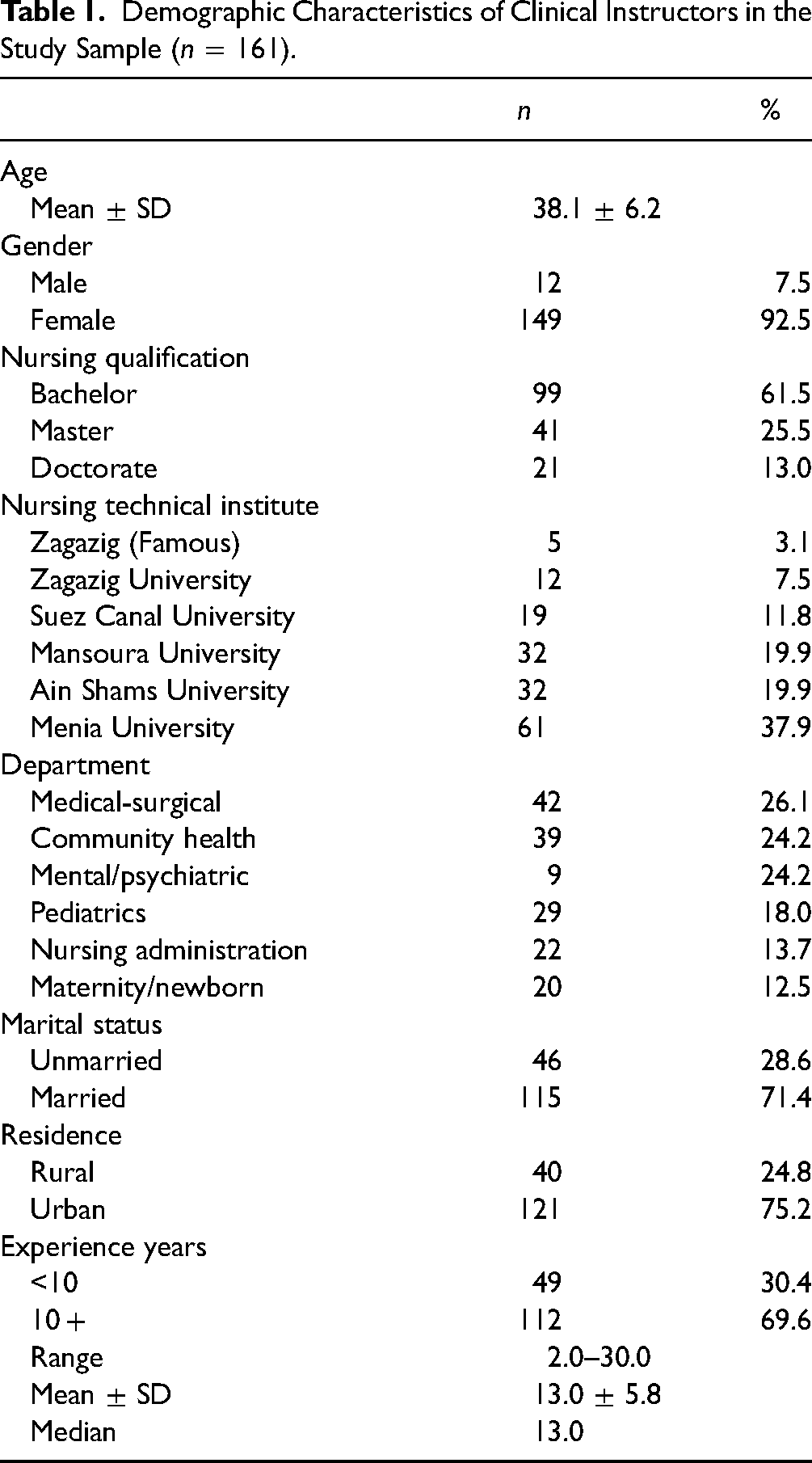
The study sample included 161 clinical instructors, mean age was 38.1 ± 6.2 years and a female majority (92.5%) (Table 1). Slightly over three-fifth (61.5%) of them had bachelor's degrees in nursing, with the remaining carrying higher degrees. Their experience ranged from 2 to 30 years, with a median of 13.0 years. They were mostly married (71.4%) and living in urban areas (75.2%). The sample included participants from various nursing departments ranging between 12.5% from Maternity/newborn and 26.1% from medical-surgical departments.
Demographic Characteristics of Clinical Instructors in the Study Sample (n = 161).
As displayed in Table 2, a majority (82%) of the clinical instructors possessed a high level of job involvement, with the first quartile of 5.00 showing that at least three-fourths of them had a response “somewhat agree” or higher. Regarding empowerment, the table shows that the highest median score war meaning (4.33), while self-determination and impact had the lowest median scores (3.00). 72.0% of them had a high score of empowerments. Concerning citizenship, the median scores ranged between 3.00 for sportsmanship and 4.80 for altruism. 55.3% had a high level of citizenship behavior.
Clinical Instructors’ Scores of Empowerments, Job Involvement, and Citizenship.

Table 3 displays statistically significant positive connections between levels of empowerment, work involvement, and citizenship. The strongest relationship was seen between job involvement and empowerment ratings (r = .329 and p-value <.01). The lowest correlation was between citizenship and empowerment scores (r = .205 and p-value <.01). There is also a substantial positive link between citizenship scores and the level of qualification of clinical instructors at r = .192 and p-value <.05
Correlation Matrix of Empowerment, Job Involvement, Citizenship Scores, and Participants’ Characteristics.

*Statistically significant at p < .05; ** Statistically significant at p < .01.
The female gender was discovered as a statistically significant positive predictor of the empowerment score in the multivariate analysis (Table 4). Working in Menia or Ain Shams University institutes is a significant positive predictor of this score compared to working in Zagazig University institutes. This workplace element was also found to be a substantial positive predictor of job involvement and empowerment. Meanwhile, the nursing instructor's level of qualification and the job involvement score were significant positive predictors of the citizenship score.
For the Empowerment, Job Involvement, and Citizenship Scores, the Best Fitting Multiple Linear Regression Model was Found.

A mediator analysis was performed to explain the function of job involvement in the relationship between empowerment and citizenship (Table 5). The results revealed that job involvement was a significant mediator of this relationship, indicating an important whether indirect effect of the empowerment score as an independent variable on the citizenship score as a dependent variable via the impact of the job involvement score as a mediator.
Mediator Effect of Job Involvement (M) Between Empowerment (IV) and Citizenship (DV).

IV = independent variable; DV = dependent variable; M = mediator.
Sobel test: tests whether the indirect effect of the IV on the DV via the mediator differs significantly from zero.
*Statistically significant at p < .05.
Discussion
The current study assessed the effect of job involvement in mediating the relationship between empowerment and OCB among clinical teachers at nursing technical institutes. Research hypothesis suggests that empowerment of clinical instructors leads to higher OCB, also job involvement of clinical instructors leads to improve OCB and empowerment.
The current study found substantial positive relationships between the scores of nursing clinical instructors on job involvement, empowerment, and OCB. Job participation acts as a mediator between empowerment and OCB. The findings result in the acceptance of the research hypothesis.
Most clinical instructors in the current study showed high levels of job involvement, as evidenced by high median scores. This shows that most of these clinical instructors identify themselves in their jobs, which is important in their feeling more satisfied with their work-life. The finding is under Dartey-Baah et al. (2019), whose study on leadership, OCB, and job involvement showed that most participants had high levels of job involvement.
According to the results of the current study, the workplace was the only characteristic affecting the scores of job involvement. Thus, its scores varied significantly among technical institutes affiliated with different universities. This might be explained by the work environment and climate, as well as the work organization and relationships. Added to this is the variation among universities and institutions, which became more prominent following the recent changes in university reforms, giving more autonomy to individual institutions, as pointed out by Maassen et al. (2017). The effect of work climate and environment on OCB has been observed in research in Brazil (Araujo & Figueiredo, 2019) and the United States (Qiu et al., 2020).
It was also shown that the empowerment score is strongly and favorably associated to the job involvement score. It was discovered as an independent positive predictor of employee engagement in the multivariate study. The finding is totally credible given the favorable influence of empowerment on organizational commitment and a sense of belonging to the workplace, both of which drive job involvement. Dartey-Baah et al. (2019) showed a substantial link between job involvement and empowerment scores, which is consistent with this. A Chinese study found that empowerment predicted teachers’ job involvement positively (Ma et al., 2021).
The current study also found that almost three-fourths of clinical instructors had high levels of empowerment. The empowerment dimensions with the highest score were that of the meaning. The dimensions of self-determination and impact had the lowest scores. This reflects the lack of autonomy at work and the absence of participation in decision making experienced by these clinical instructors. In congruence with this, the literature emphasizes the importance of autonomy for clinical instructors and educators to provide them with more trust and self-confidence to organize their work and make their own decisions (Andrews, 2019; Hemmings & Kay, 2015), and this would promote their feelings of responsibility and belonging (van Lankveld et al., 2016).
Concerning the factors influencing clinical instructors’ empowerment, the present study identified workplace, and gender as significant independent predictors. As regards gender, female instructors seem to be more empowered in comparison with their male counterparts. This might be related to the higher seniority and longer years of experience of female instructors compared with the male instructors, whose start of entry into the nursing career was more recent. To support this, in a study by Ryghaug et al. (2018) on creating energy citizenship in nursing staff, most participants were females.
OCB was the third key variable evaluated in this study. More than half of them received a high score, according to the results. The finding is consistent with the findings of Cooper (2018), who conducted a study on citizenship, inequality, and difference. According to the findings, more than half of the participants showed a high level of organizational citizenship.
In the present study, the highest score in citizenship behavior was in the dimension of altruism, while the lowest was in the sportsmanship dimension. The high altruism score reflects instructors’ helping attitudes through encouraging beginners, solving problems, and helping get work resources, which might be prevalent in the study settings. Sportsmanship refers to more tolerance for others’ errors and organizational problems, avoiding tension at work, and not exaggerating problems (Podsakoff et al., 2000). The sportsmanship dimension, in agreement with the current study, was the citizenship dimension had the lowest score in a study in Iran (Jafarpanah & Rezaei, 2020).
In terms of the factors influencing nurse teachers’ citizenship behavior scores, the current study found a substantial positive link between the level of certification and this score. The qualification level was discovered as an important independent positive predictor of citizenship score in the multivariate study. This is expected given the positive effect of academic attainment along with the maturation and accumulated experience. The results agreed with Biagioli et al. (2018), whose study in Italy found a positive association between nurses’ professional attainment and OCB.
The employment involvement score was discovered as a substantial independent positive predictor of the citizenship behavior score in the current study's multivariate analysis. The finding could be attributed to the fact that a clinical instructor who is deeply involved in their job would be more helpful to colleagues and co-workers and more tolerable to pitfalls and work problems, to maintain the organization's high prestige. A study in Italy found that job involvement was critical in influencing clinical instructors’ OCB (Han et al., 2020).
The primary goal of this study was to investigate the function of job involvement as a mediator between empowerment and citizenship. The results of the survey confirmed this mediator's role in job involvement. As a result, a more empowered employee will be more involved in the job, which will develop their corporate citizenship behavior. Kariuki & Kiambati (2017) agree with the findings. They reported that nurses’ job involvement and organizational commitment played a similar mediation function in the connection between OCB and empowerment.
Recommendations
The nursing institutes’ administration needs to pay more attention to clinical instructors, empowering them through psychological support and fair salaries to increase their perception of organizational justice. They need more autonomy and active participation in decision making, which would improve their job involvement and consequent better citizenship behavior. These subjects need to be addressed in more depth in nursing education. More study is advised to investigate the efficacy of empowerment initiatives as a path to job involvement, resulting in greater citizenship in clinical instructors’ behavior. More study is recommended to investigate the efficacy of empowerment initiatives as a path to job involvement, resulting in greater citizenship in clinical instructors’ behavior.
Conclusion
The scores of empowerments, job involvement, and citizenship behavior of clinical nursing instructors are positively correlated. Job involvement plays a mediator role between empowerment and OCB scores.
Footnotes
Acknowledgement
Researchers appreciate the participation of studied subjects.
Declaration of Conflicting Interests
The author declared no potential conflicts of interest with respect to the research, authorship, and/or publication of this article.
Funding
The author received no financial support for the research, authorship, and/or publication of this article.