




Abstract
Introduction
In the last decade, disasters increased by 60% worldwide. These occurrences have resulted in approximately two million deaths and 4.2 million injuries and left 33 million people homeless. Nurses are part of the front-line response team and should be critical during disasters. For nurses to respond competently, they must have the knowledge and skills to provide comprehensive and holistic care to the populations affected by disasters.
Objectives
This study aims to assess the level of competencies among nurses providing disaster care and identify their predictors.
Method
A descriptive correlation design was utilized to measure and predict nursing competencies in providing care to individuals amid disasters. An electronic form of disaster response competencies assessment survey was distributed to 400 nurses working at three public hospitals in the central region of Jordan.
Results
Jordanian nurses reported a moderate level of competencies in providing care for individuals. Furthermore, multiple regression analysis revealed that disaster training, disaster education, sex, and real disaster experience significantly predict nurses’ competencies.
Conclusion
With the increasing frequency of disasters, nurses should be adequately prepared to respond to disasters competently to relieve the negative consequences of these events on the affected individuals.
Introduction
Background
In the last decade, disasters have increased by 60% worldwide. These occurrences have resulted in approximately two million deaths and 4.2 million injuries and left 33 million people homeless. Moreover, at least three billion people were affected differently (Kharb et al., 2022). Disasters are classified into natural, human-created, or hybrid disasters according to their underlying cause. Natural disasters are beyond human control, including earthquakes, tornadoes, droughts, and volcanic eruptions (Nashwan et al., 2023; The International Disaster Database, 2020).
Human-created disasters are those occurrences resulting from events that are caused by humankind, such as wars and armed conflicts, structural collapse, biological, mass gathering, and traffic accidents (Veenema, 2018), while hybrid disaster is a combination of natural and man-created disasters such as fire, floods, and diseases pandemic (Veenema, 2018). On the other hand, disasters may be classified into slow-onset disasters or rapid-onset disasters according to the speed of occurrence (Veenema, 2018). A rapid-onset disaster happens suddenly, such as volcanic eruptions, earthquakes, floods, tidal waves, and tornadoes. By contrast, slow-onset disasters occur over a period of time and affect the community slowly, such as droughts and heat waves (Veenema, 2018).
Regardless of their type, disasters negatively affect the affected community's emotional, psychological, and physical states (Salam et al., 2023; The International Disaster Database, 2020). A disaster management strategy should be carried out to control these negative consequences. Disaster management is “organization, planning and application of measures preparing for, responding to and recovering from disasters” (International Federation of Red Cross, 2020). During disasters, nurses have more tasks to save themselves and others; therefore, they should be equipped with disaster response competencies involving four main domains: care for individuals, care of the community, as well as psychological care, and care of vulnerable groups (World Health Organization [WHO] and International Council of Nurses [ICN], 2009).
Review of Literature
As nurses constitute the largest group in the healthcare system (WHO, 2020), they play a primary role in all stages of disaster management. Therefore, they should be adequately equipped with the disaster competencies to deal with a disaster, safeguard populations, and limit injuries and deaths (Al Thobaity et al., 2017; Alhamory et al., 2024). The main role of nurses amid disasters is to provide psychological and physical care for individuals. Nurses care for individuals under threatening circumstances during a disaster, requiring a competent, skilled, and knowledgeable response team. Assessment, utilizing scarce resources, management care, maintaining safety, referrals, triage, evaluation, and decontamination are just a few of the competencies a nurse performs amid disasters (Rayan et al., 2019). Understanding nurses’ critical roles and exploring the factors that influence their competencies is essential.
However, nurses’ competencies are varied according to their sex, age (Nejadshafiee et al., 2020), salary (Park & Kim, 2017), clinical experience, educational level (Li et al., 2020; Nejadshafiee et al., 2020), previous disaster experience, as well as working unit (Nejadshafiee et al., 2020). In addition, disaster education plays a critical role in preparing nurses to deliver an effective response during disasters; it helps increase nurses’ theoretical knowledge related to disasters (Kitagawa, 2021). Disaster training is the cornerstone of disaster management (Noh et al., 2020). It will increase nurses’ capacity to respond to disasters, provide nurses with a practical simulation of how the disaster occurs, and provide them with opportunities to practice in similar conditions (Whetzel et al., 2013).
Searching the nursing literature showed that a few publications have addressed the issue of disaster management globally (Labrague et al., 2018). Previous studies focused on assessing nurses’ preparedness regarding disasters (Li et al., 2020; Nejadshafiee et al., 2020) and their willingness to participate in emergency and disaster events (Al-Hunaishi et al., 2019). In the United States, a correlational study was conducted to measure nurses’ preparedness for disaster and their willingness to participate in disaster, involving 186 nurses working at one outpatient facility and three hospitals. The study findings revealed that nurses in the United States are weakly prepared for disasters, and their disaster competency level is low. However, the study used a small convenience sample, limiting the study findings’ representativeness.
On the other hand, the literature review has shown that there is still a scarcity of research on disaster competencies among Jordanian nurses. Therefore, this study assessed Jordanian nurses’ perceptions regarding their disaster competencies. The results of the current study will help policymakers and administrators in hospitals develop and update continuing education programs based on nurses’ needs to achieve the optimal level of disaster management (Alkhalaileh, 2021).
Purpose of the Study
The study aims to assess the perceived levels and predictors of Jordanian nurses’ competencies in providing care for individuals amid disasters.
Methods
Design
A cross-sectional descriptive design was utilized to assess the level and predictors of nurses’ competencies while providing care for individuals amid disasters. The study was carried out at three public hospitals in the central region of Jordan, with total bed capacity ranging from 450 to 750.
Sample
Inclusion/Exclusion Criteria
Jordanian nurses who participated in the current study were conveniently recruited from the selected public hospitals if they had a diploma or baccalaureate degree in nursing, had at least six months of clinical experience after graduation, and with a history of participating in a declared disaster.
Sample Size
To calculate the appropriate sample size, the G*Power software program was used by determining a medium effect size of 0.3, a power of 0.90, and a significance level of α ≤ .05, with four predictors. Subsequently, the yielded sample size is 373 participants. However, 400 participants were recruited in the current study.
Ethical Considerations
The ethical committees of the public hospitals involved approved the current study. Nurses’ participation was confidential, voluntary, and anonymous, and electronic informed consent was sought from eligible participants who agreed to participate. Ethical considerations were ensured during the research process.
Instruments
The perceived level of nurses’ competencies was measured using the Disaster Response Competencies Assessment Questionnaire (NDRCAQ) (Marin et al., 2020), which was developed based on the International Framework of Disaster Nursing Competencies (WHO & ICN, 2009) with special attention to the response phase of disaster management, rather than preparedness, mitigation, and the recovery phase (Marin et al., 2020). The questionnaire includes two parts; the first consists of 4 items measuring nurses’ competencies in assessing individuals amid disaster. The second part contains 18 items concerning nurses’ competencies in implementing care amid disaster. Nurses responded on a 5-point Likert scale ranging from zero “weak” to four “proficient.” Cronbach's alpha was .96 for NDRCAQ (Marin et al., 2020), which revealed the tool's high internal consistency as Waltz et al. (2017) recommended. In addition, content validity was evaluated by calculating the content validity index (CVI); the evaluation of the tool yielded that CVI was 0.88 (Marin et al., 2020).
Data Collection Procedure
An Internet-based questionnaire was used to collect data, and the survey link (https://forms.gle/ZWoXRsqp9SKZJhfk8) was sent to participants via email and mobile applications, including WhatsApp and Facebook. The questionnaire cover letter included information about the title of the study, the purpose of the study, and the researcher's contact information. The next page was the consent form page. The participants were informed to read the consent form and click on agree bottom if they agreed to participate in the study and to proceed to the questionnaire. To minimize the missing responses, the participants were directed to answer all the questions in the questionnaire, or they could not proceed to another page (Waltz et al., 2017). On completion of the questions, the nurses were requested to submit the questionnaire, and the data were sent to the server. The data collection procedure takes place from March 2023 to June 2023.
Data Analysis
The statistical package for social science (SPSS) software, version 22 , was used for the data analysis. Descriptive statistics were utilized to describe the sample regarding socio-demographic characteristics and measure competencies level. Point biserial r, and Pearson's r test were utilized to test for a significant correlation between nurses’ competencies level and their characteristics. Furthermore, multiple linear regression was run to determine the predictors of nurses’ competencies level. Statistical significance was set at**** p < .05.
Results
Sample Characteristics
400 Jordanian nurses who actively participated in disasters (62.2% females) aged 21–52 agreed to participate and answered the questionnaire. Most participants (73.8%) had a baccalaureate degree in nursing, and 34.8% had clinical experience ranging from 6 months to 4 years. Of the sample 148 (37%) nurses worked in General Floor and 71 (17.8%) in Emergency Department. Nurses who received disaster education were 246 (66%), while 276 nurses (74%) received disaster training. A detailed summary of the participants’ socio-demographic characteristics is presented in Table 1.
Socio-demographic Characteristic of Nurses.

n: number; %: percent.
Nurses’ Competencies in Providing Care to Individuals Amid Disasters
Most nurses in the current study perceived themselves as moderately equipped with the competencies needed to care for individuals during disasters (M = 2.53, SD = 0.77).
The average score of the assessment subscale was (M = 2.49, SD = 0.84). The highest mean score was for “item 3”, which showed that nurses perceived themselves as competent in decontamination (M = 2.6, SD =0.95). The lowest score in the assessment part was “item 1,” which showed that the nurses perceived themselves as weakly competent in assessing patients and determining their needs for nursing care (M = 2.40, SD = 0.94). The mean score of the implementation subscale was (M = 2.53, SD = 0.79). The highest mean score was reported in “documentation” competence (M = 2.82, SD = 0.97), whereas the lowest mean score was for “refers patients” competence (M = 2.17, SD = 1.13). The average of the participant's responses is presented in Table 2.
Means of Providing Care for Individuals Competencies among Nurses (N = 400).
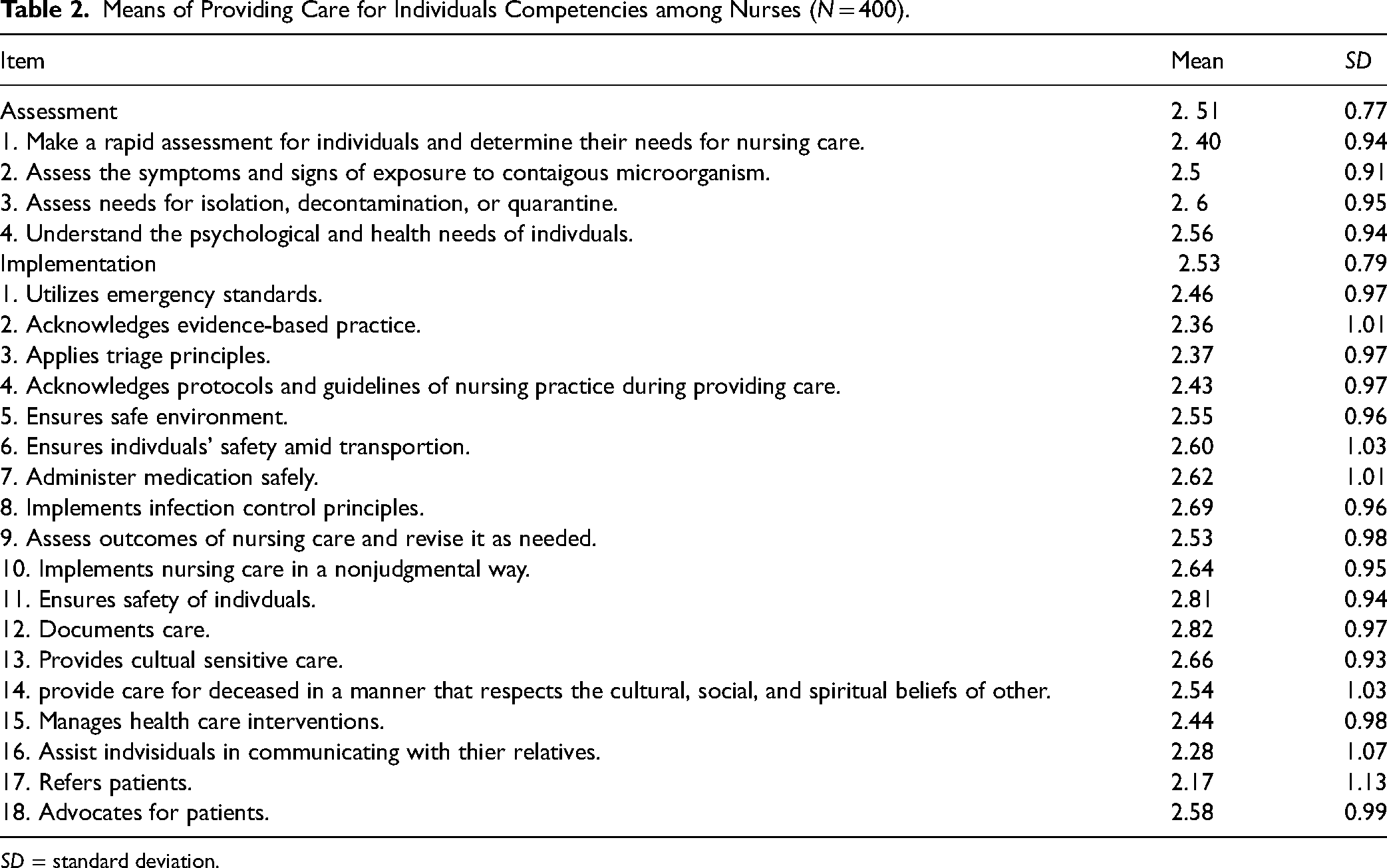
SD = standard deviation.
The findings of the point biserial r correlation test yielded a significant positive relationship between competencies level and gender rpb (398) = .21, p < .001, previous disaster experience rpb (398) = .22, p < .001, receiving disaster education rpb (398) = .27, p < .001, and disaster training rpb (398) = .35, p < .001. Besides, Pearson's r correlation test showed a weak significant positive association between age and competencies level with r (398) = .13, p = .01.
Therefore, study participants’ traits of being male, older age, having disaster experience, receiving disaster education, and participating in disaster training were associated with high levels of nurses’ competencies. On the other hand, there are nonsignificant correlations between salary, clinical experience, educational level, working area, and competencies level with r values of .04, .09, .03, .06, and .03, respectively. Table 3 shows the values of correlation coefficients.
Correlation Coefficients between Competencies Level and Nurses’ Sociodemographic Characteristics (N = 400).

a: measured by Pearson's r correlation test, b: measured by Point Biserial r test. □ p < .05, □ □ p < .01
Predictors of Nurses’ Competencies in Providing Care to Individuals
Standard linear regression analysis was calculated to determine the predictors of nurses’ competencies in the care of individuals. The findings demonstrated that the regression model could significantly predict nurses’ perceptions of their competencies in providing care for individuals amid disasters. F (4, 395) = 18.62, p < .001, ΔR2 = .15). The regression model explains 16% of nurses’ variance in care of individual competencies. Receiving disaster training (β = .22, p < .001) exerted the strongest influence on nurses’ disaster response competencies, followed by disaster education (β = .21, p = .003), sex (β = -.16, p = .001) and disaster experience (β = .12, p = .02). Table 4 shows the model fit.
Predictors of Nurses’ Competencies in Providing Care to Individuals.

B = regression coefficient; SE = standard error; β = standardized b.
Discussion
We aimed to assess the level and predictors of nurses’ competencies while providing care to individuals. Our results yielded a lack of nurses’ experience in dealing with real disasters, receiving disaster management courses, and engaging in disaster training. These results were supported by Al Khalaileh et al. (2012), who stated that most Jordanian nurses have limited disaster experience and do not engage in disaster management courses or training. However, our findings may be attributed to the fact that Jordan stands at the early phase of disaster management (Alkhalaileh, 2021), and to date, there is no disaster management plan to prepare healthcare providers, including nurses, to respond to disasters (Al-Qutob et al., 2020). Although Jordan is in a politically tense and war area, no human-made or natural disasters have happened. This makes Jordan less prepared for disasters, as no nationwide disaster policy exists. Also, with the limited reactive role of the National Center for Security and Crisis Management in Jordan, no preparedness or proactive measures were taken regarding the appropriate infrastructure that prepares Jordan for upcoming disasters. Furthermore, Jordan has no disaster training schedule for healthcare providers and laypersons.
With a lack of sufficient similar literature on nurses’ competencies, while providing care for individuals amid disasters, we compared our results to the studies on nurses’ preparedness to deal with disasters (Abu Sumaqa et al., 2024; Li et al., 2020). Our results showed that Jordanian nurses were not adequately equipped with the competencies to provide care to individuals amid disasters. Similar findings were revealed by Jordanian healthcare providers working at primary healthcare centers who reported low readiness for disaster response (Al-Ali & Abu Ibaid, 2015). However, this study considered only healthcare providers working at primary healthcare centers in the northern region of Jordan, which may limit its generalizability (Al-Ali & Abu Ibaid, 2015). Thus, a further national study may be needed to address this limitation.
Among Saudi Arabian nurses who share the same religion, culture, language, and border with Jordan, 429 nurses were recruited from six public hospitals to explore their skills and knowledge regarding disaster preparedness. A disaster preparedness evaluation survey measured the nurses’ knowledge and skill level. The study findings revealed that nurses were perceived as weakly prepared to manage disasters (Al Thobaity et al., 2015). The findings of this study were consistent with the results of another study that evaluated the information, attitude, skills, and familiarity with disaster management among Saudi nurses. Saudi nurses reported low knowledge and skills in disaster preparedness and moderate familiarity with disaster management (Ibrahim, 2014). Both previous studies used a convenience sampling strategy, which limits the generalizability of findings, as documented by Polit and Beck (2016). More to the point, a recent study that used a stratified probability sampling method revealed that Saudi Arabia's healthcare providers exhibited a moderate level of readiness in facing disaster, and they had a deficit in disaster knowledge and skills (Al Thubaiti et al., 2019).
Compared to international literature, the Chinese nurses’ competencies were better than that of Jordanian nurses, which might account for the experience of Chinese nurses in dealing with pandemics such as severe acute respiratory syndrome (SARS) (Li et al., 2020). Furthermore, in another study, the disaster competency levels were higher for Iranian nurses than those of Jordanian nurses, who obtained an average score of 2.36 out of a possible score of 4. Iranian nurses working in three educational hospitals obtained an average score of 166.38 out of 244, suggesting good disaster competencies (Nejadshafiee et al., 2020). This result may be attributed to the experience of Iranian nurses in responding to natural disasters, including the Bam earthquake (Nejadshafiee et al., 2020).
The majority of Jordanian nurses showed a good level of competence in maintaining safety. Similar findings were reported by Taiwanese nurses who perceived themselves as well-equipped with “safety” competence (Chen et al., 2021). However, the least ranked answer nurses gave was “refers patients to other agencies as needed” competence; different results were stated by nurses in Taiwan who perceived themselves as well equipped with “referral” competence. This difference between Jordanian and Taiwanese nurses in the “referral” competency may be because Taiwanese nurses in this study are novices (Chen et al., 2021) and do not have enough knowledge, skills, and experience to care for individuals during disasters; therefore, they usually refer individuals to more knowledgeable, skillful, and experienced nurses, which in turn makes them more competent in the “referral” process. However, WHO and ICN (2019) emphasized that nurses should work as part of a multi-disciplinary team and collaborate with other healthcare institutions to make an appropriate referral during a disaster. Therefore, any future disaster education or training program for Jordanian nurses should add “referral” content.
The current study showed that disaster training significantly predicts the perceived disaster competencies, supported by a previous study that showed that attending COVID-19 training was the best determinant of disaster preparedness level among nurses (Li et al., 2020). These findings were also supported by Whetzel et al. (2013), who stated that disaster training provides nurses with a practical simulation of how the disaster occurs and provides them with opportunities to practice in similar conditions.
Furthermore, our findings reported that previous disaster experience is a good predictor of nurses’ perceived disaster response competencies, which was relatively relevant to a previous study conducted in South Korea (Park & Kim, 2017), which showed that having a previous disaster experience appears to be the best determinant of disaster management competencies. Similar findings were reported by Li et al. (2020), who found that previous experience in dealing with infectious diseases exhibited a significant influence on disaster preparedness among nurses during the COVID-19 pandemic. These findings were also supported by Chen et al. (2021), who found that previous experience in dealing with disease pandemics was the primary predictor of disaster competencies among nurses. In the current study, disaster education was found to predict nurses’ competencies in providing care to individuals; these findings were supported by Park and Kim (2017), who stated that nurses’ perception of disaster competencies is enhanced proportionally via disaster education.
Implications
Based on the study results, assessing the level of disaster response competencies among all nurses who provide care to individuals amid disasters is necessary. Identifying the level of disaster competencies could help plan continuing education program courses based on nurses’ needs. Tailored educational programs focusing on the competencies should be developed at healthcare institutions to improve nurses’ competencies and, ultimately, the care provided to individuals amid disasters. Furthermore, nurses should receive continuous assessments and follow-ups to evaluate the impact of continuing education programs on their competencies.
The results of this study can help nurses identify their role during a disaster, which includes providing care to the community and individuals, psychological care, and care to a vulnerable group. A better understanding of their responsibilities and roles during the disaster will translate to better nurses’ performance in responding to disaster. Furthermore, a committee of expert nurses in the disaster nursing specialty should be established at healthcare institutions to educate and train nurses regarding disaster management, improving nurses’ competencies and the quality of nursing care provided to the affected individuals. We believe nurses with previous disaster experience who received disaster education and training should be assigned to field hospitals to ensure an efficient and effective response to disasters. Furthermore, those nurses should mentor and support novice nurses to improve their disaster competencies.
Moreover, the results of this study should guide policymakers at all levels, national and state, of healthcare institutions to evaluate the state of disaster competencies among healthcare providers, including nurses, to establish training and educational programs according to gaps in nurses’ competencies. In addition, the Jordanian Nursing Council (JNC) should consider the importance of the disaster management era by establishing a policy that considers disaster training and education as prerequisites for licensed nurses.
Recommendations
Further experimental research studies are recommended to examine the impact of competency-based educational programs on the disaster competencies level among nurses. A more representative sample that includes nurses working in military hospitals is recommended in future studies to support generalizability.
Limitations
In the current study, a self-reported questionnaire was utilized to assess the perceived level of nurses’ competencies, which may not reflect the actual level of competencies, and it depends on the accuracy of nurses’ responses. Furthermore, study participants were recruited through a convenience sampling technique, increasing the risk of selection bias and limiting the study findings’ representativeness (Polit & Beck, 2017).
Conclusion
Nurses are the largest responders during a declared disaster, so they significantly care for victims. Therefore, they should be equipped with disaster competencies to maintain community well-being. However, the majority of Jordanian nurses showed a moderate level of disaster competencies. Also, nurses had limited experience in real disasters, and some did not engage in disaster management courses or training. Moreover, multiple regression analysis revealed that disaster training and education significantly predict nurses’ disaster response competencies. Therefore, the upcoming health policies should focus on providing disaster education and training as part of continuing education programs for all employees at healthcare institutions, including nurses.
Supplemental Material
sj-docx-1-son-10.1177_23779608241288752 - Supplemental material for Determinants of Disaster Competencies Among Jordanian Nurses in Public Hospitals
Supplemental material, sj-docx-1-son-10.1177_23779608241288752 for Determinants of Disaster Competencies Among Jordanian Nurses in Public Hospitals by Sajeda Alhamory, Inaam Khalaf and Jafar Alasad Alshraideh, Yasmeen Abu Sumaqa, Ahmad Rayan, Mariam kawafha, Dua'a Fayiz Al Maghaireh, Suad Jakalat, Manar Abu-abbas, Mohammad Al-Ma'ani, Muamar O. Aldalaeen in SAGE Open Nursing
Supplemental Material
sj-docx-2-son-10.1177_23779608241288752 - Supplemental material for Determinants of Disaster Competencies Among Jordanian Nurses in Public Hospitals
Supplemental material, sj-docx-2-son-10.1177_23779608241288752 for Determinants of Disaster Competencies Among Jordanian Nurses in Public Hospitals by Sajeda Alhamory, Inaam Khalaf and Jafar Alasad Alshraideh, Yasmeen Abu Sumaqa, Ahmad Rayan, Mariam kawafha, Dua'a Fayiz Al Maghaireh, Suad Jakalat, Manar Abu-abbas, Mohammad Al-Ma'ani, Muamar O. Aldalaeen in SAGE Open Nursing
Footnotes
Acknowledgments
We would like to thank the participants who kindly agreed to participate in this study and answered the questionnaire.
Author Contributions
All listed authors have met the International Committee of Medical Journal Editors (ICMJE) criteria for authorship. Specifically:
All authors made a significant contribution to the concept, design, acquisition, analysis, and interpretation of data. All authors have drafted and revised the article critically for important intellectual content. All authors have approved the final version of the article for publication. All authors have agreed to be accountable for all aspects of the article and have resolved any issues related to its accuracy and integrity.
Declaration of Conflicting Interests
The author(s) declared no conflicts of interest with respect to the research, authorship, and/or publication of this article.
Funding
The author(s) received no financial support for the research, authorship, and/or publication of this article.
Ethical Approval
Our study was approved by the Institutional review board (IRB) of the Jordanian Ministery of Health (approval no. 2021\6\15).
All participants provided electronic informed consent prior to enrollment in the study.
This study conforms with the principles outlined in the Declaration of Helsinki.
ORCID iDs

Supplemental Material
Supplemental material for this article is available online.
References
Supplementary Material
Please find the following supplemental material available below.
For Open Access articles published under a Creative Commons License, all supplemental material carries the same license as the article it is associated with.
For non-Open Access articles published, all supplemental material carries a non-exclusive license, and permission requests for re-use of supplemental material or any part of supplemental material shall be sent directly to the copyright owner as specified in the copyright notice associated with the article.
