




Abstract
Introduction
The COVID-19 pandemic was associated with numerous changes in daily life conditions that could affect the psychological response of individuals worldwide.
Objective
The study aimed to describe and examine differences in depression, anxiety, and stress in relation to living conditions during the COVID-19 pandemic.
Methods
A cross-sectional design was used. Purposive snowball sampling was employed to include 642 participants. Arabic versions of the Depression, Anxiety, and Stress Scales were used to collect data. Descriptive statistics, t-test, ANOVA, and Pearson's correlation were used to analyze the data.
Results
The total mean scores of depression, anxiety, and stress were 12.26 (SD = 10.53), 9.04 (SD = 9.34), and 13.49 (SD = 10.72), respectively. Of the study sample, 122 (19.5%), 139 (22.2%), and 99 (15.9%) had severe to extremely severe levels of depression, anxiety, and stress, respectively. Significant differences were found in depression, anxiety, and stress in relation to age, chronic diseases, and house size.
Conclusion
The findings showed an increased prevalence of depression and anxiety during the COVID-19 pandemic. Mental health practitioners need to recognize the impact of pandemics on youth, females, low-income populations, and individuals with chronic diseases. Preventive mental health services among these populations, such as screening and counseling, would help reduce the health risks.
Introduction
The Coronavirus outbreak began in China in December 2019, and the World Health Organization (WHO) declared a pandemic in March 2020 (Hassan et al., 2020). Approximately 225.02 million people have been affected worldwide as of September 14, 2021, with 4.64 million deaths. Concerning the pandemic in Jordan, 807,384 individuals have been infected with COVID-19 as of September 14, 2021, with 10,548 of them dying (WHO, 2021). Currently, clinicians are working hard to give vaccines to disrupt the virus's transmission cycle, but a large number of people have COVID-19 infection, with symptoms ranging from mild to severe (Wang et al., 2020a). Mental health is defined by the WHO (2022) as a state of wellbeing that is supported by six psychological elements: (a) self-acceptance; (b) meaning in life; (c) autonomy; (d) healthy relationships with others; (e) environmental mastery; and (f) personal growth. Because of the COVID-19 pandemic, anxiety about contracting the virus or dying from it has made mental health and emotional problems one of the biggest global public health concerns. As a result, a large number of people experience increased levels of anxiety, rage, panic, PTSD symptoms, and depression (Mukhtar, 2020). Symptoms like anxiety, fear, and depression are the most common triggers that impact mental health of people including abnormally high levels dread, irritation, helplessness, loneliness, and tension (Ahorsu et al., 2020). According to Bhuiyan et al. (2020), under severe circumstances, it may cause suicidal thoughts and attempts. Furthermore, according to Lee (2020), the number of domestic abuse cases in China has increased during the lockdown, and women are under extreme psychological stress. In addition, too much stress can cause physical problems (WHO, 2022) such as heart, blood vessels, diabetes (Bhatti et al., 2022), and temporomandibular disorders (Minervini et al., 2023a, 2023b).
Review of Literature
A triad of stress, anxiety, and depression among people is one of the most common negative psychological symptoms widely investigated and reported during the pandemic (Luo et al., 2020; Salari et al., 2020). A systematic review conducted in the general public by Salari et al. (2020) showed that the occurrence of stress in 9,074 participants among five studies was 29.6%, the prevalence of anxiety in 63,439 participants among 17 studies was 31.9%, and the prevalence of depression in 44,531 participants among 14 studies was 33.7% (Salari et al., 2020). Furthermore, another systematic review that included 62 studies with 62,639 participants from 17 nations showed that stress, anxiety, and depression prevalence was 40%, 33%, and 28%, respectively (Luo et al., 2020). A rapid scoping review of 16 studies that included 113,285 participants estimated mental health problems within the first seven months of the pandemic showed that the prevalence of stress, anxiety, and depression was 53%, 35%, and 20%, respectively (Lakhan et al., 2020). Also, a longitudinal study surveyed 1,738 Chinese participants twice at the beginning ad during the epidemic's peak demonstrated rates of 28.8%, 8.1%, and 16.5% of stress, anxiety, and depression at the initial outbreak, respectively, and there were insignificant longitudinal variations for theses triad symptoms (Wang et al., 2020a).
Stress, anxiety, and depression were also investigated as a group or as separate symptoms in several cross-sectional studies in many countries and across nations at the same time. A cross-sectional study involved 678 general public participants from the United States of America, Canada, United Kingdom, Pakistan, and other countries showed stress in 57.4%, anxiety in 50.9%, and depressive symptoms in 58.6% of participants (Shah et al., 2021). Another cross-sectional study comprising seven Arab countries, including Jordan, showed that the differences in COVID-19 related stress, anxiety, and depression were significantly different between these countries; levels of depression, anxiety, and stress in Jordan were among the highest levels in the study (Shuwiekh et al., 2020). A study in China comprises of 1,210 participants from 194 cities found that 8.1% reported moderate to severe levels of stress, 28.8% reported moderate to severe levels of anxiety, and only 16.5% reported moderate to severe levels of depression (Wang et al., 2020a). Further, a study that included 354 general Indian public reported a rate of 11.6%, 28%, and 25% of stress, anxiety, and moderate to severe levels of depression, respectively (Verma & Mishra, 2020).
A group of factors was correlated with mental health problems during COVID-19 pandemic. A systematic review of Xiong et al. (2020) showed that symptoms of stress, anxiety, and depression were significantly correlated with age equal to or less than 40 years, female gender, student and unemployment status, and chronic illnesses (Xiong et al., 2020). A study by Mazza et al. (2020) on 2,766 Italian reported that gender, negative affect, and detachment were correlated with higher levels of stress, anxiety, and depression. Furthermore, participants with infected family members reported a higher level of anxiety, and those who had a young person work outside their home reported higher levels of stress (Mazza et al., 2020). Another cross-sectional study in Spain comprised 976 adults who reported higher stress, anxiety, and depression symptoms in younger individuals with a chronic disease (Ozamiz-Etxebarria et al., 2020a). Shah et al. (2021) showed that younger age, female gender, and non-marital status were significantly associated with higher stress, anxiety, and depression (Shah et al., 2021). Meanwhile, social distancing was found to be protective against stress and anxiety (Alkhamees et al., 2020), and up-to-date, accurate information and preventive measures (e.g., hand hygiene, wearing a mask) were found to be protective against stress (Wang et al., 2020a), anxiety (Wang et al., 2020b), and depression (Alkhamees et al., 2020; Wang et al., 2020a). There are limited studies that examined the relationships of stress, anxiety, depression with living conditions within the public during the pandemic, particularly in Jordan.
Purpose
This study aimed to (a) describe levels of depression, anxiety, and stress among the Jordanian population during COVID-19 pandemic; (b) describe living and environmental conditions, work conditions, and daily life changes during the pandemic; and (c) examine differences in depression, anxiety, and stress in relation to living and environmental conditions, work conditions, and daily life changes during COVID-19 pandemic.
Study Questions
What is the level of depression, anxiety, and stress among Jordanian population?
What are the living and work conditions, and daily life changes during pandemics from Jordanian population perception?
What are the differences in depression, anxiety, and stress in relation to living and environmental conditions, work conditions, and daily life changes during COVID-19 pandemic?
Methods
Study Design
A cross-sectional design was used in this study.
Sample and Settings
The study was conducted in Jordan in February 2021. The inclusion criteria were Jordanian citizens aged 18 years or above, can read and understand Arabic, and were willing to participate in the study. The sample size was calculated based on population proportion sample size calculation. The parameters used were the size of adult population in Jordan 6.92 million (Department of Statistics, 2020), margin of error (5%), a 95% confidence level, and a four confidence interval. The resulting estimated sample size was 600. The sampling techniques of networking and snowballing were used to reach the study participants. Different social media (Facebook and WhatsApp groups) were used to distribute the link of the questionnaire. The link of the study was shared with administrators of the social media networks in Jordan. The administrators agreed to post and send the link of the study to invite participants.
Data Collection
Data collection took place in February 2021. A web-based (online) self-administered questionnaire was used to collect the data. Google Forms was used to structure the questionnaire (https://drive.google.com). The researchers used two options to prevent duplicate responses include enabling Google Forms’ built-in “limit to one response & response validation and restricting responses to one per person using Google Forms Add-ons.” A cover letter was used to explain the purpose of the study and what is required from the participant. Participants were provided with a link to access and complete the questionnaire and were instructed that the questionnaire takes 15–20 min to be completed. Submitted questionnaires were saved to the researcher's private Google drive.
Instrumentation
Demographic sheet. Include information about age, sex, academic level, employment status, monthly income, marital status, health insurance, and chronic diseases.
Living, Environmental, Work Conditions, and Changes in Daily Life during COVID-19 were adopted from Rodríguez-Rey et al. (2020) study, which was consist of seven questions to ask about living and environmental conditions during the home confinement including number of family members, number of dependent cohabitants (including children and older people), number of household rooms, whether the residence had any open-air area, the average number of hours a day spent at home during the last week, and the number of days spent without leaving their home. Also, it includes two questions about work-related variables during the pandemic including whether participant losing job during COVID, and whether they believed that their income was likely to decrease due to the pandemic. And another two questions about significant changes in daily life due to the COVID-19 pandemic including their perceived impact of the pandemic, and if they cancel/postpone any travels or social gatherings during COVID.
Depression, Anxiety, and Stress. They were measured using the Arabic version of the Depression, Anxiety, and Stress Scales (DASS) (Moussa et al., 2017). It is a self-report questionnaire which was first developed by Lovibond and Lovibond (1995) for mental health evaluation that is divided into 3 subscales of 14 questions each: stress, anxiety, and depression. On a four-point Likert scale, from 0 (did not apply to me at all) to 3 (applied to me very much, or most of the time), participants assess how much a symptom has affected them over the course of the previous week. It provides a quantitative (dimensional) measure of the severity of each syndrome (Lovibond & Lovibond, 1995). The Arabic version of DASS was similar to the original in content except it was in Arabic which is the native language of the participants, and included three subscales of 12 items with total of 42 items on 4 in Likert scale (Moussa et al., 2017). The psychometric properties of the Arabic version of the DASS have been demonstrated to be good in previous studies (Alansari, 2020; Moussa et al., 2017). Each subscale score can range from 0 to 40. The depression subscale score is interpreted as follows: 0–9 indicates no evidence of depression, 10–13 indicates mild depression, 14–20 indicates moderate depression, 21–27 indicates severe depression, an ≥28 indicates extremely severe depression. The anxiety subscale score is interpreted as follows: 0–7 indicates no evidence of anxiety, 8–9 indicates mild anxiety, 10–14 indicates moderate anxiety, 15–19 indicates severe anxiety, and≥ 20 indicates extremely severe anxiety. The stress subscale score is interpreted as follows: 0–14 indicates no evidence of stress, 15–18 indicates mild stress, 19–25 indicates moderate stress, 26–33 indicates severe stress, and ≥ 34 indicates extremely severe stress.
Data Analysis
Data were analyzed using the Statistical Package for Social Science (SPSS) version 23 (IBM Corporation, 2012). Descriptive statistics, including frequencies and percentages, were calculated to describe demographics, living, environmental, work conditions, and changes in daily life during the pandemic. Means, standard deviations, and percentile were calculated to describe the age, depression, anxiety, and stress subscales. The t-test, one-way ANOVA, and Pearson's correlation were used to test differences and associations. The results were considered statistically significant if P ≤ .05.
Ethical Consideration
Ethical approval was obtained from the Scientific and Research Committee at the University where the primary work in. The researchers did not obtain permission from institutions or facilities because data was collected through an electronic self-administered questionnaire. The protocol for the research project conforms to the provisions of the Declaration of Helsinki in 1995 (as revised in Edinburgh 2000). The researchers obtained permission from the authors of the questionnaires to use them in this study. Participation in the study was voluntary, and the anonymity of the participants was ensured throughout the study. The first page of the questionnaire included the consent form and clicking on the “next” bottom indicated that the participant agreed to participate.
Results
Sample Characteristics
The sample consisted of 642 participants. The age of the participants ranged between 18 and 68 years. Most participants were females (66.8%) and had university-level education or higher (88.3%). Further characteristics of the sample are presented in Table 1.
Sample characteristics (N = 624).

Living and Environmental Conditions, Work Conditions, and Daily Life Changes During COVID-19 Pandemic
Most of the participants had more than six family members (48.1%), and about 35% of the sample lived with an older adult at home. One third of the sample did not commit at all to home quarantine. More than13% lost their job during COVID-19. Most of the participants canceled or postponed travels or social gatherings during the pandemic. Further conditions are explained in Table 2.
Living and environmental conditions, work conditions, and daily life changes during COVID-19 pandemic (N = 624).

Depression, Anxiety, and Stress During COVID-19 Pandemic in Jordan
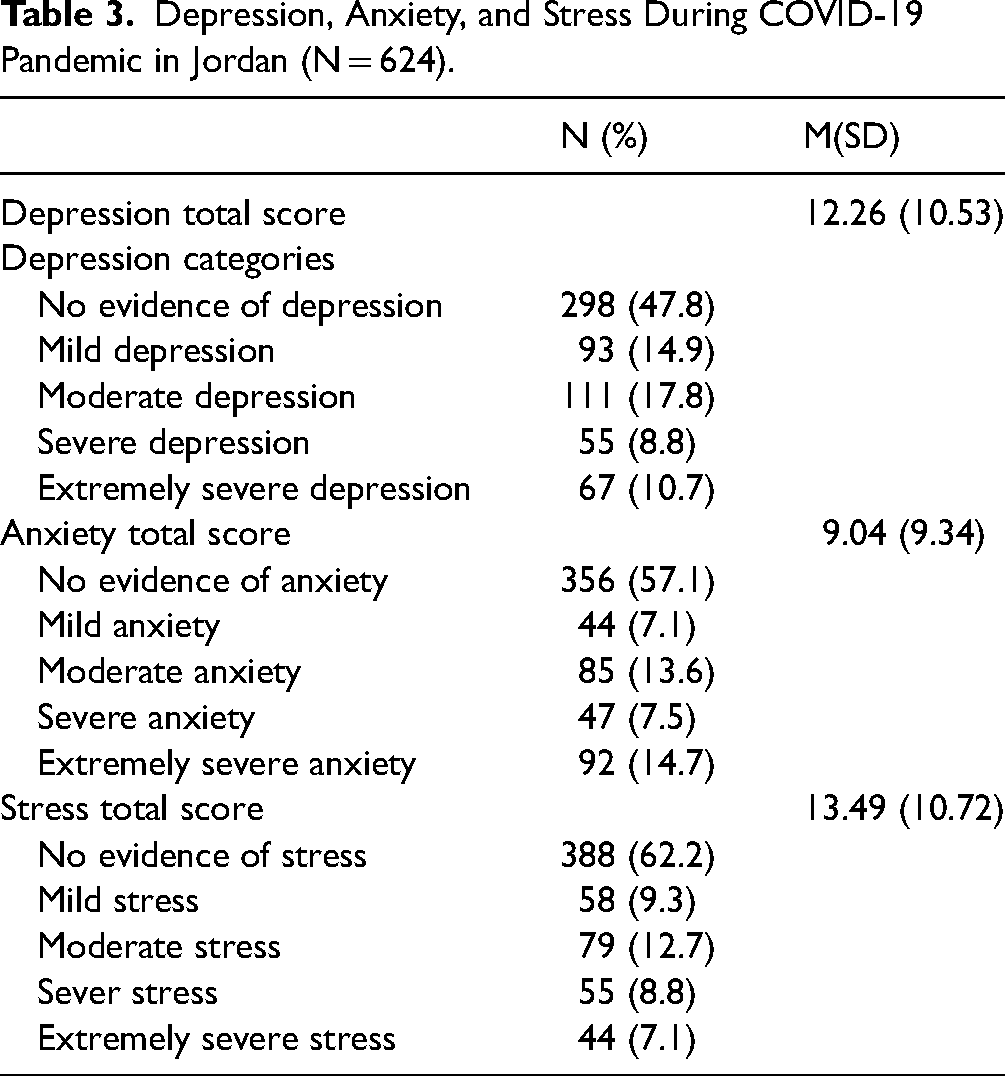
The mean total score of depression was 12.26 out of 40 (SD = 10.53), indicating mild depression, and 19.5% of the sample had severe to extremely severe depression. The mean total score of anxiety was 9.04 out of 40 (SD = 9.34) which indicates mild anxiety, and the mean total score of stress was 13.49 out of 40 (SD = 10.72) with no evidence of stress. Table 3 shows also that 22.2% of the sample had severe to extremely severe anxiety and 15.9% had severe to extremely severe stress.
Depression, Anxiety, and Stress During COVID-19 Pandemic in Jordan (N = 624).
Differences in Depression During COVID-19 Pandemic in Jordan
Levels of depression were significantly higher among the following categories: younger age participants, females, participants without a health insurance, participants who had chronic diseases, participants who lived with an older person in their home, participants with family income less than 352 JD, participants with less than three house rooms, participants who stayed in-home quarantine for 10 days or less, and participants who were unmarried (divorced, widowed, or separated), participants who stayed in-home quarantine for 10 days or less, participants who spent 20–24 h at home, participants who lost their job due to the pandemic, participants who were uncertain about the risk of income reduction, and participants who reported that the pandemic affected their life very much. Table 4 shows the significance level of these differences.
Significant Differences in Depression, Anxiety, and Stress During COVID-19 Pandemic in Jordan. (N = 624).

Note. r = Pearson correlation coefficient; t = t-test; F = F-statistic (ratio of variance).
Differences in Anxiety During COVID-19 Pandemic in Jordan
Anxiety levels were significantly higher among younger participants. Participants with chronic diseases, participants who lived with an older person in their home, and participants with less than three house rooms reported higher anxiety levels as shown in Table 4.
Differences in Stress During COVID-19 Pandemic in Jordan
Participants’ stress level was negatively associated with their age (r = −.123; P = .002). Table 4 also shows the significantly higher levels of stress were among female participants, participants with chronic diseases, participants with less than three house rooms, participants who stayed in-home quarantine for 10 days or less, participants who were not working before the pandemic, participants who were unsure of the risk of income reduction, and participants who reported that the pandemic affected their life rather much.
Discussion
In the current study, depression, anxiety, and stress prevalence were 52.2%, 42.9%, and 37.9%, respectively. Depression is the most prevalent mental health problem among the Jordanian population during COVID-19 pandemic. These rates seem almost consistent with what was reported in a cross-sectional study that examined levels of depression and anxiety in a general Jordanian population (N = 1,798) in March 2020; the rates of depression and anxiety were 66.7% and 58%, respectively (Naser et al., 2020). The levels of moderate to extremely severe depression were higher among participants in the current study (37.3%) in comparison to a previous national study that examined the presence of depression among 4,002 Jordanian participants (31.8%) (Jaddou et al., 2012). However, a systematic review that assessed levels of depression, stress, and anxiety among general populations worldwide during the pandemic showed lower levels of depression, stress, and anxiety compared to the Jordanian population; the prevalence rates were 33.7%, 29.6%, and 31.9%, respectively (Salari et al., 2020). Another systematic review was conducted on studies from 17 nations (most of them were conducted in China) showed that the prevalence of depression, stress, and anxiety was 28%, 40%, and 33%, respectively (Luo et al., 2020). These comparisons indicate that the prevalence of depression and anxiety among the Jordanian population during the pandemic is higher than the average reported in studies across different countries. This is alarming, as a longitudinal study in China revealed that the levels of these mental health problems do not significantly decrease over time (Wang et al., 2020).
Our analysis showed that being younger was associated with higher depression, and stress levels. Inconclusive relationships between age and DASS scores were found across different studies. Consistent with our findings, younger individuals reported higher stress, anxiety, and depression levels in a sample of 976 adults in Spain (Ozamiz-Etxebarria et al., 2020b). Additionally, Hou et al. (2020b) found that the severity of depression symptoms would decrease with age increase. However, another study found that age was not associated with DASS subscale scores (Wang et al., 2020). One possible explanation could be that older adults develop more active strategies and positive religious coping associated with fewer stressful and depressive symptoms (Bjørkløf et al., 2013). In the current study, individuals with chronic diseases reported higher mean levels of depression, anxiety, and stress. These results confirm previous studies showing that individuals with chronic health conditions suffer from high levels of psychological distress during the pandemic (Gorrochategi et al., 2020; Ozamiz-Etxebarria et al., 2020b). These individuals would have higher depression, anxiety, and stress levels since people with chronic diseases are at a higher risk of severe COVID-19 symptoms, intensive care unit admissions, and mortality (Geng et al., 2021). This highlights the importance of providing psychological counseling for these individuals to assist them in coping with COVID-19 crisis. Moreover, individuals who have less than three rooms at home had higher levels of depression, anxiety, and stress. Some studies found that suitable housing including the size of the house is a critical factor that impacts the mental health of individuals during the COVID-19 crisis (Bower et al., 2021). Other studies found no association between household size and these factors (Wang et al., 2020).
Gender differences were found in relation to depression and stress; females reported higher levels of depression and stress compared to males. Similarly, females were experiencing more severe stress and anxiety symptoms (Hou et al., 2020b). In the same line, a study that examined the prevalence of depression, anxiety, and stress among the general population in Saudi Arabia during this pandemic found that depression, anxiety, and stress were significantly higher among females (Alamri et al., 2020). On the other hand, the male gender was significantly associated with higher depression, anxiety, and stress in China (Wang et al., 2020). No significant difference in depression between males and females was found in China (Hou et al., 2020a). It was found that women in the Middle East, more than any other region, suffer from higher rates of depression compared to men (World Bank, 2013). The most plausible explanation for this finding is the women's struggle to transition from traditional roles to modern life roles in the Middle East (Eloul et al., 2009).
The results of this study also showed that people who lost their jobs and their income was reduced are more prone to increase levels of depression, anxiety, and stress. These results were consistent with many other studies (Li et al., 2020; Molarius & Persson, 2022). This may be due to the profound effect of COVID-19 on how people live and work, which has had a disastrous effect on jobs and economies worldwide because the decision to ‘lockdown’ the country also negatively impacted the employment market (Bell & Blanchflower, 2020). Also, income uncertainty is linked to several negative effects on both mental and physical health. During COVID-19 people in this study as well as many other studies, in the workforce who feel insecure about their jobs and incomes frequently report higher levels of Stress, anxiety, despair, and physical and emotional tiredness, as well as psychosomatic complaints that may last for a long time (Bell & Blanchflower, 2020). This may be due to their decreased access to the multitude of hidden advantages that occupations offer, such as stable incomes, health insurance, social interaction, social status, regular activity, and organized time.
In the beginning of COVID-pandemic, all governments globally introduced a lockdown resulting in wide restrictions on movement and socialization that consequently increase the stress, anxiety, and depression of Jordanian people since they spent a lot of time and hours at home. Staying at home for long hours without socialization bring the challenge of loneliness that may impact the mental health; it is true that loneliness has been linked to worse health and psychological outcomes, such as higher rates of physical and mental illnesses and death (Taylor et al., 2022). Following the COVID-19 pandemic and the implementation of governmental pandemic-related measures and restrictions, individuals in Jordan and worldwide have been exhibiting a diverse array of rapid psychological responses including stress, anxiety and depression as a result of many changing condition related to living, daily life, and work conditions, so shaping effective public health initiatives to support mental health, encourage healthy lifestyles, and lessen psychological issues and dread in at-risk populations during the COVID-19 pandemic is necessary. Furthermore, both during and after the lockdown, more qualitative, longitudinal, and experimental investigations may be guided by this study results.
Strengths and Limitations
This study has some limitations to be addressed. The cross-sectional design used limits the ability to detect causal relationships. Also, the networking, snowballing, and online recruitment method used to select the sample could have led to selection bias. Despite these limitations, this study provides valuable information about the Jordanian population's psychological response during the COVID-19 pandemic.
Implications for Practice
The results can be used to develop psychological interventions that mitigate the psychological impact of the pandemic. Further, it provides baseline data that can be used to evaluate the effectiveness of prevention and control efforts during a pandemic. Specific mental health interventions should be focused on young and female populations in Jordan. Qualitative research is required to provide a deeper comprehension of how the general public has handled psychological issues and psychological negative impacts in response to the epidemic. Furthermore, experimental research is required to assess the efficacy of applied psychological therapies for the general population within the COVID-19 epidemic. Lastly, our findings could potentially be important if any additional pandemics emerge in the future.
Conclusion
During the COVID-19 pandemic in Jordan in 2021, 37.3%, 35.8%, and 28.6% had moderate to extremely severe depression, anxiety, and stress levels, respectively. The findings showed an increased prevalence of depression and anxiety in the Jordanian population during COVID-19 pandemic. Gender differences in depression and stress symptoms were observed, with females experiencing more severe depression and stress symptoms than males. It is essential to safeguard younger people's mental health, people who suffer from chronic diseases, and people with unsuitable housing conditions.
Footnotes
Acknowledgment
I confirm that all authors meet the authorship and agree with the content of the manuscript.
Authors Contributions
All authors have made substantial contributions to all of the following: (a) the conception and design of the study, or acquisition of data, or analysis and interpretation of data, (b) drafting the article or revising it critically for important intellectual content, (c) final approval of the version to be submitted, and (d) agreed to be accountable for all aspects of the work in ensuring that questions related to the accuracy or integrity of any part of the work are appropriately investigated and resolved.
Declaration of Conflicting Interests
The authors declared no potential conflicts of interest with respect to the research, authorship, and/or publication of this article.
Funding
The authors received no financial support for the research, authorship, and/or publication of this article.
Ethical Statement
This research was reviewed by the Institutional Review Board at The University of Jordan (no 4/1/2016) and Al-Ahliyya Amman University. The Ethical Committees at the Faculty of Nursing have approved the protocol for the research project where the researcher works, and it conforms to the provisions of the Declaration of Helsinki in 1995 (as revised in Edinburgh 2000). Informed consent was obtained from nurses as well. The anonymity of the study participant was maintained throughout the research process.
