




Abstract
Introduction
As the threat of COVID-19 continues, new evidence and knowledge of the disease is coming to light, thus it is critical to evaluate nurses’ knowledge, attitudes, and practices (KAP) regarding the control and prevention of COVID-19 infections.
Objective
The objective of the study was to assess the KAP of nurses regarding the prevention and control of COVID-19 at a selected regional hospital in Namibia
Methods
A quantitative, descriptive cross-sectional study was used to quantify and measure the relationships between the demographic variables and the key variables of KAP regarding the prevention and control of COVID-19. A total of 101 respondents were conveniently sampled. Data were collected online and analyzed using SPSS version 27.
Results
The mean scores were: knowledge 26.8 (83.8%), attitude 44.8 (70%), and practice 46.8 (78%). The Pearson's correlation showed that the practice score was positively correlated to the attitude score (r = 0.556, p < 0.01), while the independent samples t-test showed that gender, COVID-19 status, and nurse status had no effect on knowledge, attitude, or practices (p > 0.05). There was a significant mean difference in the attitude scores between the vaccinated and the non-vaccinated nurses: t (86.251) = 2.974, p ≤ 0.05, as well as in the practice scores: t (98.956) = 1.989, p < −0.05. Multiple linear regression indicated that the regression model was statistically significant (F = 2.536, p < 0.001, adjusted R2 = 0.145).
Conclusion
The results of this study revealed that some of the nurses had inadequate KAP related to the prevention and control of COVID-19. Consequently, these nurses need more intensive training to ensure that they display a high level of knowledge, positive attitudes, and good practices regarding the virus. This will both safeguard the nurses and reduce the transmission of COVID-19.
Introduction
The Coronavirus 2019 (COVID-19) is an ongoing global public health threat, which has led to a worldwide pandemic. This ongoing threat is caused by a virus, Severe Acute Respiratory Syndrome, Coronavirus 2 (SARS-CoV-2) (Ferdous et al., 2020). The outbreak was declared a public health emergency of international concern in January 2020 and has claimed millions of lives globally (Ali et al., 2020; Sohrabi et al., 2020).
While the cases of COVID-19 are on a downward trend globally, albeit with occasional upticks, the threat remains high. This suggests that the pandemic is far from being controlled, hence the need to continue implementing measures to prevent and control infection rates. The ongoing spread of the infection is attributed to the public's poor understanding of the disease (Begum, 2020). While a lot has been done to raise awareness and improve knowledge among the public and healthcare providers, practices around COVID-19 uptake are not improving. Healthcare workers perceive that limited infection control materials and poor knowledge regarding transmission are the major barriers to infection control (Bhagavathula et al., 2020). In addition, healthcare workers are at high risk of getting the infection and are a source of transmission in the community (Harith et al., 2022). Even though some studies have evaluated knowledge, attitudes, and practices (KAP) on COVID-19 among the public and healthcare providers, more research is needed. In Namibia, for example, no studies have been conducted regarding nurses’ KAP regarding the prevention of COVID-19.
Following the outbreak of COVID-19, Namibia took a number of measures to prevent and control its spread. At all major health facilities in the country, COVID-19 isolation rooms/units were established in existing facilities and new prefabricated facilities. New healthcare staff were hired and the budgetary allocation for health was increased to ensure a supply of protective gear and respiratory support equipment, among others. While there were challenges accommodating every COVID-19 patient at the peak of the pandemic, there was a relatively adequate supply of protective gear. In terms of vaccinations, in June 2021 only 22,285 people were fully vaccinated (1.5% of the targeted population), despite the availability of vaccines. This highlighted the slow uptake of the vaccine.
At the site of this study, there is an isolation unit where some COVID-19 patients are admitted, which is why this study was key to ascertain if correct procedures are being followed when handling COVID-19 patients, including the use of personal protective equipment, as some isolation unit nurses have tested positive for the virus. This hospital recorded 110 healthcare workers testing positive for COVID-19, of which almost half were from the hospital itself. This is a concern for the hospital and the Ministry of Health, which is why this study is important. These findings will help authorities organize the necessary educational programs in order to provide up-to-date information and deliver the best practices to control and prevent COVID-19 among nurses.
Review of Literature
Various databases were searched to inform this study, including PubMed, Science Direct, and BioMed, using the search words “nurses + infection + prevention + control + COVID-19 + knowledge + attitudes + practices.” Various combinations of these words were used. The review covered the KAP of nurses and other healthcare workers as they related to COVID-19.
Some extant literature demonstrated that nurses and healthcare workers’ knowledge regarding the prevention and control of COVID-19 is generally high, with mean scores ranging between 75% and 91% (Alrubaiee et al., 2020; Amro et al., 2022; Maurya et al., 2022; Tien et al., 2021). Similar results were reported in certain studies among nurses, where the majority displayed good knowledge regarding the prevention and control of COVID-19 (Harun et al., 2022; Shawahna, 2021). Other studies, however, showed that healthcare workers possess only a moderate knowledge of control and prevention measures (Orji et al., 2023). It is important to note that these studies were conducted in various countries that have different circumstances when it comes to the management of COVID-19.
The evidence regarding the COVID-19 infection control and prevention practices of nurses and healthcare workers highlights that the practice levels vary widely. Three studies on healthcare workers revealed that the practices regarding infection control were satisfactory, with means ranging from 78% to 92% (Alrubaiee et al., 2020; Amro et al., 2022; Tien et al., 2021). The highest practices score was replicated in another study amongst nurses at 91.6% (Shawahna, 2021). Nevertheless, other investigations on prevention practices found only moderate scores (Orji et al., 2023). Much lower scores were found in research that focused on nurses’ prevention practices (Harun et al., 2022; Maurya et al., 2022).
Furthermore, literature that evaluated healthcare workers’ attitudes toward the prevention and control of COVID-19 was studied. According to three studies in different countries, the healthcare workers’ attitudes were generally positive or rated as good (Alrubaiee et al., 2020; Amro et al., 2022; Tien et al., 2021). These studies agree with those conducted among nurses, which showed high scores for attitudes toward preventive measures against COVID-19 (Maurya et al., 2022; Shawahna, 2021). On the other hand, there is evidence suggesting that both nurses and healthcare workers’ attitudes are not always that high, with Harun et al. (2022) finding only 51% of healthcare workers have a positive attitude, and Bangani et al. finding just 55% of nurses with a positive attitude. These results suggest that healthcare workers’ and nurses’ attitudes vary from place to place, which speaks to the differences in contexts.
In addition to an analysis of healthcare workers’ KAP, other studies were examined to assess the factors associated with these variables. Maurya et al. (2022) argued that the healthcare workers’ knowledge scores were strongly correlated to their attitudes and practices (p < 0.05). These findings were backed by Amro et al. (2022), whose research noted that knowledge was significantly associated with attitude and practice (p < .01), and in turn there was an association between attitude and practice (p < .01). Additional literature established that having good knowledge is linked to the application of good prevention practices (Tien et al., 2021). Further studies showed mixed results regarding the influence of years of experience on infection prevention and control practices, with some suggesting that the more experienced the healthcare worker, the poorer their practices (Maurya et al., 2022), while others found differently (Harun et al., 2022).
Methods
Design
The quantitative, descriptive cross-sectional study used a self-reported online questionnaire to quantify and explore the relationships between the demographic variables and the key variables of KAP regarding the prevention and control of COVID-19.
Research Questions
The following research questions were addressed in this study:
What are nurses’ knowledge levels regarding the prevention and control of COVID-19? What are nurses’ attitudes toward the prevention and control of COVID-19? What are nurses’ practices regarding the prevention and control of COVID-19? What are the relationships between nurses’ KAP and other variables regarding the prevention and control of COVID-19?
The study was conducted at a government intermediate hospital in Namibia, which is one of the largest hospitals in that part of the country with 300 beds. It acts as a referral hospital for district hospitals in the Kavango East region.
Sample
The target population was all categories of nurses working at the hospital (n = 225). These nurses were chosen because all of them worked in the COVID-19 isolation unit on a rotational basis, hence they met the inclusion criteria. A convenience sampling method was used with the intention of including all nurses in the study as long as they were willing to participate. The total population of nurses was 225; 113 were registered nurses and 112 were enrolled nurses. This population was considered too small to do any sample size calculation, so all 225 were considered as the potential sample. Only 101 nurses took part in the study.
Inclusion/Exclusion Criteria
All nurses (registered and enrolled) working at the selected hospital were included in the target population as they were all responsible for the prevention and control of COVID-19 and all took turns working in the COVID-19 unit. Nurse managers were excluded as they are not directly involved in the practices of control and prevention of COVID-19 in the nursing units.
Research Instrument
In line with the objectives of the study, the researchers developed a questionnaire that was based on literature and guidelines from the World Health Organization and the Namibian Ministries of Health and Social Services regarding COVID-19 (Asdaq et al., 2021; Saqlain et al., 2020; Wen et al., 2021). English was used in the questionnaire as the respondents were conversant in the language. The questionnaire consisted of four sections: demographic variables; nurses’ knowledge with respect to the prevention and control of COVID-19; nurses’ attitudes with respect to the prevention and control of COVID-19; and nurses’ practices with respect to the prevention and control of COVID-19. The demographic variables were age, gender, marital status, nurse category, vaccination status, years of experience, and duration of working in the COVID-19 isolation unit.
Knowledge was measured using 32 items, with each item having two options—yes and no. One point was given for a correct answer and no points were given for an incorrect response. The total scores could thus range from 0 to 32, with a score of 27 (84%) and above indicating good knowledge. The attitude section contained 16 items and used a Likert scale to assess the extent of agreement with the statements. The response options ranged from 1 (I don’t like it) to 3 (I like it). The total scores ranged from 16 to 48, with a score of 46 (95%) and above being suggestive of a positive attitude. The practice section had 15 items, with a Likert scale being used to measure the level of agreement with the statements. The response options ranged from 1 (never) to 4 (always). The total scores in this section ranged from 15 to 60, with a score of 49 (81%) and above indicating good practices. Considering the risk that was involved in practicing infection control researchers chose a higher score of at least across the knowledge attitude and practice variables (Ashebir et al., 2022). Five experts (a nurse and a doctor specifically trained on COVID-19 infection control; a public health specialist involved in managing COVID-19; a nurse who worked directly with COVID-19 patients; and one researcher in the academic unit of the university) examined the questionnaire and made recommendations on the categorization of good/poor knowledge and positive/negative attitudes. A pilot study was also conducted among 12 nurses who were excluded from the main study. The internal consistency reliability (Cronbach's α) was 0.82.
Data Collection Procedures
The researchers obtained permission to conduct the research from the University, the Ministry of Health, and the hospital. The head nurse at the hospital linked the researchers to the nurses. Initially, a Google form link to the questionnaire was shared through the nurses’ WhatsApp groups, however, there was a slow response rate, leading researcher CK to approach individual nurses directly. Those who agreed to participate completed the questionnaire either on their phones or the researcher's phone. The data were collected when the nurses were either on their lunch break or not on duty to avoid compromising patient care. The data were collected over a period of two months between September and October 2021.
Statistical Analysis
Data were analyzed using SPSS version 27. Categorical variables were analyzed through frequencies and percentages, while continuous variables were analyzed using mean and standard deviation. Independent sample t-tests were applied to compare mean scores among different groups within the sample, and one-way analysis of variance (ANOVA) was applied to compare means among three or more groups. Pearson's correlation was used to test the relationships between the KAP variables. Multiple linear regression analysis was used to explore the factors influencing the nurses’ prevention and control practices for COVID-19. Statistical significance was two-tailed at p ≤ 0.05 level of significance.
Ethical Considerations
The relevant
Results
Sample Characteristics
Table 1 provides a summary of the demographic characteristics of the respondents. The mean age of the nurses was 29 years (5.8). Of the 101 nurses who volunteered to participate in the study, 54.5% were registered nurses and 45.5% were enrolled nurses. Regarding gender, 69.3% were female and 30.7% were male. For the COVID-19 test, 48.5% had tested positive for COVID-19 and 51.5 had tested negative. The marital status of the population was 20.8% married and 79.2 single, while 12.9% of the population had a chronic illness and 87.1% had no chronic illnesses. The vaccinated status of the population showed that only 41.6% were vaccinated against COVID-19, and 58.4% were not.
Sociodemographic Data.

Research Question Results
Table 2 presents the mean scores of the variables, showing the total score for knowledge as 26.8 (83.8%), attitudes as 44.8 (70%), and practices as 46.8 (78%). This shows that the scores were generally high across all three variables.
KAP Mean Scores.

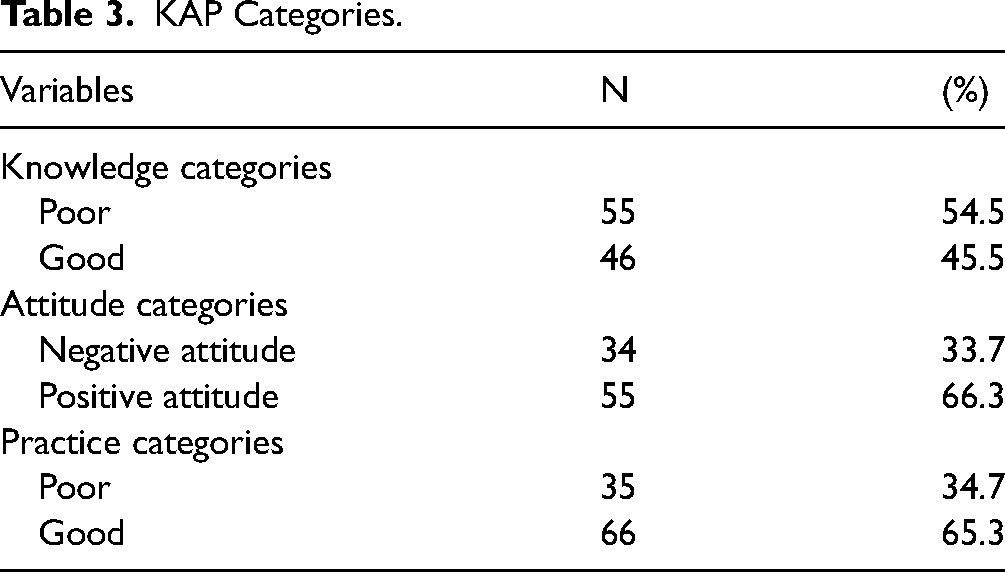
Table 3 shows that the majority of the nurses in this survey reported having poor knowledge (54.5%) regarding the prevention and control of COVID-19, with 45.5% having good knowledge. Regarding their attitudes, most participants (54.5%) had a positive attitude toward the control and prevention of COVID-19, while 33.7% had a negative attitude. For the practices score, the results showed that 65.3% of nurses displayed good practices regarding the prevention and control of COVID-19, while 34.7 displayed poor practices.
KAP Categories.
Correlations
A Pearson's correlation showed that there was no significant relationship between the variables; only the practices score was found to be positively correlated to the attitudes score (r-0.556, p < 0.01). This means that the nurses with good practices were likely to have a positive attitude toward the prevention and control of COVID-19.
Independent t-Test
The results showed that there is no significant difference in the KAP of male and female nurses, positive and negative COVID-19-tested nurses, and registered and enrolled nurses. There is, however, a significant mean difference in the attitude scores between the vaccinated and the non-vaccinated nurses: t(86.251) = 2.974, p ≤ 0.05, as vaccinated nurses tend to have more a positive attitude toward the prevention and control of COVID-19 compared to the non-vaccinated nurses. The practice scores also showed a significant mean difference between the vaccinated and the non-vaccinated nurses: t(98.956) = 1.989, p < −0.05, that is, the vaccinated nurses have better practices when it comes to the prevention and control of COVID-19 compared to the non-vaccinated nurses. There was no significant difference between the knowledge scores of the vaccinated and non-vaccinated nurses.
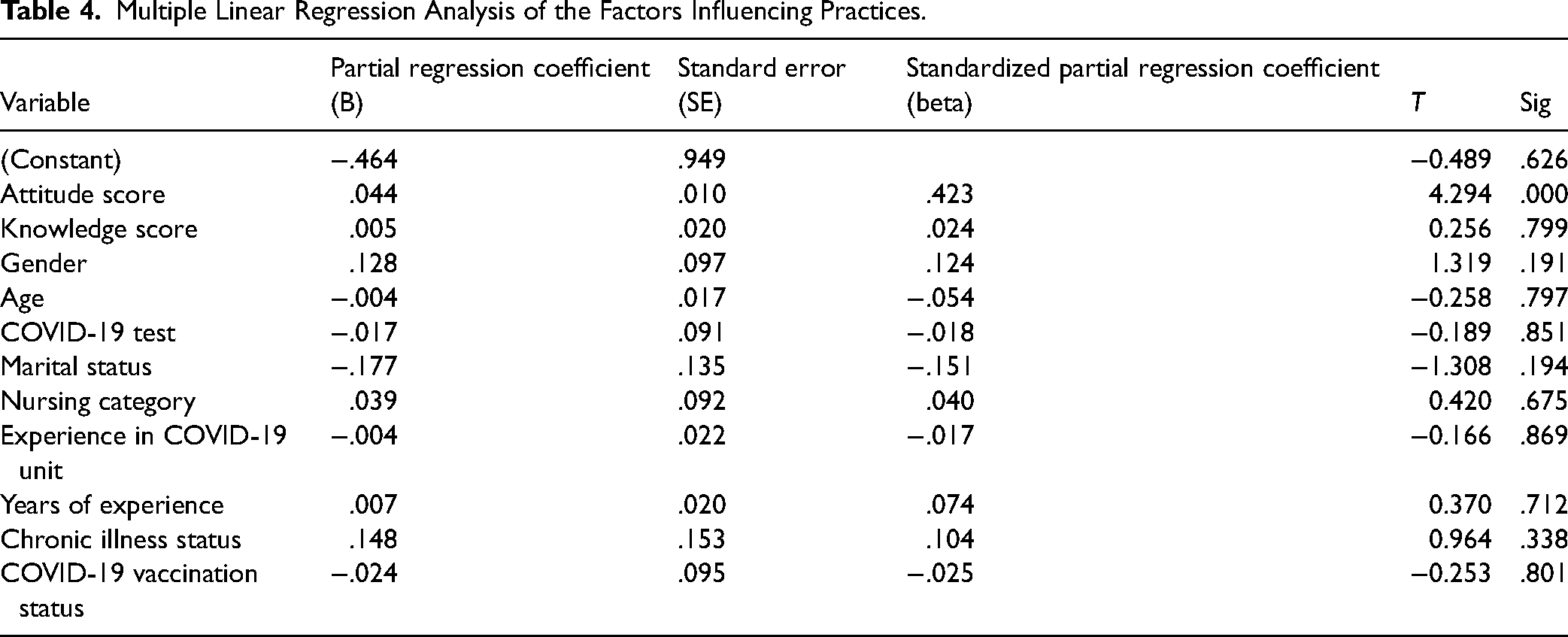
A multiple linear regression analysis of the factors influencing practices (N = 101) was done, with practices score as the dependent variable. Attitude score, knowledge score, age, COVID-19 test, marital status, nursing category, experience in the COVID-19 unit, years of experience, chronic illness status, and COVID-19 vaccination status were the independent variables. The results indicated that the regression model was statistically significant (F = 2.536, p < 0.001, adjusted R2 = 0.145), and one independent variable (attitude) included in the model had a statistically significant influence on practices (p < 0.05), as shown in Table 4.
Multiple Linear Regression Analysis of the Factors Influencing Practices.
Discussion
The results of the study show that the nurses’ knowledge (83.8%), attitudes (73%), and practices (78%) scores regarding the prevention of COVID-19 were generally high. However, because the knowledge cut-off for good knowledge was set high, the majority of the nurses (55%) had poor knowledge, while 66.3% had positive attitudes and 65.3% had good practices.
In this study, the nurses had a mean knowledge score of 83.8% for the prevention and control of COVID-19. Although Shawahna (2021) argued that it is not easy to define what is considered adequate knowledge, in this study 88% was the cut-off for adequate knowledge. Some studies have recorded lower mean knowledge scores of 75.7% (Shawahna, 2021; Tavassoli and Hesary, 2021), while others have recorded higher scores. In studies by Tien et al. (2021) and Maurya et al. (2022), the knowledge scores were 91% and 93%, respectively.
The majority of the nurses (54.5%) had poor knowledge scores based on an arbitrary cut-off point of 88%. This means that most nurses lack the necessary knowledge to facilitate the prevention and control of COVID-19. These findings were inconsistent with those reported in a previous study, which showed that few nurses possess adequate knowledge at 30.8% (Shawahna, 2021). Other studies report a high proportion of sufficient knowledge regarding the prevention and control of COVID-19, including nurses at 75% (Yesse et al., 2021) and HCWs at 73.3%. With some studies including other healthcare workers, the actual proportion of nurses with adequate knowledge is not conclusive, however. In addition, different studies use different measuring instruments to test knowledge, with some having more items than others, hence there is a need to further validate the tools regarding nurses’ knowledge of prevention and control of COVID-19. As per previous studies, more needs to be done in terms of the education of nurses to elevate their knowledge of COVID-19.
Almost two-thirds of the nurses (66.3%) who took part in this study showed a positive attitude toward the prevention and control of COVID-19, yet this result is inconsistent with those reported by previous studies. Research by Shawahna (2021) and Farah et al. (2021) showed that less than half (47.3%) and just above half (54.8%) of nurses have a positive attitude, respectively. On the higher side, other studies showed that a large proportion of nurses reported a positive attitude, that is, 71.5% of the nurses (Tien et al., 2021), 84.2% (Yesse et al., 2021), and 85.1% (Alrubaiee et al., 2020). In light of the findings of this and related studies, it is important to question how positive attitudes are determined. In this study, a positive attitude was measured using 16 items with three response options, only one of which indicated a positive attitude. A positive attitude was considered when a participant chose the positive option on at least 15 of the items (a score of at least 95%). While this may be high, it can be argued that 66.3% of the nurses in this study were positive about practicing prevention and control of COVID-19. Future studies should also be transparent about how they determine the attitude categories of participants.
Regarding the practices related to the prevention and control of COVID-19, 66% (a score of 82% and above) of the nurses had good practices. Similarly, Yesse et al. (2021) and Farah et al. (2021) indicated that 68.7% and 61.5%, respectively, of the HCWs in their studies demonstrated acceptable preventive practices with regard to COVID-19. However, some studies have suggested that the majority of nurses display good practices in the prevention and control of COVID-19. According to Tien et al. (2021), 83.1% of the healthcare workers they surveyed were implementing all the relevant measures for preventing COVID-19. Likewise, in the study with Shawahna (2021) indicating an even high percentage of nurses (94.5%) whose practices were considered adequate (80% and above). The existing evidence is thus insufficient to reach conclusions regarding nurses’ practices when it comes to the prevention and control of COVID-19. Standardization of the tools to measure this would be the best way forward.
The results revealed that the attitudes of nurses correlate with their practices when it comes to the prevention and control of COVID-19, which was also found in other studies (Alrubaiee et al., 2020; Asdaq et al., 2021; Farah et al., 2021). The results of this study could thus mean that it is important to focus on creating a positive attitude among nurses if they are to implement best practices of COVID-19 prevention and control. The absence of a correlation between the variables of knowledge and attitude and knowledge and practices could be explained by the fact that nurses have now become much better informed about COVID-19, that is, their practices or attitudes can no longer be influenced by knowledge. Early studies by Alrubaiee et al. (2020) and Maurya et al. (2022) picked up correlations between knowledge and attitudes and knowledge and practices, as nurses and health workers had variations in their knowledge levels that ultimately influenced their attitudes and practices.
The vaccinated group of nurses had significantly better means scores for attitudes and practices regarding the prevention and control of COVID-19. Such a result could mean that the nurses who got vaccinated are more accepting of the measures to control COVID-19 than those who were not, rather than vaccination status influencing attitudes or practices. This result has not been reported in previous studies. Furthermore, only the attitude score was found to be a predictor of the nurses’ practices of prevention and control of COVID-19. This further supports the strong correlation reported in this study. In contrast, other studies did not find attitude to be a predictor of a nurse's practices, but knowledge was. For instance, knowledge level was reported to be a determinant of the preventive behavior of nurses and healthcare workers in many studies (Farah et al., 2021; Tien et al., 2021; Yesse et al., 2021).
Strengths and Limitations
This study is one of the few to be conducted in Southern Africa and the only one conducted in Namibia to explore nurses’ KAP regarding COVID-19 infection prevention and control. Considering that nurses are a high-risk group because of the long time they spend with COVID-19 patients, this study added important evidence regarding their KAP when it comes to infection control and prevention. This evidence is important as it can inform the interventions needed to strengthen infection control practices around COVID-19. Most prior studies focused on healthcare workers in general, masking the KAP of nurses, who by comparison spend more contact time with patients than other healthcare workers.
On the other hand, this study was conducted at only one hospital, limiting its generalizability. In addition, the questionnaire used in this study had not been used before, which could have compromised its validity despite measures being taken to ensure its quality.
Implications for Practice
According to this study, the proportion of nurses with good knowledge, positive attitudes, and good practices as they relate to COVID-19 prevention and control was just above 50%. This is of great concern as the failure to ensure infection control and prevention can have fatal consequences. In addition, any slight failure in infection control can lead to the infection of nurses. The KAP of nurses thus need to be better than in other units, hence the need for the hospital management and the MoHSS to provide support to improve infection control measures. Further research should look at what contributes to poor infection control practices and attitudes, as well as how future pandemics can be better managed regarding infection and control. There is also a need to help nurses by providing them with continuing education and support so that they are ready for any future pandemics.
Conclusion
The results of this study revealed that just over 50% of nurses in the north-east of Namibia had relatively adequate knowledge of, positive attitudes toward, and good practices regarding, the prevention and control of COVID-19. However, these figures are not good enough considering that any breach in infection in COVID-19 units could result in the infection of nurses. Consequently, all COVID-19 nurses need more intensive training to ensure a higher level of knowledge, more positive attitudes, and better practices, not just a certain proportion, in order to safeguard every nurse and reduce the transmission of COVID-19.
Supplemental Material
sj-docx-1-son-10.1177_23779608231225868 - Supplemental material for Knowledge, Attitudes, and Practices of Nurses Regarding the Prevention and Control of COVID-19 at a Selected Regional Hospital in Namibia
Supplemental material, sj-docx-1-son-10.1177_23779608231225868 for Knowledge, Attitudes, and Practices of Nurses Regarding the Prevention and Control of COVID-19 at a Selected Regional Hospital in Namibia by Daniel. O. Ashipala, MSc, Christine Kaihoto, BSc, and Takaedza Munangatire, PhD in SAGE Open Nursing
Footnotes
Authors’ Contributions
DOA contributed to conceptualization, methodology, writing (original draft, review, and editing), visualization, project administration, and supervision. CK contributed to conceptualization, methodology, writing (original draft), and formal analysis. TM contributed to methodology, writing (original draft, review, and editing), software, validation, visualization, and project administration. All authors approved the final version for publication.
Declaration of Conflicting Interests
The authors declared no potential conflicts of interest with respect to the research, authorship, and/or publication of this article.
Funding
The authors received no financial support for the research, authorship, and/or publication of this article.
Ethical Consideration Detail
Ethical clearance for this study was granted by the University's School of Nursing Ethics (SoNREC) Committee and the Ministry of Health and Social Services (MoHSS) research committee.

Supplementary Material
Supplemental material for this article is available online.
References
Supplementary Material
Please find the following supplemental material available below.
For Open Access articles published under a Creative Commons License, all supplemental material carries the same license as the article it is associated with.
For non-Open Access articles published, all supplemental material carries a non-exclusive license, and permission requests for re-use of supplemental material or any part of supplemental material shall be sent directly to the copyright owner as specified in the copyright notice associated with the article.
