




Abstract
Introduction
T2DM is a chronic health condition that requires routine self-care. Despite T2DM patients being able to manage self-care behaviors, psychosocial factors, including social support, have been considered effective in improving diabetic self-care behaviors.
Objective
This study aimed at examining the influence of social support on self-care behavior among T2DM patients in Dr. Soliaman Fakeeh Hospital.
Methods
This was a cross-sectional study. The study was carried out at Dr. Soliaman Fakeeh Hospital using a sample size of 192 T2DM patients. Data were collected using a self-administered questionnaire comprised of a demographic section, the Scale of Perceived Social Support (MSPSS) section, and the Diabetes Self-Care Activities Questionnaire (DSCAQ) section. The data were analyzed using descriptive statistics and inferential statistics.
Results
The study analyzed data from 192 complete responses (91.86%) out of 209 respondents. Regarding gender, most of the respondents were female T2DM patients (n = 103, 53.6%), while males (n = 89, 46.4%) The highest level of social support was from the family (mean of 5.49). The highest performing self-care activity performed by the respondents was blood glucose monitoring (mean of 6.01). Analysis of the correlation between the Scale of Perceived Social Support (MSPSS) and the DSCAQ revealed positive and significant correlations (r = 0.370, p = 0.001).
Conclusions
This study showed that social support influenced self-care behaviors in patients with T2DM. Therefore, interventions should be developed focused on enhancing the levels of social support and self-care behaviors.
Introduction
yeandiii In the current twenty-first century, T2DM is a significant healthcare problem associated with hyperglycemia (Michels et al., 2022). The disease is linked with an increased economic burden on the patient, the family, and the community (Tharek et al., 2018). Additionally, T2DM is regarded as the sixth leading cause of mortality and morbidity rates, impacting more than four million individuals annually (Mohebi et al., 2018). Individuals diagnosed with T2DM have a reduced life expectancy to about 15 years, and therefore the illness is a serious health threat globally (Paulsamy et al., 2021). T2DM is the most prevalent T2DM and leads to premature deaths and reduced quality of life for patients because of its related long- and short-term complications (El-Radad et al., 2023).
Literature Review
The overall pooled prevalence of T2DM in Saudi Arabia was 16.4% (Jarrar et al., 2023). Self-care practices for managing T2DM entail regular physical activity, appropriate dietary practices, foot care practices, self-monitoring of blood glucose, and compliance with the treatment regimen (Vissenberg et al., 2017). Although the importance of diabetes self-care management practices is still effective and efficient in producing significant prevention and control of diabetes, the findings of previous studies in Saudi Arabia confirmed that aspects of self-care management practices were more problematic. It indicates that only 15.0% of diabetic patients had a controlled blood glucose level and poor compliance with self-management practices (Al Johani et al., 2015)
Individuals diagnosed with T2DM are required to undertake self-care activities to prevent and delay complications related to diabetes and improve their overall quality of life (Silva-Tinoco et al., 2020). Self-care entails actions undertaken by individuals to care for themselves by maintaining healthy behaviors. Self-care activities for individuals with T2DM include healthy dietary patterns, self-blood glucose monitoring, foot care, exercise, and adherence to recommended medication (such as insulin and oral hypoglycemic agents) (Raquinio et al., 2021). Studies have shown the benefits of self-care among diabetic patients, including reducing the risk of cardiovascular complications by close to 80% in diabetic patients (Huang et al., 2019). The studies have demonstrated the relationship between self-care behaviors and blood glucose control (Ishak et al., 2022)
Social support is a psychosocial factor associated with adherence to self-care and the control of chronic illnesses (Karimy et al., 2018). Social support refers to a psychological sense of acceptance, belonging, and assistance that enhances the individual's ability to cope with stressful situations. In diabetes, social support is an important aspect of psychological health that makes diabetic individuals feel like they belong in social networking. Perceived social support is significant compared to other social support categories, including social fixation and received social support (Khin et al., 2021).
There is enough evidence indicating the benefits of social support toward adherence to self-care practices among T2DM patients. Generally, family members, particularly spouses, healthcare professionals, and other significant individuals, provide great levels of social support (Onyango et al., 2022). To the best knowledge of the researcher, there are limited studies that have addressed the influence of social support on self-care behaviors among Saudi T2DM patients. Therefore, the current study aimed at examining the influence of social support on self-care behavior among T2DM patients in Dr. Soliaman Fakeeh Hospital.
Method
Design
The study adopted a cross-sectional design to assess the influence of social support on self-care behavior among T2DM. Data were collected in the period between March and June 2023.
Research Question
What is the influence of social support on self-care behavior among T2DM patients in XX?
Population and Setting
The population of the study involved individuals with T2DM. The collection of data for the study was carried out at Dr. Soliaman Fakeeh Hospital. The setting is one of the largest healthcare facilities in Saudi Arabia, and it provides a diverse range of treatments and available facilities for patients with diabetes, including an outpatient clinic, an inpatient program, and several pharmacies. The study setting was selected because this hospital is one of the largest hospitals offering specialized services to such patients in the area, and the type of patient is similar to other patients who use other healthcare services.
Sample
The study employed a non-probability convenience sampling method. The researcher identified a total of 256 T2DM patients who were enrolled in the diabetic clinic and attended the follow-up clinic regularly. The sample size included 192 T2DM patients. The sample size was computed using the Raosoft online sample size calculator (Raosoft, 2004) with an overall target population of 192 patients, a 95% confidence level, and a 5% margin error.
Inclusion and Exclusion Criteria
The inclusion of the patients in the study was based on being diagnosed with T2DM for a minimum period of 1 year and a maximum period of 5 years aged 18 years and older, being able to write, read, and communicate verbally, and having no psychological problems, including anxiety and mood disorders. The exclusion criteria of patients included: patients diagnosed with T2DM for less than 1 year or more than 5 years, having psychological issues, and those who did not want to participate in the study. The justification for specifying the duration of the disease is that patients diagnosed with diabetes for less than 1 year showed motivated behavior in using healthy self-practices. In addition, patients who had been diagnosed with diabetes for more than 5 years showed a high level of social support
Study Procedure
After obtaining the study's ethical approval, the principal researcher visited the research site and explained the study's purpose and objectives to nurses in clinics. Then, the scale questions are placed on a Google link and distributed to potential patients. Participants were requested to read the information sheet in Arabic and submit the signed consent form. Confidentiality of the patient's information is assured.
Data Collection Tools/Instruments
Data was collected using a self-administered questionnaire consisting of three sections:
Section A: The sociodemographic characteristics of the respondents include age, gender, marital status, time since T2DM diagnosis, education level, and employment status.
Section B: The Scale of Perceived Social Support (MSPSS). The scale was used to measure the level of social support received by the respondents. MSPSS was developed by Zimet et al. (1988) to establish the social support factors perceived by individuals (Zimet et al., 1990). The scale is comprised of 12 items subdivided into three groups, each comprising four items about the social support source: family (Items 3, 4, 8, and 11), friends (Items 6, 7, 9, and 12), and a special person (Items 1, 2, 5, and 10). The items were graded on a 7-point scale. To obtain the score of the subscale, the scores of the four items are added to each scale, and then the total score is obtained by adding all the scores of the subscales. Higher recorded scores signify more social support. Previous studies have shown the validity and reliability of the scale in determining social support received by individuals (Eastman et al., 2018; Kim et al., 2022). The scale has been tested in several studies conducted in Saudi Arabia in Arabic, and the internal consistency is 0.86 (Al-Hadi Hasan & Waggas, 2022). The researcher conducted a pilot study with seven participants in order to assess the Arabic scale's appropriateness, relevance, and clarity. The results showed the study participants indicated all items were clear and relevant.
Section C: Diabetes Self-Care Activities Questionnaire (DSCAQ). The questionnaire was developed and revised by Mirzaei et al. 2022). The questionnaire is composed of 11 items with five subdomains; the domains include diet (Items 1, 2, 3, and 4), exercise (Items 5 and 6), blood glucose monitoring (Items 7 and 8), foot care (Items 9 and 10), and smoking (Item 11). The scale was used to determine how frequently, for the past 7 days, the patients performed self-care activities, including proper dietary, physical exercise, testing blood sugar, and foot care. The dimension of smoking was not utilized in the current study because it did not have any purpose. The questionnaire was answered based on an 8-point Likert scale (0–8), which indicated the number of days self-care behaviors were performed. The results of the pilot study showed the study participants indicated all items were clear and relevant, and the internal consistency was 0.83 (Al Johani et al., 2016).
Ethical Consideration
The study was approved by the Institution Review Board Committee at Fakeeh College for Medical Science (475/IRB/2023). Informed consent from the respondents was collected after the purpose of the study, and their roles, information confidentiality, and right of withdrawal from the study at any data collection point were explained to them. Participation in the study was voluntary.
Statistical Analysis
Statistical data analysis was performed using the SPSS program, version 27.0. Descriptive statistics were used for categorical variables. A one-way analysis of variance (ANOVA) was used to determine the relationship between respondents’ sociodemographic characteristics, social support, and self-care behaviors (p < 0.05). Pearson correlational analysis was used in determining the influence of social support on the self-care behaviors of T2DM patients (p < 0.05).
Results
Sociodemographic Characteristics
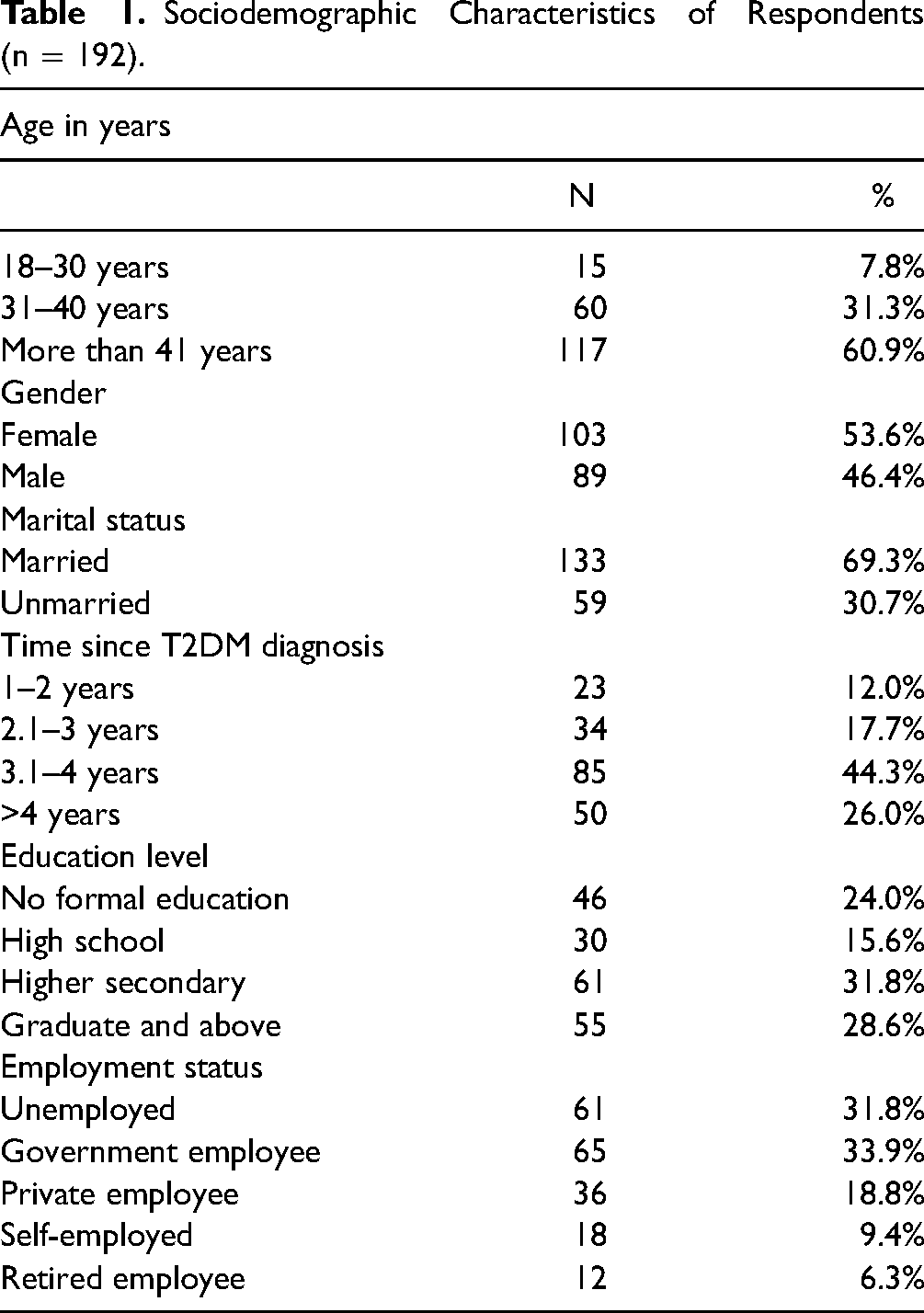
The study collected data from 209 respondents and tabulated it. The results established that the responses of 17 participants were incomplete. Thus, data from 192 respondents was analyzed as percentages. The sociodemographic characteristics of the respondents are presented in Table 1 below. The majority of the respondents were aged above 41 years (n = 117, 60.9%), followed by 31–40 years (n = 60, 31.3%) and 18–30 years (n = 15, 7.8%). Regarding gender, most of the respondents were female T2DM patients (n = 103, 53.6%), while males (n = 89, 46.4%). The marital status of the respondents revealed that most of them were married (69.3%, while those unmarried were 30.7%. More respondents had diabetes for 3 years (n = 85, 44.3%). Regarding their level of education, most of the respondents had higher secondary (n = 61, 31.8%), those with no formal education (n = 46, 24.0%), high school (n = 30, 15.6%), and those who were graduates were represented by n = 55, 28.6%. The employment status of the respondents revealed that those who were unemployed were (n = 61, 31.8%); government employees (n = 65, 33.9%); private employees (n = 36, 18.8%); self-employed (n = 18, 9.4%); and retired employees (n = 12, 6.3%).
Sociodemographic Characteristics of Respondents (n = 192).
Social Support
Table 2 below shows the level of social support received by T2DM patients included in the study. The findings revealed that the patients received social support, with the highest level of support coming from family (mean of 5.49), followed by friends and special persons (mean of 5.16 and 5.12, respectively).
Association Between Demographic Characteristics, Social Support, and Self-care Behaviors.

DSCAQ=Diabetes self-care activities questionnaire.
Diabetes Self-Care Activities
Table 2 below shows the level of social support received by T2DM patients included in the study. The findings revealed that the patients received social support, with the highest level of support coming from family (mean of 5.49), followed by friends and special persons (mean of 5.16 and 5.12, respectively).
One-way ANOVA test was performed to determine sociodemographic characteristics influencing social support and self-care behaviors among T2DM. The findings of the one-way ANOVA showed a relationship between sociodemographic variables, social support, and self-care behaviors. All demographic variables had significant associations with social support and self-care behaviors (p < 0.05), as presented in Table 3. For example, male patients had higher social support and self-care behaviors compared to female patients. In addition, married patients reported statistically higher social support and self-care behaviors compared to unmarried patients. In terms of age, patients aged between 18 and 30 showed higher social support and self-care behaviors compared to other age groups. The results also indicate that patients with shorter durations of disease revealed higher social support and self-care behaviors compared to patients in the chronic stage of disease. Unemployed patients reported that they had higher social support and self-care behaviors compared to other employment statuses.
The Results of Comparison of Social Support and Self-Care Behaviours According to Demographic Data.

M = Mean, SD = standard deviation.
Correlational Analysis
Pearson correlation was used to determine the influence of social support on the self-care activities or behaviors of T2DM patients. Pearson correlation coefficients showed a significant association between social support domains and the self-care behaviors of respondents. Family social support positively correlated with self-care behaviors (r = 0.198, p = 0.006), there was no significant correlation between friends’ social support and self-care behaviors (r = −0.032, p = 0.661), and there was a positive correlation between social support from special persons and self-care behaviors (r = 0.295, p = 0.001). Further analysis of the correlation between the Scale of Perceived Social Support (MSPSS) and the DSCAQ revealed positive and significant correlations (r = 0.370, p = 0.001). The correlations indicated that social support influenced the self-care behaviors of the respondents diagnosed with T2DM. The results of the correlation analysis between the Scale of Perceived Social Support (MSPSS) and the DSCAQ are presented in Table 4.
Correlation Between Social Support Subscales and Self-care Behaviors.

aCorrelation is significant at the 0.01 level (two-tailed).
Discussion
The present study was carried out to determine the influence of social support on self-care behavior among T2DM patients. This study established that most of the respondents were female (53.6%), married (69.3%), and had T2DM for 3 years (44.3%). Similar results have been reported by the study, which investigated the association between social support and self-care behaviors among patients with T2DM and identified that most of the respondents were female (67.4%) and the majority (93.5%) of the respondents were married (Mohebi et al., 2018). The reason associated with the high number of female respondents is an assumption that the compliance rate to medication, treatments, and follow-up is high among female patients compared to males; similarly, married patients have family support toward adherence to medications, compliance, and check-ups (Paulsamy et al., 2021).
Based on the study findings, there was a significant positive relationship between sociodemographic features, social support, and self-care behaviors. The findings of the study demonstrated that social support and self-care behaviors were high among married patients compared to single diabetic patients. Consistent with these findings, Karimy et al. (2016) identified that married patients showed better self-care behaviors compared to unmarried ones. The differences in social support and self-care behaviors between married and unmarried diabetic patients can be attributed to the supportive system, including spouses and family, of married diabetic patients. Based on the ANOVA findings, education level showed a significant association with social support and self-care behaviors. Other previous studies have also revealed that a level of education is essential in illness management. For instance, Ghannadi et al. (2016) also reported a significant positive relationship between self-care behaviors and education level. Based on the study findings, the time since the diagnosis of T2DM significantly influenced social support and self-care behaviors. Patients within 1 year of illness diagnosis showed a high level of self-care behaviors compared to others, which can be attributed to their efforts to prevent other complications related to T2DM.
A study conducted by Adwan and Najjar (2013), also revealed a significant relationship between diabetes duration and diabetes self-management, where low diabetes self-management was observed among patients with a longer duration of diabetes. Furthermore, social support and self-care behaviors were found to be high among patients aged between 18 and 30 years compared to other age groups included in the study. Comparing employment status, the findings showed that unemployed T2DM patients had better social support and self-care behaviors compared to those employed and retired. Negative support behavior was only related to one self-care practice, taking medicines as prescribed, while positive support behavior was connected with several self-care practices relating to nutrition and physical exercise. According to some research, interpersonal relationships with family and friends have a higher impact on visible self-care behaviors than those taken alone.
According to the results of the study, there was a statistically significant influence of social support on the self-care behaviors of T2DM patients. The correlational analysis showed a significant positive relationship between social support and self-care behaviors among T2DM patients (r = 0.370, p = 0.001). This indicated that the self-care behaviors of T2DM patients increase with an increase in levels of social support and vice versa. The results of this study are consistent with previous studies that evaluated the effects of social support on the management of chronic illnesses, including diabetes. For instance, Marquez et al. (2016) revealed that social support has a significant role in weight loss and physical activity in diabetic patients. Shayeghian et al. (2015) also identified that social support was linked to better blood glucose control and other self-care behaviors. Shibayama et al. (2019) also identified that social support was significantly associated with self-care behaviors, including blood glucose monitoring.
The findings of the study showed that self-care behaviors were followed by diabetic patients with high perceived social support. Social support is a psychosocial component with two essential roles for patients with T2DM: (a) improving their quality of life and self-care behaviors and (b) enhancing the levels of patients’ adherence to the stressful condition (Werfalli et al., 2020). The findings showed that high social support was from family and friends; these align with the results by Mohebi et al. (2018), who reported that family members together with friends provide great social support for T2DM patients. Therefore, diabetic patients receiving support from family members and their friends show better adherence to self-care behaviors. These findings emphasize the significance of communication between family members and patients. Family is considered a basic social network unit essential for individuals to learn behavioral measures. Furthermore, decisions about illness control and medication are also impacted by the patient's family members.
The highest self-care behaviors were related to blood glucose monitoring, followed by adherence to diet, foot care, and lastly, adherence to physical exercises. Seddigh and Tang (2022) and Werfalli et al. (2020) reported low scores on self-care behaviors associated with self-blood glucose monitoring, which contradicts the present study findings on the highest performing self-care behaviors as blood glucose monitoring. The study recommends that future studies should include patients diagnosed with diabetes at any time and include children's patients. In addition, future studies need to assess self-care practices and clinical outcomes.
Strengths and Limitations
It is noteworthy that the study has several strengths, such as the fact that the sample is adequately powered to control type II error. Also, the study used scales with established psychometric properties. Although studies have several strengths, it also has some limitations. First, the current study was a cross-sectional one, and therefore, the causal relationship between social support and self-care behaviors could not be inferred. Secondly, data were collected using a self-administered questionnaire. Lastly, the sample size is not a representation of the study population because it was a convenient sample.
Relevance to Clinical Practice
Based on the study results, it shows the importance of social support for self-care behavior among T2DM patients. So, family caregivers must be involved in tailoring patient management plans. Education programs on self-management could also be developed so as to help create awareness of the importance of self-care behaviors for comfortably living with T2DM.
Conclusion
In conclusion, the findings have shown that there is a significant positive influence of social support on the self-care behaviors of patients with T2DM. Social support is a psychosocial concept influencing adherence to self-care behaviors among patients with chronic illnesses such as T2DM. The findings showed that both social support and self-care behaviors are influenced by sociodemographic factors including age, gender, marital status, time since T2DM diagnosis, education level, and employment status.
Footnotes
Acknowledgement
The study authors acknowledged nurses who participated in the study.
Author Contribution Statements
AH and NS designed the study; AH and NS collected and analyzed data; AH and NS wrote initial draft and final paper.
Declaration of Conflicting Interests
The author(s) declared no potential conflicts of interest with respect to the research, authorship, and/or publication of this article.
Ethical Statement
This study was approved by the Institutional Review Board of Fakeeh College for Medical Sciences (440/IRB/2023) and MOH (R203/2023).
Funding
The author(s) received no financial support for the research, authorship, and/or publication of this article.
