




Abstract
Introduction
Nurses are responsible for providing primary care to millions of patients, and emergency nurses serve on the frontline in providing care for mildly to severely critically ill patients.
Objectives
This study aims to assess and evaluate the clinical competence and its related factors among emergency nurses in Palestinian hospitals.
Methods
A cross-sectional study was conducted among 170 nurses working in the emergency units of hospitals in the West Bank, Palestine. Data collection utilized the Nurse Competence Scale, and the Job Satisfaction Scale.
Results
The results showed that only 33(19.4%) of the participants exhibited a good level of clinical competence, with none reaching the very good level. Among them, the highest proportion of good level 60 (35.3%) was in the helping role, while the lowest 38 (22.4%) was in ensuring quality. About 35% of nurses reported very low or low job satisfaction, while 58% had high or very high job satisfaction. Additionally, the results revealed a statistically significant relationship between clinical competence and job satisfaction (P < 0.05). Both clinical competence and job satisfaction were positively correlated with age and experience.
Conclusion
The study found a significant relationship between demographic characteristics (e.g., education, experience, and marital status) and clinical competency among emergency nurses. Notably, less than half of the participants demonstrated good clinical competency, with none reaching a very good level. The highest scores were observed in the helping role domain, while the lowest were in the ensuring quality domain. Furthermore, clinical competence was found to be significantly associated with job satisfaction. Consequently, enhancing nurses’ clinical competency will lead to an improvement in the quality of patient care.
Keywords
Background
Nurses need to integrate their personal characteristics and socio-demographic factors with their knowledge and skills to practice effectively and safely in their designated roles and positions (Dickerson & Chappell, 2016). In clinical practice, nurses are required to implement and apply their skills, knowledge, and personal characteristics to each situation. They should also be able to adapt their skills and knowledge to the circumstances they encounter in clinical practice (Takase & Teraoka, 2011). A recent study conducted in Palestine revealed that the majority of emergency nurses (73.7%) held a university bachelor's degree, indicating a strong educational background. Additionally, approximately half of the nurses had less than 5 years of experience, while a small percentage (7%) had over 10 years of experience in the emergency department, reflecting a diverse range of professionals with varying levels of experience in the field (Salameh & Aboamash, 2022).
Review of Literature
Emergency nurses serve on the frontline, providing care to patients ranging from mild to critically ill. Due to the round-the-clock nature of their role, they must deliver timely and cost-effective care (Shoqirat, 2014). Additionally, they frequently encounter situational changes that can impact their competence, job satisfaction, and contribute to burnout (Lowe, 2010). The competence of emergency nurses has a direct influence on the satisfaction of both the nurses themselves and the quality of care provided to emergency patients. Numerous research studies have examined the level of nurse competence in various healthcare settings (Flinkman et al., 2017). Competency serves as a foundation for learning and practice in the emergency care unit (Ghanbari et al., 2017). Clinical competence serves as a fundamental prerequisite in nursing, with each nurse expected to possess it in clinical settings due to its crucial role in delivering optimal healthcare services (Karami et al., 2017).
Previous research has indicated a significant association between clinical competence, self-efficacy, and job satisfaction (Mirlashari et al., 2016). Job satisfaction holds particular significance for nurses as they play a pivotal role in providing healthcare services, making it a determining factor in the success or failure of healthcare organizations and the quality of care delivered to patients within those organizations (Heydari et al., 2013).
According to previous studies, there exists a positive and strong correlation between work experience, education level, and age with the level of competency and job satisfaction among nurses (Amiri et al., 2018, 2019; Ghahfarokhi et al., 2021). However, it is worth noting that the competency level among emergency nurses, as reported in most previous studies, was found to be moderate (Faraji et al., 2019; Vand Tamadoni et al., 2020).
Therefore, continuous measurement and evaluation of the clinical competence of emergency nurses and their satisfaction, along with their relationship to external factors such as socio-demographic factors and education level, as well as internal factors like nurses’ working position, is crucial and should be prioritized by hospitals. Accordingly, the purpose of this study is to assess the level of competence and job satisfaction among nurses working in the emergency department of Palestinian hospitals. Additionally, the study aims to examine the relationship between clinical competence, job satisfaction, and demographic characteristics, providing valuable insights for improving nursing practice and enhancing the overall quality of care.
Methods
Design
The study employed a quantitative, cross-sectional descriptive design. Data were collected through a combination of self-administered questionnaires and online surveys due to the constraints imposed by the COVID-19 restrictions, which made physical access to all hospitals challenging. The study was conducted from March to May 2021.
The study was conducted at Palestinian hospitals located in the middle and north of the West Bank. The participants included all nurses working in the emergency department who were willing to participate in the study. The study encompassed nine governmental hospitals in the middle and north of the West Bank, as well as five private hospitals in the middle of the West Bank.
Research Questions
What is the level of clinical competence among emergency departments nurses in West Bank hospitals?
What is the level of job satisfaction among emergency departments nurses in West Bank hospitals?
Is there a relationship between clinical competence and demographic characteristics of emergency departments’ nurses in West Bank hospitals?
Which factors serve as a Predictors of clinical competence among emergency department nurses in West Bank hospitals?
Do specific factors Predict job satisfaction among emergency department nurses in West Bank hospitals?
Is there a relationship between job satisfaction and demographic characteristics of emergency department nurses in West Bank hospitals?
Is there a relationship between clinical competence and job satisfaction level of emergency department nurses in West Bank hospitals?
Sample
The study population consisted of emergency nurses employed at Palestinian governmental hospitals in the middle and northern regions of the West Bank, as well as emergency nurses working at private hospitals in the middle West Bank. All registered nurses working in the emergency departments of these selected hospitals were invited to participate in the study, totaling 200 nurses. The actual sample consisted of all nurses who agreed to participate in the study and completed the study questionnaire, totaling 170 nurses. This response rate of 85% exceeded the minimum required sample size of 132, which was determined using the Raosoft online sample size calculator (http://www.raosoft.com/samplesize.html) (Raosoft, 2021). The calculation was based on confidence level of 95%, margin of error of 5%, population size of 200 and response distribution (population proportion) of 50%. Data collection began between mid-March 2021 and mid-May 2021.
Inclusion and Exclusion Criteria
The inclusion criteria set for sample selection were as follows: all registered nurses working in the emergency departments of Palestinian hospitals. The exclusion criteria set for sample selection were as follows: student nurses, volunteers, and part-time nurses.
Study Instruments
The questionnaire comprised three parts: The first part is demographic data, which was developed by the researchers and included information on age, gender, level of education, marital status, type of hospital and years of experience. The second part is the Nurse Competence Scale (NCS), which was designed by Meretoja et al. (2004), based on Benner's theory in 2004. This questionnaire measures the following domains (areas): helping role, teaching-coaching, diagnostic functions, managing situations, therapeutic interventions, ensuring quality and work role. The questionnaire used for NCS measured the level of competency for nurses using a visual analogue scale (VAS), which divided the level of competence into four components based on the average competence score of the seven subdomains: low level (0–25), rather good level (>25–50), good level (>50–75), and very good level (>75–100).
The third part is the job satisfaction scale, which consisted of 10 items and was adopted from a study conducted by Macdonald and Maclntyre (1997). Each item measured job satisfaction by the level of agreement and disagreement (strongly disagree, 1; disagree, 2; do not know, 3; agree, 4; strongly agree, 5). The total score for all 10 items was calculated and classified into five categories: very low (10–26), low (27–31), average (32–38), high (39–41), and very high (42–50) according to Macdonald and Maclntyre (1997).
Validity
The NCS scale consists of 73 items and 7 subscales (helping role, teaching-coaching, diagnostic functions, managing situations, therapeutic interventions, ensuring quality and work role) The questionnaire was translated into the Arabic language by a certified language center and then reviewed by 7 experts (5 of them holding PhD in nursing and the other two were emergency clinical nurse specialists). They assessed the validity and phrasing of the questions. Based on their feedback, modifications were done accordingly.
Reliability
The reliability of the instrument was assessed using the Cronbach alpha coefficient (Cronbach alpha). For satisfaction = 0.970; NCS = 0.80. Additionally, a pilot study was conducted on 20 nurses of the emergency nurses from the same setting and was excluded from the study. The pilot study aimed to identify and exclude any potentially confusing variables from the main study.
Ethical Consideration
The approval for data collection was obtained from Arab American University Ethical committee and from the Palestinian Ministry of health (MOH) to conduct the study in the Palestinian hospitals. The Arabic consent was verbally read to each participant during the distribution of printed questionnaires, while participants filling out the online questionnaires were able to read it themselves. The consent form clearly emphasizes that the data will be collected anonymously, ensuring that no participant's information can be identified. Participation in the study is voluntary, and the privacy and confidentiality of data are guaranteed. The collected data will be used solely for research purposes, and participants have the right to withdraw from the study at any time. Furthermore, user agreement was signed with the MAPI Research Institute (Lyon, France) to translate the tool into Arabic language. The NCS was used with permission from the developer.
Data Analysis
The statistical analysis of the collected data was carried out using the Statistical Package for Social Sciences (SPSS) version 21.0. Descriptive statistics (frequencies, percentages, means, and standard deviations) were used to summarize the data. Pearson correlation coefficient was used to test correlation of competence scores with age and experience, while one-way ANOVA was used to test differences in mean competence scores across levels of job satisfaction and socio-demographic factors. Furthermore, the linear automatic modeling regression function of SPSS was performed to build models to predict the overall average clinical competence score and the total job satisfaction score using the forward stepwise method based on the R2 criterion for entry and removal of predictor variables (models with higher R2 have better fit).The factors used in building the prediction model for clinical competence score were: age, gender, marital status, educational level, type of hospital, years of experience in ER and job satisfaction score. For predicting job satisfaction score, the same predictor variables were used except that the clinical competence score replaced satisfaction score as a predictor variable.
Results
Participants’ Characteristics
Among all participants, 60% worked in governmental hospitals, 28.8% worked in private hospitals, and 11.2% worked in both types of hospitals. In terms of gender, the majority of the participants (60.0%) were male, while 46.5% of them were single, 46.5% were married, and 7% were either divorced or widowed. Furthermore, the majority of participants (65.9%) held a bachelor's degree. The mean age of participating nurses was 29.16 (SD = 5.6) years, and the average years of experience were 5.49 (SD = 4.505), as shown in Table 1.
Demographic Characteristics of the Participants (N = 170).

SD = standard deviation.
Clinical Competence Among Emergency Departments’ Nurses
The analysis indicated that among the participants, only 33 (19.4%) demonstrated a good level of clinical competence, with none reaching a very good level. Furthermore, across all domains of clinical competence, none of the participants achieved a very good level. Among all domains, the highest proportion of participants demonstrating a good level (60, 35.3%) was observed in the helping role, while the lowest proportion (38, 22.4%) was found in ensuring quality, as presented in Table 2.
Distribution of Participating Nurses According to Competence Level (N = 170).

Correlation of Clinical Competence With Age and Experience
The Pearson correlation coefficients between competence score, their components, and the ages and experience of nurses are presented in Table 3. The results showed significant correlations (P < 0.05) with both age and experience for total competence score and all its domains. These correlations were all positive, ranging from 0.19 to 0.34, indicating that clinical competence among emergency nurses tends to increase with age and experience.
Pearson Correlation Coefficients of Clinical Competence With Age and Experience of Emergency Departments Nurses in West Bank Hospitals (N = 170).

* Correlation is significant at the 0.05 level (2-tailed).
** Correlation is significant at the 0.01 level (2-tailed).
Effect of Socio-Demographic Factors on Clinical Competence Score
Results of the one-way ANOVA showed that the overall average clinical competence scores of nurses differed significantly among types of hospital and according to marital status (P < 0.05) but were not affected by gender and educational level (P > 0.05). Nurses working at private hospitals had higher average competence scores (45.20 ± 7.40) than nurses working at governmental hospitals (40.93 ± 10.82), and married nurses had significantly higher average competence scores (45.53 ± 6.91) than single nurses (39.48 ± 11.24) (Table 4).
Means of Overall Average Competence Score by Socio-Demographic Factors of Participants (N = 170).

Job Satisfaction Among Nurses of Emergency Departments
The analysis revealed that 87 (51.2%) of participants reported having very high job satisfaction. However, more than one-quarter of the participants 45 (26.5%) reported having very low job satisfaction (Table 5). The total job satisfaction score was positively correlated with age (Pearson correlation = 0.111, P > 0.05) and experience (Pearson correlation = 0.155, P < 0.05).
Distribution of the Emergency Departments’ Nurses (N = 170) According to Job Satisfaction Level.

Relationship Between Clinical Competence and Job Satisfaction Level
The correlation coefficient between job satisfaction score and the average competence score of nurses was 0.614 (P < 0.001). Also, one-way ANOVA revealed statistically significant differences in mean scores of overall clinical competences among job satisfaction levels (P < 0.001). The highest mean scores of overall average clinical competences were observed among participants with high and very high levels of job satisfaction (44.3 ± 6.8 and 47.67 ± 6.22, respectively). Additionally, there were significant differences in the mean scores of all clinical competence domains (helping role, teaching-coaching, managing situations, therapeutic interventions, work role, diagnostic functions, ensuring quality) among the levels of job satisfaction (P < 0.001). Nurses with high and very high job satisfaction levels had the highest competence scores, as presented in Table 6.
Mean Competence Scores by Job Satisfaction Level of Emergency Departments’ Nurses (N = 170).

M = Mean; SD = Standard deviation; F = F value, One way ANOVA.
Prediction Models for Clinical Competence and Job Satisfaction Scores
The variables retained for predicting the clinical competence score using the linear automatic modeling procedure included job satisfaction score (P < 0.001, importance = 0.834), years of experience in ER (P = 0.001, importance = 0.071), type of hospital (P = 0.021, importance = 0.05), educational level (P = 0.173, importance = 0.032), and gender (P = 0.169, importance = 0.012), with adjusted R2 = 0.521 (Figure 1).
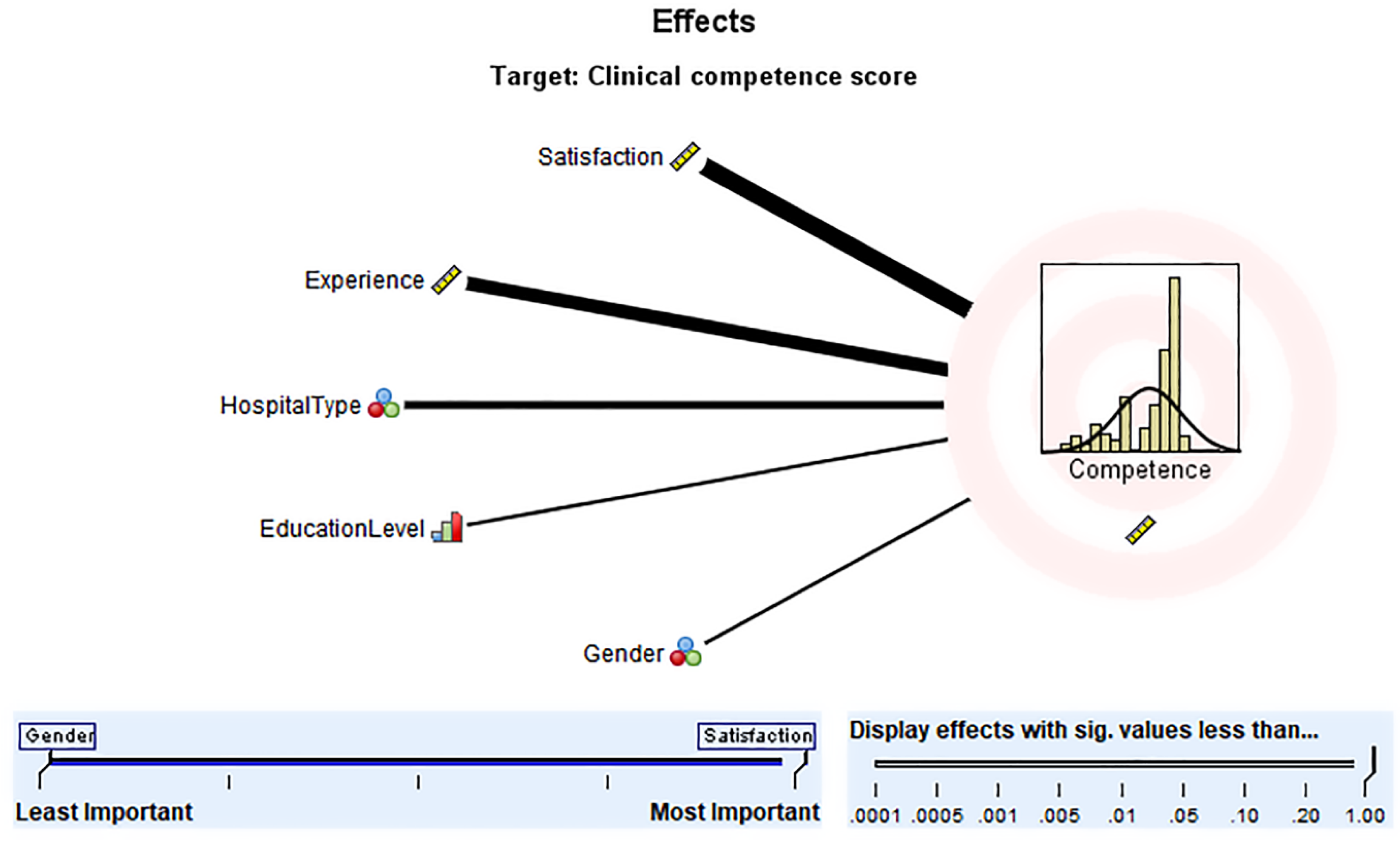
Important Predictors of Clinical Competence Scores of Nurses Working in Emergency Departments in Palestine.
For predicting the job satisfaction score, the prediction model included competence score (P < 0.001, importance = 0.955), gender (P = 0.041, importance = 0.027), and type of hospital (P = 0.234, importance = 0.018), with adjusted R2 = 0.472 (Figure 2).
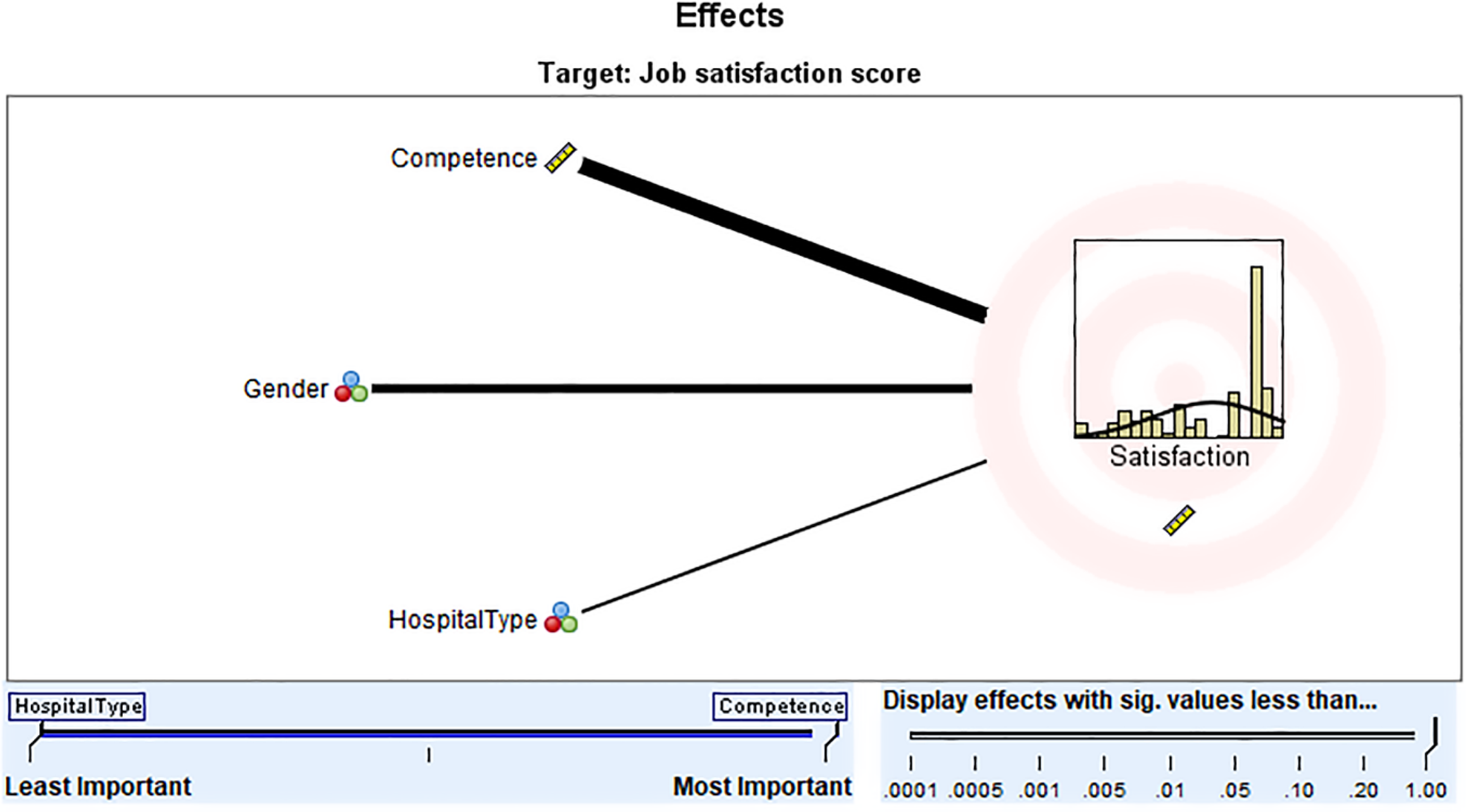
Important Predictors of Job Satisfaction Scores of Nurses Working in Emergency Departments in Palestine.
Discussion
The present study aimed to assess the clinical competency and related factors among emergency nurses working at Palestinian hospitals. The majority of nurses in the emergency department were young males, with an average age of 29.16 years. The distribution of marital status was nearly equal between married and single nurses. In Palestine, it is common to employ young nurses in the emergency department due to their ability to handle high work pressure and adapt to the various challenging situations they encounter.
According to the study findings, none of the emergency nurses exhibited a high level of clinical competency. Instead, the majority demonstrated a rather good level, with only 33.19% achieving a good level. These findings contrast with a study conducted in Iran, which reported that over half of the nurses had a very good level of clinical competency (Faraji et al., 2019). This inconsistency in clinical competency levels may be attributed to factors such as insufficient training, inadequate continuous education, or a lack of specialized courses for emergency nurses. Offering virtual workshops and training courses can be a convenient solution for emergency nurses with heavy workloads. These platforms provide accessible and ongoing education, enhancing clinical skills and improving patient care outcomes (Faraji et al., 2019; Liu et al., 2014). Furthermore, the findings of several studies consistently indicate that the component of “quality assurance” consistently receives the lowest ranking. This highlights the importance for nursing managers to prioritize and promote this component in healthcare settings. The results suggest that there is a clear need for improvement in ensuring and maintaining the quality of care provided to patients. By addressing and strengthening the aspect of quality assurance, healthcare organizations can strive towards delivering better outcomes and enhancing the overall quality of care (Kalantary et al., 2016; Najafi Ghezeljeh et al., 2022). Nurses who demonstrate a good level of clinical competency excel in the helping role, while their level is lower in ensuring quality. These results are supported by the study conducted by Kirca et al. (2020) that reviewed the association between nurse's competency and their behaviors in medical mistakes, also they are supported by the study conducted by Bam et al. (2020) which investigated competency self-assessment of nurses and compared rating of clinical competency between emergency nurses and general nurses who are working at emergency department.
The study findings indicate that married nurses have a higher level of clinical competency in several domains, including the helping role, teaching-coaching, managing situations, therapeutic interventions, and work role, compared to other emergency room nurses. However, no significant difference was observed in other clinical competency domains among married nurses. Regarding educational level, a significant relationship was found between education level and the management of situations, but no significant difference was found in other clinical competency domains. Furthermore, the study revealed a significant relationship between age, experience, and the mean of clinical competency. As nurses age, it is anticipated that their clinical experience would naturally increase as well. Based on evidence, a nurse's clinical competency is influenced by their job history (Istomina et al., 2011). In reality, as nurses accumulate more experience in their roles over time, their clinical competence is expected to increase correspondingly. Thus, it can be anticipated that as job experience grows, so does the level of clinical competency. These results are consistent with previous research findings, that reviewed the aspects and elements of work and clinical competence for nurses who are working in the emergency care unit (Ghahfarokhi et al., 2021; Heydari et al., 2013). While the study conducted by Lakanmaa et al. (2015) and the study conducted by Faraji et al. (2019) are not compatible with the study results because their results showed that the experience years and the education level are associated with a low level of clinical competency.
The study findings revealed that job satisfaction is the most important predictor of clinical competency. Nurses who reported higher job satisfaction demonstrated the highest mean scores in clinical competency. It is recommended that hospitals align nurses’ job responsibilities with their educational level and experience to enhance motivation, increase job satisfaction, and ultimately improve clinical competency levels. This, in turn, will have a positive impact on the quality of care provided and contribute to significant improvements in the healthcare sector, considering the crucial role nurses play (Ayalew et al., 2019). Additionally, reducing the number of night shifts can contribute to improved competency levels and job satisfaction (Ghahfarokhi et al., 2021). Moreover, motivating nurses to engage in self-assessment of their competency can enhance their awareness of their clinical competence and drive them to further develop their skills. This, in turn, can lead to improvements in the quality of care provided to patients (Lakanmaa et al., 2015).
These results are consistent with previous research findings regarding the relationship between employed nurse's competency level and job satisfaction, nurse's collapse, burnout, and secondary level of traumatic stress (Zakeri et al., 2021).
Study Limitation
One limitation of the study was the use of self-administered questionnaires. Additionally, the study was conducted during a period when our country was facing the COVID-19 pandemic. The restrictions and rapid changes in the country's situation related to the pandemic limited mobility from one region to another.
Implications for Practice
Considering the positive results from this study, it is recommended that further studies be conducted to investigate the impact of simulation technology on improving clinical competency. A qualitative study specifically examining the clinical competency of emergency nurses working in Palestinian hospitals would be valuable in understanding the specific challenges and needs of this population. Additionally, it is important for policy makers to recognize the importance of continuous measurement of competency levels for emergency nurses and to take steps to support the development of their clinical competency. This can be achieved through ongoing training, access to simulation technology and resources, and providing incentives for nurses to continue to advance their skills and knowledge.
Conclusion
Emergency nurses play a major role in healthcare as they work on the front line and are the first responders to any health crisis. Therefore, improving their clinical competency through educational programs and workshops will empower patient care and improve the quality of care provided to patients (Amiri et al., 2018). The study revealed a strong link between demographic factors and clinical competency, with noteworthy findings on job satisfaction. These results provide valuable insights into the factors influencing clinical competency among emergency nurses and underscore the importance of considering demographic factors and job satisfaction to enhance clinical performance and ensure high-quality patient care.
Footnotes
Declaration of Conflicting Interests
The authors declared no potential conflicts of interest with respect to the research, authorship, and/or publication of this article.
Funding
The authors received no financial support for the research, authorship, and/or publication of this article.
