




Abstract
Introduction
The use of social networking sites (SNSs) is growing among higher education students, including healthcare students. Nonetheless, limited research has examined the perceived use behavior among healthcare students in developing countries such as India.
Objective
This study attempts to assess the use behavior of SNSs by undergraduate students in the fields of nursing and pharmacy in India through the lens of Connectivism and New Social Learning theories.
Method
The study used a Google form to collect data through an online questionnaire. A sample of 483 participants included 258 Bachelor of Science in Nursing students, 161 General Nursing and Midwifery students, and 64 Bachelor of Pharmacy students from various Indian nursing and pharmacy schools.
Results
The majority of the respondents prefer to use SNSs for several purposes such as watching academic videos on YouTube, sharing their ideas, thoughts, and current development in their respective fields through WhatsApp, getting job-related information from different Facebook pages, etc. A substantial number of nursing students believed that these SNSs help them build relationships with professionals across the country. At the same time, many students also indicated that extensive use of SNSs might cause sleep difficulties, data privacy concerns, and a lack of focus while studying.
Conclusion
To have an impact on how SNSs are used in healthcare education, more attention should be paid to build connectivism between educators and their students on social learning environment, which the findings of this study's suggestions could be put into practice.
Keywords
Introduction
The advent of Information and Communication Technology (ICT) in modern science is nothing less than a boon to humankind (Aceto et al., 2018; Gudmundsdottir et al., 2020). It has introduced a new chapter in communication media and lubricated accessing information across geographical constraints. These tremendous impacts of ICT with global expansion proved itself to be the most advanced, real-time, and effective way to communication (Almathami et al., 2020; Nazim et al., 2022; Shamsuzzoha et al., 2016). It is never denied that the communication has shifted from a paper-and-pencil to a web-based one because of the popularity of social media.
Social networking platforms such as WhatsApp, Twitter, Wikis, YouTube, Facebook, LinkedIn, Blogs, and Instagram, according to Usher et al. (2014) and Tuckett and Turner (2016), are one of the most important places to look for information in today's society. In most of the cases, the phrases “social media” and “social networking sites” (SNSs) are used interchangeably, which refers to a mechanism that is designed, developed, and centered around social interaction (Casella et al., 2014; Nyangeni et al., 2015). A more meaningful definition of social media would be “a group of Internet-based applications that build on the ideological and technological foundations of Web 2.0 and allow the creation and exchange of user-generated content” (Kaplan et al., 2010, p. 61). However, Tiryakioglu and Erzurum (2011, p. 135) defined SNSs as “an online service, platform, or area where social communication and relations can be established, and individuals can share information.” SNSs offer users the ability to share their views, feelings, activities, events, and fields of interest. In contrast to traditional broadcast media, social media computer-tailored communication tools, which allow end users collaborate, participate, and share to consume and produce material with others around the world in real time (Tuckett & Turner, 2016; Usher et al., 2014). In addition, “Increased bandwidth, broadband network availability and improved functionality have enhanced the accessibility and attractiveness of social media” (Usher et al., 2014, p. 1). The use of web 2.0-based media is a way to engage with people in the community, whether on a local or a huge scale (Baquee et al., 2020). Social media is becoming widely used in medical facilities due to the fact that it has no restrictions on where or when one can access it (Tuckett & Turner, 2016).
A growing number of nursing students are taking to SNSs using smartphones and mobile devices (Catıker et al., 2021; Chandrasena & Ilankoon, 2022; Griffin et al., 2021; Gupta et al., 2021). Healthcare professionals have access to virtual reality and gaming environments, as well as SNSs and blogs. These tools can be utilized to enhance professional networking and education, promote organizations, provide patient care and education, and conduct public health campaigns (Ventola, 2014). Based on the above discussions, several questions arise: which SNSs are predominantly used by Indian healthcare students? For what purposes do they use these sites? What are the positive and negative impacts of SNSs? Therefore, the present study investigates the usage behavior of SNSs among Indian healthcare students.
There is no doubt that the growing usage of SNSs in healthcare education among students and educators should promote learning and enhance students’ academic performance (Flynn et al., 2015). However, limited studies examined how SNSs affect students’ learning in developing countries such as India. The current research builds on the Connectivism theory (Siemens, 2005, 2006) and New Social Learning theory (Bingham and Conner, 2010) for a better understanding of social media usage for learning purposes. These two learning theories were identified as best aligned with educators’ practices in healthcare education (Flynn et al., 2015). Connectivism assumes that learning is a network phenomenon affected by ICT and socialization. Excessive use of SNSs has promoted the principles of connectivism such as diversity in opinion, connection to a source of information, and sharing of up-to-date information and knowledge. SNSs make healthcare students connected to a wider learning community, who share with them the same interest (Goldie, 2016). It also helps students learn from each other and encourages knowledge transfer in a virtual environment promoting social learning (Bingham and Conner, 2010). The current research draws on these two conceptual frameworks (connectivism and new social learning) to understand the use of SNSs among healthcare students in India.
Review of Literature
As a vehicle, SNSs help users create profiles, connect with others, and establish their personal and social identities, learn and connect with others (Baquee et al., 2020; Boyd & Ellison, 2007; Griffin et al., 2021; Guraya et al., 2018; Sobaih et al., 2016). They have a spectrum of views from other students; however, participants’ autonomy is respected, which enhances social learning and connectivism (Goldie, 2016). Over the last couple of years, a lot of research works have been carried out on how social media might aid in healthcare students’ personal and professional activities (Alharbi et al., 2021; Azizi et al., 2019; Byrne et al., 2018; Nyangeni et al., 2015). The potential of SNSs to improve patients’ interpersonal connections and knowledge about healthcare is enormous (Cronquist & Spector, 2011). Among the advantages is the accelerated flow of information, which improves both communication and coordination of patient care (Piscotty et al., 2013). In their study, Price et al. (2018) found that students have a positive attitude toward using SNSs, leading to “increased awareness of nursing issues.” However, some students make use of SNSs for “social purpose” rather than academic purpose (Tuckett & Turner, 2016).
Culp-Roche et al. (2020) noticed that generation X were less comfortable in using technology-based platforms, such as SNSs, than the generation Y did. Guraya et al. (2018) highlighted that Facebook was the preferred SM platform used for “education and sharing lectures and notes.” Azizi et al. (2019) observed that male students use SNSs more than their female counterparts for interaction with peers, and there is a significant negative relationship that prevailed between the students’ addiction to SNSs and academic performance. Nurses started to embrace and use SNSs, and they’re using SNSs for multiple purposes (O’Connor et al., 2018; Terzi˙ et al., 2019) such as to further their own professional development as well as for job/placement opportunities (Moorley & Chinn, 2014; Pimmer et al., 2018). The use of SNSs by healthcare providers is also essential to the development of nurses’ skill, experience, and knowledge (Ferguson, 2013). As a nurse, access to a social and professional network on SNSs can influence the health and well-being of patients and caregivers alike (Moorley & Chinn, 2014; Tuckett & Turner, 2016).
According to Cronquist and Spector, nursing students need guidance in using SNSs and other forms of e-professionalism. Terzi˙ et al. (2019) heralded in their study that nursing students used SNSs least for interacting with teachers and highest to discuss with friends. Interestingly, Duke et al. (2017) showed that students were more aware about the privacy features and professional behavior during SNSs use than their faculty. However, its irrational use might give birth to several negative impacts, for example, deteriorating relationship and waste of time (Terzi˙ et al., 2019). Many in the nursing community are concerned that nurses’ inappropriate use of SNSs could have a negative impact on the health and well-being of their patients (Gutiérrez-Puertas et al., 2019).
In Indian context, Lalnunpuii & Verma (2016) found that medical students use SNSs to share information, thoughts, and opinions to others. Time spent on SNSs was not found to be associated with negative effects or psychiatric disorders (Ojha et al., 2021); however, higher use of SNSs and dependence on them had positive association with anxiety and depression (Barman et al., 2018; Basu et al., 2021). Medical students were more likely to use SNSs than paramedical and nursing students, although the level of academic use was equal (Lahiry et al., 2019). Having gone through the related past studies, the researchers have revealed that medical students were using SNSs for sharing information, such as their ideas and opinions among peers. Many students have reported that they follow YouTube videos for preparing their practical work (Buzzetto-More, 2014; Maziriri et al., 2020). However, very limited studies have been conducted on nursing and pharmacy students in India on how they utilize SNSs for various purposes. The present study tries to fill this gap.
The purpose of this study is to examine how nursing and pharmacy students in undergraduate programs use SNSs. Specifically, it focuses on how SNSs might benefit students in both their personal and academic life. The following questions are the focus of this study:
RQ1: What is the preferred SNSs for healthcare
students?
RQ2: Is there any differences in SNSs use among the students of various programs?
H1: There is a significant association between use of SNSs and acquiring knowledge.
H2: There is a significant association between the developing professionalism and gender of the respondents.
Methods
This study reviewed a large amount of literature on the use of SNSs among healthcare students across the world. In order to attain the research questions, a quantitative analysis is adopted using the survey method along with online questionnaire as a tool for data collection.
Data Collection Instruments
The study used an online questionnaire using Google Forms as the data collection instrument. Initially, a draft questionnaire was prepared based on past studies conducted by many researchers (Gupta et al., 2021; Guraya et al., 2018; Sobaih et al., 2022a, 2022b; Valdez et al., 2020). Teijlingen and Hundley (2001) recommended that “a pilot study is a small-scale version of the larger survey.” Therefore, the web link to the draft questionnaire was sent to 15 undergraduate students of Pondicherry Institute of Medical Sciences (PIMS) through WhatsApp for pre-testing, and it was requested that they provide their feedback. Further, the questionnaire was modified based on their suggestions. The final questionnaire was grouped into three major sections. The first section aimed to gather basic information, such as gender, course, background, etc. The second section included the kinds of SNS they were using. The third section covered the purpose, perceptions, habits, and effects of SNSs. A five-point Likert scale ranging from 1 = strongly agree to 5 = strongly disagree was used.
Sample
The target population of this study consists of healthcare students, specifically including Bachelor of Science in Nursing (B.Sc.N), General Nursing and Midwifery (GNM), and Bachelor of Pharmacy (B.Pharm) students. The study employed the snowball sampling method, a non-probability sampling technique used to identify and recruit participants through referrals from existing participants. This method is particularly valuable when studying populations that are challenging to reach or have limited visibility (Neuman, 2014). The questionnaire was distributed through SNSs such as WhatsApp and Facebook. The questionnaire link was opened on August 3rd, 2021, and disabled after 45 days of circulation.
Data Settings
Initially, a total of 536 responses were accepted, which were categorized under four programs such as Nursing Science (n = 270), GNM (n = 172), Pharmacy (n = 71), and others (n = 23). After sorting and data cleaning, only 483 valid responses were considered for this study. This study used descriptive and inferential statistics in the 22nd edition of the “Statistical Package for Social Sciences” (SPSS Inc., Chicago, IL, USA). First, the Kolmogorov–Smirnov test was used to determine the data's normality, which reflected a non-normal distribution of variables pertaining to the purpose, use behavior, perceptions, and impacts of SNS. Cronbach's alpha for reliability coefficient was performed to assess the internal reliability of the questionnaire that has been confirmed with an acceptable alpha value (α = 0.74). Kruskal–Wallis H test was used to evaluate the differences among different programs and the use of SNSs. The relationship between the use of SNSs and academic achievements were assessed by performing chi-square test. All tests were considered significant if the p-value was less than .05.
Results
Out of the 536 students, 483 valid and relevant responses were included, accounting for 90.11% as shown in Figure 1. The profile distribution respondents grouped under courses highlighted that the students from B.Sc.N (n = 113, 23.40%) and B.Pharm (n = 38, 7.87%) were mostly 21–25 years old, while in GNM (n = 81, 16.77%), most of the students were less than 20 years old. In terms of gender, B.Sc. and GNM nursing male students were (n = 139, 28.78%) and female were (n = 95, 19.67). It was found that in all three courses, majority of the students were from semi-rural areas as shown in Table 1.
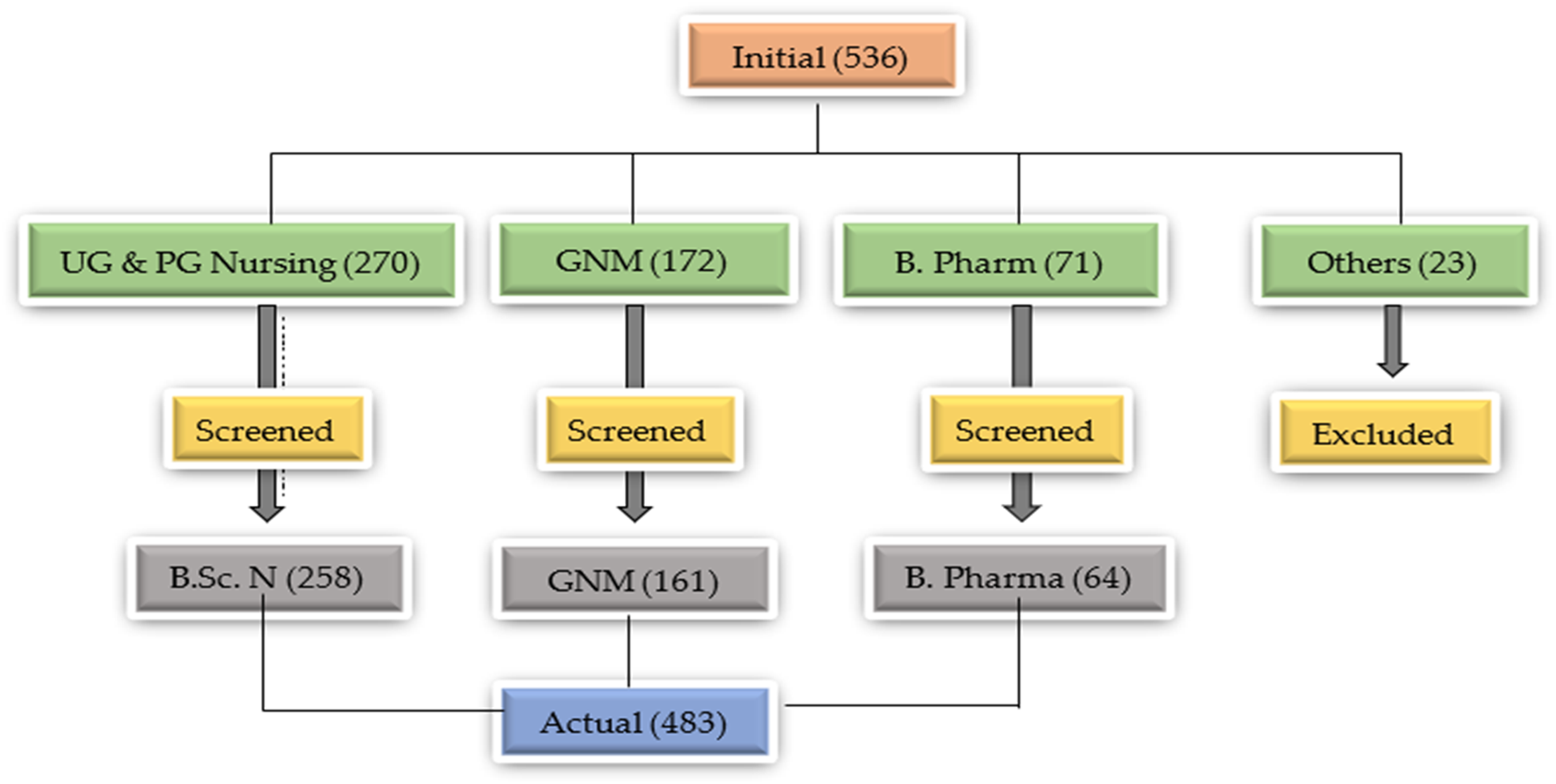
Data acceptance flowchart.
Respondents’ Profile.

To know the user satisfaction level in terms of the purpose of SNSs use, perception of SNSs, use behavior, negative impacts of SNSs, and positive impacts of SNSs, the respondents were asked to indicate their preferences with a five-point Likert scale from “1 = strongly agree” to “5 = strongly disagree.” The results in Table 2 shows that the healthcare students had varied responses in terms of their purpose of using SNSs as a means of communication. The respondents expressed their opinion that they strongly agree with the items such as watching academic videos on YouTube, establish contacts with others, interact with teachers/experts in their field, share their ideas, and discuss academic problems with a mean value of 1.5, 1.71, 1.71, 2.20, and 1.73, respectively. Moreover, the respondents were also found to agree with all the items under the perception of SNSs. Regarding the use behavior of SNSs, the study revealed that the students agree with most of the items that were mentioned under the behavior. As far as negative impacts of using SNSs are concerned, it is found that the participants agree with all the items except the item “SNSs cause sleep disorder” (m = 1.78, strongly agree). Regarding the items of positive impact of using SNSs, the students were found to agree with all the items except improve communication skills (m = 2.50, neutral).
Mean, Standard Deviation, and Qualitative Description of SNSs Use.

Note. **1.00–1.80 (Strongly Agree); 1.81–2.60 (Agree); 2.61–3.40 (Neutral); 3.41–4.20 (Disagree); 4.21–5.00 (Strongly Disagree).
Participants’ demographic characteristics with mean, standard deviation, and p-value against frequency of SNSs use are highlighted in Table 3. The study found that the value of total mean and standard deviation against all demographic variables are consistent (mean = 1.13 and 0.539). However, p-value was inconsistent in other characteristics such as against age where p-value is significant (0.001), and in the remaining cases, p-values are insignificant (0.85, 0.786, 0.102, and 0.387, respectively).
Comparison of Mean and Standard Deviation of SNSs Use Frequency in Terms of Demographic Characteristics.

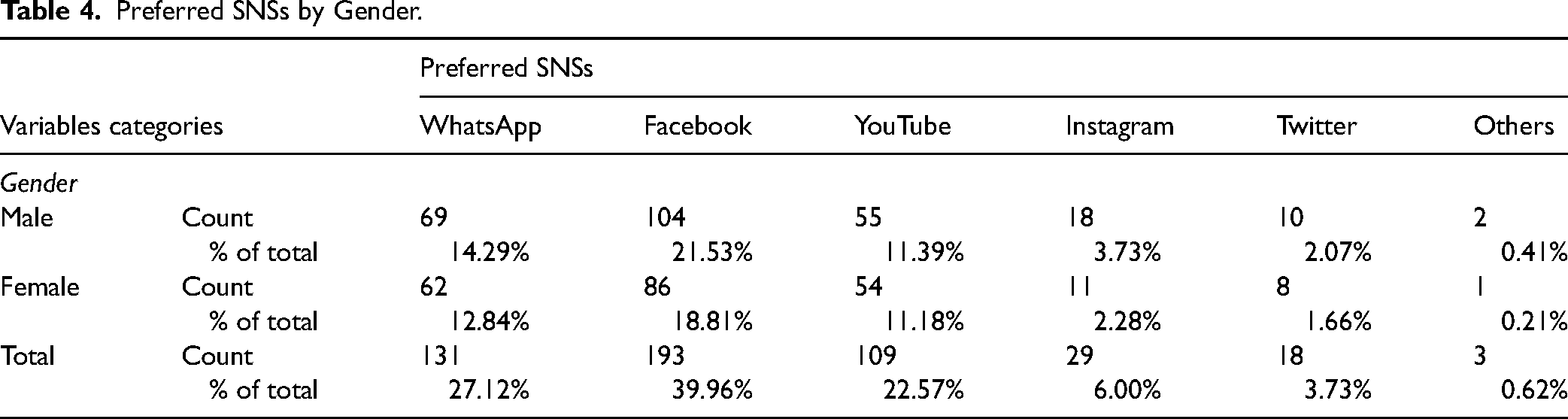
Table 4 shows preferred SNSs among the participants, which was the research question number 1. From the figure, it is found that Facebook was the most preferred SNSs among both male (n = 104, 21.53%) and female respondents (n = 86, 18.81%), respectively. WhatsApp was found as the second most preferred SNSs among the participants (n = 131, 27.12%) followed by YouTube (n = 109, 22.57%), Instagram (n = 29, 6%), Twitter (n = 18, 3.73%), and others (n = 3, 0.62%), respectively.
Preferred SNSs by Gender.
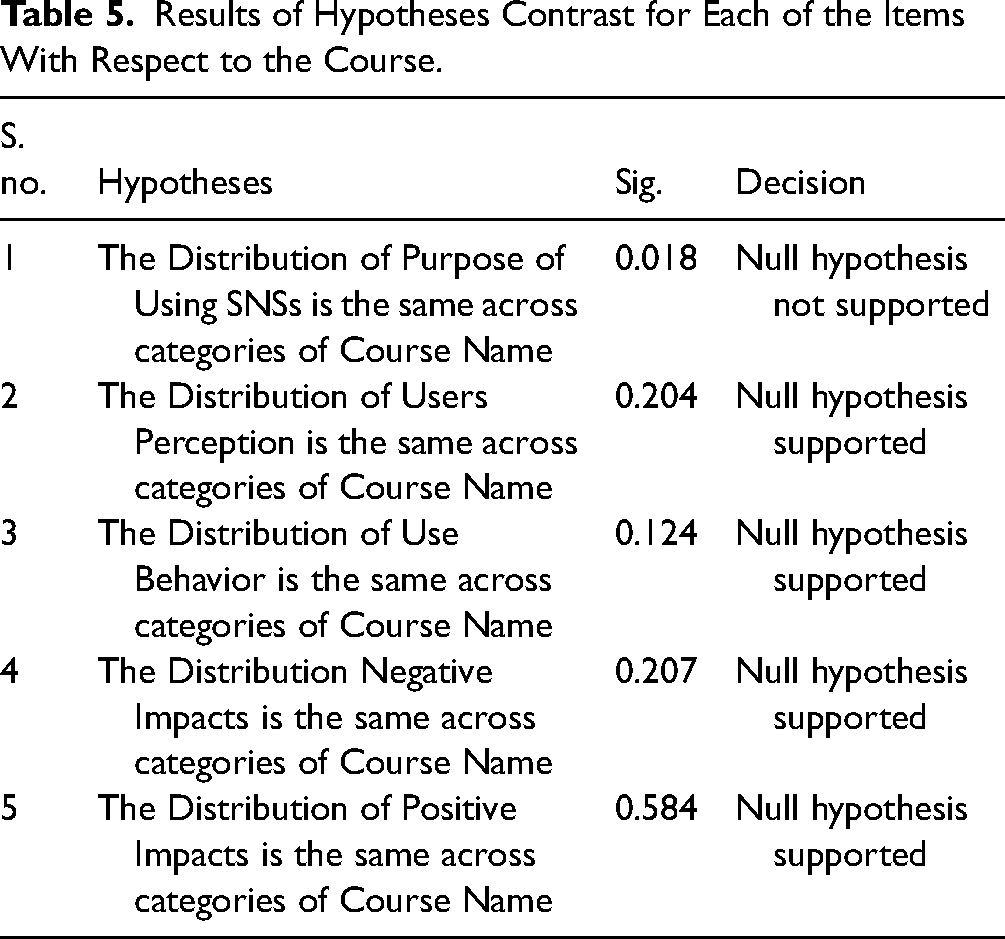
Comparing each factor in terms of course/program name, Kruskal–Wallis test (Table 5) revealed statistically insignificant differences in the first hypothesis (p = .018), thereby rejecting the null hypothesis between purpose of using SNSs and course names. Additionally, p = .204 value rejects the alternate hypothesis that there is any association between users’ perceptions and course name, whereas p = .124 supports the null hypothesis of any relationship between use behavior and course names. Similarly, p = .207 and p = .584 reject the alternate hypothesis between relationship of negative impacts and course names and positive impacts and course names, respectively.
Results of Hypotheses Contrast for Each of the Items With Respect to the Course.
A chi-square test for independence with α = .05 was used to find out the association between use of SNSs and acquiring/gaining knowledge among the respondents. The chi-square test showed statistically significant result with a p-value of < .05. Therefore, as seen in Tables 6 and 7, there is association between use of SNSs and acquiring/gaining knowledge among the respondents.
Association Between Use of SNSs and Acquiring Knowledge.

Association Between Professionalism and Gender.

To evaluate the association between professionalism and the gender of the respondents, a chi-square test for independence with α = .05 was used. The chi-square test was statistically insignificant at 5.
Discussion
The fundamental objective of this study was to explore how SNSs were used for learning purposes among healthcare students in India drawn on the Connectivism theory (Siemens, 2005) and New Social Learning theory (Bingham and Conner, 2010). The research found out the type of SNSs used, their benefits, and the relationship between their features. After analyzing the collected data, the results showed that most of the respondents were 21–25 years old, male, and in pursuing third and fourth year. Besides, majority of the students were belonging from the semi-rural areas. The study revealed that Facebook, WhatsApp, and YouTube were the most preferred SNSs among both male and female respondents. Similar results were revealed by Valdez et al. (2020) that most of the nursing students from Israel, Iraq, Oman, the Philippines, and Turkey were under the age group of 20–25 years. They found that most of the respondents across the five countries were more engaged in SNSs like Facebook and WhatsApp. Some reported that most of the nursing students engaged with a variety of SNSs for multitude of reasons to remain in “touch with others” (Alharbi et al., 2021; Nyangeni et al., 2015), to become “socially competent” (Terzi˙ et al. 2019), “engaging and informative approach to learning” (Price et al. 2018), and to “support in their daily lives and studies” (Lahti et al., 2017). Moorley and Chinn (2014) and Pimmer et al. (2018) found that nursing students have a positive attitude toward SNSs as they can communicate with peers and educators and share class updates, and study materials and promote discussions.
A very large number of respondents reported that they were engaged with a variety of SNSs because of many factors such as they can establish contact with peers, family members, educators, watch academic videos/contents on YouTube, interacting with experts in the fields, share their ideas, and to discuss academic problems with others and get up-to-date information about placement/job, etc. These results justifies the adoption connectivism and new social learning frameworks for explaining the usage of SNSs for learning purposes among healthcare students in India. Students connect and share with their colleagues similar information of interest and experience (Siemens, 2006). Students also found that SNSs helps them maintain connection to facilitate continual learning, which again supports the claim made by Siemens (2006) as a key principle of connectivism (Ryberg et al., 2012). Koehler and Vilarinho-Pereira (2021) believed that using “social media, learners can use visibility to monitor their problem-finding and generating-solution efforts more closely. Learners can individually track their actions and progress or use cues from peers’ actions to consider different approaches and ideas” (p.19). Guraya et al. (2018) highlighted that most of the medical students use SNSs for discussing their problems with educators and friends. Roodt and Peier (2013) revealed that more than 90% of respondents use YouTube for social and academic purposes. The result also correlated with the findings of Lahti et al. (2017) that majority of nursing students in Finland prefer social media for educational purposes followed by to be able to share their thoughts and communication. Pimmer et al. (2018) found that “the relevance of WhatsApp as part of nursing students’ (inter)personal learning environments. In addition to the high levels of perceived usefulness of WhatsApp as a means to enhance communication with students and nurses, the platform's use was also tied to a number of socio-professional indicators” (p. 123).
As far as use behavior of SNSs is concerned, the study found that majority of the participants preferred to use SNSs every day with their smartphone. Terzi˙ et al. (2019) revealed that “students received help when they contacted their teachers via social media.” As far as the negative impacts of using SNSs are concerned, majority of the students indicated some of the serious problems they had confronted such as sleeping disorders, data privacy, and distraction of attention during learning time. Besides all these, most of the students believed that SNSs consume a maximum time and hamper social and private relationships. In this context, Valdez et al. (2020) pointed out that “the negative and positive aspects of SNS utilization are a contentious issue that has yet to be resolved because SNSs can be addictive and their improper usage may lead to less positive outcomes” (p 11). Another study by Hamal (2021) highlighted that most of the SNSs were causing the utmost distractions among college students, which in turn affects their grades and reduces reading habits. It is in line with Terzi˙ et al.’s (2019) study where they found that most of the nursing students agree that day-by-day they were addicted with SNSs. Further, they believed that irrational use might give birth to several negative impacts on their social life like data privacy, etc.
Over 73% of the respondents believe that SNSs can improve academic performance, regardless of whether they are regular users. According to Alahmar (2016), nearly 42% of medical students surveyed in Babylon, Iraq, believed that social media had a positive impact on their academic performance. Therefore, the respondents expressed more positive views compared to those in Iraq. Avcı et al. (2015) found that almost 90% of students used SNSs for professional purposes. This study found that 67.7% of respondents agreed that SNSs play a positive role in developing their professional identity. Medical students who use social media responsibly can benefit both their education and professional development.
Strengths and Limitations
The current research provides an insight on the use behavior of SNSs by healthcare students in higher education through the lens of connectivism and new social learning conceptual frameworks. The research gives a better understanding of students’ actul usage of SNSs and considered both positive and negative consequences of this usage. The research confirmed that students were engaged with a diversity of SNSs, such as Facebook, WhatsApp, and YouTube, mainly for connectivity and social learning by establishing a connection with peers, family members, and educators, watch academic videos/contents on YouTube, communication with experts in the fields, share their ideas, and to discuss academic issues with both colleagues and educators. Despite that students reported some deficiencies for their extensive usage of SNSs, for example, sleeping disorders, digital distraction of their study, and disrespecting of their privacy, they ensured that the use of SNSs can contribute positively to their academic performance and development if they responsibly use the SNSs. Hence, the role of educators is important in the learning community on SNSs.
The limitations of this paper is that only students from one medical institute were selected for the study; hence, to have a better understanding about the topic, a broad range of institutions can be selected to get the detailed information. The study could be repeated with a broader sample from various institutions.
Implications for Practice
The results of this study confirm that healthcare schools and their educators should have a better understanding of connectivism and social learning because this will enable them effective usage of SNSs for improving learning. Educators have to be aware of connectivism principles and promotion of new social learning, which is not odds with formal education. They need to create online learning community and enhance connectivity (Sobaih & Moustafa, 2016; Sobaih et al., 2022a, 2022b). The study confirmed that healthcare students who use social media in a responsible manner will benefit both in their education and their professional development, which will benefit patients in the long run. This responsible use of SNSs improves learning. Hence, it is important that higher education administrators find proper ways to encourage healthcare and medical students to have a responsible use of SNSs. For example, raising students’ awareness about responsible use of SNSs through different various campaigns and training session to create a positive effect on students’ responsible use of SNSs. This enables students to harvest the positive consequences of SNSs usage for academic purposes such as enhancing their academic performance and overcoming the challenges such as sleeping disorders, data privacy, and distraction of attention during learning time. Encouraging students to use SNSs responsibly can benefit both their education and professional development.
Conclusion
SNSs are a common activity among nursing students as a means of connecting them to others in their social and professional circles; it helped students succeed in both. A lot more research is needed on the impact that social media has had on the development of students’ professional identities. In order to maximize students’ professional development, nursing schools should take into account the many reasons students use social media to connect. Nursing schools and healthcare facilities should work together to guarantee that SNSs are utilized in an ethically appropriate manner by nursing students in the clinical setting. Adopting the findings of this study and putting them into practice could have a positive impact on the ethical and legally appropriate usage of social media in healthcare facilities. A better understanding of how nursing students’ professional identities are formed through social media can be used to support nursing students when they enter the workforce. Due to several reasons, only the students enrolled in the undergraduate nursing and pharmacy programs in India were included in this research. To have an impact on how SNSs are used in healthcare, the findings and suggestions of this study could be put into practice.
Footnotes
Author Contributions
Conceptualization: A.E.E.S, A.B., and I.A.P.; methodology: I.A.P., A.B., and S.A.M.; software: I.A.P. and A.B.; validation: A.E.E.S, A.B., I.A.P., and S.A.M.; formal analysis: I.A.P. and A.B; investigation: I.A.P., A.B., and S.A.M.; resources: I.A.P., A.B., and S.A.M.; data curation: I.A.P. and A.B.; writing—original draft preparation: A.E.E.S, A.B., I.A.P., and S.A.M.; writing—review and editing: A.E.E.S, A.B., I.A.P., and S.A.M.; visualization: I.A.P. and A.B.; supervision: S.A.M.; project administration: S.A.M.; funding acquisition: A.E.E.S. All authors have read and agreed to the published version of the manuscript.
Declaration of Conflicting Interests
The authors declared no potential conflicts of interest with respect to the research, authorship, and/or publication of this article.
Funding
The authors disclosed receipt of the following financial support for the research, authorship, and/or publication of this article: This work was supported by the Deanship of Scientific Research, Vice Presidency for Graduate Studies and Scientific Research, King Faisal University, Saudi Arabia (grant number GRANT3043).
Institutional Review Board Statement
The study was conducted according to the guidelines of the Declaration of Helsinki and approved by the deanship of scientific research ethical committee, King Faisal University (project number: GRANT3043, date of approval: 1/10/2022).
Informed Consent Statement
Informed consent was obtained from all subjects involved in the study.

Data Availability Statement
Data is available upon request from researchers who meet the eligibility criteria. Kindly contact the first author privately through the e-mail.