




Abstract
Background
Infection Prevention and Control Linked Nurses (IPCLN) are the spearhead of implementing the Infection Control Prevention Program. The performance of nurses in preventing and controlling infections during the Covid-19 pandemic greatly influenced the quality of services.
Objective
This study aimed to determine the factors that influence the performance of IPCLN during the Covid-19 pandemic.
Methods
Cross-sectional study was performed on 34 nurses at Cicendo Eye Hospital with a total sampling technique. The questionnaire in this study included knowledge, motivation, supervision, and the performance of nurses which had previously been tested with these characteristics with a result of Cronbach's alpha of 0.75. Data were analyzed using univariate, bivariate, and multivariate analyses.
Results
The mean score of IPCLN knowledge in this study was 14.82 ± 4.01, motivation 92.47 ± 15.85, supervision 34.74 ± 5.89, and performance 7.94 ± 2.71. There is a relationship between knowledge (p = .000), motivation (p = .000), and supervision (p = .000) on nurse performance. Motivation is the dominant factor influencing IPCLN performance compared to knowledge and supervision (Stand. Estimate = 0.5121; 95% CI = 0.1301–0.487; p < .001).
Conclusion
Motivation is a dominant factor in IPCLN performance in this study. However, hospital management needs to maximize and make policies to improve IPCLN performance in terms of motivation. These policies can be through providing incentives for nurses, developing free continuing education programs, and issuing funds for nursing education scholarships.
Introduction
The Covid-19 pandemic is a deadly disease in the world. World Health Organization [WHO] (2021) estimates the death toll is between 80,000 and 180,000 among healthcare workers infected with Covid-19. Meanwhile, in Indonesia, at least 1,545 health workers died during the research study period, most of whom were doctors and specialists (n = 535, 35%), nurses (n = 428, 28%), and midwives (n = 359, 23%) (Ekawati et al., 2022). However, global reports clearly show that the broader risks and threats to contracting the virus and possibly dying from exposure to Covid-19, including long-term symptoms, stigma, discrimination, work overload, fatigue, emotional disturbance, and sleep deprivation, are clear (Ekawati et al., 2022; Labrague & De Los Santos, 2020; Rangachari & Woods, 2020).
Nurses have an important role in controlling infection during the Covid-19 pandemic (Mokhtar, 2017). Nurses actively care for patients and must be fast and responsive in providing services to infectious patients, including Covid-19 (Wulansari & Wahyono, 2022). However, the pandemic has indirectly affected the performance of nurses (Alqahtani et al., 2022; Bartzik et al., 2021; Lestariningsih et al., 2022; Makowicz et al., 2022; Putra, 2021; Reganata & Saputra, 2022; Yousaf et al., 2021; Yulianti, 2021). Changes in the routine and flow of health services, daily challenges, stressors, family and community pressure, fear and insecurity in the face of something unknown make health professionals, including nurses, fragile and vulnerable (Bartzik et al., 2021; Makowicz et al., 2022; Mokhtar, 2017; Putra, 2021; Reganata & Saputra, 2022; Reis et al., 2020; Ryusuke & Sanica, 2021). Therefore, this situation can affect the nurse's performance and service quality during the Covid-19 pandemic (Ryusuke & Sanica, 2021).
Review of Literature
The performance of nurses during the Covid-19 pandemic is the main key in hospital services. Several studies have also reported a decrease in nurse performance during Covid-19 (Ahmed et al., 2022; Alqahtani et al., 2022; Ekawati et al., 2022; Lestariningsih et al., 2022; Makowicz et al., 2022; Reganata & Saputra, 2022; Reis et al., 2020; Ryusuke & Sanica, 2021; Zhang et al., 2021). For example, a study in Indonesia said that around 60.9% of nurses working in Indonesia had low performance, carrying out more than 65% of non-nursing tasks. In comparison, only 35% carried out nursing care according to their roles and functions (Tarigan et al., 2019). In addition, the performance of nurses in health services is still low, around 50.5% (Putri, 2020). Thus, the manifestation of low nurse performance can result in the loss of thousands of hours of work and huge financial losses for the organization (Reganata & Saputra, 2022).
The Covid-19 pandemic has had a serious impact on the working conditions of health workers including nurses (Lau et al., 2021; Razu et al., 2021). Despite this, nurses with greater professional commitment will continue to work, fulfilling their duties and saving the lives of millions during this difficult time (Duran et al., 2021; Momeni & Khatooni, 2023). Hence, most of them do their best to fulfill their job responsibilities (Duran et al., 2021). Therefore, the Infection Prevention and Control (IPC) program will be effective if the knowledge and education of staff are good, policies are adequate, analysis of places at risk of infection, and good coordination between hospital units.
In Indonesia, the IPC program is regulated according to the Decree of the Minister of Health concerning managerial guidelines for IPC in hospitals and other health care facilities (Regulation of the Minister of Health Number 27 of 2017: Guidelines for Infection Prevention and Control in Health Service Facilities., 2017). The regulation explains that every hospital is required to have an IPC team consisting of an Infection Prevention and control officer (IPCO), an Infection Prevention Control Nurse (IPCN) and an Infection Prevention and Control Linked Nurse (IPCLN) with separate criteria. The criteria for becoming an IPCLN are nurses with a minimum education Diploma, who have an interest in IPC and have attended basic IPC education and training.
IPCLN's performance during the Covid-19 pandemic was filling out daily surveillance, conducting infection control prevention education for officers, patients and visitors in their respective units, conducting audits of officer compliance with implementing infection control prevention programs, and identifying possible outbreaks with IPCN coordination. IPCLN is urgently needed in hospitals. Increasing competence and work motivation is a way to improve IPCLN performance (Setiawan et al., 2022; Sutarto et al., 2016). In addition, good supervision knowledge and skills are needed for infection control (Dachirin et al., 2020). Therefore, knowledge, supervision, and motivation are the main factors influencing employee engagement in improving the performance of IPCN (Hentu & Pendit, 2022). Nurses with better professional performance will help reduce infection rates in hospitals and save the lives of millions of people during this difficult time. It is very important to examine the factors that affect IPCLN performance during the Covid-19 pandemic in Indonesia. Therefore, this study aims to determine the factors that influence the performance of IPCLN during the Covid-19 pandemic.
Methods
Study Design
A cross-sectional study was conducted at the Cicendo Hospital in Indonesia, from August to November 2021.
Research Questions
Research questions of this study: (1) how is knowledge, motivation, supervision, and performance among IPCLN and (2) what are the factors related to IPCLN performance at Cicendo Hospital, Indonesia.
Sample
The participants of this study were 34 nurses who are members of the IPCLN at the Cicendo Eye Hospital. The sampling technique in this study used total sampling. Cicendo Eye Hospital is a National Eye Hospital based on the Decree of the Minister of Health of the Republic of Indonesia No.059/MENKES/SK/I/2009 dated 16 January 2009 and a Teaching Hospital based on the Decree of the Minister of Health of the Republic of Indonesia No. 127 /Menkes/SK/V/2014, 5 May 2014. The existence of this Eye Hospital is used as a government support hospital in dealing with the problem of the Covid-19 pandemic. The total number of nurses working at the Cicendo Eye Hospital is 150 people, while the nurses who are members of the IPCLN are as many as 34 people. The criteria for nurses involved in IPCLN are work experience of more than 5 years and have passed training in Prevention of Infectious Diseases so that it is hoped that they can assist government programs in reducing Covid-19.
Inclusion and Exclusion Criteria
The sample inclusion criteria for this study were nurses who were members of the IPCLN at Cicendo Hospital.
Procedure
The data collection technique used a questionnaire that was given directly to IPCLN. Data were collected from August to November 2021. This month, Covid-19 cases in Indonesia are still increasing due to the emergence of new variants during the second wave which peaked in May–July. After the respondent agreed to participate in the study and filled out an informed consent form, the respondent was asked to be willing to fill out a questionnaire and return it to the researcher. If the respondent does not agree to be involved in the research, the researcher respects the respondent's decision. Therefore, respondents who were not willing were not used as the research sample. In this study, all respondents agreed to be involved in the research.
Instrument
The instruments used in this study consisted of several sub-sections, namely demographic characteristics (such as; gender, age, educational background, marital status, and length of work), knowledge, motivation, supervision and performance. The instrument knowledge (18 items), motivation (31 items), and supervision (11 items) were developed by Sarifudin (2018) and have been tested for validity and reliability (Sarifudin, 2018). The performance questionnaire (10 items) was developed by the Cicendo Eye Hospital in Bandung about the performance of IPCLN. All instruments have been tested for validity and reliability according to the characteristics of the population. The validity test of the knowledge questionnaire with an r-count value of 0.470 (valid), the motivation questionnaire with an r-count value of 0.458 (valid), and the supervision questionnaire with an r-count of 0.515 (valid) (Sarifudin, 2018). Thus, the performance questionnaire has been tested for Content Validity Index with a value of 0.938. Instrument reliability is tested in this study using Cronbach's alpha. The instrument is said to be good for use when the analysis results are in the range of 0.70–0.95, and in this research instrument, the reliability test results show a number of 0.75.
Statistical Analysis
Data analysis is presented in the form of frequency and percentage distribution tables. This study analyzed data using univariate, bivariate, and multivariate. Univariate analysis in this study included frequencies and percentages to describe demographic characteristics. In addition, the mean score, standard deviation, minimum and maximum values are calculated to describe the scores for each variable, namely knowledge, motivation, supervision, and performance. Then, to identify the relationship between knowledge, motivation, supervision, and the performance, we conducted an analysis using a Pearson correlation test with a significance level of p < .05. Furthermore, the normality of the data for each variable was identified using the Kolmogorov–Smirnov test, which obtained a value of p > .05 which indicated that the data was normally distributed. Then, the heteroscedasticity data showed that there was no heteroscedasticity data where the value of p > .05 was tested using Goldfeld-Quandt and Harrison-McCabe. These two results indicate that the analysis can be continued using linear regression. Thus, multivariate analysis with multiple linear regression examines the relationship between variables to describe the dominant factors influencing IPCLN performance.
Institutional Review Board Approval
The Ethics Committee of Cicendo Hospital has approved this research No. LB.02.01/2.3/024/2021 dated July 19, 2021. This research also adhered to the five rights of human subjects in research in Polit and Beck (2010).
Results
Sample Characteristics
Based on demographic characteristics, almost half of the respondents are female (70.6%), age range of 46–55 years (73.5%), and all respondents were married (100%). In addition, most of the respondents have an education level of Registered nurse (55.9%) and have a working period of > 20 years (58.8%) (see Table 1).
Characteristics of Respondents (n = 34).

Knowledge, Motivation, Supervision, and Performance Among IPCLN
Table 2 shows that the mean IPCLN knowledge score in this study was 14.82 ± 4.01, motivation 92.47 ± 15.85, supervision 34.74 ± 5.89, and performance 7.94 ± 2.71.
Average Distribution of Knowledge, Motivation, Supervision and Performance Among IPCLN (n = 34).

Factors Associated With Performance Among IPCLN
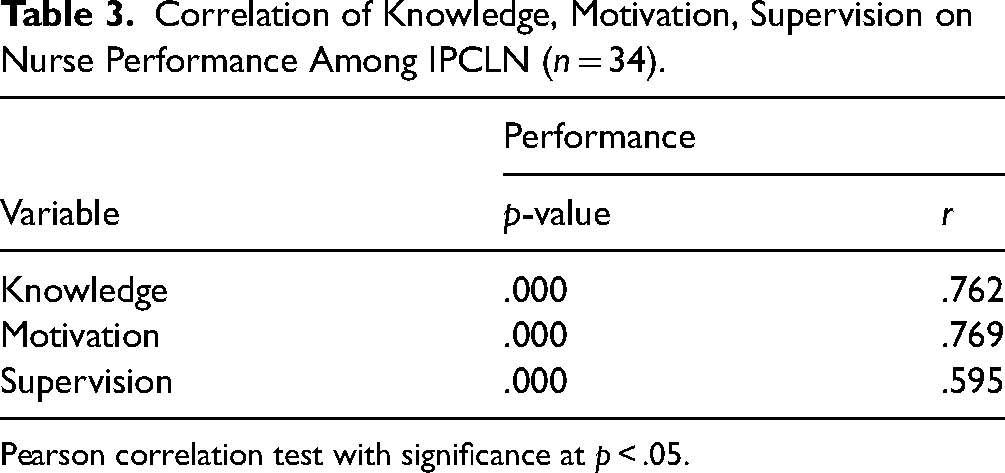
Table 3 shows that there is a relationship between knowledge (p < .000), motivation (p = .000), and supervision (p = 0.000) on nurse performance. In addition, the results of logistic regression analysis (see Table 4) showed that motivation is the dominant factor affecting IPCLN performance (Stand. Estimate = 0.5121; 95% CI = 0.1301–0.487; p < .001) compared to knowledge and supervision. This means that for every 1% increase in the work motivation variable, the IPCLN performance variable will increase by 51.2% assuming the other independent variables remain the same. In addition, after further analysis with supervised regression analysis, there is no relationship with IPCLN performance (Stand. Estimate = 0.0668; 95% CI = −0.0837–0.145; p = .587).
Correlation of Knowledge, Motivation, Supervision on Nurse Performance Among IPCLN (n = 34).
Pearson correlation test with significance at p < .05.
Factor Affecting Nurse Performance Among IPCLN (n = 34).

Multiple linear regression with significance at p < .05.
Discussion
Nurses have an important role in providing direct health care, so a nurse's performance is very important to note (Yulianti, 2021). One factor determining the caliber of hospital services is the work productivity of the nurses (Setiawan et al., 2022). In order to deliver a good service, one must increase competence, motivation, and workload management (Setiawan et al., 2022). Based on the results of this study, it shows that mean IPCLN performance score in this study was 7.94 ± 2.71, ranging from 1 to 10. The mean performance score is close to the maximum value so that the respondents in this study were able to carry out their duties properly, on time, and in accordance with the responsibilities and goals of the hospital (Setiawan et al., 2022).
Nurses’ performance level can affect the quality of service and hospital management. The low work productivity of the nurses can result in loss of thousands of man-hours and enormous financial losses for the hospital (Reis et al., 2020). In addition, the level of productivity of nurses in work is related to the quality of health services, so it needs special attention to increasing client satisfaction as well as to describe the perception of the excellence of health services in the community (Diana et al., 2021; Gunawan et al., 2019; Lestariningsih et al., 2022; Mokhtar, 2017; Priyantini & Ayatulloh, 2023). The work productivity of the nurses is influenced by many factors (Kahya & Oral, 2018).
This study's results show that nurses’ motivation is the most dominant factor in nurse performance. IPCLN with good motivation will have 51 times better performance (see Table 4). Work motivation can generate enthusiasm or encouragement for individual or group work towards work to achieve goals (Setiaman et al., 2022). Supported by previous studies, it is said that the factor most closely related to nursing performance was work motivation (p < .05) (Gunawan et al., 2019; Mustariningrum & Koeswo, 2015; Priyantini & Ayatulloh, 2023). Even though Covid-19 caused nurses to experience decreased motivation (Saisai & Seifeddine, 2022), however, in this study, most of the nurses had motivation score 92.47 ± 15.85, ranging from 55 to 119 (see Table 2). The sense of care and responsibility that nurses have can affect motivation at work so that this encourages nurses to provide the best service during the Covid-19 pandemic (Morishita et al., 2022).
In this study, all IPCLNs that have been selected by management are of course based on their level of ability, education and leadership in connection with their duties as motivators for their colleagues in the unit where they are assigned. We can observe this from the length of their working lives, which are on average above 20 years, so they can be said to have sufficient work experience (see Table 1). Work experience will affect everyone's ability and work skills in addition to physical fitness, mental health, education and accumulated training (Mustariningrum & Koeswo, 2015).
Another factor that influenced the nurses performance is knowledge about infection control and management. Our finding showed that knowledge has a significant relationship to the performance of a nurse after motivational variables. This is because the findings of this study show IPCLN knowledge score in this study was 14.82 ± 4.01 ranging from 3 to 18, so this score is close to the maximum value. In addition, the majority had an educational background as registered nurses. Nurses with a bachelor's degree or registered nurses have more ability to combine basic knowledge and practice by considering the rationale for the actions taken (Fukada, 2018). This is in line with the theory of organizational behavior developed by Robbins, which says that knowledge is the main basis for a person to behave according to the organization's goals (Robbins, 2015).
Knowledge is a main factor of individual factors (Ryusuke & Sanica, 2021). Knowledge is closely related to nurse performance (Ryusuke & Sanica, 2021; Sarumi & Sari, 2022; Tesfaye & Abera, 2015). In addition, less knowledge can impact poor infection control (Ibrahim Abdeen Mhana et al., 2022). Previous studies showed there was a significant positive correlation between nurse knowledge and nurse performance (Hidayah & Putri, 2020; Jumoke & Mutula, 2018). Liza's study shows a significant relationship between knowledge, attitude, and behavior with nurses’ occupational health and safety actions in controlling nosocomial infections (Liza et al., 2015). That is, poor infection control will align with nurses’ lack of performance in controlling infections in hospital services.
Suboptimal IPC, including inadequate decontamination and poor hand hygiene, are the most frequently raised transmission issues (Islam et al., 2020; Shbaklo et al., 2021; Wee et al., 2021). The spread of infection is also caused by the lack of nurse compliance in IPC so this will have an impact on the performance of nurses (Lee & Jun, 2022). Previous studies reported that the lack of adherence in carrying out IPC such as hand washing, using personal protective equipment, and other practices can be caused by a lack of knowledge about proper techniques, supplies, supervision, and motivation of nurses at work (Alhumaid et al., 2021; Driscoll & Evans, 2022). Therefore, efforts to prevent infection must be balanced with supervision by the infection control team (Wee et al., 2021). The supervision results in this study show the mean supervision score was 34.74 ± 5.89, ranging from 21 to 44. Good supervision will simultaneously affect the performance of the IPCLN (Mustariningrum & Koeswo, 2015; Shbaklo et al., 2021). Controlling and observation of IPCLN influences on performance and compliance related to IPC behavior. If the supervision is increased, it will also improve the performance of the IPCLN itself (Lubis & Arruum, 2019).
Based on bivariate analysis, supervision has a relationship with the performance of IPCLN nurses (p = .000) (see Table 3). However, when viewed from the multiple regression test, it shows that supervision does not show a significant correlation (see Table 4). This means that supervision has not been able to encourage the achievement of good performance if the independent variables tested are fixed. Implementation of supervision is not only to oversee whether all IPCLN carry out their duties properly in accordance with applicable instructions or procedural standards, but also to improve the process of implementing the ongoing IPC program activities (Mustariningrum & Koeswo, 2015). Previous studies have said that Covid-19 has had a negative impact on the clinical supervision of healthcare workers and students in care settings (Martin et al., 2022). The unpreparedness of supervisors during Covid-19 was the main factor in failure in controlling and observation. In order for the observation process to run well, the supervisor must try to optimize comfortable working conditions including the physical environment, as well as the working atmosphere between the IPCLN and other health workers (Martin et al., 2022; Mustariningrum & Koeswo, 2015).
Many factors affect the performance of nurses in service and infection control during the Covid-19 pandemic. For hospitals, leadership, workload, and job satisfaction are still important factors in maximizing nurse performance (Ryusuke & Sanica, 2021). However, the pandemic period created a new workload that was far different from the conditions before the pandemic (Yousaf et al., 2021). An increased workload will reduce the focus that can be given to each job, resulting in a decrease in job satisfaction that will affect nurse performance (Song et al., 2020). In addition, excessive workload will also have an impact on reducing nurse motivation (Zainaro et al., 2021). In addition, knowledge, skills, performance feedback, persistent fear of infection, and fatigue are other factors that affect nurse performance (Alqahtani et al., 2022; Diana et al., 2021; Tesfaye & Abera, 2015). Therefore, it is necessary to carry out educational interventions for nurses and develop and update infection control guidelines to improve the performance of health workers, especially IPCLN, in providing services (Belal et al., 2020; Spendlove, 2011). The in-service education intervention reported a remarkable increase in nurses’ knowledge and performance of infection control measures in the hospital (Belal et al., 2020).
Implication for Practice
This study provides an overview for all nursing practitioners to determine the factors that can affect the performance of nurses, especially in an infectious work environment, so as to optimize the factors that are still lacking. In addition, the results of this study found that motivation is the main factor influencing nurse performance so that the hospital needs to pay attention for improving the motivation among nurses.
Strength and Limitations
The limitation of this study is that it was only carried out in one area of the hospital, so that the participants in this study were relatively few. Therefore, there is a need for further research with the same variables and population with more samples so that the results of the study can be generalized better and more comprehensively. Then, the use of instruments to assess the performance of nurses is a limitation in this study. Even though this instrument has been tested for validity and reliability, it has never been published in any article because this is internal. Because this Cicendo Hospital is part of a teaching hospital so it can be used for Teaching Hospitals in Indonesia (national). In the future, it is necessary to conduct research to assess validity and reliability specifically for performance questionnaire. Therefore, the instrument can be used globally.
Conclusions
The results showed a strong positive relationship between knowledge, motivation, and supervision with IPCLN performance during the Covid-19 pandemic at Cicendo Eye Hospital. The higher the knowledge, motivation, and supervision of IPCLN, the nurse's performance will also increase. In this study, motivation at work is the dominant factor influencing IPCLN performance. Therefore, the hospital's strategy to improve motivation is to provide incentives for nurses, then develop free continuing education programs, and issue funds for nursing education scholarships. Hospitals also need to provide regulations in the form of sanctions for nurses who work not in accordance with the rules and roles they have. In addition, hospital management needs to develop and update policies to increase IPCLN awareness and infection control capacity. This can be done through continuous education and training on IPCLN and optimization of supervision. Utilizing technology for supervision can be a solution as a need for a supervision model during the Covid-19 pandemic so that supervision can be carried out optimally. Future research needs to identify the efficacy of using technology in supervision for IPCLN nurses.
Footnotes
Acknowledgement
This study received support from the Faculty of Nursing, Padjadjaran University and Cicendo Eye Hospital. The authors thank the management of Cicendo Eye Hospital for the support and the respondents involved in this study.
Author Contributions
Conceptualization was carried out by all authors, guided together by the first, second, and third authors. Fourth and fifth authors conducted literature searches and data extraction, synthesized quantitative data and verified the data by all authors. All authors contributed substantially to the manuscript's critical review, editing, and revision. All authors approved the final version of the manuscript.
Data Availability Statement
All data generated or analyzed during this study are included in published article.
Declaration of Conflicting Interests
The author(s) declared no potential conflicts of interest with respect to the research, authorship, and/or publication of this article.
Funding
The author(s) received no financial support for the research, authorship, and/or publication of this article.
