




Abstract
Introduction
Numerous studies have established the importance of social support on psychological symptoms among older adults, however, the distinct contribution of different levels of family and friends’ social support has not been thoroughly assessed
Objectives
This study determined the contribution of different levels of friend and family social support (high, moderate, low) on psychological symptoms among the older adult
Methods
A cross-sectional study was conducted among 538 older adults attending outpatient clinic
Results
Older adults with moderate social support from family were 3.6 more likely to have depression symptoms than those with high family social support (AOR = 3.623, 95%CI 1.275–2.875, P = .020). Also, those with moderate family social support (AOR = 2.875, 95%CI 2.425–11.875
Conclusion
High social support confers a protective measure against depression and is effective in reducing psychological symptoms among older adults.
Introduction
The older adult global population is growing rapidly (Li et al., 2019) and Nigeria, the most populous country in Africa, is not an exception. Nigerians are living longer than before due to public awareness of hygiene, improved sanitary conditions, and declining fertility (Ebimgbo & Okoye, 2021). Ageing however comes with worse psychological health outcomes compared to other age groups (Awick et al., 2017; Chen et al., 2019). Social, personal, and emotional factors are some of the components determining the level of the psychological well-being of older adults (Olena & Lyubov, 2018).
Psychological symptom's such as depression and anxiety are common among older adults related to performance reduction and feelings of loss (Ebrahimi et al., 2018). Other contributing factors are concerns of being a burden to family members (Balsamo et al., 2018), medication side effects (de Oliveira et al., 2019), and poor social support (Li et al., 2019). Psychological symptoms among older adults can result in dementia (Balsamo et al., 2018), a decline in quality of life (Mohd et al., 2019), and Alzheimer's disease progression among cognitively normal older people (Donovan et al., 2018).
Social support is important in ameliorating psychological symptoms and reducing the negative impact on older adults. Social network structures improve mental health outcome and enhance the older adults’ ability to cope with stressful events (Chen et al., 2019; Santini et al., 2020). Previous studies have established the importance of family and friends social support on psychological symptoms among older adults (Chen et al., 2019; Li et al., 2019; Mohd et al., 2019; Unsar et al., 2016). However, the distinct contribution and specific roles of each level of friend and family social support (high, moderate, low) on psychological symptoms among older adults is scanty. The results of this study could present important information that can be useful in improving the social support provided for older adults in reducing psychological symptoms. This study therefore assesses the specific role of levels of family and friends social support on the psychological symptoms among older adults. It also predicts the influence of sociodemographic variables of older adults on the level of depression and anxiety.
Method
Research Design
A cross-sectional design was conducted to study the psychological symptoms and social support of older adults attending outpatient clinics in two selected Teaching Hospitals in Oyo State, Nigeria.
Research Setting
The study was conducted among older adults attending the outpatient clinic of Bowen University Teaching Hospital (BUTH) and Ladoke Akintola University Teaching Hospital (LAUTH), Ogbomoso, Oyo State, Nigeria. The two teaching hospitals are located in Ogbomoso, Oyo State, Nigeria. BUTH is a private mission hospital owned by the Nigeria Baptist Convention while LAUTH is a state-owned teaching hospital. Both hospitals serve as referral centers for other neighboring hospitals.
Target Population
Older adults who were 65 years and older, visiting an outpatient clinic, irrespective of their diagnosis of chronic or acute conditions, were targeted.
Sample Size
All older adults attending an outpatient clinic who were willing to participate in the study between February and July 2021 were recruited for the study. The total sample size was 538 older adults from the two hospitals.
Sampling Technique
A purposive sampling technique was used to recruit the participants. Inclusive criteria were older adults 65 years and older, not in serious pain, not cognitively impaired, and who were willing to participate.
Research Instruments
Data were collected using a structured questionnaire utilizing the 7-item Generalized Anxiety Disorders Scale (GAD-7), the Patient Health Questionnaire (PHQ-9), and the Multidimensional Scale of Perceived Social Support (MSPSS).
The GAD-7 is a seven-item brief clinical measure or screener for assessing anxiety symptoms or severity in the primary care setting (Spitzer et al., 2006) and has an excellent psychometric property (Johnson et al., 2019). The tool is measured on a 4-point Likert scale (0–3) and total scores range from 0 to 21. Scores between 11 and 21 are considered as being anxious (Spitzer et al., 2006).
The PHQ-9 is a mental disorder screening instrument for measuring severity of depression. It has nine items scored on a 4-point Likert scale. The total depression severity score is calculated by the summation of the nine items scores and ranges from 0 to 27. PHQ-9 scores greater than 15 are adjudged as being depressed related to meeting the diagnostic criteria of major depression (Andreas & Brunborg, 2017). The psychometric properties of PHQ-9 among older adults have been ascertained to be adequate (Aslan et al., 2020). The MSPSS instrument was used to evaluate the social support received by older adults from family, significant others and friends (Zimet et al., 2010). It comprises 12 items on a 7-point Likert scale ranging from very strongly disagree to very strongly agree. The level of social support is determined by calculating the mean of the total item scores. Social support received from friends is the sum of items 6, 7, 9, and 12 divided by 4. For significant others, the sum of items 1, 2, 5, and 10 are divided by 4; and family is the sum of items 3, 4, 8, and 11 divided by 4. Any mean score ranging from 1 to 2.9 is low support; a mean score of 3 to 5 is moderate support; a mean score of 5.1 to 7 is high support. The internal consistency and reliability have been reported to be good with a Cronbach alpha of 0.82 (Mohammed, 2018; Olabisi et al., 2020).
Method of Data Collection
Permission to collect data was received from the head of the outpatient clinic. Older adults attending an outpatient clinic of the hospital were informed about the study. The purpose of the study was explained to them and individuals below 65 years were excluded. The respondents filled out the questionnaires on site at the clinic and they were collected by one of the researchers after completion.
Data Analysis
The data analysis was carried out using Statistical Packages for Social Sciences (SPSS 23). Descriptive statistics were presented with frequency and percentages. Logistic regression was used to predict the influence of sociodemographic characteristics and social support on depression and anxiety. The inferential analyses were considered significant at P-value less than .05.
Results
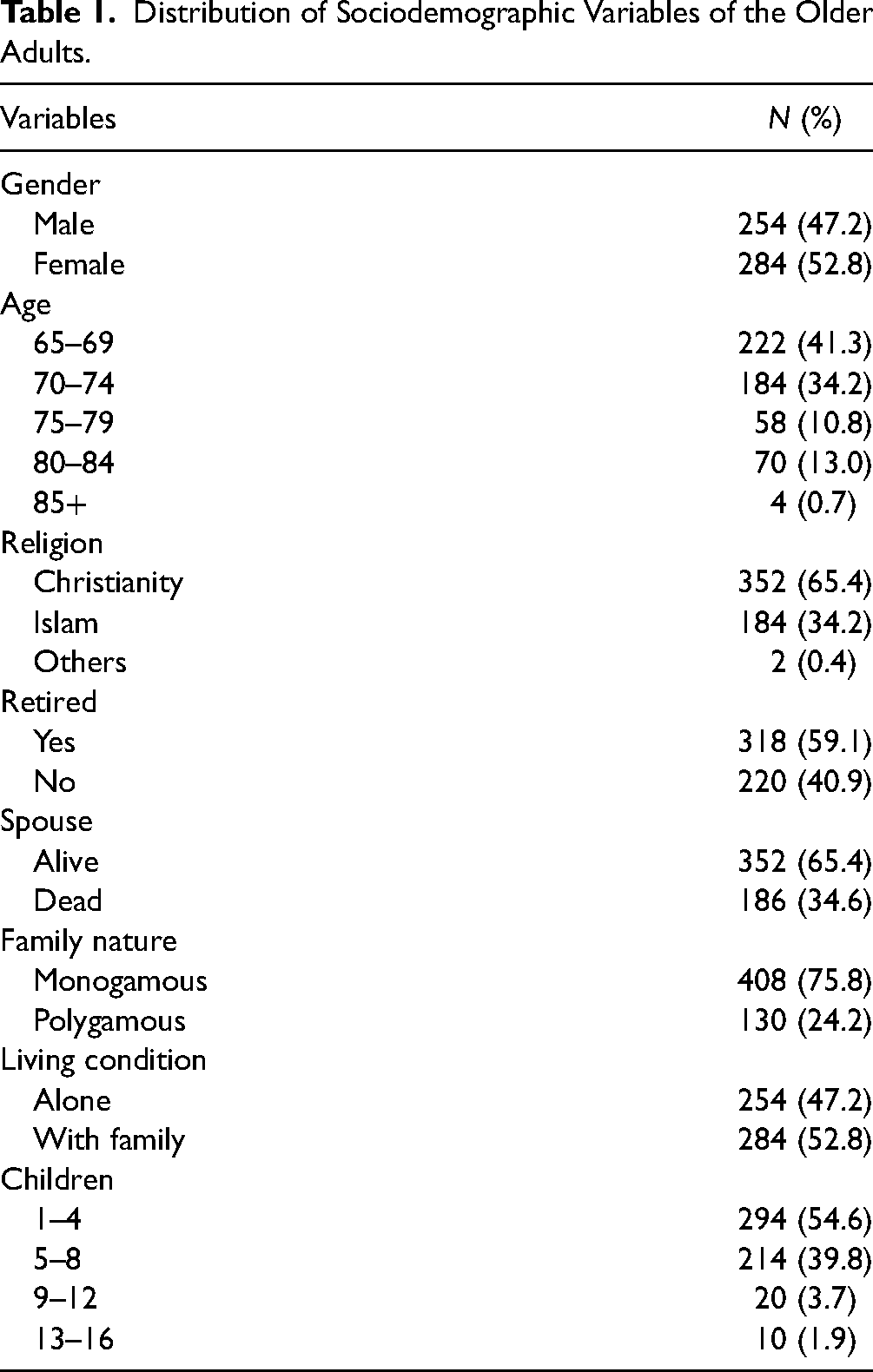
More than half of the respondents were females (52.8%) and 41.3% were between the age of 65 and 69 years. More than one third of the respondents (34.2%) were Muslim and more than half were retired (59.1%). Three quarters of the respondents (75.8%) were from a monogamous family setting and a little above average (52.8%) lived with a family member (Table 1).
Distribution of Sociodemographic Variables of the Older Adults.
The level of anxiety, depression and social support among older adults revealed that about one quarter (n = 136; 25.3%) of the respondents were anxious while (n
Level of Anxiety, Depression, Social Support From Friends, Family and Significant Order.

Older adult Muslims were likely to have more depression symptoms than older adult Christians (AOR = 3.339, 95%CI 1.199–22.264, P = .036). Those from polygamous settings were 4.7 times more likely to have depression symptoms (AOR = 4.739, 95%CI 3.063–7.284, P = .001). Living with family members (AOR = 5.271, 95%CI 2.843–9.771, P = .002) and older adults with five to eight children (AOR = 12.546, 95%CI 1.044–150.752, P = .046) were associated with more depression symptoms. Older adults with moderate social support from family were 3.6 times more likely to have depression symptoms than those with high family social support (AOR = 3.623, 95%CI 1.275–2.875, P = .020).
Older adults between age 80 and 84 years were more likely to have anxiety than those age 65 and 69 years (AOR = 8.573, 95%CI 3.513–20.921, P = .000). Not being retired (AOR = 0.261, 95%CI 0.141–0.485, P = .000), spouse death (AOR = 0.229, 95%CI 0.110–0.478, P = .000), and polygamous family setting (AOR = 3.525, 95%CI 1.905–6.523, P = .000) were associated with increased anxiety symptoms. Older adults with nine to twelve children (AOR = 0.886, 95%CI 0.228–5.535, P = .021) and with thirteen to sixteen children (AOR = 0.919, 95%CI 0.153–5.416, P = .010) were likely to have more anxiety symptoms compared with those with one to four children. Older adults with moderate family social support (AOR = 2.875, 95%CI 2.425–11.875, P = .002), low family social support (AOR = 2.966, 95%CI 1.312–3.875, P = .007), and low friends social support (AOR = 2.966, 95%CI 1.312–3.875, P = .009) were likely to have more anxiety symptoms than those with high social support (Table 3).
Logistic Regression Showing the Predictors of Depression and Anxiety Among the Older Adults.

N = number; S.S. = social support.
Discussion
Social support is the relationships and interactions involving sharing of resources between two or more people with the purpose of strengthening positive feelings and enhancing well-being (Mohd et al., 2019). The social support of family and friend's networks is most cherished in African culture. It provides succor for the family members experiencing distress and challenges. Though previous studies revealed that family and friends social support improved mental health and reduced psychological symptoms including depression and anxiety (Chen et al., 2019; Jen et al., 2018; Li et al., 2019; Olabisi et al., 2020; Oon-Arom et al., 2021; Qi et al., 2022; Santini et al., 2020), this study examined associations between social support and psychological symptoms (depression and anxiety). Researchers found that a high level of family social support is more effective and older adults with moderate level of family social support are three times likely to have depression compared with a high level of family social support. Moreover, a low level of family and friends social support is not effective in reducing the anxiety among older adults compared with high friends and family social supports.
The results of this study have shown that older adults in a polygamous setting experienced higher psychological symptoms. This is consistent with previous studies that polygamous family are characterized by jealousy, anger and violent relationships capable of affecting the mental health of the family members (Ozer et al., 2013; Rahmanian et al., 2021; Sinai & Peleg, 2021).
Contrary to previous study findings that being Muslim had positive religious coping methods which reduced the level of depression (Abu-Raiya et al., 2019; Thomas & Barbato, 2020). The findings from this study revealed that Muslims are more depressed than Christians. The findings of this study can be related to the settings where the study was carried out. Previous studies were conducted in a Muslim dominated environment; this present study was carried out in Christian dominated environments. Contrary to a previous study that living with family members reduced the level of psychological burden (Carol et al., 2017), this finding revealed that older adults living with their family members were more depressed than those living alone. This is in line with a previous study that found the quality of support and satisfaction with family members were the major factors in reducing the level of depression among older adults (Chi & Chou, 2001).
The study also revealed that an increased number of children in a family contributed to a high level of depression among older adults This is in line with studies conducted during COVID-19 that large family size is associated with increased level of depression, anxiety and stress (Le et al., 2020; Radwan et al., 2021). In addition, one of the factors contributing to the level of anxiety was age difference. As age increased in this study, it was positively associated with the level of anxiety. This finding was in accordance with a study that anxiety and fear of death increased as older adults aged (Pearman et al., 2021).
Limitations of the Study
The main limitation of this study involved the collection of data by questionnaire. In-depth interviews of older adults might reveal more perceptions of the respondents. Only older adults visiting the outpatient clinics were sampled.
Relevance to Clinical Practice
Understanding the influence of friends and family social support on psychological symptoms among older adults will enable healthcare providers to educate and implement social support strategies in reducing the level of depression and anxiety among this population.
Conclusion
High social support confers a protective measure against depression and is effective in reducing psychological symptoms among older adults. Family setting, religion, and death of spouse are risk factors for increased psychological symptoms among older adults. Healthcare professionals should not only advocate for social support, but specifically advocate for high family and friends social support for older adults. This support may provide effective interactions that guarantee older adults psychological well-being. In addition, policy should be instituted on promoting social support for older adults.
Footnotes
Acknowledgment
The authors appreciate the respondents who participated in the research.
Declaration of Conflicting Interests
The author(s) declared no potential conflicts of interest with respect to the research, authorship, and/or publication of this article.
Ethical Approval
Ethics Research Committee of Bowen University Teaching Hospital approved the study (BUTH/REC-163). Informed consent was also obtained from each of the respondents’ and they were told not to write their names or means of identity on the questionnaire.
Funding
The author(s) received no financial support for the research, authorship, and/or publication of this article.
