




Abstract
Introduction
Postpartum family planning (PPFP) has been reported to decrease the risk of stunting by increasing the interval between pregnancies by 0.9 percent every month. In Indonesia, the prevalence of stunting affects 21.6% in 2022; however, it is expected that by 2024, the figure would drop to 14%.
Objective
This study aims to analyze the relationship between gender equality and husband support in the use of PPFP.
Methods
The study was conducted using a cross-sectional method and took place from August to October 2022. The participants comprised 210 women who had given birth in the first 4 to 12 months in Kulon Progo, Yogyakarta, Indonesia. The data was collected from women who visited the pediatrics and family planning clinics of community health centers from August to October 2022, using a structured questionnaire and analyzed using both the Chi-Square Test and Binary Logistic Regression Analysis.
Results
The results showed that 38.1% of the participants used PPFP. The estimated results reveal that variables such as education, husband support, gender equality, home visits, and postnatal visits (p < 0.05) influenced the implementation of postpartum contraception. While other variables such as age, occupation, income, number of children, and parity did not affect the model (p > 0.05).
Conclusion
Participating in postpartum family planning requires the husband's support and gender equality. We recommend a deliberate effort on improving postnatal mothers using postpartum family planning, one of the strategies is to increase intensive outreach to pregnant women with higher education to their husbands about the importance of postpartum family planning.
Introduction
According to several reports, 121 million unintended pregnancies occur annually worldwide, with a rate of 64 cases per 1000 women aged 15–49 years from 2015 to 2019. It was noted that 61% of these unintended pregnancies result in abortion, and the global abortion rate was recorded as 39 per 1000 women aged 15–49 years (Bearak et al., 2020). The majority of those perilous abortions occur in developing nations, notably in Asia, which contributes to 97% of all unsafe abortions. The global maternal death rate in 2020 was 223 per 100,000 live births, with a target of 70 per 100,000 live births by 2030 (World Health Organization [WHO], 2023). Previous studies have indicated that 94% of maternal deaths occur in low-income areas and are preventable cases, such as unintended pregnancy that can be prevented through contraception. The incidence of unintended pregnancy was 30.8% among users of the lactation amenorrhea method (Hakik et al., 2021).
The government of the Republic of Indonesia has taken initiatives to improve human quality and control the number, as well as to improve the quality of human resources and family planning services through “Tribina Keluarga” activities (Toddler Family Development, Youth Family Development, Elderly Family Development). The national development policies and strategies are presently outlined in the Presidential Regulation of the Republic of Indonesia Number 18 of 2020 concerning the 2020–2024 National Medium-Term Development Plan including Improving Maternal, Child, Family Planning, and Reproductive Health, including: expanding access and quality of family planning and reproductive health services based on the regional characteristics (Badan Kependudukan dan Keluarga Berencana Nasional [BKKBN], 2022). Strategic steps in the future to accelerate the achievement of postpartum family planning service targets by encouraging districts/cities to include postpartum family planning services in the regional medium-long-term development plans, simplifying, recording, and harmonizing data between BKKBN and the Ministry of Health, as well as empowering family assistance teams to find and provide education to pregnant and postpartum women (Kantor Staf Presiden, September 29, 2022).
The lack of use of contraception after childbirth can have serious consequences, such as an increased risk of unwanted pregnancy (Moreira et al., 2019), pre-pregnancy obesity, gestational diabetes, and uterine rupture (Hutcheon et al., 2019), increased incidence of bleeding, hypertension disorders, fetal malposition, infection, hospitalization, and preterm birth (Bauserman et al., 2020). The occurrence of pregnancy within the first year after birth increases the risk of fetal and neonatal death, premature birth, low birth weight, and small gestational age babies (Gebremedhin et al., 2018).
In the Postpartum Family Planning (PPFP) program implemented in the Kulon Progo District, Yogyakarta, Indonesia, the use of contraception by mothers increased from 13.83% in 2019 to 30.6% in 2020. In 2021, out of 30 postpartum women, 10 (33.3%) used PPFP rather than relying on standard operating procedures, to reach 40% by 2024. Thus, this study aims to examine the correlation between gender equality and husband support for the use of PPFP.
Review of Literature
The PPFP services goal is to regulate the spacing of pregnancy/births and avoid unintended pregnancy, and this helps each family to plan for childbirth safely and healthily (BKKBN, 2017; Kementerian Kesehatan RI [Kemenkes RI], 2019). Glasier et al. (2019) described all women who give birth, regardless of outcome or delivery way, should be offered effective contraception options, nonetheless the change is frequently lost the 57 low- and middle-income countries showed that 62% of women who gave birth in 2019 were not immediately initiated into PPFP (Rossier et al., 2015). Postpartum contraception has been reported to have the ability to reduce maternal and infant mortality by preventing unintended pregnancies and giving a minimum of two years gap between births (Yemane et al., 2021). The interpregnancy interval of fewer than six months since the last delivery is associated with an increased risk for preterm birth, small gestational age, and infant mortality (Ahrens et al., 2019), by increasing the distance between pregnancies, reducing the risk of stunting by 0.9 percent/month (Amaha & Woldeamanuel, 2021). Mothers in low-income households with many children have inadequate family support (Rutaremwa & Kabagenyi, 2018). Improved partner communication can help women in identifying their husband/partner's approval. Interventions including informal education and encouraging male involvement in family planning can enhance contraceptive prevalence (Prata et al., 2017). Gender equality reflects equal evaluation by society's equal assessment of men's and women's similarities and differences and their roles. The idea that women and men, girls and boys have equal circumstances, treatment, and opportunities to realize the fullest potential, human rights and dignity, and to contribute to (and benefit from) economic, social, cultural, and political development (United Nation International Childrend's Emergency Fund [UNICEF], 2017). According to Aventin et al. (2023), there was an important role in gender equality in family planning.
In 2020, the maternal mortality rate in Indonesia was estimated to be 189 per 100.000 live births (Balai Pusat Statistik [BPS], March 31, 2023). The infant mortality rate in Indonesia in 2021 was 18.9 per 1,000 live births (World Bank, March 23, 2023). The 2030 Sustainable Development Goals (SDGs) target for maternal and infant mortality rates is 70 per 100,000 live births, and 12 per 1,000 live births, respectively (United Nations, September 19, 2020). According to the 2022 Child Nutritional Status Survey, the stunting prevalence in Indonesia was 21.6%. Maternal mortality rate, infant mortality rate, and stunting prevalence remain serious health issues in Indonesia (Kemenkes RI, 2023).
WHO recommends that PPFP focuses on avoiding unintended pregnancies and close spacing during the first 12 months after childbirth (WHO, January 16, 2016). Postpartum contraception in this study is defined as the use of contraceptives immediately after child birthing for as long as six weeks (42 days). Therefore, the objective of this study was to determine the prevalence and relationship between gender equality and husband support in the use of postpartum family planning.
To develop a series of evidence-based interventions, it is of the utmost importance to assess the prevalence and relationship between gender equality and husband support in the use of postpartum family planning. Thus, research needs to be conducted to assess the prevalence of PPFP and factors related to PPFP to inform researchers, health workers, and health planners to produce data that can help guide protocols to increase the use of PPFP which plays a role in improving maternal and infant health and reducing stunting.
Methods
Study Design
A cross-sectional study was conducted at the pediatrics and family planning clinics of twelve community health centers sub-districts in Kulon Progo, Yogyakarta, Indonesia from August to October 2022. At the beginning of the survey, eligible participants were asked to complete an informed consent form stating their willingness and agreement to participate. All responses were kept confidential, and participants were allowed to withdraw from the study at any time.
The independent variables in this research are gender equality and husband support, which were measured using a Likert scale questionnaire. The dependent variable is the use of postpartum family planning, specifically contraception within the first 42 days after childbirth, and the data source is medical records. Control variables include parity, number of children, home visits, and postnatal care visits, all of which were gathered from medical records. Demographic data were collected based on the participants’ answers.
The participants completed the survey using the questionnaire, which took approximately 25 min. The author provided a contact person to all participants if they wanted to learn about the survey results or consult regarding the use of postpartum family planning.
Research Question
What was the relationship between gender equality and husband support in the use of postpartum family planning in Kulon Progo, Yogyakarta, Indonesia?
Sample
The participants in the study were postpartum women in the first 4 to 12 months after giving birth. Data collection was carried out in Kulon Progo Regency when mothers visited the pediatrics and family planning clinics of community health centers from August to October 2022 using a structured questionnaire with strict adherence to the COVID-19 protocols. The samples were selected using the proportional random sampling method based on data from women who gave birth in 2021 in each of the 12 sub-districts in Kulon Progo, Yogyakarta, Indonesia. Based on the inclusion and exclusion criteria, a total of 210 postpartum women were used as participants.
A sample size of this study is used for determining the sample size in a cross-sectional study to estimate prevalence or a proportion. The formula is as follows:

According to the Regional Health Office Report of Yogyakarta, the prevalence of PPFP was 13.62% (Dinkes, 2020). This means that the value of p = 0.136 with an absolute precision of 5% (0.05) and a confidence level of 95%. The calculation with the above formula is:


Inclusion/exclusion criteria
Sample inclusion criteria included the postpartum women in their first 4 to 12 months after giving birth, being able to read and write, having a husband, being able to communicate well, and having a maternal and child health book, and family planning card. The exclusion criteria are having a background of health workers/cadres/field extension workers.
Statistical Analysis
The data obtained in this study were analyzed using Descriptive, Chi-Square Independence, and Logistic Regression Analyses. A descriptive analysis of the sociodemographic variables, such as age, educational level, employment status, family income, number of children, parity, gender equality, husband support, home visits, postnatal care (PNC) visits, and PPFP used was carried out to obtain their frequency and percentage distribution. Furthermore, the Chi-Square test was used to assess the statistical significance of the relationship between sociodemographic factors and the use of postpartum contraception. The logistic regression analyses were used to analyze the significant sociodemographic variable affecting postpartum contraception usage. The level of statistical significance was set at p < 0.05, and the analysis was carried out using SPSS for Windows V.26.
Results
Sample Characteristic
Table 1 shows that among 210 respondents, the majority of study respondents, 109 (51.9%) were aged 20–35 years old, 125 (59.5%) had a middle level, and 134 (63.8%) were employed. Moreover, 129 (61.5%) respondents had a family income of IDR 1.904,275-IDR 5,000,000, 97 (46.2%) had a parity of two times, and 101 (48.0%) had two children. Among 210 respondents, 152 (71.4%) had good gender equality, and 131 people (62.4%) had good husband support. Home visits were less than 141 (67.1%) and post-natal care visits with the highest proportion were good at 115 (54.8%). There are 80 (38.1%) participants in postpartum family planning.
Demographic Characteristic.

Research Question Results
Relationship Between Gender Equality And Husband Support In The Use Of Post Partum Family Planning
The bivariate analysis was used to analyze the demographic and socio-demographic variables of respondents with postpartum contraception. The results of the Chi-Square test between the independent and dependent variables are presented in Table 2.
Chi-Square Analysis Variable Research on Age, Education, Employment, Income, Number of Children, Parity, Gender Equality, Husband Support, Home Visits, Postnatal Care Visits with the Postpartum Contraception Use.
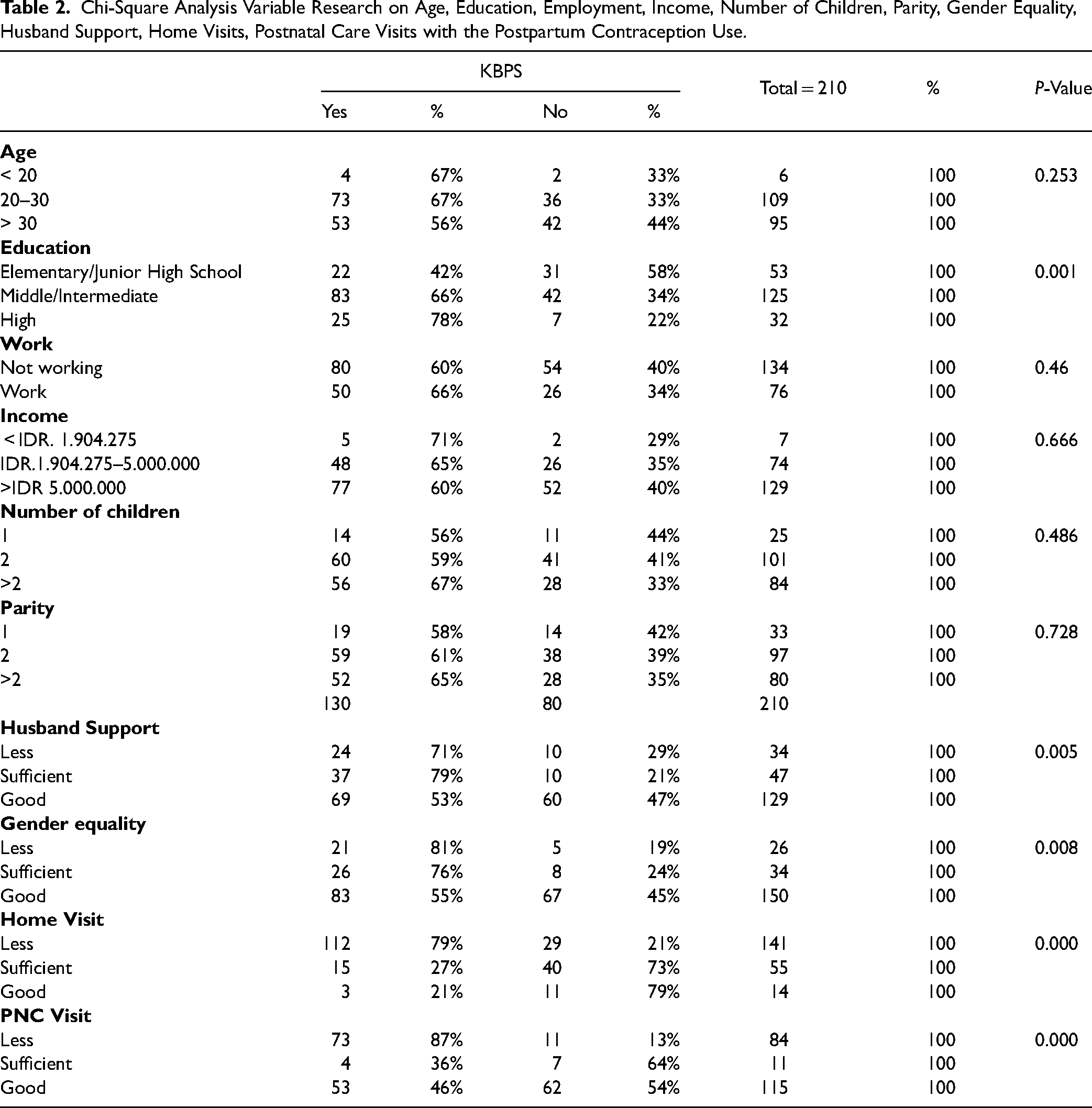
The results of the Chi-square test analysis showed that there were 5 significant variables (p < 0.05), namely education p-value 0.000, husband's support p-value 0.005, gender equality p-value 0.008, home visits p-value 0.000, and postnatal care visits p-value 0.000. To test the overall/multivariate model, logistic regression analysis was performed on the variables affecting family planning participation (Table 3).
The Goodness of Fit Model.

Logistic regression analysis is conducted when the measurement of the dependent variable (Y) is dichotomous or responds to two choices (Tabachnick et al., 2019), identifiable as those who participated in family planning (1) and did not participate in family planning (0). In this analysis, the maximum likelihood estimator was used (Hair et al., 2018). The initial stage was to test the fit of the overall model with the Likelihood Log −2 Test statistic which has a Chi-Square distribution (Tabachnick et al., 2019). The estimation results show that the p-value is (0.000 < 0.05) which indicates that by including the independent variables in the model there are independent variables affecting the model. In addition to −2 log-likelihood, the logistic regression's fit can be examined using the Hosmer and Lemeshow test (HL statistics) which has a Chi-Square distribution (Osborn, 2015). The result of the p-value is 0.639 > 0.05, indicating that the outcome can be explained by the data (fit model with data). As with multiple linear regression, the R square value of the logistic regression is generated, which is called Pseudo R Square. In logistic regression, this measure is referred to as goodness of fit (Hair et al., 2018). This measure consists of the Cox and Snell R-Square, which was determined to be 0.458. However, this R-Square value can be greater than one so that the form of improvement is Nagelkerke R square with a result of 0.622 which implies that the independent variables included in the model explained 62.2% of the variation/opportunity of respondents to participate in family planning or not. The classification matrix can be used to calculate the logistic regression model's prediction accuracy Hair et al. (2018) describe the overall count as (116 + 60) divided by 210, which is 83.8%, which means the model has a prediction accuracy of 83.8%.
Influence Of Husband Support And Gender Equality Among Post Partum Family Planning.
Individual testing follows once the overall model fit findings reveal that the model is acceptable (satisfactory). Based on Table 4. The influence between individual variables is carried out using the Wald test statistic (Pallant, 2020), and logistic regression interpretation based on the odds ratio (exp B) (Hair et al., 2018). The estimation results show that the variables influencing the use of postpartum contraception include education, husband support, gender equality, home visits, and postnatal care visits (p < 0.05). While other variables such as age, occupation, income, number of children, and parity did not affect the model (p > 0.05). The research findings for the education variable show that respondents with middle/intermediate education are 0.187 times less likely to participate in family planning than those with basic education/elementary education and those with high education are 0.057 times less likely to participate in family planning than those with basic/elementary education. These results confirm that the higher the respondent's education, the lower the chance to participate in family planning. The logistic regression coefficient for husband support is also negative, indicating that those who perceive sufficient husband support are less likely to participate in family planning and those with good husband support are also less likely to participate in family planning. The results indicate that the husband's support for his wife's participation in family planning is low. The husband's role in the family is essential, but there is a need for socialization and two-way communication between the wife and husband in determining family planning participation.
Binary Logistic Regression Analysis.

Home visits to participating in family planning have a 13.18 times higher chance than infrequent home visits, while home visits to participate in family planning are 174.48 times higher. The results confirm that the more frequent home visits, the more likely respondents are to participate in family planning.
PNC visits have a significant effect where respondents with good enough post-natal care visits to participate in family planning have a 15.4 times higher risk and the risk of respondents with good post-natal care visits participating in family planning is 9.29 times higher.
Discussion
In this study, there are 80 (38.1%) were participants in postpartum family planning. The target in Indonesia is 40%, this shows that the postpartum family planning program has almost reached the target, however, health promotion efforts must continue. The estimation results showed that the variables that influenced the use of postpartum contraception included education, husband support, gender equality, home visits, and post-natal care visits (p < 0.05), while other variables such as age, occupation, income, number of children, parity were not effective on the model (p > 0.05). In the education variable, the increase in the respondent's education is equal to a decrease in the opportunity to participate in family planning. The results of this study are supported by Lasong et al. (2020) who revealed that secondary education was positively related to contraceptive use. Husband support for the use of contraceptives enhances postpartum women's willingness to use them fivefold (AOR = 5.76, 95% C.I: 4.82–6.88) (Ezeanolue et al., 2015). The results of this study are in line with Antarini's (2021) variables related to the use of modern family planning including education, number of children, knowledge, health status, and visits to health services. The results of this study are in contrast to Boadu's study (2022) on women with less formal education are less likely to use modern methods of contraception than women with higher education.
The result of this study indicates that good gender equality increases the probability of respondents in family planning. This was because the contraception techniques were determined by women, who feel more empowered in a society with relative gender equality (de Looze et al., 2019). Prior studies found that efforts that promote gender equality have the potential to improve contemporary contraceptive use in Nigerian cities (Okigbo et al., 2018).
The results of this study indicate that husband support is low in supporting wives to participate in family planning. The husband's role is important in the family, but the need for socialization and two-way communication between the wife and husband in determining family planning participation needs to be built. The results of this study are not in line with what Boadu (2022) has described decision-making with partners as a stronger determinant of contraceptive method use than decision-making specifically for women. Ontiri et al. (2021) have argued that covert contraceptive use is common because of a lack of spousal support for the use of modern methods. Previous studies revealed that husband support or opposition to contraceptive use among women has a strong influence on its usage, especially in developing countries (Balogun et al., 2016). This finding is in line with Kassa et al. (2021) that the prevalence of postpartum intrauterine contraceptive use in Ethiopia was 21.63%, with husband support being one of the factors influencing the usage of PPFP with IUDs.
These results confirm that the more frequent the home visits, the more likely respondents are to participate in family planning. The results of this study are in line with Handler et al. (2019) the practice of postpartum home visits is an important method for enhancing the provision of post-natal care for women.
PNC visits have an important effect, with respondents with sufficient enough post-natal care visits participating in family planning having a 15.4 times higher risk and respondents with good post-natal care visits participating in family planning having a 9.29 times higher risk. The results of this study correspond to Amour et al. (2021), who found that women who received family planning counseling during post-natal care visits were considerably more likely to take contraception than women who were not given FP counseling.
Strength and Limitations
To the best of our knowledge, this is the first postpartum family planning participation study in Kulon Progo, Yogyakarta, Indonesia. This was successful in documenting the achievement of postpartum family planning and the impacting factors. These findings form the basis for further studies of causal effect relationships that may provide a more conclusive relationship between factors associated with postpartum family planning participation. This study did not examine other factors that potentially influence postpartum family planning participation such as financing, or the use of reminder messages.
Implication for Practice
The research findings show that husband support and gender equality are essential factors in postpartum family planning participation. We recommend a deliberate effort on improving postnatal women using postpartum family planning, one of the strategies is to increase intensive outreach to pregnant women with higher education with their husbands about the importance of postpartum family planning.
Conclusions
Participation in postpartum family planning is influenced by educational level, gender equality, and husband support. The interesting thing is that the variables of home visits, post-natal care visits, and gender equality have a positive effect on respondents participating in postpartum family planning; however, the level of education and husband support harm postpartum women in participating in postpartum family planning. Health workers play a significant role in promoting postpartum family planning. Postpartum family planning can benefit both mothers’ and children's health. Gender equality has been created well, demonstrating the success of the ministry's program for women's empowerment in socializing gender equality so that it can encourage the success of postpartum family planning. Despite this variable level of education, the husband's support is a challenge for local governments. Respondents with higher education and support from their husbands still seem to have low participation in postpartum family planning; thus, there is a need for more intensive outreach to postpartum women who are highly educated and their husbands about the importance of participating in postpartum family planning through various activities.
Footnotes
Declaration of Conflicting Interests
The author(s) declared no potential conflicts of interest with respect to the research, authorship, and/or publication of this article.
Funding
The author(s) received no financial support for the research, authorship, and/or publication of this article.
