



Abstract
Introduction
Although the number of Chinese nurses employed in Japan is increasing, the situation regarding their work conditions has not been clarified. It is necessary to understand such conditions to consider support for Chinese nurses in Japan.
Objective
This study examined the professional nursing practice environment, occupational career, and work engagement of Chinese nurses in Japan.
Methods
Using a cross-sectional study design, 640 paper questionnaires were mailed to 58 Japanese hospitals that employed Chinese nurses and included a QR code for online responses. A survey request form and URL were sent to the Wechat app, where Chinese nurses in Japan communicate. The contents include attribute-related questions, the Practice Environment Scale of the Nursing Work Index (PES-NWI), Occupational Career Scale, and Utrecht Work Engagement Scale. Either Wilcoxon's rank-sum or the Kruskal–Wallis test was performed to compare scores of the study variables between subgroups.
Results
A total of 199 valid responses were obtained, of which 92.5% were female, and 69.3% had a university degree or higher. The PES-NWI score was 2.74, and the work engagement score was 3.10. The group with a university degree or higher had significantly lower scores on PES-NWI and work engagement than those with diplomas. Regarding the subscale of occupational career, scores of forming and coordinating interpersonal relationships, self-development, and accumulating a variety of experience were 3.80, 2.58, and 2.71, respectively. The scores were significantly higher with more than 6 years of nursing experience in Japan than those with 0–3 years or 3–6 years.
Conclusion
Most participants had university degrees or higher, and their scores of PES-NWI and work engagement tended to be lower than those with diploma degrees. Participants showed low self-ratings in self-development and lacked a variety of experience. Understanding Chinese nurses’ work conditions in Japan enables hospital administrators to develop measures for continuing education and support.
Background
In recent years, there has been an increase of nurses migrating internationally. The number of foreign-born nurses working in Organization for Economic Cooperation and Development (OECD) countries grew by 20% in the 5 years from 2011 to 2016, reaching approximately 550,000 (OECD, 2019). In Japan, the number of foreign-born healthcare workers increased tenfold in the decade from 2009 to 2019, reaching 2,269, of which more than 75% were from China (Ministry of Justice, 2019). Ishikawa (2019) stated, “According to the Ministry of Justice's residence status statistics, December 2018 ‘Medical,’ it is estimated the majority of the 1,500 Chinese are employed as nurses.” According to these facts, many foreign-born nurses working in Japan are nurses of Chinese origin, but the actual number and other details regarding these nurses are unknown.
There are two main routes to accepting foreign nurses in Japan. The first route is employment of nurses from the Philippines, Indonesia, and Vietnam according to the Economic Partnership Agreement that began in 2008 (Ministry of Health, Labor, and Welfare, 2021). The second route is mediated by private operators, with employment of nurses from China and other Asian countries (Kamimoto, 2013). The program for nurses based on the Economic Partnership Agreement is comprehensively provided by the Ministry and Welfare Organization, an incorporated association approved by the Ministry of Health, Labor, and Welfare. However, the program for Chinese nurses is administered by various private operators, and there is no organization with comprehensive management of this program. Various surveys and studies (Abuliezi et al., 2021) have been conducted regarding the current situation of nurses employed via the Economic Partnership Agreement. However, there are no data on the type of support provided to Chinese nurses and the specific number of Chinese nurses employed in Japan. Research on the current situation of Chinese nurses employed in Japan is minimal.
Review of Literature
In previous studies of Chinese nurses employed in Japan, difficulties communicating in Japanese were reported, such as being confused about when to speak, even if they could speak Japanese (Bu, 2017). Nurses also found it difficult to complete nursing records in Japanese (Ishihara, 2012) and struggled with career advancement (Gong, 2020). These previous studies are mainly qualitative studies, and there are no surveys regarding the conditions of Chinese nurses employed in Japan. The working environment of these nurses and whether facilities are available to support them in working comfortably remain unclear.
Studies of nurses working in countries other than their country of origin have indicated that problems with English fluency cause work-related stress and cognitive fatigue, with language issues continuing to act as a barrier and impacting patient safety (Tregunno et al., 2009). Foreign nurses also perceive difficulty adjusting to the host country's work environment (Newton et al., 2012; Safari et al., 2022), feel discriminated against (Larsen, 2007), and have fewer opportunities for career development and advancement (Adhikari & Melia, 2015). These findings indicate that a pressured and under-resourced work environment could cause frustration and inhibit effective patient care (Viken et al., 2018).
Host countries must provide a positive work environment where nurses of foreign origin can work comfortably and without experiencing discrimination (Primeau et al., 2021). Similarly, providing a supportive environment for Chinese nurses employed in Japan is important, and a work environment where nurses can develop their careers and work with vigor and enthusiasm is crucial. It is essential to understand the conditions of Chinese nurses employed in Japan, with a focus on their professional nursing practice environment, occupational career, and work engagement. Understanding their actual situation will serve as reference when considering support measures for Chinese nurses.
Japan does not recognize nursing licenses obtained in other countries. To work as a nurse in Japan, one must pass the Japanese National Nursing Examination. In 2006, the revised policy allowed doctors, nurses, and other medical staff who graduated from foreign training schools to be qualified to take the examination in Japan upon certification by the Ministry of Health, Labor, and Welfare. With revision of this policy, the number of foreign medical personnel has been increasing yearly (Ministry of Justice, 2019). Japanese nurses indicate that they do not feel negatively about accepting foreign nurses, but they feel worried because they do not know the actual situation of foreign nurses (Shiraishi, 2016). Additionally, patients over 65 years of age have indicated that they are reluctant to accept care from foreign nurses (Miyashita et al., 2006). Although employing foreign nurses has begun as a policy, an environment that facilitates foreign nurses working in Japan has not yet been created.
Support for foreign nurses in Japan depends on each medical facility, and the type of support varies (Furukawa et al., 2012). The condition under which Chinese nurses work, whether they can develop their career as a nurse, and whether they are working actively are unknown. In this study, we aimed to clarify the actual conditions of Chinese nurses employed in Japan, including their professional practice environment, occupational career, and work engagement.
Methods
Study Design
A cross-sectional design through a self-reported questionnaire was used for this study. Cross-sectional studies are characterized by the collection of relevant data at a given point in time (Kesmodel, 2018). Since the purpose of this study is to investigate working conditions of Chinese nurses employed in Japan, the research design is suitable for this purpose.
Participants
The inclusion criteria were nurses born and raised in China until high school and employed as registered nurses or practical nurses in Japanese hospitals. Study participants must also understand the purpose of this study and give their consent.
Participants exclusion criteria were nurses born and raised in China until high school but working in Japanese non-hospital settings such as clinics, long-term care facilities, and nursing homes.
Recruitment and Data Collection
It was difficult to know which medical institutions employ Chinese nurses in Japan, and we wanted to recruit as many participants as possible. We conducted participant recruitment using the following methods. (1) 640 research request forms and questionnaires were mailed to 58 Japanese hospitals that employ Chinese nurses according to information from the Internet and books on foreign medical tourism. The paper version of the questionnaire had a printed QR code that was answered online. (2) A questionnaire request form and URL were sent to the WeChat group of Chinese nurses in Japan, inviting them to respond. The Chinese nurses were also reminded several times to increase the collection rate. (3) Using the snowballing method, participants were asked to pass on the survey URL to other Chinese nurses in Japan whom they knew.
The paper and online surveys had the same content and were conducted simultaneously, and the survey period was from June to July 2021.
Measures
In this study, participants were nurses working in Japanese hospitals with sufficient Japanese language skills to complete the questionnaire. Furthermore, the Japanese version of The Practice Environment Scale of the Nursing Work Index (PES-NWI) is appropriate for measuring the nursing practice environment of Japanese hospitals. Therefore, the questionnaire was conducted in Japanese.
Professional Nursing Practice Environment
The PES-NWI was used to assess the professional nursing practice environment. This scale was developed by Lake (2002) and translated into Japanese by Ogata et al. (2008). The Japanese version of the PES-NWI includes 31 items. Nurses were asked to indicate the extent to which certain work environment attributes were present in their current job using a Likert-type scale ranging from 1 (strongly disagree) to 4 (strongly agree), with high scores indicating increased support in the work environment for professional nursing practice. The scale consists of five subscales, including nine items for nurse participation in hospital affairs; 10 items for nursing foundations for quality of care; five for nurse manager ability, leadership, and support; four for staffing and resource adequacy; and three items for collegial nurse–physician relations. The Japanese version of the PES-NWI has shown both acceptable validity and reliability (Cronbach's α=0.79) (Ogata et al., 2018). In the current study, the PES-NWI demonstrated high internal reliability for the composite score (Cronbach's α=0.81). Permission to use the instrument in the present study was granted by the original authors.
Occupational Career
Occupational career was measured using the Nursing Career Assessment Scale developed by Ishii et al. (2005). This scale has shown both good validity and reliability (Cronbach's α=0.88–0.91) (Tsuruta et al., 2007). In the current study, the Nursing Career Assessment Scale demonstrated high internal reliability (Cronbach's α = 0.80). The scale assesses the exploration and acquisition of professional practice and human relations skills. It consists of four subscales, including 17 items for practicing and pursuing quality nursing, 12 items for forming and coordinating interpersonal relationships, seven items for self-development, and seven items for accumulating a variety of experiences. Items are measured using a 5-point Likert scale (from 1 disagree to 5 agree). Permission to use the instrument in the present study was granted by the original authors.
Work Engagement
Work engagement was measured using the Utrecht Work Engagement Scale. This scale was developed by Schaufeli et al. (2006) and translated into Japanese by Shimazu et al. (2008). The Japanese version of the Utrecht Work Engagement Scale consists of three subscales: vigor, dedication, and absorption, with three items for each subscale. This scale has seven response alternatives ranging from 0 (never) to 6 (always), with higher scores indicating greater work engagement. The Japanese version of the Utrecht Work Engagement Scale has been found to have acceptable internal consistency, reliability, and construct validity (Cronbach's α > 0.90)(Shimazu et al., 2008). In the current study, the Utrecht Work Engagement Scale demonstrated high internal reliability for the composite score (Cronbach's α = 0.93). This scale was used for research purposes without the author's permission.
Ethical Considerations
A request letter was distributed to all participants, or a link to the request letter was sent via WeChat, explaining the outline of the study, ensuring anonymity and protection of privacy, that cooperation was voluntary, and that individuals would not be disadvantaged by refusing cooperation in this research. Consent was obtained by participants expressing their willingness to participate in this study on the questionnaire. The Osaka University Hospital Ethics Committee approved this study (Approval No. 20586-2).
Data Analysis
Descriptive statistics were first calculated to obtain the mean, standard deviation, frequency distribution, and percentage for each question item. The internal consistency of each scale was determined using Cronbach's alpha coefficient.
The data distribution was checked, and the results showed a non-normal distribution. Either Wilcoxon's rank-sum test or the Kruskal–Wallis test was performed to compare scores of the study variables between subgroups of variables. The Steel–Dwass test for multiple comparisons was used when there was a statistically significant difference between the three groups.
We used JMP Pro16 for data analysis (SAS Institute Inc., Cary, NC, USA). A p-value < .05 was considered statistically significant.
Results
There were 29 respondents to the paper survey, and the URL of the survey was clicked 407 times. After data cleaning, 199 responses with a non-response rate of 8% or less were treated for analysis (see Figure 1 for the data cleaning process). Chinese nurses employed in 17 of Japan's 47 prefectures, mainly Tokyo and Osaka, responded to the survey.

Data cleaning process.
Participants’ Sociodemographic Characteristics
Table 1 shows the characteristics of the participants. The mean age of participants was 28.3 years; the average years of nursing experience in Japan were 3.9 years, and more than 90% were registered nurses (n = 183).
Socio-demographics Characteristics of Study Participants (n = 199).

The total of 199 was not reached due to missing values.
M = mean; SD = standard deviation.
Scores of Study Variables
As shown in Table 2, the composite score on the PES-NWI was 2.74. Regarding occupational career scores, the highest subscale score was practicing and pursuing quality nursing, with 3.95, and the lowest subscale score was self-development, with 2.71. The work engagement score was 3.10.
Scores of Study Variables.
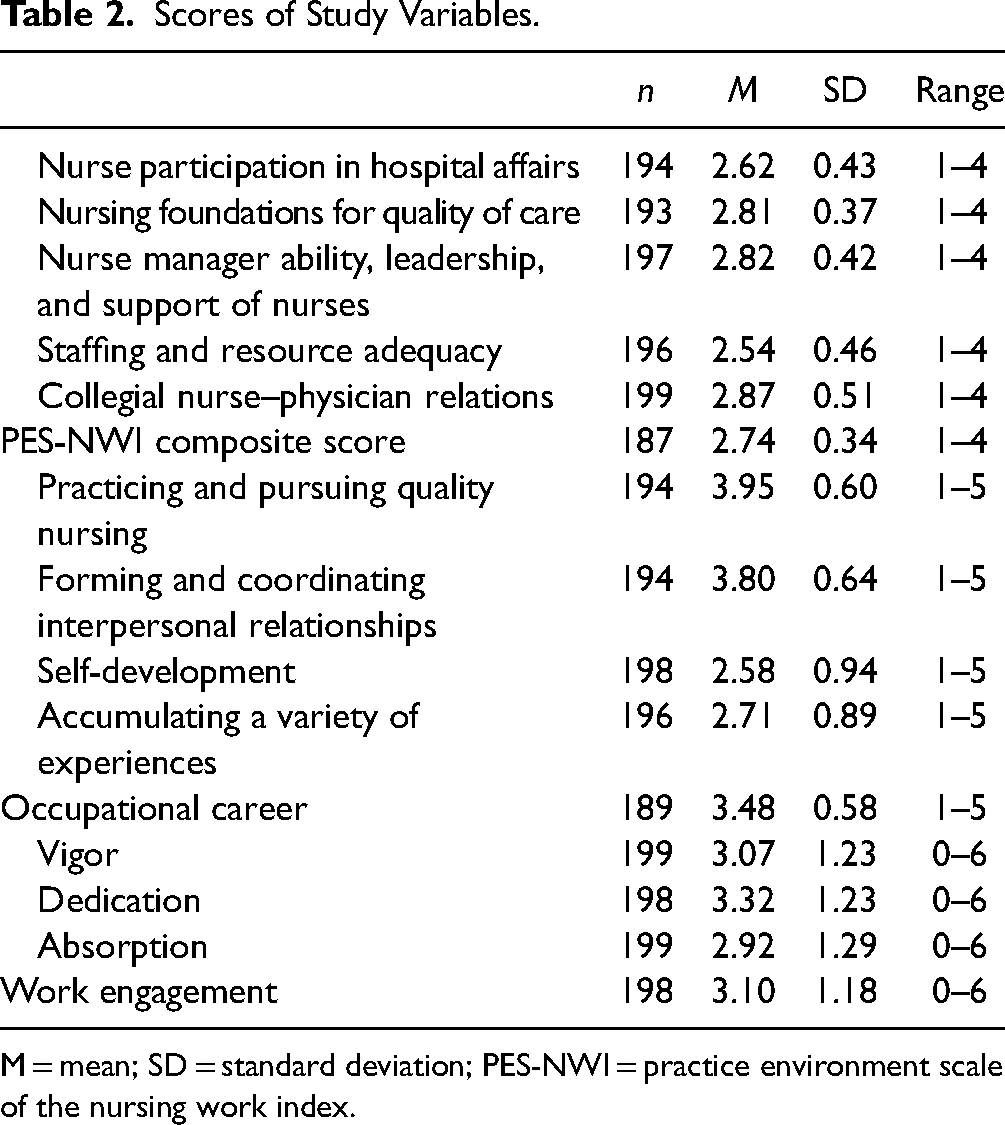
M = mean; SD = standard deviation; PES-NWI = practice environment scale of the nursing work index.
Comparison of PES-NWI Between the Subgroups of Demographics
As shown in Table 3, participants with a diploma (n = 53, M = 2.83, p = .035) had statistically significantly higher PES-NWI composite scores than participants with a bachelor's degree or higher (n = 132, M = 2.70). Participants who were satisfied with their salary (n = 89, M = 2.81, p = .013) had statistically significantly higher PES-NWI composite scores than participants who were dissatisfied with their salary (n = 98, M = 2.67).
Comparison of PES-NWI Between the Subgroups of Demographics (n = 187).

The total of 187 was not reached due to missing values.
M = mean; SD = standard deviation; PES-NWI = Practice Environment Scale of the Nursing Work Index.
*p < .05, **p < .01, ***p<.001.
Comparison of Subscales on the Occupational Career Between the Subgroups of Demographics
Table 4 shows that occupational career had a significant statistical association with age, years of nursing experience, living with a spouse, and living with children. We focus on years of nursing experience in Japan, as follows.
Comparison of Subscales on Occupational Career Between the Subgroups of Demographics (n = 189).

The total of 189 was not reached due to missing values. Wilcoxon rank sum test was used for comparisons between two groups, and Kruskal-Wallis test was used for comparisons between three or more groups.
M = Mean; SD = standard deviation.
*p < .05, **p < .01, ***p<.001.
Regarding the forming and coordinating of interpersonal relationships subscale, we found a statistically significant (p < .001) difference between years of nursing experience in Japan: participants with more than 6 years’ experience (n = 43, M = 4.08) had the highest scores, followed by those with 3 to 6 (n = 74, M = 3.75) and 0 to 3 years’ experience (n = 63, M = 3.65). Also, participants with more than 6 years of nursing experience in Japan scored significantly (p < .01) higher than participants with 0 to 3 and 3 to 6 years of experience.
On the self-development subscale of occupational career, there was a statistically significant (p = .019) difference between years of nursing experience in Japan: participants with more than 6 years’ experience (n = 43, M = 2.91) had the highest scores, followed by those with 3 to 6 (n = 74, M = 2.52) and 0 to 3 years’ experience (n = 63, M = 2.43). Also, participants with more than 6 years of nursing experience in Japan scored significantly (p < .05) higher than participants with 0 to 3 years of experience.
Finally, on the subscale accumulating a variety of experiences, there was a statistically significant (p < .001) difference between years of nursing experience in Japan: nurses with more than 6 years’ experience (n = 43, M = 3.34) had the highest score, followed by those with 3 to 6 (n = 74, M = 2.69) and 0 to 3 years’ experience (n = 63, M = 2.35). Also, participants with more than 6 years of nursing experience in Japan scored significantly (p < .001) higher than participants with 0 to 3 and 3 to 6 years of experience. And participants with 3 to 6 years of nursing experience in Japan scored significantly (p < .05) higher than participants with 0 to 3 years of experience.
Comparison of Work Engagement Between the Subgroups of Demographics
As seen in Table 5, scores for work engagement were significantly higher among participants with a diploma (n = 58, M = 3.38, p = .041), those living with a spouse (n = 59, M = 3.38, p = .047), those living with their children (n = 33, M = 3.72, p < .001), and participants who were satisfied with their salary (n = 94, M = 3.42, p = .001) in comparison with participants who had a bachelor's degree or higher (N = 138, M = 2.98), those not living with a spouse (n = 139, M = 2.99), those without children (n = 165, M = 2.98), and participants who were dissatisfied with their salary (n = 104, M = 2.81).
Comparison of Work Engagement Between the Subgroups of Demographics (n = 198).

The total of 198 was not reached due to missing values.
*p < .05, **p < .01, ***p<.001.
Discussion
In this study, we investigated the professional nursing practice environment, occupational career, and work engagement of Chinese nurses employed in Japanese hospitals. Data were collected from 199 Chinese nurses employed in 17 of Japan's 47 prefectures, primarily Tokyo and Osaka, giving a broad picture of Chinese nurses employed in Japanese hospitals.
Participant Characteristics
One feature of the participants is that all most of them (99%) have passed the required level of the Japanese Language Proficiency Test (JLPT) N1 to work in Japan (equivalent to B2 to C1 of the Common European Framework of Reference for Languages). Economic Partnership Agreement (EPA) nurses have shown to have difficulty communicating in Japanese even after passing the Japanese nursing examination (Efendi et al., 2016). The second characteristic of the participants is that their average age is around 28, which is relatively young compared to foreign nurses working in other countries. For example, the average age of foreign nurses working in the United States is 46 (Geun et al., 2018), 36 in Australia (Timilsina Bhandari et al., 2015), and 42 in Finland (Wesołowska et al., 2019). The third characteristic of the participants is that they began their working career as nurses in Japan, where approximately 80% had received nursing education in China but had no working experience as a nurse. Conversely, foreign nurses working in other countries often have a certain number of years of work experience in their home country. For example, a study of Chinese nurses working in Australia had between 1 and 20 years of work experience in their home country (Zhou, 2014). Additionally, in a survey of 814 foreign nurses working in Singapore, 43.5% of the nurses had also worked outside of Singapore (Goh & Lopez, 2016). Japan's EPA nurse candidates must have at least 2 years of work experience in their home country (Ministry of Health, Labor, and Welfare, 2021).
Regarding the participants’ characteristics, many have been working in Japan since they were new nurses and need to communicate in Japanese and perform nursing tasks simultaneously. Therefore, it is likely that they experience various difficulties in the process of performing nursing in Japanese hospitals. In this process, hospitals must provide appropriate orientation training based on the characteristics of Chinese nurses employed in Japan. Tailored orientation training has been shown to facilitate the adaptation of nurses working in countries other than their origin (Kamau et al., 2022). After identifying the participants’ demographics, we can use this information as a reference for future orientation materials for Chinese nurses employed in Japan or nurses from other countries. In addition, adapting the participants to nursing care in Japanese hospitals will lead to their continued employment in Japan and further improve the quality of their nursing care.
PES-NWI Composite Score
The composite score for the participants’ nursing practice environment was 2.74 with all subscale scores above 2.50. According to Lake and Friese (2006), participants rated the nursing practice environment as favorable. However, a review of the nursing practice environment (Swiger et al., 2017) noted that it is not appropriate to judge whether the practice environment is favorable based on the median value of 2.50 when the sample size is small. The score of participants also tended to be lower than the scores of studies within the last 5 years of Chinese nurses working in China, which ranged from 2.90 to 3.54 (Cheng, Cui et al., 2020; Li et al., 2019; Li et al. 2020; Liu et al., 2021; Wu et al., 2018; Yan et al., 2018). This score was lower than those of Asian nurses working in the United States, which were 3.45 (Liou & Grobe, 2008) and 3.52 (Cheng & Liou, 2011). On the other hand, participants’ nursing practice environment score tended to be higher than those of Japanese nurses working in Japan, which ranged from 2.47 to 2.8 (Anzai et al., 2014; Muto & Ishii, 2018; Ogata et al., 2008, 2011, 2018, 2021; Tei-Tominaga & Sato, 2016).
It was found that the nursing practice environment was rated significantly higher by those with fewer years of nursing experience (Muto & Ishii, 2018; Narita & Ishii, 2015). The average years of nursing experience of the participants were 3.9 years, while the years of nursing experience of the participants in Ogata et al.'s (Ogata et al., 2011, 2018, 2021) study of Japanese nurses were 7.0 years, 9.3 years, and over 10 years, respectively. Since the participants’ years of nursing experience were relatively short, the nursing practice environment may have been rated highly. Based on the above criteria for judging the nursing practice environment favorability and the results of comparing the scores with Chinese nurses working in China and Japanese nurses, overall, it is difficult to judge whether the participants’ nursing practice environment is favorable or not.
Comparison of PES-NWI Between the Subgroups of Demographics
Participants with a diploma who were satisfied with their salary had significantly higher composite scores on the PES-NWI. Education level was associated with the composite score on the PES-NWI, consistent with a study of Chinese nurses working in China (Zhang et al., 2014). However, a survey of Japanese nurses found no association between educational level and composite score on the PES-NWI (Anzai et al., 2014). Differences in the Chinese and Japanese nurse promotion systems may influence these results. The Japanese nurse promotion system follows the clinical ladder of nurses, regardless of educational background. In China, educational background affects promotion (Sakuda & Sakaguchi, 2013); therefore, nurses’ evaluation of the professional nursing practice environment likely differs depending on educational level. Our participants who were satisfied with their salary rated composite scores on the PES-NWI highly, consistent with another study among Japanese nurses (Narita & Ishii, 2015).
Although the results of the study did not allow us to determine whether the participants’ nursing practice environment was favorable, approximately 70% of the participants had a university degree or higher, and their evaluation of the nursing practice environment was significantly lower than that of the participants with a diploma degree. This data suggests the need to improve the work environment as perceived by the participants with university degrees or higher. The results also indicate that those who were satisfied with their salary rated the nursing practice environment significantly higher.
Subscales on Occupational Career
The practicing and pursuing quality nursing subscale score of occupational career was 3.95 among our respondents. This score was higher than scores of 3.52 (Kimoto et al., 2014) and 3.48 (Doi et al., 2022) in studies among Japanese nurses. This indicates that our participants rated their nursing abilities and learning attitudes highly. The first interpretation of these findings is that Chinese nurses may be more proactive in their education to realize their goal of coming to Japan (Tuo et al., 2021) and learning about Japan's advanced nursing and healthcare systems. Such learning also facilitates foreign nurses’ adaptation to nursing practice in the host country (Kawi & Xu, 2009). We consider that the participants in our study may have a positive attitude toward learning because they wish to better adapt to nursing practice in Japan.
The score on the forming and coordinating interpersonal relationships subscale of occupational career was 3.80. This score was higher than scores of 3.41 (Kimoto et al., 2014) and 3.50 (Doi et al., 2022) in surveys among Japanese nurses. Our study participants may have studied hard to pass the JLPT N1 level and Japanese National Nursing Examination so that they could work in Japan, which may have contributed to positive and high self-evaluations of their interpersonal relationships.
The self-development subscale score of occupational career was 2.58 in our study. This score was lower than the scores of 2.71 (Kimoto et al., 2014) and 2.82 (Doi et al., 2022) for Japanese nurses. Similarly, the subscale score for accumulating a variety of experiences in an occupational career was 2.71. This score was lower than that in studies by Kimoto et al. (2014) at 2.86 and by Doi et al. (2022) at 3.47. Participants’ scores for self-development and accumulating a variety of experiences were lower than those among Japanese nurses owing to a lack of opportunities for professional development. Foreign nurses working in countries other than their home countries have fewer opportunities for professional development (Adhikari & Melia, 2015) and may not be given many opportunities to develop their abilities.
Furthermore, our study participants may not yet be able to develop their abilities and accumulate various experiences because of their short work experience (average nursing experience of 3.9 years). In comparison, the average years of nursing experience among Japanese nurses in the above studies were 9.8 years (Kimoto et al., 2014) and 19.2 years (Doi et al., 2022), respectively. It can be assumed that these competencies have not yet been fully developed owing to nurses’ short average years of service in our study. Furthermore, although participants had passed the JLPT N1 level, they were not completely free from language barriers, which may have deterred foreign nurses from pursuing a specialization in nursing in Japan.
Comparison of Subscales on the Occupational Career Between the Subgroups of Demographics
Years of nursing experience in Japan, age, and living with a spouse or children were significantly associated with subscales of occupational career except for the subscale in practicing and pursuing quality nursing. Prior research (Tsuruta et al., 2007) has revealed that occupational career scores increase with years of experience. For this reason, we focus on years of experience in this section.
In the subscale score for formulating and coordinating interpersonal relationships, participants with more than 6 years of work experience had significantly higher scores than nurses with 0 to 3 years. This result was consistent with a previous study among Japanese nurses (Tsuruta et al., 2007). Additionally, a study of Korean nurses working in the United States indicated that it takes 5 to 10 years to form satisfactory interpersonal relationships (Adams & Kennedy, 2006). One possible interpretation is that interpersonal relationship formation and adjustment require roughly 6 years for Chinese nurses working in Japan.
In the subscale score for self-development, participants with more than 6 years of work experience had a statistically significantly higher score than those with 0 to 3 years; there was no statistically significant difference in score between those with 3 to 6 years and those with 0 to 3 years of experience. However, in a previous study among Japanese nurses, nurses with 3 to 5 years of work experience had a statistically significant higher score than nurses with less than 3 years of self-development. From this, it can be inferred that Chinese nurses lag behind Japanese nurses in their capacity for self-development.
Regarding the subscale score for accumulating a variety of experiences, participants with 3 to 6 years and more than 6 years of work experience had significantly higher scores than those with 0 to 3 years of experience. Also, participants with more than 6 years of experience scored significantly higher than nurses with 3 to 6 years of experience. This result was consistent with previous studies (Tsuruta et al. 2007). The participants are capable of accumulating diverse experiences in Japanese hospitals.
The results of the study indicated that the participants were able to develop their occupational careers in Japanese hospitals with their years of experience. However, the participants were behind their Japanese counterparts in self-development. When the participants fell behind their peers in their self-development competence, they were more likely to quit their jobs because they could not see a future in nursing. Therefore, it is imperative for hospitals in Japan to provide support for participants so that they can improve their nursing self-development.
Work Engagement
Our participants’ mean work engagement score (mean age 28 years) was 3.10 and at the low-medium level. This score tended to be lower than the work engagement scores of nurses working in China (mean age 27–33), which range from 3.13 to 4.67 (Cao & Chen, 2020; Cheng, Yang et al., 2020; Dong et al., 2020; Wan et al., 2018; Wang et al., 2017; Wang et al., 2021; Yao et al., 2021; Zhang et al., 2021; Zhu et al., 2015). A possible interpretation of our finding is that participants’ work engagement may have been negatively affected by the tremendous stress caused by problems communicating in Japanese (Lin, 2017) compared to nurses working in China. It is also speculated that Chinese nurses’ lack of professional development and promotion opportunities in Japanese hospitals (Tuo et al., 2021) may have negatively impacted their work engagement.
Study participants’ work engagement scores tended to be higher than those of Japanese nurses (mean age 31–48 years), which ranged from 2.13 to 3.20 (Fukuzaki et al., 2021; Hara et al., 2021; Kinouchi et al., 2019; Kunie et al., 2017; Naruse et al., 2016; Okada et al., 2019; Saiga & Yoshioka, 2021; Saito et al., 2018; Watanabe & Yamauchi, 2018). Japanese nurses rate their work engagement lower in self-evaluation. In an international comparative study of work engagement, Japanese workers scored uniquely low compared with workers in 15 other countries (including China), stating that it is socially desirable to suppress positive emotions and attitudes (Shimazu et al., 2010). This suggests that Japanese nurses may score lower for work engagement because they understate their positive work-related feelings regarding work engagement. Additionally, Japanese nurses perceive a greater workload than our study participants, which may have a negative impact on their work engagement. In previous studies, the perceived workload has been negatively correlated with work engagement (Zhang et al., 2021). In a study of native and foreign nurses working in Germany, German nurses had significantly higher perceived workload than foreigners, which they associated with the fact that native nurses have more work experience than foreigners and are assigned more responsibility (Roth et al., 2021). Similarly, it can be inferred that Japanese nurses are currently entrusted with more responsibility in their work than foreign-born workers, which may have a negative impact on work engagement among Japanese nurses.
Comparison of Work Engagement Between the Subgroups of Demographics
This study showed that work engagement scores were significantly higher for nurses with a diploma, nurses living with a spouse or children, and nurses who were satisfied with their salary. In a study of Japanese nurses (Ogiso & Ito, 2019) and previous studies of Chinese nurses working in China (Cao & Chen, 2020; Wang et al., 2017; Wang et al., 2021), there was no association between educational background and work engagement. In other words, the present results are unique to this study. Although a university degree or higher is advantageous for promotion in China, when working in Japan, Chinese nurses with a higher educational background may be treated the same as Chinese nurses with a diploma degree. Thus, participants with a university degree or higher may not perceive their education as valuable, which may have a negative impact on their work engagement.
Work engagement scores were significantly higher for nurses living with their spouses or children. This result was consistent with findings among Japanese nurses (Nakamura & Yoshioka, 2016) and nurses working in China (Cao & Chen, 2020). According to Shimazu (2014), there is a spillover effect from family to work, with negative aspects, such as reduced motivation to work owing to housework and childcare duties, and positive aspects, such as a pleasant weekend motivating people to work harder. The results of this study suggest that having a spouse or children may lead to a sense of responsibility and satisfaction with work, which may increase work engagement.
Work engagement scores were significantly higher among nurses satisfied with their salary. This result was consistent with a study among Japanese nurses (Ito et al., 2018). The desire for a higher salary and pursuit of a good quality of life are important factors in migration among foreign nurses (Roth et al., 2021; Zhou et al., 2016), and satisfaction with one's salary can be considered to be an achievement of a primary goal of migration, which may have a positive impact on work engagement.
The study results also showed that the participants with a diploma degree, family living with them, and were satisfied with their salary had higher work engagement. However, more than 70% of the participants had university degrees or higher and did not live with their families. Thus, it is essential to support the work engagement of these participants in the future.
Strengths and Limitations
This study targeted Chinese nurses in Japanese hospitals and clarified their attributes, professional nursing practice environment, occupational career, and work engagement. The results of this study may provide helpful information to support clinical education and professional career development of Chinese nurses employed in Japan. However, this was a cross-sectional study, and we cannot make a definitive statement regarding causal relationships between attribute characteristics and the professional nursing practice environment, occupational career, and work engagement. Additionally, in consideration for free-will participation, we did not set all of the online survey questions to be mandatory to answer. Second, it is assumed that some people gave up answering the questions because they felt burdened in the process due to the large number of questions. Once a survey was opened and a question was answered, the data was automatically saved, so even if a person failed to answer a question, it was counted as one, which may have resulted in the many incomplete surveys. Participants in this study were not randomly selected, which may limit generalizability. Furthermore, this study was conducted in Japanese. Although all participants had achieved the highest level in the JLPT, we cannot guarantee that there were no errors in their understanding of the Japanese language.
Implications for Practice
The majority of participants were university graduates or higher, and their nursing practice environment score and work engagement score were significantly lower than those with diplomas. Therefore, improving the nursing practice environment and work engagement as perceived by participants with university degrees or higher is necessary. The ability to self-develop and accumulate various experiences in their occupational career was lacking. The managers of Japanese hospitals need to understand participants’ working conditions and provide opportunities for their occupational development.
Conclusions
The purpose of this study is to clarify the professional nursing practice environment, occupational career, and work engagement of Chinese nurses employed in Japan. The Chinese nurses employed in Japan in this study were characterized as individuals who have passed the highest level of the JLPT N1, are an average age of 28, and have an average of 3.9 years of nursing experience in Japan. Moreover, approximately 80% of them started working in Japan as new nurses with no prior experience. Most participants were university graduates or above, and their nursing practice environment score and work engagement score tended to be lower than those of the non-university graduate participants. Participants tended to have lower self-ratings for self-development and accumulating a variety of experiences in their occupational career but had higher self-ratings for practicing and pursuing quality nursing and forming and coordinating interpersonal relationships. These findings suggest that understanding Chinese nurses’ work conditions in Japan will be useful when considering ongoing education and support measures.
Footnotes
Acknowledgments

Availability of Data and Materials
The data supporting this study's findings are available on request from the corresponding author. The data are not publicly available owing to privacy or ethical restrictions.
Author Contributions
Conceptualization: YY, KT, YS. Methodology: YY, KT, YS. Analysis and interpretation: YY, KH, YS, KT. Writing—original draft: YY. Writing—review and editing: YY, KH, YS, KT. Supervision: KH, YS, KT.
Declaration of Conflicting Interests
The author(s) declared no potential conflicts of interest with respect to the research, authorship, and/or publication of this article.
Funding
The author(s) received no financial support for the research, authorship, and/or publication of this article.