




Abstract
Introduction
Student in a maternity nursing program must be engaged in practical training and they must be well prepared and directed along the way to becoming qualified professionals.
Objective
The study aimed to investigate the effect of progressive muscle relaxation exercise on anxiety among male nursing students undergoing maternity clinical training.
Methods
A quasi-experimental, pre-post study was conducted on nursing at Arab American University Palestine. The sample of the study consisted of 48 male nursing students enrolled in the maternity nursing course. They were selected through convenience sampling. This study was conducted on one group of male nursing students that received Jacobson's progressive muscle relaxation exercise for five consecutive days per week. The S-anxiety scale (STAI Form Y-1) was applied to collect data before and after the intervention.
Results
The magnitude of anxiety reduction after the progressive muscle relaxation exercise was greater than before (t (47) = 21.2, p < .05).
Conclusion
The current study's findings indicated the influence of progressive muscle relaxation on maternity clinical setting anxiety reduction among male nursing students.
Introduction
Professional education may be a demanding experience that has a negative impact on both physical and mental health (Singh & Kohli, 2015; Subih et al., 2021). Nursing students may face stress as a result of several parts of their academic and clinical courses, such as course assignments, clinical experiences, projects, the anxiety of causing harm to patients, and combining academic work with family responsibilities (Alzayyat, 2016; Fashafsheh et al., 2021). Feelings of unmet clinical learning requirements (Suresh et al., 2013); interactions with nurses, physicians, and patients (Burnard et al., 2007); and fear of harming a patient are all clinically relevant aspects of stress (Wallace et al., 2015). The nursing program was regarded as a terrible experience for students who made mistakes in the clinical setting (Zieber & Williams, 2015). Furthermore, many students experience stress as a result of being monitored by instructors and nursing staff, as well as exams (Gibbons et al., 2009; Wallace et al., 2015).
Literature Review
Nursing has traditionally been a female-dominated profession. Although the percentage of men entering nursing has grown throughout the years, men remain underrepresented and in the minority (Tickner & True, 2018). Men in nursing encounter a variety of challenges, including concerns about their gender, gender inequality, a lack of motivation, insufficient training on the appropriate use of touch, and uneven therapeutic changes. Such obstacles would have an influence on males engaged in nursing education and training (Buthelezi et al., 2015). Some clinical learning disparities include restricted opportunities to care for patients in obstetrics or being regularly requested to help in transferring heavy patients (Hodges et al., 2017).
Consequently, each student in a maternity nursing program must be engaged in practical training. Furthermore, in order to lessen the intensity of the practice on live patients, maternity students must be well prepared and directed along the way to becoming qualified professionals (Meyer, 2012). Although midwives claim that midwifery is inherently stressful, this stress is mostly caused by contextual and environmental factors. When males first approach rotations in their nursing education program in maternity clinical training settings, challenges related to gender role expectations tend to be exacerbated. Because maternity care is so intimate, male nurses feel unsure and concerned about this part of care (Zamanzadeh et al., 2013). Nursing students have extremely few opportunities to get hands-on experience in practical tasks. This causes unpleasant fears and experiences, as well as an increase in stress during clinical education (Ahmadi et al., 2018).
Faculty and students must work together to create realistic strategies to help male student nurses prevent, minimize, or resolve psychological harm (Otim et al., 2021). Using relaxation techniques, students’ academic stress can be alleviated (Manansingh et al., 2019). According to several research studies, the PMR exercise should be practiced throughout nursing courses to promote student satisfaction and positive outlooks (Bostani et al., 2020; Toqan et al., 2022). As a result, this study aimed to investigate the effect of progressive muscle relaxation exercise on anxiety among nursing students in maternity clinical training (Figure 1).

Flow diagram of the study.
Methods
Design and Sample
The current study was a quasi-experimental, pre- and post-design study. The study was conducted at the school of Nursing, Arab American University Palestine and was conducted in 2020.
Sample
Total male nursing students enrolled in the maternity clinical course were enrolled for a total of 48 students. The sample size was calculated using the Raosoft program with a confidence level of 95%, a margin of error of 5%, and a response rate of 50%. A total sample of 43 participants was needed to conduct this study. The number of nurses was too small to take a sample of them, so all nurses 48 were enrolled in the study.
Inclusion/Exclusion Criteria
The inclusion criteria were nursing students enrolled in a maternity nursing course. Exclusion criteria included a history of psychological illnesses, skipping more than two intervention meetings, using sedatives, and being exposed to stressful situations in the previous three months.
Interventions
The participants received Jacobson's PMR exercise. Jacobson's muscle relaxation was implemented at the school of nursing.
Upon obtaining formal approval from the university authorities, a list of the nursing students enrolled in the maternity nursing course for the 2020 academic calendar year was obtained. Two weeks before entering the clinical environment, all participants completed written informed consent forms and were asked to fill in the demographic information form and the STAI questionnaire at pretest. Then, the intervention implemented for five consecutive days per week for two weeks prior to starting the maternity nursing clinical practice. At the end of the last session, the participants fill the STAI questionnaire another time at posttest.
Jacobson's PMR
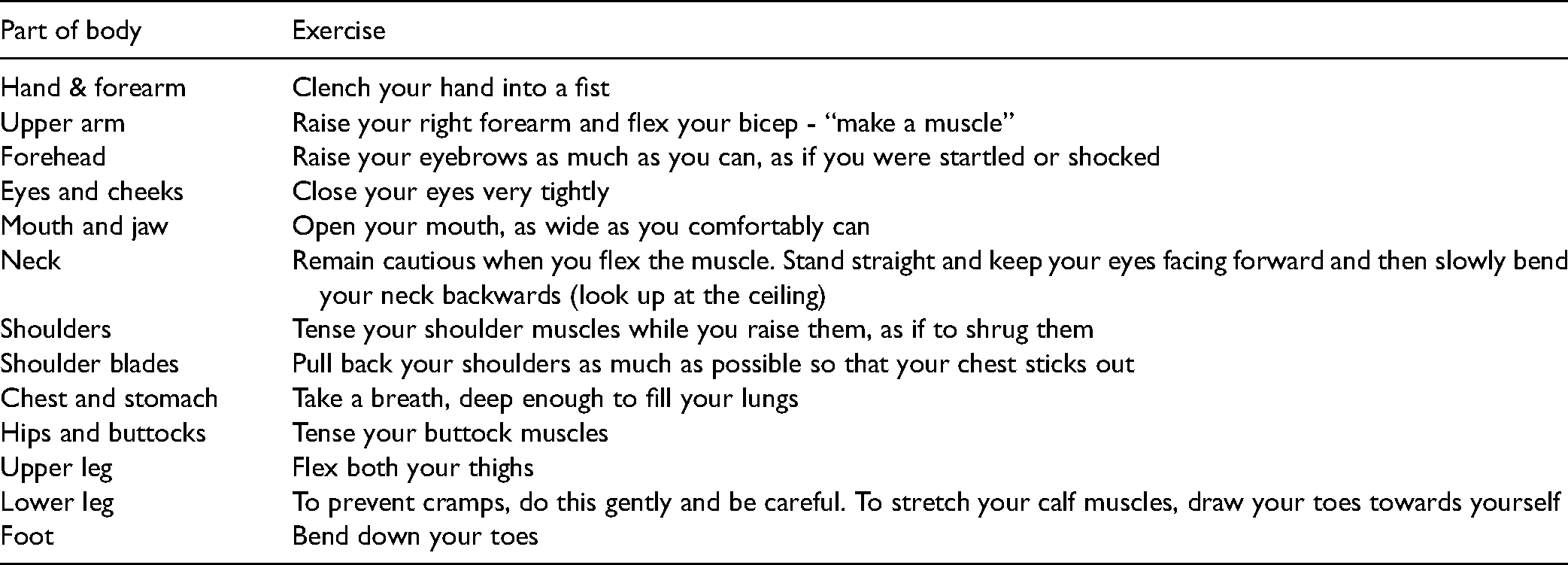
Jacobson's PMR exercise has been applied in some studies (Bostani et al., 2020; Jacobson, 1987). This exercise was implemented for 48 participants in groups of ten over five consecutive 45-min sessions each week for a two-week period. The researcher emphasized to the students at the start of the first session that the exercise's purpose was to assist them in minimizing muscular tension. Additionally, he instructed the students not to leave the meetings and to attend all sessions. In other sessions, the researchers implemented PMR exercise. In this exercise, muscle groups are considered as follows: hand and forearm, upper arm, forehead, eyes and cheeks, mouth and jaw, neck, shoulders, shoulder blades, chest and stomach, hips and buttocks, upper leg, lower leg and foot. These muscles should be contracted and relaxed in the stated order (Table 1) (Ramasamy et al., 2018). Whereas the researcher was using this exercise, the students felt at ease on the ground. Students had been encouraged ahead of time to wear comfortable clothes in order to avoid tension. Also, the students were instructed to complete each training session at home for 10–15 min each day. Students were instructed at the end of every session to continue implementing relaxing exercises at home. Again, they completed the STAI questionnaire for the second time on the day they entered the clinical environment.
Progressive Muscle Relaxation (PMR) Exercise.
Instrument
Socio-Demographic Information
Demographic characteristics of the participants included age and residence site.
State-Trait Anxiety Inventory (STAI)
The self-evaluation STAI questionnaire, developed by Spielberger et al. (1983) includes separate scales for measuring state (S-scale) and trait (T-scale) anxiety. In the present study, only the S-anxiety scale (STAI Form Y-1) was used. “The questionnaire consisted of 20 items that evaluated how the participants felt at the time of responding to each item. Note that 10 items were associated with the anxiety-present (items 3, 4, 6, 7, 9, 12, 13, 14, 17, 18) and the remaining items were associated with the anxiety-absent (items 1, 2, 5, 8, 10, 11, 15, 16, 19, 20). The intensity of the participants’ feelings was rated on a 4-point Likert scale: (I) not at all, (II) somewhat, (III) moderately so, and (IV) very much so. The anxiety present items were scaled from 1 to 4 such that higher scores indicated the presence of a high level of anxiety” (Spielberger et al., 1983). However, “the anxiety-absent items were scaled in reverse from 4 to 1. The total score for the STAI Form Y-1 ranged from a minimum of 20 to a maximum of 80.” The reliability of the questionnaire ranged between 0.86 and 0.95 (Spielberger et al., 1983).
Ethical Consideration
The study was approved by the Arab American University Palestine Institutional Review Board (IRB00098913). All participants completed written informed consent forms after receiving formal approval from the Arab American University Palestine. Also, the study's purpose, as well as the risks and benefits of participation, were described to the students. Additionally, the participant was informed about the possible negative effects of PMR, such as fear of relaxing, elevated levels of physiological activation, and so on. They were instructed to contact the researcher (second author) if any undesirable effects occurred. They were also told that they might opt out of the research at any time. Moreover, confidentiality was taken into account in this study, and all participants’ information was maintained in a closed file cabinet with limited access. Furthermore, each participant was identifiable by a code number.
Data Analysis
Data were analyzed using the Statistical Package of Social Science (SPSS, Version 23; SPSS Inc., Chicago, Illinois). Descriptive statistics for all parameters included in this analysis were performed. These analyses included distributions of frequency, percentage, means and standard deviations. Analysis of paired t-test was performed to verify if there was a significant difference between pre- and post-intervention exercise.
Results
Sample Characteristics
A total of 48 participants completed the study. The analysis showed that the mean age of nurses students was 21.13(SD = 1.7) years. Nearly two-thirds of all study participants 30(61.2%) were living in a rural area regarding residence of participants (Table 2).
Demographic Characteristics of Participants (N = 48).

Research Question Results
Paired t-test was performed to assess the differences between pre- and post-progressive muscle relaxation exercise program. The analysis revealed that there was a significant difference between pre- and post-progressive muscle relaxation program (t (47) = 21.2, p < .05). There was less anxiety post-program (M = 1.32 ± 0.36) than pre-program (M = 2.89 ± 0.28), as seen in Table 3.
Comparison Between Anxiety Before and After PMR (N = 48).

p-value significant at the .05 level.
Discussion
The study aimed to investigate the effect of progressive muscle relaxation exercise on anxiety among male nursing students undergoing maternity clinical training. The anxiety score was measured pre- and post-program in the intervention group. The results showed decreased anxiety score among the nursing students after the program. It is well known that there are several stress-reduction techniques, one of which is PMR. The PMR program had a favorable influence on the average anxiety score of nursing students in maternity clinical training, according to our findings. Despite the fact that there are just a few studies in the literature that used PMR as an intervention to reduce stress in nursing students, their findings are congruent with ours. Toqan et al. (2022) found that PMR exercise for two weeks decreased pediatric nursing students stress. Pelit-Aksu et al. (2021) found that clinical stress decreased in students who completed PMR exercise for three weeks in one of these studies. Kim (2000) also instructed nursing students to undertake PMR for 8 weeks before to clinical practice and showed that PMR was useful in lowering clinical stress symptoms. In addition, Gangadharan and Madani (2018) found that PMRE was significantly helpful and most of the participants stated that their negative emotions reduced and their emotional state turned back to normal. Alhawatmeh (2017) found that conducting PMR twice a week for three weeks decreased stress in Jordanian nursing students.
According to Veiga et al. (2019), a relaxation program lowered psychological and physiological stress indicators in nurses. Another study on nurses conducted by Maharjan and Baby (2019) found that 53.3% of the nurses had moderate stress, 40.0% had mild stress, and 6.7% had severe stress. 73.3% of nurses reported mild stress in the posttest, whereas 26.7% reported no stress. The study showed that progressive muscle relaxation therapy can help nurses reduce their stress levels.
Relaxation is the most efficient and effective therapy for psychosomatic disorders such as anxiety (Heravi-Karimavi et al., 2004). This is due to the body's attempt during the relaxed state to repair damage and eliminate toxins by generating natural chemicals. Furthermore, relaxation increases useful output by nurturing internal abilities and increasing the capacity to think and innovate via the empowerment of psychological and mental strength, as well as an increase in self-confidence (Kim & Kim, 2018).
The main idea of PMR is to teach individuals how to intentionally inhibit their muscle tension and, as a consequence, reduce their degree of anxiety. The convenience, cost efficacy, and independence of practice are among the key benefits of this strategy in anxiety reduction and management. Nursing is demanding for nursing students and contributes to their anxiety as a result of the amount of educational material they must learn as well as the stressful clinical setting. PMR, as an effective approach of reducing clinical environment anxiety, may change individuals’ perceptions of their ability to cope with daily life stressors and can be used to lower students’ anxiety.
Strength and Limitations of the Study
This seems to be the first study in Palestine to evaluate the effect of progressive muscle relaxation exercise on anxiety among male nursing students undergoing maternity clinical training. This study had some limitations that may have influenced the study's results. This study relied on self-reported questionnaires, which may increase the possibility of reporting bias due to personal interpretations of questionnaire items. Also, only the age and residence from socio-demographic data were used and this was a limiting factor. Furthermore, one methodological limitation of this study was that there was no control group.
Implications for Practice
Nursing schools can promote PMR through nursing training courses in relaxation techniques for instructors and students to minimize anxiety in clinical settings.
Conclusion
The current study's findings indicated the influence of PMR on maternity clinical setting anxiety reduction among male nursing students. As a result, it is recommended that teaching programs on this approach be conducted for nursing students at nursing schools prior to the commencement of maternity clinical practice in order to lessen anxiety.
Footnotes
Acknowledgments
The authors would like to express their thanks to the maternity nursing students who participated in the study.
Declaration of Conflicting Interests
The author(s) declared no potential conflicts of interest with respect to the research, authorship, and/or publication of this article.
Funding
The author(s) received no financial support for the research, authorship, and/or publication of this article.
