




Abstract
Introduction
Pediatric nursing students are expected to work hard to help children realize their full potential by giving care, knowing their growth process, and being responsive to their needs. Students should be able to communicate effectively and solve problems. Nurses who care for pediatric patients experience compassion fatigue as well as moderate to severe levels of work-related stress. The purpose of this study was to investigate the effect of progressive muscle relaxation exercise on anxiety among nursing students during pediatric nursing clinical training.
Methods
A quasi-experimental, pre-post study was conducted in the faculty of nursing at the Arab American University/Palestine. The sample of the study consists of 60 nursing students enrolled in the pediatric nursing course were selected through convenience sampling. This study was conducted on one group of nursing students that received Jacobson's progressive muscle relaxation exercise for five consecutive days per week for two weeks before entering the clinical environment. The S-anxiety scale (STAI Form Y-1) was applied to collect data before and after the intervention.
Results
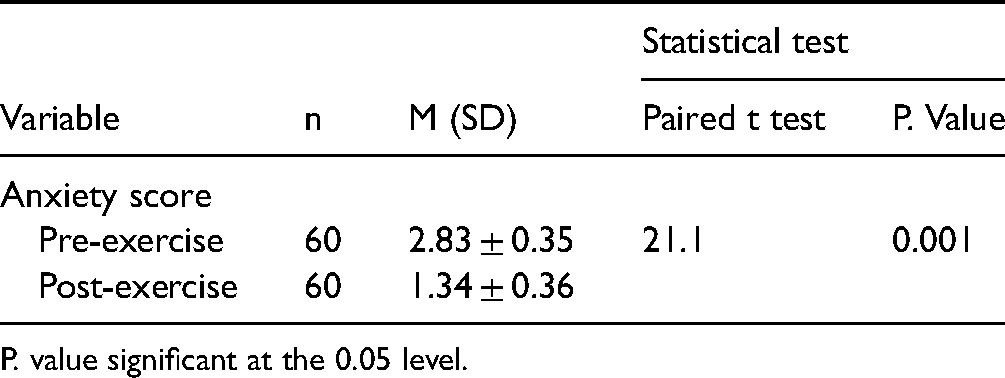
The magnitude of anxiety after the progressive muscle relaxation exercise was greater reduced than before (t (59) = 21.1, P < 0.05). There was less anxiety post the program (M = 1.34 ± 0.36) than pre- program (M = 2.83 ± 0.35).
Conclusion
The study findings indicated the positive influence of progressive muscle relaxation exercise on nursing students’ anxiety levels in pediatric clinical settings. As a result, it is recommended that teaching programs on this approach be conducted for nursing students at nursing schools prior to the commencement of pediatric clinical practice in order to lessen anxiety.
Introduction
Clinical training will enable students to assist a wide range of people, form relationships with them, and acquire problem-solving techniques (Fukada, 2018). This is also important in pediatric nursing practice, where students are expected to work hard to help children realize their full potential by giving care, knowing their growth process, and being responsive to their needs. As a result, students in pediatric nursing practical training should be able to communicate effectively and solve problems (Speedie & Middleton, 2021).
Despite the fact that pediatric nursing training has more restrictions than other nursing programs, clinical experience is an essential component of nursing education (Kim, Lee, & Eo, 2013). However, it has been determined that nurses who care for pediatric patients experience compassion fatigue as well as moderate to severe levels of work-related stress (Aljohani et al., 2021; Labrague et al., 2018; Onieva-Zafra et al., 2020). Pediatric nurses are at a significant risk of anxiety because they are routinely exposed to distressing aspects of childhood illnesses or death, medical treatment or errors, and the family's emotional reaction to childhood disease (Shen et al., 2015; Yoshioka et al., 2021). Anxiety is characterized by doubt about one's ability, and it frequently results in poor academic achievement (Robinson et al., 2013).
Anxiety triggers in nursing students are widely established, with clinical placement anxiety frequently figuring as one of the primary reasons (Alshahrani et al., 2018; Alzayyat, 2016; Blomberg et al., 2014; Hamaideh et al., 2017; Labrague et al., 2018; Galbraith & Brown, 2011; Shaban et al., 2012). Furthermore, anxiety and stress have been recognized as contributors to high levels of burnout among nurses and nursing students, with some studies indicating a negative association between anxiety and academic performance (Hossain, Bent, & Hendren, 2021; Li & Hasson, 2020). Pre-placement anxiety, clinical reality (theory-practice gap), clinical learning, becoming a nurse,' and academic concerns were highlighted as persistent themes (Chernomas & Shapiro, 2013; Thomas et al., 2012). Fear of making errors, problems pertaining to death and dying, experiencing pain and suffering, relationships with instructors, being observed and assessed, and attempting to balance academic, clinical, and personal responsibilities are additional sources of stress in clinical placement (McKenna & Plummer, 2013; Chernomas & Shapiro, 2013; Liu et al., 2015). Students and faculty must collaborate to develop practical techniques to support student nurses in avoiding, minimizing, or resolving psychological harm (Otim, et al., 2021). Students’ academic stress can be reduced by using relaxation techniques (Manansingh, et al., 2019). Some studies have recommended that the progressive muscle relaxation (PMR) exercise be used throughout nursing courses to increase student satisfaction and positive outlooks (Bostani, et al., 2020). Progressive muscle relaxation is a deep muscle relaxation method based on the principle that muscle tension is the physiological response of the human body to irritating thoughts (Cougle et al., 2020). This technology was developed by Jacobsen in 1938, in which the body and mind are greatly relieved from any tension and anxiety. These activities build students’ resilience using behavioral antibodies (conditioning) and expose them to triggers that enable them to handle the stress of academic pressure (Hallman et al., 2011).
The main idea of PMR is to teach individuals how to intentionally inhibit their muscle tension and, as a consequence, reduce their degree of anxiety. Convenience, cost-effectiveness, and independence of practice are among the key benefits of this strategy in anxiety reduction and management. Nursing is demanding for nursing students and contributes to their anxiety as a result of the amount of educational material they must learn as well as the stressful clinical setting. Individuals’ perceptions of their ability to cope with day-to-day stressors may shift, and PMR can be used to reduce students’ anxiety. Furthermore, few stress management techniques target students at times when they are most stressed, such as during clinical placements, when they are prone to being alone and without the assistance of other students or instructors. As a result, it is advocated that nursing students benefit from an intervention that is immediately available to them. Therefore, the purpose of the current study was to investigate the effect of PMR on anxiety among nursing students during pediatric nursing clinical training.
Methods
Study Design, Site, and Participants
The current study was a quasi-experimental, pre and post- design study. The study was conducted at the Faculty of Nursing, Arab American University/Palestine, and was conducted in 2020. The sample included 60 pediatric nursing students in a bachelor's program in nursing. This pediatric nursing course is composed of two parts: theory and clinical. This course is in the third year of the nursing program. There were 60 students enrolled in this course. The inclusion criteria were nursing students enrolled in a pediatric nursing course. Exclusion criteria included a history of psychological illnesses, skipping more than two intervention meetings, using sedatives, and being exposed to stressful situations in the previous three months.
Intervention
This study was conducted on one group that received Jacobson's PMR exercise. Jacobson's muscle relaxation was implemented at the faculty of nursing for five consecutive days per week. The researchers first met the course coordinator at the nursing faculty and asked him to serve as a liaison to approach students in the pediatric health nursing course. The coordinator's role was restricted to approaching and informing the students about the study and its purpose and inviting them to participate in the study. In addition, the announcement about the study was positioned on the students’ board and electronic contact links in coordination with the nursing department administrator. The coordinator then invited the researcher to provide students who display a desire to take part in the study with the information related to the study. The researcher provided information about the aim, content, and duration of the research and what participants were required to do.
The informed consent forms were signed by the students who stated an interest in participating in the study and met the inclusion criteria. Students received printed information about the date and time of the study. On the first day of the intervention, the participants filled in the demographic part and the STAI questionnaire. The intervention was held two weeks before the start of pediatric clinical training. Again, they completed the STAI questionnaire for the second time on the day they entered the clinical environment.
Jacobson's PMR
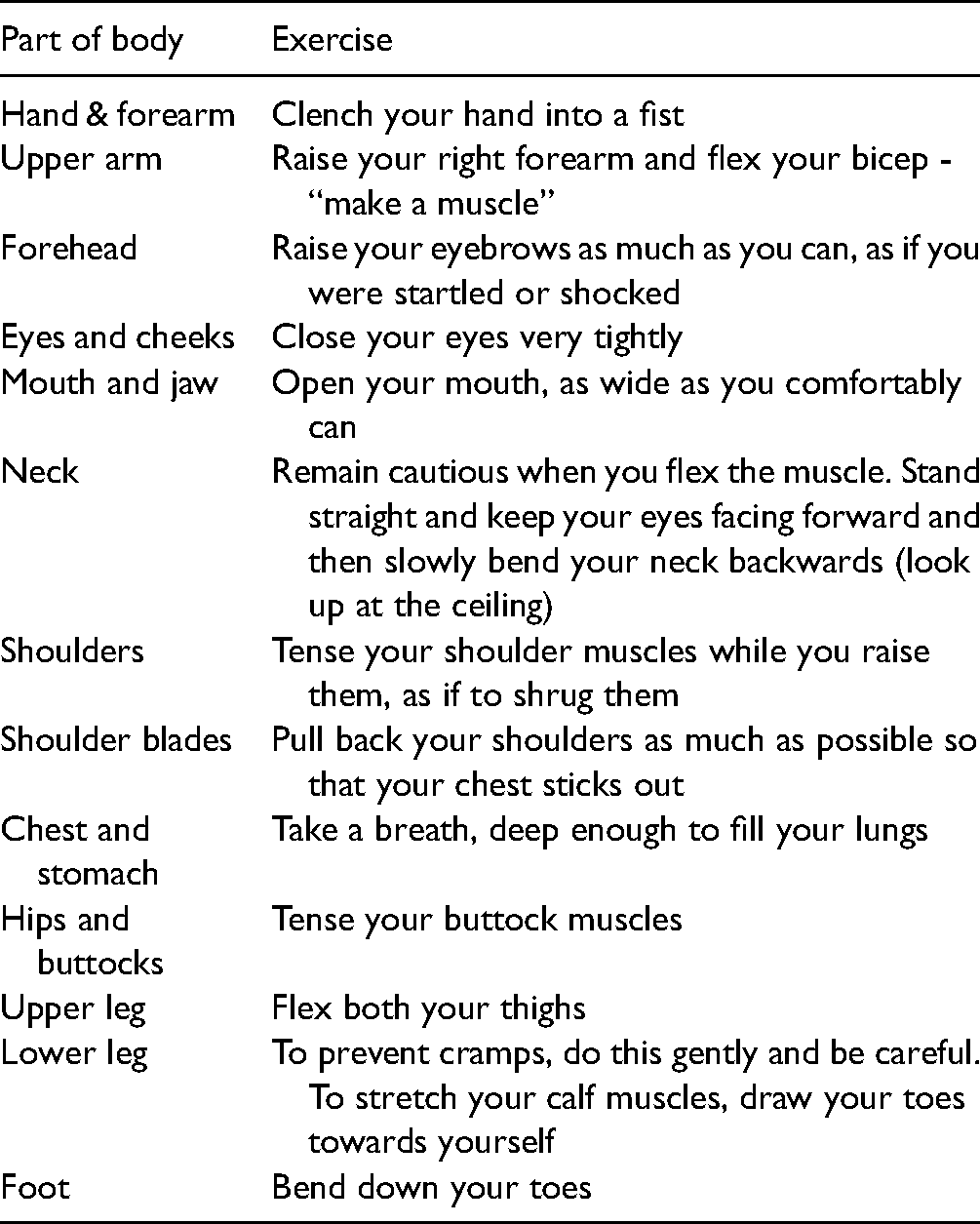
Jacobson's PMR exercise has been applied in some studies (Bostani et al., 2020; Jacobson, 1987). This exercise was implemented for 60 participants in groups of ten over five consecutive 45-min sessions each week for two weeks. The researcher emphasized to the students at the start of the first session that the exercise's purpose was to assist them in minimizing muscular tension. Additionally, he instructed the students not to leave the meetings and to attend all sessions. In other sessions, the researchers implemented the PMR exercise. In this exercise, "muscle groups are considered as follows: hand and forearm, upper arm, forehead, eyes and cheeks, mouth and jaw, neck, shoulders, shoulder blades, chest and stomach, hips and buttocks, upper leg, lower leg, and foot. These muscles should be contracted and relaxed in the stated order" (Table 1) (Ramasamy et al., 2018). Whereas the researcher was using this exercise, the students felt at ease on the ground. Students had been encouraged ahead of time to wear comfortable clothes in order to avoid tension. Also, the students were instructed to complete each training session at home for 10–15 min each day. Students were instructed at the end of every session to continue implementing relaxing exercises at home.
Progressive Muscle Relaxation (PMR) Exercise.
Study Instrument
Socio-Demographic Information
Demographic characteristics of the participants included age, gender.
State-Trait Anxiety Inventory (STAI)
The self-evaluation STAI questionnaire, developed by Spielberger (1983), includes separate scales for measuring state (S-scale) and trait (T-scale) anxiety. In the present study, only the S-anxiety scale (STAI Form Y-1) was used. The questionnaire consisted of 20 items that evaluated how the participants felt at the time of responding to each item. Note that 10 items were associated with the anxiety-present (items 3, 4, 6, 7, 9, 12, 13, 14, 17, 18) and the remaining items were associated with the anxiety-absent (items 1, 2, 5, 8, 10, 11, 15, 16, 19, 20). The intensity of the participants’ feelings was rated on a 4-point Likert scale as (I) not at all, (II) somewhat, (III) moderately so, and (IV) very much so. The anxiety present items were scaled from 1 to 4, such that higher scores indicated the presence of a high level of anxiety "(Spielberger, 1983). However, "the anxiety-absent items were scaled in reverse from 4 to 1. The total score for the STAI Form Y-1 ranged from a minimum of 20 to a maximum of 80. The reliability of the questionnaire ranged between 0.86 and 0.95 (Spielberger, 1983).
Ethical Consideration
The study was approved by the Arab American University Institutional Review Board (IRB00098914). All participants completed written informed consent forms after receiving formal approval from the Arab American University. Also, the study's purpose, as well as the risks and benefits of participation, were described to the students. Additionally, the participant was informed about the possible negative effects of PMR, such as fear of relaxing, elevated levels of physiological activation, and so on. They were instructed to contact the researcher (second author) if any undesirable effects occurred. They were also told that they might opt out of the research at any time. Moreover, confidentiality was taken into account in this study, and all participants’ information was maintained in a closed file cabinet with limited access. Furthermore, each participant is identified by a code number.
Results
Sample Description
A total of 60 participants completed the study. The analysis showed that the mean age of nursing students was 21.22(SD = 1.8) years. The majority of the sample were females 48(80.0%), as seen in (Table 2). The analysis revealed that most of the partcipants 54(90.0%) answered moderately so for the item “I feel anxious”, 49(81.7%) for the item “I feel nervous”, 47(78.3%) for the item “I feel upset”, as seen in (Table 3).
Demographic Characteristics of Participants (N = 60).

Distribution of the Anxiety Items among the Participants (N = 60).

A paired t- test was performed to assess the differences between pre and post progressive muscle relaxation. The analysis revealed significant differences between pre and post the progressive muscle relaxation program (t (59) = 21.1, P < 0.05). There was less anxiety post program (M = 1.34 ± 0.36) than pre- program (M = 2.83 ± 0.35), as seen in (Table 4).
Comparison Between Anxiety Before and After PMR (N = 60).
P. value significant at the 0.05 level.
Discussion
The findings of the study revealed that practicing PMR is beneficial in lowering the mean score of pediatric clinical training anxiety among nursing students. These results supported by Zargarzadeh et al. (2014), confirmed that relaxation training had a significant impact on students’ test anxiety reduction. Another study, Ahmadnejad et al. (2011), evaluated the effects of relaxation therapy on anxiety reduction in a clinical setting among school students and found it to be effective. Also, Heidari et al. (2011) found that educating muscular relaxation and the gradual removal of tension, along with biofeedback, dramatically reduces students’ anxiety. Furthermore, Korkut et al. (2021) found that students who practiced muscular relaxation had lower anxiety levels than those in the control group.
In a study on the effectiveness of PMR on nursing students, Gangadharan and Madani (2018) found that the participants had a substantial drop in their anxiety level following the intervention. Also, another study undertaken on nurses by Patel (2014) indicated that in pre-test, 53.3% of the nurses had moderate stress, 40.0% had mild stress, and 6.7% had severe stress. In the posttest, 73.3% of nurses reported mild stress, whereas 26.7% reported no stress. The study concluded that Progressive Muscle Relaxation Therapy is beneficial in lowering the stress level of staff nurses. The limitations of the current study are that the sample was quite small and the intervention was conducted in one clinical practice period and at one university. Hence, this will limit the generalizability of the findings.
Conclusion
The study's findings indicated the positive influence of progressive muscle relaxation exercise in pediatric clinical setting anxiety reduction on nursing students. As a result, it is recommended that teaching programs on this approach be conducted for nursing students at nursing schools prior to the commencement of pediatric clinical practice in order to lessen anxiety.
Footnotes
Acknowledgments
The authors would like to express their thanks to the pediatric nursing students who participated in the study.
Conflict of Interest
Researchers declares no conflict of interest with any organization regarding the materials discussed in this paper.
Funding
This research did not receive any specific grant from funding agencies in the public, commercial, or not-for-profit sectors.
