




Abstract
Introduction
There is an existing gap between what people learned from theory and what they clinically practiced, as revealed in research studies in nursing. This gap is primarily due to identified barriers in utilizing the research findings in actual nursing practice.
Objective
To present a scientific mapping of the Scopus-indexed literature published from 2002 to 2021, which studied barriers to research utilization in nursing using the BARRIER scale.
Methods
This systematic review utilized bibliometric analysis. One hundred seventy-nine extracted literature from Scopus was manually reviewed, and the study included 53 documents for further analysis.
Results
Remarkably, almost three-fourths of the documents identified setting-related factors as the most common barrier to research utilization in nursing (n = 39, 73.58%). This is followed by presentation-related factors (n = 16.98%) and nurse-related factors (n = 5, 9.43%), respectively. Findings revealed that insufficient time at work in implementing new ideas was perceived as the top barrier in research utilization in nursing.
Conclusion
It is crucial to determine the hindrances to the utilization of research findings. The results of this study establish the connection between research and evidence-based practice which stimulates in meeting the gap in the current nursing practice. Future studies must include research utilization studies that apply tools other than the BARRIER scale.
Introduction
There is a discrepancy between the knowledge gained from theoretical research and actual clinical practice (Benton et al., 2020; Mackey & Bassendowski, 2017). A significant number of research studies have focused on developing and applying practical research ideas in practice from the past five years (Estabrooks, 1999a). The clinical application coexists with evidence-based practice (Mackey & Bassendowski, 2017). It is asserted that health interventions provided by professionals went through a selective process of choosing the best available scientific research evidence in making decisions about the care of the patient. As a result, developing, evaluating, and implementing research poses a challenge. The relevance of clinical nursing practice that is evidence-based is gaining recognition; however, clinical application poses a challenge and would frequently fail (Estabrooks et al., 2008).
With limited tools to measure barriers in research utilization, the Barriers to Research Utilization (BARRIER) scale was developed by Funk et al. (1991) by identifying the common barriers cited in the literature. Since then, the tool is now being widely used by nursing practitioners, clinicians, administrators, and academicians in determining the barriers to the utilization of research findings in practice in the United States (Atkinson et al., 2008; Baernholdt & Lang, 2007; Brown et al., 2009, 2010; Cline et al., 2017; Fink et al., 2005; Karkos & Peters, 2006; Niederhauser & Kohr, 2005; Phillips, 2015; Schoonover, 2009; Stichler et al., 2011), the United Kingdom (Bryar et al., 2003; Carrion et al., 2004; Kirshbaum et al., 2004), Finland (Kuuppelomäki & Tuomi, 2003; Oranta et al., 2002), Sweden (Andersson et al., 2007; Boström et al., 2008), Australia (Hutchinson & Johnston, 2004), Turkey (Kocaman et al., 2010; Tan et al., 2012; Uysal et al., 2010; Yava et al., 2009), China (Chien et al., 2013; Wang et al., 2013; Zhou et al., 2015), Saudi Arabia (Aboshaiqah et al., 2014; Aljezawi et al., 2019; Omer, 2012), Ireland (Brenner, 2005; Glacken & Chaney, 2004), Spain (Cidoncha-Moreno & Ruíz de Alegría-Fernandez de Retana, 2017; Sarabia-Cobo et al., 2015), Canada (McCleary & Brown, 2003), Greece (Patiraki et al., 2004), and Taiwan (Chen et al., 2013).
From 2006 to 2010, three distinct quantitative reviews of research that used the BARRIER scale were conducted (Carlson & Plonczynski, 2008; Hutchinson & Johnston, 2006; Kajermo et al., 2010). These reviews overlapped its literature and findings conducted in a similar time frame from 1991 to 2009. The said reviews covered the literature for more than 10 years ago. Thus, an updated review of BARRIER scale studies is essential to ensure the relevance and applicability of research findings in the evolving clinical practice. Moreover, Estabrooks et al. (2004) mapped out the literature on barriers to research utilization in the scientific community and the recent network of researchers for articles published only from 1972 to 2001.
Literature Review
Research Utilization
Research utilization is described as applying scientific research findings to clinical practice. Scientific evidence and conclusions in this field are relevant to practitioners to make optimal decisions and improve patient conditions and outcomes (Da'seh & Rababa, 2021). However, there is a limited study on the barriers of research utilization in nursing, including the organization and expansion of this field of study.
Research utilization studies marked history in the 1980 and gained popularity in the 1990s. Estabrooks (1999b) identified no empirical methods in the health literature that attempted to map the field. As a result, she mapped factors hindering research utilization in nursing using bibliometric methods. Her study determined the structure of this scientific community and the recent network of researchers, which the study was published from 1972 to 2001. Those studies were the last attempt at bibliometric research.
Bibliometrics
Bibliometric analyses contribute to the growth and exchange of knowledge within a specified field of academic research (Estabrooks et al., 2004). The bibliometric approach uses empirical data and quantitative analysis to utilize the published literature and publication patterns within a field. Pritchard (1969) first coined the term bibliometrics that “employs mathematical and statistical methods in bibliometric to determine and analyze the growth and trend of a particular research theme” (p. 349).
BARRIER Scale
The BARRIER scale was developed by Funk et al. (1991) and is a widely accepted and utilized tool in determining perceived barriers as research findings in the United States, the United Kingdom, Finland, Sweden, Norway, and Australia. This tool established validity and reliability (Bryar et al., 2003; Carrion et al., 2004; Closs et al., 2000; Funk et al., 1995; Gerrish & Clayton, 2004; Nilsson Kajermo et al., 1998; Oranta et al., 2002; Parahoo, 2000; Retsas, 2000). The tool includes factors that interfere with research utilization, as follows: (1) the characteristics of the adopter, which consider the nurse's research values, skills, and awareness; (2) the characteristics of the organization, which include the settings, barriers, and limitations; (3) the characteristics of the innovation that apply to the research qualities produced; and (4) the characteristics of the communication, which relates on how the accessibility and manner of research presentation.
The BARRIER scale is a 29-item and 4-point Likert-type questionnaire. The respondents are asked to appraise how the identified barriers affect research utilization. The tool ranges from 1 (“to no extent”) to 4 (“to a great extent”). The tool is reliable with Cronbach's alpha index scores: nurse (α = .80), setting (α = .80), presentation (α = .72), and research (α = .65) by (Funk et al., 1991).
Purpose of the Study
The purpose of the study is to identify the perception of nurses on these barriers from 2002 to 2021 using the Barriers to Research Utilization (BARRIER) scale. Specifically, it will answer the following research questions: (1) What is the current state of research utilization in nursing in terms of research productivity and impact and citation per document? (2) What intellectual structure can be derived in the study in nursing, including its networks of co-citation, keywords co-occurrence, and co-authorship? and (3) What are the top barriers to research utilization in nursing?
Theoretical Framework
The Theory of Diffusion (RTD) of Innovations by Rogers (1995) was utilized in this study. RTD is a behavioral theory that describes how the user decides whether to adopt or reject new ideas, response patterns, or technology. Rogers (1995) defined the notion of diffusion as a process that includes the exchange of new ideas among individuals. The primary components of the RTD are channels, innovation, time, social systems, and communication. The innovation-decision integrates these components, explaining how the adopter learns to put the evaluation and innovation into practice. Furthermore, Rogers (1995) specified that the innovation-decision process has five stages: knowledge, persuasion, decision, implementation, and confirmation. Therefore, this study focused on knowledge and persuasion stages, emphasizing “innovation” to apply research knowledge.
Conceptual Framework
Scientific mapping is the process of identifying the intellectual structure and classifying the scientific output of a given field of study over a period (Hallinger & Kovačević, 2019). Moreover, Zupic and Čater (2015) defined intellectual structure as the product of examining scientific domains, such as the research tradition, the disciplinary composition, persuasive research topics, and the pattern of their interrelationships. The intellectual structure described scientific activity's size, timing, space, and composition. Specifically, citations are seen as a metric of research productivity and quality. This implies that the more articles are cited, the higher their influence or quality contributes to the body of knowledge (Geisler, 2000).
Methods
Study Design
This study employed a quantitative bibliometric analysis of Scopus-indexed nursing research utilization articles published from 2002 to 2021. The approach utilizes published literature and identifies publication patterns in nursing using empirical data and quantitative analysis. Moreover, it determines and analyzes the growth and trend of research utilization in the field.
Sampling Criteria
The inclusion criteria required Scopus-indexed full-text articles and reviews related to research utilization from 2002 to the present. This research utilized the BARRIER scale in determining the barriers to nursing research utilization. This excluded professions other than nursing; reviews which are not written in English or with no English translation; and included only the specific literature on research barriers; articles on research implementation, journal clubs, and evidence-based practice; notes, letters and correspondence, dissertations; and discussions about policy, management, governmental, or organizational concerns.
Data Collection
The Preferred Reporting Items for Systematic Reviews and Meta-analysis (PRISMA) procedure was adopted (Moher et al., 2009). PRISMA follows four stages: identification, screening, eligibility, and inclusion (see Figure 1). The study focused on Scopus-indexed publications and publications that are written in English.

Preferred reporting items for systematic reviews and meta-analysis (PRISMA).
For the accuracy of the search process, during the identification stage, documents were retrieved using the Scopus database and the Boolean query in Scopus’ advanced search function: ALL (“Research Use” and “Research utilization”) AND (“barriers”) AND (“nursing”) AND (“bibliometric”) AND (“systematic review”). The oldest review was published in 1972, and the most recent was in 2021. Only studies and review papers published from 2002 to the present were considered. After applying the exclusion criteria, only 53 articles were subjected to further analysis.
Data Analysis
A “Scopus-Analyze Search Result and Citation Overview” was used to calculate various bibliometric indicators, such as research productivity, research impact, and citations per document. The h-index was identified to measure the quantitative index involving productivity, citation impact, and influence of authors, institutions, and countries or regions in research utilization.
The VOS viewer software developed by van Eck and Waltman (2010) was used to obtain graphical visualizations of the knowledge flow network of nursing research utilization. It generated a map of the co-citation, keywords co-occurrence, co-authorship network published in research utilization in nursing. Larger nodes represent the more frequent citations. Moreover, the distance between the nodes indicates more frequent co-citation and keywords co-occurrence and authorship. Furthermore, node proximity reflects variations in the content of the scholarly works of the author. The more that studies are mentioned together signifies that work is conceptually comparable.
Visualizations on the intellectual structure
Visualizations included those presented by Linnenluecke et al. (2020), Moral-Muñoz et al. (2020), Hallinger and Kovačević (2019), and Cobo et al. (2011). The metrics used are research productivity, research impact, and citations per document.
Research productivity is represented by the number of documents per year by a source identified in research utilization in nursing and its barriers. This includes the number of publications produced each year, affiliation, source, author's country or locality, and funding sponsor. The researchers consider the primary author's country or locality and authorship.
Research impact is based on the SCImago journal rank and source normalized impact per paper. A citation per document refers to the top documents’ total and yearly citations. This includes source citations and documents not cited by year.
Results
The Current State of Research Utilization in Nursing in Terms of Research Productivity and Impact, and Citations per Document
Using the “Scopus Analyze Search Results” function, 53 documents were retrieved from 2002 to 2021. It shows the frequency of publications about research utilization in nursing. The majority of the documents were published in 2004, 2005, 2008, and 2013 with 5 documents each. It was observed that there is a minimal drop in the number of publications from 2015 to 2018. No study on nursing research utilization using the BARRIER scale was conducted after 2019.
The top authors in nursing research utilization studies are affiliated with Karolinska Institute and Karolinska University Hospital, Sweden. The remaining studies come from the United States, the United Kingdom, and Australia. The Journal of Clinical Nursing (JCN) had the highest number of publications in research utilization studies. However, this publication trend differed in the bibliometric study conducted from 1972 to 2001 by Estabrooks et al. (2004). The Journal of Advanced Nursing (JAN) was recorded as the highest number of publications in the same field.
The researchers bibliometrically identified the research performance of the top publication sources, using the metrics as defined by Scopus. Research impact is based on the SCImago journal rank by year and by year's source normalized impact per paper. It is observed that the International Journal of Nursing Studies (IJNS) tops among the other journals in terms of research impact. This means that this journal is frequently cited in high-impact publications. This is followed by the Journal of Advanced Nursing, which is almost tied with the Journal of Clinical Nursing in its SCImago journal rank and the normalized impact per paper each year.
The Journal of Advanced Nursing ranked first in source citation, followed by the Journal of Clinical Nursing. There was an increasing trend in the number of source citations in the past two decades until a noticeable sudden drop of citations in 2021 in all journals. The Journal of Nurses in Staff Development ranked first among those not cited documents.
Kajermo, who published 3 documents as a principal author, was marked first to contribute to nursing research utilization. Among other authors in the field are Cline et al. (2019) and Andersson et al. (2007), whom each have 2 published documents. The majority of the authors come from the United States, followed by Spain, Australia, and Turkey. The rest of the authors come from Canada, Saudi Arabia, and the United Kingdom.
The identified sponsors had funded at least one study in terms of funding sponsors. These sponsors are the European Oncology Nursing Society, Ministry of Science, ICT and Future Planning, National Research Foundation of Korea, and Sigma Theta Tau International. The rest of the articles did not disclose funding sponsors.
Intellectual Structure and Networks of Co-citation, Keywords Co-occurrence, and Co-authorship
Using the “View Citation Overview” function of Scopus, a remarkable increase in the citation was noted from 2002 to 2008. Then, the fluctuating trend started in 2009 onwards. There was a considerable dramatic drop in citation, which was observed in 2018. The h-index of the 53 documents is 23, which means there are 23 documents of the 53 documents cited at least 23 times.
The selected 53 documents had total citations of 1,894 over the 15 years. Those documents published in 2010 and 2016 received the highest number of citations. Moreover, the document “Nursing practice, knowledge, attitudes and perceived barriers to evidence-based practice at an academic medical center,” in 2009 with 273 citations as the highest. It was closely followed by the document “Overcoming barriers and promoting the use of research in practice” in 2005 with 233 citations.
Top Barriers to Research Utilization in Nursing
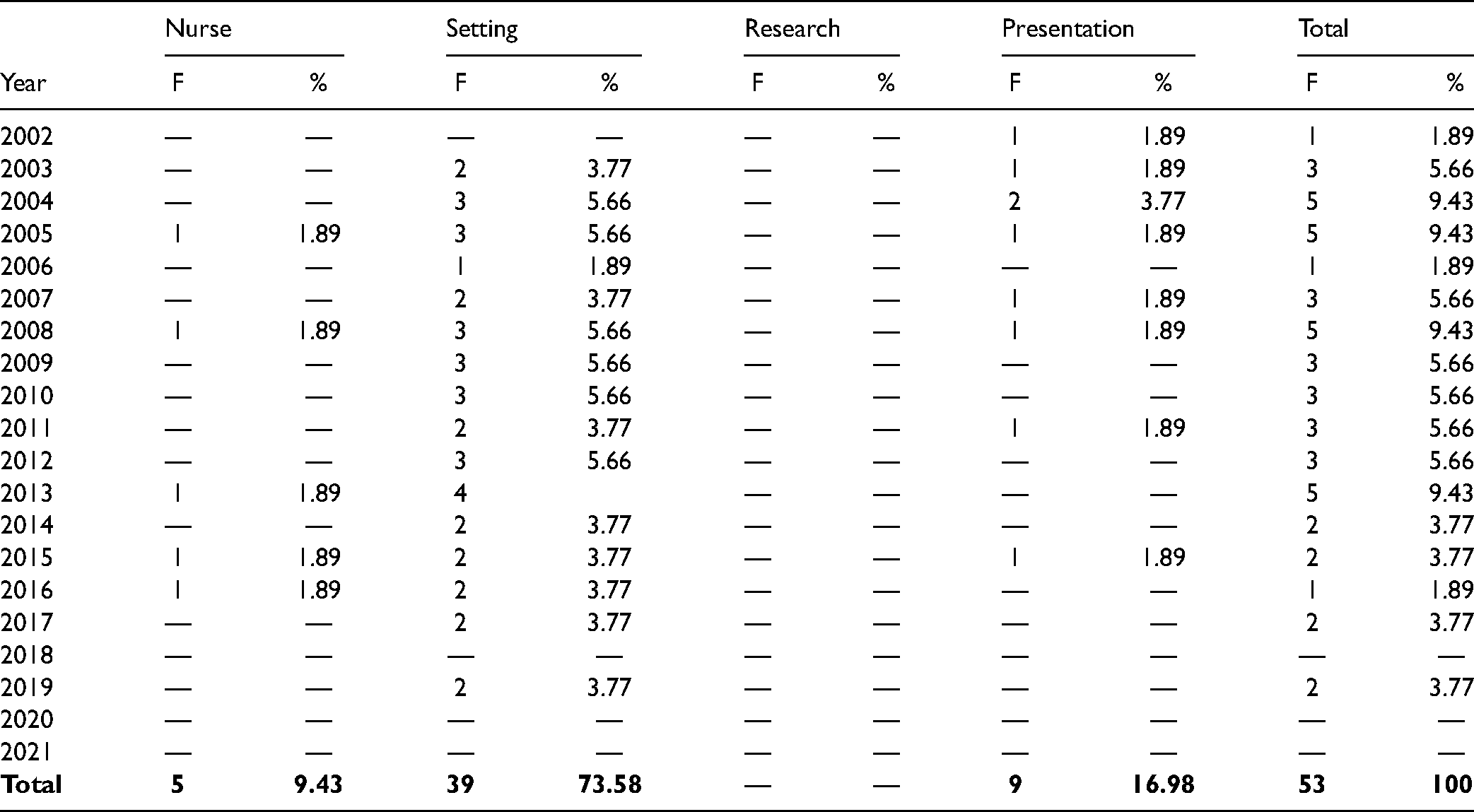
Table 1 presents the development of barriers to research utilization in nursing from 2002 to 2021. Remarkably, almost three-fourths of the documents identified setting-related factors as the most common barrier to research utilization in nursing (n = 39, 73.58%). This is followed by presentation-related factors (n = 16.98%) and nurse-related factors (n = 5, 9.43%), respectively. Among the documents, research-related factors are not identified as barriers to research utilization in nursing. No research utilization studies utilized the BARRIER scale in 2018 and 2020 up to the present.
Development of Barriers to Research Utilization in Nursing from 2002 to 2021.
The items related to setting were identified as the most common barriers. These include items, “There is insufficient time on the job to implement new ideas” was perceived as the top barrier to nursing research utilization (n = 18, 36%); followed by items, “The facilities are inadequate for implementation,” “The nurse does not feel he or she has enough authority to change patient care procedures,” and “The nurses do not have enough time to read research” with (n = 6, 12%); and item, “Implications for practice are not made clear” was also included as one of the top barriers (n = 3, 6%).
Co-citation network
Figure 2 presents the co-citation network based on cited authors with a minimum number of citations of 20 for each author. Out of 1,660 authors, only 26 authors met the threshold. Red nodes and lines represent the first cluster, the second cluster in green, and the third cluster in blue on the map. Champagne and Funk have the most co-citations more than any other possible co-authorship. Kajermo and Nordstrom are the most co-cited authors in the green cluster, while Krusebrant and Bjorvent are in the blue cluster. Furthermore, the works of Champagne, Tornquist, and Funk are aligned conceptually.

Co-citation network.
Keyword co-occurrence network
Figure 3 shows the keyword co-occurrence network using the keywords with a minimum number of co-occurrences set to 8. There were 378 keywords identified; however, only 35 keywords with strong links are shown in the network. The most common keywords are “human,” “humans,” “adult,” “articles,” “attitude of health personnel,” “nursing research,” and “female.”

Keywords co-occurrence network.
Co-authorship network
The co-authorship network is generated from 53 documents (see Figure 4). Each author in the network has a minimum of 1 document and formed 2 clusters. The circle size represents the number of documents made by the author, and the lines represent the strong links between the authors. Out of 180 authors, only 12 authors formed a strong connection in the network. Thompson had the highest co-authorship. He co-authored with Bryar, Baum, Cooke, and Griffith on the red cluster and Lopez and Chau on the green cluster.

Co-authorship network.
Discussion
Fifty-three studies that utilized the BARRIER scale were included in this review. Setting-related barriers and limitations were identified as the top barriers to research utilization in nursing (n = 39). This is followed by presentation-related barrier (n = 9); and the awareness and nurse-related skills (n = 5). None of the barriers identified research-related barriers. Furthermore, the setting-related barriers accounted for 73% of the top 5 barriers listed. The BARRIER scale's setting-related barriers include insufficient time at work to implement new ideas, insufficient facilities for execution, a lack of power to improve patient care, and inadequate time to read the research. The identified barriers consistently emerge as the main factor affecting research knowledge translation to clinical practice. Regardless of diverse specialization, the absence or presence of support within an organization influences the kind of research culture that promotes a healthy environment for clinical nursing practice (Berthelsen & Hølge-Hazelton, 2017). The nurses’ professionalism, academic reflection, and incorporation of nursing research into daily routine in a supportive environment are essential facets of sustaining nursing research culture toward efficient utilization of research findings to practice. Thus, nursing managers and stakeholders must advocate for initiatives that promote research utilization (Berthelsen & Hølge-Hazelton, 2017).
Significant findings using the most frequently occurring keywords suggest that the discussions on research utilization studies focused on the attitude of health personnel toward understanding adults’ behavior and humanity. Notably, global networks of authors working on research utilization studies were noticeable. The evidence suggests that authors from different countries share related concepts on research utilization. The Middle Eastern authors showed exclusive inter-region collaboration but not with authors from Western countries such as the United States, Canada, and Australia. This could be attributed to the local contextual variation in nursing practice and research utilization.
Research-related barriers were not seen as the top barrier to research utilization. The technology could have contributed to the faster dissemination of research findings. Furthermore, there are multiple avenues for disseminating research findings nowadays, such as journal publishing, conferences, and research colloquia. These provide nurses access to reputable and scientific sources that generate high-quality research.
The theory of diffusion supports the idea that barriers to research utilization start with determining an individual's knowledge on the existence of a challenging situation. Then, this individual is persuaded that change is necessary and will decide to identify appropriate interventions to answer the problem. As an adopter of research findings, nurses must be convinced of applying the new ideas to current practice.
The study's research findings are beneficial to bring improvement to patient outcomes and delivery of care. Therefore, applying theory-derived, research-based knowledge to inform decisions about care delivery is essential. Research utilization is evident in policy and decision-making processes (Walugembe et al., 2015), clinical decisions in patient care units (Estabrooks et al., 2008); in developing practice guidelines for patient referral in an emergency setting (Sukwatjanee, 2018); in reviewing evidence-based management in intrapartum care (Gennaro et al., 2007); use of research to inform practice in pediatric settings (Cummings et al., 2010); in organizing framework for knowledge translation in a public health setting (Wilson et al., 2011), and in documenting HIV research-utilization activities, outputs, and outcomes (Kalibala et al., 2021).
This research has several implications. First, there is a need to reflect on the setting-related factors that hinder research utilization and provide a concrete solution to fill the inadequacies. Providing enough time for nurses to read research findings will allow them to implement relevant research findings and scientific knowledge into clinical practice. Some strategies can be employed to promote the culture of research utilization, such as hiring more skilled and efficient personnel to reduce the workload of the nurse, organizing nurse's work shifts, providing adequate staffing between patients and nurses in the wards, and work deloading for nurses involved in research or issuing a directive requiring nurses to devote part of their time to utilize and implement the research findings. Furthermore, employees reward system, recognition, and availability of conducive, non-threatening, and facilitative environment to implement relevant results to clinical practice. It is therefore indispensable to engage nurses in negotiation and apply decision-making skills, utilizing their bargaining power to request the organization's needs in support of research utilization.
The study provided valuable insights into the status of research utilization, while some limitations need to be noted. First, this bibliometric did not include comments on the quality or content of the articles included in the study. Other methods (such as content analysis) are preferable if such analysis is desired. Second, the BARRIER scale has been examined, with low validity and bias concerning construct validity (Kajermo et al., 2010). However, the scale addressed the general barriers to nursing research utilization; it was beneficial in data collection (Carlson & Plonczynski, 2008; Hutchinson & Kajermo et al., 2010). Third, the BARRIER scale has been criticized for variety of reasons, including not being comprehensive enough (Carlson & Plonczynski, 2008), incorporating generalized notions (Kajermo et al., 2010), and being obsolete in terms of technological integration in research methodologies (Kajermo et al., 2010). It is suggested that an upgraded scale is necessary to incorporate new themes related to nurses’ understanding of barriers. Carlson and Plonczynski (2008) supported the latter idea and proposed the addition of items reflecting the contextual factors in relation to the organizational environment and nursing practice (Hutchinson & Johnston, 2004). Moreover, Rycroft-Malone et al. (2004) added that a local contextualization is vital from an organizational standpoint when creating and enhancing an evidence-based approach. Berthelsen and Hølge-Hazelton (2021) suggest excluding the BARRIER scale because it is outdated or to modify it based on current challenges and focal points in clinical nursing practice. Moreover, emerging tools could have resulted in fewer researches that used the BARRIER scale from 2019 to the present. Fourth, some of the excluded studies that used other scales to measure barriers to research utilization with different parameters other than the BARRIER scale could be a source of selection bias. However, the researchers of this present study believe that the BARRIER scale is still helpful in identifying, exploring, and evaluating the barriers to nursing research utilization. Moreover, they also think the identified barriers from the study will pinpoint the most tailored fit interventions in creating the culture of research utilization.
Conclusion
Despite its limitations, the present findings provide an updated overview of the current research utilization studies conducted in nursing. It is crucial to determine the hindrances to the utilization of research findings. The results of this study establish the connection between research and evidence-based practice which stimulate in meeting the gap in the current nursing practice. Time is a limited resource for implementing research findings; yet, a strong political will by nursing administrators must be imposed. The nurses should feel the ownership of their research, and they are supported and recognized by the administration for their efforts. It is recommended that future studies include research utilization studies that will utilize other tools than the BARRIER scale.
Footnotes
Acknowledgments
The authors thank Ms. Sheryl Nuevo-Jabonete, Mr. Rogelio Ruzco Tobias and Asst Professor Angelica H. De La Cruz for their assistance.
Declaration of Conflicting Interests
The authors declared no potential conflicts of interest with respect to the research, authorship, and/or publication of this article.
Funding
The authors received no financial support for the research, authorship, and/or publication of this article.
