



Abstract
Introduction
Community awareness about cancer warning symptoms and risk factors in the general population is essential and can be considered as a basis for cancer control programs. Since Patients are rarely aware of the early warning symptoms and cancer risk factors, the burden of disease is increasing everywhere in the world. Evidences has been shown that cancer is highly prevalent in Ethiopia in which the diagnosis is made at later stages of the disease.
Objective
To assess Cancer Warning Symptoms awareness and associated factors among individuals living in Assella Town, Ethiopia.
Methods
A community-based cross-sectional study was employed in Assella town from May 1st to June 1st, 2020 among 410 adult residents 18 years old and above. A systematic random sampling technique was employed to select the households from which the study subjects randomly identified. Data were collected through face-to-face interview by using pre-tested structured questionnaire and entered into Epi data version 3.1 then exported to SPSS version 25.0 for analysis. Logistic regression analyses were used to identify factors associated with outcome variables. Odds ratio and 95% CI at P-values <0.05 was used to determine the presence of association.
Results
The findings of this study revealed that the overall level of awareness of cancer warning symptoms is 214 (52.2% (AOR = 95% CI 47.1, 56.8)). Educational level (AOR = 3.44, 95%CI, 1.50–7.88 (p = 0.003)), awareness of cancer risk factors (AOR = 2.56, 95% CI, 1.67, 3.93, (p < 0.001)) and economic status (AOR = 3.13 (95% CI 1.84, 5.33, p < 0.001)) were identified as factors significantly associated with awareness of cancer warning symptoms among adult populations.
Conclusion
Almost one-out-of-two adults residing in Assella town has awareness about cancer warning symptoms. Educational level, awareness of cancer risk factors, and economic status among Assella town residents were identified as factors associated with good level of awareness about cancer warning symptoms.
Background
Cancer is a group of diseases characterized by the uncontrolled growth and spread of abnormal cells. It accounts for 21% of death worldwide (Al-Azri, Al-Hamedi, Al-Awisi, Al-Hinai, & Davidson (2015)). The cancer cells possess abnormalities in the regulating of cell division and survival (Veerakumar, Kar., 2017) by mutation which results in the DNA defect by ignoring growth-regulating signals in the environment surrounding the cell, invading tissue and metastasizing to the distant organs ((Islam et al., 2017; WHO 2018, (Bray et al., 2018; Jemal & Brawley, 2019; Yohannes, Belaineh, & Alula, 2013)).
Public awareness about cancer warning symptoms and risk factors in the general population is essential and the basis for cancer control programs (Memirie et al., 2018). Since Patients are rarely aware of the early warning symptoms and cancer risk factors, the burden of disease is increasing everywhere in the world ((Fidler et al., 2017) (Siegel & Miller, 2020)). Evidence has shown that cancer is highly prevalent in Ethiopia in which the diagnosis is made at a later stage of the disease ((Islam et al., 2017; World Health Organization, 2013), WHO. WHO fact sheet on cancer, swizerland, Geneva 2018)).
The alarming warning symptoms of cancer include but are not limited to changes in bowel and bladder habits, abdominal pain
Review of Literatures
Globally the magnitude of cancer among adults showed 975,396 new cases and 358,392 deaths, which is equated to an age-standardized rate (AGR) of 43.3 new cases and 15.9 deaths per 100,000 people per years (Islam, Billah, Hossain, & Oldroyd., 2017). Worldwide in both sexes, lung cancer is the most commonly diagnosed (11.6%) and the leading cause of cancer death (18.4%) (Fitzmaurice et al., 2015).
The overall burden of cancer in the world is projected to continue to rise, particularly in developing countries; most likely 21 million people will be diagnosed as new cases, and 13 million will die of cancer in 2030. Although the incidence of all cancers is twice as high in more developed countries, mortality rate is only 8% to 15% (Ethiopian Federal Ministry of Health (2015)).
Cancer is still one of the major public health problems worldwide (Fidler et al., 2017). In Ethiopia, it is the second leading cause of death among the adult population (Bray et al., 2018). The global cancer burden is estimated to rise in the next successive decades. This implies that 1 in 5 men and 1 in 6 women worldwide may develop cancer during their lifetime. Worldwide, the total number of people who will survive after 5 years of a cancer diagnosis is estimated to be 43.8 million (World cancer, Cancer fact sheet, 2018).
Different studies in different parts of the world revealed different levels of cancer warning symptoms awareness and different factors affecting level of cancer warning symptoms awareness among adult population. More specifically, a study conducted in India showed average awareness (Thoudam & Sakhardande (2018)). Another study conducted in Lebanon on colorectal cancer revealed that 67% of respondents were not aware (Tfaily et al. (2019). A study conducted in Indonesia on public awareness of common cancer symptoms among adult population showed 53.2% of the study the respondents had adequate awareness (Wimardhani et al., 2019). A study conducted in Saudi Arabia showed that 42.5% of the study participants recognized awareness of cancer warning symptoms (Ravichandran, Mohamed, & Al-Hamdan, 2010). A study conducted in Tanzania regarding awareness of cancer warning symptoms showed 71% reported correct warning symptoms of cancer (Munishi, McCormack, Mchome, Mangi, Zullig, Bartlett, Mmbaga (2020)). A similar study conducted in Morocco on public awareness about cancer risk factors showed only 2.2% level of awareness about cancer among the study participants (El Rhazi, Bennani, El Fakir, Boly, Bekkali, Zidouh, & Nejjari (2014)). A study conducted in China revealed that 47.0% of the participants had low awareness about the warning symptoms of gastric cancer (Liu, Zeng, Wang, Huang, Huang, Liu & Zeng (2019)).
In Ethiopia, cancer accounts for about 5.8% of total national mortality. Although population-based data do not exist in the country, it is estimated that the annual cancer incidences were around 60,960 cases and the annual mortality over 44,000. For people under the age of 75 years, the risk of being diagnosed with cancer is 11.3% and the risk of dying from the disease is 9.4%. (Swinburn et al., 2011).
Awareness of cancer warning symptoms, cancer screening and early detection can reduce the risk of cancer-related morbidity and mortality. Successful national cancer control policies and programs will help to raise awareness of cancer, reduce exposure to risk factors, support the adoption of healthy lifestyles, and increase the proportion of cancers detected early Bray, Ferlay, Soerjomataram, Siegel, Torre, & Jemal, (2018). The positive effects of good awareness about cancer warning symptoms will significantly help for early detection and diagnosis of cancer (((Thoudam & Sakhardande, 2018), (Hvidberg, Pedersen, Wulff, & Vedsted (2014)), (Tfaily et al., 2019))). In contrary to this, poor awareness may lead to delayed detection, diagnosis and poor cancer survival (((Pedgaonkar et al., 2012; Schliemann et al., 2020), (Al-Azri, Al-Hamedi, Al-Awisi, Al-Hinai, & Davidson (2015)))).
However, there is a scanty of information in Ethiopia on the extent to which the adult population were aware of cancer warning symptom which is crucial and cost-effective for prevention and treatments of cancer.
Purpose of This Study
The main purpose of this study is to assess Cancer Warning Symptoms Awareness and associated factors among individuals living in Assella town Ethiopia.
Methods and Materials
Study Design
A community-based cross-sectional study was employed.
Research Questions
The main questions in this study include:
What is the level of cancer warning symptoms awareness among the adult population in the study area? What are factors associated with cancer warning symptoms awareness among the adult population in the study area?
Study Setting
The study was conducted in Assella town from May 1st to June 1st, 2020. Assella town is located 175-kilo meter southeast of Addis Ababa. The town is found in the Oromia Regional state as an administrative town of Arsi Zone. According to the 2007 central statistics agency (CSA) of Ethiopia report, the town has a total population of 65,250 with a growth rate of 2.99% and the town has 22,564 households. The town has 08 Kebeles (the smallest administrative units in Ethiopia). The town has one referral, general, and primary hospital, three health centers, eighteen medium clinics, seventeen pharmacies, and thirty drug stores.
Sample
A total of 422 adult participants were selected by using standard sample size calculation formula for single population proportion.
Inclusion and Exclusion Criteria
Awareness towards cancer warning symptoms: Awareness of cancer warning symptoms was measured by 11 different items which was adapted from cancer research UK Cancer Awareness Measure (CAM) Toolkit (Version 2.1). A score of 1 point was given for a correct answer (yes), otherwise 0 (no). The total score of awareness of cancer warning symptoms was computed (possible range: 0–11) and dichotomized into poor and good awareness if less than the mean value and greater or equal to the mean value respectively (Simon et al., 2012).
Ethical Considerations and Institutional Review Board Approval
Ethical clearance and letter of approval for the study was obtained from the Ethical Review Board of Jimma University, institution of health and letter of permission was taken from Assella town administration, health office and Kebele administration in which the participants were selected. Oral consent was obtained from each study participant after the objectives of the study were explained. The participations were informed as participation in this study was fully voluntarily and they could withdraw from the interview if they were unhappy during the interview. The confidentiality of responses was maintained throughout the research process.
Statistical Analysis
The data was checked, cleaned and entered into EPI data version 3.1 statistical software then exported to SPSS version 25.0 for analysis. Descriptive statistics (mean, standard deviation, and cross-tabulations) were used to describe the study variables. Bivariate and multivariable logistic regression analysis were performed to identify the candidate variables & factors affecting the level of awareness of cancer warning symptoms among the study participants respectively after checking the assumptions. Those variables with a p-value less than 0.05 with AOR 95% confidence interval was considered as statistically significant in multivariable analysis. Finally, the results were presented using a charts, graphs, and frequency tables.
Results
Socio-Demographic Characteristics of the Samples
Among 422 selected participants of the adult population, 410 were interviewed yielding the response rate of 97.16%. The mean age of the respondents was 40.9 ± 11.94 years with 28.0% in the age range of 30–39 years. Regarding religion, 146 (35.6%) of the respondents were Muslims. Half of the respondents (50.5%) were Oromo followed by Amhara 106 (25.9%) on their ethnicity. Regarding their marital status, slightly more than two thirds (273/66.6%) of the study participants were married. For the educational status, 126 (30.7%) of the study participants attended their secondary school whereas the rest 96 (23.4%) attended higher education. Concerning the respondents occupational status, about one third 137 (33.4%) of the study participants worked as a self-employee (Table 1).
Socio-Demographic Characteristics of Adult Populations in Assella Town, Oromia Region, Ethiopia, 2020 (n = 410).

Family History of Cancer
Regarding to family history of cancer 64 (15.6%) study subjects had a family history of cancer and the rest 346 (84.4%) do not have any family history of cancer (Figure 1).
Research Question Results
The Level of Awareness about Cancer Risk Factors
More than half 234 (57.1%) of the respondents reported they have been aware of cancer risk factors. The level of awareness of cancer risk factors was 53 (75.7%) within the age group of 19–29. About 73% of the study participants who had a good awareness of cancer risk factors attended their higher education (Table 2).
Socio-Demographic Variance About the Level of Awareness of Cancer Risk Factors and Sources of Information About Cancer Warning Symptoms among Adult Population in Assella Town Ethiopia, 2020.

Sources of Information Regarding to Awareness of Cancer Warning Symptoms
The majority of the respondents 332 (81.0%) reported they heard information about the warning symptoms of cancer from multiple sources. Nearly two thirds (65.4%) of the respondents used television as a source of information for warning symptoms of cancer and the rest one third of respondents used health professionals as a source of information about warning symptoms of cancer.
Health Seeking Behavior of the Study Participants
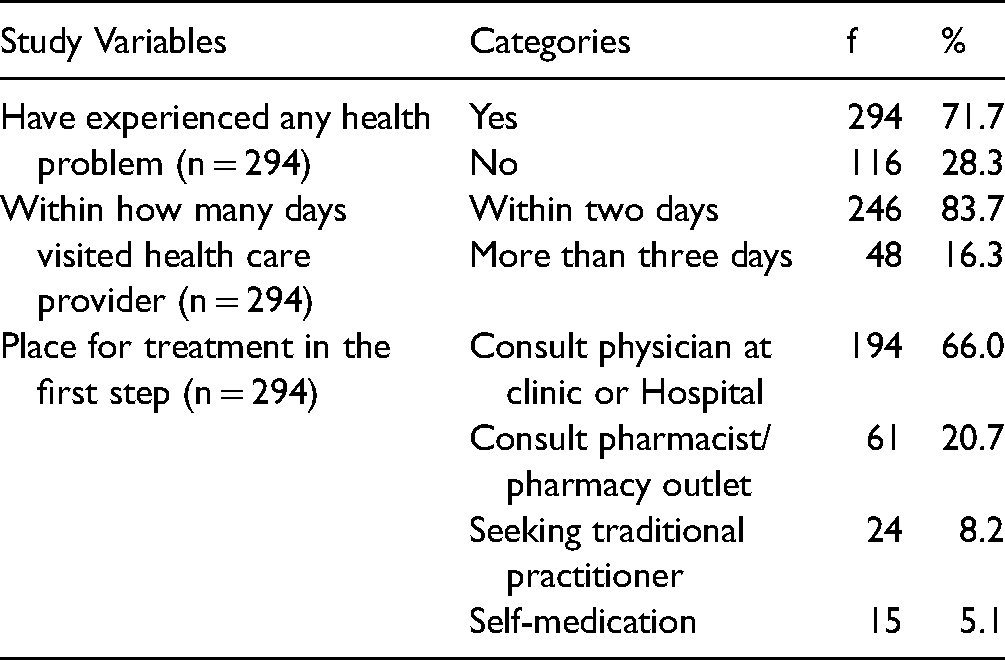
During the study period more than two-thirds 294 (71.7) of the study participants had experienced at least one type of health problem. Among the respondents who had experienced health problems 246 (83.7%) respondents had visited health care providers within two days of the onset of health problems. Similarly, 48 (16.3%) respondents had visited health care providers after more than three days of the onset of health problems. Similarly, 194 (66.0%) respondents had consulted physicians at the clinic or hospital for their first treatment while 24 (8.2%) participants had contacted a traditional practitioner (Table 3).
Health Seeking Behavior among Adult Populations in Assella Town, Oromia Region, Ethiopia, 2020.
Awareness of Cancer Warning Symptoms
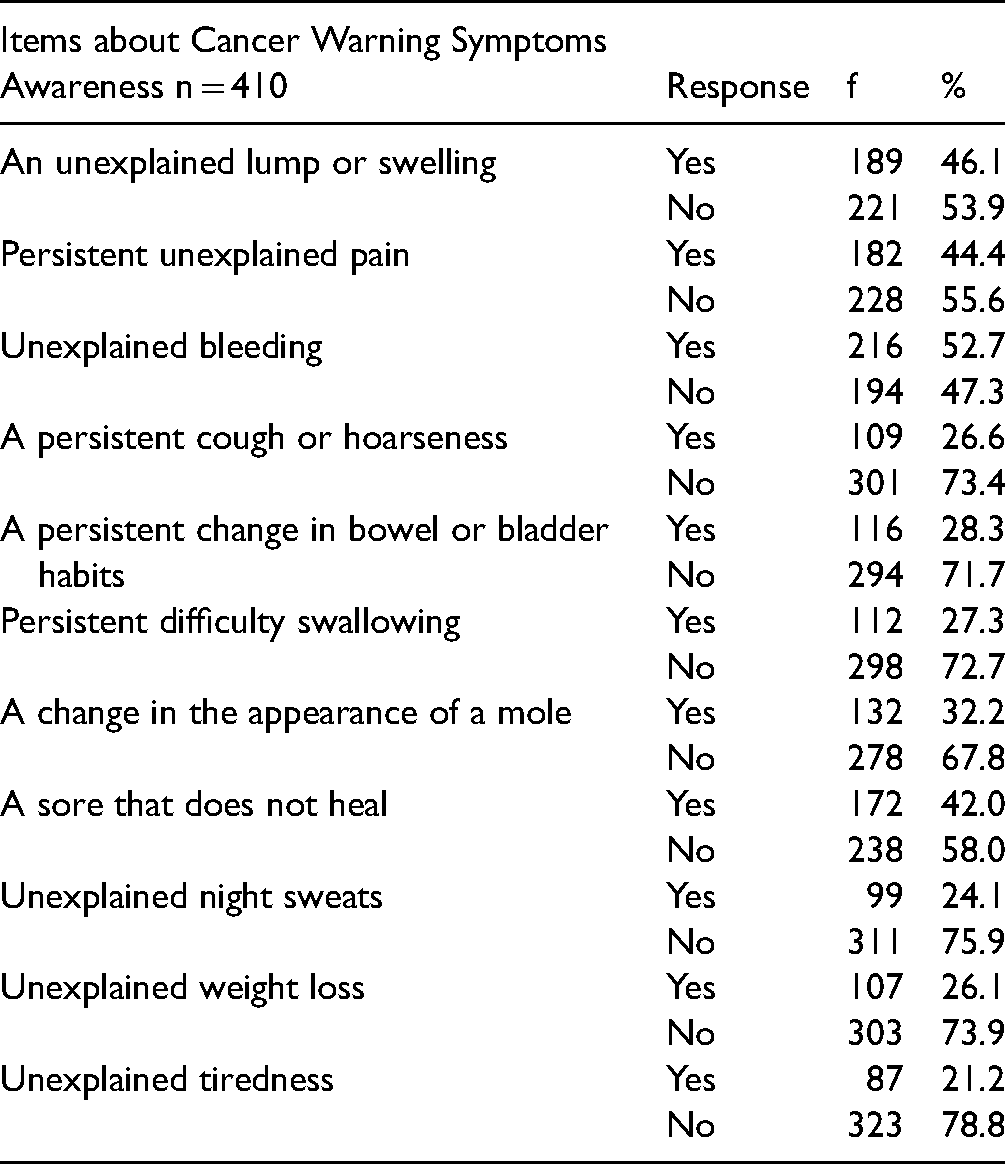
Regarding items used to measure awareness of cancer warning symptoms among study participants about 189(46.1%) of study subjects responded unexplained lump or swelling could be a symptom of cancer. Among the study subjects participated in this study, 182(44.4%), 216(52.7%),109(26.6%), and 116(28.3%) responded persistent unexplained pain, unexplained bleeding, persistent cough and hoarseness and persistent change of bowel habit respectively could be a warning symptoms of cancer (Table 4).
Items Used to Measure Cancer Warning Symptoms Awareness among Adult Population in Assella Town Oromia Region, Ethiopia, 2020.
Regarding awareness of cancer warning symptoms, slightly more than half 214 (52.2% (95% CI 47.1–56.8)) of the respondents had a good awareness about cancer warning symptoms (Figure 2). The level of awareness about cancer warning symptoms was 135 (53.6%) among females. Similarly, the level of awareness of cancer warning symptoms were 39 (55.7%), 55(47.8%), 57(52.3%), 41(50.6%) and 22 (62.9%) among the age groups of 19–29, 30–39, 40–49, 50–59 and greater than or equal to 60 years respectively. Government employees had 52 (59.1%) level of awareness about cancer warning symptoms.

Family history of cancer among adult populations in Assella town Ethiopia, 2020.

Awareness of cancer warning symptoms among adult populations in Assela town, Oromia region, Ethiopia, 2020.
Factors Associated with Awareness of Cancer Warning Symptoms
To identify factors affecting the level of awareness about cancer warning symptoms, bivariate and multivariable logistic regression analysis were done. Accordingly, educational status, family history of cancer, information about warning symptoms of cancer, experience of health problems, awareness of cancer risk factors and wealth status were found to have an association with awareness about cancer warning symptoms at P-value less than or equal to 0.25. In multivariable logistic regression analysis, educational status, awareness of cancer risk factors and wealth status were found to have statistically significant association with awareness of cancer warning symptoms at p-value less than 0.05. Respondents who had attended their higher educational level were 3.4 times (AOR = 3.44; 95% CI, 1.50–7.88 (p = 0.003)) more likely to have awareness about cancer warning symptoms than those who had could not read and write. Similarly, respondents who had awareness about cancer risk factors were 2.5 times (AOR = 2.56; 95% CI, 1.67–3.93, (p < 0.001)) more likely to have better awareness about cancer warning symptoms than those who had no awareness of cancer risk factors. Additionally the study participants who had high level of wealth status were 3.13 times (AOR = 3.13; 95% CI 1.84- 5.33, p < 0.001)) more likely to have awareness about cancer warning symptoms compared to respondents who had low level of wealth status (Table 5).
Binary and Multivariable Logistic Regression Model to Identify Factors Associated with Awareness of Cancer Warning Symptoms among Adult Population in Assela Town, Oromia Region, Ethiopia, 2020.

Key. ** indicates the independent factors associated with awareness of cancer warning symptoms at p < 0.05. COR: Crude Odds Ratio, AOR: Adjusted Odds Ratio, CI: Confidence Interval.
Discussion
This study assessed the level of awareness about cancer warning symptoms and factors associated with the adult population in Assella town. The overall finding showed that slightly more than half (52.2% (95% CI 47.1, 56.8)) of the study participants had an awareness about early cancer warning symptoms with slight variation with educational level, awareness of cancer risk factors, and wealth status. This indicates that the majority of the study participants had awareness about cancer warning symptoms likely at a later stage of the cancer disease process which could negatively affect survival rate (Islam, Billah, Hossain, & Oldroyd., 2017).This finding implies the need for creating awareness about cancer warning symptoms in the general population. The finding of this study is in line with a study conducted in Lebanon which showed 50% of respondents had awareness on the warning symptoms of cancer (Rhazi, et al., 2014), a study conducted in Mumbai India in which 48.2% of respondents reported good level of awareness (Richards, et al., 2017), and a study conducted in Indonesia which showed 53.2% of respondents had awareness about cancer warning symptoms (Veerakumar, & Kar., 2017).
However, the findings of this study were found to be lower than those of studies conducted in Iran 58.3% (Wimardhani, et al., 2019), Iranian 73.3% (WHO Cancer Fact Sheet, 2018). The discrepancy might be due to the difference in socio-demographic characteristics, educational status and the methodological difference between this study and the study conducted in Iran. Similarly the level of awareness about cancer warning symptoms was 82.0% in Australia (World Cancer, Cancer Fact Sheet, 2018), the possible justification might be due to the fact that the majority of respondents were reported as having a high economic status in Australia whereas the current study only 32.9% of respondents had a high level of economic status. Similarly, the findings of this study were lower than a study conducted in India Pune City which showed the overall awareness of cancer warning symptoms was 67% (Pedgaonkar et al., 2012). The possible justification might be due to variation in the level of education among the study participants in the two study countries. Additionally the level of awareness about cancer warning symptoms among adult populations reported in Tanzania was 90% (Chestnov, 2013). This discrepancy might be due to a difference in sample size and study designs employed in the two studies.
The finding of this study was higher than the study conducted in Oman on public awareness of cancer warning symptoms which showed 40.6% (Veerakumar, & Kar., 2017). The possible justification might due to the difference in the level of educational status among the study populations in the two countries which clearly showed 62.9% attended higher education in this study whereas 44.9% participants attended higher education in Oman.
In this study adults who attended higher education were 3.4 times more likely to have awareness about cancer warning symptoms than adults who can’t read and write. This finding is also supported by a study conducted in Denmark, Iran, and Saudi Arabia (Ravichandran et al., 2010; WHO. 2018b; Wimardhani et al., 2019). This implies that as the level of education increases, the chance of the individual's exposure to a different source of information to know cancer warning symptoms will increase.
Respondents having awareness of cancer risk factors were 2.5 times more likely to be aware cancer warning symptoms as compared to their counterparts. Additionally the study participants who had high level of economic status were 3.13 times more likely have awareness of warning symptoms of cancer compared to respondents who had a low level economic status. A similar finding was reported from a study conducted in Denmark, Malaysia which showed adults who had a high level of economic status was predictor variable which affected the level of awareness of cancer warning symptoms(Ravichandran et al., 2010))(World Cancer Fact Sheet, 2018). This implies that adults who had a high level of wealth status might have access to information through mass media like televisions and internet to get information about cancer warning symptoms and may have better experience of visiting health care institutions.
Strengths and Limitations
This study tried to explore a very important and timely topic in Ethiopia at the community level which was community awareness about cancer warning symptoms. The awareness at the community level may play a pivotal role for cancer prevention and treatment. On the other hand, this study was limited to the specific town of Oromia Regional state Arsi Zone Assella town and the results may not show the overall level of cancer warning symptoms awareness among the adult population living in Ethiopia. So, other nationwide interventional community-based studies focusing on awareness creation and risk reduction is recommended for future researchers. The other limitation of this study may be lack of similar studies in Ethiopia; so comparison of the results was done with other countries where health policies, coverage and cancer controlling strategies may differ.
Implications for Practice and Research
Giving the right and appropriate attention to cancer warning symptoms is important for early screening, diagnosis and accessing health services. It can be considered as a crucial and contemporary solution for cancer prevention, treatment and control programs. The identification of cancer warning symptoms awareness is recommended by different national and international Health Care Organizations to prevent and control cancer. Community Health teaching strategies aiming to increase level of cancer warning symptoms awareness and associated factors at the grass root level should be considered by nurses working at primary, secondary and tertiary health care facilities.
Footnotes
Acknowledgments
We would like to thank Jimma University for financial support. Our heartfelt thanks should also go to all Assella health office staffs, Assella town municipality, each Kebele administration office, study participants, data collectors and supervisors.
Data Availability
The data supporting the findings of this work is available at the hands of the corresponding author.
Declaration of Conflicting Interests
The author(s) declared no potential conflicts of interest with respect to the research, authorship, and/or publication of this article.
Funding
The author(s) received no financial support for the research, authorship and/or publication of this article.
