



Abstract
Background
Meditation on Twin Hearts (MTH) involves blessing the earth to alleviate the sufferings, and praying for the well-being of the entire society using heart and crown chakra. This meditation is characterized by mechanisms of loving-kindness, self-healing imagery, and open awareness.
Purpose
This study aims to identify the experiences and perceived benefits associated with practicing MTH by nursing students.
Method
Qualitative method using content analysis was used to study meditation experiences. After obtaining the informed consent, 22 nursing students were introduced to MTH. Experiences and feedback from meditation sessions were reported each day during their 8 week practice. Nursing students also answered seven open-ended questions on the last day of the meditation session.
Findings
The verbatim descriptions of experiences reported by nursing students were abstracted to elements (17), properties (6), and categories (2). Identified properties are positive experiences, experiences of awareness, energy experiences, tangible outcomes, physiological reactions, and feedback on the study program.
Conclusion
The experiences narrated by nursing students include positive affective experiences, health benefits, resolution of problem, awareness and energy experiences, and prosocial tendencies. These findings indicate that MTH would enhance the well-being of the nursing students and could be used as a self-care measure.
Introduction
Besides the intensive theoretical learning that a nursing school entails, nursing students must also demonstrate clinical and critical thinking skills (Kang et al., 2009). According to investigations, nursing students are exposed to highly stressful conditions as compared to students in other healthcare fields such as physical therapy, pharmacy, dentistry, and medicine (Beck et al., 1997; Jones & Johnston, 1997). Seventy six percent of nursing students had considerable stress levels, which was higher than the stress levels of medical students (Consolo et al., 2008). Within nursing schools, stress levels might vary depending on the different educational levels and nursing programs (Burnard et al., 2008; Lindop, 1999; Timmins & Kaliszer, 2002).
Sheu et al. (2002) describe stressors that occur during clinical practice includes, caring for patients, clinical environment, lack of professional knowledge, academic workload, compounding to fear of failure. Change in environment, change in food type, irregular diet, economic problems, future prospects, problems with the value system of current society, self-expectations, and expectations from family, etc., are other contributing stressors (Gibbons et al., 2011; Labrague et al., 2017).
Clinical practice stressors among nursing students lead to substantial distress during the learning process (Chernomas & Shapiro, 2013). Stress during clinical practice will affect a nursing student's willingness to pursue a career in nursing (Bhurtun et al., 2019). Nursing students develop depression, affective disorders, social dysfunction, somatic symptoms, and sleep disturbance due to stress (Chernomas & Shapiro, 2013; Silva et al., 2020). Considering this, there is a need to figure out how to successfully reduce nursing students’ stress levels during clinical nursing practice (Hsiao et al., 2012). Finding ways to effectively decrease stress levels and improve the clinical experience are needed using other activities, therapies and mental health support (Chernomas & Shapiro, 2013; Yeom & Choi, 2013).
Earlier studies in this line, have supported that meditation and subtle energy therapies help student nurses develop improved concentration, academic performance, deeper understanding of themselves and reduce stress (Kramer, 2017). A widely practiced mindfulness meditation is one such technique had proved to be effective in reducing depression, stress and anxiety among nursing students (Ratanasiripong et al., 2015; Yeom & Choi, 2013). In a study, practicing loving-kindness and compassion meditation was found effective for empathy improvement and stress management of nursing college students.
Meditation on Twin Hearts (MTH) is a similar technique introduced by Master Choa Kok Sui. MTH is commonly practiced by Pranic Healers and Arhatic Yogis, and is characterized by mechanisms of loving-kindness, self-healing imagery and open awareness. The components of MTH meditation have associations with characteristics of mindfulness, compassion and loving-kindness and it is also known as loving-kindness compassion meditation. Loving-kindness meditations (LKM) can enhance the same mindfulness and compassion components similarly (Mantzios et al., 2021). Mindfulness is the active state of cultivating self-control and stillness through engaging in the present moment and being non-judgmental, which encourages open awareness and acceptance (Kang et al., 2009; Karunamuni & Weerasekera, 2019), whereas MTH is aimed at achieving cosmic consciousness or awareness through activating some major chakras. Like mindfulness meditation, MTH involves the concentration of attention to achieve immense awareness with the cultivation of a positive state of mind. Twin Hearts refers to “crown chakra” located at the top of head and the “heart chakra” located at center of chest. Chakras are the human whirling energy centers. (Sui, 2009). Besides, meditation on loving-kindness involves the intentional cultivation of a kind attitude, authentic, warm-hearted positive emotions, compassion towards oneself and others (Zeng et al., 2015). Like LKM practice, MTH is oriented towards blessing the earth with compassionate love to alleviate the sufferings, and praying for the well-being of the entire society using heart and crown chakra (Sui, 2009).
Previous studies on MTH have gained an understanding of the effectiveness of practicing this meditation on psychological well-being. In a controlled study on MTH practiced for 4 weeks, there was an improvement in mental health and quality of life of female adolescents. Participants expressed novel subtle experiences of tingling, attraction, and warm sensation in their hands during meditation (Jois et al., 2017a). In a study by Blinne and Perez (2016), MTH practitioners experienced significantly less anxiety, more happiness, higher levels of problem-focused coping, and stopping unpleasant thoughts and emotions. Those who had thousand hours of MTH practice showed cognitive improvements (Tarrant et al., 2019). During the COVID-19 pandemic, MTH has been practiced by medical staff as a self-care measure to be emotionally resilient and composed (Bhatia, 2020). Overall, earlier literature has proved the associated benefits and experiences results from practicing this meditation. However, the present study seeks to identify the experiences and perceived benefits of MTH practice by nursing students
Method
Design
Exploratory study design was followed to identify experiences and perceived benefits associated with practicing MTH by nursing students. This method also promote consistency and provides evidence from a feasibility point of view and helps in conducting future controlled studies (Campbell et al., 2000).
Participants
Purposive sampling techniques were employed for recruiting the samples for this study. Based on Inclusion and Exclusion criteria, 22 nursing college students in the age group of 18–26 years from Nataraja College of Nursing, Mysore, India were selected. Informed consent was obtained from nursing students and their confidentiality were maintained. The mean age of nursing students was 20.45 ± 2.01 years. Table 1 provides the sociodemographics of the participants.
Demographics of the Participants.

Inclusion Criteria
Those above 18 years and interested in practicing meditation.
Nursing students of both genders.
Exclusion Criteria
Those not signed the informed consent form.
Chronic physical or psychological ailments.
Pregnant women.
Previous practice of meditation of any kind.
Participants were informed regarding study procedures and clarified that their participation in the study was voluntary, and no compulsion of any kind was used. Participants are assured that they may quit the study at any point in time. To avoid any sort of force on students, staff members of the college were not involved in the study team.

Protocol for practicing Meditation on Twin Hearts (MTH).
Data Collection and Setting
Analysis
Qualitative content analysis of inductive approach was adopted to analyze the collected data from nursing students (Elo & Kyngäs, 2008; Graneheim & Lundman, 2004). In the preparation phase, words or phrases from the reported data (diary record and structured interview schedule responses) was reviewed based on the experiences and feedback of nursing students during the practice of MTH.
In the next stage, meaningful portions were spotted from the wordings and categorized according to a set of rules or schemes of categories related to the relevance of the study. For identifying the experiences and feedback of practicing MTH more precisely, transcripts were reviewed and assessed systematically by two researchers. Experiences and feedbacks were listed, and similar experiences were clustered and labeled. Then sub-categories and generic categories were formulated under main categories (Figure 2).
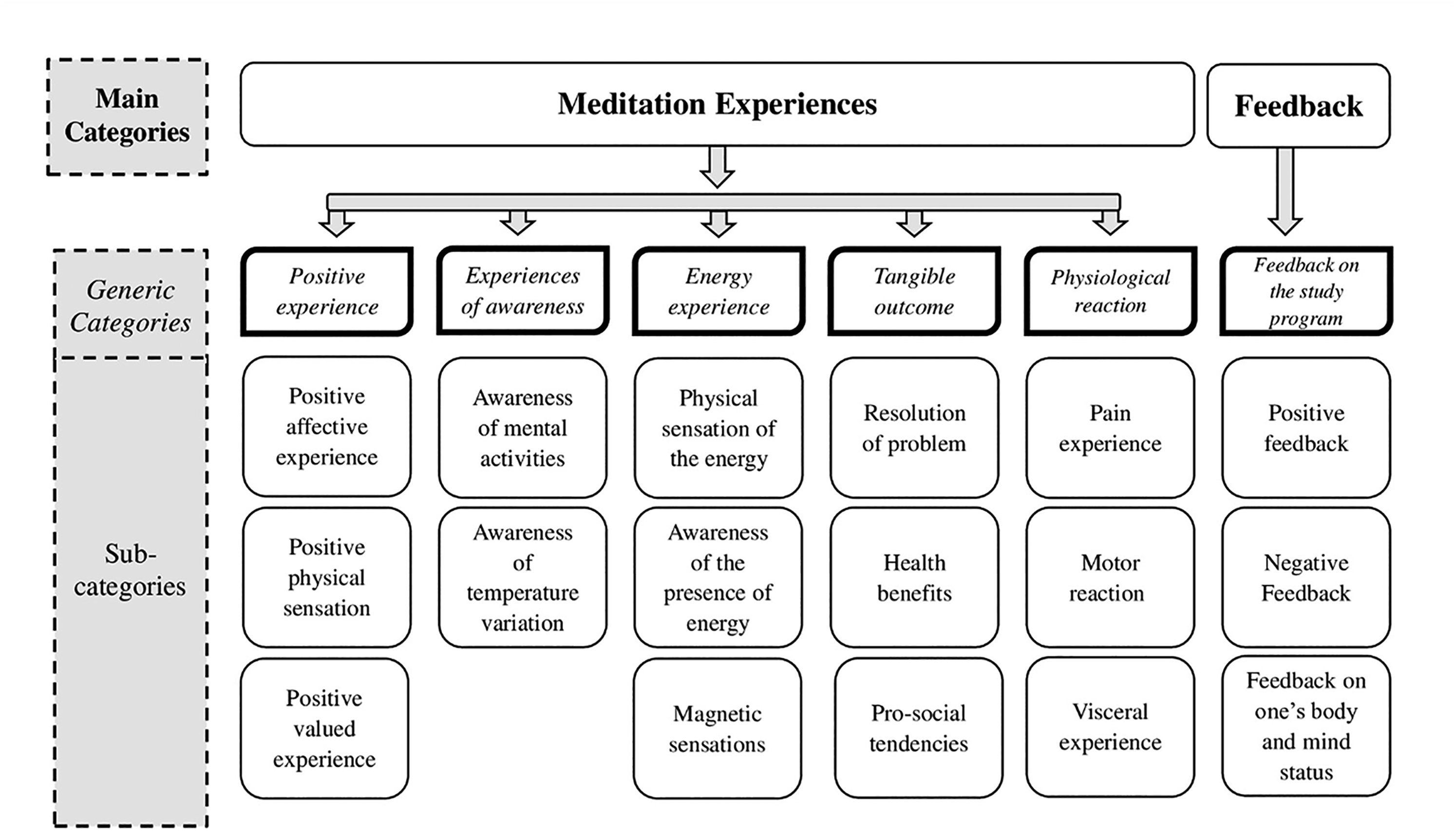
Content analysis on Meditation on Twin Hearts (MTH) experiences of nursing students.
Results
After analyzing the response of nursing students two main categories, namely Meditation Experiences and Feedback were derived, respectively (Table 2).
Subcategories of Meditation Experiences and Feedback on Meditation on Twin Hearts (MTH.)

Main Category I: Meditation Experiences
Overall reports of MTH for 40 days identified a verity of experiences and most of the identified experiences are beneficial to the nursing community. Apart from the physical and psychological experiences, nursing students reported different energy experiences as well. The generic categories under the meditation experiences are.
Generic Category 1: Positive Experiences
Experience of a positive feelings or comfort during meditation, positive sensations and experiences positively influencing the life activities due to the MTH were mentioned as positive experiences. The generic categories are subdivided into three as positive affective experiences, positive physical sensations, and physical valued experiences. For example, “free from the worries and sorrows of the life”, “freshness in the eyes and other parts of the body” and “feel enthusiastic to study in the classroom”, etc.
Generic Category 2: Experience of Awareness
Special experiences of the awareness of the current condition of body and mind of nursing students during the MTH practice were grouped into the experience of awareness. It was sub categorized into awareness of mental activity and awareness of temperature variations. For example, “notice the positive state of mind”, “enhancement in concentration ability” and “warm/heat sensations during the blessing of the earth” etc.
Generic Category 3: Energy Experiences
Experiences or awareness of energy sensations, including pranic energy, magnetic sensations through body or hand during the meditation were mentioned under energy experiences. Awareness of the presence of energy, physical sensation of energy, magnetic sensations are the subcategories included in it. For example, “Felt light is passing through hands while a blessing”, “a feeling of heaviness in the hands while blessing”, “Magnetic attraction between hands, the attraction was more at the tip of the fingers,” etc.
Generic Category 4: Tangible Outcomes
Intra-personal, inter-personal, health related benefits and tendencies to help others after attending MTH were grouped as tangible outcomes. Subcategories are health benefits, resolution of the problem and prosocial tendencies. “No backache”, “health is improving gradually”, “anger reduced”, “Financial and family problems are solved”, “feel happy when helping others who are in trouble” etc.
Generic Category 5: Physiological reactions
Effects during the meditations were reported by few nursing students categorized as physiological reactions. The sub categories are pain reaction, motor reaction and visceral experience. For example, “body pain”, “felt like the body is swinging” and “got tears in the eyes” etc.
Main Category II: Feedback on Meditation
Feedback/opinion about MTH given by nursing students were grouped as
Generic Category 6: Feedback on the Study Program
Interest in participating MTH, positive feedbacks on MTH and justifications or causes of non- involvement in MTH were mentioned in this generic category. The sub divisions are positive feedback on meditation, negative feedback on meditation and feedback on one's own body and mind. For example, “practicing the meditation gives happiness”, “wants to continue it in the future”, “I do not have an interest in meditation” and not able to meditate due to headache” etc.
Discussion
In this study, nursing students practiced the MTH for 8 weeks and their experiences of meditation have been analyzed. The nursing students reported that daily practicing meditation enhanced their well-being. They acknowledged that practicing meditation can bring positivity in their lives; they could notice that physical, psychological, and social changes have been evident in their being. Experiences emphasizing those changes among nursing students were analyzed conceptually to get a rigorous understanding.
The findings from positive experiences reflect that practicing MTH had beneficial effects on the overall well-being of nursing students in this study. Nursing students reported a sense of happiness, joyful, and stable mood state after practicing meditation every day. Because of the regular practice of meditation, they were more active and energetic than before, and their muscles were in a relaxed state, were astonished and surprised about the positive and beneficial influences of practicing this meditation on their lives.
An earlier study on adolescents who practiced MTH for 1 month show a significant decrease in the perceived stress levels with a significant increase in the overall quality of life (QOL) in the experimental group as compared to the control group. (Jois et al., 2017a). In another study on MTH, participants reported a significant decrease in anxiety, relief from unpleasant thoughts and emotions, and enhanced happiness (Blinne & Perez, 2016). Results of studies on other meditation and energy healing practices are consistent with the findings of the present study. In a study, stress among nursing students due to academic activities and clinical settings was reduced after meditation practice (Amarnath et al., 2018). As a stress-management technique, medical students practiced deep breathing meditation in a calm space. It involved an open attitude, focused deep diaphragm breathing in a relaxed posture. As a result of 2 years of practice, it decreased self-doubt, nervousness, and anxiety (Paul et al., 2007). A significant decrease in stress, trait anxiety, after the practice of transcendental meditation among college students was noticed (Burns et al., 2011). Self-Reiki use, have led the nurses to experience a feeling of energized, less tired, with a sense of calmness. Literature also shows that regular practice of meditation reduces stress and anxiety (Brown & Robinson, 1993), reduces pain (Kabat-Zinn, 1991), and initiates physical healing (Campbell, 1991). The practice of Heart Touch Technique helped Nurses to reduce stress and enhanced spiritual wellbeing (Walker, 2006). All these findings support the advantages of the self-intervention program in combating life stressors to cope up with professional demands effectively. A feasibility study on transgender women with mild-to-severe mental health conditions also evidenced in experiencing the positive affective experiences and awareness experiences after practicing MTH. All participants were willing to continue their meditation practice further (Joshi et al., 2021).
In the experience of awareness, nursing students were aware of their thought and have gained control over disturbing thoughts as well as unstable mind. The advantage of practicing any kind of meditation is that it helps individuals become more aware of their thoughts and realize how these thoughts affect their emotional and physical state (Wilber, 1998). Awareness of one’s mental state is very important to handle stressful situations and behaving appropriately. Awareness of one’s mental state plays a major role in coping with the critical and challenging situations in the nursing profession. To attain a wellness state among nurses in healthcare is possible through capturing the ability to restore one's self to a peaceful and aware state (Vitale, 2009). Loving-kindness, compassion meditation supports self-regulation in maintaining attention. One component of MTH, open awareness helps in enhancing the cognitive process and sustained attention (Tarrant et al., 2019). The finding of the present study supports this fact. Nursing students have reported that after the successive days of their meditation sessions they have noticed gradual improvements in their focusing capacity or concentration level.
Awareness of temperature variations denotes that nursing students experienced warm and cool sensations in their hands during “blessing in meditation sessions.” During MTH practice, the subject feels an enormous amount of pranic energy during blessing the earth. During another study on MTH, female adolescents felt energized, energy flowing from hands, heaviness in the hands and lightness in body (Jois et al., 2017a). A study found that the prana between palms leads to a warm sensation in the participant’s hands (Jois et al., 2015). Besides, Lazar et al. (2005) study shows that the practice of insight meditation influences the experience of internal and external sensations. Doing meditation increases the thickness of the cortex in somatosensory areas of the brain. This increase in cortex thickness was positively correlated with meditation experience, so we may hypothesize that it functionally corresponds to an increase in body and mental awareness.
The sub category of energy experiences encompasses the presence of energy including energy forms that are explained in the pranic energy perception studies and it is expressed in different sensations. Previous findings on pranic energy studies are supporting the current findings. Varied types of physical and other sensations such as tingling, heaviness in the hands, magnetic sensations, and electrical sensations are all the result of the presence and flow of prāna between the hands (Srikanth et al., 2017b). Besides, when a person receives prāna through any kind of energy healing or through absorbing energy, they may experience pressure, tingling, vibration, temperature changes, electromagnetic, and other physical sensations (Rindfleisch, 2010). In a study on energy healing therapies, nurses describe that they noticed sensations of warmth, tingling, and pulsation which were relaxing (Raingruber & Robinson, 2007). A study supported the fact that tingling occurs during the practice of meditation (Buie & Blythe, 2013). Complementary therapies interpret tingling as the presence or flow of energy (Hui et al., 2007; Raingruber & Robinson, 2007; Tihanyi et al., 2016). Tingling during these interventions are often caused by (1) attention-related processes and (2) changes in peripheral physiology, for example, during relaxation, static postures and slow exercises, or deep breathing brought by autonomic and somatomotor self-regulation and affective processes (Van Diest et al., 2000).
The tangible outcomes cover “health benefits,” “pro-social tendencies,” and “resolution of problems”. Experiences reported by nursing students such as “relieve from headache”, “relieving from body pain and tiredness”, “eye pain is cured”, “free from anxiety and stress”. These findings from the current study can say that practice of this meditation for a period may contribute to healthier life both physically and mentally. The responses related to the sub category of “resolution of the problem” are “financial and family problems are solved.” As a result of the regular practice of MTH, some nursing students have developed “pro-social tendencies.” They express that they feel happy when helping others who are in trouble, blessing others, and praying for others made them happy, etc. Brief loving-kindness meditation increases the connectedness towards others and positivity toward the practitioners of meditation (Hutcherson et al., 2008). The nursing profession includes interactions with patients and it makes higher levels of consciousness (Endo, 2017). The prosocial tendencies influence the higher consciousness of nursing students. The phrases used in the narrative of MTH during the blessing phase made a Metta meditation experience helped nurses in cultivating the sense of loving-kindness for themselves, later to other lives and finally to the entire humanity.
Neuroscientific research shows that greater activation of a subset of brain regions namely, the insula and temporoparietal junction during the practice of compassion meditation leads to awareness of one's body sensations and in social cognition and empathic responses (Lutz et al., 2008; Singer et al., 2004).
The nursing students narrated their experience of “motor reactions” as “floppy sensation.” “the body was rotating,” etc. The narrated expressions in “pain experience” involve responses like “closing the eyes causes giddiness”, “eye pain”, and “muscle pain during practicing meditation” etc. The most reported pain is in the eye area. The “visceral experience” involves, “got tears in the eyes” response. Only one nursing student has reported this sensation. We cannot discuss here the mechanism behind such experiences from nursing students and further studies in this line are required.
In the main category of feedback on MTH, nursing students expressed that “practicing this meditation is beneficial to health,” “it makes to forget sadness,” “I like meditation,” etc. The negative feedback on the study program consists of the responses such as “today I don't like to do meditation,” “I do not have an interest in meditation.” Feedback about one's body and mind statuses involve the responses as “my mind is in stress today,” “not able to close eyes for a longer time,” etc. Above this overall feedback from nursing students represents their opinions, attitude, and their preparedness and willingness to practice the meditation. However, the majority number of positive feedbacks from nursing students communicates their utilization of meditation intervention in a genuine sense.
From the responses of the MTH meditators, it is found that enhanced awareness state among them leads them to feel the temperature variation, presence of pranic energy in different forms, prosocial tendencies, motor reactions, pain experiences and visceral experiences with the present momentary experiences and feedback on MTH practice. The nursing students also mentioned the perceived benefits as experiences of positive affective states, positive physical sensation, health benefits, resolution of problems, and positive valued experiences. Like other attention meditation, a combination of self-healing-imagery, loving-kindness, compassion, sustained attention, and self-regulation may act on nursing students in attaining the perceived benefits of MTH.
Hence, the findings of this study uphold the advantages of practicing the MTH regularly. However, in this article, we are not going to the argument that practicing this meditation has more advantages than any other type of meditation in combating stress and achieving well-being. Because each meditation has its characteristics, orientations, and associated benefits. None of the meditation practices is superior or inferior to other meditation practices. However, MTH would stand as unique in balancing the energy state of the person who practices this regularly. This balance of energy state is would serve as a key aspect in achieving overall well-being.
Implementation of the Study
As a self-administering and cost-effective intervention, regular practice of this guided meditation in clinical nursing helps to achieve a balanced state of mind, to enhance the prosocial tendencies in maintaining compassion, well-being and loving-kindness for the welfare of others and themselves. Nursing faculty members and leaders in holistic nursing can include such an intervention program for self-care with a basic nursing syllabus. This helps nurses to manage their profession smoothly and effectively. The outcome will provide the drive for broader utilization of this relatively cost-effective method of self-healing approach.
The findings of this study have application in health and well-being, education, and research. The theoretical or descriptive mode of expressions obtained from using an open-ended questionnaire in this study would have scope for developing and standardizing more sophisticated tools for using in future research on same as well as similar lines. Besides, results from this qualitative study would serve as the foundation for future repeated studies targeting nursing students with a large sample, rigorous study design and follow-up assessments.
Limitations and Future Research
There is a need to replicate this study with a broader sample of student nurses. Other limitations such as language barriers, fatigue, and lack of focus on meditation during the initial days might have influenced experiencing and reporting the sensations. The generalizability of our study findings may affect because the sample selection concerned with the population of nursing students and they were new to MTH.
A scale based on MTH experiences helps to better compare various experiences and effects during this meditation. The root cause of the emergence of experiences and how these experiences are affecting the mental health of nursing students due to MTH must be studied. Detailed investigations of factors affecting or influencing participants in sensing different experiences have to be established.
Conclusion
The experiences of MTH among nursing students were analyzed and was found that practicing this meditation is useful to them in combating their mental health issues and feel the realm of energy in a true sense during meditation. The range of experiences narrated by nursing students denotes the influence of meditation on their overall well-being. The nursing students would benefit from understanding how their mental, physical, social, and spiritual being is influenced by practicing MTH. The outcome from this article will provide the drive for broader utilization of this relatively cost-effective method of self-healing approach.
Footnotes
Acknowledgments
We acknowledge Master Choa Kok Sui for teachings, guidance, blessings and board members of the World Pranic Healing Foundation, India, for encouragement, support, and funding. We are thankful to the coordinator of Nataraja School of Nursing, Dr. Rajesh and Principal Ms. Sumana, Dr. Nagendra Prasad K., and Ms. Shalini N. S. for their valuable contributions.
Ethical Consideration
Permission was obtained from the authorities, Nataraja College of Nursing, Mysuru to conduct the study.
Declaration of Conflicting Interests
The author(s) declared no conflicts of interest with respect to the research, authorship, and/or publication of this article.
Funding
World Pranic Healing Foundation, India funded this study.
