




Abstract
Introduction
Knowledge management-based nursing care has a positive effect in preventing healthcare associated infections (HAIs). Therefore, nursing professionals can utilize key strategies of knowledge management to support clinical decision making, reorganize nursing actions, and maximize patient outcomes.
Objectives
The aim of this study was to determine the effect of knowledge management-based nursing care educational training on HAI prevention behavior at the High Care Unit (HCU) of Saiful Anwar Hospital Malang.
Methods
A quasiexperimental design with a pretest, educational training intervention, and posttest were conducted on 15 nurses in the HCU of Saiful Anwar Hospital Malang, which lasted for 16 days. Furthermore, observation of nursing care documentation, nurses’ handwashing compliance, and presence of infection-causing bacteria in the HCU staff and environment (hands rub handle, medical record, and patient's bed) was carried out pre (day 1–7) and post training (day 10–16). Subsequently, educational training related to knowledge management-based nursing care was conducted for 2 days (day 8–9) by the Doktor Mengabdi Team of Universitas Brawijaya.
Results
The knowledge level and completeness of the nursing care documentation in the HCU room significantly increased after the training (p < .05). Also, compliance to the six steps five moments of nurses’ handwashing increased after the training (p > .05). Infection-causing bacteria were found in the HCU environment and staff before and after the training involving Pseudomonas stutzeri, Sphingomonas paucimobilis, Enterobacter cloacae, Staphylococcus aureus, Acinetobacter baumannii, Pasteurella pneumotropica, and Acinetobacter lwoffii. Therefore, increased knowledge of HCU nurses and complete documentation (r = .890; p = .054), increased knowledge of HCU nurses and handwashing compliance (r = .770; p = .086), and handwashing compliance and bacterial presence (r = .816; p = .084) all had a positive correlation.
Conclusion
Knowledge management-based nursing care educational training increased infection prevention behavior in the HCU of Saiful Anwar Hospital Malang.
Keywords
Introduction
Healthcare associated infection (HAI) is an infection obtained by patients from healthcare facilities during nursing care (Haque et al., 2018). Generally, it is a serious problem for healthcare facilities globally and the number of cases increases yearly (Sahiledengle et al., 2020). HAI accounts for 7% and 10% in developed and developing countries, respectively. According to the WHO estimates, approximately 15% of hospitalized patients suffer from these infections. Consequently, this has an impact on the length of stay in the hospital, long-term disability, increased antimicrobial resistance, increased socio-economic disruption, and increased mortality. Therefore, HAI can be used as a measure of the quality of health services and is of important concern for healthcare facilities (Khan et al., 2017).
The pathogens that cause HAI are frequently found in the hands, through which about 80% of infections can be transmitted (Onyedibe et al., 2020). Inadequate handwashing behavior by nurses, the health care staff who interact directly with patients, transfers pathogens that cause HAI directly to the host (Hammerschmidt & Manser, 2019; Joseph & Joseph, 2016). The level of compliance to handwashing by health workers can reduce HAI including bloodstream and respiratory tract infections. Therefore, an effective way to reduce HAI is to increase the compliance of nurses’ handwashing (Hammerschmidt & Manser, 2019).
Furthermore, a study conducted at Dr. Moewardi Hospital Surakarta showed several inappropriate behaviors by health workers with the potential to increase infection transmission to health workers, patients served, and the wider community. These include improper handwashing and use of gloves, unsafe re-closing of syringes and disposal of sharp equipment, decontamination techniques and inadequate sterilization of equipment, and inadequate room hygiene practices (Parsinahingsih & Supratman, 2008). Also, another study conducted by interviewing the chief of nurse in the High Care Unit (HCU) of Saiful Anwar Hospital Malang showed that the nurse in charge had knowledge of the Standard Operating Procedure (SOP) for handwashing in the hospital, but its application in daily activities was neglected. Although there were hand rubs in every door and patient's bed which supported nurses in handwashing, their use was not optimal due to the large number of patients and the nurses’ haste to act. The data showed 80% handwashing compliance of nurses at the HCU of Saiful Anwar Hospital Malang from September–December 2018.
This study aims to increase the 80% compliance of nurses at the HCU of Saiful Anwar Hospital Malang to 100%. Therefore, a strategy is needed to improve the HAI prevention behavior, thereby improving the quality of service. Generally, knowledge management-based nursing care is a novel concept and has been used successfully in the prevention of HAI in patients after cesarean section (Ahsan, 2014). This study aims to determine the strategy of knowledge management-based nursing care educational training to increase HAI prevention behavior in the HCU of Saiful Anwar Hospital Malang.
Research Questions
Does the implementation of knowledge management-based nursing care increase infection prevention behavior at the HCU of Saiful Anwar Hospital Malang?
Does the knowledge management-based nursing care training increase nurses’ knowledge about knowledge management-based nursing care at the HCU of Saiful Anwar Hospital Malang? Does the implementation of knowledge management-based nursing care increase knowledge management-based nursing care documentation at the HCU of Saiful Anwar Hospital Malang? Does the implementation of knowledge management-based nursing care increase nurses’ handwashing compliance at the HCU of Saiful Anwar Hospital Malang? Does the implementation of knowledge management-based nursing care decrease the presence of infection-causing bacteria in the HCU staff and the environment at the HCU of Saiful Anwar Hospital Malang? Does the effectiveness of knowledge management-based nursing care training improve infection prevention behavior at the HCU of Saiful Anwar Hospital Malang?
Review of Literature
The Importance of Knowledge Management in Nursing to Quality Improvement for HAI Prevention
Knowledge management is the process of developing, sharing, using, and handling knowledge and organizational information (Girard & Girard, 2015). In nursing organizations, knowledge management is a comprehensive approach to understanding organizational activities in order to define the necessary knowledge, discover existing knowledge, add and develop new knowledge, store and coordinate knowledge, share knowledge, and to use and implement knowledge in nursing care (Karamitri et al., 2017). Therefore, the benefits of implementing knowledge management in nursing organizations include the ability to concentrate on patients’ expectations, track, and anticipate changes that occur in the internal and external environments, and enhance resource usage that emphasizes the lowest possible cost. Also, it includes the ability to manage process alignment between sections, monitor activities in each process systematically, find and repair process errors, consider the evolving business process of each production input, and correctly calculate changes under organizational conditions (Khan et al., 2017).
However, evidence-based HAI prevention practices are incompletely implemented. Although successful reduction programs require an executive oversight that keeps hospital leaders engaged in infection prevention, it is a challenge due to competing priorities (Bearman et al., 2019). Therefore, the benefits of knowledge management can be used to improve the quality of HAI prevention.
The Evidence That Knowledge Management in Nursing is Effective
One form of applying knowledge management in nursing is knowledge management-based nursing care. This is a novel concept in nursing care and has been used in a study to prevent HAI in patients after cesarean section. Also, the study showed that nurse performance in preventing HAI after cesarean section increased after the knowledge management-based nursing care training. Therefore, nurse performance had a significant relationship with the incidence of HAI in patients after cesarean section in hospitals (Ahsan, 2014).
Factors That Can Facilitate or Impede Knowledge Management Strategy
A successful knowledge management strategy depends on processes that improve personal and organizational capability, motivations, opportunities for learning and knowledge acquisition, and being carried out in a manner that delivers positive outcomes (Hassanian et al., 2015).
The Nursing Care as a Systematic System for Clinical Decision Making
The nursing care or process is a clinical practice system, which is a rational thinking mechanism used by the nurse to provide the best possible treatment to patients (Burhans & Alligood, 2010; Izumi et al., 2010; Toney-Butler & Thayer, 2020). Generally, it is similar to the steps used in scientific thinking and problem solving, involving five complex and simultaneous stages which include assessment, diagnosis, nursing care plan, implementation, and evaluation (Ackley et al., 2020; Karaca & Durna, 2019; You et al., 2013). Nurses are required to document the stage of nursing care for each patient, to provide proof of legal protection of the patient's condition and treatment, which can be crucial in clinical decision making about the standards of care (Asmirajanti et al., 2019).
The Stages of Knowledge Management-Based Nursing Care and How They are Applied
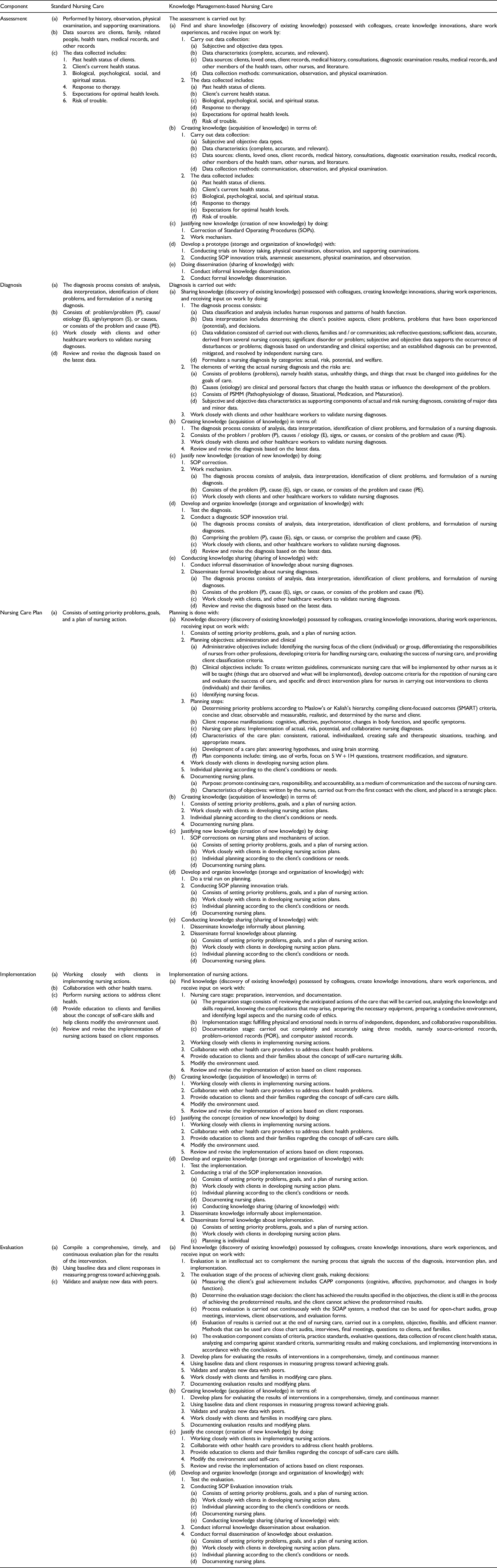
The stages of nursing care are assessment, diagnosis, plan, implementation, and evaluation (Ackley et al., 2020; Karaca & Durna, 2019; You et al., 2013). Table 1 shows the difference between standard nursing care and knowledge management-based nursing care and its application.
Differences of Standard Nursing Care with Knowledge Management-Based Nursing Care.
Methods
Study Design
The study was conducted on 15 HCU nurses of Saiful Anwar Hospital, Malang using a quasiexperimental design with a pretest, educational training intervention, and posttest.
Setting
This study was conducted in the HCU of Saiful Anwar Hospital Malang, Saiful Anwar Hospital Malang Hall, and the Microbiology Laboratory of Saiful Anwar Hospital Malang.
Sample, Sampling, and Recruitment
The samples consisted of HCU nurses (n = 15), nursing care documentation (n = 20), and HCU environment with hand rub handles (n = 5), medical records (n = 5), and patient's beds (n = 5). They were selected by total sampling according to the inclusion and exclusion criteria. In addition, the HCU nurses were recruited directly by the researcher and a written informed consent was obtained.
Inclusion and Exclusion Criteria
The inclusion criteria for the HCU nurses were willing to be included in the study and not on leave, while the exclusion criteria were internship nurses and nursing students. Also, the inclusion criteria for nursing documentation included those filled in the points of assessment, diagnosis, planning, implementation, and evaluation. Meanwhile, the inclusion criteria for the hospital environment were hand rub handles, patient medical records, and patient beds in the HCU of Saiful Anwar Hospital Malang.
Knowledge Management-Based Nursing Care Educational Training
A two-day training related to knowledge management-based nursing care, which focused on three components, was provided by the Doktor Mengabdi Team of Universitas Brawijaya in March 2019. These components include knowledge management-based nursing care and its documentation, HAI, and the importance of the six steps and five moments of handwashing. The training was conducted in four sessions at the Saiful Anwar Hospital hall. However, session 1 provided material about knowledge management-based nursing care (Table 1) and its documentation, while session 2 involved practicing knowledge management-based nursing care and documentation. Also, session 3 provided material about HAI and the importance of the six steps and five moments of handwashing, while session 4 involved practicing it. Furthermore, sessions 1 and 2 were held on day 8, and also, sessions 3 and 4 on day 9, by an interactive lecturing method using PowerPoint. The training continued for 1 week, after which a posttest was conducted.
Instruments for Data Collection
Instrument for measuring nurses’ knowledge about knowledge management-based nursing care
The knowledge level about knowledge management-based nursing care and its documentation, HAI, and the importance of the six steps and five moments of handwashing to prevent HAI was measured using a questionnaire containing 25 multiple choice questions with five answer choices. Subsequently, the questions consisted of nine questions about knowledge management-based nursing care and its documentation, and eight questions each about HAI and the importance of six steps and five moments of handwashing to prevent HAI. The questions were made by the Doktor Mengabdi Team of Universitas Brawijaya. In addition, the scoring techniques were used to calculate the correct number multiplied by 4%, so that the lowest and highest values were 0% and 100%, respectively.
Instrument to observe knowledge management-based nursing care documentation
The knowledge management-based nursing care documentation was measured using the nursing documentation evaluation instrument, which was first tested for validation in the Novitarum study (2013). Consequently, the five parts rated include assessment, diagnosis, nursing care plan, implementation, and evaluation. However, the 10 aspects of assessment, three aspects of diagnosis, six aspects of the nursing care plan, four aspects of implementation, and two aspects of evaluation were rated. Therefore, a total of 25 aspects were observed and rated in the nursing care documentation.
Instrument to observe nurses’ handwashing compliance
The instrument used was a modified WHO handwashing observation sheet containing the six steps and five moments of handwashing compliance. A score of 1 was assigned to each correct step and a score of 0 was given for a missed step. Furthermore, the percentage of compliance of the six steps and five moments of handwashing was calculated for each nurse using the formula of Compliance (%) = Action/Opportunity × 100 (Aliyah, 2019).
Instruments to observe the presence of infection-causing bacteria in the HCU staff and environment
The instruments used include sterile cotton swabs, phosphate buffer saline (PBS) solution, sterile containers, brain–heart infusion broth (BHIB) medium, lugol, gentian violet, alcohol, MacConkey agar (MCA) medium, blood agar plate (BAP) medium, saline fluid, Vitek-2 Compact tool, and DensiCHEK Plus tool.
Procedure for Data Collection
The study lasted for 16 days; however, the observation of nursing care documentation, nurses’ handwashing compliance, and presence of infection-causing bacteria in the HCU staff and environment (hand rub handles, medical records, and patient's beds) was carried out pre (day 1–7) and post training (day 10–16). Educational training related to knowledge management-based nursing care was given for 2 days (day 8–9) by the Doktor Mengabdi Team of Universitas Brawijaya.
Observation to nurses’ knowledge about knowledge management-based nursing care
Knowledge level about creating knowledge management-based nursing care and its documentation, HAI, and the importance of six steps five moments handwashing to prevent HAI was measured using pretest and posttest questions. The training nurses were given a questionnaire containing 25 multiple choice questions with five answer choices and asked to choose the correct answer for all the questions. However, a pretest was given before the training materials were delivered on day 8 and a posttest directly after all the training materials were delivered on day 9. The results were compared between both test answers, to determine whether or not there was an increase in knowledge after being given the two day training.
Observation to knowledge management-based nursing care documentation
Observations of complete knowledge management-based Nursing Care documentation were carried out by assessing the completeness of nurses’ documentations (n = 20) using the nursing documentation evaluation instrument. The five parts of nursing care documentation involved assessment, diagnosis, plan, implementation, and evaluation, and they were rated, pre and post training.
Observation of nurses’ handwashing compliance
Nurses’ handwashing compliance was observed for one week with 4 × observations for each nurse, pre and post training, by the same observer.
Observation of the presence of infection-causing bacteria in the HCU staff and environment
A total of 15 HCU staff consisting of nurses and 15 samples of the hospital environment consisting of five hand rub handles, medical records, and patient beds were observed for the presence of pathogens that cause HAI pre and post training. The samples were swabbed with sterile cotton swabs soaked in PBS solution, then put into a sterile container and sent to the Microbiology Laboratory of Saiful Anwar Hospital Malang to determine the presence of pathogens that cause HAI.
In the laboratory, samples were isolated in BHIB medium aseptically and incubated for 24 h at 37°C. Furthermore, gram staining was performed using lugol, gentian violet, and alcohol to observe the morphology of pathogenic bacteria under a microscope. However, gram-negative bacteria were inoculated into MCA medium, while gram-positive bacteria were inoculated into the BAP medium aseptically and then incubated for 24 h at 37°C. The bacteria were identified using the Vitek-2 Compact tool, where colony samples were suspended with saline fluid and vortexed. Then the turbidity measurement was carried out using the DensiCHEK Plus tool to obtain a turbidity value of 0.5. The sample suspension was inserted into the cassette to be identified by the Vitek-2 Compact tool for at least 5 h to determine the type of pathogenic bacteria that automatically causes HAI.
Pretest and Posttest
Pretests and posttests were performed by the same people according to the procedure for data collection.
Data Analysis
The data collected were analyzed using SPSS for Windows version 16.0 with a confidence level of 95% and an error rate (α) of 0.05. Furthermore, the data were tested using the Shapiro–Wilk and Levene tests to obtain normal and homogeneous results. The Wilcoxon test was used to measure different levels of nurses’ knowledge data, complete documentation data of knowledge management-based nursing care, and nurses’ handwashing compliance data, and pre and post training. However, the Spearman rank correlation test was used to measure the correlation between increased knowledge of the HCU nurses and documentation completeness, increased knowledge of the HCU nurses and handwashing compliance, and handwashing compliance and bacterial presence.
Results
Characteristics of the HCU Nurses of Saiful Anwar Hospital Malang
Table 2 shows that the majority of the HCU nurses of Saiful Anwar Hospital Malang were young female adults (53%) with less than 5 years of work experience as a nurse (40%) and their last education was Diploma in Nursing (73%).
Characteristics of the High Care Unit Nurses of Saiful Anwar Hospital Malang.

Knowledge of the HCU Nurses of Saiful Anwar Hospital Malang About the Knowledge Management-Based Nursing Care
Before and after the knowledge management-based nursing care training, the knowledge of the HCU nurses of Saiful Anwar Hospital, Malang was measured by pretest and posttest questions, which showed a significant increase (38%) after being given training (p = .000) (Figure 1).

High Care Unit (HCU) nurses’ knowledge about knowledge management-based nursing care before and after training. * indicates the statistical difference (p < .05).
Knowledge Management-Based Nursing Care Documentation Completeness at the HCU of Saiful Anwar Hospital Malang
Observation of the knowledge management-based nursing care documentation was carried out before and after training. The results showed that the nursing documentation completeness increased. Also, the completeness of assessment point increased by 5.5% (p = .047), diagnosis by 8.33% (p = .049), nursing care plan by 20% (p = .001), and implementation by 16.25% (p = .001) after the training. Figure 2 shows that the HCU nurses of Saiful Anwar Hospital Malang documented the evaluation completely, before and after training.

Knowledge management-based nursing care documentation completeness before and after training. * indicates the statistical difference (p < .05).
Nurses’ Handwashing Compliance at the HCU of Saiful Anwar Hospital Malang
Observation of handwashing compliance, which was carried out four times for each nurse before and after training, showed increased compliance with the six steps and five moments of handwashing. In steps 1–4, there was an increase in compliance by 26.78% (p = .066, p = .066, p = .068, and p = .066, respectively), and in step 5, by 30.32% (p = .066), and in step 6 by 28.55% (p = .068) after training. The results for the five moments of handwashing showed an increase in compliance by 32.1% before touching a patient (p = .068), 26.78% before the clean/aseptic procedure and after touching a patient (p = .066), 28.55% after body fluid exposure/risk (p = .068), and 44.62% after touching patient’s surroundings (p = .068) (Figure 3).

Handwashing compliance before and after training. (a) High Care Unit (HCU) nurses’ compliance with the six steps of handwashing. (b) HCU nurses’ compliance with the five moments of handwashing.
The Presence of Infection-Causing Bacteria in the HCU Staff and Environment of the HCU of Saiful Anwar Hospital Malang
The swab test results of the HCU staff (HCU nurses) and environment (hand rub handles, medical records, and patient's bed) showed the presence of infection-causing bacteria. Figure 4 shows a 20% decrease in patient’s beds and a 13.33% increase in the medical records after training. The bacteria found include Pseudomonas stutzeri, Sphingomonas paucimobilis, Enterobacter cloacae, Staphylococcus aureus, Acinetobacter baumannii, Pasteurella pneumotropica, and Acinetobacter lwoffii.

The presence of infection-causing bacteria on the High Care Unit (HCU) staff and environment before and after training.
The Effectiveness of Knowledge Management-Based Nursing Care Training in Improving Infection Prevention Behavior at the HCU of Saiful Anwar Hospital Malang
There were positive correlations between increased knowledge of the HCU nurses and documentation completeness (r = .890, p = .054), increased knowledge of the HCU nurses and handwashing compliance (r = .770, p = .086), and handwashing compliance and bacterial presence (r = .816, p = .084).
Discussion
Education is pivotal to the outcome of an effective HAI prevention training strategy (Mehtar et al., 2011). Therefore, the trainers provide interactive teaching methods for the trainees with up-to-date information about knowledge management-based nursing care. Consequently, this can be applied in the clinical environment to improve the quality of HAI prevention behavior (Koo et al., 2016). The majority of trainees in this study were young adult nurses who were achievement oriented, highly motivated, and relatively independent trainers adapted to their needs by creating flexible schedules and instructed appropriately for their level (Stevens et al., 2019). Therefore, participants were guided to create knowledge about nursing care to learn, teach, and apply the knowledge in the documentation of nursing care.
However, an active knowledge management culture is required for a continuous learning process (Ahmady et al., 2016). The nurses’ knowledge regarding knowledge management-based nursing care is explored to build this culture. Conversely, majority of the HCU nurses of Saiful Anwar Hospital, Malang were unfamiliar with knowledge management-based nursing care. The training was held for two days and the HCU nurses were taught and accompanied in creating knowledge management-based nursing care and its documentation, HAI, and the importance of six steps five moments of handwashing to prevent HAI. Subsequently, the knowledge of nurses increased (38%) significantly after the training, indicating that the training had a positive effect on nurses’ knowledge about HAI prevention. This result supports the findings by Farotimi et al. (2018), Burute et al. (2014), Adly et al. (2014), and Taha (2014) that a training program is effective and nurses should be exposed to infection control to equip them with the necessary knowledge and skills to fight against the spread of infection in healthcare settings. Therefore, it is hoped that their behavior in preventing infection can be improved using the knowledge management-based nursing care strategy.
Given the importance of psychological aspects in the behavior change strategy, especially in the case of improving HAI prevention behavior, there are three recommendations by Weston et al. (2018) that must be considered. First, the researcher should consult the psychological literature on health behavior/behavior change when developing new models. Second, researchers interested in exploring the relationship between behavior and disease spread should use the social psychological literature to increase the complexity of the social world represented within the infectious disease models. Finally, the use of context-specific behavioral data (e.g., survey data and observational data) is recommended to parameterize models. Consequently, the researcher is required to pay more attention to the psychological aspects of nurses when applying the knowledge management-based nursing care strategy which has not been carried out in this study.
The first step observed as a success indicator of this training was the nursing documentation, as an integral part of the nursing care, which is implemented according to standards. Furthermore, majority of the nurses completed documentation above 75% on the points of assessment, diagnosis, nursing care plan, and evaluation, and this was related to the last education and length of work as a nurse. Diploma nurses in Indonesia have the authority to carry out holistic assessments, nursing actions, and evaluate the results of these actions. Meanwhile, the authority to carry out the full nursing care, starting from assessment, diagnostics, nursing care plan, implementation, and evaluation, lies with the bachelor's degree nurse (Indonesia, 2019). After the training, documentation completeness increases, but the person in charge of the contents of diagnosis and nursing care plan rests with the bachelor's degree nurse.
The results of the six steps five moments of nurses’ handwashing compliance before training showed the same score in the compliance and non-compliance categories. It was found that the nurses used the gloves immediately without washing their hands; they did not remind each other about the importance of washing hands, rushed into taking action, and thus they forgot to wash their hands, and there was a lack of discipline in handwashing. The first four steps were carried out by the nurses, with handwashing as the sixth step. Also, the moment of washing hands that was rarely used by the nurses was after touching the patient's surroundings and before touching a patient. Therefore, the factors that affect compliance with the six steps five moments of handwashing of the nurses include limited time, increase in the workload of nurses, decreased number of workers, a belief that using gloves does not require handwashing, a sink that was difficult to reach, and a lack of discipline in handwashing as they did not care and were not in line with the rules (Karabay et al., 2005). To increase handwashing compliance in training, the targeted factors included providing motivation for regular and periodic training and seminars about handwashing, using role models to provide examples and motivation for washing hands, the use of visual aids in the form of posters or videos about handwashing, increasing staff motivation by providing incentives and motivational seminars, and involving patients to remind staff to carry out handwashing properly (US, 2013). These steps were successful and the compliance for the six steps five moments of handwashing for nurses showed improvement after the training. This result was in line with the study by Martos-Cabrera et al. (2019) that the strategies beyond teaching techniques such as lectures may be more effective in increasing hand hygiene compliance.
According to Kretzer and Larson (1998), there is no successful intervention in improving and sustaining such infection control practices as universal precautions and handwashing by health care professionals. The interventions to improve compliance must combine institutional and personal variables such as self-efficacy, beliefs, perceived health threat, cues, attitudes, subjective norms, perceived behavioral control, intention, and the stages and processes of change (Kretzer & Larson, 1998). Furthermore, this is in line with the research by Weston et al. (2018), that if knowledge management-based nursing care is applied to improve HAI prevention behavior in hospitals, it must pay attention to psychological aspects, both personal nurses and institutions where nurses work, so that the implementation and expected results will be appropriate.
The results of random swabs before and after training found the bacteria that cause HAI, which included Pseudomonas stutzeri, Sphingomonas paucimobilis, Enterobacter cloacae, Staphylococcus aureus, Acinetobacter baumannii, Pasteurella pneumotropica, and Acinetobacter lwoffii on the HCU staff and hospital environment. Also, these pathogenic bacteria were found in the HCU nurses and patient medical records after training. The results indicated that the six steps five moments handwashing is crucial for nurses, including when documentation in the medical records is carried out.
Although there were positive correlations between increased knowledge of the HCU nurses and documentation completeness, increased knowledge of the HCU nurses and handwashing compliance, and handwashing compliance and bacterial presence, it was not statistically significant. However, this was related to the limited number of samples, time, and funds the researcher owned. Knowledge management-based nursing care training provided the results of increasing knowledge of the HCU nurses, so that compliance with documentation and handwashing increased or reduced the pathogenic bacteria that cause HAI.
Strengths and Limitations
This study teaches the principle of discovering, acquisition, creating, storing and organizing, and sharing knowledge to nurses. Also, it explains the positive results of implementing these principles to be used as a basic strategy to improve the management and quality of nursing services, especially in the prevention of HAI. Funding in this study was very limited, therefore only a small sample was obtained from one room. The study results cannot be generalized to a large scale, though there are benefits that can be obtained at the HCU of Saiful Anwar Hospital Malang. Also, due to the short duration of the training and measurements taken immediately after training, the nurses’ knowledge and compliance may not have adequately reflected in their behavior over time. Therefore, future work can focus on the sustainability and effect on nurses’ practice by a longitudinal study. The testing effects may have influenced the follow-up test results because people had better scores in the second test. In addition, the impact on the objective patient care outcomes was not explored as this was not the focus of this study.
Implication for Practice
The knowledge management-based nursing care model is a new concept that needs to be studied and practiced in both academic and practical settings. Through the process of acquisition, creating, storing and organizing, sharing, and discovering existing knowledge, nurses are trained to build critical thinking and decision making to improve the quality of nursing care. Furthermore, this concept needs to be widely disseminated to all nurses through intense in-service training programs.
Conclusion
Knowledge management-based nursing care training improved infection prevention behavior at the HCU of Saiful Anwar Hospital Malang. However, further research is needed with a larger sample and more rooms or hospitals.
Supplemental Material
sj-pdf-1-son-10.1177_23779608211044601 - Supplemental material for Knowledge Management-Based Nursing Care Educational Training: A Key Strategy to Improve Healthcare Associated Infection Prevention Behavior
Supplemental material, sj-pdf-1-son-10.1177_23779608211044601 for Knowledge Management-Based Nursing Care Educational Training: A Key Strategy to Improve Healthcare Associated Infection Prevention Behavior by Ahsan Ahsan, Elvira S. Dewi, Tony Suharsono, Setyoadi Setyoadi, Venny G. Soplanit, Shilfi I. Ekowati, Nabila P. Syahniar, Ratna S. Sirfefa, Annisa W. Kartika, Evi H. Ningrum, Linda W. Noviyanti and Nurul Laili in SAGE Open Nursing
Footnotes
Acknowledgments
The authors are grateful to Lembaga Penelitian dan Pengabdian Masyarakat (LPPM), Universitas Brawijaya, for facilitating and financing this community service research in Doktor Mengabdi Program 2018. The authors are also grateful to Saiful Anwar Hospital Malang, especially the Pengendalian dan Pencegahan Infeksi (PPI), High Care Unit (HCU), and Microbiology Laboratory team for facilitating this research from the beginning.
Ethical Clearance
The study was approved by the Ethics Committee of Saiful Anwar Hospital Malang (Ethical Clearance No. 400/015/K.3/302/2019).
Declaration of Conflicting Interests
The authors declared no potential conflicts of interest with respect to the research, authorship, and/or publication of this article.
Funding
The author(s) received no financial support for the research, authorship and/or publication of this article.

Supplemental Material
Supplemental material for this article is available online.