



Abstract
Introduction
Knowledge on ageing has an impact on the quality of care provided to older people. Although older Ghanaians provide various forms of support to family and communities, many of them experience poor nursing care in the Ghanaian health system. There is, however, dearth of evidence regarding knowledge of ageing among Ghanaian nurses.
Objective
This study therefore used a descriptive survey approach to investigate knowledge of graduating undergraduate nurses on physiological, and psychosocial changes in ageing.
Methods
Seventy graduating undergraduate nurses were surveyed to identify their knowledge on physiological and psychosocial changes leading to care needs of older people in Ghana. Three undergraduate nursing programs with gerontological nursing courses were purposively selected for the study. Descriptive statistics were used to analyze the data in order to present quantitative descriptions of variables in this study.
Results
The response rate in the study was 42%. Findings of the study show graduating undergraduate nursing students have inadequate knowledge on ageing. Several gaps in knowledge regarding ageing were identified. Although undergraduate nursing schools had gerontological nursing courses in their programs, over 90% of participating graduating nursing students indicated pain, anxiety and depression are normal aspects in the ageing process.
Conclusion
It is imperative to improve the current curricula content on gerontological nursing in Ghanaian nursing schools to equip nurses with knowledge and skills needed to provide quality healthcare to older people in Ghana. Improving knowledge on ageing through evidence-informed gerontological nursing curricula content will lead to better nursing care of older Ghanaians. Providing educational opportunities for improved quality nursing care of older Ghanaians is in line with the United Nations (UN) Sustainable Development Goal 3, which aims at providing equal and quality healthcare to all age groups by 2030.
Older people are defined as persons who are 60 years or over (United Nations, 2017). Population ageing is recognised as a global issue and has many implications for social policy, especially health care (Aboh & Ncama, 2017; United Nations, 2017). By 2050, the world's population of people over 60 years will nearly double from 12% in 2015 to 22% (World Health Organization [WHO], 2018a). The population of older people in Ghana has increased from 4.92% in 1960 to 6.34% in 2020 (Ghana National Population Council, 2014; Ghana Statistical Service, 2014). Even though older Ghanaians provide various forms of support to family and communities, several studies reveal Ghanaian older people experience various health challenges such as long waiting hours in accessing healthcare, poor attitudes from health staff, and inadequate information from health staff (Adatara & Amooba, 2020; Atakro et al., 2021; Dovie, 2019; Kpessa-Whyte, 2018; Kpessa-Whyte & Tsekpo, 2020). Older people admitted for non-life threatening conditions usually develop hospital related adverse events such as pressure ulcers and aspiration pneumonia and consequently die from these events due to poor healthcare within Ghanaian hospitals (Donkor et al., 2017; Volta Regional Hospital, 2018). Although nurses are at centre of care provision to older Ghanaians, their knowledge on ageing has been seldomly explored. This study therefore investigated knowledge of ageing among graduating undergraduate nurses in three undergraduate nursing programs in the Ashanti region of Ghana. Findings from this study will help curricula developers fill gaps in knowledge regarding nursing care of older people. The study will therefore inform reforms in educational policies regarding gerontological nursing.
Literature Review
Physiological Changes in Older People Generally and Ghana Specifically
There are numerous changes to various body systems attributed to the ageing process. The cardio-vascular system is one of the main body systems affected by the ageing process. Changes in the heart during ageing include atherosclerosis, late life valve changes, arteriosclerosis, decreases in catecholamine and other enzymes, decrease in sinoatrial (SA) node cells, diminished elasticity of blood vessels, and narrowing of coronary arteries (Bernoth & Winkler, 2018; Eberstole et al., 2008; Freedman, 2014; Goldberg et al., 2016; Singam et al., 2020; Touchy & Jett, 2016). These age-related heart changes in older people can result in increased risks for high systolic blood pressure, orthostatic hypotension, and reduced exercise tolerance (Bernoth & Winkler, 2018; Tan & Kenny, 2006; Touchy & Jett, 2016). A review of 30 research articles carried out by the American Heart Association (AHA) ascribed shorter life expectancy in people of African descent to a greater incidence of heart diseases (American Heart Association, 2017). A survey of older Ghanaians found an association between high mortality and chronic heart diseases (Ayernor, 2012). A related survey by Tetteh et al. (2020) reported older Ghanaians with heart diseases have increased risk of other chronic conditions such as stroke, angina, diabetes, and cataract. Nurses need knowledge about these changes in older people’s cardiovascular system to understand the consequences of these changes on other body systems and on the quality of life of older Ghanaians.
Another system affected as a person grows older is the renal system. The age related changes impacting the renal system include progressive decreases in glomerular filtration rate (GFR), reduced renal blood flow, reduced number of nephrons, reduced glomerular elasticity, impaired osmotic pressure and reduced blood flow to kidneys (Eberstole et al., 2008; Touchy & Jett, 2016; Weinstein & Anderson, 2010). These age-related changes manifest as reduced bladder capacity and inefficient bladder emptying which can precipitate greater susceptibility to bladder infections and incontinence (Eberstole et al., 2008; Touchy & Jett, 2016). The burden of chronic kidney disease (CKD) is rapidly rising in Ghana due to increases in key risk factors including hypertension and diabetes (Tannor et al., 2019). Tannor et al. (2019) recently investigated the prevalence of CKDs among older Ghanaians and found increasing age as a predictor.
Although the nervous system also undergoes some changes in ageing, it must be noted that neurophysiological changes do not occur in all older people in the same way (Eberstole et al., 2008; Touchy & Jett, 2016). It is important to understand that intellectual performance in older people remains unchanged (Bernoth & Winkler, 2018; Eberstole et al., 2008; Touchy & Jett, 2016). Ageing changes in neurological functioning are also often interpreted through a cultural lens, for example older women with dementia are considered witches in some Ghanaian communities and are usually sent to witches camps, banished from their communities or tortured to death (ActionAid, 2012; Brooke & Ojo, 2020; Tawiah, 2011; Whitaker, 2012). Parallel to this is the belief in many communities in Ghana that pain is normal in older people (Aziato et al., 2016).
Respiratory system changes also occur as people age. Age-related changes in the respiratory system include increased chest wall compliance, loss of elastic recoil, decreased responsiveness to chemo-receptors, decreased numbers of cilia, and decreased responsiveness to hypoxemia and hypercapnia (Bernoth & Winkler, 2018; Touchy & Jett, 2016). These changes can lead to fatigue, breathlessness, reduced cough response to inhaled materials and increased risk of respiratory infection and aspirations (Bernoth & Winkler, 2018). In a Ghanaian national survey, researchers found that smoking was more prevalent among older people compared with the younger generation (Owusu-Dabo et al., 2009). Higher rates of smoking in older Ghanaians have led to the occurrence of respiratory diseases (Owusu-Dabo et al., 2009).
Another system affected by the ageing process is the sensory system. Sensory changes in ageing involve reduced smell, taste, vision and auditory changes, as well as changes in tactile perception (Cavazzana et al., 2018; Touchy & Jett, 2016). Changes in smell and taste are attributed to reduction in olfactory cells (Touchy & Jett, 2016). The effect of changes related to taste and smell is loss of appetite which may lead to malnutrition (Touchy & Jett, 2016). Apart from changes in smell and taste, visual impairments occur at difference rates between Africans and Caucasians. For example open angle glaucoma is six times higher in people of African descent than Caucasians and leads to blindness 10 years earlier in persons of African descent than in Caucasians (Racette et al., 2003). The prevalence of visual impairments among older Ghanaians has increased from 17.1% to 21.7% over the last decade (Budenz et al., 2012; Nuertey et al., 2019). The main causes of blindness among older people in Ghanaian communities are cataracts and glaucoma, which are preventable and treatable (Guzek et al., 2006; Guzek & Ching, 2003). Hearing impairment is also more prevalent in older Ghanaians than children (Adadey et al., 2017).
Psychological Factors Contributing to Care Needs of Older People Generally and in Ghana Specifically
The WHO reports that about 15% of older people have mental health disorders due to psychological problems that confront them (WHO, 2017a, 2017b). The main psychological factors responsible for mental health problems in older people have been found to be anxiety and depression usually resulting from physical, psychological, financial, sexual abuses or mistreatments (Bryant et al., 2013; Dong & Simon, 2013; Jeste et al., 2005; Kok & Reynolds, 2017; WHO, 2017a). There is a growing trend of psychological abuse of older people in many African countries including Ghana due to the beliefs of witchcraft in older people (ActionAid, 2012; Brooke & Ojo, 2020; Gorman, 2000; Madueme, 2020; Onyinah, 2020; Onyinah & Scott, 2020; Sanou, 2020; Tawiah, 2011; Whitaker, 2012). In some regions of Ghana many older women with mental health issues are regarded as witches and abused, marginalised or even killed (ActionAid, 2012; Adinkrah, 2020; Crampton, 2013; Onyinah, 2020). These mistreatments have led to increased incidence of anxiety and depression in older Ghanaian women (Government of Ghana, 2010). Depression is associated with mortality in old age. The mortality rate of people 55 years and above with depression is four times higher than those without depression (Nwakasi et al., 2020). However, several reports have indicated under-diagnosis and under-treatment of depression and anxiety in older people (Bryant et al., 2013; Jeste et al., 2005; T. B. Kelly et al., 2005; VanItallie, 2005). The under-diagnosis and under-treatment of depression and anxiety in older people may be due to beliefs of some health professionals that anxiety and depression are a natural part of being old (Chen, 2009).
Social Factors Contributing to Care Needs of Older People Generally and in Ghana Specifically
There are a number of typical social changes that occur in the lives of older people relating to changes in work, family life, social valuing and engagements in social activities (Luo et al., 2009; Ranzin, 2002). In many cultures, ageing offers the opportunity to reduce the time spent in active formal work. Retired older people may have the opportunity to travel and engage in other activities they have always hoped to undertake (Andereck & Nyaupane, 2011; Nimrod, 2008). Several government reports show that in Ghana, older people are seen as people of wisdom and usually play roles of advisors to younger people. These reports also indicate that older Ghanaians are carers for younger children in villages where parents travel to cities to find better jobs (Ghana Statistic Service, 2013; Government of Ghana, 2010; National Population Council, 2014). The government reports also show older people in Ghana are often primary caregivers of younger people with HIV, orphaned children, and other weaker older people (Ghana Statistic Service, 2013; Government of Ghana, 2010). These reports are consistent with a qualitative study of older Ghanaians which found older people provide advice to the younger generation and also provide care for children, sick people and other weaker older people (Van Der Geest, 2004). These roles may make their lives richer. However, many older people simultaneously suffer health problems and experience loneliness resulting from reduced social support systems and networks (Arslantas et al., 2015; Dovie, 2019; Madhavi et al., 2014). Increasing urbanisation and modernisation of the Ghanaian society has resulted in older people in Ghana experiencing loneliness and lower levels of family and social support (Dovie, 2019; Kpessa-Whyte, 2018). Weaker older people in Ghana who are unable to move out of their homes to visit friends and other family members are more lonely (Van Der Geest, 2004).
Even though changes such as physiological, psychological, and social occur during the ageing process, knowledge of Ghanaian nurses on these changes have not been explored. It is important to provide healthcare professionals, particularly nurses, with knowledge on ageing to enhance care provision to older people in Ghana. Including evidence-informed gerontological nursing curricula content and relevant pedagogy in nursing programs in Ghana may also help meet the physiological, psychological, and social needs of older Ghanaians to enable them to contribute their quota to the development of the Ghanaian society.
Materials and Methods
Study Design
A descriptive survey approach was used to evaluate graduating undergraduate nurses’ knowledge on gerontological nursing in three Ghanaian undergraduate nursing programs. Descriptive statistics were used to analyze data.
Purpose of the Study
The purpose of the study was to investigate knowledge of ageing among graduating undergraduate nurses in three undergraduate nursing programs in the Ashanti region of Ghana.
Research Questions
The study sought to answer the following research questions:
What is the current knowledge level of Ghanaian graduating nurses on physiological and psychosocial changes in ageing? What are the gaps in knowledge regarding changes related to the ageing process among Ghanaian graduating undergraduate nurses?
Study Setting
Three undergraduate nursing programs in the Ashanti Region of Ghana were involved in the study. One public and two private universities were selected. Only nursing schools with a gerontological nursing course in their program were purposively selected. All three selected schools were accredited by the Nursing and Midwifery Council (NMC) of Ghana. Study site 1 had a total population of 70 graduating nursing students (see Table 1 below). Study site 2 had a total population of 31 students. Study site 3 had a total population of 33 students.
Number of Participants by Nursing School (n = 70).

Sample Size and Sampling Technique
The sample size for each school in the study was calculated using Slovin’s formula (Tajeda & Raymond, 2012). Formula: n = N/(1 + Ne2).
Where N is the size of population and e is the margin of error.
Site 1. N = 70/(1 + 65 × 0.052).
N = 60.
Site 2. N = 31/(1 + 31 × 0.052).
N = 29.
Site 3. N = 33/(1 + 33 × 0.052).
N = 30.
Inclusion and Exclusion Criteria
Only NMC accredited undergraduate nursing programs with gerontological nursing courses were purposively selected for the study. Only graduating undergraduate nursing students, that is, students who had written their final exams in level 400 (fourth year) and were preparing to write their licensing examinations were purposely selected for inclusion in the study. Students who were in their 1st, 2nd or 3rd years or below the age of 18 were excluded.
Instrument for Data Collection
The questionnaire for the study was adapted from Breytspraak and Badura’s facts on ageing scale. The Breytspraak and Badura (2015) scale is a modification of Palmore’s Facts on Ageing Quiz (FAQ) originally developed in 1977 by Palmore to measure knowledge on ageing (Palmore, 1977). The scale was identified in literature as the latest version of the Palmore FAQ. This modified FAQ has 50 items that measures knowledge on various aspects of ageing including physiological, psychological and social changes and needs (Breytspraak & Badura, 2015). One half of the questionnaire contain items identical to Palmore’s facts on ageing quiz. The other half are ageing and older people’s care issues that have recently received attention by gerontology researchers. To address validity, Breytspraak and Badura consulted faculty experts to review specific specialty areas. The modified quiz had a Cronbach's alpha of .718 in a recent quasi-experimental study (Boutin et al., 2019). The questionnaire was modified for the Ghanaian context. The scale was sent to three Ghanaian academic gerontological nursing experts. These experts were nurse academics who have taught gerontological nursing in Ghanaian undergraduate nursing programs for more than five years. Feedback from the nurse academics were used in modifying the questionnaire. Four questions that were deemed not relevant to the Ghanaian context were removed and replaced by two questions suggested by the experts (see Online Appendix 1, Q47 and Q48). The modified questionnaire for this study had Cronbach's alpha of .690.
Data Collection Procedure
The total population of nursing students in each program was requested from heads of nursing schools. Graduating students’ emails were requested from heads of selected schools. Consent forms were sent to the students’ emails. Participant Information Sheet (PIS) was attached to consent forms to assist participants in making decisions regarding consent for the study. Two follow-up emails were sent to potential participants who did not respond to the initial email requesting consent. Only students who indicated their willingness by filling in and returning the consent forms (via email) were involved in the study. A google survey was created and link sent to participating students (via email). The data was collected between 1st August 2020 and 30th October 2020.
Data Analysis
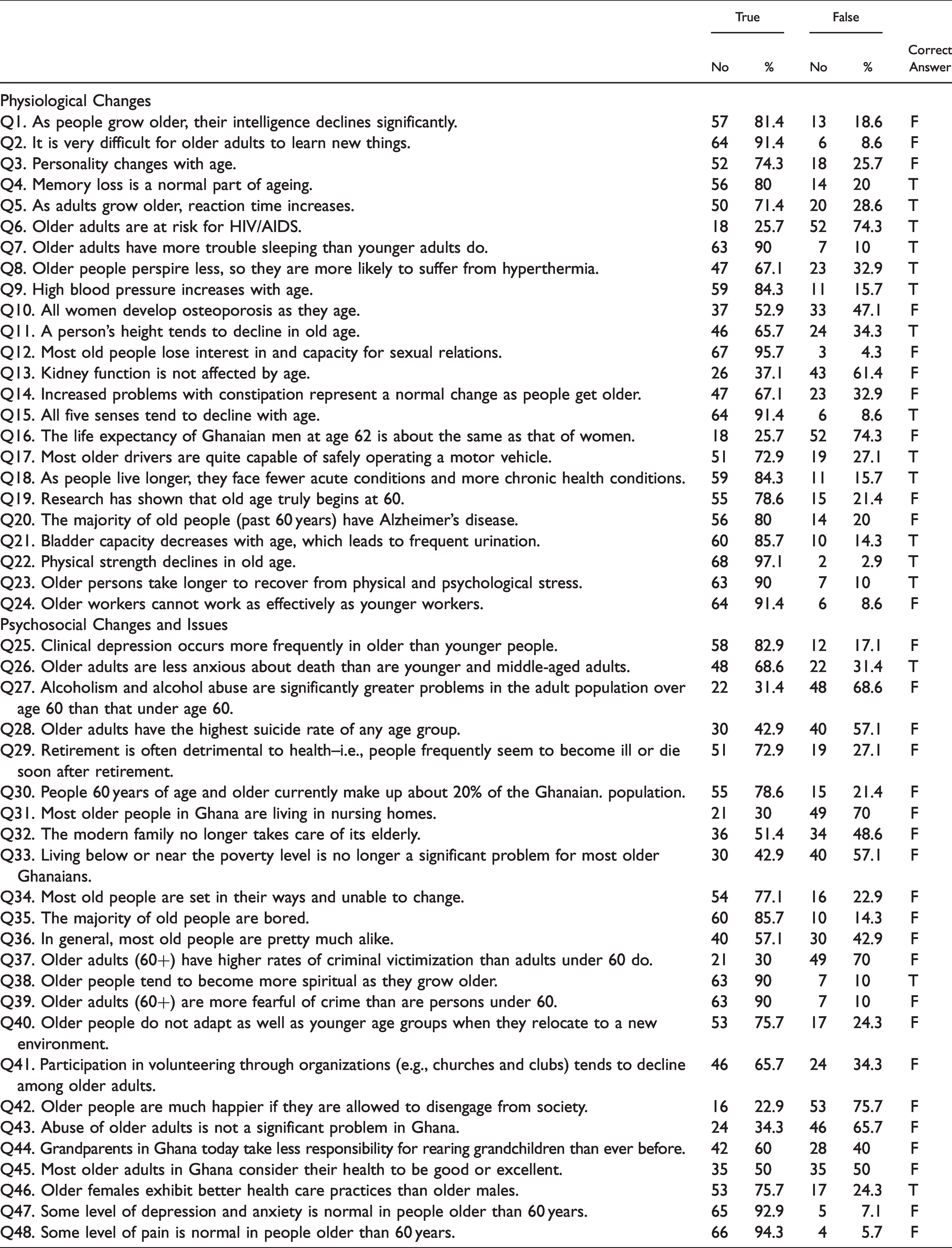
Data were coded and analysed using Statistical Package for Social Sciences (SPSS) version 27 (IBM Corp, 2020). Descriptive statistics (frequencies and percentages) of variables within the questionnaire were run. Results of demographic data are presented in Table 2 below. Results of knowledge on the ageing questionnaire are presented in Table 3 below. The benchmark for adequate knowledge was set at 60% of questions on ageing answered correctly by students. The correct answer for each question is provided within the table (see Table 3 below).
Demographic Characteristics (n = 70).

Knowledge About Older People (n = 70).
Ethical Consideration
Data collection commenced after ethical approval was given by the Committee on Human Research Publication and Ethics at the Kwame Nkrumah University of Science and Technology (KNUST) with reference number CHRPE/AP/366/20. An introductory letter was submitted to heads of nursing schools. Individual informed consent was obtained from students prior to data collection. Participants were informed that they could withdraw from study at any point without any form of penalty. No identifiable data (example student names, name of school or locations of school) were collected in study. Codes were used in representing selected schools for the purposes of data analysis. Participants were assured that data would only be used for the study purposes.
Results
Demographic Data of Respondents
Majority of participants (88.6%) were within the ages of 20 and 34. Fifty percent of participants were females and 50% were males. Almost all participants were Christians (Table 2).
Results of Knowledge on Physiological Changes in Older People
As shown in Table 3 above, graduating nursing students’ knowledge about physiological changes in older people was inadequate as only 14 questions (Questions 4, 5, 7, 8, 9, 11, 13, 15, 16, 17, 18, 21, 22, 23) representing 58% were frequently answered correctly (see Table 3 above). This fell short of the 60% benchmark needed to be rated as adequate knowledge. Ten questions (Questions 1, 2, 3, 6, 10, 12, 14, 19, 20, 24) representing 42% were frequently answered incorrectly.
Results of Knowledge on Psychosocial Changes
As shown in Table 3 above, graduating nurses demonstrated inadequate knowledge on psychosocial changes and issues in ageing as only ten questions (Question 26, 27, 28, 31, 33, 37, 38, 42, 43, 46) representing 42% were frequently answered correctly by graduating nursing students. Fifteen questions (58%) frequently answered incorrectly include Questions 25, 29, 30, 32, 34, 35, 36, 39, 40, 41, 44, 45, 47, 48 (see Table 3 above).
Discussion
Knowledge on ageing has an impact on the quality of nursing care provided to older people. Findings of the study show inadequate knowledge on ageing among graduating nursing students. Several gaps in knowledge on physiological changes in old age were identified. Graduating nurses indicated that older people are not at risk of Human Immuno-deficiency Virus (HIV) or Acquired Immune Deficiency Syndrome (AIDS). However, Center for Disease Control (CDC) reports that people aged 50 and older have many of the same HIV risk factors as younger persons (Center for Disease Control & Prevention, 2020). This report by the CDC may be due to the fact that the need for sexual conduct and relationships exists throughout life (Gore-Gorszewska, 2020; Graham et al., 2020). This contrasts the assertion of graduating nursing students that old people lose interest in sexual relations (see Table 3, Q17 above). The graduating nurses, who were mostly young people (see Table 2 above), may not understand the needs of older people regarding sexual relations. Nurses and nursing students need to be educated on the facts about sexual relations and ageing as wells as sexually transmitted infections (STIs) such as HIV/AIDS in older people as this may impact health education of older people on the prevention of STIs.
Furthermore, the majority of graduating nurses (67.1%) regarded constipation as a normal physiological change in older people. This assertion is inaccurate as studies show little difference in colon activity between healthy older and younger people (Wong et al., 2020). When constipation occurs, it is the result of factors such as inadequate exercise, inadequate fluid intake, low fibre diet, or certain medications (Al Khaja et al., 2020; AlMutairi et al., 2020). Certain conditions such as depression, hypothyroidism, neurological diseases and bowel cancer may also contribute to constipation (Al Khaja et al., 2020; AlMutairi et al., 2020). It is therefore necessary to identify the source of the constipation in older people and treat it. Improving nurses knowledge on the causes and management of constipation in older people will help prevent bowel complications such as bowel obstruction that may result from poor management of constipation (A. M. Kelly, 2019).
In addition, more than 80% of participants agreed with the statement ‘as people grow older, their intelligence declines significantly’. In relation to this belief, many graduating nurses indicated that older adults are unable to learn new things (see Table 3, Question 2). It is however, important to understand that intellectual performance in older people remains unchanged during the ageing process (Bernoth & Winkler, 2018; Eberstole et al., 2008; Touchy & Jett, 2016). There may be a longer duration of information processing in some older people due to a reduced number of nerve cells, neurotransmitter changes, and loss of myelinated fibres (Bernoth & Winkler, 2018; Eberstole et al., 2008; Touchy & Jett, 2016). This notion must be corrected among nurses in Ghana as this is likely to affect health education of older people in the Ghanaian health system.
Another significant finding of the study is the gaps in knowledge about psychosocial changes and issues that affect older people. Half of participating graduating nurses stated older people in Ghana consider their health to be good or excellent (see Table 3, Question 45). However, recent research reports (Adatara & Amooba, 2020; Atakro et al., 2021; Kpessa-Whyte & Tsekpo, 2020) found Ghanaian older people are confronted with many health challenges in the Ghanaian health system. Challenges include high cost of healthcare, long waiting hours in accessing healthcare, poor attitudes from health staff, lack of drugs from the healthcare facility, inadequate information from health staff, and lack of specialist care (Adatara & Amooba, 2020; Atakro et al., 2021; Kpessa-Whyte & Tsekpo, 2020). These challenges are due to governments prioritisation of paediatric, maternal and family planning services over care of older people (Kpessa-Whyte, 2018). Government and philanthropic health spending are usually channelled towards the care of children and pregnant women rather than aged care (Kpessa-Whyte, 2018). Nurses in Ghana must be made aware of these challenges in order to contribute their quota to resolving them by giving equal attention to the care of older people.
Graduating nurses also indicated that depression, and anxiety are normal psychosocial changes in older people (see Table 3, Q49). This is not consistent with reports which show anxiety and depression in older people are usually a result of physical, psychological, financial, sexual abuses or mistreatments (Kok & Reynolds, 2017; WHO, 2017a, 2017b). There is a growing trend of psychosocial abuse of older people in many African countries including Ghana due to the beliefs of witchcraft in older people especially older women (Brooke & Ojo, 2020). In some regions of Ghana, many older women with mental health issues are regarded as witches and abused, marginalised or even killed (Onyinah, 2020; Onyinah & Scott, 2020). The issue of abuse of older people in Ghana has been acknowledged by graduating nurses in the study (see Table 3, Q43). Several reports have, however, indicated under-diagnosis and under-treatment of depression and anxiety of older people by health professionals (Bryant et al., 2013; Jeste et al., 2005). The under-diagnosis and under-treatment of depression and anxiety in older people may be due to beliefs of some health professionals that anxiety and depression are a natural part of being old (Bryant et al., 2013).
Parallel to the under-recognition of anxiety and depressions in older people is the fact that pain in the aged is regarded as normal in many communities in Ghana (Aziato et al., 2016). This finding by Aziato et al. (2016) has been confirmed in the study through answers provided on pain by graduating nurses (see Table 3, Q48 above). However, studies show that pain in older people results from pathological disorders such as musculoskeletal or nervous system disorders (Hertelendy et al., 2019; Kaewdok et al., 2020). It is important to equip nurses in Ghana with knowledge on identifying the causes of depression, anxiety, and pain in older people and how to manage them.
In summary, it has been shown that Ghanaian graduating nurses lack knowledge on several aspects of ageing. It is important to correct the wrong perceptions about physiological and psychosocial changes in older people among Ghanaian nurses through evidence informed gerontological content in Ghanaian undergraduate nursing programs. Providing educational opportunities leading to better care for older Ghanaians is in line with the United Nations (UN) Sustainable Development Goal 3, which aims at providing equal and quality healthcare to all age groups by 2030 (WHO, 2018b).
Strengths and Limitations
This study seems to be the first to assess knowledge of Ghanaian graduating undergraduate nurses about ageing. Findings of the study can lead to curricula modification regarding gerontological nursing education in Ghana. The study points out areas where graduating nurses had knowledge deficit on ageing. Providing nurses with adequate knowledge on ageing will subsequently result in their understanding of the needs of older people.
This study is limited by its small sample size and purposive sampling technique used in selecting participants. Generalisation of study to other populations should therefore be done cautiously considering the limitations of the study.
Implications of Study
Findings in this study show the need for further investigations into knowledge about the care of older people. Future studies could compare knowledge in student groups with gerontological nursing curricula content in their program and groups that do not have content on gerontology. Pre-test post-test studies could be used to assess knowledge of nursing students on ageing. For example, specific content on areas such as psychosocial needs and pain in ageing could be taught and students’ knowledge assessed using pre-test post-test designs to determine the effect of gerontological nursing content on knowledge. Findings from this study could also be compared to nursing students’ knowledge on ageing in other countries or jurisdictions.
The study identified the gaps in ageing knowledge among graduating nurses in Ghana. The study will therefore inform reforms in educational policies regarding gerontological nursing education in Ghanaian nursing schools. Findings could help strengthen the current gerontological nursing curricula content in undergraduate nursing programs in Ghana.
Conclusion
Findings in this study show graduating nurses have inadequate knowledge on physiological and psychosocial changes in older people. As there is an increase in the population of older Ghanaians, there is a need to educate nurses in Ghana on ageing topics in which they lacked knowledge about ageing. Stakeholders in Ghanaian nursing education such as Nursing and Midwifery Council (NMC) and Ghana College of Nurses and Midwives (GCNM) should strengthen the current content in gerontological nursing in order to equip nurses with the knowledge needed to provide high quality care to older Ghanaians. The contributions of older people to the development of the Ghanaian society will depend on the quality of health provided them. Providing educational opportunities leading to better care for older Ghanaians is in line with the United Nations (UN) Sustainable Development Goal 3, which aims at providing equal and quality healthcare to all age groups by 2030 (WHO, 2018b).
Supplemental Material
sj-pdf-1-son-10.1177_23779608211020957 - Supplemental material for Knowledge of Ghanaian Graduating Undergraduate Nurses About Ageing
Supplemental material, sj-pdf-1-son-10.1177_23779608211020957 for Knowledge of Ghanaian Graduating Undergraduate Nurses About Ageing by Confidence Alorse Atakroin SAGE Open Nursing
Supplemental Material
sj-pdf-2-son-10.1177_23779608211020957 - Supplemental material for Knowledge of Ghanaian Graduating Undergraduate Nurses About Ageing
Supplemental material, sj-pdf-2-son-10.1177_23779608211020957 for Knowledge of Ghanaian Graduating Undergraduate Nurses About Ageing by Confidence Alorse Atakro in SAGE Open Nursing
Supplemental Material
sj-pdf-3-son-10.1177_23779608211020957 - Supplemental material for Knowledge of Ghanaian Graduating Undergraduate Nurses About Ageing
Supplemental material, sj-pdf-3-son-10.1177_23779608211020957 for Knowledge of Ghanaian Graduating Undergraduate Nurses About Ageing by Confidence Alorse Atakro in SAGE Open Nursing
Footnotes
Acknowledgment
The author would like to thank all participating graduating nurses for agreeing to take part in the study.
Data Accessibility Statement
Data for the study is saved securely on a password protected server. Data for this study will be shared upon request due to legal or ethical restrictions on sharing data publicly. Data contain sensitive information and as such the ethical review board had requested that the data only be shared with justifiable reasons.
Declaration of Conflicting Interests
The author(s) declared no potential conflicts of interest with respect to the research, authorship, and/or publication of this article.
Ethical Approval
Data collection begun after ethical approval by the Kwame Nkrumah University of Science and Technology (KNUST) with reference number CHRPE/AP/366/20. Consent was received from participating graduating nurses prior to survey.
Funding
The author(s) disclosed receipt of the following financial support for the research, authorship, and/or publication of this article: There was no funding for the study. Funds were provided by author.

Supplemental Material
Supplemental material for this article is available online.
References
Supplementary Material
Please find the following supplemental material available below.
For Open Access articles published under a Creative Commons License, all supplemental material carries the same license as the article it is associated with.
For non-Open Access articles published, all supplemental material carries a non-exclusive license, and permission requests for re-use of supplemental material or any part of supplemental material shall be sent directly to the copyright owner as specified in the copyright notice associated with the article.
