




Abstract
Introduction
For nursing practice to be responsive to the needs of patients, it must be driven by contextual research evidence. To guide institutional and national nursing research policy, there is need to determine the quantity and quality of nursing research in Ghana.
Purpose
The purpose of this integrative literature review was to quantify, critically evaluate, and describe nursing research publication in Ghana from January 2007 to December 2016 with regard to the country's research capacity to sustain evidence-based practice.
Results
Sixty (60) out of 749 articles identified from EBSCOhost, ProQuest, PubMed, Science Direct, Scopus, Wiley Online Library, and Google Scholar using three keywords (nursing, health, and Ghana) were included. A total of 60,778 human subjects were used in these studies. There were more quantitative (28) studies than qualitative (23) studies. These studies recorded 219 authors from 120 institutions, 55 of which were outside Ghana. Forty-five percent of the articles were published in journals with impact factor. There was a steady increase in publication in Ghana over the decade. A majority of the studies published in education were in curriculum implementation and evaluation.
Conclusions
The increasing number of peer-reviewed nursing research publications in Ghana and the curriculum implementation and evaluation in Ghana signified an increasing capacity of the country to implement and sustain evidence-based practice.
Recommendations
It is recommended that regular research be conducted to evaluate the responsiveness to old and new nursing programs in Ghana.
Background
Nursing education started in Ghana in 1878 where male orderlies were trained to bathe and feed patients during the British colonial era (Adu-Gyamfi & Brenya, 2016). Nursing developed from the 19th century to the 21stcentury when it became well recognized as a profession in Ghana, providing the highest number of health-care workers than any other category in the country. Despite nurses forming the majority of health-care professionals in Ghana, Bell, Rominski, Bam, Donkor, and Lori (2013) reported a nurse-to-patient ratio of 1:2,024 in some parts of Ghana. This was as a result of the limited opportunity of the nursing education institutions to enroll and train qualified students (Bell et al., 2013).
In Ghana, nurses are given extended roles through task-shifting, especially in rural settings where there are no medical doctors (Gyamfi et al., 2017; Okyere, Mwanri, & Ward, 2017). These nurses are expected to take on extended roles without any form of training or licensure, creating anxiety and the opportunity for adverse effects and medicolegal malpractice (Okyere et al., 2017). Nurses are responsible for a large portion of health-care decision-making in Ghana. If nursing practice is more responsive and efficient, health-care services and indices in Ghana will improve. For nursing practice to be efficient and responsive to the needs of the population of Ghana, it must be contextual research-driven (Agyei, Kofi, Fiankor, & Osman, 2015; Jirojwong & Welch, 2013; Tingen, Burnett, Murchison, & Zhu, 2009). The importance of nursing research in providing quality and cost-effective care to patients as well as professional development cannot be overstated (Agyei et al., 2015; Jirojwong & Welch, 2013; Tingen et al., 2009). Eliminating evidence from practice makes practice outdated and dangerous to patients (Agyei et al., 2015).
Nursing practice, education, and administration in Ghana is based on tradition rather than evidence (Adu-Gyamfi & Brenya, 2016; Baatiema et al., 2017). Culture and socioeconomic status of patients, an insufficient number of health facilities, poor staff development, lack of practice protocols, health professional incompetency, lack of collaboration, and lack of political will were barriers to evidence-based practice in Ghana, as outlined by Baatiema et al. (2017).
Agyei et al. (2015) found that nurses exhibited the readiness to employ evidence in practice but did not have the knowledge and skills to translate research into practice. They recommended that nurses and other medical practitioners should be equipped with the knowledge and skills necessary for evidence-based practice in Ghana. The authors, however, believed that the responsiveness of nursing practice, education, and management was associated with the research output of Ghana. International evidence and policies conflict with the cultural context of Ghana and health-care practice, resulting in nursing practice being based on traditions rather than such evidence and policies (Donkor & Andrews, 2011).
In a sub-Saharan Africa-wide review of clinical nursing education research, Kpodo, Thurling, and Armstrong (2016) discovered that West Africa lagged behind the East and the Southern parts of Africa in clinical nursing research dissemination. In the same study, it was discovered that none of the studies included came from Ghana (Kpodo et al., 2016). The quantity, quality, and level of evidence, type, journals of publication, and focus of nursing research in Ghana, however, were not known.
Purpose
The purpose of this study was to quantify, critically evaluate, and describe nursing research publications in Ghana from January 2007 to December 2016 with regard to the country’s research capacity to sustain evidence-based practice.
Methodology
An integrative literature review framework developed by Whittemore and Knafl (2005) guided the review (Christmal & Gross, 2017). An integrative literature review is important in exploring the length and breadth of studies published in a particular jurisdiction or on a topic of interest. Reviews help in exploring the context and concepts under study. The integrative review methodology was preferred for this study due to its ability to allow for the inclusion of both qualitative and quantitative studies. The framework consisted of five stages, namely, “problem identification, literature search, data evaluation, data analysis, and presentation.” The report was guided by Prevention and Recovery Information System for Monitoring and Analysis (PRISMA) checklist of reviews (Moher, Liberati, Tetzlaff, Altman, & The PRISMA Group, 2009).
The Search Process
Boolean combination of the keywords—nursing, health, and Ghana—was used to conduct an advanced computerized search in EBSCOhost, ProQuest, PubMed, Science Direct, Scopus, Wiley Online Library, and Google Scholar. The database searches provided 615 titles. An additional 182 titles were identified through a hand search conducted using known authors’ names and the search terms in Google search engine. The studies were loaded onto the Mendeley reference manager, and 48 duplicates were identified and removed, leaving 749 articles.
The 749 article titles were scanned for relevance to the study, and 703 studies were irrelevant to the review and were discarded, leaving 46 articles. Two nursing education and researchers in Ghana were contacted to evaluate the list of 46 studies retrieved and provide links to any articles that were not captured by the computerized search. One researcher provided a list of 15 relevant articles, whereas the other provided the names of other prominent authors in Ghana who were then searched in Research Gate and Google Scholar for publications resulting in the retrieval of 23 articles. In all, 84 articles were preliminarily included for critical appraisal.
Inclusion/Exclusion Criteria
Studies were included if they were published between 2007 and 2016, in a peer-reviewed journal, and on nursing in Ghana. The study had to be conducted by at least one nursing author from Ghana, and the setting of the study must have been within Ghana. After the critical appraisal, a total of 60 articles were included in this study (Figure 1) and displayed on the data matrix in Table 1. The excluded studies and the reasons for exclusion were shown in Table 2.
Literature search, evaluation, and inclusion process. Studies Included. Note. AMTSL = active management of the third stage of labor; MCQs = multiple choice questions; ICN = International Council of Nurses. Excluded Articles and Reasons for Exclusion.


Critical Appraisal
The 84 studies were extracted onto the data matrix as shown in Tables 1 and 2. The content of the matrix was evaluated by three reviewers, one serving as the adjudicator on the studies when the other two reviewers disagreed on including a study. The three reviewers had extensive experience in integrative and scoping literature review. Two of the reviewers had published a peer-reviewed study on integrative literature review methodology.
Evidence level and quality of studies
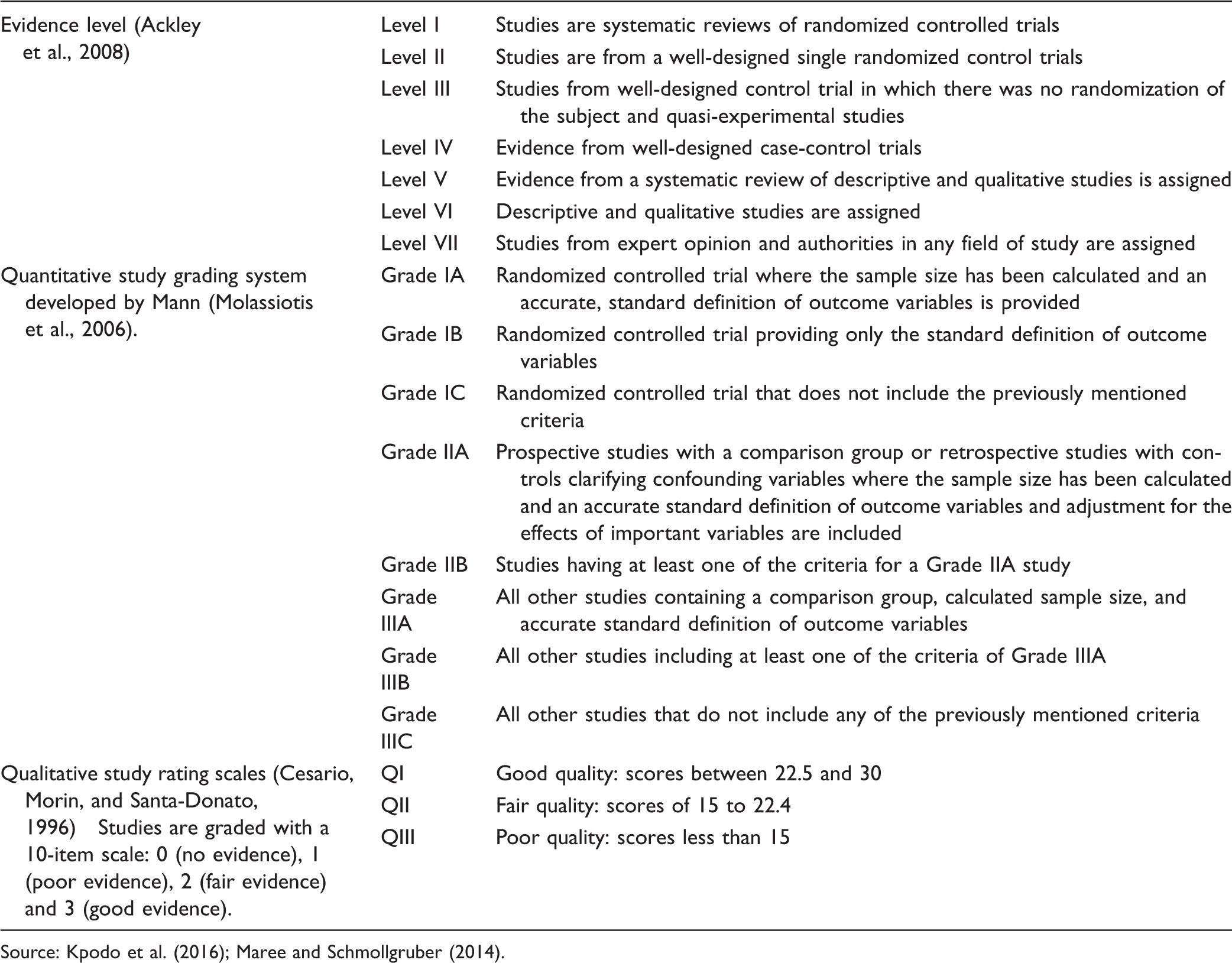
Evidence Level and Quality Rating Scales.
Results
Quality of Studies Included
The majority (92.86%) of the quantitative studies included in this study were Evidence Level VI and Quality Level IIB. Two (7.14%) of the studies were at Level III (one with Quality Grade IIIA and the other IIIB). Thus, the highest level of evidence included in this study was at Level III and Quality Grade IIIA. All the 23 qualitative studies included in this study were of Evidence Level VI (Table 3). Twenty-two (95.65%) of them were of good quality (QI) whereas one was of fair quality (QII; Kpodo et al., 2016; Maree & Schmollgruber, 2014; Molassiotis et al., 2006). The evidence level of the other studies included ranged from Level V to Level VII. Their quality had not been evaluated, but the researchers reached consensus on their importance for inclusion in this study.
Yearly Trend in Publication
In 2007 and 2008, only one article each year was published. There was no study included for the year 2010. Publication increased in 2011 and sharply dropped in 2012 in which only one study was recorded. From 2012 to 2016, there was an encouraging increase in nursing research publication with 2016 recording the highest (16) out of the 60 articles included in this study (Figure 2).
Yearly trend in publications over the decade (2007–2016).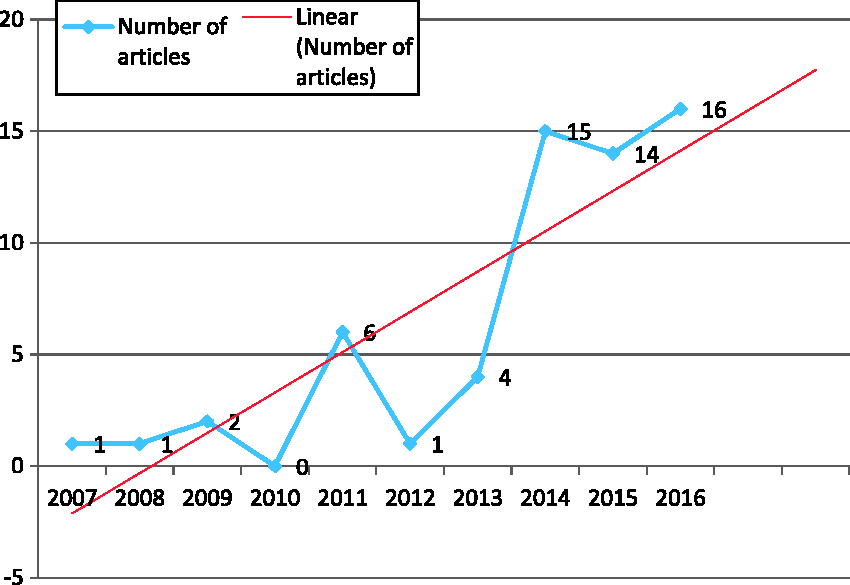
Studies Included
Out of the 60 studies included in this review, 28 were quantitative studies, 23 qualitative, 3 were multimethod studies, 1 was a mixed method study, 2 were literature reviews, and 3 were expert opinion and experiences.
Quantitative studies
The quantitative studies included were mostly (85.71%) cross-sectional surveys and quantitative descriptive studies. Two (7.14%) were retrospective record reviews, whereas one (3.57%) each were pretest–posttest and comparative quasi-experimental studies.
A total of 59,246 subjects were used in this study out of which 55,174 were patients, 3,199 were nursing students, 764 were nurses and midwives, and 109 nurse educators.
The majority (10) of the studies were in the area of nursing management and administration, 6 in nursing education, 5 in maternal and child health, 3 on female reproductive health, 2 on emergency nursing, and 1 each in the areas of chronic diseases and geriatrics.
Qualitative studies
Out of the 23 qualitative studies, 5 were descriptive, 6 exploratory descriptive, 4 exploratory, 2 ethnographic, 2 descriptive phenomenological, 1 interpretive phenomenological, 1 interpretive, 1 explanatory descriptive ethnography, and 1 vignette-based focus group approach. There were 1,284 subjects recorded in the qualitative studies, 96 of whom were students and 293 nurses and midwives.
Other studies
Other studies included were three multimethod studies, one mixed method study, two literature reviews, and three expert opinions. These studies recorded 248 subjects. Two studies were published on surgical nursing, two in education, two in management, one in trauma nursing, one in community health, and one in cultural issues.
Authorship and Collaborations
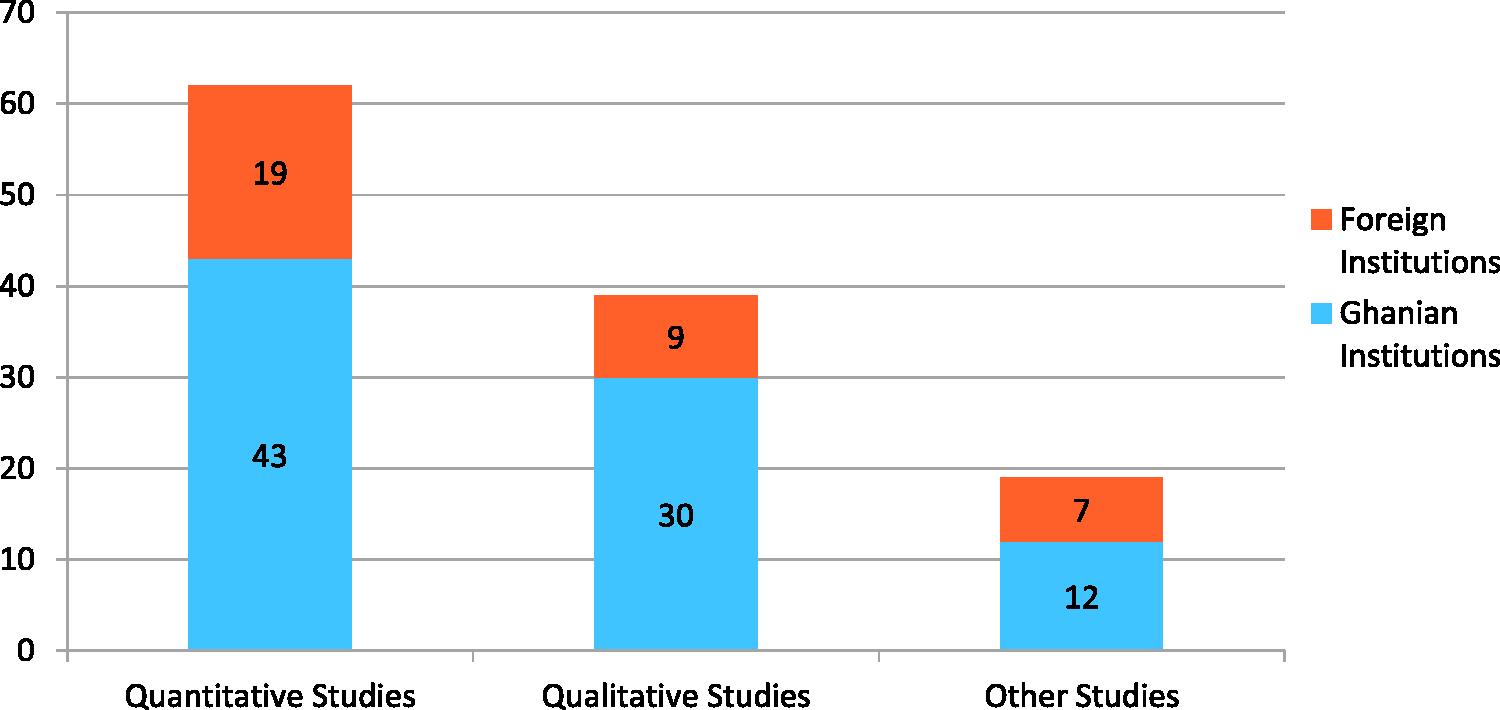
Figures 3, 4, and 5 show the distribution of the 219 authors and 120 institutions who published the 60 articles included in this study. There were more Ghanaian nursing researchers from institutions located in Ghana authoring the studies than authors from institutions outside Ghana. The location in Ghana was important for evaluation of the contextual relevance of the studies.
Distribution of authors. Distribution of institutional affiliation of authors. Distribution of principal (first) authorship of studies included.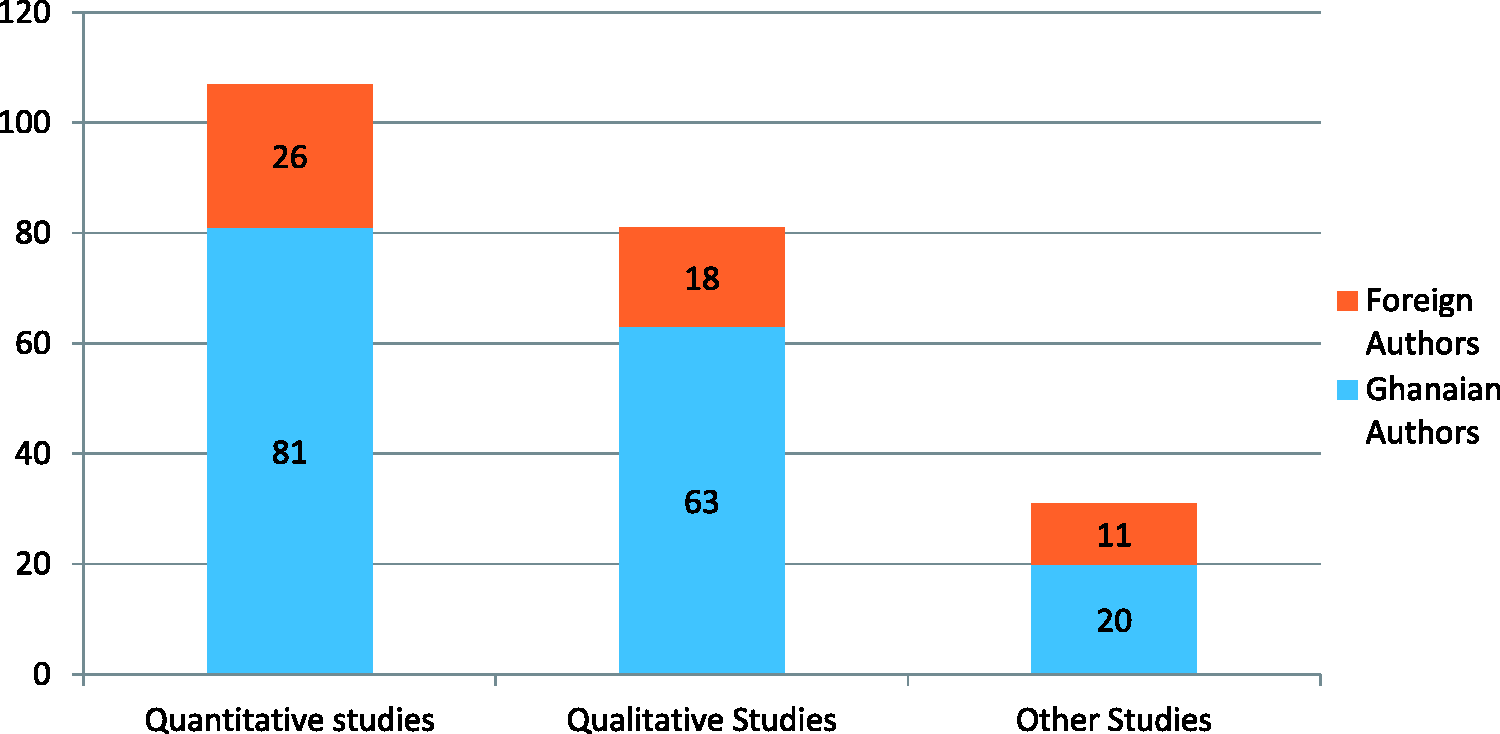

Impact Factor of Journals Published
Out of the 60 articles included in this study, 27 (45%) were published in journals listed on 2016 Thomson Reuters journal citation report with impact factor (Thomson Reuters, 2016). The impact factor of the journals published ranged from 14.722 (The Lancet Global Health) to 0.950 (Health Care for Women International). Assuming nursing research in Ghana was cited according to the Thomson Reuters impact factor calculations, the probability of nursing research from Ghana being cited was 0.97, that is the sum of impact factors of journals published (58.228) divided by the total number of articles included in this study (60).
Discussion
Nursing research publication is increasing in Ghana just as that of sub-Saharan Africa (Adejumo & Lekalakala-Mokgele, 2009; Kpodo et al., 2016). Even though there is a steady increase in publication of studies in the country, there is more room for improvement in research output. Limited opportunities for postgraduate nursing education and the nonexistence of doctoral nursing program in Ghana at the time of submission of this article are contributory factors to the low research output in Ghana. Contrary to the findings of Sun and Larson (2015) and in concordance with findings from Maree and Schmollgruber (2014), the majority of nursing publications in Ghana were quantitative. The majority of the nursing research in Ghana, however, was exploratory and descriptive, indicating that nursing research was at the developing stage in Ghana (Sun & Larson, 2015).
The highest level of evidence included in this study was Level III (quasi-experimental studies), whereas the majority were of Level VI (descriptive and qualitative studies). Similar levels of evidence were evident in sub-Saharan Africa-wide review conducted by Kpodo et al. (2016). This may be due to the seemingly high use of Heideggerian interpretive research paradigm in nursing (Weaver & Olson, 2006).
Major research areas in nursing in Ghana were education and administration, which was incongruous to the research priority areas recommended by Tlou (1998). Nursing is a practice-based profession; therefore, much focus needs to be placed on clinical research in the country to influence the promotion of evidence-based practice (Sun & Larson, 2015). With the majority of the subjects for the studies included being patients, it was very important for the studies to be directed toward influencing clinical practice to improve the health and well-being of the patients.
Even though the number of peer-reviewed nursing research publications was increasing in Ghana, the majority of the studies were published in journals without impact factor and journals not rated by the Thomson Reuters journal citation result. This was a result of the unavailability of nursing policy or strategy on research dissemination by the Ministry of Education of Ghana (Center for Innovation in Research and Teaching, 2017; World Health Organization, 2014; Yale Center for Clinical Investigation, 2011). Andoh (2017) discovered that a significant number of journal articles authored by PhD holders in Ghana were published in predatory journals.
The intention of the majority of the studies was not to influence policy; however, a few of the studies were directed toward policy uptake and policy implementation. Some of the studies were published on curriculum implementation and evaluation in nursing education institutions in Ghana, indicating the existence of an opportunity for research to guide policy.
The majority of authors and affiliated institution in the studies included in this review were Ghanaian nurses. Similarly, the principal researchers for the majority of the publications were through international collaborations. These are important factors in keeping studies conceptually relevant.
Conclusion and Recommendations
As the first countrywide nursing research review in Ghana, this study provides evidence on the type of studies conducted in Ghana, research areas, quality of studies, trends in nursing research publication over a decade, author and institutional collaborations, and the quality of the publications. With the meagre numbers of health workforce in sub-Saharan Africa and the scarce resources available, nursing research is needed to better understand the patient needs that influence policy formulation to promote efficient use of resources (Columbia Global Centers, 2015). The research capacity of Ghanaian nurses is increasing, but at a slower pace compared with other countries. This is a result of the relatively small number of nurses with postgraduate degrees and research training.
We recommend the Ministry of Education, higher education institutions, and other institutions responsible for research in Ghana to develop research dissemination strategies to guide research publication. Experienced nursing researchers and faculty should mentor young academics and researchers on research integrity and the need to disseminate findings in appropriate journals and conferences. Researchers should advocate for the uptake of research findings into policy and practice in Ghana as to promote the development of the nursing profession.
Footnotes
Declaration of Conflicting Interests
The author(s) declared no potential conflicts of interest with respect to the research, authorship, and/or publication of this article.
Funding
The author(s) received no financial support for the research, authorship, and/or publication of this article.