




Abstract
The increasing prevalence of chronic diseases in aging places demands on primary care. Nurses are the major nonphysician primary care workforce. Baccalaureate nursing programs should expose students to primary care and older adults to support these demands and help recruit new graduates to this setting. However, many baccalaureate nursing programs focus on acute care and placements aimed at older adults are viewed negatively. To address these curriculum challenges, third-year Canadian baccalaureate nursing students were placed in an innovative primary care program—Health TAPESTRY—for community-dwelling older adults. Health TAPESTRY involves an interprofessional primary care team, trained lay volunteers conducting home visits, system navigation, and an online software application. The goal of this study was to explore third-year baccalaureate nursing students’ perceptions of this unique clinical primary care placement. This qualitative descriptive study explored students’ perceptions of this placement’s strengths, weaknesses, opportunities, threats (SWOT), and outcomes. Nursing students participated in focus groups (n = 14) or an interview (n = 1) and five completed narrative summaries following visits. Qualitative content analysis was supported by NVivo 10. Strengths of the clinical placement included training for the intervention; new insights about older adults; and experience with home visiting, interprofessional team functions, and community resources. Weaknesses included limited exposure to older adult clients, lack of role clarity, lack of registered nurse role models, and technology challenges. Opportunities included more exposure to primary care, interprofessional teams, and community resources. No threats were described. Nursing students’ clinical experiences can be enhanced through engagement in innovative primary care programs. Adequate exposure to clients, including older adults; interprofessional teams; mentoring by registered nurses or advanced practice nurse preceptors; and role clarity for students in the primary care team should be considered in supporting baccalaureate nursing students in primary care clinical placements.
Keywords
As the hub of the health-care system, primary care includes an important focus on disease prevention; health promotion; and enhancement of the effectiveness, efficiency, and equity of the system (Macinko et al., 2003; Starfield et al., 2005; Starfield, 2012; Van Lerberghe et al., 2008). The aging population and increasing prevalence of chronic diseases places large demands on the primary care workforce. Registered Nurses (RNs) are the major nonphysician workforce in primary care in Canada, the United States, Australia, the United Kingdom, and the Netherlands (Freund et al., 2015). Task shifting of certain clinical activities from physicians to nurses has been widely observed in Europe, the United States, Canada, Australia, and New Zealand (May et al., 2009). Contributions of primary care nurses (also referred to as family practice nurses) have been shown to result in positive clinical outcomes such as improved blood pressure, increased physical activity, shorter hospitalizations, improved access to services, and patient satisfaction (Curnew & Lukewich, 2018; Matthys et al., 2017; Vanhook et al., 2018). Furthermore, a Cochrane systematic review concluded that for some ongoing and urgent physical complaints and for chronic conditions, trained nurses, such as nurse practitioners, practice nurses, and registered nurses, probably provide equal or possibly even better quality of care compared to primary care doctors, and probably achieve equal or better health outcomes for patients. (Laurant et al., 2018, p. 2)
Despite the growing demands on primary care and the value of primary care nurses, an integrative review showed that nursing curricula in Australia, United Kingdom, United States, New Zealand, and Canada tend to be acute care-focused depicting negative perceptions of the primary care nursing role, which has impacted undergraduate students’ attitudes and preparedness to work in this setting (Calma et al., 2019). Given the changing roles of nursing in health-care delivery, the focus on health over disease-based and acute care-focused curricula, and the need to increase knowledge and skills in care coordination and interprofessional team-based care (Bouchaud et al., 2016), baccalaureate nursing programs need to elevate primary care content in programs and prepare students for roles in primary care (Barton, 2017; Calma et al., 2019; Shaffer et al., 2018). Therefore, the goal of this article is to explore third-year Canadian baccalaureate nursing students’ perceptions of an innovative primary care clinical placement aimed at serving community-dwelling older adults.
The Health TAPESTRY Program
To address the gaps in education in primary care as well as healthy aging, nursing students were placed in an innovative primary care program—Health TAPESTRY—a program that supports community-dwelling older adults (Dolovich et al., 2016, 2019). The Health TAPESTRY (Health Teams Advancing Patient Experience: Strengthening Quality) program, centered in community-based primary care, encourages person-focused care and promotes optimal aging through four interconnected parts: trained community volunteers, interprofessional health-care teams, eHealth technologies, and community engagement (Dolovich et al., 2016). Two interprofessional teams were made up of nurse practitioners, occupational therapists, system navigators, Registered Practical Nurses (who have completed a 2 year college program in Canada, i.e., not baccalaureate prepared), dietitians, pharmacists, and physiotherapists. Health TAPESTRY provided a unique opportunity to explore practical learning experiences for students outside of traditional primary care. Nursing students enrolled in a Community Professional Practice Nursing course were situated within the Health TAPESTRY program for their practicum. In this 6-hour per week course, students work with clients as individuals, families, groups, communities, and populations in a variety of settings to recognize their client population’s priority barriers to health and apply health promotion approaches, such as supporting healthy aging. It is evaluated on a pass/fail basis, offered over one 12-week term (72 hours), supervised by a nursing faculty tutor, and supported by a preceptor (registered social worker who was also on the research team) who provided access to patients and two primary care practices. Practices employed nurse practitioners and Registered Practical Nurses but no RNs at the time.
Nursing students were engaged in community health nursing practice activities, such as conducting a local community assessment and exploring relevant community health and social services. These activities made up approximately 25% (18 hours) of the total clinical hours. For the remainder of the course, nursing students participated in delivering the Health TAPESTRY program. They completed standardized volunteer training which included online modules, in-person training, and practice through role play and with technologies used in the program. Paired with experienced trained community volunteers, who were typically retired professionals (frequently nurses and teachers; Oliver et al., 2018), they completed home visits with older adults. On visits, students formed trusting relationships with clients and completed validated questionnaires on an online survey tool (the TAP-App) via tablet computers to determine clients’ health goals and needs. Results were automatically summarized into a client report including a short narrative summary of the student’s or volunteer partner’s key observations of the client and their social context. Digital reports were sent to the electronic medical record for the primary care team to review in weekly huddles [i.e., real-time regular small team meetings (Ghorob & Bodenheimer, 2015)] and coordinate care. Written personal reflections were also captured in nonclinical program research notes. Students shared client observations and had other opportunities to work with the primary care team. The team determined if students needed to conduct follow-up visits.
Review of Literature
Primary Care Nursing and Baccalaureate Education
Primary care RNs provide health promotion, disease/injury prevention, population health initiatives, patient education and coaching, complex care coordination, chronic disease management, leading care management teams, and patient navigation (Bodenheimer et al., 2015; Lamb et al., 2015; Oelke et al., 2014). They contribute to improved diabetic care, decreased hospital admissions, and advocacy around socioenvironmental factors (e.g., poverty, homelessness) influencing client health, particularly those with suboptimally controlled chronic illnesses (Flinter et al., 2017; Lukewich et al., 2016). RNs practicing in high-performing innovative U.S. primary care practices supervised and trained team members and held major roles in chronic disease management and case management: Postbaccalaureate education for these roles was helpful pointing to the need for prelicensure primary care exposure and skill development (Flinter et al., 2017).
One barrier to RNs taking enhanced roles in primary care is a lack of education in this clinical area (Bauer & Bodenheimer, 2017). A 2017 survey of U.S. nursing schools (n = 529) found that although programs included some primary care content, it was challenging to deliver; others objected to incorporating it at all (Wojnar & Whelan, 2017). Primary care placements for Australian preregistration students has been enabled by primary care RNs’ desire to mentor them (McInnes et al., 2015). However, primary care placements for undergraduate nursing students are difficult to find (Gale et al., 2016). While nursing education is largely dominated by acute care placements, this knowledge and these skills do not transfer well to community-based primary care, which requires more flexibility over structure, more person-focus over condition-focus, and more independent decision making (Ali et al., 2011; Oelke et al., 2014). Partly due to an acute care focus reported in Canada and the United Kingdom, nursing students have concerns over whether prelicensure education fully prepares them for work in primary care (Ali et al., 2011; Oelke et al., 2014). Factors that predict intention to work in primary care include how important nursing students think it is to learn about their role in primary care and the inclusion of primary care clinical placements (Bloomfield et al., 2018).
Healthy Aging and Baccalaureate Education
Increasing the number of nurses who care for older adults in primary care can be a key health-care system response to the rapidly aging population. A review of Canadian health and social services educational programs found that many health and social service education programs have insufficient content in gerontology, despite the presence of well-developed competencies for caring for older adults (Boscart et al., 2017). An integrative review of international papers relating to nursing student’s interest in gerontology found that they lacked positive experiences with older adults during their programs (Garbrah et al., 2017). The authors suggest that nursing students need to interact with older adults prior to being placed in geriatric placements to stave off stereotypical attitudes. Gerontological nursing associations have recommended that one strategy to add gerontological content and experiences to training is through clinical placements at sites which provide care to older adults, such as primary care (CGNA & NGNA, 2008). Adequately preparing baccalaureate nursing students to care for older adults and help them age well at home is important, as health provider attitudes related to aging can affect the quality of care provided (Liu et al., 2013). RN students have expressed some distaste for caring for older adults, finding it less glamorous, and perceived that nursing education sometimes implies that such care does not fully apply their skills and knowledge (Evers et al., 2011; Potter et al., 2013). However, engaging students in this field can potentially nurture more positive attitudes and behaviors toward older adults (Baumbusch et al., 2012; Hovey et al., 2017; Potter et al., 2013). Primary care can be an important venue to offer such opportunities.
The overall goal of this study was to explore students’ perceptions of this RN student community health practicum experience. The study explored how nursing students’ engagement in Health TAPESTRY might address an existing curriculum gap and provide a unique primary care placement. Objectives included examining student perceptions about strengths, opportunities, weaknesses, and threats (SWOT) about the clinical learning experience as well as perceived outcomes.
Methods
Design
A qualitative descriptive approach was used to conduct the SWOT analysis. SWOT has been used in academic settings to understand internal and external factors to facilitate the development of a vision for an initiative (Balamuralikrishna & Dugger, 1995). The study explored two research questions: (a) What are the students’ perceptions about the strengths, weaknesses, opportunities, and threats (SWOT analysis) (Gürel & Tat, 2017) of the Health TAPESTRY program as a community health nursing placement? (b) What are students’ perceptions of the impact of the Health TAPESTRY placement?
Sample
Students were placed at one of two clinical practice sites of the McMaster Family Health Team (MFHT) in Hamilton, Ontario, Canada, consisting of 36,000 rostered patients. Providers included family physicians; nurses, including nurse practitioners and Registered Practical Nurses; medical residents; and allied health-care professionals such as dietitians, physiotherapists, occupational therapists, social workers, system navigators, and pharmacists. A total of 15 third-year undergraduate nursing students who were enrolled in the Community Professional Practice Nursing course (N3QQ03) at McMaster University were recruited over two terms (n = 8, fall 2016; n = 7, winter 2017) with the Health TAPESTRY program at the MFHT. There were no other eligibility criteria to participate.
Institutional Review Board Approval
Ethics approval was obtained from the Hamilton Integrated Research Ethics Board, project #2017-2128. Written consent for study participation was obtained from all students.
Measures and Data Collection
Narrative Summaries of Home Visits
Five students prepared narrative summaries in the TAP-App following home visits (e.g., thoughts about the client, interactions, volunteer pairing, the processes, and anything that they felt was meaningful). Most summaries were prepared by the non-student volunteer pair.
Focus Groups and Interviews
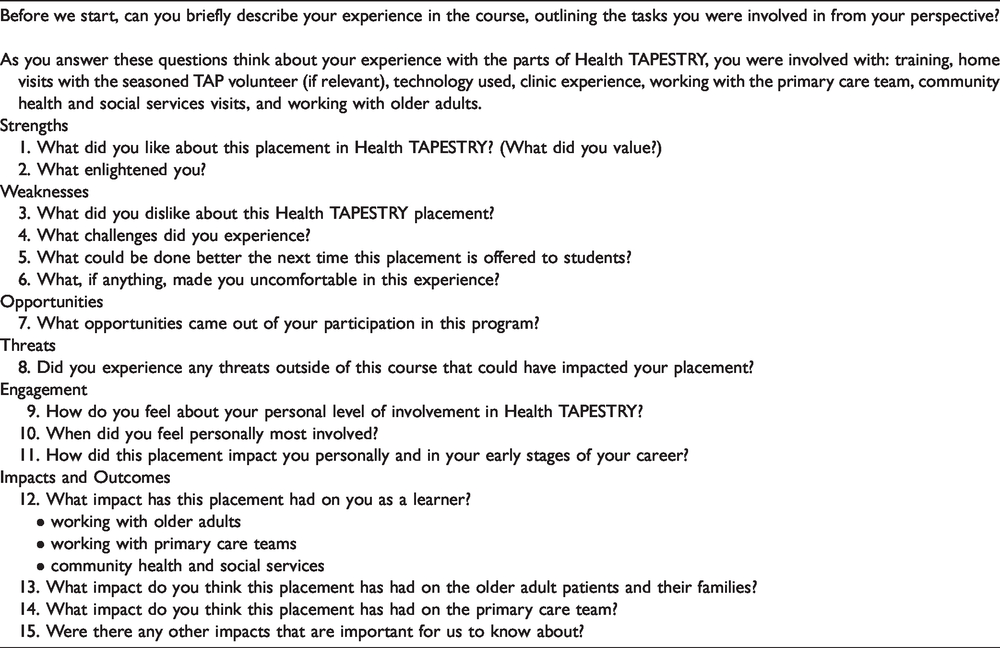
Students were invited to a focus group or were offered an interview at the end of their placement. They were facilitated by a research assistant (F. P.) trained in conducting interviews, guided using a semistructured question guide based on SWOT (see Table 1 for questions). Interviews were audio-taped and transcribed. Four focus groups (n = 4, 4, 3, and 3) were conducted at the university and one interview was completed over the phone with a student who was unavailable for the focus group.
Question Guide.
Data Analysis
Transcripts from the focus groups, interview, and narrative summaries were entered into NVivo Version 10 (QSR International, 2014). Coding was undertaken by one member of the research team (author F. P.) and checked by another (author J. G.), both of whom are experienced in qualitative analysis. Transcripts were coded inductively using open coding and then grouped into overarching themes under the categories under SWOT and impacts/outcomes, using thematic analysis (Braun & Clarke, 2006). Coding for 25% of the transcripts was reviewed at random by the lead researcher (R. V.).
Findings
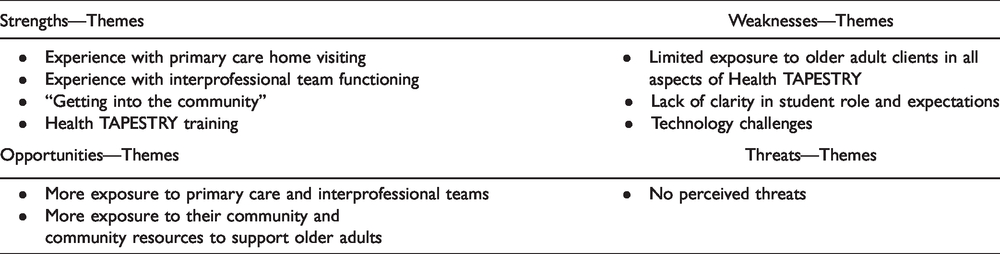
All 15 nursing students agreed to participate. They were all female and ranged from 20 to 22 years of age (mean = 20.6; SD = .7). Paired with a community volunteer, they conducted 15 home visits with 13 clients. Three students did not have an opportunity to conduct a Health TAPESTRY program home visit, but participated in other home visits arranged by the practice. Table 2 summarizes SWOT themes based on 15 participant focus groups/interviews. Pseudonyms are used in quotes.
SWOT Results.
SWOT Analysis Results
Strengths.
Experience With Primary Care Home Visiting
Conducting primary care home visits with older adults was a major placement strength. Students found the primary care home visits to be valuable and enjoyable and provided a holistic view of clients in their home environment. A few students noted that completing surveys in the TAP-App was a good icebreaker to begin the home visit. “ … It was also nice to get an idea of the holistic view of the clients, asking: ‘How’s your day?’ And also seeing how she’s doing or how is her wellbeing or how’s her state.” [Marina]
Based on home visits, students gained more insight into the lives of older clients and things that matter to them. “Just like how there wasn’t like a quick fix, like it wasn’t just like a medication you could put them on, it was like a way broader lens to look at someone.” [Sanja] Common needs the students identified as facing older adults were a desire for more involvement in social activities, having minor difficulties with daily life activities, mobility issues, and health concerns.
Students found that working with a volunteer partner who was experienced in Health TAPESTRY was beneficial to engage with clients. Intergenerational pairing was well-received, as students found that they had different skills to share compared to community volunteers (e.g., using technology versus interviewing skills). “We had never gone into patients’ homes before and we were still new with the TAP-App, so, it made me so much more comfortable being with an adult who has volunteered before, who has done this before.” [Sanja]
A few students missed attending a Health TAPESTRY home visit due to low uptake of the Health TAPESTRY program by clients at that time. To compensate, they were given a valuable opportunity to conduct home visits with a nurse practitioner or pharmacist. “I went with the pharmacist- it was just interesting to see how she would be asking general questions to the client, but then she would also kind of focus on the pharmacological aspect of the client …” [Maneet]
Experience With Interprofessional Team Functioning
Students identified that one of the placement’s main strengths was learning about the benefits of interprofessional team function. Most students reported that attending the interprofessional primary care team huddle was a positive experience. Huddle teams were welcoming and discussions added to students’ understanding of pathology and management of clients’ health issues. … huddles were very informative […] okay, these are what I think are [my client’s] priorities and that’s what you wrote down on the TAP-App. And then you heard the whole interprofessional team talk about it. You don’t get that experience anywhere else. [Jasmine] … having all of those health professionals around a table all at the same time discussing things; discussing the patient from so many different aspects versus being in their own office and just putting in what they think their best intervention for what they specialize in. [Mei]
Getting Into the Community
Students conducted community health and social service agency visits to learn about community resources for older adults to complete their clinical hours. They also shared this knowledge in the huddle. Evie provided students’ insights about community health nursing and learning about community resources. “I think we all gained a more general knowledge, just about [community resources] and feel more comfortable; and kind of when maybe we would integrate that and kind of try to suggest things to clients.” One group of students created a list of community resources in the catchment area to support physical activity and shared this in the huddle.
Health TAPESTRY Training
Training was needed to orient students to the Health TAPESTRY program and their role. Although a few students noted that it did not add new knowledge and was too lengthy, thus taking away from clinical experiences, most students felt training set them up well for participation in the TAP-App and home visiting. Some found the online modules and role playing helpful: “… we did some role playing with [the Research Coordinator] and another volunteer coordinator and it was really helpful because in the beginning we didn’t really understand what our position would be in the TAPESTRY program …” [Marina].
Weaknesses.
Limited Exposure to Older Adult Clients in All Aspects of Health TAPESTRY
The main weakness was that not all students had an opportunity to experience all aspects of the Health TAPESTRY program with clients. Some had one Health TAPESTRY home visit and three had none due to difficulties recruiting patients to the program during the placement. This limited students’ ability to contribute in team huddles and see the full clinical follow up of care. A few students brought issues identified in home visits to the huddle; however, it was sometimes not used by the team. I started looking for a speech-language pathologist for my client, but the issue was that we would go to one huddle and we would get information that they wanted us to get; and then we could go to the next huddle and those people who had requested it weren’t there and we didn’t have a central person who really knew what was going on and what had been requested that we could give that to. [Anna]
Lack of Clarity in Student Role and Expectations
Some students were confused about their role and expectations which led to frustration. This was partly related to changing activities week to week because of slow Health TAPESTRY recruitment as well as challenges in coordinating home visits and huddle activities on the students’ clinical day. As Mila noted: “… knowing what was even expected of us, we were still unclear. I think it was still by week three, we were still unclear about what was expected of us from the [Family Health team].” A lack of RN mentorship in the huddle team was another challenge. Also, students had to explain their role a few times to the huddle team. “… the team was like, ‘So, what exactly are you guys doing?’ And we’re just, ‘We’re listening—again.’ They’re. ‘Do you have any more clients?’ And we’re, ‘No.’” [Sanja]. This weakness was exacerbated by tutor, preceptor, huddle team, and volunteer coordinator communication challenges around student expectations. Scheduling home visits was complicated due to challenges in finding mutually convenient times for students, older adult clients, and community volunteers, and the volunteer coordinator’s confusion about class schedules.
Technology Challenges
Some students struggled with technology using the Health TAPESTRY software application and online training modules. “The online training that we did at the very beginning was very glitchy.” [Katelyn] Students noted that the TAP-App surveys were limited in the type of data that they collected. They looked forward to sharing their detailed observations during huddles. “I found myself a bit frustrated with the surveys, because often he would expand on his answers, and I felt that there was a lot of important nuance lost in the process.” [Anna]
Opportunities.
More Exposure to Primary Care and Interprofessional Teams
The greatest opportunities reported by students were to observe how primary care interprofessional teams worked behind the scenes through huddles and to shadow nurse practitioners. “Just getting to see different health care professionals work together, like nurse practitioners and then the OT and then the doctor sitting in and just seeing them all work through client issues …” [Sanja]. A few students also noted having opportunities to see differences in holistic patient management by primary care professionals which differed from the treatment- and disease-focused model that they were used to seeing in hospitals. “If they’re on the cardiac unit or they’re on the mental health unit […]; they’re not suffering from something specific, but it’s dealing with a whole person.” [Mei]
More Exposure to Their Community and Community Resources to Support Older Adults
Many students also spoke about having opportunity to learn more about the city that they lived in and available community health and social services for older adults. … seeing how I’m living in a different city, is seeing the many resources available in the city, as well as seeing the effect of the existence of such a program within the city, how much it can benefit the community. [Michelle]
Threats
There were no voiced threats. However, a threat was the lack of uptake of clients in the program.
Impacts and Outcomes of the Placement
Better Understanding of Interprofessional Primary Care Teams
The main impact that students described was learning about how an interprofessional approach to care works, and about health professional roles in practice. I think it was eye-opening to see how much coordination and all that goes behind every single individual patient’s care at the clinic, which is really nice. They have a dietitian and a physio and all sorts of disciplines looking after one patient and how to follow them really well. [Jenny]
Increased Knowledge of Community Resources
Students learned about specific local community resources and also how to find resources to address access barriers for older adults. We also got to think about things that you might not have thought previously before, like how accessible by public transportation a certain service is, or if the building is accessible for someone who has a wheelchair or a walker and things like costs, things that you might not have thought of before, but for certain populations like older adults, might be a sort of barrier. [Maneet]
Increased Communication and Assessment Skills
Students gained skills in working with older adults that they could apply in the future, such as signs to look for related to elder abuse, assessment of weight loss in aging, and communication skills. I think I got way better at speaking in the two languages, like when we were at the client visit or even talking to your older adult volunteer and things like that, you had to talk in a certain way that was appropriate for their level and appropriate for the visit. And then when you’re back to the [huddle] … I got used to talking that professional language that was suitable to everyone—all the disciplines at the table. [Maryanne]
Better Understanding of Life Challenges Older Adults Face and Their Resilience
Some students described gaining new perspectives about older adults. For example, students saw resilience in older adults and motivation related to their health. She was very motivated, she’s like ‘I walk all the time’. There are a lot of older adults who are encouraged to do that, so, it’s just a different perspective because we’re usually dealing with […] older adults who are sick, but getting to see that older adults can be motivated or want to socialize or want to encourage physical activity … [Marina] This person was discharged two months ago. But the [home care coordination agency] never got contacted or this person is not acutely ill, but in horrible living conditions, because there’s no maintenance of them or checking up or they’re not connected to anything. […] So, it was definitely something for us as future nurses to really pay attention to, to make sure that people aren’t just falling through the cracks, they’re out of the hospital and then that’s it … [Sanja]
Limited Impact in Relation to Learning About Older Adults
A few students described no impact from Health TAPESTRY on views about older adults, since they had prior work experiences with them. I work in a nursing home. I have had a lot of patients in the hospital that are older adults […] it’s always valuable to gain new experiences and seeing people in their homes is very different as well. But, I don’t think it radically changed my ideas and beliefs about older adults. [Evie]
Impact on Future Career Choices
Some students experienced community health nursing (e.g., primary care, public health) as a potential future career choice. It gives you just that glimpse into community nursing, how it’s not all about giving people medications in the hospital, but it could be more of just about making sure people are well connected to friends or social connections […], or just making sure someone’s not feeling too lonely because they live at home; and things like that. [Maneet] He mentioned a few times something about finding a student at [the university] who would be willing to come and help him with correspondence and things like that a few times a week, as a job. It’s inspired me to bring up the possibility with my community tutor, of starting a service where students are matched with seniors, either in a casual job or volunteer capacity.
Discussion
Nursing students typically come to community health placements with previous acute care experience and an illness-care perspective. Community professional practicums aim to increase students’ experience in upstream, population-based health promotion actions. Although practical learning experiences are generally accepted as strong ways to gain knowledge and skills, there is a lack of practical experience in primary care settings (Betony & Yarwood, 2013; Christensen et al., 2015; Peters et al., 2015). Gaining experience in primary care is particularly important given the WHO-UNICEF call for care delivery that is “proactive rather than reactive, comprehensive and continuous rather than episodic and disease-specific, and that is built on sustainable patient-provider relationships rather than incidental, provider-led care” (World Health Organization, 2018, p. 1). It also calls for a response to fragmentation through integration of services within and beyond the health sector. Regions worldwide are trying to close these gaps through innovative educational programs where students learn the substantially different skills needed for primary care and community health nursing. Placements in community-based primary care programs such as Health TAPESTRY can help address these concepts and this gap.
Strengths and opportunities identified in the Health TAPESTRY placement included getting into the community to experience the value of home visits and learning about community resources and exposure to primary care and interprofessional teams and their functioning. This placement also increased students’ understanding of treatment beyond illness management with a focus on a holistic approach and preventive care. Our findings are consistent with past research. For example, Australian nursing students found the most appealing aspects of primary care were having a holistic, whole-person focus, patient engagement and rapport building (Peters et al., 2015). U.K. nursing students exposed to brief learning experiences in public health and primary care learned how health care was being delivered in areas that they knew little about, strategies for health promotion and prevention, and different roles nurses could play in these fields (Anderson, 2009). Overall, nursing students tend to enjoy practical learning experiences outside of hospitals (Bjork et al., 2014; Christensen et al., 2015; Peters et al., 2015).
Although nursing students’ experiences in Health TAPESTRY were set up to gather community services information, and despite students’ attempts to link primary care patients to health and social services, there was a disconnect experienced in this study. Some nursing students brought community health and social service information to the huddle, but uptake was low. This finding is supported in the literature (Ploeg et al., 2016). These implementation challenges demonstrate how complicated it is to execute experiential placements that cross boundaries among primary care, community-based care, and older adult care. The precise nature of this complexity is a component of what we thought would be valuable for students to participate in this placement. Research has shown that primary care physicians rely on consults with the health-care team to create community linkages, family members to make connections, and patient self-referrals (Ploeg et al., 2017). Strategies that may improve communication and trust between community-based health and social care sectors include obtaining endorsements from patients on community services, relying on staff with previous community experiences, sharing consultation notes, and delegating a team member for community outreach. Low uptake of community health and social service information by the huddle may be explained by the weaknesses found in the study as described here.
Some participants reported a lack of clarity about their roles and expectations in the placement. These students were unable to enact an RN scope of practice roles in this setting. This was likely related to the absence of a primary care baccalaureate-prepared RN preceptor. Studies have shown that a primary care nurse preceptor, supervisor, or role model is an enabler in primary care nursing placements as seen in Australia (McInnes et al., 2015; Peters et al., 2015), Spain (Serrano-Gallardo et al., 2016), Sweden (Bos et al., 2015), and Lesotho (Christensen et al., 2015). Baldwin et al.’s (2014) integrative review validates the value of preceptors in supporting clinical nursing education. However, a large U.S. survey of schools and or colleges (n = 529) found that one barrier to primary care content in baccalaureate and masters level entry to practice programs was a lack of RN role models to serve as preceptors (Wojnar & Whelan, 2017). Research is needed to explore barriers in securing willing primary care nursing preceptors given that primary care nurses make up a large part of the primary care workforce (Freund et al., 2015).
Difficulties in enacting the RN scope of practice for students in the study was also likely related to the expectations of the placement which were focused on the Health TAPESTRY program. Another challenge was the small number of Health TAPESTRY clients for team huddle discussions, which impacted students’ communication with the team. Health TAPESTRY was transitioning from a fully supported research project to a regular clinical program which was a possible reason for the low program uptake by clients at that time. These factors could have reduced students’ role clarity and influenced the team’s perceptions about the value nursing students could bring, such as knowledge of community health and social services.
Study Strengths and Limitations
Although the sample size of students was small (n = 15), a strength was that all students who were assigned to the Health TAPESTRY primary care placement agreed to participate in the research study. However, this involved nursing students within one course, connected to one family health team (at two practice sites) potentially limiting transferability of results to other types of primary care settings. The faculty member who supervised the students was a member of the research team (R. S.) and was not involved in data collection or analysis. However, she was able to assist in our understanding of the context of the qualitative results. Low client uptake of Health TAPESTRY was a fidelity and implementation issue that affected outcomes; larger caseloads would likely have impacted perspectives and perceived impacts by nursing students. It was also difficult to separate the influence of exposure to Health TAPESTRY from other parts of the clinical course, for example, conducting a community assessment and gaining knowledge of community resources, which are integral to an RN scope of practice in primary care.
Implications for Education and Practice
Results point to a number of implications for RN education. Primary care needs to be valued and understood in undergraduate nursing education programs. As such, more undergraduate placements, especially with seniors, are needed in primary care settings to develop the required competencies for RNs. An integrative review drawing from nine international papers published between 2000 and 2013 was conducted examining general or family practice nursing competencies which provide some direction for curriculum development (Halcomb et al., 2016). Common themes included the areas of communication, health promotion, clinical practice, and professionalism. Other common themes included teamwork, research and evaluation, the use of information technology, and education. New Canadian entry to practice competencies are currently being developed for family practice nurses by a pan-Canadian team which may further contribute to guiding nursing curricula (Lukewich, 2019). Preceptorship among RNs working in primary care needs to be developed and encouraged given the positive impact and critical role that preceptors have on a high-quality clinical learning experiences for nursing students (Baldwin et al., 2014; McClure & Black, 2013; Ward & McComb, 2017). In addition, a tool to assist educational programs in the selection of primary care placements to ensure that optimal scope of practice is experienced could be useful.
Ensuring that RN students receive optimal primary care placements requires preceptors willing to accept students and encourage an optimal scope of practice. Lukewich (2015) examined the optimization of primary care nurses in Ontario and found that of 344 respondents, 40% of them did not have a clear job description, 24% did not practice to their full scope, and 20% were pessimistic or uncertain about their future primary care role. A systematic review of RN roles in primary care indicated that the use of clearly delineated protocols and standardized responsibilities can help ensure that nurses perform more tasks (Norful et al., 2017). Job descriptions and protocols are needed not only to support role clarity for nurses but also nursing students’ in primary care. Engagement of nursing students in team meetings such as huddles and home visits as an extension of primary care services in the clinic should be encouraged.
Conclusion
Primary care placements for nursing students are lacking and community placements to support exposure to the aging population are needed. The Health TAPESTRY program offers one model to address these needs. The Health TAPESTRY program provided students with unique community-based primary care opportunities to learn about interdisciplinary primary care team functions, home visiting, and healthy aging at home. However, such placements require nurturing, refinement, and the presence of RN preceptors to ensure that students receive meaningful learning experiences and a clear understanding of nursing roles.
Footnotes
Acknowledgments
The authors gratefully acknowledge Katharine May and Shalom Village for their coordination of volunteers.
Declaration of Conflicting Interests
The author(s) declared no potential conflicts of interest with respect to the research, authorship, and/or publication of this article.
Funding
The author(s) disclosed receipt of the following financial support for the research, authorship, and/or publication of this article: This work was supported by the Labarge Optimal Aging Initiative (project number 20004680).
Institutional Review Board Approval
Ethics approval was obtained from the Hamilton Integrated Research Ethics Board, project #2017-2128. Written consent for study participation was obtained from all students.
