




Abstract
Introduction
Admission criteria for selecting the undergraduate nursing candidates have been a major concern in many countries over the past few decades. The quality of graduate nursing professionals appears to be associated with the effectiveness of undergraduate student selection processes.
Aim
This literature review aimed to assess and summarize the existing research evidence regarding undergraduate nursing program admission criteria.
Methods
Twenty-two eligible studies were selected for full review from PubMed, Cochrane Library, ScienceDirect, Scopus, ERIC, Medline, and CINAHL databases.
Results
The following themes were identified using thematic analysis: grade point average, traditional interviews, and multiple mini-interviews as admission criteria. Studies on commonly used admission criteria, examining their effectiveness and limitations, were reviewed and analyzed.
Conclusion
The continuous development of admission criteria for undergraduate nursing education has both opportunities and challenges. To choose the best applicants for nursing programs, a thorough evaluation was required by using a multifaceted selection process that equally considers caring values, academic ability, and overall potential. This can significantly contribute to the progress of the nursing profession and, more importantly, the safety and quality of care that patients and local communities will receive.
Background
Criteria for admission to undergraduate nursing programs were a fundamental determinant of the quality of entry students and the holistic development of the nursing profession. The success of any higher education institution depends on its undergraduate selection (Capponi & Mason Barber, 2020). Therefore, admission criteria for selecting the undergraduate nursing candidates have been a major concern in many countries over the past few decades (Shulruf et al., 2011; Zamanzadeh et al., 2020).
The nursing profession requires a high level of commitment, intense academic preparation, and emotional fortitude (Yousafzai & Jamil, 2019). Its rigorous requirements make it important to carefully evaluate entrance requirements to ensure that prospective nurses have the knowledge and skills needed to excel in their coursework and, eventually, deliver top-notch patient care (Tamimi et al., 2023). Therefore, the selection of capable students for health professional schools was a critical starting step that facilitated the cultivation of competent and compassionate health professionals (Yousafzai & Jamil, 2019). Generally, admission criteria were set by educational institutions, such as ministries of education, while universities largely determine their specific requirements (Griffin, 2025).
Universities use a variety of methods to choose applicants, frequently including grade point average (GPA), admissions tests, interviews, letters of recommendation, personal statements, and previous healthcare experience to assess both academic cognitive and non-cognitive abilities (Yousafzai & Jamil, 2019). Hence, it was concluded that the responsibility to select and admit students to undergraduate nurse education programs often falls with university admission teams and nurse educators. Consequently, nursing schools were responsible for implementing valid and reliable admission criteria to select the most qualified applicants (Vierula et al., 2024).
The nursing profession is known as one of the most difficult and stressful professions (Ibrahim et al., 2024; Nabizadeh-Gharghozar et al., 2021). It covers significant challenges and rewards, which require emotional and physical resilience. Consequently, nurses need to be in good health based on valid occupational health standards to take responsibility for nursing work (Gallagher & Timmins, 2022). For this reason, occupational health screening was common for students entering nurse education programs (Gallagher & Timmins, 2022).
Studies suggest a possible association between recruitment mechanisms and the clinical competence and compassion levels of newly graduated nurses (Vierula et al., 2024). Furthermore, there was a lack of attention to the psychological and mental capacities of students admitted to nursing programs (Vierula et al., 2024). Despite the necessity to attract and select a professional workforce, nursing, unlike other healthcare occupations, does not have a comprehensive analysis of the selection criteria and recruitment tactics employed (Zamanzadeh et al., 2020). Therefore, the implications of current admission trends require attention that will not only enhance the admission process but also contribute to the development of a nursing workforce better equipped to meet the demands of healthcare. A conceptual framework representing the nursing admission criteria was originally developed to support the study (Figure 1). This conceptual framework embodies a comprehensive nursing admissions model that amalgamates academic credentials, personal characteristics, environmental influences, and several assessment instruments. It focuses on both cognitive factors like GPA and test scores, and non-cognitive traits, like empathy, resilience, and drive. The framework encourages fairness and inclusion by taking into account candidates’ socioeconomic background, cultural diversity, and life experiences. The main goal is to improve the success of the program, the readiness of nurses to work, the number of nurses who stay in the field, and the diversity of the nursing workforce.

A conceptual framework about holistic nursing admission criteria.
In this framework, GPA is classified as an academic qualification, whereas interviews and multiple mini-interviews (MMIs) are designated as both personal attributes and evaluative instruments, illustrating how each criterion enhances a thorough and equal admissions process.
Methods
This narrative review seeks to evaluate and assess the current research findings about the admission criteria for undergraduate nursing programs. A narrative approach was chosen since the study designs, populations, and outcomes measured were too different from each other to be able to combine them into one number. However, systematic components like explicit inclusion and exclusion criteria and a PRISMA flow diagram were added to make sure that the methods were strict and clear.
The PICO framework was adapted to direct the research focus as follows: Population (P): Individuals applying to nursing programs as undergraduates Intervention/Exposure (I): Criteria for admission and selection (e.g., GPA, interviews, several mini-interviews) Comparison (C): Different ways of letting people in or not having certain conditions Outcome (O): Student academic performance, program completion, clinical competence, and preparedness for practice
Selection of Studies
Studies were included if they primarily targeted undergraduate nursing students and analyzed admission factors pertinent to this demographic. Eligible studies employed quantitative (e.g., cross-sectional, correlational, cohort), qualitative (e.g., grounded theory, descriptive), or review-based methodologies (systematic or scoping reviews). Only peer-reviewed, full-text articles published in English from 2005 to 2024 were included. Studies from many nations and contexts were incorporated to facilitate international comparison, as long as they concentrated on tertiary-level undergraduate nursing education rather than secondary school pre-nursing programs. Editorials, opinion articles, student dissertations, and gray literature were omitted. Secondary sources were excluded from the synthesis unless utilized contextually. This review employed a narrative methodology owing to the variability in study design, population attributes, institutional contexts, and outcome metrics among the included literature, rendering a meta-analysis or systematic synthesis approach inappropriate.
Search Strategy
A thorough literature search was performed in the following health-related databases: PubMed, CINAHL, Scopus, Cochrane Library, ERIC, Medline, and ScienceDirect. These databases were chosen because they jointly index the majority of pertinent health, nursing, and education journals where relevant papers are expected to be published. The search approach integrated free-text phrases and subject titles where necessary. The principal search terms encompassed (“admission criteria” OR “admission prerequisites” OR “student selection” OR “undergraduate nursing admission” OR “nursing program admission”) AND (“nursing students” OR “undergraduate nursing” OR “bachelor of nursing” OR “student nurse”) AND (“interviews” OR “multiple mini-interviews” OR “MMI” OR “grade point average” OR “GPA” OR “academic performance” OR “selection methods”).
Medical Subject Headings (MeSH) and database-specific indexing phrases were utilized when accessible (e.g., Students, Nursing [MeSH] in PubMed; Education, Nursing, Baccalaureate [MeSH]). For Scopus, supplementary non-MeSH keywords were incorporated to encompass a wider range of terminological variations. To augment the thoroughness of the search, backward citation tracking was conducted by examining the reference lists of all included research to locate other eligible papers. Figure 2 presents a PRISMA flowchart that encapsulates the search approach.
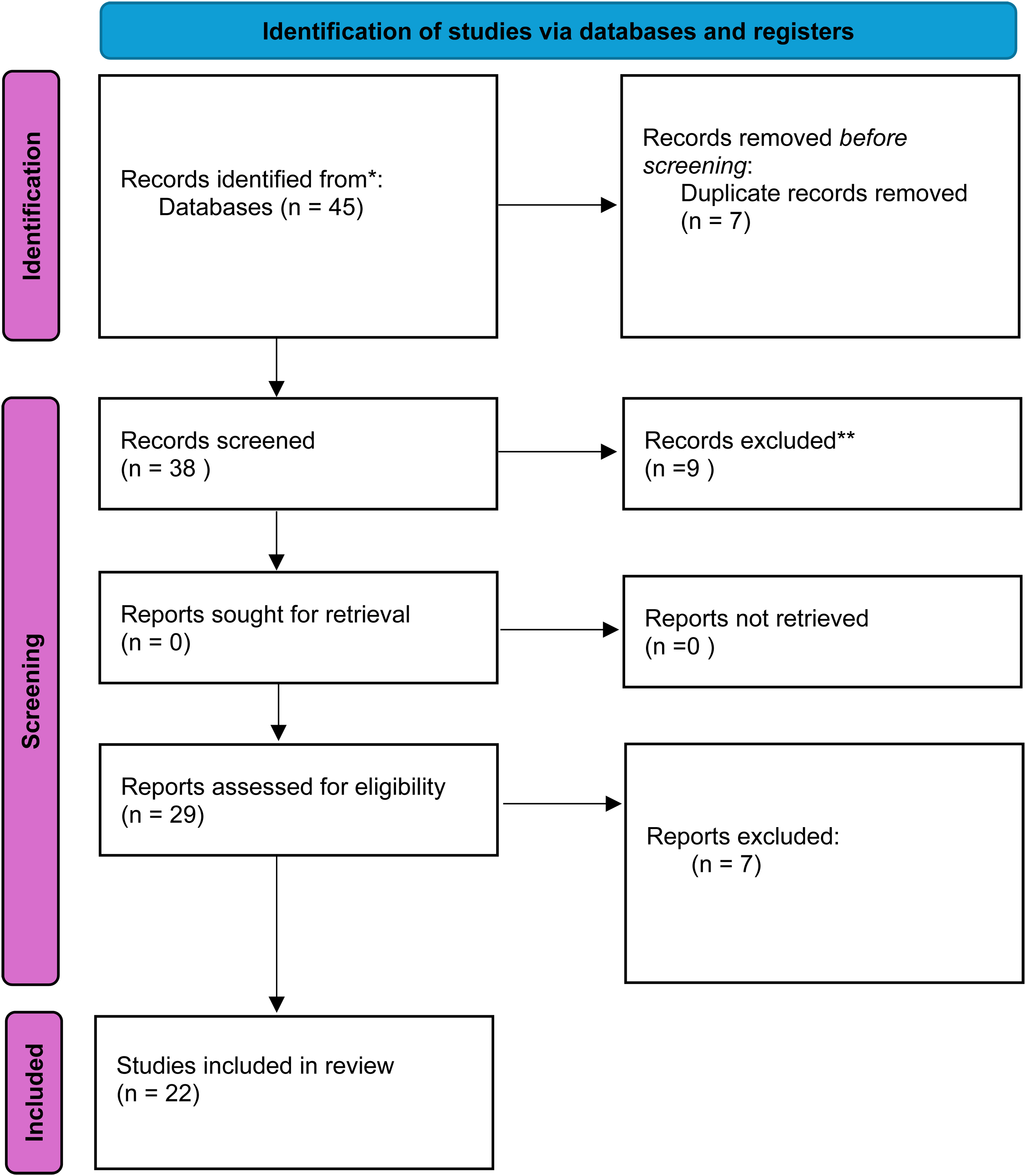
PRISMA flow diagram of the literature review process.
We rigorously put the data from the 22 studies into a structured datasheet (Table 1). The categories for extraction were the author(s), year, country, title, study design, setting and sample, objectives, important findings, and suggestions. Two independent reviewers did the data abstraction procedure to make sure it was accurate and to reduce bias. We talked about any disagreements and came to an agreement.
Summary of Studies Datasheet (n = 22 Studies).

GPA, grade point average; MMI, multiple mini-interview.
A thematic analysis was conducted utilizing Braun and Clarke's six-phase framework: (1) familiarization with the data, (2) generation of initial codes, (3) formation of themes, (4) review of themes, (5) definition and naming of themes, and (6) selection of exemplar data to demonstrate conclusions. This strategy enabled the recognition of persistent trends across research while recognizing differences in context and methodology. The review process was also driven by the best practice criteria for evidence synthesis found in the JBI Manual for Evidence Synthesis (Aromataris et al., 2024). This manual gave a structure for making sure that narrative reviews were methodologically sound, open, and consistent.
Results
A total of 45 articles published between 2005 and 2024 were retrieved. After the removal of duplicates, 38 articles were screened for titles and abstracts. Twenty-nine relevant articles underwent full-text screening, of which 22 were found eligible to be included in the review (Figure 2). The studies’ information was extracted and organized in an electronic and paper datasheet (Table 1) by two authors (EA & SBH) to facilitate the review and interpretation of findings. The datasheet was divided into eight sections, which include author(s)/year/country, title, Journal name, purpose of study, study design, setting/sample, findings, and recommendations.
This review yielded 22 articles, eight of which were conducted in the United States of America (USA), five in the United Kingdom (UK), two in each of the following countries: Australia, Iran, Pakistan, and Finland, and one study in New Zealand. The majority of the studies were of a quantitative approach (n = 14, 64%), followed by the qualitative approach (n = 4, 18%), then two studies (9%) were a scoping review, and two studies (9%) were a systematic review.
Thematic analysis utilizes the method of following six processes that make up the iterative process: (1) familiarizing oneself with the data; (2) creating codes; (3) generating themes; (4) reviewing themes; (5) defining and labeling themes; and (6) identifying exemplars (Braun & Clarke, 2012). Firstly, relevant data from the chosen articles were collected, such as admission criteria and application forms for undergraduate nursing students. By reviewing the collected data, the authors become familiar with the information related to undergraduate nursing students using the key information, including eligibility requirements, academic criteria, personal statements, letters of recommendation, interviews, and any other factors considered in the admission process. Open coding, identifying concepts from the data, was started, and then descriptive codes were used to capture the essence of the admission criteria mentioned in the documents or interviews that took place. Related codes into preliminary themes were extracted by looking at their patterns, connections, or similarities. Naming themes as follows: (1) the GPA, (2) traditional interviews, and (3) MMIs as admission criteria.
Grade Point Average Pre-Admission Criteria
GPA was one of the primary academic program admission criteria. It remains a cornerstone of admission criteria, serving as a quantifiable indicator of academic performance. The majority of studies that were reviewed demonstrated that high school GPA was one of the best indicators of nursing student success, achievement, and program completion (Crouch, 2015; Schmidt & MacWilliams, 2011; Shulruf et al., 2011)
The predominant belief was that candidates with high GPAs and standardized test scores were generally believed to demonstrate stronger academic skills, which may be associated with future success in healthcare professions. However, although the GPA offers a valuable measure of academic capacity, it does not cover the multifaceted skills necessary for effective nursing practice. Tamimi et al., 2023 demonstrated that non-cognitive abilities, such as ethical judgment and empathy, were qualities required in those applying to join healthcare professions. These qualities cannot be measured by quantifiable measurements alone, such as GPA (Wagner et al., 2020). Moreover, interpersonal and communication skills cannot be evaluated by GPA (Finch et al., 2014). These limitations have led some institutions to incorporate additional evaluative components such as interviews.
Interviews
The face-to-face interviews provide a qualitative complement to the GPA, evaluating interpersonal skills, critical thinking, and the ability to empathize with patients, crucial attributes in the nursing profession (Capponi & Mason Barber, 2020). It was a non-academic program admission criterion that comprised two to three interviewers and one applicant who answered a series of preset questions and was scored according to the answers they provided (Crawford et al., 2021). The reason behind the interview was to evaluate the interpersonal and communication skills and the interest and aptitude that cannot be evaluated through the GPA and entrance exams (Mabope et al., 2022). Additionally, according to the evidence, morals and empathy were largely determined before students undergo professional training, making it essential to assess these qualities as part of the application and selection process (Ward et al., 2012).
A structured interview was intended to assess key professional competencies, including communication skills, teamwork skills, decision-making, and insight into self (Finch et al., 2014; Yousafzai & Jamil, 2019). Further, once the interview was included, attrition decreased, diversity increased (Talman et al., 2018), and cost decreased (Schmidt & MacWilliams, 2011).
A significant challenge that has emerged in this context was the subjective nature of the interview process, which was often a determining factor in the selection of candidates. Interviewer biases, such as the halo/horn effect, implicit bias, explicit bias, and extraneous characteristics, have contributed to reduced validity and reliability (Herrera, 2019; Wagner et al., 2020). In addition, the lack of consistency in interview practices in different institutions exacerbates these concerns even more. Therefore, the implementation of structured interview formats, training for interviewers, and continual monitoring and adjustment to ensure inter-rater reliability can mitigate bias and increase the reliability of the evaluation process (Finch et al., 2014; Wilson et al., 2008).
The Multiple Mini-Interview
MMI was one of the non-academic program admission criteria, which was originally used solely for medical school admission; nevertheless, increasing psychometrics have led to its adoption in other schools, like nursing schools (Calma et al., 2019).
Gale et al., 2016 suggested that future recruitments need a combination of intellectual and social skills, as well as characteristics such as honesty, empathy, and integrity. Such qualities were often not effectively captured through traditional interviews, highlighting the need for the implementation of MMI that could be feasible and successfully implemented (Ali et al., 2019).
Through a circuit interview structure, candidates in MMI spend 8–10 minutes at each of six to eight stations, with a different assessor at each station (Gale et al., 2016). It was intended to assess many of the personal characteristics, like critical thinking, communication skills, ethical decision-making, and knowledge of the healthcare system, which were previously insufficiently assessed by traditional interviews (Herrera, 2019). Additionally, the MMI has stronger psychometrics (reliability and validity) for selecting nursing students than traditional interviews (Ali et al., 2019; Gale et al., 2016; Perkins et al., 2013), with robust internal consistency (Callwood et al., 2020). Therefore, MMIs were considered an alternative to traditional interviews (Crawford et al., 2021).
MMI aims to recruit students who demonstrate the values and attitudes essential for healthcare professionals, including caring, compassion, honesty, leadership, and sound decision-making, ultimately fostering the development of compassionate individuals with strong communication skills (Gale et al., 2016). Interestingly, an efficient, well-structured MMI interview will allow achievement of overall admission goals and ensure selected applicants display traits aligned with the college vision and values and enhanced diversity (Wagner et al., 2020), along with the prediction of academic performance (Yousafzai & Jamil, 2019).
On the other hand, candidates who were interviewed using MMI argued that it limited the opportunity for applicants to discuss their past achievements and experiences and instead compelled them to perform rather than respond naturally and authentically (Yousafzai & Jamil, 2019). Furthermore, the MMI demands more time and effort than regular interviews because it needs participants to organize, carry out, and enter data, as well as the right infrastructure (Griffin, 2025; Yousafzai & Jamil, 2019).
It is noteworthy that, despite the common use of standardized test scores in admission criteria across numerous academic institutions, none of the 22 studies reviewed specifically investigated or highlighted standardized testing as a principal selection instrument for undergraduate nursing programs. This highlights a gap in the literature regarding how standardized test results may influence the selection process for nursing students.
Discussion
The objective of the current study was to review and analyze the existing research evidence regarding undergraduate nursing program admission criteria. In summary, a variety of admission criteria have historically and currently been used to assess undergraduate nursing students’ values and potential to become competent and compassionate nurses. Results of the current review showed that GPA, traditional interviews, and MMI were the main admission criteria in selecting undergraduate nursing students.
Nursing schools were mandated (by policies, individuals, local practices, etc.) to choose and instruct candidates who possess the right qualities to provide high-quality healthcare (Zamanzadeh et al., 2020). Selecting the right candidates for the nursing profession was essential to ensuring job compatibility, enhancing future workforce performance, and, perhaps most importantly, safeguarding patient safety (Chai et al., 2019). In addition, the continuous nursing shortage, the reduction of resources (Finch et al., 2014) (Schmidt & MacWilliams, 2011), and program attrition (Finch et al., 2014; Schmidt & MacWilliams, 2011) make it crucial to select applicants who will succeed (Schmidt & MacWilliams, 2011). According to the World Health Organization (WHO), a shortage of 11 million health workers (including nursing) was expected by 2030, primarily in low- and lower-middle-income nations (WHO, 2025).
Crouch (2015) found that assessing nursing students’ critical thinking abilities was especially important as professional nurses encounter more acutely ill patients, navigate developing technologies, and face complex ethical challenges (Crouch, 2015). Ethical competence was widely regarded as essential in health science professions, as it was linked with professionals acting with integrity and compassion. Therefore, selecting candidates who demonstrate potential for developing strong ethical judgment may support the cultivation of these attributes (Vierula et al., 2024). However, a review of the literature reveals that there remains a lack of consensus on the most effective criteria for admission into the nursing profession (Griffin, 2025; Talman et al., 2018). Besides, there was currently no standardized method available to reliably predict a student's success in completing a nursing program (Crouch, 2015).
Although GPA, interviews, and MMIs were the predominant admission criteria analyzed in the reviewed papers, the lack of emphasis on standardized test scores is significant. The infrequent focus on standardized exams in the examined literature may indicate a wider trend in nursing education that favors holistic and competency-based evaluations over standardized measures, given their prevalent role in higher education admissions processes (Yousafzai & Jamil, 2019). This underscores a domain for future investigation to assess the predictive validity and suitability of standardized test scores in nursing admissions, particularly. Finch et al. found in their qualitative study that including an interview as part of the admission process, alongside GPA, enables the faculty of nursing to assess a student's fit within the program. Additionally, students often perceive the interview as a positive experience and a valuable opportunity to present themselves beyond academic metrics (Finch et al., 2014).
In their cross-sectional study, they examined the reliability and predictive validity of MMI evaluation based on the practice outcomes of undergraduate nursing students (Callwood et al., 2020). The study found that using MMIs revealed a significant predictive validity of nursing outcomes among nursing students, noting that the academic entry level and age do not appear to affect MMI scores. Similarly, a study by Gale et al., 2016 found that MMI shows little to no bias based on age, gender, nationality, or secondary school location. These outcomes hold broad relevance in guiding both national and international implementation of MMIs as part of the selection criteria for healthcare professionals. Therefore, Schmidt & MacWilliams, 2011 suggested that a combination of admission criteria was more effective than relying on any single variable alone.
One point that was valid to discuss here was that many nursing programs were linked by regulatory and accreditation requirements, which emphasize traditional evaluation methods, which can hinder the exploration of alternative approaches. Therefore, there was a palpable need for institutions to balance innovation with rigor, ensuring that all the newly adopted admission criteria maintain the integrity and competence standards required for nurse accreditation. Meaning that meeting regulatory requirements while also pursuing best practices may increase the likelihood of recruiting and retaining student nurses who become proficient, competent, and compassionate professionals with passion and ambition to deliver excellent care to all they serve. The selection of undergraduate nursing students was a fundamental starting point; it was equally crucial to consider the ongoing support, training, and professional development opportunities provided to these students throughout their education and their graduate roles (Negarandeh et al., 2021).
It was essential to acknowledge the contextual disparities among the nations featured in the analyzed studies. Diverse healthcare systems, educational structures, and cultural norms can profoundly affect the formulation, execution, and results of nurse admission standards. What was productive or possible in one country setting may not immediately apply to another due to varying institutional priorities, resource availability, or societal values. Recognizing these contextual differences was crucial for accurately understanding the results and for informing the adaptation of best practices to local environments.
While the evaluated admission criteria, such as GPA, traditional interviews, and MMIs, exhibited predictive validity in many contexts, their relevance across international educational and cultural environments may necessitate careful modification. Resource-intensive procedures such as MMIs may be more feasible in high-income nations with adequate infrastructure, skilled evaluators, and institutional backing. Conversely, institutions in low- and middle-income contexts may depend more significantly on academic indicators like GPA due to limitations in staff or resources. Cultural norms pertaining to communication, decision-making, and professionalism may impact the assessment of attributes such as empathy and ethical judgment during interviews or MMIs. Consequently, although the evaluated criteria provide a solid basis, their application must be tailored to fit local settings, guaranteeing both practicality and cultural significance. Recognizing these differences can facilitate the wider applicability of the findings and augment the significance of nursing admission procedures worldwide.
This review has identified numerous significant deficiencies in the existing literature concerning undergraduate nursing admission criteria. Currently, there is no globally recognized or defined method for the selection of nursing students, resulting in variance among schools and regions. Secondly, while standardized test scores were frequently utilized in various higher education contexts, none of the 22 studies examined directly assessed their predictive validity or efficacy in nursing education, highlighting a notable gap in the literature. Third, there was an absence of longitudinal data connecting diverse selection methods, such as GPA, conventional interviews, and MMIs, to long-term outcomes, including program completion, clinical competency, and professional practice.
Although this research focuses on admissions criteria as predictors of academic and professional success, it was critical to recognize that these variables were part of a larger educational environment. Once admitted, students’ outcomes were influenced by institutional resources, mentorship availability, professional socialization opportunities, teacher participation, and the general learning environment. These factors have a substantial impact on students’ growth, retention, and preparation for practice. Thus, any examination of admissions processes should be contextualized within a broader perspective of the entire student journey through nursing education.
Implications
This review of the requirements for undergraduate nursing students to be admitted can be a useful instrument for guiding practice and policy. The findings of the current review may guide nursing schools to improve their selection processes to ensure that candidates possess not only high academic talents but also the emotional intelligence and communication skills required for effective patient care. Furthermore, establishing consistent admission criteria was essential to ensure that all nursing graduates attain a fundamental pattern of knowledge and skills, thus promoting public trust in the profession.
Furthermore, it can serve as the foundation for future research studies (especially longitudinal studies) to explore whether a strong correlation exists between admission criteria and student success, ultimately aiming to produce competent and compassionate nurses by the end of the program. Nursing education was a constantly evolving field, particularly with the rise of artificial intelligence (AI). As AI continues to advance, it is crucial to consider its impact on future nursing admission criteria.
At Fatima College of Health Sciences, a higher education institution based in the United Arab Emirates, we believe the findings will contribute to the development of best practice policies and procedures for selecting students based on their potential to become competent and compassionate healthcare professionals. This will help address the United Arab Emirates’ growing need for skilled healthcare professionals, particularly in the nursing field. Additionally, the results emphasize the importance of involving faculty and industry partners in the student selection process, as these students represent the future workforce. This was particularly crucial, given that many universities were assessed based on their success in helping graduates secure employment within 9 to 12 months of completing their programs.
Recommendations
In light of these shortcomings, future research should focus on developing standardized, evidence-based frameworks for evaluating candidate potential. Longitudinal studies must be undertaken to evaluate the correlation between diverse selection instruments (e.g., GPA, MMI, interviews) and student success indicators, including retention, academic performance, and post-graduation clinical competency. Additionally, emerging methods like artificial intelligence-assisted screening and virtual assessments must be assessed for their reliability, potential to mitigate bias, and feasibility. Institutions must also investigate how to synchronize these improvements with accrediting standards and regulatory requirements, ensuring rigorous and justifiable selection processes.
Conclusions
The continuous development of admission criteria for undergraduate nursing education has both opportunities and challenges. To choose the best applicants for nursing programs, a thorough evaluation was required by using a multifaceted selection process that equally considers caring values, academic ability, and overall potential. Institutions must evaluate not only prevailing best practices but also endeavor to address gaps in data, especially with standardized testing and longitudinal outcomes. A cohesive, research-based methodology for application selection will improve the capacity to attract students who are both academically proficient and personally aligned with the requirements of the nursing profession. Ultimately, enhancing admission criteria grounded on substantial data can result in superior student outcomes and elevated quality of patient care within healthcare systems. This can significantly contribute to the progress of the nursing profession and, more importantly, the safety and quality of care that patients and local communities will receive. Future studies should focus on assessing and improving student selection methods to ensure the identification of candidates who are best suited for success in their healthcare careers.
Footnotes
Author’s Contributions
EA designed the study, coordinated the research team, designed the search strategy, conducted the literature search, organized and analyzed data, and was the primary author of the manuscript. SBH conducted the literature search, organized and analyzed data, and was the secondary author of the manuscript. LBP conducted the literature search, analyzed data, and edited the manuscript. MA conducted the literature search and analyzed data. RKI contributed to the design of the search strategy, conducted the literature search and analyzed data. AS conducted the literature search, analyzed data, and edited the manuscript. AL conducted the literature search and analyzed data. AL read and approved the final manuscript. All authors read and approved the final manuscript.

Funding
The authors received no financial support for the research, authorship, and/or publication of this article.
Declaration of Conflicting Interests
The authors declared no potential conflicts of interest with respect to the research, authorship, and/or publication of this article.