




Abstract
The purpose of this study was to examine factors influencing adaptation and resiliency of inner-city low-income, African American mothers. The number of studies that examine the lived experience of African American mothers in low-income inner-city settings is limited. The factors explored in this study, which determine the family’s ability to adapt to their life situation, include vulnerability, adaptation, and resiliency. Survey data and narrative inquiry were used to determine maternal adaptation and resilience. Quantitative data were gathered using a demographic inventory, a Family Adaptation, Partnership, Growth, Affection, and Resolve; Family Adaptation Inventory; and Family Dynamics Questionnaire. Qualitative data were gathered as the mother described her life history and answered semistructured interview questions. The mothers, who participated in this study, were clear about the principles and morals in which they believed and spent much of their time teaching those principles to their children. They believed that these rules would protect their children and ensure that their children would make good decisions in the future and help them reach their goals. They feared that their living situation could prevent their children from reaching their full potential in life. Preventing current risk situations and protecting their children from future harm was an urgent concern. This study provides evidence for resiliency in inner-city low-income African American mothers.
Keywords
Background, Significance, and Purpose
Limited studies exist examining the true lived experience of African American mothers in low-income inner-city settings. Research has focused on family adaptation models that typically emphasize negative outcomes and maladaptation in families rather than contributors to positive outcomes and health. Recent resilience-oriented models have focused more on strengths within the family that contribute to successful adaptation (Criss, Henry, Harrist, & Larzelere, 2015; Rosenberg et al., 2015). One specific factor known to improve resilience is social support, which also contributes to reducing morbidity and mortality (Todis, Bullis, Waintrup, Schultz, & D’Ambrosio, 2001), while low levels of social support contribute to a lack of resilience (Feeney & Collins, 2014). Environmental and personal conditions increase stress in poor African American mothers who live in dangerous and declining neighborhoods (Boyd-Franklin, 2013; Ceballo & McLoyd, 2002).
The purpose of this study was to examine factors influencing adaptation and resiliency in inner-city low-income, English-speaking African American mothers of any age whose oldest child was 10–11 years and had lived with her since birth. As a child ages past 10 or 11 years, there are many internal and external factors that lead to changes in the child’s response to life events. Variables such as puberty, growth and developmental, demand for independence, and so on, all begin to change, which in turn potentially impacts family dynamics in a new and challenging way from when the child was younger. Thus, it was decided to limit those types of variables, best as possible. This study sought to answer questions related to the childbirth, postpartum, and motherhood experience. Replicating the methodology of a larger study that began in 1993 with mothers from Norway and Sweden and the United States and continued longitudinally in 5-year increments with the Swedish and Caucasian American mothers (Kiehl & White, 2003; Kiehl, Carson, & Dykes, 2007), this study provides evidence for resiliency with a different demographic, inner-city low-income African American mothers.
Literature Review
An electronic literature search was conducted using PubMed, Medline, PsychInfo, SocioFile, CINAHAL, ProQuest, Web of Science, and Google Scholar to locate articles and specific authors published between 1982 and 2016. The primary key words searched included maternal/parental adaptation, African American mothers, resiliency in parenting, resilience, risk, and vulnerability. In addition, articles were investigated from reference lists of those found in the electronic search.
Vulnerability, adaptation, and resiliency factors determine the family’s ability to adapt to their life situation. Vulnerability factors inherent to motherhood include childbirth as a stressor event, situational demands of being a mother, ambiguity and the uncertainty of how the addition of a new family member will change the family routine, and coping skills (Schetter & Tanner, 2012). Traumatic stress response to childbirth and early postpartum events have been known to have long-lasting effects on a mother (Filippi, Margola, & Maggioni, 2006; Zaers, Waschke, & Ehlert, 2008). In addition to the vulnerability factors inherent to motherhood, low-income African American mothers are further faced with socioeconomic and personal factors (Wilson, 2012). A number of problems have been identified that leave African American families vulnerable including unemployment and poverty, economic insecurity, single adult households, lack of male support, and lower levels of education, all of which contribute to a family’s low-socioeconomic level as well as violence, crime, and fear of safety for their children, especially boys (Boyd-Franklin, 2013; McLoyd, 2013). Adaptation is a means of getting to resilience (Mitchell, Murdock, & McQuaid, 2004). A person who if faced with shifting or challenging life events will adapt positively if they can acclimate or adjust to the new environment. Variables contributing to adaptation and resiliency include available social support, accessible resources, problem-solving ability, coping skills, and positive patterns of functioning (Roy, 2009). Resilience definitions are varied, some referring to situations such as poverty or trauma (Hunter, 2001), others related to personal qualities necessary for resilience (de Chesnay, Wharton, & Pamp, 2005; Martinez-Marti & Ruch, 2016). One factor that presents itself repeatedly in the research as contributing to resilience is social support. It is apparent that the more social support a person has or feels they have, the more resilient they are in a given situation (Kennedy & Bennett, 2006). Characteristics of resilience include such things as flexibility, self-confidence, sense of self-worth, and evidence of healthy coping strategies. The characteristics of resilience are all important in being able to adequately respond to changes and challenges in the social determinants of health areas (Braveman, Egerter, & Williams, 2011). An individual with higher levels of resilience experience less stress, lower depression rates, and less physical symptoms associated with stressful life events (Ryan, LaGuardia, & Rawsthorne, 2005).
Theoretical Foundations of the Study
The resiliency model of family stress, adjustment, and adaptation (McCubbin & McCubbin, 1996) served as the foundation of this project. This theoretical model emphasizes family adjustment and adaptation in response to stressful life experiences. The focus of this model is the ability of the family to recover from adverse events. The framework divides stressful life events and transitions into two phases, (a) the adjustment phase and (b) the adaptation phase, and provides a way to assess the stressors, strains, and transitions of the family in the time of crisis. Patterns of protection and risk factors are evaluated, including established patterns of functioning, resources, coping skills, and ability to problem solve. In the case of inner-city low-income African American mothers, stressors include high rate of unemployment, crime, deteriorating or inadequate housing, lack of safe play areas for children, transport of children out of the neighborhood for school or deteriorating schools, and overall neighborhood condition (Klebanov, Brooks-Gunn, & Duncan, 1994).
Methodology
A purposive sample used in this mixed-method design resulted in a total of 17 low-income African American mothers. The business manager of the local nursing clinic that the participants patronized was the key informant and thus assisted in recruitment and validated appropriate participants based on inclusion and exclusion criteria. Included were English-speaking mothers of any age whose oldest child was 10–11 years old and whom had lived together since birth. All resided in an inner-city housing project plagued by crime, violence, substance abuse, and poverty (Crime Maps, 2013). Both survey data and narrative inquiry were used to determine maternal adaptation and resilience. Narrative inquiry rests on the assumption that people make sense of random situations by framing them and organizing the elements selected into a story (Bell, 2002) “Narrative is not an objective reconstruction of life—it is a rendition of how life is perceived” (Webster & Mertova, 2007, p. 3). Validity of this method is not found in statistical analysis but rather in the importance derived from the participant’s story. If it is considered important to the participant, it is considered significant during analysis.
Quantitative data were gathered using a demographic inventory and three short surveys: a Family Adaptation, Partnership, Growth, Affection, and Resolve (APGAR); Family Adaptation Inventory; and Family Dynamics Questionnaire.
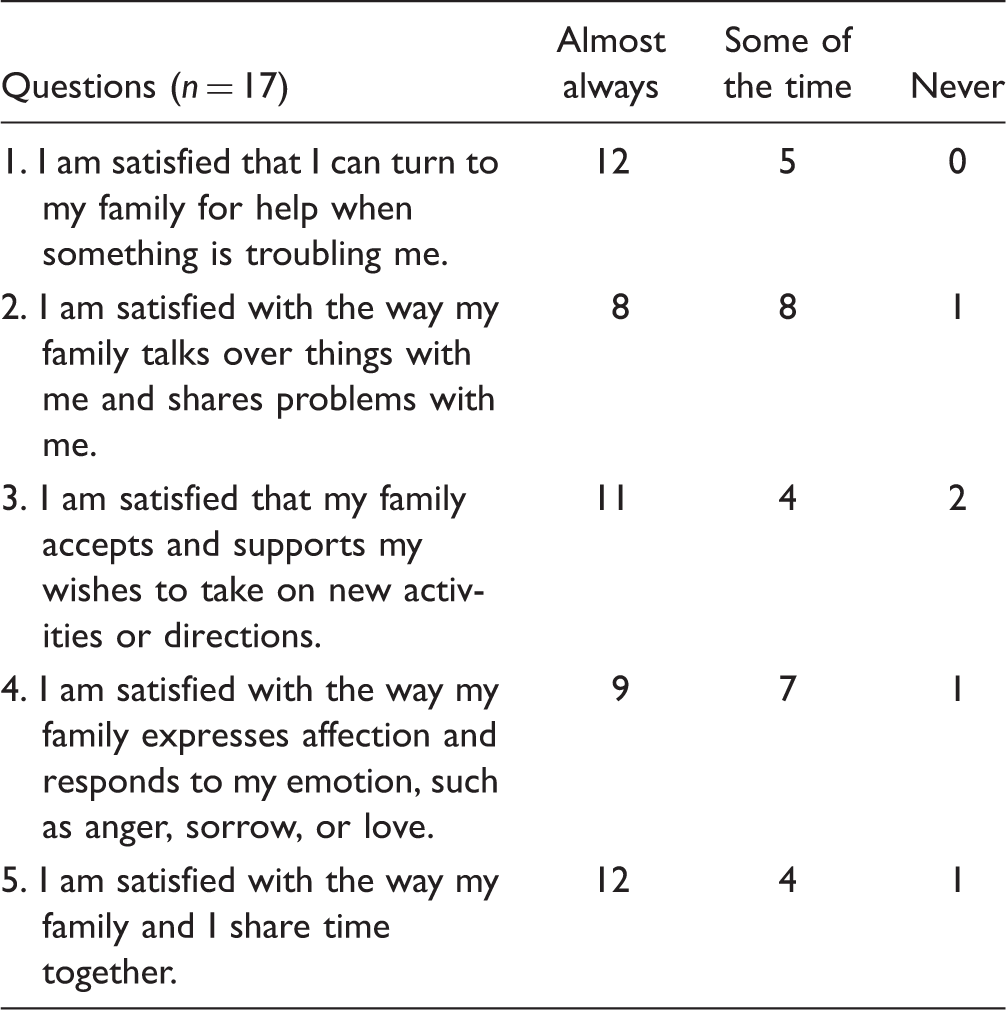
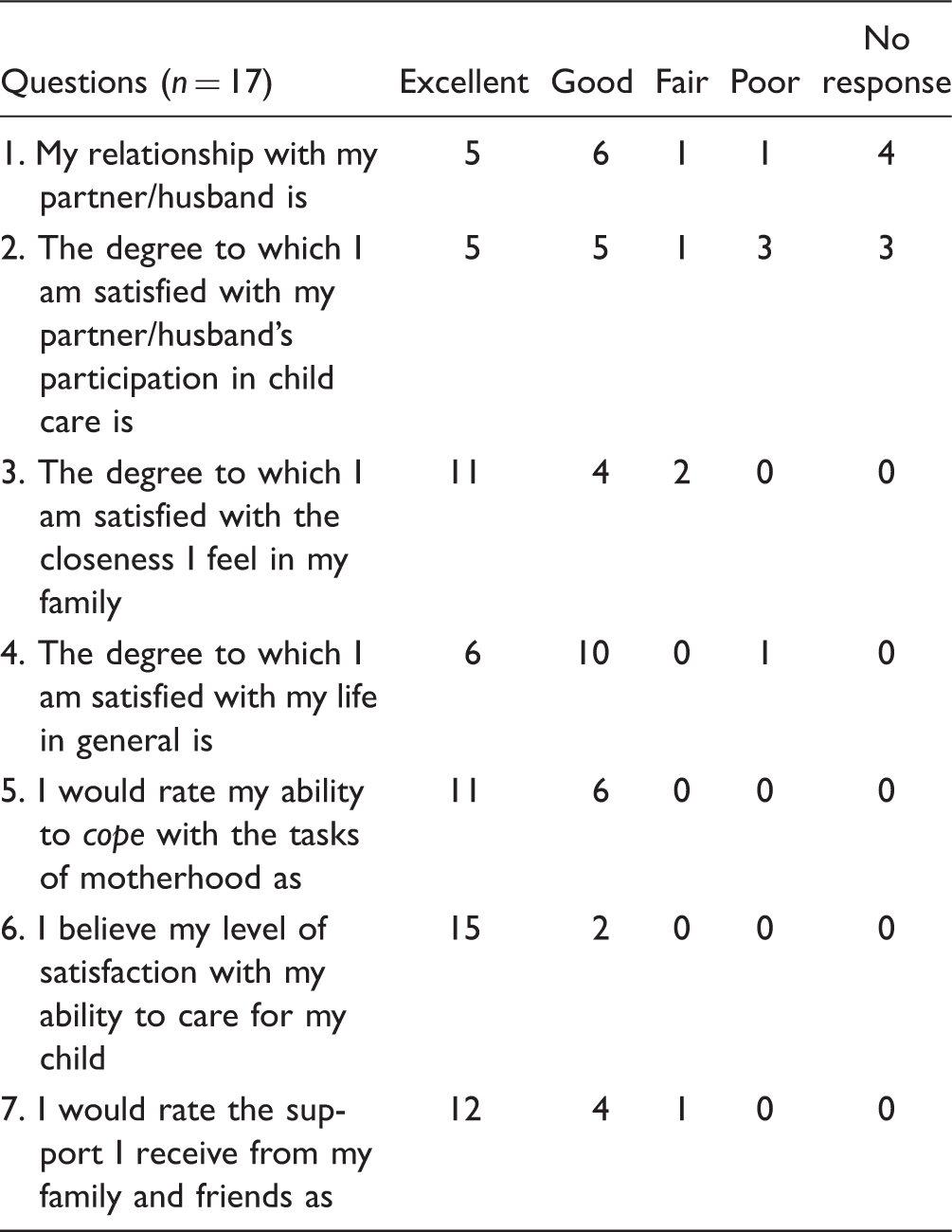
The Family APGAR examines the mother’s satisfaction with turning to her family for help, the way her family talks over things and shares, accepts, and supports her wishes to take on new activities or directions; the way her family expresses affection and responds to her emotion; and the way her family and she share time together (Sawin & Harrigan, 1994). The validity and reliability of the Family APGAR tool was established with a 1982 revision of the original tool (Smilkstein, Ashworth, & Montano, 1982). The Family Adaptation Inventory comprised seven questions, corresponding to the dimensions from the Prenatal and Postpartum Maternal Adaptation Questionnaire: quality of relationship with partner, mother’s perception of father’s participation in child care, mother’s gratification from her labor and delivery experience, mother’s satisfaction with her life circumstances, mother’s confidence in her ability to cope with the tasks of motherhood, mother’s satisfaction with motherhood and infant care, and support for maternal role from friends, parents, and other family members (Lederman, Weingarten, & Lederman, 1981). The Family Dynamics Questionnaire, which sought to understand the participant’s current family configuration, working and child care arrangements, and so on, was established with earlier research about family dynamics and demographic characteristics (Hakulinen, Paunonen, & Laippala, 1997). This instrument was found to be reliable and valid during the previous research. The instrument was deemed reliable and valid by a team of family researchers from the Midwest by testing over a period of 5 years. (Lasky et al., 1985). Family was defined for the participants as a group of two or more people who have commitment to each other and live together.
Protocol
Prior to initiating this study, approval was granted by the institutional review board of the University of Louisville. After obtaining signed written informed consent to participate and establishing rapport with each mother and completion of the study instruments, the interview followed an established protocol. Interviews were conducted at a time and location of the participant’s choosing. Interviews lasted approximately 90 min until saturation (no new emerging data) of themes occurred. Field notes were kept related to participant demeanor and nonverbal behaviors observed during the interview. Interviews were audiorecorded and later transcribed. All audiotapes, transcriptions, and identifying data were kept separately in a locked office with accessibility only to the researchers.
The interviewer offered two options, the mother could tell her life history, beginning with the birth of her first child, or simply answer interview questions. The following guiding questions were asked during the interviews to assist the researchers in assuring the broadest and most comprehensive description of the mother’s life experience:
Describe your family life the first few weeks after you had a baby. What things did you or other people do that helped the most during those weeks? As you child grows older and changes happen within your family, what worries do you have? What helps your family handle the worries? How would you describe your family life right now? On a scale of 1–5, with 1 being the least happy and 5 being the most happy, what is your current level of happiness? What is happening in your life that makes you say that number (level of happiness)?
Based on the magnitude of crime in this area, mothers were asked if they have talked with their children about risks associated with drugs, alcohol, sex, and child predators, and if they are worried about those things.
Data Analysis
Quantitative data, both descriptive and inferential, were analyzed using Statistical Package for the Social Sciences (SPSS 14.0). Relationships among variables derived from the quantitative measures were examined; however, this study will focus on the narrative inquiry of the participants. Qualitative data were managed using N-Vivo 7 Qualitative Data Analysis Software. To analyze the qualitative data, the author coded interview transcripts. Initial coding categories were derived from the most common responses of the participants and were supported by the literature on parenting. Two additional coders used the following protocol based on a family resiliency model. All coders methodically identified participants’ statements signifying risk or vulnerability and protective factors within the family. The use of three coders to analyze the field notes and interview transcripts further ensured the trustworthiness of this study (Webster & Mertova, 2007). The process of coding yielded themes and subthemes that were then compared for intercoder reliability. Intercoder reliability among coders was 84% for vulnerability/risk factors and 87% for protective factors.
Findings: Demographics and Surveys
The mothers in the study were 23–50 years of age (M = 33.4). Two mothers had one child, eight had two children, and seven mothers had more than two children. Although 10 of the 17 mothers considered themselves the primary wage earners for the family, only 6 mothers stated they worked outside the home. All participating mothers lived in poverty (Poverty Guidelines, 2016). Six mothers had some college education, nine completed high school, and two did not complete high school. Characteristics shared by most participants included lack of financial stability, lack suitable housing, fear regarding the environment external to their household, and lack advanced useful education.
Family APGAR. a
Modified from Smilkstein (1978).
Mothers Perception of Family Adaptation.
Modified from Lederman, Weingarten, and Lederman (1996).
Family Dynamics Questionnaire.

Findings: Interviews


Narrative inquiry themes.

Discussion
Quantitative findings indicated that the majority of the participants were satisfied with all dimensions assessed by the instruments. Most adaptation theories support the notion that in order to survive people do what they need to do to see their lives as acceptable. During the interviews, there was evidence that although many mothers were facing enormous challenges, they were trying to make the best of their situation. It is interesting to note that 14 (82%) of the mothers indicated that they were the only adult in the home, which might imply a lack of social support or decreased family functioning. Although the participants did not, in many cases, speak directly to the characteristics that signify resilience, their response to the various barriers that they face and their often-positive responses when describing their lives and the lives of their children are strongly indicative of their resilience.
Similar to other studies, the results of this study indicate a positive association between family relationships, social support, and parenting in African American families (Ceballo & McLoyd, 2002; Taylor, 2011, Wallace, 2013) and that the unique structure of many African American families is functional (Cain & Combs-Orme, 2005). Although only six (35%) mothers rated their relationship with their partner/husband as fair, poor, or they gave no response, many described a life in which their husband/partner did not live with their family. What they described was a man who “visited” 1–2 times/month staying for dinner and the night, then leaving until the next visit. Most said that they were satisfied with this because of the negative influence they believed the man could have on the children. This is also likely the reason that 10 of the mothers were satisfied with their partner/husband’s participation in childcare. Only 3 men lived fulltime with the family and 14 of the women in the sample indicated that they were the only adult in their home.
Survey data revealed that only one third of the mothers worked outside the home and two thirds were satisfied with that arrangement. Many mothers indicated that although they did not work in a traditional job, they considered themselves earning an income. When questioned further, mothers believed they were “earning” their public assistance money and it was a salary.
The study highlights some specific family stressors and vulnerabilities that make adaptation challenging for this population such as lack of financial stability; unsafe environment with the presence of fear related to safety, violence, and guns; and fear related to drugs, alcohol, and pregnancy. Murray et al. (2002) examined the connection between poverty and the personal resources of mothers, maternal psychological functioning, and financial pressures. They found that improving the financial situation and the resources available to a mother also improved her emotional well-being and family functioning. Mothers in this study repeatedly mentioned the lack of money that prevented them from moving out of the unsafe living environment, feeding or clothing their children, or having reliable transportation.
There were conflicting statements regarding the role of the father. Many mothers said that their children’s father set a poor example for the children and sporadic visits were enough. Several mothers said that the father came once or twice a month to eat dinner with the family, some staying overnight then leaving. Although conflicting opinions were revealed, the quality of the mother–father relationship and the frequency of involvement by the father had an impact on child behavior and on the ability of the mother to parent the children effectively. There was an implication that perhaps there was money involved that helped the mother provide for the children, although that was not openly expressed. Mothers also expressed the need to keep their children in the house rather than letting them go outside and play, even during daylight hours. They seemed to believe that if they could control their children’s location and activity, they could keep their children safe.
Depending on the strength of their value system and their often-passionate focus on parenting, the mothers conveyed a positive outlook for them and their children. The mothers also spoke of the support they feel from their faith family, their extended family, and, at times, their partner. Although the lines of what constituted their social support were sometimes blurred, the mothers spoke very openly about their support system. Despite the inequities, mothers living in difficult situations can regroup and prove resilient (Murray et al., 2002). Although this group of inner-city, poor, African-American, mothers would be thought of as high risk for the use of ineffective parenting approaches, these mothers in fact reported an array of approaches that provide protection for their young children, while also maintaining a sense of hope and goal of future successes for themselves and their children.
One important feature of the parenting perspective for these 17 mothers was the clear set of principles and morals in which they believed taught their children and which they felt was essential to their children’s future. As the mothers expect their children to follow a set of rules based on these principles, the mothers hope that these principles will help their children make good decisions in the future and will help them reach their goals.
Women living in the inner city used most of their energy as mothers teaching principles and protecting their children. This approach fits the demands of the neighborhood and the current and future risks their children faced. Current risks, such as violence, combined with future threats, as with involvement with gang members, and pregnancy, continuously worry these parents. Additionally, there was the fear that their situation could prevent their children from reaching their full potential in life. Preventing current risk situations and protecting their children from future harm was as urgent as and perhaps even more alarming than tackling existing mischief.
Limitations
Given that this study included a small sample from one region of the United States and that the data were collected at one point of time, the findings should be interpreted with caution. Generalizability and external validity of the findings are limited due to the homogeneity of the sample and small sample size. Further research should study with a larger sample adaptation and resiliency over time of African American women living in various types of communities. Considering that the age of the mother could be a mediating or moderating factor for resilience, not including the mothers’ ages as inclusion or exclusion criteria could be a limitation. It must be acknowledged that risk and protective factors can only be inferred from the results of the study (McCubbin & McCubbin, 1996). This approach to data collection and analysis make it difficult to determine differences between intervening and mediating variables such as risk or protection and outcome oriented variables such as quality of life and satisfaction. Intricacies of language, determination of what constitutes a risk or protective factor, and response to those factors are all exceptionally dependent on the individual family. Protective factors are reliant on the available resources, family coping skills, and the mother’s ability to problem solve.
Clinical Implications
According to Melies, Sawyer, Im, Messias, and Schumacher (2000), transitions may be facilitated or inhibited by a woman’s personal conditions, cultural beliefs and attitudes, socioeconomic status, preparation and knowledge, and community societal conditions. Adaptation and resilience of low-income African American mothers can be enhanced by assessment to determine vulnerability, risk, and protective factors. Nurses and other health-care providers can assist mothers in assessing their personal conditions, cultural beliefs and attitudes, socioeconomic status, and community societal conditions. Once assessed, providers could work collaboratively to assist mothers to develop a plan for reducing risk and increasing protective factors.
Equally important is the implementation of social benefits and programs that support families with children. These benefits and programs, sorely lacking in the United States, include helping mothers and their family members adapt to the stressors of parenthood. They should also include benefits such as paid parental leave, early childhood care when returning to work, and paid education for their children and themselves. However, in societies which strongly reject any form of ‘socialism’ such as the United States, these changes may have to be met through methods of social change that are less political, structural and institutional, and more creative, prevention oriented and community based. (Kiehl et al., 2007, p. 2)
Several studies have found that economic stability is more important to influencing stress than other factors such as family structure (Cain & Combs-Orme, 2005).
Recommendations for Further Research
Several areas for further research were identified from this study: public assistance, social support, living environment, sporadic presence of father, and strategies for teaching resilience.
Although only 35% of participates indicated they worked outside the home in a traditional job, they considered themselves earning an income. When questioned, further mothers believed they were “earning” their public assistance money, which indicates the value that they place on their role in the home and with their children. This notion that public assistance money was earned requires further exploration. Perhaps this discord might be a reason that participants don’t understand a system that insists they seek paid employment.
Although 82% of the mothers indicated that they were the only adult in the home, 71% indicated satisfaction with the way their family shares time together. One would suspect this means that even though they were the only adult in their home, the infrequent visits from their children’s father or their visits with other family members provides enough adult interaction for them to be satisfied. However, further study of this would yield better understanding of adult physical presence and social support.
Another area for further research relates to the notion of adaptation and resilience of mothers’ living in unsafe living environments versus those living in perceived safe living environments. Mothers described overprotective behaviors that related to the community safety such as keeping their children inside the home rather than allowing outside activities. Would these self-identified overprotective behaviors disappear if the family relocated to a safer community?
Exploration of the influence of the mostly absent father and the message that it sends to the children requires further understanding. What impact does the father have on his children’s resilience if he sporadically comes into and out of their lives?
The American Psychological Association declared that anyone can be taught resilience and that resilience is not a particular event but rather a continuing event that each person experiences uniquely, indicating adaptation (McAllister, M., & McKinnon, J., 2009; Newman, 2003; Walsh, 2002, 2003). If resilience is a teachable skill, further research needs to be done to determine the best strategies to work with low-income African American mothers to improve their lives and remain resilient.
Footnotes
Declaration of Conflicting Interests
The author(s) declared no potential conflicts of interest with respect to the research, authorship, and/or publication of this article.
Funding
The author(s) disclosed receipt of the following financial support for the research, authorship, and/or publication of this article: This study was funded by a $3952 Research on Women Intramural Research Incentive Grant from the University of Louisville.