




Abstract
Corporate branding strategies entail showcasing a store’s “look” using retail workers’ bodies. In this research note, I describe how clothing chain Abercrombie & Fitch embeds its brand of sexuality onto visible retail workers—employees the company long referred to as “models.” Drawing on interview and observational research, I examine their labor practices of cultivating workers’ appearances by imposing their employee “look policy,” recruiting workers for “the look,” stratifying employees based on appearance, employing shirtless greeters, and creating a shopping environment that encourages customers to sexually harass workers. The discussion highlights the discriminatory nature of these labor practices and resulting negative experiences for workers.
Since the mid-1990s, Abercrombie & Fitch (A&F) has sold its clothes as associated with collegiate youthfulness, natural beauty, and athletic bodies. The A&F retail operation, including A&F, Abercrombie Kids, Hollister, and until recently, Gilly Hicks, uses retail workers as mall “models,” whose bodies perpetuate the brand (Avery & Craine, 2007; McBride, 2005; Mears, 2014). In this research note, I draw on an A&F-specific subsample of a qualitative research project on clothing retail work to describe how Abercrombie embeds its brand of sexuality onto its workforce. I examine their labor practices of cultivating workers’ appearances by imposing their employee “look policy,” recruiting workers for “the look,” stratifying employees based on appearance, employing shirtless greeters, and creating a shopping environment that encourages customers to sexually harass workers. This research note critiques the discriminatory nature of these practices and highlights the resulting negative experiences for workers.
Aesthetic Labor
Corporate branding strategies entail labor practices that showcase a store’s “look” using workers’ bodies. Scholars conceptualize this as aesthetic labor to highlight how employers in the brand-based economy expect workers to “look good” and “sound right” (Warhurst & Nickson, 2001; Warhurst, Nickson, Witz, & Cullen, 2000). Aesthetic labor shapes all aspects of the labor process in clothing stores, defining whom employers consider “fit” to represent the brand (Avery & Craine, 2007; Gruys, 2012; Mears, 2014; Pettinger, 2004, 2005; Warhurst & Nickson, 2001; Warhurst et al., 2000; Warhurst, van den Broek, Hall, & Nickson, 2009; Williams & Connell, 2010). Mears (2014) explains that through this labor process, “service employees become part of the products being sold” (p. 1331). A&F’s aesthetic labor practices sexualizing its retail workforce matter because they demonstrate the cultivation, discipline, and extraction of value from workers’ bodies as sexual brand objects (Lan, 2003).
This process means that brand-based retail firms organize the work in ways that involve sexual discrimination and harassment. Prizing and devaluing workers for their bodies and beauty reflect previous studies of service sector discrimination, explaining how employer emphasis on workers’ appearances shapes hiring, scheduling, wages, and job placement decisions (Misra & Walters, forthcoming; Moss & Tilly, 2001; Tilly & Carré, 2011)—as well as the emotional labor and “soft skills” of their interactive customer service (Gruys, 2012; Pettinger, 2005; Warhurst & Nickson, 2001; Williams & Connell, 2010). My examination of how Abercrombie subjects its retail workforce to unlawful and stressful sexualized labor practices aims to contribute to the aesthetic labor literature and our broader understanding of the service work political economy.
Research Method
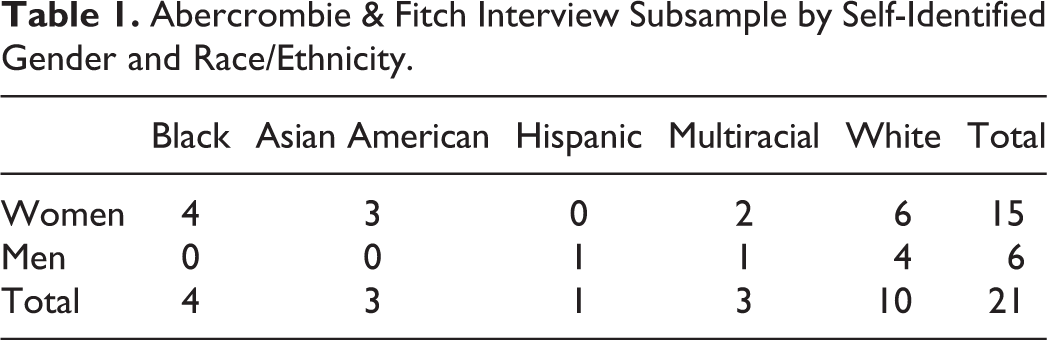
For this analysis, I draw on a subset of data from a primarily interview-based research project of 55 young U.S. clothing retail workers (Misra & Walters, forthcoming) as well as supplemental data sets of 35 shopper participant observations and web-based store information. The subsample includes 21 interviews with current and former Abercrombie retail workers (aged 18–23 years) as well as 16 shopper participant observations in A&F and Hollister. The majority of the interview participants were students at a local public university and had already left their A&F job at the time of the interview. Two attended a local two-year community college. At the time of the interview, six of the 21 respondents still worked for A&F. See Table 1 for workers’ self-described gender and race/ethnicity. Eighteen of these 21 interviews were conducted in person and three occurred using video calls. Nineteen participants had work experience in A&F stores located in the Northeastern region of the United States, while two participants had work experience with A&F in California and Georgia. Below I include pseudonyms alongside interview quotes that I present intact, save for light revisions to improve readability.
Abercrombie & Fitch Interview Subsample by Self-Identified Gender and Race/Ethnicity.
I also conducted two types of observations for this broader research study: in-store and web-based. Primarily, these were shopper participant observations, which consisted of 15–30 minutes of the researcher posing as a customer in the store (Pettinger, 2004, 2005). The surveillance of customers and the relatively small store size constrain the length of each observation. Although somewhat cursory, shopper participant observations help triangulate the labor process in clothing retail, allowing me to draw on direct observations of the organization of work and the typical customer interactions that workers encounter. Fifteen visits to A&F and Hollister were conducted in Western Massachusetts and one visit to A&F was conducted in the Los Angeles metropolitan area. Lastly, I engaged in slightly less systematic, but still informative observations of store websites, videos, and social media related to the stores, as well as worker and customer experiences. These web-based components provide further insight about how A&F brands itself, how workers perceive their jobs and the company, and how customers view the look that A&F sells.
Abercrombie’s Mall Models
A&F often greets its shoppers with a massive poster depicting a young White-looking guy with his mouth slightly agape. He poses shirtless with his upper groin area visible above the A&F jeans waistband. As Claire, a former Abercrombie model, described it: “The way my store was laid out is that like you walked in and saw the big picture of the half-naked man.” Although these models’ faces and stances vary over the weeks, seasons, and years, their chests remain eternally hairless, their faces blemish- and beard-free, and their abdomens muscular. These images show Abercrombie’s quintessential look, which the company describes as “cool” and “all American.” A&F’s visible retail workers act as the embodied versions of these young, skin-bearing, and mostly light-skin, White-looking bodies that adorn posters displayed throughout the store.
Until the most recent successful lawsuit against A&F for religious discrimination against a Muslim woman for wearing a headscarf (Liptak, 2015), the company called its sales associates models. The A&F (2014) website for retail job opportunities explains: “Models are an important part of the in-store experience and represent the brand through personal style, providing customer service and maintaining presentation standards.” Despite renaming this position to “brand representative,” the job description remains unchanged and therefore corporate expectations of visible retail workers are still appearance focused (A&F, 2015). Mall models are one of the most important dimensions of Abercrombie branding (Avery & Craine, 2007; McBride, 2005; Mears, 2014). Liz, a former Hollister stockroom worker, described the company’s expectation that employees embody the brand: When I was interviewed the manager was talking about how we have to look a certain way. And she was like, “There’s a reason for that. You guys are advertising the company …. You are a representation of the store. Therefore, the way you dress is a representation of the kind of clothes we put out.”
The A&F employee dress code is instrumental in cultivating the look among its retail staff (see also Maheshwari, 2013). Wearing the newest Abercrombie products is a requirement of the look policy (McBride, 2005; Mears, 2014) and a key labor mechanism to assert control over retail workers’ bodies (Lan, 2003). This policy requires workers to wear certain clothing from the current line. Even with the employee discount, workers fork over between US$30 and US$70 (depending on the outfit) every six weeks or so to stay current with the merchandise. All of the Abercrombie workers in my subsample received minimum wage, making this requirement highly exploitative.
Not only must workers don the newest full-priced clothing, but they must also adhere to the intensive rules governing workers’ hair, nails, jewelry, and makeup. Managers monitor whether workers fully comply with the look policy. Key to their job is surveilling and adjusting workers’ bodies. Regional- and store-level management enforces A&F’s appearance policy using various techniques from recuffing jeans in the corporate-designated style to directing employees to remove unsanctioned makeup, nail polish, facial hair, and jewelry.
During interviews, workers shared stories of managers sending staff home for violating the dress code. Some recounted having managers alter their appearance on the spot so they could complete their shift as scheduled. For instance, David, an Abercrombie model, said, “If the district manager sees you [with] facial hair at work, he’ll make you like shave it off there.” Others recalled managers telling them and their coworkers to wear more form-fitting clothes and remove unsanctioned makeup and jewelry as well as directing them to purchase merchandise in order to finish their shift in compliance with the dress code. While such enforcement may be unsurprising given the specificity of the look policy, these practices highlight the intensity with which A&F scrutinizes and regulates workers’ bodies in order to perpetuate the brand.
Recruiting for the Look
Many interviewees explained that A&F purposefully hires “good-looking” young people to work as mall models, ranging in age from 17 to 22. Abercrombie managers and their assistants actively recruit shoppers around the mall and college campuses to find models. I interviewed many workers who were recruited. Hannah, a former Gilly Hicks model, remembered that they distribute interview invitations to people who match the brand ideal: “On their little card, they pretty much tell you, they’re like, ‘We’re looking for attractive people to put in the store.’” Recruiting people with the look comprises an organizational strategy to select potential prize employees for their capacity to embody the brand (Mears, 2014; Warhurst et al., 2000). Although this hiring practice is questionable given antidiscrimination employment laws (Avery & Craine, 2007; Mears, 2014; Warhurst et al., 2009), it serves as a central sorting mechanism by which A&F maintains its bodily standards for retail workers.
The facts that Abercrombie recruits models and expects employees to possess the look have not escaped potential workers. During my research, I discovered hundreds of how-to videos to help viewers prepare for job interviews at A&F stores, recommending that they “wear what an Abercrombie model would wear” (Imjulielee, 2012) and offering makeup tips to attain the desired “natural beauty” look (Alybaly13, 2011). Such sources reveal the degree to which the youth workforce recognizes A&F’s looks-obsessed labor process, signaling that the company’s discriminatory practices are established as a crux of the brand and the work experience.
Not only do managers actively seek models to staff the store, but they also carefully stratify workers into visible and invisible jobs. While these so-called models work primarily on the sales floor folding clothes, cashiering, and assisting customers, another group is relegated to the stockroom. The difference between models and stockroom workers is entirely appearance focused. One former Hollister model, Patricia, described how managers regulate workers’ bodies. She spoke to the beauty-based discrimination of stratifying workers into different jobs: No one ever said anything to the people in the back, but as I said earlier, it was kind of like, “Oh the people in the back…” The managers would just say stuff, and you could kind of tell if they put you out front, they liked what you were wearing, that they liked how you looked. And if you were having a bad day and you ended up in the back, you would be like, “Oh yeah, knew that would happen.”
Going Shirtless and Getting Harassed
“Shirtless greeting” is one such signature retail labor practice (Berlinger, 2011). During a big shopping event and regularly at stores in major cities, men pose near the storefront wearing only A&F jeans and flip-flop sandals. Sometimes a woman stands between the shirtless men, modeling Abercrombie’s newest miniskirt. Shoppers meet these workers with fanfare and take pictures with them. This shirtless job involves managers selecting workers from their model staff. Jason, a former shirtless Abercrombie model, explained that the managers: Would approach me like, “Hey, are you interested in doing Black Friday shirtless greeting? If you are just meet up with me after [your shift] and we’ll take a picture.” And you take your shirt off, take a picture in the back of your whole waist up… Then the district manager would approve you for shirtless greeting.
However, shirtless greeting is mostly a rarity at smaller scale stores where Abercrombie workers appear more fully clothed while welcoming customers. Yet these encounters also demonstrate A&F’s sexualized aesthetic labor practices by situating workers so that they are likely to interact with customers of another gender. For instance, most of my time conducting shopper participant observations as a female researcher, I interacted only with men workers. Women seldom worked in the first room of women’s clothing, where female shoppers are most likely to begin browsing. This gendered and sexualized positioning indicates that A&F purposefully assigns workers to interact with customers under pretenses that customers regularly interpret as sexually inviting.
A&F workers described how customers frequently stare and sometimes “hit on” them. Many women noted their dislike of this experience, with only a handful of men and women saying they liked “looking good” at work and receiving sexual attention from customers. Patricia, who previously worked as a Hollister model, said, I always felt like kind-of an item to them. Weird … I remember like that they made me unbutton [my shirt], and like you couldn’t have bra straps [visible]. And, I was like their Barbie sometimes I felt like, which I didn’t really like at all.
Conclusion
A&F uses a host of practices to embed its sexual brand onto its retail workers’ bodies. This research note shows how Abercrombie’s labor practices, from their recruitment-based hiring and stratified job assignments to their look policy and encouragement of sexualized worker–customer interactions, impose their brand onto workers’ bodies. These aesthetic labor practices repurpose retail workers’ bodies to promote a particular brand of sex appeal through mechanisms that are otherwise lumped into a general sense of how service industry employers cultivate “looking good” and “sounding right” in their workforce (Warhurst & Nickson, 2001). My analysis of sexualized aesthetic labor practices illuminates some aspects of discrimination and harassment that stem from embedding Abercrombie’s look onto retail workers’ bodies. While A&F creates a sexual brand to increase revenue, workers tend not to experience these labor practices as establishing welcoming workplaces. Instead, they express discomfort with their bodies becoming sexual brand objects.
Although I focused on A&F, these practices exist across brand-based service industries. Decline of aesthetic labor may occur due to judicial decisions that deem these practices discriminatory (Liptak, 2015). Yet we should expect sexualization of workers to continue for some time throughout the service economy, subjecting employees to discrimination and alienating appearance-based practices in attempt to create “cool” brands (Warhurst et al., 2009).
As critiques of aesthetic labor emerge, we should consider the possible linkages between these labor practices, workers’ experiences, and activism. Disrupting the normalcy of seeing low-wage workers exploited as brand objects seems prudent. Consumer- and media-based activism may be a vital way to expose the industry’s exploitative practices by turning corporate brands against themselves (see also Harold, 2004). Economic boycotts could also illuminate connections between branding and unlawful employment practices. Further research can help broaden our understanding of corporate utilization, as well as employee and customer experiences, of aesthetic labor within the brand-based service industry.
Footnotes
Acknowledgements
The author offers her sincere thanks to the anonymous reviewers, Ana J. Bridges, Joya Misra, and Derek Doughty for their helpful feedback on previous versions of this research note.
Declaration of Conflicting Interests
The author(s) declared no potential conflicts of interest with respect to the research, authorship, and/or publication of this article.
Funding
The author(s) disclosed receipt of the following financial support for the research, authorship, and/or publication of this article: This research note received support from the Labor Research and Action Network.