




Abstract
This article employs a content analysis to investigate whether and how the violent woman archetype in action film changed from 1960 to 2014. We find a trend toward hypersexualized female action leads (FALs), starting in the 2000s. This trend is in line with the broader social trends of hypersexualization during this period, evidenced in a variety of other media sources. We then combine these findings with existing research to discuss the likely affects on viewers’ attitudes and beliefs. We suggest that the trend toward hypersexualizing FALs has harmful public health affects and is part of a broader cultural backlash against gender equity.
Introduction and Motivation
Scholarly interest in representations of women and femininity/masculinity in film has intensified in recent years (Gwynne & Muller, 2013). We join the conversation with an analysis of the cultural implications of the trend toward hypersexualized female action leads (HFAL). The broader context of this trend is a rapid increase in female sexual objectification in advertising, magazines, television shows, video games, and music videos in the past decade (Behm-Morawitz & Mastro, 2009; Fisher, Hill, Grube, & Gruber, 2004; Ivory, 2006; Miller & Summers, 2007). Popular culture has become saturated with these images in such a way that viewers are now accustomed to content that may have been considered shocking in the past (Boyle, 2010; Nikunen, Paasonen, & Saarenmaa, 2007; Paul, 2005; Sarracino & Scott, 2008). Despite the fact that women make up half of the movie-going audience Motion Picture Association of America (MPAA, 2015), only 15% of leading roles and 31% of speaking roles go to women (Lauzen, 2015). Moreover, when female characters are included, they are far more likely to be sexualized than are male characters. One in three (29%) female characters is portrayed in “revealing clothing” (compared to 7% of male characters), and one in four (26%) appear partially or fully naked during the film (compared to 9% for male characters). While some scholars argue that these trends are indicative of women’s empowerment through ownership of their own sexuality, mounting evidence suggests that this new norm of female sexual objectification in pop culture has harmful health effects for girls and women (American Psychological Association [APA], 2010; Dines, 2011).
In this analysis, we focus specifically on female action leads (FALs) in films—an increasingly popular and mainstream genre. Female characters in these films are generally sold to the movie-going public as empowered women, often even invoking rhetoric from the feminist movement in publicity campaigns. Moreover, many media scholars argue that because violent female characters—as FALs tend to be—are generally endowed with the physical strength and capacity for violence generally reserved for male characters, they offer representations of autonomy and liberation that is often missing from other fictional female typologies. Further, action films are the most male-dominated genre, so this research provides the starkest representation of the extent to which, how, and under what conditions women are allowed into this symbolically male cinematic space.
Looking at the broader media trends toward increasingly hypersexualized representations of women and girls, we ask whether female leads in the action genre have suffered the same fate; has the FALs become more hypersexualized over the last several decades? Or, alternatively, is the action film genre perhaps an exception to what seems to be the broader social rule?
We explore this question through a content analysis of the1,358 wide-release action films from 1960 to 2014. We find that, despite the potential empowerment that these characters offer, FALs are more hypersexualized in the current era than at any time since the 1960s. This result is striking, particularly in light of the broader narratives that these characters represent strong and autonomous women. We follow our analysis with an extensive discussion of the potential social and cultural implications of this trend, and its likely effects on viewers. Synthesizing the findings of several recent studies in social psychology and communication with our results, we pay particular attention to the way this trend likely affects women and girls, and the potential public health impacts it presents.
This research makes several unique contributions to existing scholarship. It is the first quantitative study of how FALs in popular film have changed over time. Media scholars almost exclusively employ qualitative case study and textual analysis. These methods are crucial for an in-depth understanding of the films and their characters, but quantitative analysis that spans a large scope of time is superior for understanding broader shifts and trends in character typologies over time. As such, this study is the first to quantitatively identify an increase in hypersexualization in the genre, and also the first to discuss the contours of the trend. This knowledge further illuminates the interplay between women’s social, economic, and political progress in the real world, and ways they are represented on the screen. By engaging with the action film, we do so in the genre that is perhaps least likely to foster hypersexualization.
Our research and subsequent discussion also directly inform the debate about whether female leads can be empowering for viewers, even in the face of hypersexualization. Indeed, the first question is whether or not these characters have become increasingly hypersexualized, as female characters in other genres have in recent years. However, the mere presence of this hypersexualization does necessarily undermine a character’s radical potential. Indeed, a vibrant debate exists about whether hypersexualization is itself empowering and, if not, whether a hypersexualized female character can still represent strength and autonomy. Bringing a social science lens, we argue that many media scholars have not sufficiently explored how human beings process sexualized images, especially the question of whether object status trumps subjectivity in the minds of viewers. In doing so, we introduce evidence not previously included in this discussion into the ongoing conversation.
It is worth noting here that we confined our analysis to violent female leads in action films. Existing literature (discussed below) suggests that this character type may be distinct from other types of FALs and, thus, requires analysis that focuses solely on this group. Moreover, as noted above, the endowment of FALs with powerful violent behavior, generally reserved for male characters, is one of the reasons to suspect this character type may not have become more hypersexualized over time. Finally, nonviolent FALs are quite rare—they represented less than 1% of the films included in our study, making them something of an anomaly—so we do not anticipate that excluding them from analysis affected our findings in any meaningful way.
To investigate shifts in violent FALs over time, we completed a content analysis of violent female action protagonists, exploring whether or not they were hypersexualized.
Contextualizing the Violent Woman in Film
Violent female characters have been a part of cinema since Kate Kelly brandished a shotgun in “The Story of the Kelly Gang” (Gibson, Thompson, Tait, Tait, & Tait, 1906), the world’s first full-length feature film. Violent women dominated the Serial Queen Melodramas (1912–1915), a series about female protagonists going to extremes to protect and rescue the people they love (Singer, 1990). Violent women occasionally appeared as femme fatales in film noir in the 1930s and 1940s and in the horror films of the 1970s, but, in the 1980s, violent women started to populate every cinematic genre. Today, she makes routine appearances in westerns, martial arts movies, romantic comedies, dramas, and action films.
Violent women became common in the action genre starting in the 1960s (Arons, 2001; Brown, 2001; McCaughey & King, 2001). B-movies from that era featured White, working-class women exacting revenge with bats and knives, while the blaxploitation films of the 1970s featured violent Black women (e.g., Pam Grier in “Foxy Brown”; Feitshans & Hill, 1974). The 1980s brought an explosion of violent FALs. Women’s social, political, and economic strides in real life were projected on the big screen through characters who were “skilled with weaponry, licensed to kill, beating up men” (McCaughey & King, 2001, p. 6). But American popular culture is still mostly driven by heterosexual male fantasies (Jeffries, 2015), and the violent woman character is not static nor is she intrinsically empowering. Trends of women’s hypersexualization in media motivated scholars to consider whether this new powerful and violent female character typology offered empowerment to girls and women, particularly if she was also hypersexualized in the process.
The Empowerment Question
Women have traditionally appeared in action films as romantic interests, tomboys, or sidekicks to male protagonists, but, in the 1980s, a new symbolically transgressive character emerged in the form of Ripley (Sigourney Weaver) in the Aliens franchise, Sarah Conner (Linda Hamilton) in “Terminator 2: Judgment Day” (Cameron & Cameron, 1991), and the title characters in “Thelma & Louise” (Gitlin, Scott, & Scott, 1991). She was physically buff and/or enacted extreme violence typically reserved only for men. This new hyperviolent woman inspired significant debate about whether she was (and is) an empowering icon for girls and women (Neroni, 2005).
Many scholars argue that, although female action characters have gained power by enacting traditionally male violence, their “toughness” is undercut in ways that perpetuate women’s second-class social status. More specifically, the violent woman is presented as physically inferior to men in ways that promote the higher value of the male warrior archetype (Early & Kennedy, 2003; Inness, 1999); she is often shown in disguise, as though her toughness is just another masquerade (Inness, 1999); her physicality is presented as comedic (Tasker, 2004); she is fetishized as a phallic woman (Dole, 2001); she fits existing Western tropes of Whiteness and heteronormativity that relegate women of color to stereotypes of being exotic, oversexualized, and criminal (Tung, 2004); and her toughness is seen as a sin that can only be rectified by sacrificing her life (e.g., Buffy the Vampire Slayer, Dark Angel, and Thelma & Louise; Crosby, 2004).
The most sustained critique of the FALs is that she is typically hypersexualized in ways that inhibit her agency (Gwynne & Muller, 2013; Tasker, 1993). Sexual objectification is the act of treating a person like an object that exists for the sexual pleasure of others. It is a capitulation of women’s sexuality to the implied male subject/consumer (Brownmiller, 1975; Dworkin, 1976; MacKinnon, 1979, 1985, 1987). From sexual objects to sexualized violence, women’s representations in film have been troubling since the start (Haskell, 1974). Plot lines often revolve around active/male and passive/female representations where women are reduced from human being to erotic objects to be consumed by a “male gaze” (Mulvey, 1975). The process of objectification is achieved with clothing (or often lack thereof) and camera angles that send the message that women are placed in the frame to be looked at (Doane, 1990), and the narrative of any given film is superseded by the gender narrative where “women are simultaneously looked at and displayed, with their appearance coded for strong visual and erotic impact so that they can be said to connote to-be-looked-at-ness” (Mulvey, 1975, p. 11). Wendy Arons (2001) argues that hypersexualization diminishes the symbolic threat posed by the violent woman character: The focus on the body as a female body—as a body in ostentatious display of breasts, legs, and buttocks—does mitigate the threat that women pose to ‘the very fabric of … society’ by reassuring the (male) viewer of his privilege as the possessor of the objectifying gaze. (p. 41)
Despite the above critiques, many scholars are more optimistic about the empowering potential of FALs, particularly those who are hypersexualized. These scholars see a transgressive power in hypersexualized female leads projecting conventionally masculine and feminine traits (Andris & Frederick, 2007; Brown, 2001, 2011; O’Day, 1998). Some celebrate the sexualized female action hero as empowered because her sex appeal is overt and does not reflect conventional feminine sexual passivity (Brown, 2004; Inness, 2004; Schubart, 2007). Brown (2001) summarizes this position well, arguing that: Rather than being disempowered through their role as the object of a fetishizing male gaze, and rather than being passive damsels in distress, these women exert power over the men in the film first through their control of the men’s looks and secondly through their ultimate victory over the men who seek to terrorize them. (p. 66)
Below, we first analyze whether, as the number of violent female leads has grown, the rate of hypersexualization has also increased—as broader backlash trends in media might suggest. This trend matters now more than ever; over 70% of Americans view movies on a regular basis, and the average person sees six movies in a theater per year (MPAA, 2015), making it “one of the most pervasive vehicles for communication in American culture” (Hirschman, 1987, p. 336). We then engage with the question of empowerment, synthesizing our analysis with existing research in public health, psychology, and other fields to delve more deeply into questions about how new media trends may affect women and girls.
Data and Method
In order to answer our research question, we performed a content analysis of violent female protagonists in U.S. wide-release action films from 1960 to 2014. Wikipedia designations were used to compile a comprehensive list of wide-release action films from every decade. A total of 1,387 action films were released in the United States during this time. 1 We selected Wikipedia because it provides the most comprehensive lists of action films organized by decade. Other sources like Internet movie database (IMDb), for example, list only the top grossing films. A film was categorized as “wide release” if it was released nationally in at least 600 theaters. A complete list of films included in the content analysis is given in the Appendix.
Once this list was compiled, three questions were asked: (1) does the film have a female protagonist?; (2) does she use violence; and (3) is she hypersexualized? A team of two coders analyzed the films to answer these questions. 2 Female characters were coded as “protagonists” if they met the following conditions: (1) had first or second billing, (2) appeared on the film’s cover, (3) were identified as a lead or colead who contributed to the plot in the IMDb film synopsis, and (4) actually appeared in the film as a lead/colead. This final criterion was determined by first viewing the trailer, and, if necessary, part or all of the film, either using a sped up frame-by-frame analysis or a full movie viewing. A total of 180 wide-release action films featured female leads or coleads during the period examined.
Next, these female protagonists were classified as either “violent” or “nonviolent.” Violence was determined by a display of physical force using the body and/or a weapon at some point during the film. As noted above, virtually every female protagonist was coded as “violent.” Of the 180 films, only 7 featured a female protagonist who was nonviolent. 3 These films were not included in the analysis, so the final data set consists of 173 films with violent female lead/coleads.
The final step was to determine whether the protagonist was hypersexualized. Scholars noted that the physique, apparel, and camera angles of violent female leads can be tailored to present very different looks, from a “masculine” tough character to androgynous to an ultra-femme “action babe” (Andris & Frederick, 2007; Gwynne & Muller, 2013; O’Day, 1998). We did not code for physique in our analysis, instead focusing on more explicit visual cues. Female protagonists were classified as hypersexualized if they were “scantily clad,” partially or fully nude, and/or presented as “sexualized body parts” through selective camera angles, during any scene in the film. 4 For each film, we test the implicit hypothesis: “the protagonist is not hypersexualized.” Coders viewed as much film footage as was needed to accept or reject this hypothesis. The findings below are based on viewing the entire film 75.7% of the time (131 films), the first 30 min of the film 19.1% of the time (33 films), and the film trailer 5.2% of the time (9 films).
There were some variations on the violent woman archetype: Characters who were gratuitously sexually objectified in most frames (e.g., a scantily clad scientist), highly sexualized as part of the plot (e.g., an undercover stripper), highly objectified in specific scenes (e.g., fighting with their breasts exposed), or were sexualized throughout with only specific scenes of violence (e.g., the “sexy girlfriend” who kills the villain). Each of these variations was classified as hypersexualized.
Analysis
General findings
As Table 1 indicates, our analysis reveals that female leads are rare in the action genre. Fewer than 10% of action films in the 1960s–1980s featured a female lead or colead, a number that peaked in the 2000s at 16% but has declined to less than 15% today. This fits with the broader trend of only 12% of female leads across all genres, a number that has declined four percentage points since 2002 (Lauzen, 2015).
Hypersexualized Female Action Leads by Decade, 1960–2014.

Our analysis reveals that gratuitous nudity is common for FALs; that they are presented as empirically different character types than male action leads because there is an expectation that they will not only kick ass but also sexually titillate. Overall, 43.9% of violent FALs were hypersexualized, but this varied widely by decade. While all of the FALs were hypersexualized in the 1960s (there were only three), only one in four were sexualized in the 1970s, 1980s, and 1990s. Then, in the 2000s, the percentage of HFALs shot up to 65.6%. It dropped to 40% from 2010 to 2014. HFALs are not only common, they have become more so over time, especially in the 2000s, a decade that saw a dramatic improvement in the number of female leads in action films. In other words, as more women were featured as action leads, they were also more likely to be hypersexualized.
We now detail the findings of each decade in greater detail to get a better sense of how FALs have shifted over time. In the 1960s, she was very rare in action films and campy, almost to the point of absurdity. The violent woman of the 1970s reflected the “new woman” of the feminist movement—armed, dangerous, and out for revenge against men who had wronged her or her family. FALs in the 1980s and 1990s were often professional women and more serious action leads, but these feminist gains were reversed with the rise of what Mark O’Day (1998) dubbed “action babe cinema.” We present detailed case studies noteworthy FALs and HFALs along the way and pay particular attention to two cases from recent popular culture memory: Catwoman from “Catwoman” and Katniss from “The Hunger Games.”
The 1960s
Three action films featured female protagonists in the 1960s. The earliest is the Italian/French film “The 10th Victim” (Ponti & Petri, 1965) featuring Caroline Meredith, a participant in a high-stakes hunting game that includes a striptease scene where she shoots a target with guns hidden in her bikini top. The following year saw the release of “Faster Pussycat! Kill! Kill!” (Meyer, Meyer, & Meyer, 1965). The plot centers on a desert crime spree involving three go-go dancers. Advertised as an “Ode to the Violence in Women,” Faster Pussycat features bulging breasts, bare midriffs, and sexualized violence galore, as the three criminals take what they want through force. The physical power exuded by the gang’s riveting leader, Tura Satana, is notable even by today’s standards, where violence is far more common than in the 1960s, but her gratuitous sexualization sends a mixed message about existing for herself versus being an object for others to visually consume (see Figure 1). The third film featuring a FALs was the “The Mini-Skirt Mob” (Dexter & Dexter, 1968), a movie chronicling the adventures of an all-female motorcycle gang headed up by Shayne, a jilted, revenge-seeking leader. According to the trailer narrative, “They’re mini skirt riders, and they ride hard, no matter what they’re mounted on.” This film includes many gratuitous shots of legs and buttocks and a sexualized “girl fight” with panties exposed.
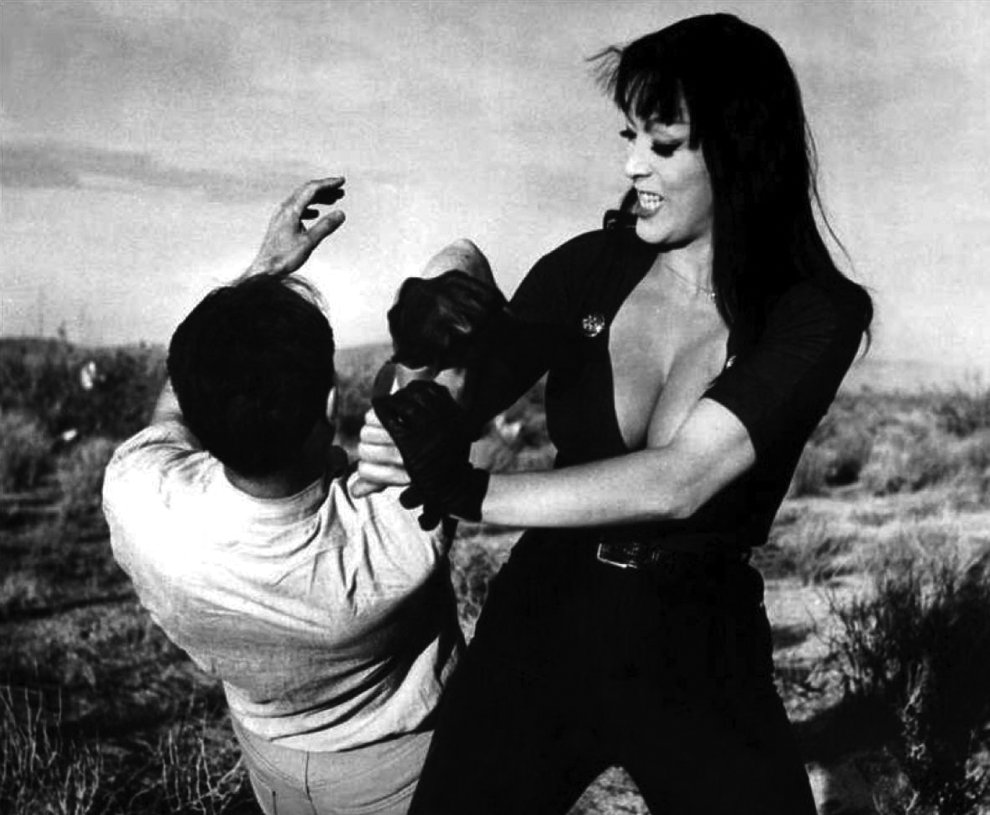
Tura Satana in “Faster Pussycat Kill! … Kill!” (Meyer, Meyer, & Meyer, 1965).
Many secondary characters in the James Bond and Matt Helm franchises fit the violent woman label during the 1960s, but of the 31 wide-release action films of that decade, only 3 feature female protagonists, and all 3 were over-the-top hypersexualized characters. It is difficult to draw definitive conclusions with so few cases, but Hollywood’s first FALs were, without exception, unabashed sexual props whose ticket into the genre was titillation.
The 1970s
The action genre gained remarkable popularity in the 1970s, as evidenced by the sixfold increase in the number of films made compared to the previous decade (31 films in the 1960s compared to 189 films in the 1970s). 5 Fifteen films featured female leads or coleads—less than 10% of the total films and a rate virtually identical to the 1960s. One in five female protagonists in these films were hypersexualized. For example, the film “Coffy” (Papazian, Feitshans, & Hill, 1973) featured Pam Grier as a vigilante-seeking revenge on drug dealers who got her sister addicted. A primary plot device is Coffy using her sexuality to lure men to her home where she kills them with privacy. Other films during the 1970s like “TNT Jackson” (Santiago & Santiago, 1975), “Cover Girl Models” (Santiago & Santiago, 1975), and “Angels Revenge” (Clark & Clark, 1979) all portrayed an HFAL, but movie goers were also exposed to a range of female leads who were capable, tough, and while sometimes sexual, not hypersexualized, including Ali McGraw in “The Getaway” (Brower, Foster, & Peckinpah, 1972), Tamara Dobson in the Cleopatra Jones series, Carrie Fisher in the first “Star Wars” (Kurtz & Lucas, 1977), and Pam Grier in “Sheba, Baby” (Sheldon & Girdler, 1975). This is the only era in which Black women dominated the genre, although they were stereotyped and often objectified in blaxploitation films (Sims, 2006).
The 1980s
Action films became even more popular in the 1980s (189 films in the 1970s compared to 255 films in the 1980s), but women remained vastly underrepresented as protagonists with only 21 female leads (8.2%, a slight decline from previous decades). Action films were undergoing a violent transformation during the 1980s, as both President Ronald Reagan and Hollywood reasserted American “manhood” in the post−Vietnam era through masculine narratives (Faludi, 1991). The 1980s brought us the wildly popular “Exterminator” series about a vigilante Vietnam veteran John Eastland (Robert Ginty) who cleans up organized crime, the “Rambo” franchise that follows a veteran’s (Sylvester Stallone) pursuit of vindication, and Chuck Norris’ “Missing In Action” series and “Invasion USA” (Globus, Golan, & Zito, 1985) with similar plots. The new hypermasculine male action hero of the 1980s wielded power through brute physical force that required muscle-bound bodies (e.g., Arnold Schwarzenegger, Stallone, Dolph Lundgren, and Jean Claude Van Damme).
Thought generally, this was an era of masculinization, there were a number of notable FALs, as well. Michelle Yeoh and Cynthia Rothrock became established bankable martial arts stars in the 1980s with multiple films featuring fast-paced fights. This decade also gave viewers action babe characters in “Alley Cat” featuring a martial arts vigilante who takes revenge against a group of thugs terrorizing her family (Ordonez, Waters, Ordonez, Palmos, & Valletta, 1984), “Sheena,” the “queen of the jungle,” who fights to preserve her homeland with bare feet and a bare midriff (Aratow & Guillermin, 1984), and “Red Sonja” a sword-wielding fighter who seeks revenge against the queen who murdered her family (Ferry & Fleischer, 1985). But perhaps the most well-known FALs of the 1980s is Princess Leia (Carrie Fisher) who became an HFAL as a scantily clad slave at the end of a chain held by Jabba the Hutt in “Return of the Jedi” (Kazanjian & Marquand, 1983). Princess Leia was not hypersexualized in the first two Star Wars movies, but this scene from the third film has become her most enduringly memorable, and her golden bikini is now the iconic image associated with her character.
The 1990s
The rapid growth of action films continued in the 1990s, with a 32% increase in films produced over the previous decade (255 in the 1980s compared to 328 films in the 1990s). Only 11.6% (43) of the films featured female protagonists. One fourth of these protagonists were hypersexualized, epitomized by Pamela Anderson’s role in “Barb Wire,” a club owner and mercenary who gets caught up in a secret government plot to fight the fascism that has swept the United States (Moyer, Richardson, Wyman, & Hogan, 1996), and Uma Thurman’s role in “The Avengers,” a secret agent intent on stopping an evil genius who has discovered how to control the weather (Weintraub & Chechik, 1998). However, female protagonists in the 1990s looked qualitatively different than previous decades.
The 1990s was a decade dominated by martial arts movies featuring Jet Li, Yeoh, Van Damme, Rothrock, Maggie Chueng, Jackie Chan, and others. The physical evolution of Weaver in the “Alien” franchise and Hamilton in the “Terminator” franchise—from thin, tough women to heavily muscled killing machines, capable of physically going toe-to-toe with male villains, as the franchises progressed—indicates greater acceptance of women as serious action heroes (providing them an opportunity to transcend traditional femininity but also requiring that they conform to male standards of masculine brute). Sarah Connor’s evolution from a scared party girl in the first “Terminator” to a buff, emotionally hardened killer in “Terminator II” epitomizes the shift of FALs in the 1990s, from tough but conventionally feminine characters to even tougher and more masculine characters.
More FALs in the 1990s were portrayed as agentic through professional roles than previous decades: as police officers (Jamie Lee Curtis in “Blue Steel,” Pressman, Stone, & Bigelow, 1990; Rothrock in the “Martial Law” series, Kathleen Turner in “Undercover Blues,” Lobell & Ross, 1993, and Claire Danes in “Mod Squad,” Ludwig, Myron, Riche, & Silver, 1999), talented special agents (Anne Parillaud in “Nikita,” Ledoux & Besson, 1990; Geena Davis in “The Long Kiss Goodnight,” Austin, Black, Harlin, & Harlin, 1996), and as professionals with advanced degrees (Laura Linney in “Congo,” Kennedy, Mercer, & Marshall, 1995; Julia Roberts in “Conspiracy Theory,” R. Donner, Silver, & Donner, 1997). At the same time, however, this decade also birthed action babe cinema featuring highly sexualized, nonrealistic representations of female physicality from slim, White, heterosexual bodies with perfect makeup and not a hair out of place (O’Day, 1998; Purse, 2011). Through stunt doubles, wires, and computer-generated imagery, the action babe of the 1990s achieves incredible physical feats while maintaining a feminine perfection that does not reflect her physical exertion or the type of physical prowess required to perform such feats. 6 For example, Davis’s character in “The Long Kiss Goodnight” is a CIA assassin, who manages to look perfect, despite surviving a knife fight, a gun fight, and torture involving a water wheel. Purse (2011) argues that the inauthentic, unconvincing physicality of the action babe is a form of visual and narrative containment of the agency of the FALs. In sum, the 1990s saw more opportunities for FALs, many of whom did not become HFALs during the course of the film and were afforded professionalized statuses. At the same time, this era birthed a new typology of the HFAL, continuing with the trends of backlash from previous eras.
The 2000s
The rapid expansion of action movies slowed in the 2000s, with only a 14% increase in wide releases over the previous decade (from 328 films in the 1990s to 383 films in the 2000s). The percentage of female protagonists overall increased from 12% to 16% (from 43 to 61), but the proportion of HFALs more than doubled from the previous three decades—from about one in four to two thirds (65.6%). In her place is a rather cookie cutter action babe, cloaked in form-fitting latex suits with bulging breasts and bare midriffs. If the 1990s were the heyday of agentic FALs, the 2000s were the heyday of the “fighting fuck toy”—a hyperviolent, hypersexualized female lead (Heldman & Holmes, 2005), which was only in nascent stages of development during the 1990s. Generally speaking then, the rate of HFALs remained somewhat constant between during the 1960s and 1980s, grew during the 1990s and rapidly increased in the beginning of the 21st century and, as detailed below, declined somewhat in recent years.
The most common hypersexualized female action character of the 2000s was set in a fantastic or fantasy world where her physical prowess could be accounted for by “magical” or artificial superhuman means, including “Tomb Raider” (Gordon, Levin, Wilson, & West, 2001), “Catwoman” (Di Novi, McDonnell, & Pitof, 2004), “Elektra” (Arad, Foster, Milchan, & Bowman, 2005), “Aeon Flux” (Gale, Gale, Goodman, Lucchesi, & Kusama, 2005), “Ultraviolet” (Baldecchi, Foster, Mark, Chan, & Wimmer, 2006), “Grindhouse” (Avellan et al., 2007), “Wanted,” (Lemley, Netter, Platt, Smith, & Bekmambetov, 2008), the “Kill Bill” franchise, and the “Underworld” franchise. 7
A rarer female lead was gritty, down to earth, and highly sexualized, like Keira Knightley in “Domino” (Hadida, Scott, & Scott, 2005), a fashion model turned bounty hunter who performs both incredible violence and a striptease in the film, and Heather Marie Marsden in “Lethal” (Cetiner, Munch, Yap, & Rikert, 2005]), a mercenary who goes up against the Russian mafia with heavy weaponry and revealing, tight outfits. HFALs also proliferated in more supporting roles during this time, especially franchises with an ensemble cast (e.g., “Gone in 60 Seconds,” Bruckheimer, Stenson, & Sena, 2000; “X Men,” L. Donner, Winter, & Singer, 2000; “The Fast and Furious,” Moritz & Cohen, 2001; “Fantastic Four,” Arad, Eichinger, Winter, & Story, 2005; “G.I. Joe,” Bonaventura, Ducsay, Goldner, & Sommers, 2009). Some action films in the 2000s explicitly harkened back to the almost comical sexualization of FALs of the 1960s, such as the “Charlie’s Angels” franchise and “Bitchslap” (Gruendemann, Jacobson, & Jacobson, 2009) featuring hyperfeminine women performing unrealistic feats of strength and violence. “Armies” of hypersexualized violent women also surfaced in the 2000s with memorable scenes from “Grindhouse” (Avellan et al., 2007) and “RoboGeisha” (Chiba, Hayama, Nakamura, & Iguchi, 2009).
Halle Berry’s character in the film Catwoman (Di Novi et al., 2004), the film adaptation of the Marvel comic, demonstrates the limitations of the action babe. IMDbPro refers to Catwoman as “a shy woman, endowed with the speed, reflexes, and senses of a cat, [who] walks a thin line between criminal and hero, even as a detective doggedly pursues her, fascinated by both of her personas.” Indeed, as the use of the term “persona,” instead of “personality” or “identity” might indicate, Catwoman is a character without core identity who, instead, acts out reified social constructs—personae or masks.
In the opening of Catwoman, the protagonist, Patience Phillips, is presented as a mousey, soft-spoken graphic designer. In the inciting incident, with her hair down and tousled, wearing frumpy, baggy clothes, Patience risks her life to rescue a stray cat on the roof of her apartment building. As Patience is balancing on the outside of her building, attempting this courageous—if not foolhardy—act, Tom Lone, a police chief, sees her and assumes she is on the verge of ending her life. Lone rushes up the stairs and a split second before Patience drops multiple stories to her probable demise, reaches through the open window, rescuing her.
Patience works at a fashion design firm where she is berated by her boss. One evening she is ordered to revise an ad layout for a new product, and after working well into the night, she is forced to hand-deliver her design because all messenger services are closed. Upon this delivery, the meek designer stumbles upon some deadly information. At this point, Patience is chased by company thugs and eventually killed. Forced through a main water line, Patience’s body is plunged under water. Her dead body surfaces and is washed up to land, covered in dirt and seaweed, and surrounded by cats. The cat Patience tried to rescue earlier in the day appears and breathes new life, via supernatural green breath, into her body. Patience is reborn as Catwoman with keen senses, great balance, a taste for tight-fitting clothes, supernatural green breath that can stun and seduce the opposite sex, and the ability to steal and kill like a pro. Indeed, the superhero agency that Catwoman receives from the green breath of an ancient cat creates a character whose every sultry, sexualized move exists for the consumption of the audience.
At this point in the film, the leading character shifts from being a meek, spineless protagonist subject to a fighting, sexualized protagonist object. Patience, now Catwoman, cuts her hair and tightens her clothes. Simultaneously, her ability to relate to the opposite sex increases and she seeks out the rescuing police officer from whom she previously hid.
As night approaches, something “animalistic” overtakes Patience as she dons a never-been-worn-before tight black leather “date outfit” and black stiletto heels (see Figure 2). Patience slinks through the night discovering a strong sense of sexual confidence, along with an ability to steal from thieves and kill like a cat. Avenging her murder becomes Catwoman’s driving passion. When Officer Lone asks Patience if she has heard of Catwoman, she replies “Oh yeah–hot, black leather, whip.”

Halle Berry in “Catwoman” (Di Novi et al., 2004).
Patience creates an outfit of intrigue by cutting large areas of leather from her “date outfit” to create a suit that hides her identity (covers her eyes) and leaves little else to the imagination. Her body becomes the sight for objectification as the camera focuses on her open back, black-leathered buttocks, high-heeled feet, black-gloved and gem-studded claws, cleavage-revealing bodice, and hip swinging walk. As the story progresses, Catwoman does in fact kill the men who “killed” her. The camera follows her, focusing on body parts surrounded with black leather. She kicks and runs and jumps wearing stiletto heels, cracking her dominatrix whip. Patience is dead, but Catwoman, using Patience’s human form, is a merciless killer whose body is constantly objectified. At the end of the movie, Catwoman walks across a high steel beam into the full moon. Metaphorically, she is walking away from all ties of her “human” existence; her ability to kill has given her the power to be “as good or as bad as she wants to be.” She chooses a solo existence as her sexualized body slinks into the full moon; even this otherwise agentic act is constructed for the consumption of the male gaze that follows her. The film presents her agency, power, and freedom as derivative of her hypersexualization.
The 2010s
From 2010 to 2014, the number of female protagonists in action films declined from 15.9% to 14.9%, likely due to Hollywood’s latest fascination with movies based on comic book characters (e.g., the Spider-man franchise, 2010, 2012, and 2014; the G.I. Joe franchise, 2009, 2011, and 2013; “Man of Steel,” Nolan, Roven, Snyder, Thomas, & Snyder, 2013; the X-men franchise, 2009, 2011, 2013, and 2014; “The Avengers,” Feige & Whedon, 2012; the Thor franchise, 2011 and 2013; the Captain America franchise, 2011 and 2014; the Iron Man franchise, 2008, 2010, and 2013), and women’s long-standing erasure as (mainstream) comic book superheroes. The box office flops of comic book adaptations Catwoman, Elektra, and Aeon Flux made female-led comic book adaptations risky for Hollywood studios which, we argue below, is directly linked to protagonist hypersexualization.
The proportion of HFALs declined substantially during this period: from 65.6% in the 2000s to 40.0% in the first 4 years of the 2010s. Despite this decline, the overall rate is still significantly higher than it was prior to the 1990s. FALs are still expected to be substantively different than male action leads; they are expected to be sex objects. This expectation was apparent in the critical reception of “Mercenaries” (Latt, Rimawi, Bales, & Ray, 2014), the female equivalent of the popular “The Expendables” franchise. “Mercenaries” starred action genre veterans Kristanna Loken, Cynthia Rothrock, Vivica A. Fox, Zoe Bell, and Brigitte Nielson. As one film critic wrote: A quote kept entering my head when watching this movie, a line Steve Buscemi once uttered: “Where could a guy find some action?” Not that type of action, I’m talking about sex and nudity, particularly from the best looking of the bunch, Kristanna Loken. Alas, there is none, which pretty much removes the reason why any of us might remotely avoid changing the channel, should it accidentally appear on TV some night.
8
The current status of FALs seems somewhat bleak in terms of overall numbers and expectations of hypersexualization. However, there are indicators that the genre is shifting again through market forces. Three franchises that feature late-teen female protagonists who are not hypersexualized have been wildly successful in recent years: The Twilight Saga (2008, 2009, 2010, 2011, and 2012), The Hunger Games series (2012, 2013, 2014, and 2015), and the Divergent series (2014, 2015, 2016, and 2017) have raked in US$3.3 billion, US$2.3 billion, and US$580 million, respectively (TheNumbers.com, 2015). All three franchises feature strong-willed, physically capable female protagonists—Twilight’s Bella (Kristen Stewart), The Hunger Game’s Katniss (Jennifer Lawrence), and Divergent’s Tris (Shailene Woodley). 9 We delve deeper into “The Hunger Games” as an example of an empowered FALs who defies the HFAL norm.
“The Hunger Games” is an action thriller set in a dystopic future world where children fight to the death on a reality television show. In its first weekend, “The Hunger Games” grossed US$155 million, making it the third highest opener of all time, despite a marketing budget half the size of a typical big-studio, big-budget film (Barnes, 2012). It was the top opener for a film released outside of July, the top nonsequel opener, and the top opener with a female protagonist, and by the second weekend, it became the fastest nonsequel to break the quarter-billion-dollar mark (Barnes, 2012). The success of the series is largely based on the wide appeal of its teenage hero, Katniss Everdeen, a reluctant, believable hero who has acquired exceptional archery expertise by necessity (to feed her family). The plot is set in future North America where only the capitol city of Panem and 12 districts survived. Panem has tight control on the districts, each of which provides specific resources to the capitol. Katniss’ District 12 supplies coal to Panem, and she and her mother and sister are near starvation because her father died in a mining accident. Katniss escapes this bleak landscape by unlawfully climbing through a fence and hunting for food in the forest surrounding District 12. Panem hosts the Hunger Games each year where two people (tributes) from each district fight to the death. This death game is meant to remind the residents of the districts of the threat they face should they defy the capitol and attempt to establish independence. Katriss fights valiantly in the Hunger Games but refuses to kill Peeta Mellark the other tribute from District 12—a strikingly feminine act. Instead, they threaten suicide to save their lives.
Jennifer Lawrence wears a variety of costumes in each of The Hunger Games films—everyday clothes, inventive ball gowns, and other hyperfeminine apparel for the events leading up to the games, and specially tailored fighting suits for the actual Hunger Games. Her wardrobe changes are frequent and stylish, but she is never reduced to a sexual objectified through revealing clothing or suggestive camera angles. The filmmakers, staying true to the book, made the decision to maintain Katniss’ subjectivity by allowing her to be a visually complex character whose clothing serves the task at hand rather the heterosexual male gaze. They could have easily fallen into expectations for the action genre by hypersexualizing Lawrence’s fighting suits during the games, but instead, they made the outfits uniform for male and female tributes alike, signaling an unusual gender equality in their respective status as fighters (see Figure 3).

Sam Clafin, Josh Hutcherson, and Jennifer Lawrence in “The Hunger Games: Catching Fire” (Jacobson, Kilik, & Lawrence, 2013).
Katniss is more believable as a hero than the hyperfemme action babes or more masculine “fighting fuck toys.” She derives her power from her will of steel, her high emotional intelligence, and her earned prowess with a bow and is never expected or reduced to being “just like a man.” Her hero status is believable because she is performing fantastic but not superhuman feats. She gets dirty and sweats and is allowed to bleed and be messy. Katniss also derives power from the relationships she develops with others that are crucial to her survival in the Hunger Games. The films are a feminist utopia in the way they reward nurturing and communication in a violent world. The Hunger Games are also transgressive in that Katniss challenges the gender binary by fluidly moving from hypermasculine violence in the ring to hyperfemininity in the festivities surrounding the games and into an androgynous look when she is left to her own devices. Lawrence’s masculinity is more action than embodiment since she is not a large or particularly muscular person. The Hunger Games expose the social construction and constraints of femininity by dressing no-frills Katniss up like a doll in feminine gowns, manicured hair, and heavy makeup in order to curry the favor of the residents of Panem on whom she relies for supplies during the games.
Brown (2011) argues that women’s sexualization is inevitable in the action genre because market forces dictate that the industry “cater to the most prurient interests of their key customers” (Brown, 2011, p. 8), but the blockbuster success of the Twilight saga, The Hunger Games, and the Divergent series turn conventional wisdom about FALs on its head. Movie studios artificially limit their profits when they target only male audiences because they bank on one demographic (young males) to show up while steadily alienating or offending other demographic groups (Hughes, 2012). What’s more, 40% of the audience for The Hunger Games was male, an indicator that the interests of different demographics can overlap significantly, even without sexualizing female leads. These new teen franchises hold positive potential for women’s empowerment, but they are exceptions within a larger trend of HFALs.
Returning to our research question, we conclude that when FALs entered the in the 1960s, they began as fairly hypersexualized. However, with the second wave of the feminist movement, we began to see FALs as more human, professional, and empowered characters in the 1970s, 1980s, and especially the 1990s—even if the overall rate of sexualization did not decrease. In the 2000s, the genre reverted back to a 1960s style hypersexualization of female leads, and the rate of hypersexualization grew enormously.
Discussion and Public Health Effects
The above analysis and subsequent discussion detail the evolution of FALs vis-à-vis hypersexualization over the last four and a half decades. In this section, we discuss the potential effects of our findings vis-à-vis the empowerment question, discussed above. We focus our attention on new research from a variety of social sciences, and the potential implications for public health that these studies suggest. Below, we engage with two primary questions: (1) how does the hypersexualization of FALs affect how viewers see these characters? and (2) how does the hypersexualization of FALs affect the attitudes and health of the viewers who see them? Put simply: are HFALs believable in their roles? And, beyond believability, are they empowering and/or detrimental to the health of the viewing public?
Viewer Perceptions of HFALs and Implications for Believability
New social science research emphasizes the importance of viewers’ perceptions of media content. While no studies specifically focus on how hypersexualization shapes viewer perceptions of FALs, recent studies shed some light on how people process images of sexually objectified women, more broadly. Generally speaking, when a human being is sexually objectified, they lose agency and personhood in the eyes of viewers (Heflick & Goldenberg, 2009). This suggests that, when FALs become HFALs, they may lose the ability to convincingly carry a hero’s storyline. Scholars have already noted that female action heroes are less convincing than male action leads, making them financially risky for studio investment (Brown, 2011; Early & Kennedy, 2003; Tasker, 2004). Since the rate of HFALs has increased dramatically in recent years, viewers’ inability to see sexually objectified women as fully human may offer one reason why FALs are less believable in their roles, overall.
Fiske (2009) finds that, when a man sees a sexually objectified woman, his brain sees her in the same way it sees an inanimate tool—a thing that exists for use—and not an entity possessing a “fully experiencing mind” (Fiske, 2009, p. 31). Further, both men and women view sexually objectified women as less warm, less moral, and less competent (Heflick & Goldenberg, 2009; Heflick, Goldenberg, Cooper, & Puvia, 2011; Heldman & Wade, 2011), so HFALs may be perceived as less capable and heroic than their male counterparts (and FALs who are not hypersexualized). 10 Both men and women appeared to be less concerned about the pain and suffering of sexually objectified women, because they perceive them as less worthy of empathy (Heflick & Goldenberg, 2009). In a cinematic context, sympathy and empathy are required for viewers to bond with fictional characters (Sklar, 2009). If hypersexualization inhibits this bonding, HFAL’s performances may, indeed, be less relatable and believable.
Viewers may also perceive HFALs as less convincing because of their position of power vis-à-vis the audience. Any action film character, male or female, gains subjectivity and social value by executing masculine physicality, violence, and other behaviors (Linder, 2009; Young, 1980). In other words, they must occupy and maintain an agentic position of power. But the audience’s dehumanization of HFALs may subsume any power she once had. When a FALs is hypersexualized, the audience is cued to ascribe “sex object” status to her. Sex objects are, by definition, subordinate to their viewers, whose socially prescribed role is to visually consume them. In this way, HFALs are asked to simultaneously occupy positions of power and subordination—an impossibility. This renders HFALs imposters and/or unbelievable in their role, potentially contributing to recent box office flops like Elektra, Catwoman, etcetera.
Effects of Hypersexualized FALs on Viewers and Implications for Empowerment
In addition to potentially decreasing their believability, the rise in hypersexualization of female leads in action films over the last several decades may present consequences for public health, as well. In a broad sense, the hypersexualized trend we uncover contributes to an extant culture of sexual objectification. This environment causes girls and women to internalize the heterosexual male gaze, a process labeled “self-objectification” (Fredrickson & Robertson, 1997). 11 Self-objectification is activated when girls/women view sexually objectifying entertainment content (Grabe & Shibley Hyde, 2009) or hear objectifying words (Roberts & Gettman, 2004). Higher rates of self-objectification are linked to clinical depression, habitual body monitoring, diet restriction, symptoms of anorexia and bulimia, social physique anxiety, and shame about bodily functions such as menstrual cycles and breast-feeding (Aubrey, 2007; Burney & Irwin, 2000; Calogero, 2004; Fredrickson & Roberts, 1997; Grabe, Shibley Hyde, & Lindberg, 2007; Johnston-Robledo & Fred, 2008; Johnston-Robledo, Wares, Fricker, & Pasek, 2007; Muehlenkamp & Saris-Baglama, 2002; Noll & Fredrickson, 1998; Roberts, 2004; Tiggemann & Kuring, 2004). Self-objectification also inhibits cognitive functioning, diminishes motor skills, and undermines sexual pleasure (Calogero & Thompson, 2009; Fredrickson & Harrison, 2005; Fredrickson & Roberts, 1997; Fredrickson, Roberts, Noll, Quinn, & Twenge, 1998; Gapinski, Brownell, & LaFrance, 2003; Quinn, Kallen, Twenge, & Fredrickson, 2006; Steer & Tiggemann, 2008). It’s been linked to lower self-esteem, diminished personal efficacy, political efficacy, and lower overall well-being (Gapinski et al., 2003; Heldman & Holmes, 2005; Mercurio & Landry, 2008; Murnen, Smolak, Mills, & Good, 2003; Strelan, Mehaffey, & Tiggemann, 2003). Exposure to sexualized female victims in superhero films is linked to a decrease in support for egalitarian gender roles, while exposure to sexualized FALs lowers body esteem in female viewers (Pennell & Behm-Morawitz, 2015). FALs also cause female viewers to prioritize body competence, which speaks to the potential for FALs to empower girls and women (Pennell & Behm-Morawitz, 2015). Long-term exposure to sexually objectifying content has also been linked to greater tolerance of sexual harassment and heightened acceptance of rape myths in men (Dill, Brown, & Collins, 2008; Milburn, Mather, & Conrad, 2000)—the target audience for most action films. And although many of these studies lack causation in their design, the critical mass of this literature is compelling. Within this context, the recent rise in HFALs and question of whether they yield female empowerment takes on a new light. Indeed, it is difficult to envision a scenario in which empowerment—sexual or otherwise—serves as a result.
Conclusion
Using a content analysis, our research demonstrates that the rate of hypersexualizing FALs has steadily increased since the early 2000s. This increase in sexualization exists within a broader rise of women leads in action films, and of action films, more generally. We note that there is some hope in newly popular teen action franchises, but that these films are not the norm in the genre. We suggest that this increase in hypersexualization may be one reason that FALs are perceived as less convincing in their hero roles. We also argue that increase contributes to broader cultural normalization of female objectification, which has measurable and negative public health effects. Short- and long-term exposure to sexually objectifying images has been linked to troubling beliefs about sexual harassment and violence for men, and to lower self-efficacy in women.
The trend toward hypersexualization of FALs is not random. The devolutions of the violent woman in film are interplays with shifts in gendered power in broader society. Film archetypes and the rules that guide them (who gets to live and die, who gets rewarded, and who gets punished) indicate the social order(s) being upheld at any given time. “When depictions of the violent woman appear in large numbers and in similar roles, they tell us about … social problems and contradictions and the cultural response to these contradictions” (Neroni, 2005, p. 18). So what does it mean or matter that women remain vastly underrepresented in the action genre and that, when they are represented, their agency is often limited or negated through their hypersexualization? As gender is exposed as a social construct in public discourse, and is perceived as having diminishing utility for organizing the world, women’s increased presence in action films is cultural a manifestation of their burgeoning power. The hypersexualization of these women is a way of containing and curtailing this power. This hypersexualization demonstrates that, no matter how powerful a woman becomes in traditionally masculine domains (action films) and on men’s terms (e.g., using violence), she will remain in an inferior position within the confines of acceptable femininity. She will continue to serve as an object, rather than a subject.
Social progress is not a steady march forward. Instead, it is marked by spurts of effort on the part of activists who are often met with backlash that stalls or reverses progress. Advances in social justice are rarely linear because the systems of power that disadvantage groups morph in ways that make the isms (e.g., racism, classism, sexism, heterosexism, and ableism) harder to detect. They become more deeply embedded ideologically and transform into less obvious covert disguises. For example, while Jim Crow racism has declined, other forms of racism that are more difficult to identify—symbolic racism (Kinder & Sanders, 1996) and colorblind racism (Bonilla-Silva, 2010), for example—have increased. Similar to these shifting forms of racism, the creation and trend of the HFAL is one of the many ways that sexism is becoming harder to detect and address. The HFAL and her rise to dominance, we believe, is part of the larger cultural backlash against women’s empowerment during the period in which women and men—through direct action, consumer activism, and the feminist blogosphere—are effectively challenging the existing social order (Harris, 2008a, 2008b).
Footnotes
Content Analysis of Violent, Hypersexualized Women in Action Films by Decade (1960–2014).
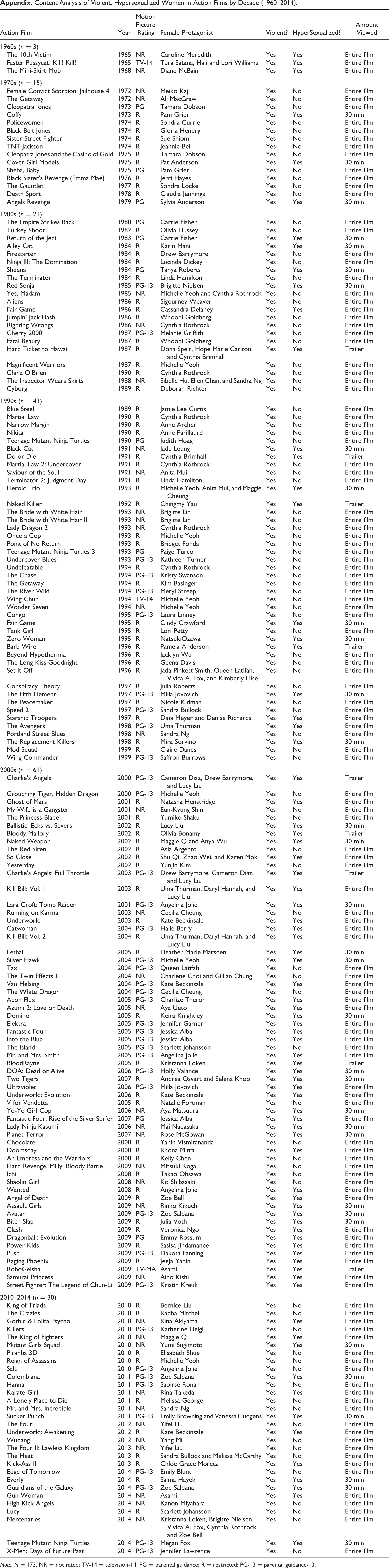
| Action Film | Year | Motion Picture Rating | Female Protagonist | Violent? | HyperSexualized? | Amount Viewed |
|---|---|---|---|---|---|---|
| 1960s (n = 3) | ||||||
| The 10th Victim | 1965 | NR | Caroline Meredith | Yes | Yes | Entire film |
| Faster Pussycat! Kill! Kill! | 1965 | TV-14 | Tura Satana, Haji and Lori Williams | Yes | Yes | Entire film |
| The Mini-Skirt Mob | 1968 | NR | Diane McBain | Yes | Yes | Entire film |
| 1970s (n = 15) | ||||||
| Female Convict Scorpion, Jailhouse 41 | 1972 | NR | Meiko Kaji | Yes | No | Entire film |
| The Getaway | 1972 | NR | Ali MacGraw | Yes | No | Entire film |
| Cleopatra Jones | 1973 | PG | Tamara Dobson | Yes | No | Entire film |
| Coffy | 1973 | R | Pam Grier | Yes | Yes | 30 min |
| Policewomen | 1974 | R | Sondra Currie | Yes | No | Entire film |
| Black Belt Jones | 1974 | R | Gloria Hendry | Yes | No | Entire film |
| Sister Street Fighter | 1974 | R | Sue Shiomi | Yes | No | Entire film |
| TNT Jackson | 1974 | R | Jeannie Bell | Yes | No | Entire film |
| Cleopatra Jones and the Casino of Gold | 1975 | R | Tamara Dobson | Yes | No | Entire film |
| Cover Girl Models | 1975 | R | Pat Anderson | Yes | Yes | 30 min |
| Sheba, Baby | 1975 | PG | Pam Grier | Yes | No | Entire film |
| Black Sister’s Revenge (Emma Mae) | 1976 | R | Jerri Hayes | Yes | No | Entire film |
| The Gauntlet | 1977 | R | Sondra Locke | Yes | No | Entire film |
| Death Sport | 1978 | R | Claudia Jennings | Yes | No | Entire film |
| Angels Revenge | 1979 | PG | Sylvia Anderson | Yes | Yes | 30 min |
| 1980s (n = 21) | ||||||
| The Empire Strikes Back | 1980 | PG | Carrie Fisher | Yes | No | Entire film |
| Turkey Shoot | 1982 | R | Olivia Hussey | Yes | No | Entire film |
| Return of the Jedi | 1983 | PG | Carrie Fisher | Yes | Yes | 30 min |
| Alley Cat | 1984 | R | Karin Mani | Yes | Yes | 30 min |
| Firestarter | 1984 | R | Drew Barrymore | Yes | No | Entire film |
| Ninja III: The Domination | 1984 | R | Lucinda Dickey | Yes | No | Entire film |
| Sheena | 1984 | PG | Tanya Roberts | Yes | Yes | 30 min |
| The Terminator | 1984 | R | Linda Hamilton | Yes | No | Entire film |
| Red Sonja | 1985 | PG-13 | Brigitte Nielsen | Yes | Yes | 30 min |
| Yes, Madam! | 1985 | NR | Michelle Yeoh and Cynthia Rothrock | Yes | No | Entire film |
| Aliens | 1986 | R | Sigourney Weaver | Yes | No | Entire film |
| Fair Game | 1986 | R | Cassandra Delaney | Yes | Yes | Entire film |
| Jumpin’ Jack Flash | 1986 | R | Whoopi Goldberg | Yes | No | Entire film |
| Righting Wrongs | 1986 | NR | Cynthia Rothrock | Yes | No | Entire film |
| Cherry 2000 | 1987 | PG-13 | Melanie Griffith | Yes | No | Entire film |
| Fatal Beauty | 1987 | R | Whoopi Goldberg | Yes | No | Entire film |
| Hard Ticket to Hawaii | 1987 | R | Dona Speir, Hope Marie Carlton, and Cynthia Brimhall | Yes | Yes | Trailer |
| Magnificent Warriors | 1987 | R | Michelle Yeoh | Yes | No | Entire film |
| China O’Brien | 1990 | R | Cynthia Rothrock | Yes | No | Entire film |
| The Inspector Wears Skirts | 1988 | NR | Sibelle Hu, Ellen Chan, and Sandra Ng | Yes | No | Entire film |
| Cyborg | 1989 | R | Deborah Richter | Yes | No | Entire film |
| 1990s (n = 43) | ||||||
| Blue Steel | 1989 | R | Jamie Lee Curtis | Yes | No | Entire film |
| Martial Law | 1990 | R | Cynthia Rothrock | Yes | No | Entire film |
| Narrow Margin | 1990 | R | Anne Archer | Yes | No | Entire film |
| Nikita | 1990 | R | Anne Parillaurd | Yes | No | Entire film |
| Teenage Mutant Ninja Turtles | 1990 | PG | Judith Hoag | Yes | No | Entire film |
| Black Cat | 1991 | NR | Jade Leung | Yes | Yes | 30 min |
| Do or Die | 1991 | R | Cynthia Brimhall | Yes | Yes | Trailer |
| Martial Law 2: Undercover | 1991 | R | Cynthia Rothrock | Yes | No | Entire film |
| Saviour of the Soul | 1991 | NR | Anita Mui | Yes | No | Entire film |
| Terminator 2: Judgment Day | 1991 | R | Linda Hamilton | Yes | No | Entire film |
| Heroic Trio | 1993 | R | Michelle Yeoh, Anita Mui, and Maggie Cheung | Yes | Yes | 30 min |
| Naked Killer | 1992 | R | Chingmy Yau | Yes | Yes | Trailer |
| The Bride with White Hair | 1993 | NR | Brigitte Lin | Yes | No | Entire film |
| The Bride with White Hair II | 1993 | NR | Brigitte Lin | Yes | No | Entire film |
| Lady Dragon 2 | 1993 | NR | Cynthia Rothrock | Yes | No | Entire film |
| Once a Cop | 1993 | R | Michelle Yeoh | Yes | No | Entire film |
| Point of No Return | 1993 | R | Bridget Fonda | Yes | No | Entire film |
| Teenage Mutant Ninja Turtles 3 | 1993 | PG | Paige Turco | Yes | No | Entire film |
| Undercover Blues | 1993 | PG-13 | Kathleen Turner | Yes | No | Entire film |
| Undefeatable | 1994 | R | Cynthia Rothrock | Yes | No | Entire film |
| The Chase | 1994 | PG-13 | Kristy Swanson | Yes | No | Entire film |
| The Getaway | 1994 | R | Kim Basinger | Yes | No | Entire film |
| The River Wild | 1994 | PG-13 | Meryl Streep | Yes | No | Entire film |
| Wing Chun | 1994 | TV-14 | Michelle Yeoh | Yes | No | Entire film |
| Wonder Seven | 1994 | NR | Michelle Yeoh | Yes | No | Entire film |
| Congo | 1995 | PG-13 | Laura Linney | Yes | No | Entire film |
| Fair Game | 1995 | R | Cindy Crawford | Yes | Yes | 30 min |
| Tank Girl | 1995 | R | Lori Petty | Yes | No | Entire film |
| Zero Woman | 1995 | R | NatsukiOzawa | Yes | Yes | 30 min |
| Barb Wire | 1996 | R | Pamela Anderson | Yes | Yes | Trailer |
| Beyond Hypothermia | 1996 | R | Jacklyn Wu | Yes | No | Entire film |
| The Long Kiss Goodnight | 1996 | R | Geena Davis | Yes | No | Entire film |
| Set it Off | 1996 | R | Jada Pinkett Smith, Queen Latifah, Vivica A. Fox, and Kimberly Elise | Yes | No | Entire film |
| Conspiracy Theory | 1997 | R | Julia Roberts | Yes | No | Entire film |
| The Fifth Element | 1997 | PG-13 | Milla Jovovich | Yes | Yes | 30 min |
| The Peacemaker | 1997 | R | Nicole Kidman | Yes | No | Entire film |
| Speed 2 | 1997 | PG-13 | Sandra Bullock | Yes | No | Entire film |
| Starship Troopers | 1997 | R | Dina Meyer and Denise Richards | Yes | Yes | Entire film |
| The Avengers | 1998 | PG-13 | Uma Thurman | Yes | Yes | Entire film |
| Portland Street Blues | 1998 | NR | Sandra Ng | Yes | No | Entire film |
| The Replacement Killers | 1998 | R | Mira Sorvino | Yes | Yes | 30 min |
| Mod Squad | 1999 | R | Claire Danes | Yes | No | Entire film |
| Wing Commander | 1999 | PG-13 | Saffron Burrows | Yes | No | Entire film |
| 2000s (n = 61) | ||||||
| Charlie’s Angels | 2000 | PG-13 | Cameron Diaz, Drew Barrymore, and Lucy Liu | Yes | Yes | Trailer |
| Crouching Tiger, Hidden Dragon | 2000 | PG-13 | Michelle Yeoh | Yes | No | Entire film |
| Ghost of Mars | 2001 | R | Natasha Henstridge | Yes | Yes | Entire film |
| My Wife is a Gangster | 2001 | NR | Eun-Kyung Shin | Yes | No | Entire film |
| The Princess Blade | 2001 | R | Yumiko Shaku | Yes | No | Entire film |
| Ballistic: Ecks vs. Severs | 2002 | R | Lucy Liu | Yes | Yes | 30 min |
| Bloody Mallory | 2002 | R | Olivia Bonamy | Yes | Yes | Trailer |
| Naked Weapon | 2002 | R | Maggie Q and Anya Wu | Yes | Yes | 30 min |
| The Red Siren | 2002 | R | Asia Argento | Yes | No | Entire film |
| So Close | 2002 | R | Shu Qi, Zhao Wei, and Karen Mok | Yes | Yes | Entire film |
| Yesterday | 2002 | R | Yunjin Kim | Yes | No | Entire film |
| Charlie’s Angels: Full Throttle | 2003 | PG-13 | Drew Barrymore, Cameron Diaz, and Lucy Liu | Yes | Yes | Trailer |
| Kill Bill: Vol. 1 | 2003 | R | Uma Thurman, Daryl Hannah, and Lucy Liu | Yes | Yes | Entire film |
| Lara Croft: Tomb Raider | 2001 | PG-13 | Angelina Jolie | Yes | Yes | 30 min |
| Running on Karma | 2003 | NR | Cecilia Cheung | Yes | No | Entire film |
| Underworld | 2003 | R | Kate Beckinsale | Yes | Yes | Entire film |
| Catwoman | 2004 | PG-13 | Halle Berry | Yes | Yes | Entire film |
| Kill Bill: Vol. 2 | 2004 | R | Uma Thurman, Daryl Hannah, and Lucy Liu | Yes | Yes | Entire film |
| Lethal | 2005 | R | Heather Marie Marsden | Yes | Yes | 30 min |
| Silver Hawk | 2004 | PG-13 | Michelle Yeoh | Yes | Yes | 30 min |
| Taxi | 2004 | PG-13 | Queen Latifah | Yes | No | Entire film |
| The Twin Effects II | 2004 | NR | Charlene Choi and Gillian Chung | Yes | No | Entire film |
| Van Helsing | 2004 | PG-13 | Kate Beckinsale | Yes | Yes | Entire film |
| The White Dragon | 2004 | PG-13 | Cecilia Cheung | Yes | No | Entire film |
| Aeon Flux | 2005 | PG-13 | Charlize Theron | Yes | Yes | Entire film |
| Azumi 2: Love or Death | 2005 | NR | Aya Ueto | Yes | Yes | Entire film |
| Domino | 2005 | R | Keira Knightley | Yes | Yes | 30 min |
| Elektra | 2005 | PG-13 | Jennifer Garner | Yes | Yes | Entire film |
| Fantastic Four | 2005 | PG-13 | Jessica Alba | Yes | Yes | Entire film |
| Into the Blue | 2005 | PG-13 | Jessica Alba | Yes | Yes | Entire film |
| The Island | 2005 | PG-13 | Scarlett Johansson | Yes | No | Entire film |
| Mr. and Mrs. Smith | 2005 | PG-13 | Angelina Jolie | Yes | Yes | Entire film |
| BloodRayne | 2005 | R | Kristanna Loken | Yes | Yes | Trailer |
| DOA: Dead or Alive | 2006 | PG-13 | Holly Valance | Yes | Yes | 30 min |
| Two Tigers | 2007 | R | Andrea Osvart and Selena Khoo | Yes | Yes | 30 min |
| Ultraviolet | 2006 | PG-13 | Milla Jovovich | Yes | Yes | Entire film |
| Underworld: Evolution | 2006 | R | Kate Beckinsale | Yes | Yes | Entire film |
| V for Vendetta | 2005 | R | Natalie Portman | Yes | No | Entire film |
| Yo-Yo Girl Cop | 2006 | NR | Aya Matsuura | Yes | Yes | 30 min |
| Fantastic Four: Rise of the Silver Surfer | 2007 | PG | Jessica Alba | Yes | Yes | Entire film |
| Lady Ninja Kasumi | 2006 | NR | Mai Nadasaka | Yes | Yes | 30 min |
| Planet Terror | 2007 | NR | Rose McGowan | Yes | Yes | 30 min |
| Chocolate | 2008 | R | Yanin Vismitananda | Yes | No | Entire film |
| Doomsday | 2008 | R | Rhona Mitra | Yes | Yes | Entire film |
| An Empress and the Warriors | 2008 | R | Kelly Chen | Yes | No | Entire film |
| Hard Revenge, Milly: Bloody Battle | 2009 | NR | Mitsuki Koga | Yes | No | Entire film |
| Ichi | 2008 | R | Takao Ohsawa | Yes | No | Entire film |
| Shaolin Girl | 2008 | NR | Ko Shibasaki | Yes | No | Entire film |
| Wanted | 2008 | R | Angelina Jolie | Yes | Yes | Entire film |
| Angel of Death | 2009 | R | Zoe Bell | Yes | Yes | Entire film |
| Assault Girls | 2009 | NR | Rinko Kikuchi | Yes | Yes | 30 min |
| Avatar | 2009 | PG-13 | Zoe Saldana | Yes | Yes | 30 min |
| Bitch Slap | 2009 | R | Julia Voth | Yes | Yes | 30 min |
| Clash | 2009 | R | Veronica Ngo | Yes | Yes | Entire film |
| Dragonball: Evolution | 2009 | PG | Emmy Rossum | Yes | Yes | Entire film |
| Power Kids | 2009 | R | Sasisa Jindamanee | Yes | Yes | Entire film |
| Push | 2009 | PG-13 | Dakota Fanning | Yes | Yes | Entire film |
| Raging Phoenix | 2009 | R | JeeJa Yanin | Yes | Yes | Entire film |
| RoboGeisha | 2009 | TV-MA | Asami | Yes | Yes | Trailer |
| Samurai Princess | 2009 | NR | Aino Kishi | Yes | Yes | Entire film |
| Street Fighter: The Legend of Chun-Li | 2009 | PG-13 | Kristin Kreuk | Yes | Yes | Entire film |
| 2010–2014 (n = 30) | ||||||
| King of Triads | 2010 | R | Bernice Liu | Yes | No | Entire film |
| The Crazies | 2010 | R | Radha Mitchell | Yes | No | Entire film |
| Gothic & Lolita Psycho | 2010 | NR | Rina Akiyama | Yes | Yes | Entire film |
| Killers | 2010 | PG-13 | Katherine Heigl | Yes | No | Entire film |
| The King of Fighters | 2010 | NR | Maggie Q | Yes | Yes | Entire film |
| Mutant Girls Squad | 2010 | NR | Yumi Sugimoto | Yes | Yes | 30 min |
| Piranha 3D | 2010 | R | Elisabeth Shue | Yes | No | Entire film |
| Reign of Assassins | 2010 | R | Michelle Yeoh | Yes | No | Entire film |
| Salt | 2010 | PG-13 | Angelina Jolie | Yes | No | Entire film |
| Colombiana | 2011 | PG-13 | Zoe Saldana | Yes | Yes | 30 min |
| Hanna | 2011 | PG-13 | Saoirse Ronan | Yes | No | Entire film |
| Karate Girl | 2011 | NR | Rina Takeda | Yes | Yes | Entire film |
| A Lonely Place to Die | 2011 | R | Melissa George | Yes | No | Entire film |
| Mr. and Mrs. Incredible | 2011 | NR | Sandra Ng | Yes | No | Entire film |
| Sucker Punch | 2011 | PG-13 | Emily Browning and Vanessa Hudgens | Yes | Yes | 30 min |
| The Four | 2012 | NR | Yifei Liu | Yes | No | Entire film |
| Underworld: Awakening | 2012 | R | Kate Beckinsale | Yes | Yes | Entire film |
| Wudang | 2012 | NR | Yang Mi | Yes | No | Entire film |
| The Four II: Lawless Kingdom | 2013 | NR | Yifei Liu | Yes | No | Entire film |
| The Heat | 2013 | R | Sandra Bullock and Melissa McCarthy | Yes | No | Entire film |
| Kick-Ass II | 2013 | R | Chloe Grace Moretz | Yes | Yes | Entire film |
| Edge of Tomorrow | 2014 | PG-13 | Emily Blunt | Yes | No | Entire film |
| Everly | 2014 | R | Salma Hayek | Yes | Yes | 30 min |
| Guardians of the Galaxy | 2014 | PG-13 | Zoe Saldana | Yes | Yes | 30 min |
| Gun Woman | 2014 | NR | Asami | Yes | Yes | Entire film |
| High Kick Angels | 2014 | NR | Kanon Miyahara | Yes | No | Entire film |
| Lucy | 2014 | R | Scarlett Johansson | Yes | No | Entire film |
| Mercenaries | 2014 | NR | Kristanna Loken, Brigitte Nielsen, Vivica A. Fox, Cynthia Rothrock, and Zoe Bell | Yes | No | Entire film |
| Teenage Mutant Ninja Turtles | 2014 | PG-13 | Megan Fox | Yes | Yes | 30 min |
| X-Men: Days of Future Past | 2014 | PG-13 | Jennifer Lawrence | Yes | No | Entire film |
Note. N = 173. NR = not rated; TV-14 = television-14; PG = parental guidance; R = restricted; PG-13 = parental guidance-13.
Acknowledgment
The authors would like to thank Ian Breckenridge-Jackson, Rachel Buckner, Rebecca Cooper, Georgia Faye Hirsty, Sarah Oliver, Jessica Stowell, and Clint Swift for their research assistance on this project.
Authors’ Note

Declaration of Conflicting Interests
The author(s) declared no potential conflicts of interest with respect to the research, authorship, and/or publication of this article.
Funding
The author(s) received no financial support for the research, authorship, and/or publication of this article.