




Abstract
Provider web profiles are becoming popular locations for patients to seek information before their visits. This industry insight assesses patients’ utilization of a physical therapy clinic's website to determine the impact the addition of physical therapist biographies had on patient perceptions and physical therapist selection. Forty-six percent of first-time patients (n = 786) indicated visiting the clinic's website prior to their visit. After biographies were added, these website visitors rated the website as more helpful, and indicated a greater perception of certainty regarding the services the clinic provides. A greater percentage of website visitors made a purposeful selection of therapist after therapist biographies were posted online than prior to biographies being posted. These findings indicate that improvements to a clinic's website can positively impact patient empowerment in making personal healthcare decisions. Simply adding biographies of physical therapists to clinics’ websites can have significant effects on reducing first-time patients’ uncertainty, as well as providing a greater level of patient-centered care by offering information to empower patients to be more active participants in their healthcare choices.
Introduction
Finding a new healthcare provider has not traditionally been the easiest of tasks for patients. A recent ZocDoc survey 1 found that more than half of patients indicated when they showed up to an appointment with a new provider the clinician they visited wound up not being a good fit for their health needs. One way that clinics could potentially help patients make more informed choices regarding their provider selection is by improving the information available about the clinics’ providers on their websites, namely developing more detailed provider biographies. Colleges and universities are an ideal setting to investigate the impact improved biographies might have on this selection process as students are likely independently seeking care in the oftentimes complex healthcare environment for the first time. For example, Adu Gyamfi 2 found American college students viewed campus health centers’ websites to help manage their uncertainty about the care they might obtain there.
One specific medical context where a greater deal of information about providers might be helpful is in the field of physical therapy. Nearly one-third of college students with an orthopedic injury in the last 12 months indicated it had a negative impact on their classwork or delayed progress toward their degree. 3 Therefore, helping students better understand physical therapy services that might exist on their campuses is an important topic for clinics to address. Patients indicate that they value therapists who are compassionate 4 and who allow active clinical decision-making. 5 Providing biographical information to help patients more informatively select a therapist who is likely to match their own personal care needs is an important part of providing patient-centered care. 6
Actionable Insights
To best determine the impact the addition of biographies to a clinic's website might have on the patient experience, we collected data from first-time visitors to our campus physical therapy clinic at a large Midwestern university (May 2017-March 2020). About halfway through this data collection we were able to add biographies of all three therapists employed onto the clinic's website, and were therefore able to also assess the impact viewing these biographies might have on patients purposely selecting their therapist.
To seamlessly integrate data collection into the patient-care process, four items were added to a post-visit survey all patients completed on electronic tablets after their initial consultations. These questions included:
Biography Creation
In order to develop the online biographies, the therapists employed at the clinic filled out a brief questionnaire drafted by the lead author that included the therapists’: education, professional interests, specializations, why they like working at the clinic, their philosophies of care, and personal information about their lives outside of work. The questionnaire the therapists completed can be obtained from the first author upon request. Additionally, the first author took headshot photographs of each of the therapists to place alongside their biographies. These biographies were posted at the beginning of December 2018.
Evaluation of Website and Biographies
A total of 1709 first-time patients visited the physical therapy clinic during the duration the survey questions were active. Of these first-time visitors, 46% (n = 786) indicated they sought out information on the clinic's website prior to their visit. These website visitors were then subsequently used to assess the efficacy of the website – as only people who visited the website had the potential to be impacted by it.
Patients who visited the website after the posting of the biographies perceived the website to be more helpful than those who visited the website before the biographies were posted. Similarly, patients indicated a greater degree of certainty about the services offered at the clinic after the posting of the biographies than before. Most noticeably, we found that adding biographies to the website was related to about a 5% increase in the proportion of patients who purposely selected their physical therapist. See Table 1 for the descriptive data and the analyses performed.
Website Viewership and its Relationship to Variables of Interest.
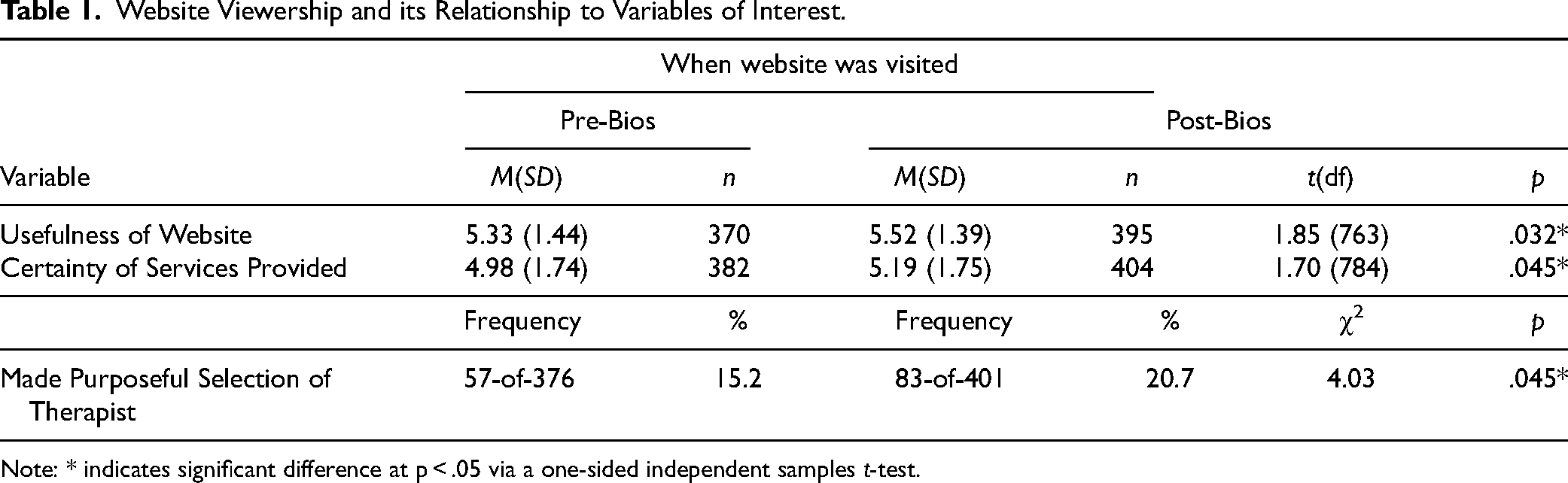
Note: * indicates significant difference at p < .05 via a one-sided independent samples t-test.
Practical Recommendations
A large proportion of patients to a campus physical therapy clinic (46%) sought information on the clinic's website prior to their first visit. This finding alone showcases students are playing active roles in their healthcare, and confirms previous findings that students are using the internet as a key source of health information. 7 This result also supports the importance that campus clinics should therefore place on the information presented on these websites, which can sometimes be lacking. 8 For example, this evaluation found that improving the information that is available on a clinic's website, via the addition of physical therapists’ biographies, can significantly impact how people view the helpfulness of the information found there, as well as increase their certainty surrounding the services the clinic offers. These outcomes are similar to those found in a campus primary care clinic, 9 where patients who viewed providers’ biographies prior to their visits had less uncertainty and were more likely to make a purposeful selection of the provider they wanted to visit for their care.
As Meyer indicates, 10 healthcare organizations should be seeking to continually improve their online touchpoints in order to help patients more easily find information they are looking for. Given that we know patients are looking for information about future providers online, developing more detailed biographical information of providers on clinics’ websites to help patients make more informed choices could be one fairly easy step healthcare organizations could take to improve the overall patient experience.
One place healthcare organizations could look for assistance in this area is across disciplinary boundaries. Clinicians themselves cannot be expected to be experts in all aspects of the patient-care process and experience. For example, the current project stemmed from a collaboration with the clinic's director and a health communication professor in the university's college of liberal arts. Unless clinics have full-time communication or marketing professionals on staff, it is likely that expertise in this area could be provided via colleagues or collaborators working in communication, or other social science disciplines. By this clinic's director being open to collaboration, biographies of all physical therapists were able to be developed and assessed, ultimately uncovering that these improvements can empower students to make more informed and purposive healthcare decisions.
While this assessment had a high degree of ecological validity (ie, surveying actual first-time patients of a campus physical therapy clinic post consultation), one limitation was the timing of data collection. In a perfect world, measures to assess a person's level of certainty, and the potential impact of the website and biographies on people's selection of therapist, would be ascertained before and immediately after a person views this information. Utilizing the current method, these perceptions and actions of patients were only able to be assessed via survey measures after a consultation was already completed, which likely attenuated potential effects – in other words, after a person's level of uncertainty was likely to be fully reduced. Future evaluations of this type should strive to intercept website viewers immediately after they view the information on the website, possibly via a pop-up invitation, to assess the usefulness of the information more proximally.
Conclusion
This evaluation adds to the body of findings on how individuals use website information to make more informed healthcare decisions. It showcases how making simple changes to a clinic's website – namely the development of provider biographies – can improve the patient experience by providing patients information they are regularly looking for to help in managing their care. Given that colleges and universities strive to prepare students for lives outside of academic settings, this evaluation also highlights the positive outcomes that can be achieved when a campus clinic works across disciplinary boundaries to offer provider information on its website, similar to information that students are likely to encounter on healthcare systems’ websites once they graduate. In doing so, clinics can set up this population to be more informed and empowered healthcare consumers throughout their lives.
Footnotes
Declaration of Conflicting Interests
The authors declared no potential conflicts of interest with respect to the research, authorship, and/or publication of this article.
Ethical Approval
The data for this paper stemmed from a quality improvement project, and was therefore classified by our institution's IRB as “not human subjects research.”
Funding
The authors received no financial support for this evaluation, authorship, and/or publication of this article.
Statement of Informed Consent
Informed consent was not obtained because data were obtained for program evaluation purposes.
