




Abstract
Enhancing consumer and patient choice has been proposed as a means to improve care quality and reduce health-related costs. Choosing a medical provider is one of the most critical and often complex decisions patients make about their health care. We investigated the perceived importance of factors patients may consider when selecting a practitioner and if rated importance of the factors varies with their characteristics and prior experiences with different types of clinicians (physicians, physician assistants, and nurse practitioners). Participants most often identified medical license, certification, and whether the provider accepts the patients’ health insurance as important, while provider type, others’ recommendations, and online reviews were among the least important. We found wide-ranging differences based on patient characteristics. Prior experience with providers was also a strong determinant of patterns of factors patients considered valuable. Policy-makers, health systems, insurers, and providers need to take into account that patients rely on a range of factors that vary based on their distinct needs, backgrounds, and previous experiences—requiring tailored information to make more informed decisions.
Keywords
Introduction
In a progressively consumer-centric health care environment, patients are increasingly empowered to be active and informed decision-makers in their health care. Increasing patient choice has been proposed to improve care quality and reduce health-related costs through increased competition (1,2). One of the most significant decisions patients make occurs when selecting a provider for their medical needs (3,4). Many consider this choice to impact the course of their treatment, and ultimately, their health outcomes (3,4). Before deciding on a provider, patients can consider multiple factors and use various sources of information to inform their choice (5). Traditionally, patients relied on recommendations from family or friends (6,7); however, with the rapid proliferation of online resources, a plethora of provider information is readily available and accessible. Patients can verify whether providers have a medical license in their respective state, disciplinary actions (8), certification status (9,10), and if the provider participates in their health insurance plan (11,12). Patients can also view public reports of practitioner quality information (13) and learn from others’ experiences through numerous websites (e.g., yelp.com, ratemd.com, healthgrades.com) (14).
Prior literature exploring the importance of factors that patients use when choosing providers demonstrates that they consider qualifications such as certification (3,7,15–17), years of experience (3,12,17), and education (17). Patients also take into account logistical factors such as appointment wait times (17–19), office location (12,17,20), whether the provider accepts their health insurance (3,11,12,15,17), and out-of-pocket costs (17). More recently, there has been a proliferation of research on provider review websites (14,21,22). Approximately a quarter of patients use online reviews (12). However, a higher proportion relies on other factors such as whether the provider accepts their insurance, convenient location, and years of experience (12). Findings also show that the ratings are not associated with more objective care quality metrics (23), and that the number of reviews per provider is scarce (24).
Furthermore, patients typically have the option of selecting a physician, physician assistant (PA), or nurse practitioner (NP) for their medical needs (25). The PA and NP professions are rapidly growing, with 148,560 Certified PAs and 325,000 NPs in the US (26,27). At the same time, the Association of American Medical Colleges projects a shortage of up to 124,000 physicians by 2034 (28). Given the expanding PA and NP health workforces and estimated deficits in the number of physicians, it is critically important to assess patient perspectives toward PAs and NPs. It is essential that patients are willing to receive care from PAs and NPs for these providers to help alleviate existing and future care gaps. Research shows that patients are equally satisfied with the care received from physicians, PAs, and NPs (29). Consumers are also receptive to receiving care from PAs, especially if the wait time is shorter than seeing a physician (30,31). Leach et al. revealed that irrespective of whether patients preferred physicians or PAs/NPs, the most important factors in selecting a provider were qualifications such as medical knowledge, experience, and education (25). Notwithstanding the abovementioned studies, there is a dearth of research exploring how important clinician type (physician, PA or NP) is to patients when choosing—particularly compared to other factors previously shown in the literature to be of value.
Research has also demonstrated that patients’ care experience is one of the most central sources of information (25,32–35). Leach et al. found that prior experience with either a physician, PA, or NP was an essential determinant for patient preferences (25). For example, having a positive experience with a PA made patients more receptive to receiving care from PAs in the future (25). Conversely, a negative experience led patients to prefer another provider type for their medical needs (25). However, except for one previous effort, most research focused on the impact of patients’ prior experience on the choice of hospitals rather than health practitioners (34,36,37). Additionally, the literature is relatively silent on how previous quality of experience with each provider type is associated with the factors patients find valuable when selecting a provider.
Given the existing literature gaps, we investigated 1) which of eleven factors related to provider qualifications, logistical aspects, and others’ perspectives are deemed most important for patients when choosing a provider; and 2) the relative strength of association of participant characteristics and prior experiences with physicians, PAs, and NPs on importance of the factors patients attach importance to when choosing.
Methods
After institutional review board (Sterling IRB# 7122) determined our study to be not-human-subjects research, we conducted a cross-sectional online survey with participants (N = 1,388) recruited from a Qualtrics online panel. Eligibility criteria required individuals to have seen a medical provider or decided about one for a dependent in the past two years. Participants were excluded if they or any family member was a medical provider. We utilized quota sampling to approximate the proportions in key demographics of the US population. Data collection occurred during November/December 2018. An attention check question was embedded to ensure quality responses (38).
The survey was developed based on a comprehensive literature review and adapted from our previously conducted study (39). The overall survey assessed three primary areas: public knowledge and beliefs regarding licensure, certification and medical education of PAs (40), care quality and satisfaction with PAs (41), and factors important in selecting a provider—the focus of the current analysis. The following question was asked: “What factors are important to you when selecting a health care provider for yourself or a family member?”. Participants were presented with 11 factors related to provider qualifications (medical license, certification, amount of education, years of experience), clinician type (physician, PA, NP), logistical factors (whether provider participates in insurance plan, cost, how quickly they could be seen, office location), and sources of information regarding potential provider (recommendations from others, online reviews). Rather than asking to check all that apply for the above factors, we used a forced-choice format. Participants were presented after each factor with the following response scale: “important,” “not important” or “not sure.” Prior research shows that this format encourages deeper item processing (42). We counterbalanced the factors to eliminate response order effects (43). The survey instrument also included socio-demographic questions relating to gender, age, race/ethnicity, education, rural-urban setting, self-reported health, and health insurance type. Lastly, three questions assessed experience with physicians, PAs, and NPs in the last 12 months: “Thinking about the experiences you have had in the last 12 months with various health care providers, please indicate the quality of your experience”. The response scale was “no experience with this type of provider,” “positive experience,” “mixed experiences with providers of this type,” and “negative experience.”
The outcome variables were the 11 abovementioned factors in selecting a provider. The three-category response scale of “important,” “not important,” and “not sure” was collapsed into two “important” and “not important/not sure.” To model participant selection of “important” for each factor, separate multivariate logistic regressions were conducted (using not important/not sure as the reference category). The predictor variables were socio-demographics and quality of experience with physicians, PAs and NPs in the last 12 months. All analyses were conducted using R version 3.63 (R Foundation).
Results
There were slightly more females, and 51.1% were between 35 and 64 (Table 1). The majority were white (72.4%), followed by African American (13.3%), other race (8.4%), and Asian (5.9%); 15.9% were of Hispanic/Latino ethnicity. Regarding education, 38.5% had a high school degree or less, while 34.3% had a bachelor's degree or higher. Almost half (47.0%) reported to reside in suburban areas while 27.9% were in rural and 25.1% in urban. The majority (69.7%) reported being in either excellent or good health. The highest proportion had private insurance only (38.9%). When asked about quality of experience with physicians, PAs, and NPs in the last 12 months, the majority indicated having a positive quality experience with each provider (79.9%, 62.5%, 65.2%, respectively); however, a higher percentage of respondents reported having no experience with PAs (23.8%) and NPs (20.3%) compared to physicians (3.2%) during this time.
Participant Characteristics.

Abbreviations: PA, physician assistant; NP, nurse practitioner.
Table 2 presents factors important in selecting a health care provider. The highest proportion indicated “important” for medical license (92.2%), followed by medical certification (89.9%) and whether the practitioner participates in patient's health insurance plan (89.6%). Conversely, the highest proportion indicating not important were reviews provided on the internet (47.0%), others’ recommendations (36.4%), and clinician type (physician, PA, NP [21.3%]).
Factors Deemed Important in Selecting a Healthcare Provider.

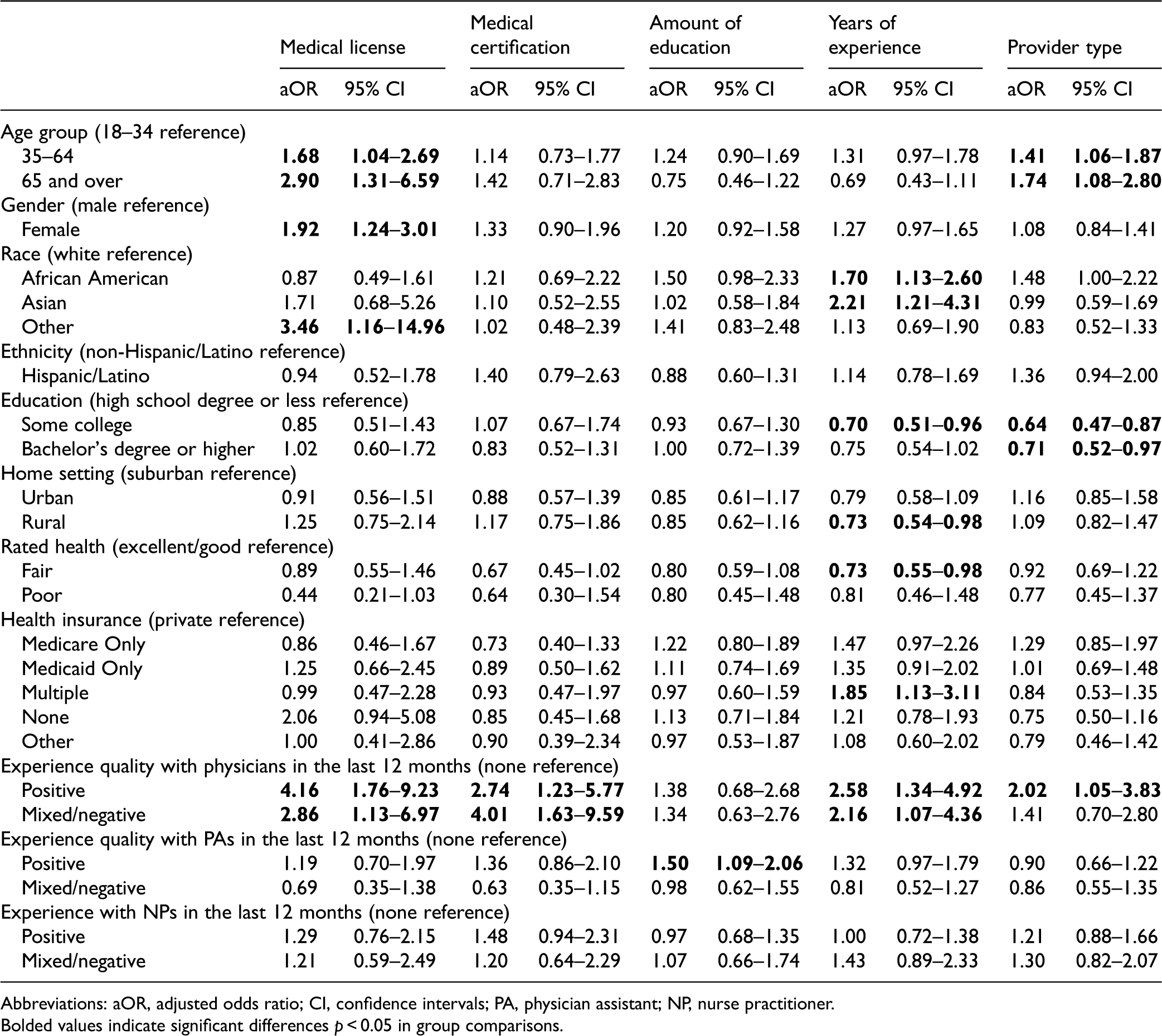
Table 3 shows multivariate logistic regression models comparing the relative strength of association of participant characteristics on importance attributed to factors related to qualifications when selecting a medical practitioner. The strongest significant predictor of increased odds for indicating medical license to be important was having a positive quality experience with physicians in the prior 12 months compared to none (adjusted odds ratio [aOR], 4.16; 95% confidence interval [CI] = 1.76–9.23). Participants reporting to have mixed/negative experience with physicians also had higher odds (aOR, 2.86; 95% CI = 1.13–6.97) of indicating medical license. Compared to 18–34, those 65 and older had almost three-fold higher odds, and those in the 35–64 age group had 68% higher odds for reporting medical license to be valuable. We also found that participants that self-identified as other race compared to white had almost three and a half higher odds, and females had 92% higher odds than males.
Patient Characteristics and Prior Quality of Experience Associated with Provider Qualifications Deemed Important in Selecting a Medical Provider.
Abbreviations: aOR, adjusted odds ratio; CI, confidence intervals; PA, physician assistant; NP, nurse practitioner.
Bolded values indicate significant differences p < 0.05 in group comparisons.
Prior experience with physicians in the last year, both positive and mixed/negative, were the only two significant predictors of indicating medical certification to be important. Participants with mixed/negative compared to no experience had four-fold higher odds, and those with positive experience had 2.74 higher odds. Regarding amount of education, participants with positive quality experience with PAs compared to none had 50% higher odds of indicating this factor to be important.
The strongest predictors of increased odds of indicating years of experience being important were positive (aOR, 2.58; 95% CI = 1.34–4.92) and mixed/negative (aOR, 2.16; 95% CI = 1.07–4.36) experience with physicians and Asian race (aOR, 2.21; 95% CI = 1.21–4.31). Respondents with multiple forms of health insurance versus private had 85% higher odds and African American participants had 70% higher odds compared to white. Conversely, participants living in rural areas versus suburban (aOR, 0.73; 95% CI = 0.54–0.98), those with fair health compared to excellent/good (aOR, 0.73; 95% CI = 0.55–0.98) and some college compared to high school or less (aOR, 0.70; 95% CI = 0.51–0.96) had decreased odds.
Positive quality experience with physicians was also the strongest predictor of indicating type of provider to be important (aOR, 2.02; 95% CI = 1.05–3.83). Compared to participants 18–34, those 65 and older (aOR, 1.74; 95% CI = 1.08–2.80) and 35–64 (aOR, 1.41; 95% CI = 1.06–1.87) had higher odds. Participants with some college had 36% lower odds, and those with a bachelor's degree or more had 29% lower odds compared to survey respondents with a high school degree or less.
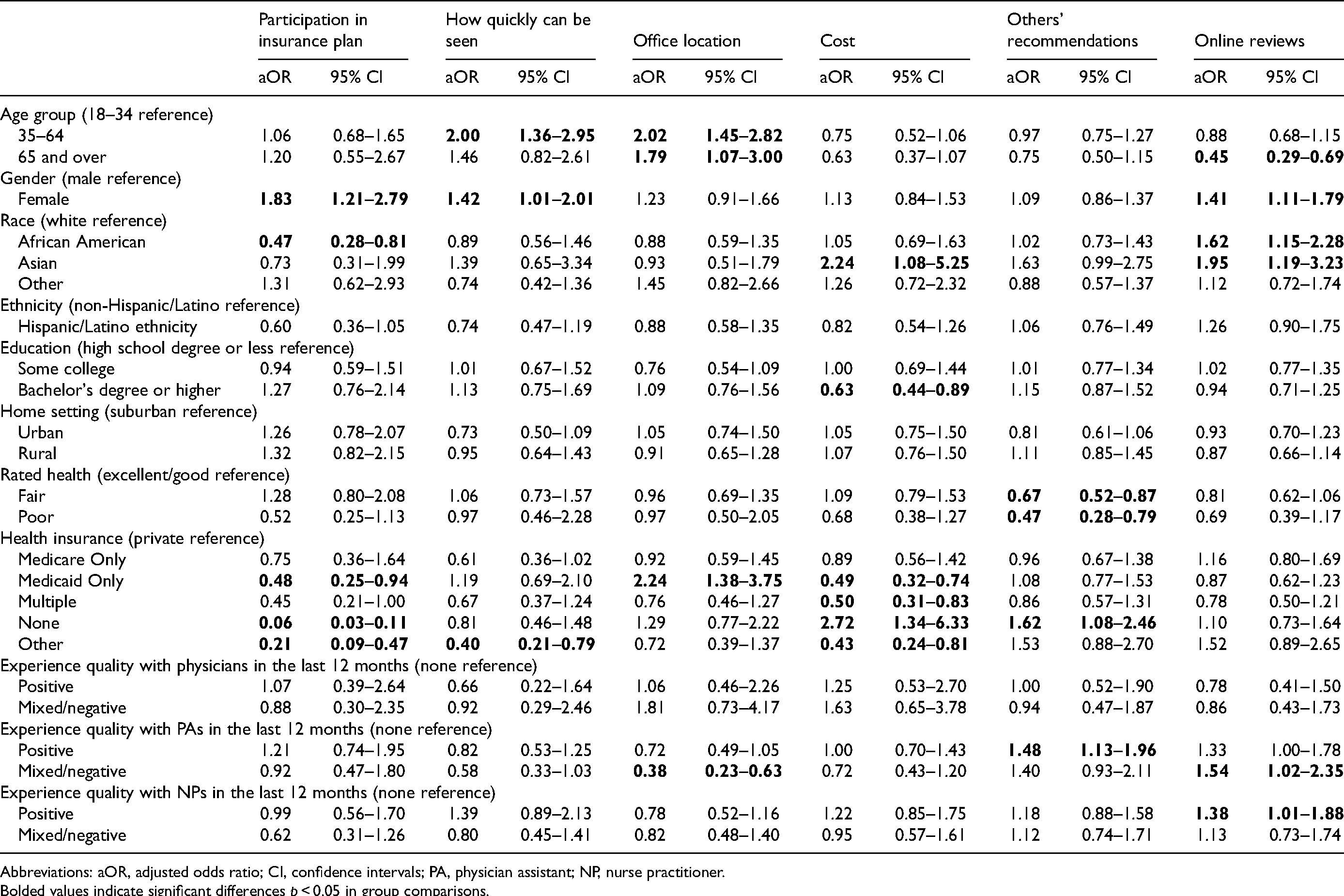
Table 4 depicts participant characteristics associated with logistical factors and others’ perspectives considered important in selecting a practitioner. Compared to males, females had 83% higher odds of indicating provider participation in insurance plan to be important. Females also had 42% higher odds of selecting how quickly they can be seen to be important. Participants 35–64 compared to 18–34 had two-fold higher odds of indicating how quickly they can be seen and provider office location to be important.
Participant Characteristics Associated with Logistical Factors and Others’ Perspectives Deemed Important in Selecting a Medical Provider.
Abbreviations: aOR, adjusted odds ratio; CI, confidence intervals; PA, physician assistant; NP, nurse practitioner.
Bolded values indicate significant differences p < 0.05 in group comparisons.
Respondents without health insurance compared to private had 2.72 higher odds of rating cost to be important. Asian participants compared to white also had increased odds of stating that this factor was of import (aOR, 2.24; 95% CI = 1.08–5.25). Conversely, respondents with more education (bachelor's degree or higher vs. high school degree or less) had decreased odds (aOR, 0.63; 95% CI = 0.44–0.89).
Persons with no health insurance compared to private had 62% higher odds of indicating that other's recommendations were important, while those with positive experience with PAs compared to none in the last 12 months had 48% higher odds for rating this factor important. Individuals with fair (aOR, 0.67; 95% CI = 0.52–0.87) and poor health (aOR, 0.47; 95% CI = 0.28–0.79) had decreased odds.
Regarding online reviews, compared to white participants, those that self-identified as Asian had almost two-fold higher odds and African American participants had 62% higher odds of rating this factor as important. Females (aOR, 1.41; 95% CI = 1.11–1.79), participants with mixed/negative experience with PAs (aOR, 1.54; 95% CI = 1.02–2.35) and positive experience with NPs (aOR, 1.38; 95% CI = 1.01–1.88) had increased odds. Older respondents (65 and older vs. 18–34) had decreased odds (aOR, 0.45; 95% CI = 0.29–0.69) for selecting online reviews as important.
Discussion
This study sought to build on prior work by investigating which of eleven factors related to provider qualifications, logistical aspects and others’ perspectives are deemed most important for patients when selecting a provider; and 2) the relative strength of association of participant characteristics and prior experiences with physicians, PAs, and NPs on importance of the factors patients attach importance to when choosing. Overall, we found that participants most often identified medical license, certification, and whether the provider accepts the patients’ health insurance as important, while provider type, others’ recommendations, and online reviews were among the least important. There were many differences based on patient socio-demographic characteristics, and that quality of prior experience was a strong independent determinant of many factors consumers considered useful. Our findings have several implications for understanding what factors patients consider important when selecting practitioners.
Consistent with prior literature, our results show that patients most value medical license, certification, and whether the provider participates in their insurance plan (11,12,15,17). Although different studies assessed discrete sets of factors, one of the most consistently measured was medical certification; this factor was rated among most important in various specialties and settings, including internal medicine, family medicine, and foot and ankle surgery with diverse patient groups (3,15,17). In our study, the only significant predictors of indicating medical certification to be important was both positive and mixed/negative experience with physicians in the last 12 months.
Clinician type was among the least often reported as important. Positive experience with physicians in the last 12 months was the strongest predictor of rating this factor as important. Older adults also had higher odds of reporting that provider type mattered to them. These findings are in-line with Dill et al., who found that younger people were less likely to have a preference for clinician type, while older persons would rather seek care from a physician (30). Our data complement prior research (30), suggesting that patients may be increasingly receptive to a greater role of PAs and NPs in care provision.
The strongest socio-demographic predictor of increased odds of reporting how quickly patients could be seen by a practitioner was the 35–64 age group category. This result is not surprising, as individuals in this age group typically have work and family responsibilities. Being able to see a provider promptly may be a necessity for their busy lives. Similarly, for office location, participants in the 35–64 age group had higher odds but also participants in the 65 and over age group and those with Medicaid only health insurance. This finding is in accordance with prior research showing that older adults and those that rely on Medicaid may experience barriers to getting to their providers (44,45). For these patient groups, a closer office location may be among the most important criteria for selecting a health care practitioner.
In our study, costs were most important to participants without health insurance, those with private insurance, and respondents with less education. These results align with that of a Gallup poll, which found that adults with no insurance, private insurance, and an annual income of less than $30,000 were most likely to delay receiving medical care in the past year, specifically due to costs (46). Mehrotra and colleagues found that 71% of participants in their study identified cost to be important or very important (47). Despite this finding, few sought out information about costs before receiving treatment; 75% indicated that they did not know how to obtain this information, which was a significant barrier (47).
Contrary to prior research (6,7), others’ recommendations was among the least frequently selected as valuable, and patients in poorer health had lower odds of relying on this factor. However, participants without health insurance and those with positive experience with PAs had higher odds of reporting this factor to be important. Similarly, reviews provided online were most often rated as unimportant. Research suggests that online reviews may currently have limited usefulness to patients due to the small number of reviews per provider and the majority of comments being positive (48). However, there were differences based on participant demographic characteristics. Similar to previous research (5,49), we found that female, African American, and Asian participants had increased odds of reporting reviews online to be important while those that were 65 and over had decreased odds. As the number of comments per provider grows, online reviews may be more valuable sources of information for patients seeking to learn about potential providers.
In the context of a consumer-driven paradigm of health care delivery and reimbursement, it is crucial to understand what factors are useful to patients when searching for and selecting a provider for their own or their family's medical needs. Choosing a provider is complex, requiring patients to consider a multitude of factors (35). With the proliferation of online resources and more options on provider type, the choice for patients may be even more complicated. Prior research has shown that increasing complexity regarding choosing providers is related to reduced decision quality (50). A better understanding of what patients find helpful when deciding on a provider can offer insight into how to provide patients with the most relevant information to make informed choices in line with their preferences and medical needs.
Our findings suggest that offering tailored information can be helpful to consumers when they are searching for a provider. For example, providers who mostly see working-age patients should monitor average wait times for appointments and supply this information to potential patients. For individuals without health insurance, healthcare practitioners should ensure that patients understand the costs they will have to pay related to specific procedures and any additional charges or fees before choosing a provider and undergoing treatment. Cost information for common services should be transparent and readily available so that consumers can make more informed decisions. Similarly, for patients with private health insurance, providers should clearly specify which insurance is accepted by the practice, whether it is in-network or out-of-network, and the total and out-of-pocket costs.
Limitations
This study is limited in that we did not utilize random probability sampling, and this could have affected its generalizability. Demographic comparisons with US Census suggest that respondent characteristics matched those of the US population regarding gender, age, race, ethnicity, education, and insurance status (51). Moreover, prior research shows that respondents from Qualtrics panels are comparable to benchmarks in demographics, cooperation, and replication (52). However, participants in our study may have been different in other unmeasured characteristics. Another limitation is that respondents were asked if each of the 11 factors were important, not important or if they were not sure when selecting a provider; we did not ask participants to rank each of the factors. This may account for the high proportions of participants selecting many of the factors as important.
Conclusion
As one of the most important health decisions, choosing a provider can include consideration of many factors. Overall, different patients draw upon varied factors when choosing providers, with prior experience being an important determinant. This study helps identify patterns of factors that are considered important to different groups of patients. Our findings could help policy-makers, health systems, insurers, and health care practitioners support and facilitate the patient choice process and enhance empowerment. We recommend healthcare practitioners provide accessible, timely, and relevant information about their qualifications and the logistical aspects of their practice. Referring providers should regard with consideration patient preferences when supplying patients with referrals to specialists. Insurers should take into account what is important to their members as they determine which providers are in-network versus out of network. These efforts may facilitate the patient choice process, thereby helping patients make informed decisions regarding their providers in congruence with their specific needs.
Footnotes
Declaration of Conflicting Interests
The author(s) declared no potential conflicts of interest with respect to the research, authorship, and/or publication of this article.
Funding
The author(s) received no financial support for the research, authorship and/or publication of this article.
