




Abstract
The Web Content Accessibility Guidelines (WCAGs) provide website development requirements with users’ cognitive/sensory limitations in mind. The purpose of this study was to assess the accessibility and usability of shoulder instability surgery and open Latarjet surgery online patient education materials (OPEMs) for persons with disabilities based on WCAG compliance. OPEMs were evaluated for search engine optimization, content, design, performance, accessibility, overall scores, body text contrast ratios, and compliance error count at increasing WCAG standard levels. Analysis suggested that OPEMs across both search terms scored poorly in WCAG compliance scores and had significant increases in the number of compliance errors as standards became more stringent. These results suggest that orthopedic OPEMs place unnecessary cognitive and physical loads on users with disabilities, warranting greater scrutiny of the availability and accessibility of orthopedic OPEMs.
Keywords
Key Findings
On average, both SIS and OLS OPEMs have low SEO, content, design, performance, and accessibility based on WCAG standards.
Both queries also contain high amounts of errors in WCAG compliance yet maintain complaint contrast ratios.
No significant difference between scores, compliance errors, or contrast ratios was found between SIS and OLS.
Introduction
Approximately 8 million individuals access online health information per day in the United States.1,2 Despite discussions with health providers serving as the main source of patient education, online patient educational materials (OPEMs) are becoming a significant source of health information, especially when patients are preparing to undergo complex procedures. Many orthopedic patients commonly seek online resources for information regarding the complications and risks of their procedures, an important part of the process of informed consent and decision making. 3 Shoulder instability surgery (SIS) and open Latarjet surgery (OLS) are common procedures, for which patients may seek OPEMs.4,5
The Web Content Accessibility Guidelines (WCAGs) are a set of technology-unspecific recommendations for increasing the accessibility of web content for persons with disabilities, such as blindness or low vision, deafness and hearing loss, learning disabilities, cognitive limitations, and photosensitivity, among others.6,7 The goal of WCAG recommendations is to provide website developers with design requirements that make websites more “perceivable, operable, understandable, and robust.” 6 Unlike measures of readability analyzed in the past, WCAGs are written as a set of testable statements that apply to a range of technologies, and commonly address visual and technical features of website design. Users with disabilities have varying levels of ability to internalize information, Many of the WCAGs describe ways to organize webpages predictably and navigably, thereby reducing the mental load on users. Among the users of any website will likely be a population who belong to a specific disability group, and WCAG standards are generalized such that they improve the user experience for users across these groups. For example, users with low vision may require a higher contrast between text and background to be able to read website content or may find picture-based explanations of surgical procedures inaccessible. To better the experience of this group, WCAG requirements for contrast ratios, alternative text, and audio explanations of images improve OPEM accessibility. Despite the importance of education material accessibly, there is no analysis of WCAG adherence for orthopedic materials to date, and thus this study aims to critically assess OPEMs for SIS and OLS.
Materials and Methods
This is a cross-sectional study to assess the WCAG adherence, usability, and accessibility of patient-facing OPEMs regarding SIS and OLS, 2 common orthopedic procedures. To do this, we followed the procedure outlined by Ghahremani et al, 8 completing Google Search queries on June 2, 2024, of the search terms “shoulder instability surgery” and “open Latarjet surgery” until 25 eligible OPEMs were collected for each query. Exclusion criteria also followed that outlined by Ghahremani et al, with the additional exclusion of non-html webpages, videos, and pdf-formatted results.
Open-source software Site Analyzer, https://www.site-analyzer.com, was used to calculate scores for search engine optimization (SEO), content, design, performance, accessibility, and overall score. Site Analyzer is an open-source web-based application that automates the testing of webpages against WCAG standards. SEO describes techniques that increase the chance a user navigates to a certain webpage by increasing the probability that a page will appear in a search result 9 Increasing the SEO score involves a range of techniques such as incorporating more keywords and relevant phrases. 9 Content scores evaluate the quality of webpage content by counting keyword repetition and quantity, or the breadth of information provided to users. Higher content scores suggest that websites contain more key information and are thus more informative to users. The design score measures the standardization of the webpage's structure, quality of the layout, and factors of its design. Performance scores measure the optimization of data loading and downloading. Higher design and performance scores suggest that a website is more compatible with, and provides similar functionality, despite different devices or connection speeds. Accessibility scores measure how easily websites can be accessed across different devices, domains across different nations, and the length of the domain. These are important because certain users may not be able to access a website from a desktop, and higher accessibility ensures that an OPEM can be accessed in places with low Internet connectivity. The summary score gives an estimate of all the previous scores.
The number of errors in compliance with WCAG 2.2 standards was counted using Silktide Accessibility Checker, https://silktide.com/. Silktide is an online which allows developers to track accessibility factors such as compliance errors, color contrast, and alternative text, as well as estimate how a website would appear for a user with cognitive disabilities or visual impairments. WCAG guidelines have 3 conformance levels, A, AA, and AAA. Each level is more stringent than the prior level, and Silktide provides a review of each evaluative statement in the guidelines to allow developers to acknowledge compliance errors. Along with compliance at each WCAG level, Silktide was also used to measure the contrast ratio of the first line of body text on the webpage.
Statistical Analysis
The mean, median, 25th, and 75th percentiles and standard deviation of each set of SiteAnalyzer scores were calculated for each query. The Jarque-Bera (JB) test was used to measure the normality of the SiteAnalyzer score distributions for each query. The mean, median, 25th, and 75th percentiles and standard deviation of compliance errors at each standard level were calculated. An ANOVA was used to determine whether the distribution of compliance errors was unique to each standard level for each query. A two-sided Cuzick's test for trend was used to determine whether an increasing trend existed across ranked compliance levels (where the first rank was level A, the second was level AA, and the third was level AAA). The mean, median, 25th, and 75th percentiles, and standard deviation were calculated for the contrast ratios for each query. Two-tailed homoscedastic Student t-tests were used to compare the distributions of SiteAnalyzer scores, compliance errors, and contrast ratios between queries. Significance for all statistical tests was defined as P < .05. Aside from Cuzick's test for trend, all analyses were completed in Microsoft Excel. Cuzick's test for trend was completed in R.
Results
Mean values were calculated for each of the SiteAnalyzer scores. The mean conformity scores for SIS were 74.9 ± 15.9% SEO score, 72.5 ± 9.8% content score, 71.7 ± 11.6% design score, 66.8 ± 15.5% performance score, 69.4 ± 15.0% accessibility score, and 75.1 ± 9.6% overall score (Table 1). Of the total SIS conformity scores for each score type (n = 25), 52% of SEO scores (n = 13), 76% of content scores (n = 19), 76% of design scores (n = 19), 84% of performance scores (n = 21), 80% of accessibility scores (n = 20), and 68% of overall scores (n = 17) were below the 80% level. The mean conformity scores for OLS were 71.6 ± 16.6% SEO score, 68.9 ± 10.2% content score, 66.7 ± 8.0% design score, 65.6 ± 13.2% performance score, 70.0 ± 12.4% accessibility score, and 71.8 ± 8.6% overall score (Table 1). Of the total OLS conformity scores for each score type (n = 25), 56% of SEO scores (n = 14), 88% of content scores (n = 22), 100% of design scores (n = 25), 88% of performance scores (n = 22), 84% of accessibility scores (n = 21), and 88% of overall scores (n = 22) were below the 80% level.
Site Analyzer Scoring Results and Normality Test Results for SIS and OLS.
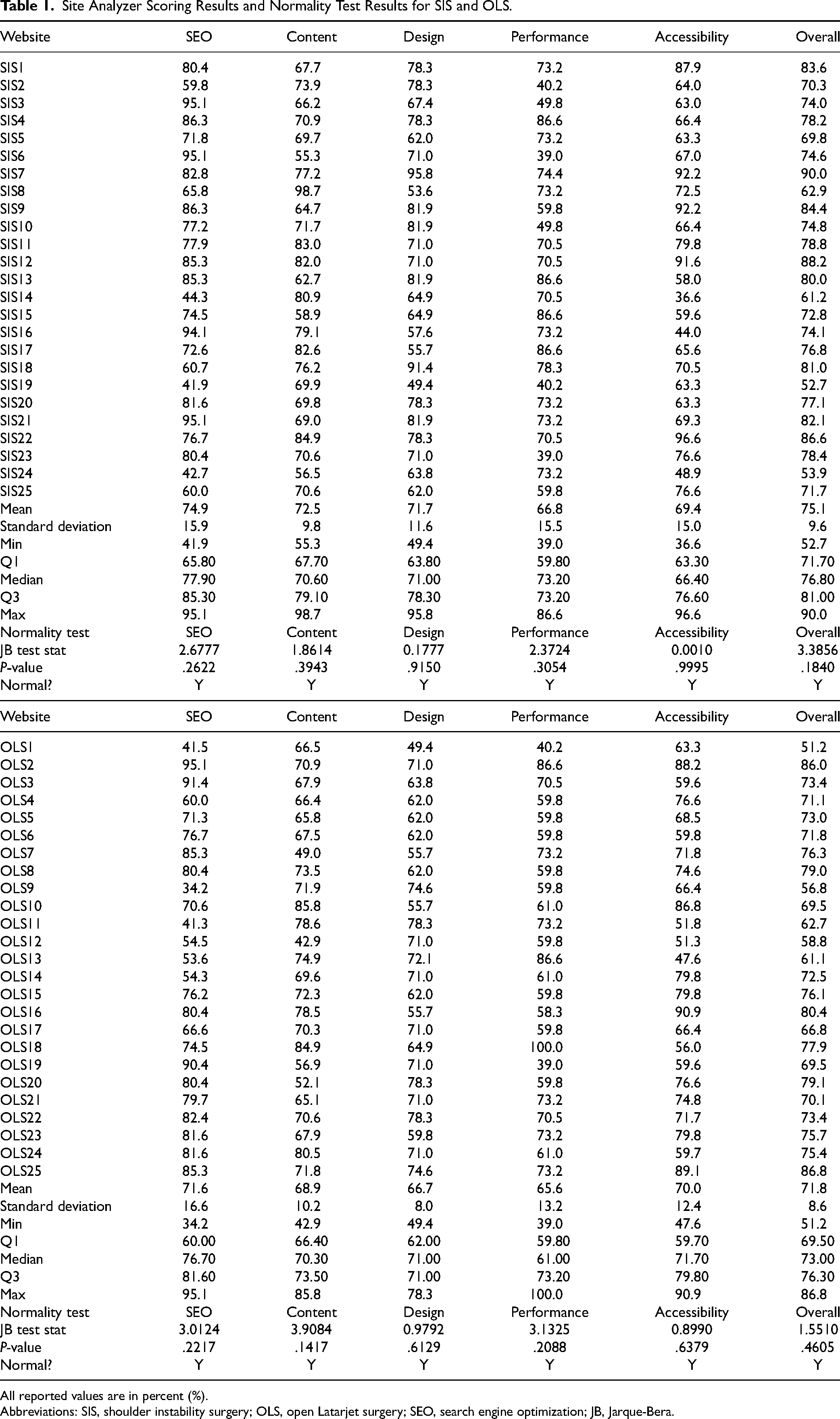
All reported values are in percent (%).
Abbreviations: SIS, shoulder instability surgery; OLS, open Latarjet surgery; SEO, search engine optimization; JB, Jarque-Bera.
JB tests for normality found that the P-values for SIS conformity scores were as follows: SEO P = .2622, content P = .3943, design P = .9150, performance P = .3054, Accessibility P = .9995, and Overall P = .1840 (Table 1). The P-values for OLS conformity scores were as follows: SEO P = .2217, content P = .1417, design P = .6129, performance P = .2088, accessibility P = .6379, and overall P = .4605 (Table 1). Because both sets of scores found P > .05, each set of scores is normally distributed.
The mean number of SIS compliance errors was 17.16 ± 19.61 at WCAG 2.2 A, 22.60 ± 20.92 at WCAG 2.2 AA, and 59.64 ± 32.28 at WCAG 2.2 AAA (Table 2). For SIS, 24% (n = 6) at the A level, 36% (n = 9) at the AA level, and 96% (n = 24) at the AAA level had more than 20 errors. The mean number of OLS compliance errors was 17.6 ± 22.21 at WCAG 2.2 A, 28.52 ± 28.59 at WCAG 2.2 AA, and 56.32 ± 36.64 at WCAG 2.2 AAA (Table 2). For OLS, 20% (n = 5) at the A level, 48% (n = 12) at the AA level, and 88% (n = 22) at the AAA level had more than 20 errors. ANOVA demonstrated that there was a significant difference between compliance errors at each level for both search terms (P < .001, P < .001). Cuzick's test for trend showed a significant positive trend in compliance errors as the WCAG standard increased (A
WCAG Compliance Errors at Each Level of Compliance for SIS and OLS.
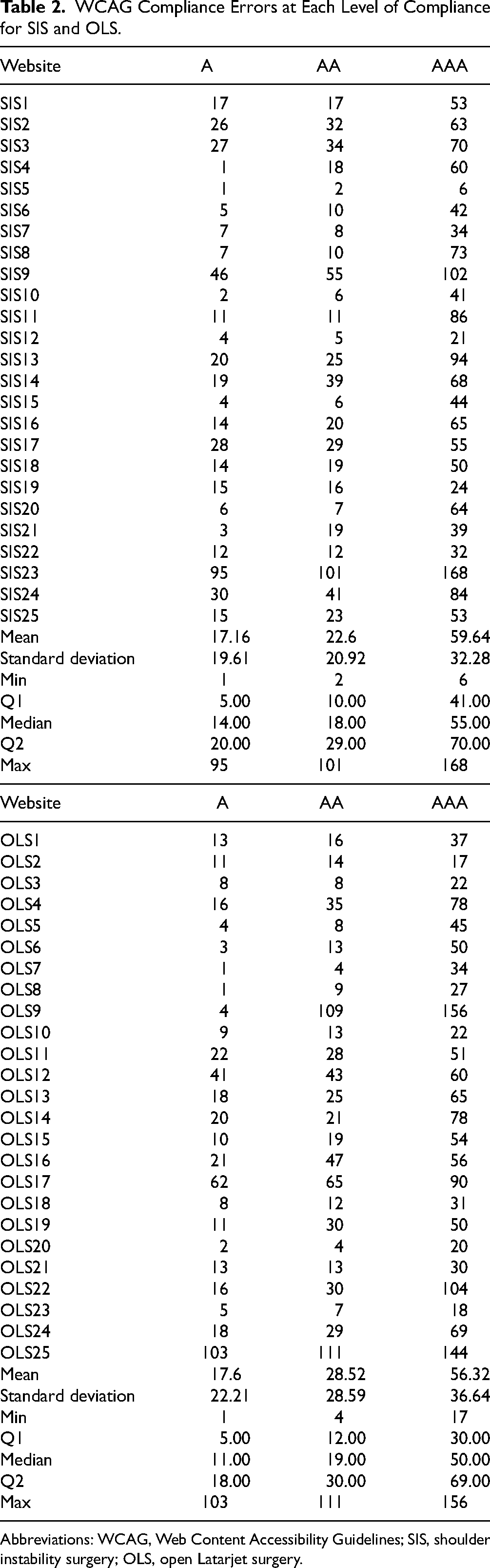
Abbreviations: WCAG, Web Content Accessibility Guidelines; SIS, shoulder instability surgery; OLS, open Latarjet surgery.
The mean contrast ratio was 12.86 ± 5.50:1 for SIS and 11.30 ± 4.46:1 for OLS. WCAG standards A/AA require that websites have a body text contrast of at least 4.5:1, and WCAG standards AAA require a ratio of at least 7.00:1. For SIS, 0% (n = 0) sites had a contrast ratio below 4.5:1, and 20% (n = 5) had a contrast ratio below 7.0:1. For OLS, 4% (n = 1) sites had a contrast ratio below 4.5:1, and 20% (n = 5) had a contrast ratio below 7.0:1 (Table 3).
Contrast Ratios. WCAG A/AA Compliance Is Measured at 4.5:1. WCAG AAA Compliance Is Measured at 7.0:1.

Abbreviations: WCAG, Web Content Accessibility Guidelines; SIS, shoulder instability surgery; OLS, open Latarjet surgery.
Two-tailed homoscedastic student's t-test used to compare SiteAnalyzer scores across queries found the following P-values: SEO P = .467, content P = .206, design P = .086, performance P = .753, accessibility P = .876, and overall P = .200. Each of these suggests no significant difference in scores between queries (P > .05). Two-tailed homoscedastic student's t-tests used to compare the distributions of compliance errors found no significant difference in errors between the 2 queries at level A (P = .941), level AA (P = .408), and level AAA (P = .735), as well as no difference between contrast ratios (P = .277) (Table 4).
Comparison of Scores and Standards Between SIS and OLS. P-Values Were Computed Using Two-Tailed Homoscedastic T-Tests.

Abbreviations: SIS, shoulder instability surgery; OLS, open Latarjet surgery; SEO, search engine optimization.
Discussion
Common consequences of lower health literacy are increases in rates of illness and hospitalizations, healthcare costs, morality, and negative health outcomes.10–12 Commonly, patients seek answers regarding care plans, procedures, and outcomes using educational materials, including those that can be found online.13–17 A large body of research has described an increase in the number of Americans with Internet access and the important role that the Internet plays in supporting healthcare information delivery.14,15,17–20 Additionally, many studies have analyzed the strengths and weaknesses of orthopedic OPEMs, highlighting specific concerns such as reading level, completeness, and quality of the information found within them.8,13–17 Less well-studied, however, is patient perceptions of these materials, as well as the shortcomings they may have for patients who suffer from other cognitive limitations.
The United States Surgeon Generals’ Call to Action to Improve the Health and Wellness of Persons with Disabilities, released in 2005, reported that patients with disabilities have worse health status, and that resources for patients with disabilities are inadequate. 21 A special focus was given to “increase knowledge among health care professionals and provide them with tools to screen, diagnose, and treat the whole person with a disability with dignity.” 21 With a similar intention, the WCAGs were published as a set of recommendations by which developers can ensure that their websites are accessible to users with cognitive disabilities. As the popularity of OPEMs as a source of patient information increases, it is important for the developers of OPEMs to ensure all patients have equal access to educational resources.
While past studies have focused on the readability of orthopedic OPEMs, an important facet of access for diverse patient populations, our study investigated the accessibility and usability of orthopedic OPEMs on the basis of WCAG compliance. WCAGs meet the needs of disabled users based on the need to be “perceivable, operable, understandable, and robust.” 6 Within these broad categories of guidelines are recommendations that developers should follow, across 3 standards or levels of accessibility: A, AA, and AAA, where increasing levels suggest more stringent requirements.
Being perceivable means that the components of a website's user interface, and the information it presents, must be organized in such a way that it is easiest to process. Because the needs of different users to perceive information vary WCAG suggests the use of different presentation structures of the same information and asks developers to format information such that it can be converted to accessible formats. The following WCAG guidelines pertain to the perception of a material: Guideline 1.1 Text Alternatives: Provide text alternatives for any non-text content so that it can be changed into other forms people need, such as large print, braille, speech, symbols or simpler language. Guideline 1.2 Time-based Media: Provide alternatives for time-based media. Guideline 1.3 Adaptable: Create content that can be presented in different ways (for example simpler layout) without losing information or structure. Guideline 1.4 Distinguishable: Make it easier for users to see and hear content including separating foreground from background.
6
Being operable means that components of the user interface must be easy to use and readily navigable. For some users, that is, those that are physically disabled, internet access is not possible through traditional devices such as a mouse or keyboard, and users instead access the internet using alternate technologies. WCAG suggests that developers organize websites based on these limitations. Guidelines pertaining to operability are as follows: Guideline 2.1 Keyboard Accessible: Make all functionality available from a keyboard. Guideline 2.2 Enough Time: Provide users enough time to read and use content. Guideline 2.3 Seizures: Do not design content in a way that is known to cause seizures. Guideline 2.4 Navigable: Provide ways to help users navigate, find content, and determine where they are.
6
Being understandable means that both the information content of the website and the key parts of the user experience must be easily understood by users. This includes complying with standard rules for navigation (eg, a rightwards-pointing arrow meaning to go forward, rather than backwards). Guidelines pertaining to understandability are as follows: Guideline 3.1 Readable: Make text content readable and understandable. Guideline 3.2 Predictable: Make Web pages appear and operate in predictable ways. Guideline 3.3 Input Assistance: Help users avoid and correct mistakes.
6
Being robust means that the webpage is dynamic, or can be used by a variety of users, whether they are human or some form of assistive technology. A guideline pertaining to robustness is as follows: Guideline 4.1 Compatible: Maximize compatibility with current and future user agents, including assistive technologies.
6
In reference to these guidelines, our analysis of SIS and OLS OPEMs suggests low levels of compliance. Within our samples of SIS and OLS OPEMs, we found a mean overall score of 75.1 ± 9.6% and 71.8 ± 8.6%, respectively. Because the JB test for normality suggested that all SiteAnalyzer measures are normally distributed, it is likely that the majority of SIS and OLS OPEMs are poorly suited for patients with cognitive disabilities. Of particular interest are the content, design, and accessibility scores, as they correlate most directly to WCAG guidelines. Within the content score are tests that measure the availability of content in varied formats, the availability of alternative text, and the readability of information provided. Scoring low on this test means that OPEMs may place an unwarranted cognitive load on disabled users, thus limiting their ability to perceive and internalize crucial procedure-related information. Similarly, design and accessibility scores evaluate the predictability of the website's design, the degree of content loss for deaf or blind users, and compatibility with alternative devices. Cuzick test for trend across the standard levels found that there was a significant upward trend in the number of WCAG compliance errors (P < .001, P < .001). These findings suggest that while a proportion of SIS and OLS OPEMs provide a minimum level of accessibility, there is a large volume of accessibility needs that are unaddressed. Higher standard levels contain suggestions which improve accessibility for a greater user audience, and the significant increase in noncompliance suggests a larger inaccessibility for users whose disabilities are more limiting.
Unlike compliance and SiteAnalyzer scores, both the SLS and OLS OPEMs performed above the WCAG recommendation for contrast ratio. Standard levels WCAG 2.2 A and AA recommend that the main body of text have a contrast ratio of 4.5:1, while WCAG 2.2 AAA recommends that the main body of text have a contrast ratio of 7.0:1. 6 In our sample, no SLS OPEM (0%) and only 1 OLS OPEM (4%,) failed to meet failed to meet this recommendation at level A/AA (0%, n = 0). Additionally, only 5 SLS OPEMs (20%) and 5 OLS OPEMs (20%) failed to meet this recommendation at level AAA. Ensuring proper contrast ratios is relevant to patients with impairments to their vision, as greater contrast between text and its background ensures heightened visibility. 6 Past studies have suggested that visual impairments are common in older adults, and ensuring OPEM visibility for this patient population is of paramount importance. 22
Student’s t-tests conducted to compare the compliance measures, compliance errors, and contrast ratios found no significant difference between the 2 search queries (P > .05), suggesting that OPEM noncompliance is not specific to a single procedure query. Rather, this reveals concerns that orthopedic OPEMs may generally lack the proper adherence to accessibility guidelines, affecting the ability of patients seeking these OPEMs to retrieve crucial information. Due to the diverse patient population served by orthopedic surgeons, it is crucial that OPEMs can be readily accessed by users with a variety of limitations in access. Mainly, our analysis suggested that the greatest improvement could be made by increasing the variability in information presentation, by providing alternative text, and by ensuring that OPEMs are accessible from alternative technologies. The purpose of these materials is to inform patient care and improve the patient's experience across the entire episode of care. For surgeons and developers alike, who have this shared goal, greater adherence to WCAG recommendations could better patient understanding of both their care and outcomes.
Limitations
There are several limitations of this study. Primarily, the computation of SEO, content, design, performance, and accessibility scores were calculated using only one tool, SiteAnalyzer. Although these scores are consistent with the reports generated by the tool, it only considers standards when calculating scores, rather than conducting usability testing of these websites. Additionally, this study reported counts of compliance errors across the 3 standards, rather than describing the counts of specific errors, though this could be an avenue of future exploration. Additionally, this study was unable to analyze the compliance of audio–visual content, which is also increasing in popularity. 8
Conclusion
OPEMs pertaining to both SIS and OLS score poorly on measures of accessibility and usability. Regarding WCAG compliance for users with cognitive disabilities or impairments, SIS and OLS OPEMs see increasing compliance errors as the standards increase. However, on average, SIS and OLS OPEMs comply with WCAG requirements for the contrast ratios of body text. WCAG compliance analysis of audio/visual resources and outside of procedural queries has yet to be done. Further research is also needed to evaluate the best approach for improving compliance to WCAG of orthopedic materials and increasing the accessibility of OPEMs across all patient populations.
Footnotes
Declaration of Conflicting Interests
The authors declared no potential conflicts of interest with respect to the research, authorship, and/or publication of this article.
Ethical Approval
Ethical approval is not applicable to this article.
Statement of Human and Animal Rights
This article does not contain any studies with human or animal subjects.
Statement of Informed Consent
There are no human subjects in this article and informed consent is not applicable.
Funding
The authors received no financial support for the research, authorship, and/or publication of this article.
