




Abstract
Humanizing healthcare experiences is imperative for global healthcare organizations, emphasizing connections, empathy, and trust between patients, providers, and the broader community. Patients seek personalized, compassionate care, while employees prioritize supportive workplaces. Modernized feedback programs recognize consumer preferences for convenience and accessibility, leveraging technology like artificial intelligence (AI) for real-time insights. Northwestern Medicine's “Short, Modern, Smart” feedback program exemplifies this, focusing on efficiency, contemporary needs, and technology for action. Key considerations include (1) Short: Streamlining surveys for efficiency, (2) Modern: Prioritizing open-ended comments for personalized insights, and (3) Smart: Leveraging AI for proactive understanding. Recommendations for organizations include implementing formal change management, adopting unified metrics for comprehensive experience measurement, and leverage AI to connect feedback back to humans. In conclusion, humanizing healthcare starts with effective feedback collection and actioning. Northwestern Medicine's approach offers insights, emphasizing streamlined processes, personalized engagement, and technological empowerment, which organizations should prioritize for growth and continuous improvement.
Introduction to the Issue
Humanizing healthcare experiences has become a top priority for healthcare organizations worldwide.1,2 At the heart of this endeavor is the understanding that healthcare is not just about delivering medical treatments, but also about fostering meaningful connections, empathy, and trust between patients, providers, and the broader healthcare community.2–4 Patients seek personalized, compassionate care that aligns with their needs and values. 5 Similarly, healthcare employees desire workplaces that prioritize their growth, well-being, and ability to provide excellent care.6,7
To meet these evolving expectations, healthcare organizations must embrace a culture of continuous improvement, rooted in a modernized approach to experience understanding.5,8 Modernized feedback programs are built on the premise that patients and employees, being consumers, have a well-established repertoire of feedback delivery. Thus, individuals expect convenience and accessibility, by meeting them where they are in their journey, as this is what they have experienced with other brands. 3 Further, they expect the ability to share these experiences in a personalized, efficient manner and that action be taken based on the information they have shared. 9
Once feedback is collected, technology integration becomes crucial for empowering organizational action, fostering relationships, and building trust between patients and healthcare providers.2–5 Modernized feedback programs leverage artificial intelligence (AI), as a powerful tool for analyzing feedback in real time, allowing organizations to gain deeper insights into nuanced experiences.5,8 Examples of how this capability can be leveraged include, analyzing patient voice transcription from a call center interaction or text from a post-discharge survey to identify topics, emerging themes, or sentiment (eg, positive, or negative tone). Upon analyzing this data, pre-identified topics may then function to alert or prompt follow-up action by members of the healthcare team.
Northwestern Medicine (NM), a Chicago-based integrated and academic health system, offers an example of a modernized feedback program in action. Using a multi-year approach, with launch in 2020, the NM “Short, Modern, Smart” feedback program was built on 3 key factors: (1) Short: Streamlining surveys for efficiency; (2) Modern: Prioritizing open-ended comments for personalized insights; and (3) Smart: Leveraging AI for proactive understanding. This manuscript walks through each factor and presents recommendations for organizations looking to embark on a similar, modernized feedback journey.
Key Factors for Consideration
Short: Streamlining Surveys for Efficiency
The “Short” component of the feedback program represented the intent to create a streamlined survey experience for patients and employees. All surveys, beyond those minimally required by the Center for Medicare and Medicaid Services (CMS), were systematically evaluated to reduce unnecessary, quantitative items and leverage more of the patient voice through open comment opportunities. All patient surveys were reduced from 26+ items to 3, with the option to participate in additional survey questions (ie, “Do you have time to answer a few more questions” (see Figure 1). Employee engagement surveys followed a similar process, reducing survey length from 25+ to 2 questions, also with similar branching logic, based on the employee's key metric score. These informed design changes resulted in decreased time to completion, increased response rates, and dramatic improvements in the percentage of surveys containing comments.
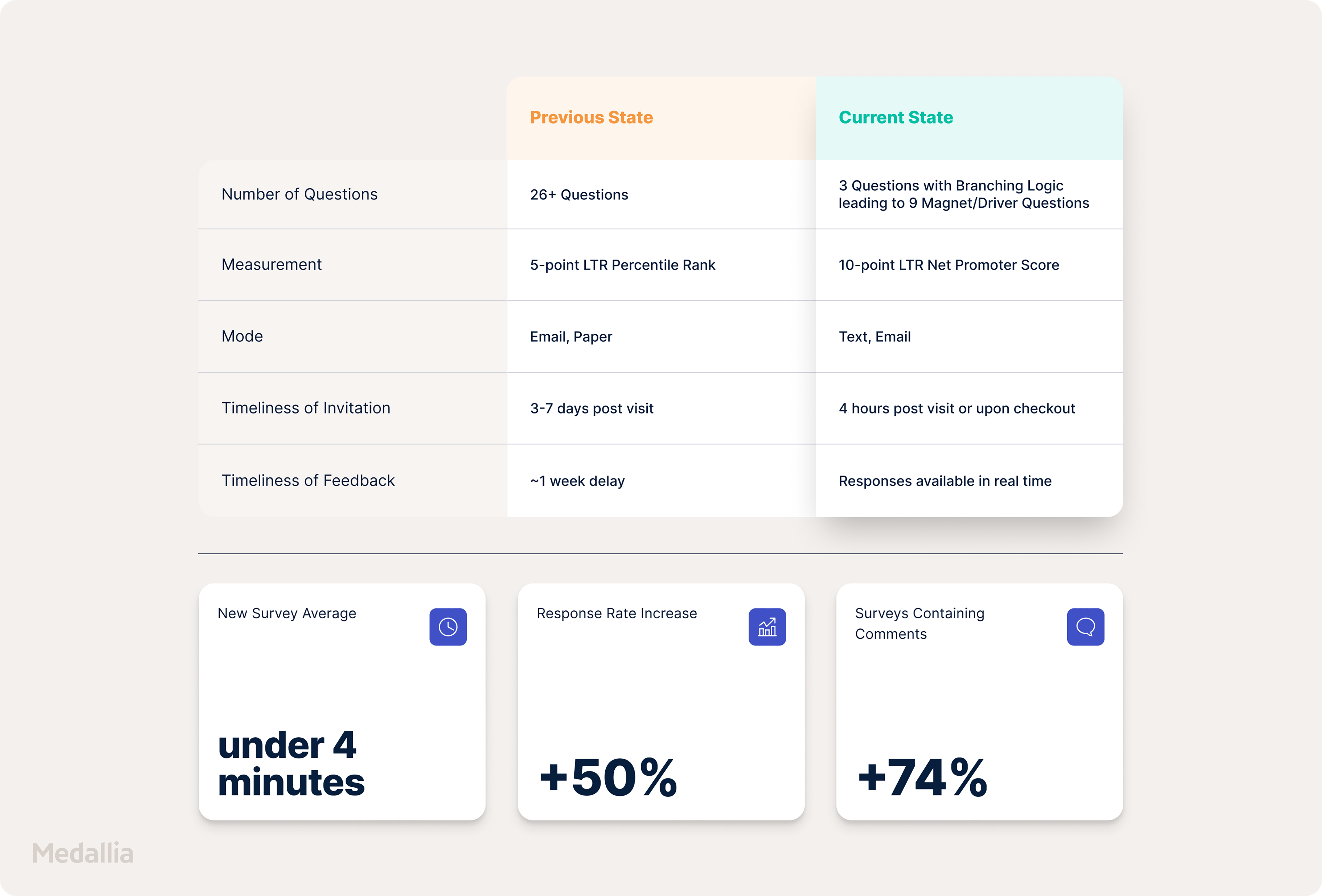
Previous versus current state of streamlined, post-discharge surveys.
An additional objective for the streamlined program design was the decision to align on a common key metric and scoring method, across patient and employee programs, to empower unified experience measurement and understanding. Likelihood to recommend (LTR) was identified as the key metric, tailored by program, and Net Promoter Score (NPS) was introduced as the scoring method. For patient surveys, this required a cultural shift and critical change management programming from the historical use of Top Box and percentile rankings as the primary method for reporting. Impact of this strategic alignment, however, has greatly empowered an improvement-focused mindset and the identification of relational insights across experience programs (eg, Clinical units with high workforce engagement also demonstrate high NPS scores).
Modern: Prioritizing Open-Ended Comments for Personalized Insights
The “Modern” portion of the program design focused on prioritizing more patient and employee voice to best understand personalized needs through open-ended comments. Initial iterations of the survey design leveraged a “Please Tell us the Reasons for your Score” comment opportunity, following each LTR metric, which enabled leaders to uncover issues they may have never thought to ask about. As an example from the ambulatory care surveys, patients shared difficulties scheduling appointments for follow-up care, due to repeatedly missing outbound calls from the contact center. The NM team would not have easily learned this information without allowing this comment opportunity, as results from the quantitative portions of the ambulatory survey demonstrated raving reviews of the healthcare team.
Building on this modernized listening capability, NM now provides patients the opportunity to share feedback about their care experience via video on their smart devices. Collecting over 1400 responses during a pilot, patients reported an appreciation for the digital advancement and eased process for feedback delivery. The level of detail and richness of content shared was also well received by executives and business leaders. Equally important, however, is the gratitude clinicians shared when receiving copies of video collages, filled with accolades about the care patients were receiving throughout the health system.
Smart: Leveraging AI for Proactive Understanding
Getting “Smart” with feedback actioning involved leveraging technology to understand more from the patient and employee voice, also through open-ended comment opportunities. The use of AI via Text Analytics, for example, has helped to identify emerging trends before they become an issue. One example from the employee engagement perspective identified work-from-home opportunities as a key priority for employees, before formally asking them. Proactive understanding of such emerging concerns or trending themes has empowered operational leaders with continuous action-planning capabilities through direct ownership and autonomy in improvement processes.
“Smart” actioning across experience programs also involves engineering response-based alerts within the same system operational leaders administer and review experience feedback. Having the automated ability to alert a leader of a new patient concern or workforce issue, based on a set of strategically selected criteria, has empowered leaders to efficiently do the right thing for the humans who engage within and across the health system. This same alert process has also been leveraged to recognize team members for the great care experiences they provide to patients (see Figure 2). By introducing an employee dictionary to the Text Analytics engine, connecting positive patient feedback, in real time, back to the leaders who support front-line teams has become an automated process.

Leveraging AI to generate employee recognition alerts from patient responses.
Recommendations
The transition to a “Short, Modern, Smart” feedback program required a multi-phase approach, spanning several fiscal years, each with key learnings and lessons to be shared. Organizations looking to embark on a similar journey may be encouraged by 3 key recommendations: (1) create a formal change management strategy, (2) embrace a unified metric that allows for growth, beyond healthcare walls, and (3) leverage AI to connect feedback back to humans.
Create a Formal Change Management Strategy
A key to success behind the “Short, Modern, Smart” feedback program was the level of executive engagement, beginning with the program sponsor, which cascaded throughout the organization. The organization leveraged ADKAR (ie, Awareness, Desire, Knowledge, Ability, and Reinforcement) as a model to assess organizational readiness, communicate changes effectively, and provide necessary knowledge and skills. The program team then reinforced the changes by aligning with strategic internal champions and integration into the organization's culture and processes. Of importance were the relationships and support of distinguished nursing executives and human resource representatives for the patient and employee programs, respectively. Additionally, because the work was identified as a “Strategic Project” to the organization, resources (eg, shared services) were prioritized to support the program's success.
Embrace a Unified Metric That Allows for Growth, Beyond Healthcare Walls
Aligning on a unified metric across experience programs is essential for understanding human experiences within both patient and employee journeys. Further, the use of a cross-industry metric (eg, NPS) enables organizations to compare their patient and employee experiences against those of other industries, beyond healthcare. Given that humans increasingly view their experiences with an industry-agnostic lens, the ability to compare organizational performance to industries of varying experience maturity will increasingly become more critical to the advancement of humanizing healthcare. 10 One factor that helped NM with this decision was having a diverse board of directors, composed of out-of-industry executives, who advocated for an approach that supported the understanding of meaningful relationships and growth (eg, NPS).
Leverage AI to Connect Feedback Back to Humans
Leveraging AI not only enables healthcare organizations to analyze feedback efficiently but also facilitates the crucial step of operationalizing and connecting this feedback back to the humans who impacted the care or employment experience. Through advanced algorithms, AI (eg, Text Analytics) can sift through vast amounts of feedback and identify insights that can be shared and actioned on by key stakeholders. This connection ensures that healthcare professionals are not only aware of patient and employee experiences but also empowered to make real-time improvements based on this feedback, ultimately enhancing human interactions across the organization.
In efforts of continued program impact, the NM engagement team is deeply committed to leveraging AI to bridge the gap between experience feedback and actionable insights for its workforce. This commitment is demonstrated in the integration of key topics or emerging themes from employee engagement surveys in their strategic planning efforts and sharing of video collages featuring patient stories directly with the clinical teams. By harnessing the power of AI, the organization ensures that feedback is not only analyzed efficiently but also translated into tangible improvements in patient care and employee satisfaction, underscoring its dedication to enhancing the overall healthcare experience.
Conclusion
Humanizing healthcare experience has never been more critical. Advancement of the human experience begins with the methods by which we are listening, learning from, and actioning on the feedback we receive from patients and employees who engage within and across a health system. NM's “Short, Modern, Smart” feedback program provides a successful example, demonstrating streamlined surveys, meeting the needs of patients and employees, and leveraging technology for action. Recommendations for organizations embarking on similar journeys stress the importance of change management strategies, unified metrics for growth and improvement, and leveraging AI to connect feedback back to the humans who impact healthcare experiences.
Footnotes
Acknowledgments
The authors would like to thank the Northwestern Medicine Engagement Team (Sarai Navar, Heather Angell, Nick Christensen) and the Medallia Professional Services Team (Alexandra Archer, Dylan Magnani, Brandon Clark).
Declaration of Conflicting Interests
The authors declared no potential conflicts of interest with respect to the research, authorship, and/or publication of this article.
Funding
The authors received no financial support for the research, authorship, and/or publication of this article.
