




Abstract
This research study investigated the effectiveness of Rational Emotive Behavior Therapy (REBT) on depression and anxiety during the coronavirus disease 2019 (COVID-19) pandemic in Nigeria. REBT is used in correcting irrational beliefs and behaviors. This study adopted a randomized pretest, post-test, control group design. Two trial-tested instruments covering; depression, anxiety, and irrational beliefs were for data collection. Data obtained with the instruments were analyzed using mean, standard deviation, and analysis of variance. The study revealed that REBT was effective in reducing depression and death anxiety in COVID-19 patients. The result of this study also showed that the introduction of REBT helped to curb the spread of COVID-19 disease by letting Nigerians to know that the existence, mode of spread, and consequences of the disease is real and not a myth.
Introduction
Coronavirus Disease 2019 Pandemic
The discovery of the deadly virus known as the Coronavirus in Wuhan, China in the year 2019 threatened the existence of mankind, 1 averred that the outbreak of Coronavirus pandemic created apprehension and misery in all corners of the globe. The disease annihilated millions of people and caused fright to the world. The disease was identified with the acronym “COVID-19” by world scientists. 2 The news and stories of coronavirus disease 2019 (COVID-19) pandemic were received differently by various communities and ethnic groups. 3 The disease attracted serious global attention, a situation that was exacerbated by its method of spread among persons, across communities and beyond nations’ international boundaries through the unsolicited agencies of physical contacts with healthy-looking infected persons who might have had contacts with some other infected persons elsewhere. Especially those who might have had contacts with persons from infected parts of the world were at greater risks of infecting others.
The arrival of COVID-19 at the global stage compelled the whole world to go asleep in a broad day light; all normal human activities were grounded and brought to a complete standstill. Around the world, COVID-19 caused countless premature deaths. Numbers of death skyrocketed by the day. The situation became so pathetic that severe panic caught every single global citizen as everyone was afraid of losing his or her own life or loved family and friends due to the rate at which the disease was killing people. As of 11 March, 2021, the COVID-19 virus had cost the world a whopping 2,641,683 lives, 4 while an alarming number of 119,109,202 infections were recorded. Nigeria was not left out of the ugly scene. Available data in Nigeria confirmed that as at 8 March, 2021, Nigeria had recorded a total of 158,906 cases of infected persons. Out of this figure, there were a total of 2000 deaths.
COVID-19 brought a new and unprecedented era in the history of Nigeria. It was the first time in Nigeria that all cerebrations and events like birthday, house-warming celebrations, intra and international movements. 1 Usually, such events always brought people together and crowded spaces, which could have impacted the spread of the COVID-19 virus among the populations. 5 Schools, worship centers and drinking bars were lockdown. Employees and their employers were forced to stay home for the safety of their lives and those of family members. Economic activities dwindled and many people lost their jobs, poverty and hunger took over people. There was no sector of any country of the world that experienced normal economic life during COVID-19 pandemic. 6 Many economies suffered depression.
When the news of the COVID-19 index case spread to all parts of Nigeria, then the President and Commander in Chief of Nigeria handed over the management, procurement, and distribution of relevant healthcare materials and professionals needed for effective control of the virus in Nigeria to Food and Drug Administration and Control and other health care bodies adopting World Health Organization (WHO's) directives and guidelines to protect all persons against the disease. 7 Health care agencies created awareness and disseminated information on the symptoms, methods of avoiding contact with the virus; maintenance of social-distancing rules, proper washing of hands in alcohol-based products, avoidance of large crowds, avoidance of unnecessary physical contacts, wearing of face masks, etc to combat the pandemic. 8 Radio, television stations, newspapers, and social media to spread news on issues concerning COVID-19. But instead of these methods of spreading information about COVID-19 would help to calm people down, it created death anxiety and depression in them.
Death Anxiety and Depression During COVID-19 Pandemic in Nigeria
The news of COVID-19 pandemic caused Death Anxiety and Depression in the lives of a lot of Nigerians. Many Nigerians were apprehensive, dismayed, and frustrated with the wave of COVID-19 because they knew that the Nigerian health sector is in a state of moribund. The situation triggered death anxiety in the life of people. Death anxiety is induced by a constant thought of death. An individual is suffering from death anxiety if he or she constantly thinks of dying for one reason or the other. Death anxiety is anxiety caused by thoughts of one's own death and is also referred to as thanatophobia (fear of death). 9 Death anxiety could be as a result of war, news of natural disasters or a pandemic like the COVID-19 pandemic. Predatory death anxiety arises from the fear of being harmed. 10 The kind of death anxiety engulfed Nigerians was not the fundamental or existential death anxiety which stems from the basic knowledge that human life must one day come to an end. 11 During the COVID-19 pandemic, death anxiety compelled many families to lock themselves indoors for many days, weeks, and months to avoid the dreaded COVID-19. 12 Death anxiety caused depression to many people.
Many Nigerians were very depressed because they believe that this ailment that is annihilating Chinese, Americans and Europeans despite the fact that they have sophisticated technologies and advanced medical care system, will wipe Nigeria out from the surface of the earth. The above thought triggered depression in the psyche of many Nigerians especially, sufferers of COVID-19.
Depression is one of the commonest mental illnesses. It is a secondary irrational belief characterized by a feeling of severe hopelessness, dejection, and a constant loss of interest in life activities due to unhappiness. Depression has become a major threat to human health all over the world. 13 It estimates that more than 350 million people are suffering from depression globally. 2 Sickness, Old age, poverty, death of a loved one, natural disaster, war, disappointment, break-up and flu-like the COVID-19 pandemic are some of the causes of depression. Depression causes weight loss, sleeping problems, weakness, confusion, lack of or concentrating and comprehension, feelings of despair excessive regret and suicidal thoughts. The COVID-19 pandemic created multiple challenges such as loneliness, financial hardship, depression, and anxiety. 14 The COVID-19 pandemic has significantly shaken public mental health causing depression and anxiety to people globally. 15 Depression and death anxiety are associated with adverse societal problems, such as risky situations and diseases like COVID-19. 14 Everybody was apprehensive that he or she may contract the disease and die prematurely. Nigerians especially COVID-19 victims were anxious and depression due to fear of uncertainties, 12 they did not know whether or not they would survive the death-defying COVID-19 era alive or not. The depression and death anxiety the COVID-19 pandemic created in Nigerians especially COVID-19 victims would have led to several deaths if not for the help of rational emotive behavior therapy (REBT) that was introduced by researchers to help victims cope with the perilous situation.
Rational Emotive Behavior Therapy
REBT was employed by researchers as a strategy to appeal to the mind and conscience of COVID-19 victims to do away with death anxiety and depression that had taken a greater part of them. The main aim of REBT is to identify and minimize such irrational beliefs. 16 The fact that REBT promotes rational life attitudes makes it relevant to the current pandemic situation because it encourages people to accept the reality of COVID-19 pandemic. REBT is a therapy introduced by Albert Ellis in the 1950s to control irrational thoughts and behaviors. REBT is a cognitive behavior therapy that deals with modifying maladjusted behavior that has to do with a faulty belief system. 17 REBT advocates a change in people's philosophy of life, so that they can face many life situations with rational beliefs and functional cognitive, emotion, and behaviors. 18 It's an approach that aids an individual to identify irrational beliefs and negative thought patterns that may lead to emotional or behavioral issues. 19 Once the area of negativity is identified, a strategy called REBT can be used to replace them with rational thought patterns. REBT researchers are of the opinion that individual's beliefs and cognitions about an event highly mediate on the cognitive, emotional, and behavioral consequences that follow the beliefs. 20 REBT helps in the reduction of irrational beliefs and promote rational beliefs. 18 REBT helps people to do away with negative thoughts and think right. REBT is a type of therapy that aims to help a person challenge unhelpful thoughts to avoid negative thoughts and feelings. 21 REBT is a therapy that focuses on changing irrational and self-defeating thoughts and beliefs to help people learn to manage their emotions. 22
This study anchors on the section “B” aspect of REBT which makes people in control of how they respond to adversity and have autonomy over their beliefs. REBT is an action-oriented approach to managing cognitive, emotional, and behavioral disturbances. 23 REBT is the best method for altering irrational beliefs was to change the thinking system or belief of the individual. REBT is effective in reducing irregular attitudes in several target groups. 24 The theoretical constitution of rational and irrational beliefs within REBT is alluring due to its evenness and comparative unfussiness. But apart from the aforementioned qualities, REBT has numerous cognitive, affective, and behavioral outcomes that are important not just to mental health alone but to all aspects of human life. Ellis suggested that the best approach to dispute and deal with irrational beliefs was to alter the irrational beliefs by means of rational, emotive, and behavioral techniques. REBT was effective in modifying and correcting irrational and false beliefs about COVID-19 pandemic. REBT helped to curb death anxiety and depression during the COVID-19 Pandemic era.
Methods
Study Setting
This study was conducted in 5 COVID-19 rehabilitation centers in South-Eastern Nigeria. The rehab centers were located in semi-urban areas during the COVID-19 pandemic era in Nigeria. All the subjects were Nigerians.
Participants
One hundred and one adults who received COVID-19 treatment due to illness during the pandemic period formed the treatment and control groups. The treatment group was made up of 50 adults while the control group comprised 51 adults. The study adopted a randomized pretest, posttest, control group design. The experimental group received was assisted with REBT manual on anxiety and depression.
A pretest-posttest randomized experimental design was adopted for the study. A pretest-posttest randomized experimental design is a type of experiment where participants get randomly assigned to either receive an intervention (the treatment group) or not (the control group). The outcome of interest is measured 2 times or once before the treatment group gets the intervention—the pretest—and once after it—the posttest. The design is considered suitable in this study because intact or existing groups were used for experimental and control groups. Pretest-posttest randomized experimental design is used in real-life conditions and investigations, where there are existing groups like we have in this study.
The design and symbols are represented thus:
Experimental Procedure
Rational Emotive Behavior Therapy Manual packages were used to emit information to the subjects on how to reduce anxiety, depression, and irrational beliefs. The Patient Health Questionnaire 9 (PHQ-9)-item depression scale and 7-item was adapted by the current researchers and was modified to suit the environmental variations and use it to elicit information on anxiety and depression. A Patient Health Questionnaire-Anxiety-Depression Scale (PHQ-ADS), a 16-item scale comprising the PHQ-9 and GAD-7. 25 PHQ-ADS) is a composite measure of anxiety and depression. Similarly, the COVID-19 Pandemic Awareness Questionnaire (CPAQ) was used by the researchers to elicit information on respondents’ level of awareness of COVID-19 pandemic's existence, spread, and consequences. CPAQ was developed by the researchers to elicit information on respondents’ knowledge of COVID-19 Pandemic's existence, mode of spread, and its consequences. The instruments were validated by health experts in Abnormal Psychology and experts in charge of disease control in Nigeria. The Experts further modified the items in the instruments and certified their appropriateness for conducting this study. Five research assistants took the questionnaires to houses for the convenience of the respondents and collected the questionnaires the following day. Mean, standard deviation, and Analysis of covariance were used for data analysis.

Key; P1 = pretest; X1 = treatment (instructions with REBT); X0 = control group (no treatment); Y1 = posttest; Y2 = follow-Up.
Results
Research Question 1: What is the Effect of REBT on Death Anxiety?
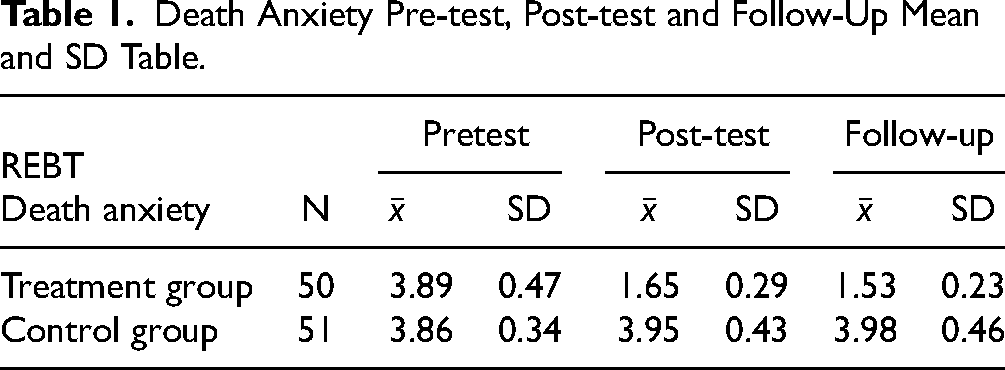
The result presented in Table 1 shows the variations in the pretest, post-test, and follow-up death anxiety mean scores of respondents exposed to REBT and those not exposed to it. The result indicates a pretest mean score of 3.89 and standard deviation of 0.47 for the treatment group and 3.86 mean score and a standard deviation of 0.34 for the control group. Similarly, the result indicates a post-test mean score of 1.65 and a standard deviation of 0.29 for the treatment group and a mean score of 3.95 and a standard deviation of 0.43 for the control group. After 3 months of the study, a follow-up data was collect to determine whether the participants were still stable or still anxious. The data collected as a follow-up indicates a mean score of 1.53 and a standard deviation of 0.23 for the treatment group and a mean score of 3.98 and a standard deviation of 0.46 for the control group. The decline in the mean of the respondents in the treatment group from 3.89 to 1.65 and consequently to 1.53 depicts that REBT is really effective in reducing a high death anxiety level. To further address the research question the following hypothesis was raised.
HA1: REBT has no significant effect on Death Anxiety
Death Anxiety Pre-test, Post-test and Follow-Up Mean and SD Table.
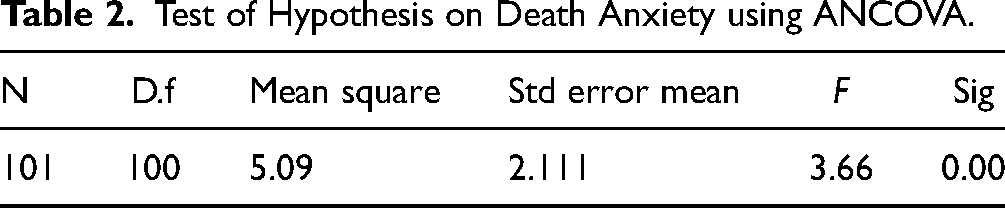
The result in Table 2 shows an F-ratio of 3.66 with an associated probability value of 0.00 that was obtained with regard to treatment as a main effect on the death anxiety of respondents. The mean scores of respondents who received REBT and those exposed to no treatment varied significantly. Since the associated probability (0.00) was less than 0.05 set as the benchmark for taking a decision, the null hypothesis (HA1) which stated that REBT has no effect on death anxiety was rejected. The inference drawn is that REBT has a significant effect on the death anxiety level of respondents who received it; as it reduced the death anxiety level of the respondents in the treatment group significantly.
Test of Hypothesis on Death Anxiety using ANCOVA.
Research Question 2: What is the Effect of REBT on Depression?
Table 3 shows the differences in the pretest, post-test and follow-up depression mean scores of respondents exposed to REBT and those not exposed to it. The result indicates a pretest mean score of 3.90 and standard deviation of 0.45 for the treatment group and 3.92 mean score and a standard deviation of 0.39 for the control group. In the same manner, the result indicates a post-test mean score of 1.77 and a standard deviation of 0.23 for the treatment group and a mean score of 3.94 and a standard deviation of 0.44 for the control group. After 3 months of the study, a follow-up data was collected to determine whether the participants retained were still stable or not. The data collected as a follow-up indicates a mean score of 1.61 and a standard deviation of 0.20 for the treatment group and a mean score of 3.96 and a standard deviation of 0.48 for the control group. In the same way, to further address the research question the following hypothesis was posed. Similarly, the turn down in the mean of the respondents in the treatment group from 3.90 to 1.77 and consequently to 1.61 demonstrates that REBT is really effective in reducing respondents’ depression level.
HA2: REBT has no significant effect on Depression
Depression Pre-test, Post-test and follow-Up Mean and SD Table.
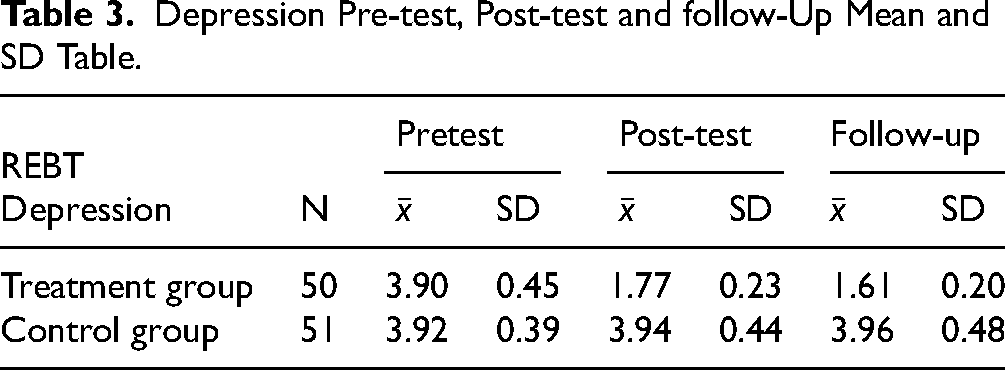
Table 4 shows an F-ratio of 2.23 with associated probability value of 0.01 was obtained with regard to treatment as a main effect on the depression level of respondents. The mean scores of respondents who received REBT and those exposed to no treatment varied significantly. Since the associated probability (0.01) was less than 0.05 set as the benchmark for taking a decision, the null hypothesis (HA2) was rejected. In the same manner, the inference drawn is that REBT has a significant effect on the depression level of respondents who received it.
Test of Hypothesis on Depression using ANCOVA.

Discussion
The result of this study shows that REBT has a significant effect on the anxiety level of respondents who received it; as it reduced the anxiety level of the respondents in the treatment group significantly. Several other studies have proved that REBT is efficient in reducing anxiety in human beings. For instance, the findings of the current study are in line with the result of another study which revealed that REBT was effective in reducing anxiety and increasing resilience in students. 6 REBT is an efficient psychological treatment for medical students who suffer from generalized anxiety disorders. 26 REBT patronage technique significantly decreases anxiety levels among inmates. 27 REBT has a significant effect on reducing examination malpractice caused by a fear of failure. 28
The result of this study revealed that REBT has a significant effect in reducing the depression level of the respondents who received it. The result of this study is in line with another which found that REBT therapy was effective in decreasing depression among depression patients. 29 REBT intervention significantly improves medical students’ ability to overcome depression and irrational beliefs. 30 REBT to be efficient in treating depression among adolescents. 31
Conclusions
In this study, REBT proved to be efficient for the treatment of depression and death anxiety. It has been proved that REBT is an efficient apparatus capable of correcting irregular beliefs.
Footnotes
Acknowledgments
The Researchers acknowledge their family and friends who helped them in one way or the other in the course of carrying out this study.
Declaration of Conflicting Interests
The authors declared no potential conflicts of interest with respect to the research, authorship, and/or publication of this article.
Ethical Approval
The Research Ethics Committee of the Faculty of Education, University of Nigeria, Nsukka approved the undertaking of this study. This research work's IRB is
Funding
The authors received no financial support for the research, authorship, and/or publication of this article.
Informed Consent
The consent of the participants was sought and obtained before they were used for the study.
