




Abstract
Lack of social trust in the physician–patient relationship will disrupt health. Since social trust has not been sufficiently studied in patients' companions, this study investigates and compares social trust and its dimensions in companions of patients discharged against medical advice with total patients’ companions in the emergency room. In this cross-sectional descriptive-comparative study, 385 patients’ companions were enrolled. This study was done by a questionnaire with five subscales: honesty, frankness, cooperative tendency, confidence, and trust. Data were analyzed using descriptive statistics and analytical statistics methods. In this study, there was no significant difference between the mean score of social trust between companions of patients discharged against medical advice (61.11 ± 9.01) and patients discharged after treatment (62.27 ± 6.97). There was a significant relationship between the mean score of the 2 groups only in the frankness domain (P-value = .001). The level of social trust in the patients’ companions was moderate in both groups. Companions of discharged patients after completing the treatment process are more explicit than the companions of patients discharged against medical advice.
Introduction
Trust between physician and patient can be analyzed in 3 ways. One is the patient's view and the patient's trust in the physician. Second, a trusted physician provides for the patient, and the third is the trust in the physician–patient relationship. In other words, one is the trust supervising the patient and the other is the trust supervising the physician and the third is the trust of supervising the relationship between physician and patient (5).
Methods
Results
Demographic Characteristics of Participants.

Comparison of Trust-Based Behavior Score in 2 Groups of Patients’ Companions
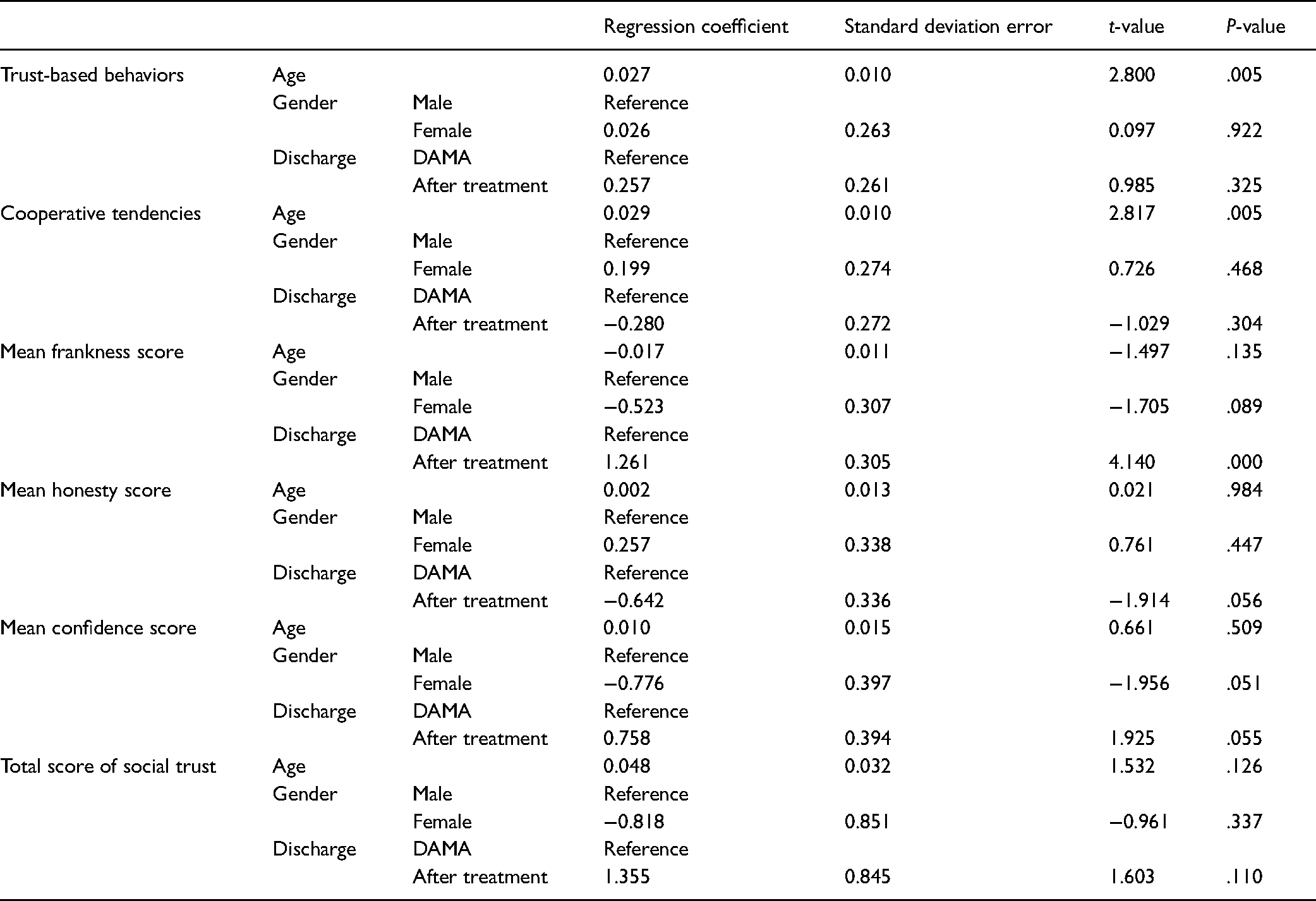
The mean score of trust-based behavior in the companions of patients discharged against medical advice was 12.82 ± 2.48 and in the companions of patients discharged after the treatment steps were 13.08 ± 2.52. Based on the independent t-test, there was no significant difference in the trust-based behavior average score (P-value = 0.29). According to the linear regression model, age, gender, and type of discharge had no significant effect on trust-based behavior. Table 2 shows the results of the linear regression. The regression results showed that the score of trust-based behavior increased by 0.027 units by one unit of patients' companion age and was higher in women than men. Also, the mean score of confidence-based behavior among companions of patients discharged after treatment was 0.257 points higher.
Regression Coefficients of Effect of age, Gender, and Type of Discharge on Score of Trust-Based Behavior.
Comparison of Cooperative Tendency Score in 2 Groups of Patients’ Companions
The mean score of cooperative tendencies in the companions of patients discharged against medical advice was 11.43 ± 2.7 and in the companions of patients discharged after the treatment stages were 11.2 ± 2.52 (P-value = 0.38). According to the linear regression model, gender and type of discharge had no significant effect on cooperative tendencies. But with the increase of one unit in the age of the patients, the mean score of cooperative tendencies was significantly higher by 0.029 units (P-value = .005). Table 2 shows the results of the linear regression. The regression results showed that the mean score of cooperative tendencies in women was 0.19 points higher than men and the mean score of cooperative tendencies in companions of discharged patients after treatment was 0.28 points lower.
Comparison of Frankness Score in 2 Groups of Patients’ Companions
The mean score of frankness in the companions of patients discharged against medical advice was 9.16 ± 2.82 and in the companions of discharged patients after treatment was 10.3 ± 2.99. Based on the independent t-test, there was no significant difference (P-value <.001). According to the linear regression model, age and gender had no significant effect on frankness. But the mean score of frankness was significantly higher by 1.26 points in the companions of patients discharged after treatment than in patients discharged against medical advice (P-value <.001). Table 2 shows the results of the linear regression. The regression results showed that the mean score of frankness in females was lower than males by 0.017 units.
Comparison of Honesty Score Between 2 Groups of Patients’ Companions
The mean score of honesty in the companions of the patients discharged against medical advice was 10.97 ± 3.93 and in the companions of the patients discharged after the therapeutic procedures were 10.39 ± 2.21. There was no significant difference between the mean honesty score (P-value = .29). According to the linear regression model, age, gender, and type of discharge had no significant effect on honesty. Table 2 presents the results of the linear regression. The regression results showed that the score of honesty increased by 0.002 units with the one unit increase of age in the patients' companions and was higher by 0.25 units in the females than the males. Also, the mean honesty of the companions of patients discharged after treatment was 0.642 units less.
Comparison of Confidence Score in 2 Groups of Patients’ Companions
The mean score of confidence in the companions of the patients discharged against medical advice was 16.73 ± 3.93 and in the companions of patients discharged after treatment was 17.3 ± 3.59. There was no significant difference in the mean confidence score based on t-independent test (P-value = .29). Based on the linear regression model, age, gender, and type of discharge had no significant effect on confidence. Table 2 presents the results of the linear regression. The regression results showed that the confidence score increased by 0.010 units by one unit of age and in women was 0.77 units lower than men. Also, the mean confidence in the companions of patients discharged after treatment was 0.75 units higher.
Comparison of the Total Score of Social Trust in 2 Groups of Patients’ Companions
The mean score of social trust in the companions of the patients discharged against medical advice was 61.11 ± 9.01 and in the companions of the patients discharged after the treatment stages were 62.27 ± 6.97. There was no significant difference between the 2 groups in social trust based on an independent t-test (P-value .16). Based on the linear regression model, age, gender, and type of discharge had no significant effect on social trust. Table 2 presents the results of the linear regression. The regression results showed that with one unit of the age of patients' companions the social trust score increased by 0.048 units and in women was 0.81 units lower than men. Also, the mean of social trust in companions of patients discharged after treatment was 1.35 higher.
In this study, 385 patients, 196 males (50.9%) and 189 females (49.1%) were studied. The mean age of participants was 39.98 (13.08) years. In this study, 192 patients were discharged from the hospital against medical advice and 193 patients were discharged after completing the treatment. The results of the study showed that the mean score of trust-based behavior, cooperative tendencies, honesty, and confidence was not significantly different between the 2 groups of patients. There was a significant relationship between the groups only in the frankness; there was a significant difference between the mean score of the 2 groups.
In this study, regarding the special culture and taboos of the society, it may be probable that some participants may have not shared their real thoughts and opinions, which can be considered as a bias.
Discussion
In the relationship between physician and patient, trust is a major social capital. Trust between physician and patient is an effective factor in the patient's recovery and physician satisfaction (17). Despite the fact that one of the pillars of ethics in medicine is to build trust between the physician and the patient, we are witnessing a decrease in this type of trust. Therefore, the purpose of this study was to investigate the level of trust of patient companions in patient management in the emergency department.
Findings of the questionnaires obtained from the viewpoints of patients' companions referring to the Emergency Department of a teaching hospital indicate that there was no statistically significant difference in social trust between the companions of the patients discharged against medical advice and the companions of patients discharged after completing the treatment process and the confidence level was moderate in both groups. Also, none of the demographic variables (age, sex, type of discharge) had a significant effect on the trust of the companions.
In investigating the factors for trust in the patient–physician relationship, it is important to consider the patients’ tendencies that make them less likely to trust physicians. In this study, the dimensions of social trust in the subscales of cooperative tendencies, trust-based behavior, trust, honesty, and openness among male and female patients' companions were measured. According to the research findings, there was no significant difference in the subscales of cooperative tendencies, trust-based behavior, trust and honesty, and only one of the subscales, namely frankness, was significantly different. This means that the frankness score in the companions of patients discharged after completing the treatment was higher than the companions of the patients discharged against medical advice, while the frankness score of the males was higher than the females. The trust and confidence-based behaviors subscale, although not statistically significant, was higher in the discharged group after completing the treatment process than the discharged against medical advice group.
Statistical analysis of some studies has shown that there is a significant relationship between gender and the level of social trust, meaning that the level of social trust among men is higher than women. First, women were less likely to trust physicians. These results are in contrast with their previous studies where gender did not make any significant difference in trust in the patient–physician relationship (7, 10). However, investigations on the generalized aspect of trust suggested that women were less likely to trust because in comparison to the males, they are more likely to be victimized, and therefore fear to take risks (18, 19). Based on this finding, it can be said that gender has a social burden in addition to its physiological aspect. It is debatable that despite the position of women in society, the self-confidence of this group can easily be influenced by the opinion of others (20, 21).
In our study, according to the questionnaire mean scores based on the sum of the subscales determining social trust, social trust among companions of the patients discharged against medical advice (61.11 ± 9.01) and the other patients’ companions (62.27 ± 6.97) is average.
This study has some limitations. For instance, the negative health factors in previous studies are strongly correlated with low trust levels in physicians (20). Therefore, it may be worthy to conduct similar studies for investigating the role of other negative habits on this relationship that have not been studied in the present study. These factors can be divided into subjective and objective measures. Smoking is a well-known objective factor of health deterioration (22). Stress, which is also a recognized factor for bad health, can be considered as a subjective measure since it can be graded into different degrees (23). The negative correlation between negative health traits and trust in the patient–physician relationship can be probably due to having negative experiences in health care in bad health conditions and therefore are not satisfied with it (24, 25).
This study investigated social trust and its dimensions of the companions of patients discharged against medical advice, and all patients’ companions in the emergency room of Tabriz Imam Reza Hospital. We found that the level of social trust of the patients’ companions in the 2 groups were similarly moderate. Also, there was no significant relationship between demographic variables and social trust. Among the social trust subscales, only there was the difference in the frankness subscales between the 2 groups, so the companions of patients discharged after completing the treatment process are more explicit than the companions of patients discharged against medical advice and it would be a good idea to study the underlying reasoning for this phenomenon in future studies. Also, although not statistically significant, men's social trust is higher than women's, and each person's social trust increases with age.
Supplemental Material
sj-docx-1-jpx-10.1177_23743735221113053 - Supplemental material for Assessment of Social Trust in Relatives of Discharged Patients With Personal Consent and Other Relatives of Patients
Supplemental material, sj-docx-1-jpx-10.1177_23743735221113053 for Assessment of Social Trust in Relatives of Discharged Patients With Personal Consent and Other Relatives of Patients by Hamid Reza Moretza Bagi, Zhila Khamnian, Forough Hatami, Samad Shams Vahdati, Reza Yazdani and Sama Rahnemayan in Journal of Patient Experience
Footnotes
Acknowledgment
We thank skill laboratory of Tabriz University of Medical Sciences and emergency medicine research team of Tabriz University of Medical Sciences for collaboration on conducting this study.
Author Contributions
HRMB constructed an idea or hypothesis for research and manuscript. ZhKh planned methodology to reach the conclusion. HRMB organized and supervised the course of the project or the article and taking the responsibility. FH took responsibility in execution of the experiments, patient follow-up, data management and reporting. SShV took responsibility in logical interpretation and presentation of the results. SR took responsibility in doing the literature review. SR took the responsibility in the construction of the whole or body of the manuscript. RY reviewed the article before submission not only for spelling and grammar but also for its intellectual content.
Ethical Statement
Procedures followed in this study were in accordance with the ethical standards of the responsible committee on human experimentation and IRB approval was received from Tabriz University of Medical Sciences Ethics Committee (IR.TBZMED.REC.1398.263). Informed patient consent was acquired from patients and their companions for inclusion in the study.
Declaration of Conflicting Interests
The authors declared no potential conflicts of interest with respect to the research, authorship, and/or publication of this article.
Funding
The authors received no financial support for the research, authorship, and/or publication of this article.

Supplemental Material
Supplemental material for this article is available online.
References
Supplementary Material
Please find the following supplemental material available below.
For Open Access articles published under a Creative Commons License, all supplemental material carries the same license as the article it is associated with.
For non-Open Access articles published, all supplemental material carries a non-exclusive license, and permission requests for re-use of supplemental material or any part of supplemental material shall be sent directly to the copyright owner as specified in the copyright notice associated with the article.
