



Abstract
One of the groups most negatively affected by the epidemic process has been the elderly patients. In this process, it is of great importance to determine the fear levels of the patients and to evaluate the factors that may be related. With this approach, this study aimed to examine the relationship between the fear of COVID-19 and health literacy scores of elderly patients living in Kahramanmaraş City, Turkey. Another aim of the study was to investigate whether the participants’ COVID-19 fear change according to various socio-demographic characteristics. The convenience sampling method were used and 266 of valid samples were collected. Descriptive statistics, t-test, ANOVA, Pearson correlation analysis, simple and multiple linear regression analysis techniques were used. The results obtained from the study showed that COVID-19 fear status of the participants were moderate while the health literacy scores were low. Higher health literacy was associated with lower fear of COVID-19. In addition, it was determined that the fear of COVID-19 showed statistically significant differences according to education level, insurance status, smoking status, follow the news status and marital status. As a result, it has been observed that the level of health literacy can be effective in protecting elderly patients from fear. Longitudinal studies have been proposed to determine whether this relationship is causal or not.
Introduction
The COVID-19 epidemic that occurred in Wuhan, China toward the end of December 2019 negatively affected the whole world (1,2). The emergence and consequences of COVID-19 have sparked fear and anxiety among individuals around the world. In this process, individuals with high levels of fear may not think clearly and rationally while reacting to COVID-19 (3). People with constant anxiety may panic and make mistakes that lead to unreasonable decisions and behaviors (4). Fear can become chronic and burdensome, especially if we take into account that the threat is uncertain and continuous (5). This situation may cause individuals with more mental health problems in the future (6,7).
The potential for fear caused by pandemic viral infections can lead to significant mental distress at the population level (8). Researches provide evidence that fear of the epidemic may lead to some health problems (9–11). Individuals should be able to control their fear level in order not to encounter bigger health problems. At this point, the level of health literacy individuals have is of great importance. Health literacy is defined as the ability to read, understand and act on health care information (12). Strengthening health literacy can develop individual and social resilience, help address health inequalities, and improve health and well-being (13). Some studies, especially during the epidemic, show that the level of health literacy protects against depression and anxiety (14,15). On the other hand, it seems that there are limited studies examining the relationship between health literacy level and the fear of COVID-19. A study conducted on students in Vietnam reported that individuals with low health literacy levels have higher fear of COVID-19 (16). A study conducted in Bangladesh also revealed that individuals with high knowledge scores have less fear level (17). On the other hand, it has been observed that although the elderly patients were most negatively affected with the epidemic, adequate studies were not conducted in this age group. In this study, the COVID-19 fear levels of elderly patients were evaluated and the possible effects of health literacy on the fear of COVID-19 were examined.
Methods
Study Design
The aim of this study was to investigate the relationship between fear of COVID-19 and health literacy among elderly patients in Kahramanmaraş City, Turkey. A cross-sectional survey design was used in this study.
Study Population and Sample
A convenience sample of elderly patients was recruited from university hospital in Kahramanmaraş City, Turkey. The inclusion criteria were as follows: individuals aged 65 and over who volunteered to participate in the study. Data were collected from March 2 to April 02, 2021. It was distributed 282 questionnaires to elderly patients, of which 266 completed the questionnaire. This equated to a response rate of 94.33%. Verbal informed consent was obtained from the patient(s) for their anonymized information to be published in this article.
Instruments
The questionnaires contained a socio-demographic section, the Fear of COVID-19 Scale (FCS) and the Health Literacy Scale (HLS). Socio-demographic variables included gender, marital status, health insurance and education level. In addition, the participants were asked if they regularly followed the news about the epidemic and whether they used to smoke regularly.
The FCS was used to measure elderly patients’ fear of COVID-19 (3). This scale comprises seven items. A 5-point Likert scale was used (1 = strongly disagree, 5 = strongly agree). The Cronbach alpha coefficients of the Turkish version were 0.82 for the total score (18). In this study, the Cronbach alpha value was 0.95. Likewise, Explanatory Factor Analysis (EFA) was performed to evaluate the validity of the scale. In EFA, a one-factor structure was obtained as in the original of the scale, the Kaiser-Meyer-Olkin (KMO) value was 0.93 and the explained variance was 77.10%.
Elderly patients’ general health literacy level was measured by HLS. This scale was developed by Toçi, Burazeri (19) and consists of 25 items over four metrics: access (five items), understanding (seven items), appraisal (eight items), and application (five items) of health information. Along with these factors, individuals’ levels of accessing, understanding, appraising and applying information in making decisions about their health status are evaluated. The items were scored on a Likert scale from 1 (unable to)–5 (without any difficulty). The Cronbach alpha coefficients of the Turkish version were 0.92 for the total score, 0.71, 0.79, 0.66 and 0.62 for the four factors (20). In this study, the Cronbach alpha coefficients of total scale and its four metrics were 0.95, 0.77, 0.86, 0.89 and 0.81, respectively. Likewise, Explanatory Factor Analysis (EFA) was performed to evaluate the validity of the scale. In EFA, a four-factor structure was obtained as in the original of the scale, the Kaiser-Meyer-Olkin (KMO) value was 0.94 and the explained variance was 62.43%.
Data Analyses
SPSS version 26.0 (SPSS Inc., Chicago, IL, USA) was used for data analysis. The scores for fear of COVID-19 and health literacy showed normal distributions. Descriptive statistics, including mean, standard deviations, frequency and percentage, were used to analyze the demographic characteristics, fear of COVID-19 and health literacy. The t-test and ANOVA were used to examine the relationships between socio-demographic variables and fear of COVID-19. Correlations between fear of COVID-19 and health literacy were tested by Pearson correlation. Simple linear regression analysis was used to identify the influence of health literacy on fear of COVID-19. In addition, multiple linear regression analysis was used to identify the influence of health literacy dimensions on fear of COVID-19. The level of significance was 0.05.
Results
The descriptive characteristics of the participants are given in Table 1. It was observed that 57.7% of the participants were male, 93.5% had health insurance, and that 56.1% were married. Approximately half of the participants (44.6%) stated that they are primary school graduates. On the other hand, the composite score of the health literacy was 2.83 (SD = 0.63), which was below the mid-point. Likewise, it is observed that the levels of fear of COVID-19 is moderate (3.45 ± 0.93).
Socio-demographic Characteristics of Respondents and their Comparison with the Fear of COVID-19.
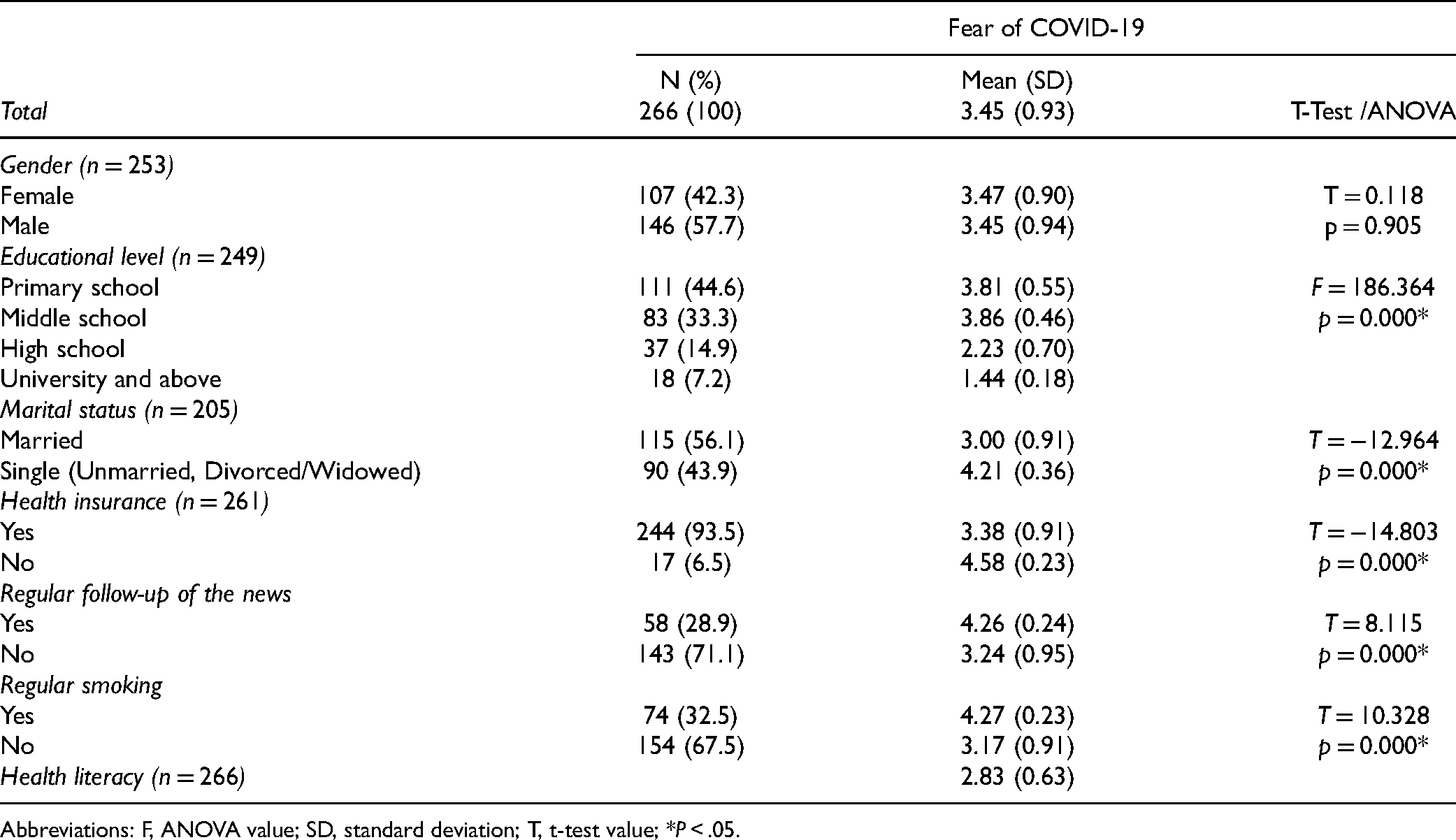
Abbreviations: F, ANOVA value; SD, standard deviation; T, t-test value; *P < .05.
In Table 1, it was examined whether the levels of fear of COVID-19 of elderly patients showed a significant difference according to educational status, gender, smoking status, follow-up of the news status, health insurance status and marital status. It was observed that individuals without health insurance had higher fear of COVID-19 levels. It was found that married and highly educated individuals were less fear of the epidemic. Likewise, it was found that regular news followers and smokers also had higher levels of fear (P < .05). On the other hand, the results of correlation analyses in Table 2 indicated that overall health literacy had the moderate negative relationship with fear of COVID-19 (r = −0.596, P < .001). All dimensions of health literacy had significant relationships with fear of COVID-19 (P < .001).
Intercorrelations Between Research Variables.

**P < .01.
When Table 3 is examined, it is observed that the health literacy explains 35.5% of the total variance in the fear of COVID-19 of elderly patients (Model 1). Simple regression analysis revealed that health literacy has significant effect on fear of COVID-19 (β = −0.596, P < .05). Likewise, in Model 2, the impact of health literacy dimensions on fear of COVID-19 was evaluated by multiple linear regression analysis. The explained variance rate was 36.9% for fear of COVID-19. Access and application dimensions had significant effect on fear of COVID-19 (respectively, β = −0.252, β = −0.301, P < 0.05).
The Effect of Health Literacy and Its’ Dimensions on the Fear of COVID-19.

Dependent variable: Fear of COVID-19.
p < .05.
Discussion
In this study, COVID-19 fear levels of elderly patients were evaluated. In addition, the relationship of health literacy and some socio-demographic variables with the fear of COVID-19 was examined. A negative relationship was found between the fear of COVID-19 and the level of health literacy. This finding we obtained was consistent with the results of other studies conducted on different sample groups (16,17). It has been shown that health literacy can be effective in protecting elderly patients from fear.
Socio-demographic variables play an important role in identifying risky groups and creating intervention strategies. In the study, it was observed that individuals with low education level, single and uninsured individuals had higher levels of fear. Similar studies on the subject supported our findings (21–23).
Elderly patients who participated in our study had moderate levels of fear. Likewise, it was found that individuals who stated that they regularly followed the news had higher levels of fear. It can be said that one of the factors affecting the fear levels of individuals may be the media. Studies also reveal that more exposure to media is associated with more fear (5,24). At this point, journalists and policy makers have some responsibilities. In the presentation of the news, care should be taken to minimize uncertainty and not to give information with disturbing images.
During the pandemic process, individuals who are afraid can engage in behaviors that can negatively affect their quality of life. Previous studies reveal that individuals who are afraid of the epidemic consume more alcohol and cigarettes (16,25). In our study, although there is no finding about whether smoking has increased or not, it was concluded that individuals who reported smoking had higher levels of fear. On the other hand, a study conducted in the USA stated that the rate of smoking decreased during the pandemic process. It was emphasized that the news that smokers were affected more by the epidemic had an effect (26). In this process, more impressive policies can be developed at the point of smoking cessation. It should not be forgotten that some crises also bring opportunities.
The ability of individuals to protect and manage their health during the epidemic period is of great importance. Many studies show that individuals with a high level of health literacy during the epidemic period have better quality of life (16,27). In our study, it was observed that the health literacy scores of the participants were below the average. These findings were consistent with the Turkish average (28). Although it does not seem possible to increase the health literacy level of individuals in a short time, it should not be ignored that efforts to improve health literacy are inevitable in order to better control future epidemics.
The implementation of public health policies related to mental health should not be overlooked during the pandemic process. As stated by Ornell, Schuch (7), mental health professionals should be at the forefront and take part in the game. For example, a study conducted in Turkey reported that individuals who contact an expert during the pandemic process have higher perceptions of quality of life (29). Likewise, in this process, individuals can be provided with consultancy services through applications and an open communication environment can be created with these people (30). For example, with some applications developed in China (such as Helpline, WeChat and Tencent QQ), remote consultancy services have been provided to elderly patients and positive results have been obtained (31). Likewise, the opinions of politicians and experts can be effective in reducing fear. For example, in a study conducted in Russia, it was emphasized that providing public information during the epidemic process can reduce fear (32). Apart from this, social support (33) provided by family and friends during the lockdown process and economic support (10) provided by governments can be effective in reducing fear.
Conclusion
The study found that health literacy level can be effective in protecting elderly patients from fear. Likewise, some socio-demographic variables were found to be associated with the fear of COVID-19. It was striking that the level of fear was high, especially in individuals who regularly follow the news. It can be seen as an important clue in revealing the effect of the media in the epidemic process. As a result, considering that such studies on elderly patients have not been done much before, it is thought that the obtained results will make an important contribution to the literature. On the other hand, these results can guide healthcare professionals and policymakers in managing public levels of fear and anxiety about the epidemic.
Limitations
Although the results are beneficial, the research has some limitations. First, elderly patients in a city in Turkey were included in the study. For this reason, it is not possible to generalize the results to the country. The second is a cross-sectional study. Longitudinal studies should be conducted to reveal whether the found relationships are causal or not.
Footnotes
Declaration of Conflicting Interests
The author(s) declared no potential conflicts of interest with respect to the research, authorship, and/or publication of this article.
Funding
The author(s) received no financial support for the research, authorship and/or publication of this article.
Ethical Approval
Ethical approval to report this case was obtained from the Social Sciences and Humanities Ethics Committee of Kahramanmaraş Sütçü İmam University [ref. no. E14743].

Statement of Human and Animal Rights
All procedures in this study were conducted in accordance with the Social Sciences and Humanities Ethics Committee of Kahramanmaraş Sütçü İmam University [ref. no. E14743] approved protocols.
Statement of Informed Consent
Verbal informed consent was obtained from the patient(s) for their anonymized information to be published in this article.