




Abstract
Known gaps exist between what patients value and institutions prioritize. We sought to incorporate patients’ reasons for valuing family medicine into a new Mission and Vision statement by deploying brief surveys to a convenience sample of patients. We conducted descriptive quantitative analyses of demographics and inductive content analysis of written responses. Patients returned 92 (20%) of 450 questionnaires. Responders were 63% female, mean age of 47 years. Patients noted distinguishing features of family medicine were (1) continuity of care, (2) all-encompassing care, and (3) trusted referrals. Some patients reported not knowing there was a distinction between family medicine and other primary care.
Introduction
A shared mission and vision statement are important to quality care (1,2). Teams that share a common sense of purpose perform better and have greater satisfaction and meaning in their work (3 –5), and incorporation of patients’ experiences into health care delivery is increasingly being recognized as critical to high-value health care (3). Known gaps exist between what patients value and what institutions prioritize (4). Past research has shown that including patients in decisions that impact their health and about how care is designed and delivered can improve patient engagement and outcomes (3,5,6). Involving patients in mission statement development has a significantly positive relationship to institutional performance as it relates to the mission (1).
Due to the transformation of our practice over 15 years, including implementing team-based care, our department desired an updated mission statement that would have meaning for both staff and patients. Our previous mission statement, noted below, did not include teamwork, continuity, or comprehensive care language. All are critical aspects of high performing primary care (7). The Mayo Clinic Department of Family Medicine is committed to providing the highest quality health care to individuals, families, and the community, and will support its staff in the improvement of services, advancement of medicine, and scholarly activity.
Method
The Mayo Clinic Family Medicine Department is an academic medical department that cares for 70 000 patients across 5 clinical sites. Scope of practice includes full-spectrum care across the life span for all clinicians. A minority of the clinicians practice maternity care. All clinicians included in this study had a primary panel of patients. Clinician participation was voluntary. This was a quality improvement project, and therefore, IRB approval was not sought. Patients were not identifiable based upon their survey responses.
We used a cross-sectional paper patient questionnaire that included 2 open-ended questions and 3 demographic questions (Figure 1). Questionnaires were collected with a convenience sampling approach. Five questionnaires each were given to all Family Medicine clinicians at each site. Practitioners included 60 Medical Doctor/Doctor of Osteopathy and 30 Nurse Practitioner/Physician Assistant clinicians. Clinicians were instructed to distribute the questionnaire to their patients during the outpatient clinic day during a 1-week distribution and collection period. Patients were given a description of the project and a personal invitation to participate. Patient demographics were entered into excel and we conducted descriptive statistical analyses to characterize the sample. Written responses to the open-ended questions were typed verbatim and imported into Nvivo 12 Software. We used conventional qualitative inductive content analysis to summarize patient responses (11). Given the pragmatic and rapid nature of the project, K.B. was the only coder for the data. She read the full data set to get familiarized with the data, and then coded each patient’s answer inductively. Wherever possible, she used patient-provided language to name codes. After the initial round of coding was completed, codes were grouped into categories. For example, the codes “comfort level,” “compassion,” “diligence,” “easy to understand recommendations,” “good care,” “knowledgeable,” and “reassuring” were grouped into a category named “quality of care.” Questions 1 and 2 were tagged separately in the data so responses could be sorted by question. After coding was completed, a summary of the findings was used for the creation of the mission and vision statement.

Patient questionnaire.
Results
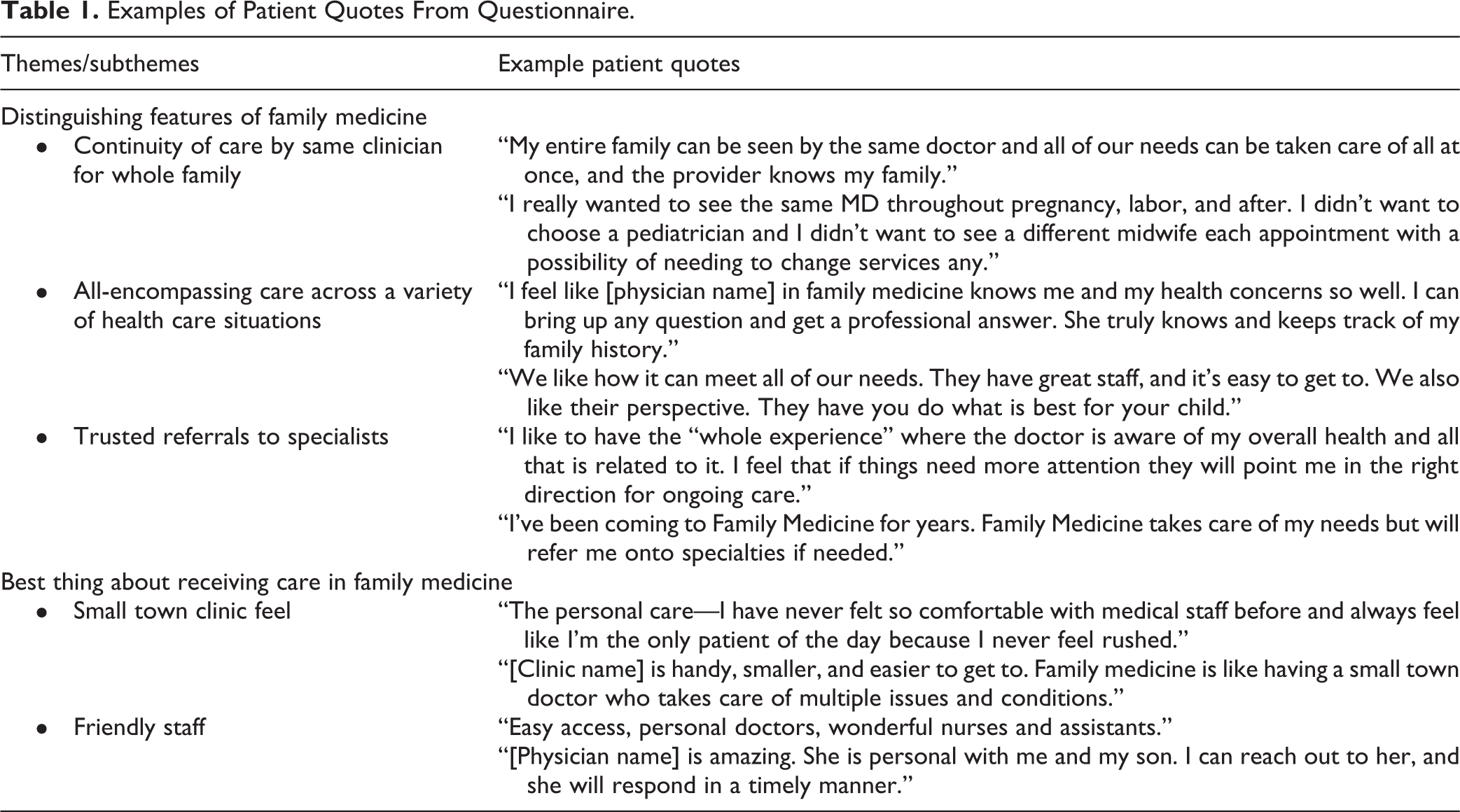
Ninty Family Medicine clinicians were given 450 questionnaires to distribute. Patients returned 92 (20%) questionnaires. Responders were 63% female with a mean age of 47 years. Patients noted that key distinguishing characteristics of care in Family Medicine were (1) continuity of care by the same clinician for the whole family, (2) all-encompassing care across a variety of health care situations, and (3) trusted referrals to specialists. Patients reported the best thing about receiving care in family medicine was (1) the “small town clinic feel,” including being known personally, and (2) friendly staff. Table 1 reflects example quotes from patient questionnaires for each of these themes and subthemes. Some patients reported not knowing there was a distinction between family medicine and other primary care or that their choice was driven by location.
Examples of Patient Quotes From Questionnaire.
Reflective of what we learned from patients, we revised both our mission and vision statements. Our mission: As a team, we partner with our patients on their care through all stages of life, listening, teaching, and growing with them. Our vision: To touch our patients throughout their lives with warmth and personalized care based on the highest levels of learning, education, and expertise, partnering with the communities we serve.
Discussion
We used a cross-sectional questionnaire to pragmatically include patients’ voice in developing a new Family Medicine mission statement. Our results highlighted that our statement should include topics that patients value including continuity of care for the whole family across diverse health care needs and the personal team-based connection. This is reflected in the mission statement with words and phrases such as “throughout all stages of life” and “partner.” The accompanying vision statement also reflects these patient priorities in the reference to continuity and the words “warmth,” “personalized,” and “partnering.” Our results also highlight an opportunity to market family medicine as distinguishable from other primary care specialties, and the simplicity of incorporating patient voices into health care delivery design.
Strengths of this project included the ability to incorporate the voices of our patients in the work through the analysis of quotations. The relative simplicity of the design allowed rapid turnover of results to move quickly on the mission/vision statement development process. Flexible and creative processes and the involvement of patients have been associated with both institutional buy-in and improved performance (3).
Limitations
Limitations included minimal demographic and practice information and convenience sampling. Anonymized responses meant we were unable to compare responses by clinician type or scope of practice. Participation was voluntary for both clinician and patients. Although some clinicians embraced the project others were disinterested, which may have contributed to the relatively low response rate.
Footnotes
Authors’ Note
Presentations: NAPCRG Annual Meeting, Chicago, IL, 11/12/2019. Mayo Clinic Karolinska Institute Annual Meeting, Stockholm Sweden, 9/23/2019. This project was deemed a quality improvement project and not subject to IRB review. Surveys were collected anonymously and collected information could not be used to identify patients. Informed consent was not obtained because this project was designated as quality improvement.
Declaration of Conflicting Interests
The author(s) declared no potential conflicts of interest with respect to the research, authorship, and/or publication of this article.
Funding
The author(s) disclosed receipt of the following financial support for the research, authorship, and/or publication of this article: This work was supported by the Mayo Clinic Department of Family Medicine.
