




Abstract
Postsecondary dietetics education is in a time of transition in Canada and specifically in Manitoba. We sought to qualitatively investigate this cohort’s perspectives on the University of Manitoba’s dietetics program. In 2020/21, interviews were conducted with undergraduate dietetics students as well as dietetics interns and graduate students who had recently completed the undergraduate dietetics program. We recruited 25 participants, all of whom self-identified as female, with 60% identifying as white, with an average age of 25 years old. Informed by critical pedagogy, our analysis yielded four themes: motivations for studying dietetics; learning outside the classroom; development of critical awareness; and uncertain career futures and training improvements. Social media featured in each of the themes, particularly in how it exposed participants to various social justice movements. While students acknowledged developing more critical awareness in their programs, they nonetheless felt a disconnect between what they perceived they needed to learn and what was taught. Participants also described uncertainty associated with the future directions of their program or career. Analysis of their perspectives reveal ways dietetics and dietetics education could further incorporate critical pedagogies that highlight social justice issues, enhancing the field’s potential to contribute to public health and health promotion. In this time of transition for dietetics education in Manitoba, drawing inspiration from perspectives of this cohort, there is an opportunity for dietetics and pedagogy to evolve. There is also potential to apply critical pedagogy to analyze trainee perspectives of other health professional education and training programs.
Background
An essential aspect of any health profession is the education of new professionals. Dietetics, one such profession, is undergoing substantial changes in Canada at the national and provincial levels. Requirements for licensure as a Registered Dietitian in Canada include the completion of an accredited undergraduate program and practical training or internship; some programs have the internship integrated within their undergraduate training and others did not. Given legislation barring unpaid internships in Ontario outside of post-secondary education, the largest province in Canada, some post-degree internship trainings are now moving to post-secondary institutions, contributing to more graduate-level programs (i.e., Master’s programs) both inside and outside of Ontario. In addition, a new accreditation organization has been established.
The dietetic profession emerged from home economics and has been increasingly influenced by nutritionism, which reduces food to nutrients (Brady, 2017). In response, critical dietetics emerged as a movement among dietetics professionals, which centers anti-oppression and social justice, parallelling emancipatory social movements in other fields (Gingras & Brady, 2019); some examples of social justice issues taken up include weight stigma, racism in dietetics, colonialism, and Indigenous food sovereignty. The extent to which the critical dietetics movement is integrated within dietetics training likely varies by institution and instructor/faculty member; while accredited programs must include learning outcomes related to health equity, cultural foodways, colonialism, systemic racism, and reflective practice (Partnership for Dietetics Education and Practice – Partenariat pour la formation et la pratique en nutrition [PDEP-PFPN], 2020), as examples, there is no formal requirement for ‘critical dietetics’ content. Health promotion is defined by the World Health Organization as “enabling people to increase control over their own health” (World Health Organization [WHO], 2016 paragraph 1), and there is a growing critique of didactic health promotion that tells people what to eat while ignoring societal injustices that impact their choices (e.g., Brady, 2020; Fraser & Brady, 2020). Critical dietetics has the potential to influence food-related health promotion, but with limited research on the topic, we became curious about the role of different approaches, including critical ones, in dietetic education and how these may shape prospective dietitians’ role in health promotion.
Many contemporary university students are part of Generation Z (Gen Z), which has been defined as those born between 1995 and 2012 (Seemiller & Grace, 2019) although we acknowledge that parameters of generational characteristics are not sharply outlined and the concept of ‘generations’ refers more to a shared context. The oldest members are now 29 and have already joined the workforce while some are currently attending post-secondary institutions. The centrality of technology in Gen Z lives has been well documented, and access to the internet or “devices” is ubiquitous (Turner, 2015). The COVID-19 pandemic also has been a “generation altering” event for Gen Z (Freeman et al., 2023), including impacting their levels of psycho-social stress and mental health. A longitudinal, mixed-methods study of college students in the U.S. indicated that participants who reported the greatest pandemic impact experienced increased stress in fall 2021 compared to pre-pandemic, even if overall stress levels remained similar (Colby et al., 2023). Notably, students also reported that the pandemic influenced how they thought about their future and life goals (Colby et al., 2023). Specific to nutrition, Gen Z is also known for concern about social justice and environmental issues, exemplified by many choosing vegetarianism and veganism for ethical and/or environmental considerations (Marinova & Bogueva, 2022). Gen Z has also been projected to be the most diverse generation in the United States thus far in terms of both race and ethnicity (Fry & Parker, 2018), which is likely similar in Canada.
Considering these generational and professional characteristics and contexts, we wanted to understand the current pedagogical dynamic in dietetic professional education. We sought to answer the following questions: How did (current and recently graduated) students describe their experiences in their nutrition/dietetics program? What are their perspectives of their courses and instructors?
Methodology
Theoretical Framework
We used critical pedagogy as an analytical lens. Sometimes also called anti-oppressive, emancipatory, or social justice education, critical pedagogy emerged in the 1970s and acknowledged that all education is political given what is prioritized reflects choices that either support or disrupt the status quo (Kincheloe, 2008). In formal education settings, critical pedagogy includes “examining the issues of power in the classroom, and to surface/challenge the biases and oppressive structures that can undermine learning and alienate students” (Saunders & Wong, 2020, p. 75). Numerous others in food education, and dietetics education specifically, have taken up critical pedagogy in their teaching practice and/or research (e.g., Classens & Sytsma, 2020; Gingras, 2008; Parker, 2023). In this study, critical pedagogy informed our research questions, our desire to hear directly from learners about their experiences and perspectives, and our analysis as we attended to which knowledges were privileged and which were marginalized in their program.
Design
We conducted a qualitative study because we wanted to gain depth of understanding of participant perspectives (Creswell, 2018). We used semi-structured, one-on-one video-conference, or phone interviews. This study is part of a larger research project investigating food pedagogies in post-secondary programs, exploring various perspectives, including that of students and instructors of food studies courses and dietetics, as well as analyzing course syllabi (Bombak et al., 2024; Riediger et al., 2024).
Setting
This study was conducted at the University of Manitoba (UM). We chose that location because the two lead authors work there and because the dietetics program has recently undergone major changes, after the interviews were conducted. Previously, the dietetics program existed at the UM as an undergraduate program, a Bachelor of Science in Human Nutritional Sciences, where students could choose to pursue a dietetics stream in preparation for a dietetics internship credential that was called the Manitoba Partnership Program, which was managed by the Winnipeg Regional Health Authority. The new program, a Master’s of Applied Human Nutrition (MAHN), is now wholly administered by the UM. The MAHN program was in development over the same period as our data collection and started intake in September 2023 after the study was complete.
Participants and Recruitment
We recruited 25 participants primarily through sharing a recruitment poster through email, in virtual courses, as well through word of mouth. Our initial inclusion criteria were current or recent students in the dietetics stream of the Bachelors of Human Nutritional Sciences at the UM, within the last 5 years. We later expanded to include current graduate students in Human Nutritional Sciences and dietetics trainees as long as they had also completed a Bachelor of Human Nutritional Sciences in the dietetics stream within the past 5 years. While there was variation in stage of education or training, all participants were current or previous students in the same BHNS program, with an intention to pursue dietetics. All participants received an honorarium of CDN $25 for their participation.
Data Collection
Interviews were conducted between October 2020 and May 2021 by AW, over the phone or through videoconferencing, whichever the participant preferred; recruitment occurred concurrently with ongoing interviews. Each interview was audio recorded and transcribed verbatim. Field notes were written immediately following each interview, to capture details about context that would not be included in audio recording, or any preliminary observations. A semi-structured interview guide was developed collaboratively by the research team who had expertise in food studies, nutrition and dietetics, and critical pedagogy. We sought to understand how students perceived food, eating, food preparation, food production, and how inequities relating to food were taught in the participants’ courses and programs. These interests informed the interview guide (Ruslin et al., 2022) (e.g., “How is food described in the nutrition classes you have taken? By instructors? By students?”). See Riediger et al. (2024) for the interview guide. Also, during the time period of data collection the UM had moved to virtual learning in response to the COVID-19 pandemic and public health orders. While this study did not especially seek to explore the effects of the COVID-19 pandemic, the participants did report many impacts on their academic lives.
We ended recruitment once 25 participants were interviewed and patterns began repeating in the data. Although all participants self-identified as female, there was some other demographic variation (e.g., race, age, career goals, stage of training at the time of the pandemic).
Data Analysis
Data analysis began with transcription through open coding, and continued once the transcripts were uploaded to NVivo 12 Pro software. We then utilized thematic analysis (Braun & Clarke, 2006), informed by our critical pedagogy framework, primarily through our attention to which knowledges were valued and which were not, as well as our intentional focus on the student and their journeys as learners. The transcripts were coded by AW and visualization techniques and discussion assisted AW and NR to arrange codes into themes and categories. We also met as an author team to review themes as the analysis progressed. Continuity was maintained through AW performing the interviews, most transcriptions, coding, and analysis.
Trustworthiness
We shared initial results with participants by circulating three infographics summarizing the study findings to solicit feedback. We also presented the findings at local conferences aimed at dietitians or dietetics students. In each instance, we received affirmative feedback on the accuracy of the findings. Additionally, the first and second authors work in the department, thus informal conversations with later students served to reinforce confidence in our findings even with the inherent power dynamics that can impede students offering critical feedback to faculty members about their program. Finally, when meeting with our research team for the larger project, our findings aligned with results of other analyses (e.g., Bombak et al., 2024; Riediger et al., 2024), which enhanced the trustworthiness of our findings.
Ethics
We received ethics approval from two ethics boards for the overarching project and the study reported here. All participants provided their informed, written consent prior to interviews. Additionally, we practiced ongoing consent throughout the interviews, checking in with participants to ensure they wanted to continue and reminding them they could choose not to answer any question. Overall, participants were enthusiastic about participating, and all finished the interview. Throughout this study we complied with the Helsinki Declaration of 1964, and later amendments. Our complete data set is not publicly available, as we did not receive Research Ethics Board approval for that because it could endanger participant anonymity.
Reflexivity
Throughout data collection, analysis, and reporting, we engaged in critical self-reflection on our own positionality and biases. All authors identify as white, cisgender women. Both AW and NR have nutrition graduate-level degrees and are employed in the Department of Human Nutritional Sciences, although neither are Registered Dietitians. AW is a research coordinator in nutrition, NR is a professor in nutrition, CR is a professor of education who teaches food education, and BP and AB are professors of sociology who study food and nutrition. Much consideration was given to how expertise in nutrition but with an outsider’s perspective of the profession shaped this study and analysis. Further, the authors have previously conducted research in Indigenous health, health equity, food security, weight stigma, gender, and dietetics education, which contributed to a sensitization to and interest in these topics that also may have shaped coding and analysis.
Findings
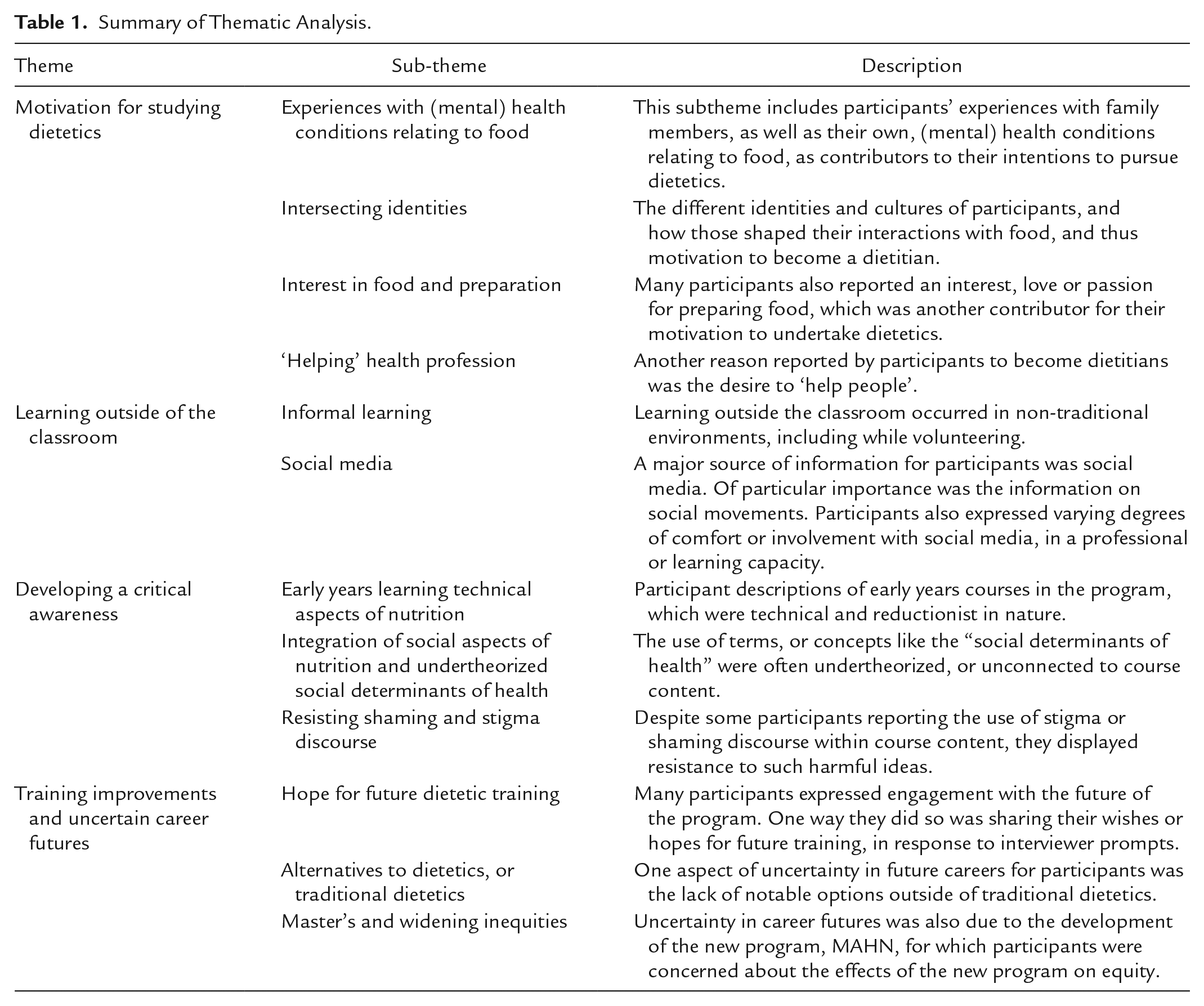
Participants were in various stages of their training or dietetic careers. All self-identified as female. Fifteen self-identified as White. The average age was 25 years old, ranging from 21 to 40 at the time of the interviews. Eighteen (72% of the sample) were born in 1995 or later, therefore the majority were members of Gen Z (For more information on demographic data, see Riediger et al., 2024). Participants were given pseudonyms to retain anonymity. Four themes were identified and are summarized in Table 1: (1) motivation for studying dietetics, (2) learning outside the classroom, (3) developing critical awareness, and (4) training improvements and uncertain career futures.
Summary of Thematic Analysis.
Motivation for Studying Dietetics
Some participants discussed personal or familial experiences seeing dietitians or dietary-related challenges that contributed to their interest in dietetics and to their educational expectations. For example, Roberta described her connection to becoming a dietitian: “I have suffered from [medical condition] for most of my life, and have worked with dietitians obviously, so food has been at the centre of my life.” Disordered or restrictive eating were also mentioned by multiple participants as experiences that drove them to pursue dietetics. Jennifer shared: “There’s a lot of discussion amongst dietetics students in terms of disordered eating, I guess, and how that’s kind of brought them to where they are in their program.”
A motivator for some participants was their desire to become a health professional and to help others. Five participants (20%) discussed wanting to become a health professional, with some international students asserting they were interested in earning a professional credential. One participant explicitly mentioned wanting to work in a role “helping people,” while around half of the participants felt “helping” people was within the purview of a dietitian.
Some participants described choosing to study nutrition and dietetics because of their interest in food and preparation. Leah stated, “a lot of the students really like food preparation, and so it’s often, talking about the meals that we’ve prepared, talking about the ingredients that we’ve used.” For many participants, their history of, and experiences with, food were shaped by their ethnic and gender identities. For example, Chloe said: I feel like when I cook food and cuisines that were traditionally made by my mom and my grandma [. . .], it really gives me . . . warmth within me, like when I’m eating it, because I feel happy and I feel connected to my family when I’m having that food.
Notably, no participants stated that an interest in social justice issues or broader structural factors impacting food systems or health motivated their pursuit of dietetics, although one shared her interest in body positivity.
Learning Outside the Classroom
Learning outside of the classroom was described as occurring in parallel to in-class learning. A major cross-cutting theme in all the categories was the importance of informal learning through social media. Despite that, many described a conflicted relationship with social media, creating some tensions. One was between active and passive learning; some participants described actively seeking out social media content for the sake of knowledge (relevant to dietetics, or not), while some participants described seeing content without seeking it out due to the “algorithm.” For example, Erin stated, “I follow so many nutrition students and that’s kind of what my algorithm is, is so much about food.”
Another source of tension was the struggle to find and distinguish reputable sources from misinformation, and occasionally feeling overwhelmed by the volume of information. For example, Karen described her cautious approach to online information: “I mean you always have to be mindful of what you’re looking at on social media.” Similarly, Desiree stated, “I’m kind of getting sick of these crazy elaborate food dishes that nobody who’s not a nutrition professional or a dietetics student would have any interest in potentially cooking.” A few participants chose to actively distance themselves from dietetics or nutrition-related social media content to separate their school/work and personal lives. Other participants, however, very intentionally engaged with social media content, including following Registered Dietitians; as Hillary shared, “I do follow a few dietitians that I think are reputable and share some good information, so yeah I definitely learn things from there too.”
Social media also was an important platform for informal learning on topics beyond nutrition, such as experiences and perspectives different than participants and about social movements, with Black Lives Matter, Indigenous issues, and body positivity all mentioned. For example, Jennifer said, “I do believe that social media is a huge factor in educating students on these social inequities and kind of opening our eyes to all of these injustices that are kind of going on.”
Volunteering was named as an important additional site of learning (Volunteer hours were a requirement of the dietetics-stream undergraduate program, and many of the opportunities were food or nutrition focused). These experiences were mostly described positively. For example, Ashley shared, “Most of my experience was community-based, which definitely was very helpful, in terms of, but not specifically to, food positivity, if that makes sense. But definitely a good learning experience.” The only negativity associated with volunteering was in relation to limited options and cancellations due to the COVID-19 pandemic.
Building a network was also named as an instructive and positive type of informal learning outside the program. These included making connections with Registered Dietitians while volunteering, working, or in other situations like conferences. Hillary, for example, described building her network while at work: “I ask the dietitian too, she’s the one that got me into it so I learn a lot from her.”
Developing Critical Awareness
Participants described how course content facilitated their critical awareness, which they reported growing over the duration of the program. Early years courses were associated more with technical nutrition science. Later years courses were more social- or community-focused. This journey was summed up by Emma: “before I would say that it’s very based on macros and micros and just very scientific, but now we’re just slowly starting to get into how important [critical awareness] actually is for wellbeing that doesn’t include [just] nourishment.”
We asked specific questions to explore how inequities, such as those associated with colonialism, class, and gender, were taught. Erin responded, “I mean it’s not discussed in the science courses.” A few students reported learning about colonialism or racial inequities in their courses, most notably in the community nutrition courses. Few participants could offer more specific examples or memories from classes, and when they did, it was often with a deficit-based lens. For example, Priyanka said, “some people in the north, they are Indigenous people, [. . .] they had food insecurity because they had to walk so far to give out their food products.” She later suggested that she had limited knowledge of the issue, however, since she had only recently moved to Canada.
Finally, related to development of critical awareness, a number of participants felt that there was a disconnect between what they were taught in the program and what they believed. Some reported resistance to the “old school” approaches of their professors, including what they saw as a problematic emphasis on Body Mass Index (BMI) or calories. For example, Paulina stated, “some instructors it has been very, let’s only talk about calories, and let’s only talk about BMI. So that has been, those ones, were kind of discouraging, ‘cause I find that to be a little bit more of a backward, in-the-wrong direction.” Others noted the relevance of social movements, highlighting Black Lives Matter and Indigenous issues, that received minimal to no attention in the program despite their perceived relevance.
Training Improvements and Uncertain Career Futures
The final theme captured what participants wished they would have learned in the program. For example, participants suggested that the dietetics program embrace the more radical movements within the field of nutrition generally, such as the benefits of taking a non-diet or weight-neutral approach. As Desiree said, “I wish that we were taught more about the complexities of, of what it means to be nourished and healthy, and what body size is healthy and the fact that there are many healthy body sizes.”
Some participants craved more experiential learning opportunities. For example, Keira shared, “I just feel like, if it was, just, we were learning it side-by-side, working with a patient like that, it would have stuck in my brain.” Other suggestions for program improvement included more content on public health nutrition, nutrigenomics, and clinical nutrition as well as how to take a more social or positive approach to dietetics. One student, Carly, despite being accepted into the dietetics internship herself, wanted more discussion about other professional options beyond working as a dietitian: “I think it would have been nice if they had emphasized more in the program jobs you can get that aren’t nutrition, like aren’t related to being a dietitian.” It is important to note here that some participants did not feel there was anything missing from the program or made no suggestions for improvement.
Given the changing environment at the UM, and of dietetics in Manitoba more generally, many participants reflected on how the program was about to change. Indeed, some participants thought our study was for the development of the new program. Some expressed concern about the potential financial issues in the new program. For example, Rachel stated, “even if our program [is] going into an unpaid internship or really expensive now-coming-up Master’s program, it’s not really talked about so much—like the privilege needed to do those kinds of things.”
Discussion
We identified four themes, much of which we interpreted as reflective of Gen Z experiences and concerns. Interpreting these using a critical pedagogical lens reveals potential for enhancing dietetics education to better align with public health promotion.
Participants’ journeys in dietetics started with their decision to pursue post-secondary training. Many participants reported an interest in health professions, a desire to help others, or personal food and health experiences as motivating factors for pursuing dietetics. We found it interesting that they did not identify gender as a contributing factor, which was glaring to us given all participants self-identified as female. Their desire to pursue this profession likely relates to the feminization of foodwork generally (Perrier & Swan, 2019) and dietetics specifically (Brady, 2017), and the pressure for women to be thin. Despite changing understandings of gender, the reproduction of gendered food labor illuminates how challenging it can be to disrupt hegemonic binaries (Perrier & Swan, 2019). The use of feminist food pedagogies (e.g., Parker, 2023) could help raise this phenomenon from the depths of the hidden curriculum to foster more critical and intersectional awareness of the gendered and white nature of dietetics and the implications for public health promotion.
In discussion of the future of the program as a consequence of the changes to dietetics education in Manitoba, participants reported being concerned about the privilege required to now have to attend graduate school in order to enter the profession. Dietetics as a profession already has limited diversity (Caswell, 2022; Riediger et al., 2019) and the shift to a new program with extra costs could have a negative impact on socioeconomic diversity. Tellingly, participants remained unconvinced that there would be improvements to equity or diversity in the new program. That concern, in part, appears to reflect their perception that other social justice matters like Indigenous issues, Black Lives Matters, and body positivity were marginalized, or absent, in the program.
For some, the differences between what they were learning about social justice in their program versus through informal learning on social media resulted in participants feeling caught between what they were taught and what they believed. Such lags between student interests and program content are not unusual, especially considering post-secondary institutions can be notoriously slow to change (Rosenberg, 2023). Still, programs do regularly come up for review, as this one has, which creates an opportunity to address such lags to help ensure programs remain relevant. Individual instructors, too, have opportunities to incorporate new content and to hone their pedagogical skills. For example, one of the key tenets of critical and feminist food pedagogy is not treating students as blank slates but starting where they are through building on their knowledge, identities, and interests (Parker, 2023; Russell, 2020). Gen Z’s interests in social movements could be an entrée for discussion of how they, as future professionals, might respond to public health promotion challenges related to equity.
Critical pedagogy is by nature emancipatory as it attends to what, and who, is marginalized and how that could be addressed through education (Kincheloe, 2008). Critical dietetics is similarly concerned with tackling oppression, including the need to diversify the profession (Gingras & Brady, 2019). Participants in our study mentioned wanting to learn more about Indigenous issues, Black Lives Matter, and body positivity. Building on their interests could be a powerful starting point for discussing equity issues in dietetics and public health promotion. For example, body positivity is arguably a de-politized, corporatized, and whitewashed version of the more radical fat acceptance movement (Senyonga & Luna, 2021), something dietetics education could explicitly address by adopting insights and practices from critical, fat, and feminist food pedagogies (Bombak et al., 2024; Parker, 2023; Russell, 2020). Doing so could also help dispel the stereotype of dietitians as weight loss professionals (Riediger et al., 2024). Further, critical food pedagogies could disrupt the continuing hegemony of nutritionism in dietetics by fostering a more holistic, inclusive, and positive approach to food (Riediger et al., 2024), thereby helping the field more meaningfully contribute to public health (Cannon & Leitzmann, 2005).
Participants reported that social media facilitated their learning about social movements they considered relevant to the practice of dietetics. While that contrasts with Law and Jevons’ (2023) study of dietetics students in the UK who did not name social media as a source of information on equity concerns, it is in line with research on the influence of social media on Gen Z’s approach to food (e.g., Marinova & Bogueva, 2022). Many of our participants also noted how they turned to social media for information and inspiration related to food and dietitians’ professional practice, but many were wary of misinformation. At present, there is limited research on the pedagogical uses of social media within dietetics education, but Woolley et al. (2022) discussed how registered dietitians have been using social media to obtain information and keep current with research in the field. Both critical food and fat pedagogies acknowledge the power of social media as a form of public pedagogy (Flowers & Swan, 2015; Monaghan et al., 2019), and other fields in higher education, such as teacher education, have embraced digital pedagogies (e.g., Coker, 2020). Indeed, dietetics education includes competencies related to identifying and appraising sources of evidence or information, which likely contributed to some participants’ skepticism regarding information obtained from social media. Dietetics education informed by critical pedagogy, particularly critical digital pedagogies, fat pedagogies, and feminist food pedagogies, could assist Gen Z in continuing to build skills to help them navigate the “digital foodscapes” (Goodman & Jaworska, 2020) they will undoubtedly continue to encounter throughout their careers.
Limitations
The COVID-19 pandemic context required interviews to be conducted online or on the phone and meant participants may have had varying learning experiences (on-line, in-person, or some combination thereof), which may have affected the data. We were only able to recruit self-identified female participants for this study, which is reflective of the profession of dietetics; this meant perspectives of other genders were not heard, despite having diversity among the participants in other aspects. Finally, conducting interviews during the transition to the new MAHN program may have contributed to uncertainties atypical of dietetics training. Thus, these findings may have limited transferability, but they do capture a unique moment in dietetics education.
Implications and Future Research
The findings of this study have implications for a variety of health professional education programs. Specifically, the concerns raised by students related to diversity and equity and the influence of social media and other critical digital pedagogies are likely similar to that of students in other post-secondary health professional programs. As many health professional programs are taking more equity-based approaches, the importance that incoming cohorts of students place on various social justice movements could be built upon to create meaningful learning opportunities. It would also be of interest to examine the perspectives of dietetics students across different institutions, as the field of dietetics continues to change in Canada. Additionally, exploring perspectives of older dietitians may further reveal how generational contexts may be influencing uptake of various social movements, and subsequent integration into education and clinical practice. Future research could also explore more deeply how health promotion is integrated within dietetics education.
Relevance to Practice
A key tenet of critical pedagogy is to start where students are. Using critical digital pedagogies would build on Gen Z’s facility with social media, both engaging them as learners and helping them navigate (and perhaps eventually contribute to) digital foodscapes, which would serve them well in their future careers. Acknowledging Gen Z’s interest in various social movements by adopting critical pedagogies, including fat and feminist food pedagogies in dietetics education, to explore these movements’ relevance to health promotion generally and dietetics specifically would also enhance learner engagement as well as be professionally useful. Given what our participants told us, this period of transition in dietetics education is ready to embrace critical pedagogies to not only better serve Gen Z but also address contemporary challenges facing public health promotion.
Footnotes
Acknowledgements
We would like to thank the participants for sharing their experiences and perspectives with us. We would also like to acknowledge Ann Bishay for her assistance with transcription.
Declaration of Conflicting Interests
The author(s) declared no potential conflicts of interest with respect to the research, authorship, and/or publication of this article.
Funding
The author(s) disclosed receipt of the following financial support for the research, authorship, and/or publication of this article: This study was funded by a Social Sciences and Humanities Research Council (SSHRC) Insight Development Grant to AEB (430-2019-00029) and partially funded by start-up funds from the University of Manitoba to NDR. NDR was supported by a Canadian Institutes of Health Research (CIHR) Early Career Investigator Award (grant #155435).
Ethics
We received approval from the Research Ethics Boards at the University of Manitoba (HS23790 (J2020:015)) and the University of New Brunswick (REB#2020-009). This study complied with the 1964 Helsinki Declaration and its later amendments or comparable ethical standards. Each participant provided informed, written consent prior to starting interviews.
