




Abstract
The current article describes a 12-week course-based research project through Collaborative Online International Learning (COIL) among nutrition students from American and Mexican universities. Students were divided into small research teams, developed questionnaires, and conducted online surveys with college students in their home institutions. After a data collection period, each research team analyzed data and compared results between American and Mexican participants. Based on their study results, each research team developed a proposed 6-month nutrition intervention project for college students. Post-COIL project survey results demonstrate that students rated high in the areas of overall COIL experience, the duration and time of interaction in the COIL project, technologies, interaction with peers and professors, global and cultural competency, and overall satisfaction of the project. This research also highlights the importance of a course-based research project in student critical thinking skills and science literacy. Future research is needed to effectively evaluate the synergistic effects of COIL and a course-based research project on student learning across the globe.
Keywords
Introduction
Due to globalization, it is becoming more important for students to have intercultural competence prior to joining today’s workforce (King et al., 2013). Intercultural learning allows a student to gain a deeper understanding and appreciation of their own culture, as well as knowledge of other cultures and enhanced cultural awareness (Perez & Barber, 2018). Intercultural learning experiences among college students facilitate collaborative learning among students (West et al., 2022) and help students become more prepared to work and live in different cultures while also developing culturally appropriate behaviors (Lee et al., 2014).
Intercultural learning experiences also appear to play an important role in facilitating student academic success (Oberhelman & Dunn, 2019). Intercultural learning promotes critical thinking skills (West et al., 2022), which may contribute to students’ academic success and higher retention rates. Moreover, research has shown that graduation rates are also positively associated with students who experienced intercultural learning in college (Oberhelman & Dunn, 2019). Thus, universities and colleges are aware of the importance of offering students opportunities to participate in intercultural learning activities that enhance critical thinking skills and collaborative learning.
One may argue that enrollment of socio-demographically diverse students may be sufficient to facilitate intercultural experience on campus. Gurin et al. (2004) argue that such a demographic shift in itself is not enough for students to become culturally competent citizens and leaders of a diverse democracy. In the past, college students’ intercultural skills were primarily obtained through work, traveling, or study abroad programs (Lee et al., 2014). Some study abroad programs can be costly and not available to all students. University campuses aim to offer more varied programs and classes to expand students’ intercultural knowledge and enhance cross-cultural sensitivity. These consist of courses and clubs, service-learning programs, collaboration courses, and intergroup dialog experience (King et al., 2013).
Collaborative Online International Learning (COIL) is a new virtual educational approach that uses digital technology to link two university courses together from around the world to build students’ cross-cultural competence (de Castro et al., 2019). COIL allows students to virtually interact with others from various parts of the world while being in their home countries. Through the use of technology it is possible for universities to offer international learning experiences to those students who may not afford to travel (Marcillo-Gómez & Desilus, 2016). Past research has shown that COIL has increased students’ cultural competency and knowledge about other countries (de Castro et al., 2019; West et al., 2022). Students have also described COIL as a positive experience (de Castro et al., 2019; Kayumova & Sadykova, 2016) and helped them recognize societal similarities and differences (Marcillo-Gómez & Desilus, 2016). COIL has shown to be effective in contributing to equality within internationalization of higher education (DeWinter & Klamer, 2021). The featured North-South collaborative project has a strong focus on “decolonization” through a spirit of co-creation and equal partnerships between European students in the North and South African students in the South (DeWinter & Klamer, 2021).
Besides cultural competency, collaborative learning is another core element of the COIL experience among college students. Collaborative learning often involves groups of students working and learning with or from one another to complete a task (Laal & Laal, 2012). Collaborative learning can occur in large groups. Research has shown that this teaching approach fosters positive interpersonal relationships between students and faculty, facilitates critical thinking, and improves self-esteem among students (Johnson et al., 2007). A recent COIL study revealed that 80% of study participants noted that collaborative learning through COIL helped them achieve good academic performance, aided in building knowledge, and increased communication skills when working in groups (West et al., 2022). Skills and knowledge that college students gain through COIL are crucial for successful professionals who work with clients and stakeholders from diverse backgrounds across the globe.
Another important pedagogical approach that facilitates collaborative learning includes course-based research projects among college students. Course-based research projects are designed to allow students to design original research questions and to make new discoveries in their field within a college course (Good, 2020). This approach is also used to provide the benefits of research experiences to a larger, more diverse population of students in different fields, including science, technology, engineering and mathematics (STEM) programs (Martin et al., 2021). Course-based research projects have shown to enhance critical thinking skills and scientific literacy (Good, 2020; Martin et al., 2021). Scientific literacy is defined as the ability to use evidence and data to evaluate the quality of science information and arguments put forth by scientists and in the media (National Research Council [NRC], 1996). Skills and knowledge that college students gain through COIL and course-based research projects appear to be crucial for successful health and nutrition professionals who work with clients and stakeholders from diverse backgrounds across the globe. COIL and course-based research project approaches may complement each other to provide the benefits of international and research experiences to a diverse population of students. The objectives of this paper are to describe an innovative course-based research project through COIL among American and Mexican college students and to present course evaluation findings. Specifically, we aimed to examine the potential effects of COIL on global and cultural competency among ethnically diverse college students.
Project Description
The authors developed a 12-week course-based research project through COIL among nutrition students from American and Mexican universities. The Institutional Review Board of California State University, Chico, granted ethical approval for this project. This pilot project was implemented in the fall of 2021. Nine students from a graduate-level nutrition course at the American University and 10 students enrolled in a senior-level clinical nutrition course from the Mexican University participated in this project. Students were divided by instructors into four research teams consisting of four or five students each from both universities. At least two students from each university were randomly assigned to a team. The instructors used a Google Sites platform Global Classroom for asynchronous activities and Zoom for synchronous sessions. The instructors from the two universities co-designed and facilitated all project activities with support from a Global Classroom coordinator and another professor. All sessions were conducted in English. Synchronous Zoom meetings were planned in consideration of the differences in time zones. The curriculum consisted of the following five phases: Icebreaker, Team Integration, Research Project Activities, Team Sharing, and Group Reflection (Table 1).
Summary of COIL Research Project Activities.
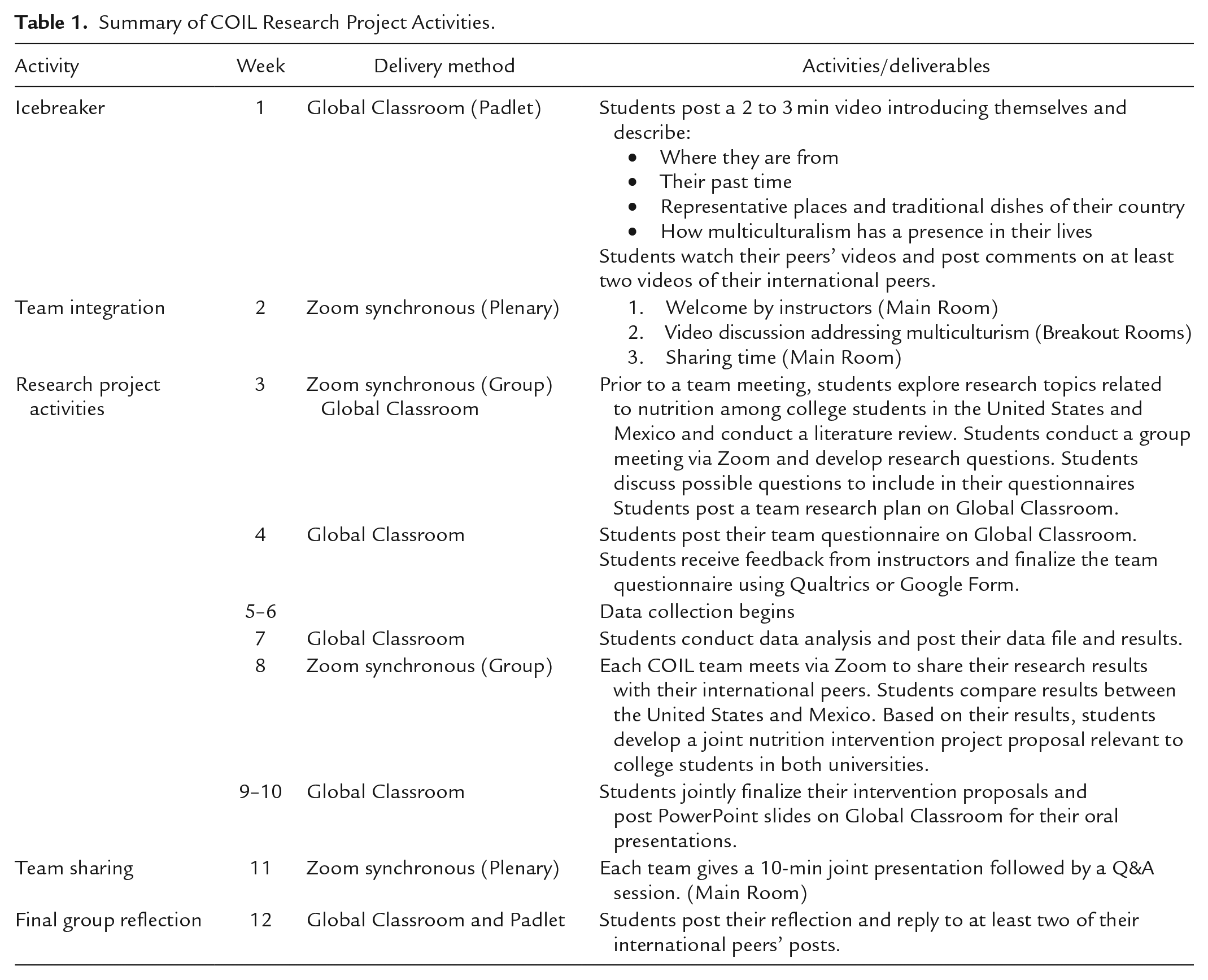
During the first phase of the project, students posted their own videos on Padlet (embedded into Global Classroom), as well as responses to their peers’ videos. In the Team Integration activity, students watched a TED talk video about biases, prejudices, and preconceived ideas prior to their meeting, and shared personal experiences about assumptions and stereotyping in Zoom breakout rooms. In the research project, each team chose a topic related to nutrition among college students. Prior to a team meeting, each student explored research topics related to nutrition among college students in the United States and Mexico, and conducted a literature review. Then, each team conducted a separate Zoom meeting to discuss their research interests and developed research questions. Research topics included (1) the COVID-19 pandemic and eating habits, (2) COVID-19 and food insecurity, (3) food contextual skills and obesity, and (4) pandemic-related mental health issues and food habits. After receiving feedback from the instructors, students finalized their questionnaires using Google Form or Qualtrics and conducted online surveys with about 60 college students in their home institutions through convenience sampling.
After a 2-week data collection period, each research team analyzed data using excel and met via Zoom to compare results between American and Mexican participants. Based on their study results, each research team developed a proposed 6-month nutrition intervention project for college students with expected outcomes. Small modifications were made for each institution based on their cultural or environmental differences. Intervention topics included a cooking intervention, nutrition education with mindful eating, nutrition intervention with affordable recipes, and nutrition and mental health promotion using social media apps. As part of the final research activity, each team gave a 10-min oral PowerPoint presentation via Zoom followed by a 5-min question and answer session.
The final project activity was a Group Reflection in which students posted their reflection videos about their project experiences on Padlet. Students also replied to at least two of their international peers’ posts. Topics that emerged from the group reflection activity included understanding different cultural perspectives, collaborative learning in research, and peer support. Specifically, some undergraduate students at the Mexican University appreciated research expertise from graduate students at the Mexican University in questionnaire development and data interpretation. Graduate students also gained skills and confidence in research through their leadership roles in the project. Some students noted that they would have liked to spend more time with their international peers.
Evaluation
An anonymous student survey consisted of 16 questions regarding overall COIL experience, the duration and time of interaction in the COIL project, technologies (Google Global Classroom, Padlet, and Zoom, as shown in Table 1), interaction with peers and professors, global and cultural competency, and overall satisfaction of the project. The survey was offered in both English and Spanish, and responses were answered using a 4-point scale (1 = strongly disagree/dissatisfied, 4 = strongly agree/satisfied). As for the duration and time of interaction in the COIL project, responses were answered using a 4-point scale (1 = very little, 2 = little, 3 = adequate and 4 = excessive). As shown in Table 2, questions related to global and cultural competency included “expand my understanding of other cultures (beliefs, values, perspectives, and practices),” “accept the similarities and differences with other cultures,” “adapt and develop efficiently in any international and intercultural context,” “Communicate effectively (both orally and in writing) with people who come from different cultural backgrounds,” “work productively with people from different cultural backgrounds,” and “raise awareness of global issues.” COIL-related attitude/behavior statements included “I would participate in another Global Classroom (COIL) in the future,” “I will look for other international and intercultural opportunities (international exchange, internships, etc.),” “This experience increased my understanding of how the academic and/or professional field is approached in different cultural contexts” and “participating in the Global Classroom (COIL) increased my confidence in using technologies that allow communication with people from other countries.” There were three open-ended questions about the best part of the COIL project, areas for improvement, and the application of knowledge to their course. Nine out of 19 students completed the survey. Five of them were American students and four of them were Mexican students.
Evaluation of COIL Among American and Mexican college students (n = 9).
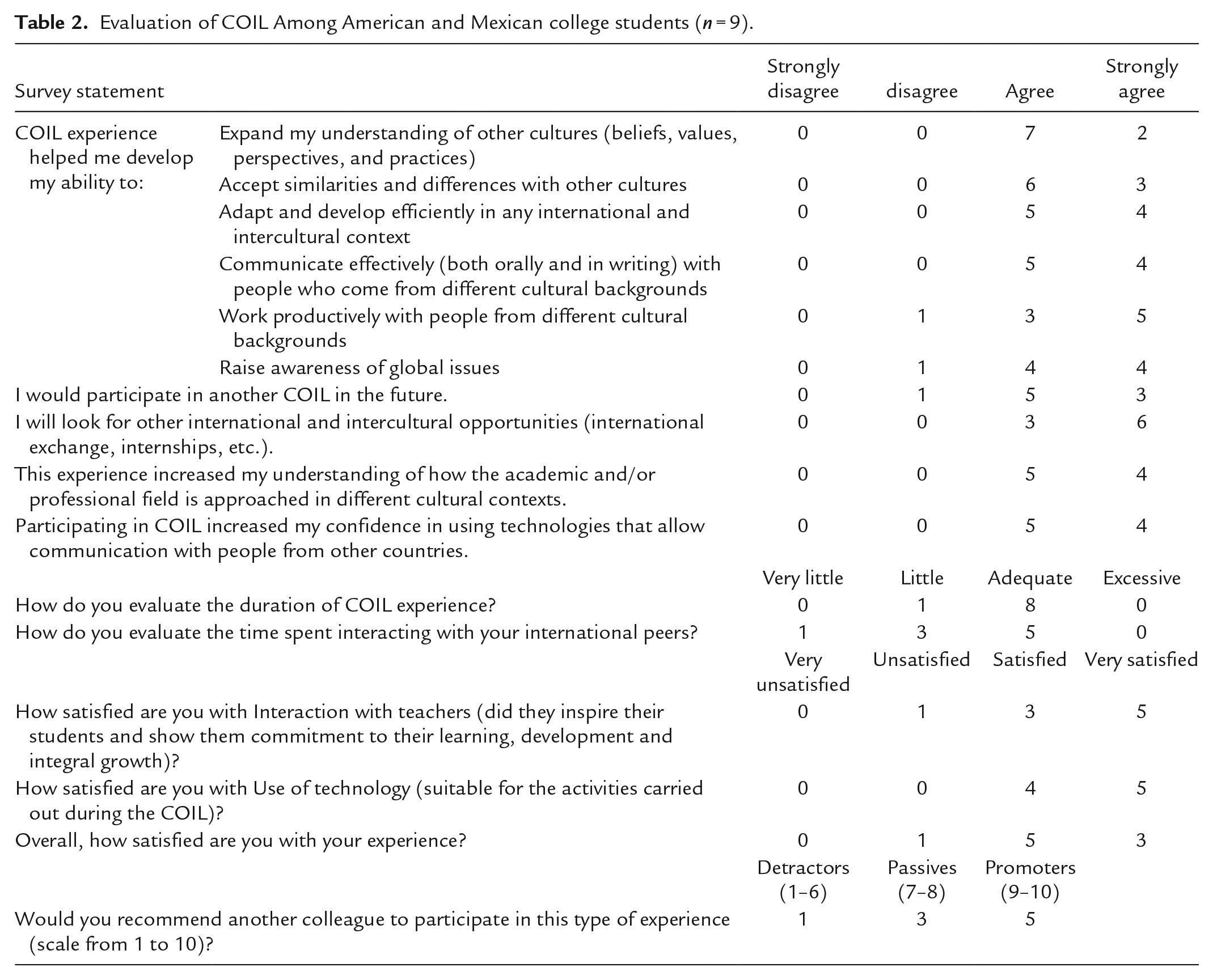
There were no major differences in responses between American and Mexican students. As shown in Table 2, survey results indicate students’ positive COIL experience. Although the response rate was low (47%), they were in accordance with student group reflection and instructors’ observations. As for global/cultural competency statements, 100% of students strongly agreed or agreed with four statements and 89% strongly agreed or agreed with two statements. Likewise, 100% of students strongly agreed or agreed with three statements regarding COIL attitudes/behaviors, and 89% strongly agreed or agreed with one statement. Additionally, 44% of participants noted that the amount of time spent with their international peers was very little or little. Finally, 89% of students were satisfied with their overall COIL experience and their interaction with instructors, and all of them were satisfied with technology used for COIL. Students noted that they enjoyed learning different cultural perspectives and conducting an international research project with international peers. Students would have liked to have more time with their international peers using more ice breakers. Students also suggested that instructors schedule class times together so they can work on the research project at the same time.
Discussion
The current pilot study of a 12-week research project through COIL appears to play an important role in cultivating global citizenship among college students. One of the main objectives of this study was to examine the potential effects of COIL on global and cultural competency among ethnically diverse students. In this research, students noted that the COIL project contributed to their increased cultural competency. Collaborating in international teams may allow students to understand other cultures and became more knowledgeable and sensitive to cultural differences and similarities (West et al., 2022). It is important to note that collaborative learning is a core element of COIL projects. According to Kayumova and Sadykova (2016), a COIL project may enable students to develop intercultural competence that they would not have obtained if collaborative activities were not included in the course.
There is limited information about the effectiveness of COIL in diverse student populations. Understanding other cultures through COIL may give students the opportunity to examine and appreciate their own cultures and assets. Katre (2020) argues that students in cross-cultural groups will gain a deeper understanding of their own cultures in addition to other cultures. In the study by West et al. (2022), Latinx students who were bilingual served as university-liaison officers in their teams to reduce language barriers between American and Ecuadorian students. Some Latinx students in the US noted that the COIL project helped them gain deeper appreciation of Latinx food and cultures, and Ecuadorian students had positive experience of sharing their own rich food culture with American students (West et al., 2022).
COIL is also an opportunity for students to experience and appreciate diversity not only between the two countries but within each country. The current study consisted of American students with diverse backgrounds such as Indian, Mexican, and Native American cultures. The cultural diversity of the American team positively contributed to Mexican students’ understanding of the diverse nature of American university populations.
The group reflection results also highlight the importance of a course-based research project. The course-based research project approach is used to provide the benefits of research experiences to a larger, more diverse population of students (Martin et al., 2021). In the current study students from the United States and Mexico developed research questions that were relevant to both American and Mexican college students, developed a questionnaire collectively, conducted data collection and analysis separately at their home institutions, interpreted and presented data collectively via Zoom, and proposed a nutrition intervention program based on their findings. One of the unique characteristics of the current project was to include both graduate and undergraduate students in a course-based research project. Although the current study did not quantitatively evaluate the effect of the project on student research knowledge and skills, graduate students appeared to provide peer support for undergraduate students and helped them develop research skills.
Peer mentoring has been identified as a common strategy for undergraduate research projects, although there is limited information about the effectiveness of peer mentoring in course-based research projects. Peer mentoring appears to facilitate the development of personal and professional attitudes in both mentees and mentors (Akinla et al., 2018). A near-peer mentoring program involves a more senior student who provides guidance and support to a junior student for their education activities. For future project-based research projects for undergraduate students, graduate students could serve as peer mentors for undergraduates with limited research experience. While American graduate students in our study were eager to learn from Mexican students and an equal relationship was observed between graduate and undergraduate students, instructors should take caution with a potential power imbalance among students from different study levels (Naicker et al., 2022).
Conclusion
In conclusion, a research project through COIL has the potential to become an effective virtual pedagogical tool for globally and culturally competent future nutrition professionals with solid scientific literacy. Technology can foster effective collaborative learning and communication across the globe. Future research should explore technology and integrated activities that allow longer and more effective student interactions. The current study also highlights the importance of a course-based research project, which aimed to enhance student critical thinking skills and science literacy for evidence-based nutrition practice. Involving graduate students in the current project appeared to provide peer support for undergraduate students and helped them develop research skills. Finally, to our knowledge, there has been no published research about synergistic effects of COIL and a course-based research project on student learning. Both COIL and course-based research project approaches expect similar learning outcomes. Communication and collaboration are thought to be important elements of effective course-based research projects and COIL. Future research using a more rigorous study design is needed to effectively evaluate the synergistic effects of COIL and a course-based research project on student learning and professional development among health and nutrition students across the globe.
Footnotes
Acknowledgements
The authors would like to thank Ms. Gloria Chapa and Dr. Andrea García Contreras of Tecnológico de Monterrey, Drs. Sara Trechter and Jennifer Gruber of California State University, Chico, our students, and student research participants for their support.
Declaration of Conflicting Interests
The author(s) declared no potential conflicts of interest with respect to the research, authorship, and/or publication of this article.
Funding
The author(s) received no financial support for the research, authorship, and/or publication of this article.
