




Abstract
Service learning is a pedagogical strategy in which students complete a project at a community-based organization where they can apply classroom skills in a real-world context. Service learning can benefit student learning outcomes and continues to expand in public health education; yet there is the potential for ethical concerns. In particular, service learning may reinforce inequities between academic institutions and community organizations by positioning academic institutions as holding significant power and resources and inadvertently promoting this dynamic to students. This perspective provides an overview of service learning in public health and related fields, discusses the benefits of service learning as well as the gaps in standardization and evaluation, and highlights situations in which inequities may emerge. Recommendations are provided, with the goal of helping future health promotion professionals better meet the objective of fostering social justice through public health.
Service learning is increasing across universities and has been described as integral to public health education (
Service Learning in Public Health
Service learning was first defined in 1993 as an educational tool to promote civic responsibility and strengthen both communities and students’ skills, wherein students participate in activities to meet community needs as a part of their academic curricula (
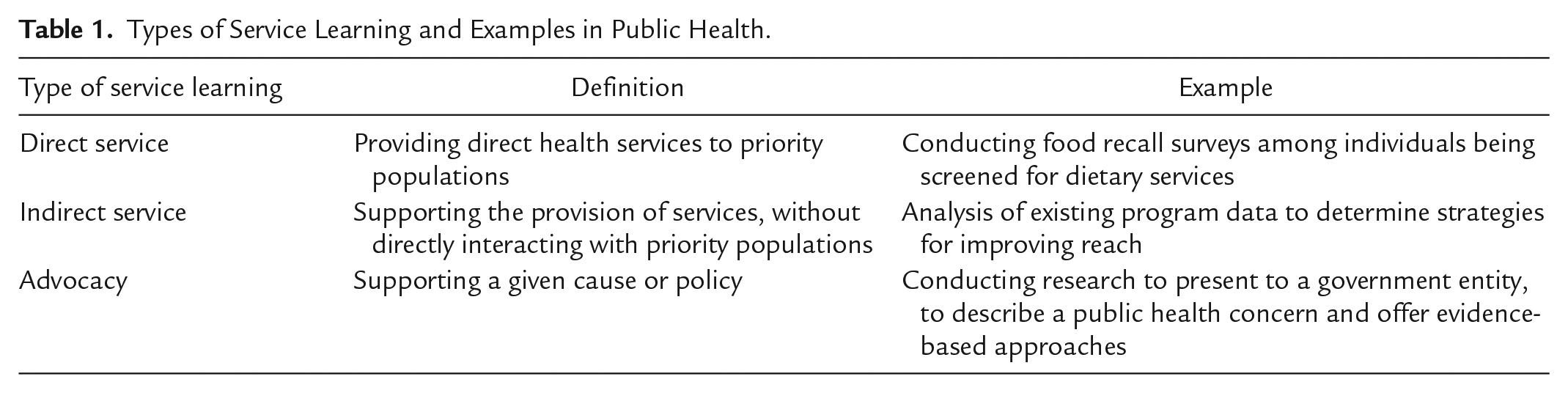
Service learning can take three forms: direct service, indirect service, or advocacy, examples of which are provided in Table 1. Substantial research has identified diverse benefits of service learning, including in public health and health promotion education. Service learning can enable students to gain real-world experience, increase career readiness, contextualize topics taught in class, and improve perceptions of their ability to link theory to practice (
Types of Service Learning and Examples in Public Health.
Power Structures and Ethics
The beliefs students forge from their service learning experience regarding academics, the public health and health promotion fields, and social justice are formative to their careers. Therefore, alongside the benefits of service learning, potential ethical concerns are also consequential. We discuss several of these potential problems below based on our experiences and the extant literature focused on community partners. Although there is minimal and dated literature on the experiences of community partners, some authors do discuss an imbalance of power whereby academic institutions hold resources of value to communities, which the latter believe are only accessible if they agree to accept service learners at their organizations (
A challenge that has also arisen in our own experiences is that unfortunately not all community organizations promote equitable or just services. Hence, it is crucial that universities be selective in their partnerships and place students with organizations that follow evidence-based practices and uphold values of justice and equity. This once occurred, for example, when a student partnered with an organization that promoted individual-level weight-loss solutions for cardiovascular health improvement, but did not consider ramifications related to fatphobia and systemic factors. Hence, it was challenging for the student to balance content being taught in class (i.e., stigmatization, social determinants of health, white supremacy, and related implications for body size), and their service learning work.
It can also be challenging to unpack students’ positionality related to their service learning, which may be dependent on their own backgrounds and identities. For students of color attending a predominantly white university, the service learning experience may be different than for white students. In general, some students may see service learning as an opportunity to work with communities very distal to their own, whereas for other students, this may mean working in their own community. Discussing this in a classroom setting can be difficult, as it requires instructors to explore the many systems of oppression that exist within society, without placing added labor on the shoulders of students and faculty who themselves experience structural oppression. For example, some concepts taught in class, such as racism and homophobia, may be hypothetical to some class members, while the lived experience of others. Hence, explaining the important ramifications of these oppressive structures, while ensuring that students are not traumatized (or re-traumatized), can be an especially difficult balance to strike. Further, as the first author has experienced, instructors of color or instructors who are a part of other marginalized groups, may shoulder an undue burden by needing to explain these concepts to their students or engage in correcting student misperceptions, wherein instructors may have to revisit traumatic experiences (e.g., microaggressions), in an effort to help students understand these critical issues.
Rethinking the Paradigm of Service Learning
Considering the many strengths and continued growth of service learning in public health and related fields, it is imperative that institutions examine their current approaches to yield the best outcomes for both students and community organizations alike. Based on both the literature and our experience, we believe this may be best achieved through the following: standardized training for all stakeholders; expanded evaluation practices; contributions from academic institutions to the community beyond service learning; further research; resource development and distribution; and systemic change within the academy. These strategies are listed and expanded upon in Table 2.
Existing Service Learning Concerns and Recommendations to Address Them.
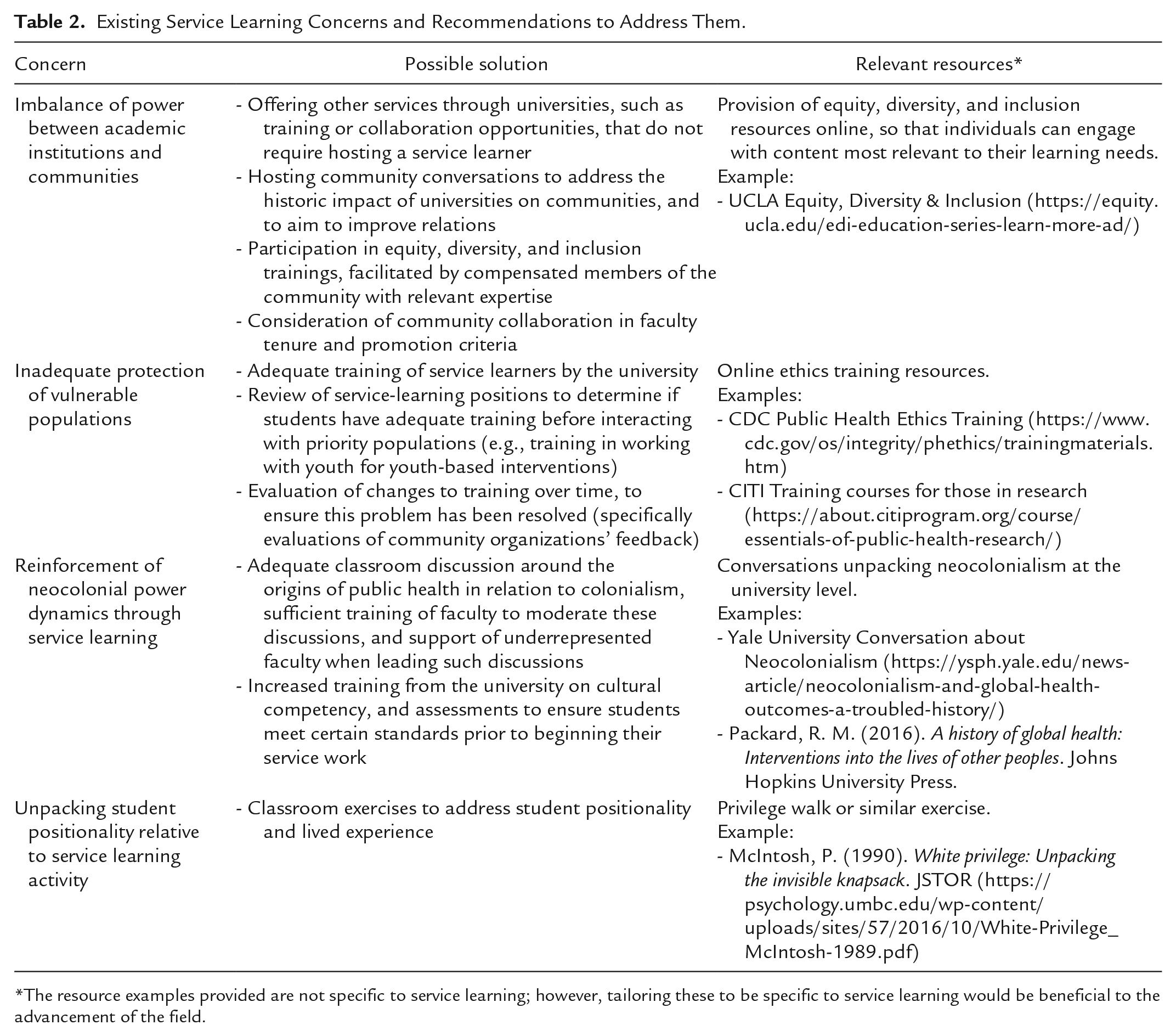
The resource examples provided are not specific to service learning; however, tailoring these to be specific to service learning would be beneficial to the advancement of the field.
Service learning training often exclusively involves students receiving an orientation at their community placement related to their service learning project. However, this traditional training model neglects the needs of those who support students: namely the community organizations and service learning course faculty. Universities can support capacity building for community organizations to ensure that they are able to host a student, without depleting their own resources, by providing checklists for resources community-based organizations would need to host a student (e.g., expected time demands of supervision), working with organizations to understand qualifications students should possess to meet stated needs, and providing organizations with a stipend to cover the cost of training if possible. Many institutions have university-wide service learning program managers; investing in these positions and ensuring that these individuals either possess a background in health equity, or receive training in this area, is essential. Additionally, faculty must also have adequate training in cultural competency, pedagogies of oppression, and an understanding of social justice, to be able to support their students in meaningful personal and classroom reflection, which is a known service-learning benefit (
Expanding evaluation around service learning is also crucial to improving its effectiveness and making it more equitable. Evaluations from all stakeholders, not just students, are generally recommended, but it is unclear the extent to which this is done, or, if it is, how and by whom the data are compiled and analyzed. Time should be dedicated to assessing trends in evaluations annually by service learning program managers or other identified individuals at the university level. By regularly tracking student satisfaction and especially student developmental outcomes, universities would have the ability to assess the extent to which service learning is beneficial across multiple learning domains. Additionally, efforts should be made to obtain meaningful feedback from community organizations, a commonly untapped source of input, in the form of both qualitative and quantitative feedback (
Finally, service learning as a pedagogical strategy should exist in a context where resource sharing between academic intuitions and community organizations is normalized outside of service learning to minimize power imbalances (
Conclusion
With public health student enrollment and service learning both increasing nationally, the impact of service learning among students and communities must be continuously and critically assessed. This includes the comprehensive effects of service learning as a pedagogical strategy, including both intended and unintended outcomes, and implications for the public health profession. Although service learning can have beneficial learning outcomes, it may also produce a power imbalance between academic institutions and community organizations that may have negative ramifications for students’ public health careers and community members. Though some academic institutions may be taking steps to address this given more recent attention to health equity and social justice, these efforts have largely not been shared, though doing so could benefit the public health and health promotion education communities. The strengths and challenges of service learning must therefore be considered and addressed in their totality, and best practices must be disseminated, for public health and health promotion professionals to truly fulfill our commitment to equity and social justice.
Footnotes
Declaration of Conflicting Interests
The author(s) declared no potential conflicts of interest with respect to the research, authorship, and/or publication of this article.
Funding
The author(s) received no financial support for the research, authorship, and/or publication of this article.
