




Abstract
Color vision is crucial for daily life, and conditions such as color blindness and deficiencies can negatively impact one's quality of life and livelihood. According to a study in India there was an increase in the prevalence of color vision deficiency (CVD) among children and young adult teenagers, who are losing empowering opportunities in education and academics. However, this trend can be managed with evidence-based new interventions and objectives from India's developing nation models. This policy paper mainly highlights the need for effective strategies to address this issue. Early identification of CVD is crucial for effective interventions and rehabilitation to reduce medical, behavioral, and economic burdens on patients, families, and society. Strategies include policy prescriptions, advocacy, public health campaigns, investing in a trained workforce, and using technology to facilitate early screening in educational institutes. These strategies aim to address the growing healthcare crisis of CVD.
Tweet: #Check Your Color Vision Today—Color Vision Deficiency
Early detection of color vision deficiency in school children is crucial to prevent educational, social, and mental health issues. One in 12 boys and one in 200 girls are red, green colorblind, often undiagnosed. This can lead to social isolation.
Key Points
Early identification of color vision deficiency is crucial for effective interventions and rehabilitation to reduce medical, behavioral, and economic burdens on patients, families, and society.
Strategies include policy prescriptions, advocacy, public health campaigns, workforce training, and technology-facilitated early screening in appropriate institutions.
Eye care professionals should advocate and raise awareness in developing countries on the importance of color vision deficiency.
Health and family welfare stakeholders should propose a policy and health care advisory on how color vision deficiency can be impactful and considered to be included under visual impairment categories.
Tertiary eye care and regional ophthalmology centers at various state levels should provide and maintain a registry to understand the impact and prevalence of color vision deficiency in India.
Introduction
What is Color Vision Deficiency?
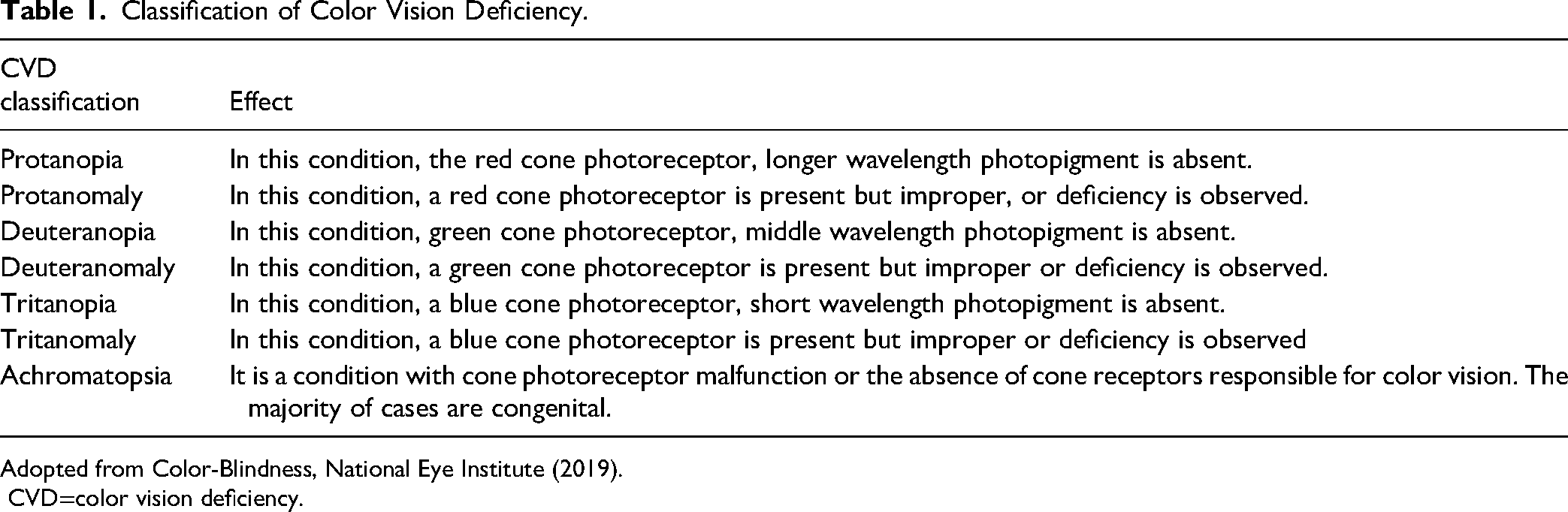
The capacity to differentiate among wavelengths of light, independent of its intensity is called color vision. Color vision includes numerous stages of the processing of information. Cone photoreceptors, which include photopigments with varying sensitivities to various wavelengths of light, are found in every area of the retina (Simunovic, 2010) (National Eye Institute, 2019). The output of a single cone does not allow one to distinguish the spectral characteristics of an object from those of its illuminant because each photopigment absorbs light across the entire spectrum. In addition, one cannot specify the wavelength or the light intensity using a single cone's output. Deficiencies are common and a person is said to have a weakness in color vision if they struggle to differentiate between shades of color, these population who is unable to see or distinguish is considered to have color vision deficiency (CVD) (Color Blind Awareness CIC (MRS0318), n.d.) as shown in Table 1.
Classification of Color Vision Deficiency.
Adopted from Color-Blindness, National Eye Institute (2019).
CVD=color vision deficiency.
Prevalence and Impact of CVD
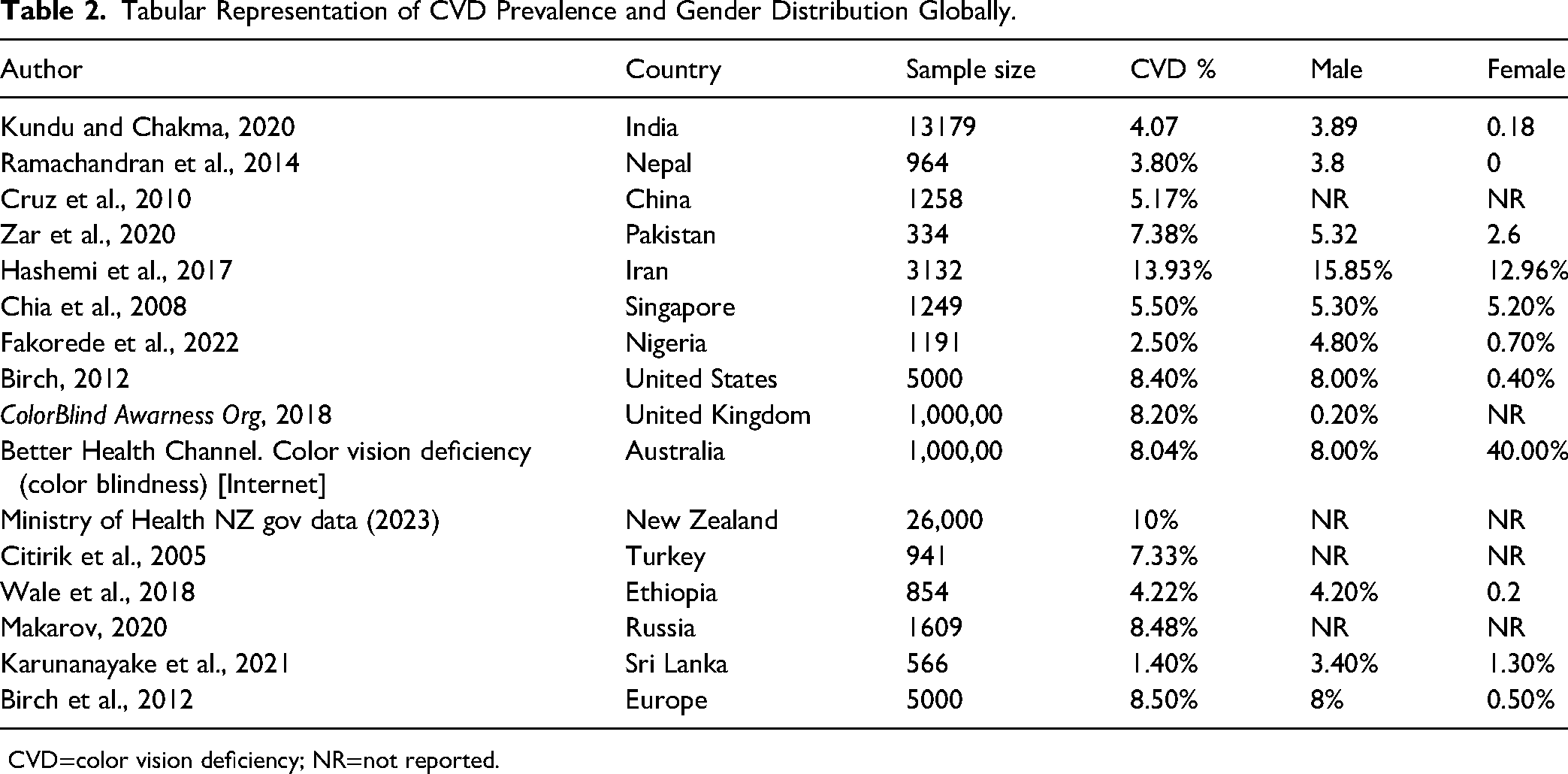
Globally, the prevalence of CVD affects 1 in 12 males (8.3%) and 1 in 200 women (0.5%) as per Color Blind Awareness CIC (MRS0318) (n.d.). Male et al. (2023a) looked at the prevalence of CVD in Telangana, India, and found that the prevalence range was 1.67% (fixed effects) and 3.44% (random effects).
However, according to the Male et al. (2023b) latest systematic reviews, in India, the overall prevalence has increased. The age group affected by the increased prevalence was children and adults. However, when the data are compared with other Asian countries and higher-income countries, the prevalence has also increased.
Moreover, only a few studies have documented the real global prevalence of CVD. Male et al. (2023b) compiled the available literature and represented the prevalence of CVD globally by conducting a systematic review and meta-analysis, as shown in Table 2.
Tabular Representation of CVD Prevalence and Gender Distribution Globally.
CVD=color vision deficiency; NR=not reported.
Cross-Nations Estimates and Impact
CVD is a genetic condition affecting an individual's ability to distinguish between colors. It is primarily inherited in the United States, with red-green color blindness being the most common form. In the UK, the prevalence is primarily influenced by genetic factors (Boyce-Bain, 2020; Hunt & Carvalho, 2016; Simunovic, 2010), with historical immigration patterns potentially affecting the prevalence in certain regions. In India, the prevalence may be influenced by genetic factors, but regional variations can also be observed due to the diverse population and historical and geographical factors. To obtain accurate prevalence statistics, government health agencies and vision health organizations should conduct cohort studies in future.
In addition, neither Canada nor the United Kingdom recognizes CVD as a disability; nonetheless, special inclusion and benefits are given according to the degree to which a person is colorblind. CVD has been recognized as a disability (ADCET act, 1992) in Australia. In the context of disability (Permvattana, 2012), the public perception of color blindness is intriguing, because few court precedents in everyday life condone discrimination against persons with color vision deficit in law enforcement, intelligence, and aviation. Case judgments do not appear to be based on occupation-specific research. Despite legally enforced direct discrimination against persons with CVD at work, society feels CVD is mild enough to be neglected.
The European countries are also given priority in the European Disability Strategy 2010–2020, which addressed color-blindness issues that are critical for consideration under disability rights. The importance of disabled people's rights and fair access to work and the rest of society is also addressed in the reports. However, these proposed regulations and new health policies are yet to be implemented (The Australian Disability Clearinghouse on Education and Training, 2012).
According to the literature, then, developed countries are already evaluating CVD as a significant impairment for considering disability and particular emphasis in the future. India, another nation with a large population, should likewise review and could update its disability laws and regulations (Barry et al., 2017; ColorBlindness European Parliment questions, 2012; The Post-2020 European Disability Strategy, 2020).
Proposed Policy Implications
Education and Awareness
Educational Institutions can help students with CVD by promoting awareness and support, adjusting information methods, and collaborating with parents. Teachers should understand the impact of color vision deficit on learning and provide accommodations and modifications. Parents can help teachers and schools understand their child's color vision deficit and resolve issues through communication. Assistive technology, such as color correcting equipment and software, can help color-blind students see colors better. Inclusive education promotes teamwork, peer-assisted learning, and collaboration, which can boost self-esteem and reduce stress. Color vision deficiencies do not prevent academic success, as they can be overcome with help, adjustments, and knowledge. Collins (2013) addressed how this impacts daily activity (Lee, 2020).
Accessible Environments
To make places accessible for color-vision-deficient people, use contrasting colors, patterns, textures, or labels in design. Provide enough color contrast to help people differentiate objects, words, and visuals. Use readable, background-contrasting text and labels with bold or italicized fonts and color-coded items for better readability. Use symbols and color coding for communication. Maintain homogeneous illumination to avoid glare and color distortion. Utilize technology and digital solutions to customize platforms and applications. Educate staff, students, and the community about CVD and involve users in the design process. These measures create color-blind-friendly (Lee, 2020) environments, enabling people with color vision deficits to navigate and engage comfortably. Using the universal color designs (Meeks, 2016) would help in solving the problems.
Medical Support and Screening
Health policy initiatives can support medical care and screening for CVD. Mandatory screening laws can help detect color vision problems early, allowing for prompt interventions and assistance. Screening tools should be widely available and easily accessible, such as digital tools or mobile apps (Color Blind Awareness CIC (MRS0318), n.d.). Education and awareness programs should be created for healthcare professionals, educators, and parents to raise knowledge about color vision insufficiency and its effects.
Color vision screening should be a normal part of pediatric health check-ups and school health assessments, ensuring healthcare practitioners have access to trustworthy screening instruments. Insurance coverage should be advocated to cover the cost of color vision tests and medical support services, lowering financial barriers and ensuring access to essential exams, consultations, and treatments (Ishijima, 2022). Supportive interventions should be created to encourage access to treatments and adjustments in educational and working contexts, such as assistive technology, alternative learning materials, and workplace adjustments. To improve the quality of healthcare, research and development should be supported, with an emphasis on new screening methods, treatment options, and rehabilitation and assistive technology devices (Male et al., 2022; Valero, 2022).
Public awareness efforts should be launched to educate the general public about color vision deficit and its consequences, emphasizing the need for early detection, supportive surroundings, and inclusion. Implementing these health policy interventions can provide greater medical assistance, early identification, and appropriate accommodations for individuals with color vision deficits, reducing access obstacles and increasing overall inclusion (Color Blind Awareness CIC (MRS0318), n.d.).
Existing Policy and Legislation
In India, the CANE foundation, which works for disability rights, presented various reports in the court for considering the CVD in inclusion for disability. But Persons with Disabilities (Equal Opportunities, Protection of Rights and Full Participation Act) was considered in 1995. Later in 2016 the law was abolished and replaced with the Rights of Persons with Disabilities Act (49 of 2016). According to Mr. Viswanathan, the committee argues that because color blindness is not a handicap under the 1995 and 2016 Act, its nature, severity, and the disciplines they may practice must be reconsidered in future for inclusion (Group, 2018).
The Supreme Court of India (Mishra, Supreme Court of India wants an Expert Panel To Determine What Areas of Medical Practice Can Color-blind MBBS Aspirants Study based on international best practices, 2017) recommended to the Medical Council of India; now National Medical Commission; that CVD students be considered for admission into medical courses for enrolling and studying, while colorblind individuals are denied entrance into Indian institutions.
Government and Non-Governmental Organization Role
The government and NGOs should address CVD in India for several reasons. First, it is a public health issue, with a higher prevalence in Asian countries, including developing ones. The treatment for CVD is limited and cannot cure permanently. Second, it affects equal education and employment opportunities, making it difficult for people with color vision deficits to work in fields like design, healthcare, transportation, and electronics. Third, early identification and intervention are crucial for providing appropriate help.
Government-NGO collaboration can help build screening programs and provide timely solutions, such as educational accommodations and assistive technology. Fourth, awareness and education can be promoted by the government and NGOs to remove myths and stigma, encouraging inclusion for color-vision-deficient individuals. Fifth, policy creation and implementation of color vision deficit policies require government engagement. Sixth, research and innovation can be conducted by government agencies, NGOs, and research institutions to enhance screening, assistive technology, and therapies for afflicted individuals. Seventh, India can align with international standards that promote disability inclusiveness and accessibility, boosting its global reputation and promoting equality.
Developing and Managing the CVD Registry
Retinal abnormalities cause retinal degeneration, and the registry's aim is to document inherited and uncommon disorders to generate novel treatments and care plans. Some registries include the Inherited Retinal Degenerative Disease Registry (MRTR), the Blue cone monochromacy patient registry (BCMR), and the Patient Registry for Retinal degeneration (PRO-RETINA). These registries provide information on CVD changes and may benefit patients, physicians, and researchers. However, implementing these registries requires clinically tested methods and may not be beneficial for multiple centers. A robust consolidated database of patients with retinal disorders is required in the future. In India, a uniform approach for identifying uncommon eye disorders patients and adding a registry to the CVD population might be advantageous. Overall, these registries (Inherited Retinal Degenerative Disease Registry - Full Text View - ClinicalTrials.gov, 2015) provide valuable information for patients, physicians, and researchers.
Proposed Strategy for Health Policy and Advocacy Implementation
Context: CVD, commonly known as color blindness, is a prevalent visual impairment affecting millions of individuals worldwide. This health policy aims to address the challenges faced by individuals with CVD, promote awareness, and ensure equal access to healthcare services and opportunities for those affected by this condition. By recognizing the significance of CVD and implementing comprehensive measures, we aim to improve the quality of life and inclusivity for individuals with CVD.
Policy Content
Awareness and Education
Develop and implement educational programs to raise awareness about CVD among the general public, educators, healthcare professionals, and employers. Encourage schools and educational institutions to include information about CVD in their curricula to foster understanding and empathy.
Accessible Healthcare Services
Ensure that healthcare facilities are equipped with tools and resources to diagnose and provide appropriate care for individuals with CVD. Promote regular eye examinations to detect CVD in its early stages, allowing for timely interventions and support.
Workplace Accommodations
Encourage employers to provide reasonable accommodations for employees with CVD, such as modified color-coded materials or alternative ways of conveying information. Promote workplace diversity and inclusivity, including individuals with CVD, to harness their full potential.
Research and Development
Allocate resources for research on CVD to better understand its causes, impacts, and potential treatments. Foster collaboration between academic institutions, healthcare organizations, and industry partners to advance knowledge and develop innovative solutions.
Implementation Process
Policy Development
Form a multidisciplinary committee comprising healthcare experts, educators, individuals with CVD, and advocacy groups to develop and revise the policy. Conduct public consultations to gather input and feedback from various stakeholders.
Implementation
Establish a timeline for policy implementation and allocate resources accordingly. Collaborate with relevant government agencies, healthcare providers, and educational institutions to ensure effective execution.
Monitoring and Evaluation
Establish key performance indicators (KPIs) to assess the policy's impact over time. Conduct regular evaluations to identify areas requiring adjustments or improvements.
Stakeholder Engagement
Engage with advocacy groups, nonprofits, and individuals with CVD to ensure their voices are heard throughout the policy's lifecycle. Encourage public awareness campaigns and partnerships to promote the policy's objectives.
Actors for Policy
Government Agencies
Responsible for policy development, funding allocation, and regulatory oversight.
Healthcare Providers (Eye care Professionals: Ophthalmologists, Optometrists and Vision Technicians)
Deliver accessible and specialized healthcare services for individuals with CVD. Collaborate with government agencies to implement screening programs.
Educational Institutions
Integrate CVD awareness into curricula and provide support for students with CVD.
Employers
Offer accommodations and promote inclusivity for employees with CVD. Support diversity initiatives.
Advocacy Groups and Nonprofits:
Advocate for the rights and well-being of individuals with CVD. Collaborate with policymakers to influence and support the policy.
Individuals with CVD
Actively participate in advocacy efforts, raise awareness, and seek support as needed. Participate in self-registry mechanisms.
Conclusion
This policy document aims to address color blindness and improve accessibility for individuals with CVD. It suggests that individuals should have equal opportunities and participation in society. The document suggests developing accessible environments, establishing design guidelines, providing medical support, enacting policies, encouraging collaboration, providing funding, and monitoring progress. The combined efforts of organizations can make the world more inclusive for colorblind individuals. Health policy and activism should consider the unique needs of the CVD population in areas such as school education and the workplace. Further research should investigate the necessity and potential benefits of developing color vision aids for this population. The goal is to create a more welcoming world for colorblind individuals. By addressing the challenges associated with CVD through this comprehensive policy, we aim to create a more supportive society for all.
Footnotes
Acknowledgements
The authors would like to thank the Institute of Eminence-University of Hyderabad, Prof. Susan Fiske of Princeton University, for valuable insights in improving this policy paper, and Dr Baskar Theagarayan of the University of Huddersfield for his guidance and assistance during Shiva Ram Male's PhD tenure.
Declaration of Conflicting Interests
The authors declared no potential conflicts of interest with respect to the research, authorship, and/or publication of this article.
Funding
The authors received no financial support for the research, authorship, and/or publication of this article.
