




Abstract
In this study, we used Terrance L. Furin’s concept of transformational countering to examine six Holocaust education resources designed to address Holocaust trivialization and antisemitism. While academic comparisons are useful to helping students understand challenging content, superficial Holocaust analogies for political purposes are identified as Holocaust trivialization. Given that the current context consists of a growing white nationalist movement characterized by authoritarianism, antisemitism, and conspiracy theories, we enter the study understanding that Holocaust trivialization and far-right extremism must be understood together. We, therefore, examined the type of support teachers receive from Holocaust and human rights organizations in countering extremism and Holocaust trivialization. After analyzing the six resources, our findings demonstrate that resources produced to counter Holocaust trivialization become quickly outdated given the rapid evolution of extremism. Also, findings indicate that teachers receive stronger support in countering extremism and Holocaust trivialization from organizations that focus broadly on supporting human rights compared to the organizations that focus exclusively on Holocaust education.
Keywords
In May 2021, Georgia Representative Marjorie Taylor Greene compared COVID-19 mitigation policies in the United States Capitol to Jewish suffering during the Holocaust (Wang, 2021). Days later, political cartoonist de Adder (2021, p. A22) published a cartoon depicting a man in front of a storefront with “Jude” scrawled on the broken windows of the shop. The man, wearing an armband with a Star of David, is sweeping up broken glass from the sidewalk. It is implied that the man is the Jewish owner of the store. The scene presented by de Adder is reminiscent of photographs from Kristallnacht in 1938 (Harran et al., 2003, pp. 143–144). Standing next to the man in the cartoon is Congresswoman Greene, who is shown stating, “I know exactly how you feel. I had to wear a mask in Home Depot once” (de Adder, 2021, p. A22). In this cartoon, de Adder astutely speaks to the absurdity and insensitivity of equating the systematic persecution and genocide of European Jews by the Nazi state to the COVID-19 mitigation practices used to address an international public health crisis. However, what is missing from de Adder’s critique is that this single instance is situated in a larger context of antisemitism and extremism.
As former high school teachers, we have watched with alarm as antisemitism has resurged across the United States to a level unseen by our generation (Anti-Defamation League [ADL], 2023). As a result of his antisemitic rhetoric as a presidential candidate and as president, support for Donald Trump helped mainstream antisemitism into politics (Lipstadt, 2020; Miller-Idriss, 2020). Because of this, we are concerned about the teachers working with students in our schools. Social media use has contributed to teens aged 13 to 17 being more likely than adults to agree with conspiracy theories such as the existence of Jewish cabals, the Great Replacement, the deep state, and low COVID-19 vaccine efficacy (Center for Countering Digital Hate [CCDH], 2023). Likewise, children are exposed to white nationalist content, Holocaust distortion, and anti-vaccination propaganda through player chat features and in-game graphics for video games targeted to teens (Ingersoll, 2019). Furthermore, the passage of right-wing educational gag orders banning controversial topics—to include the Holocaust—in schools has teachers and administrators “confronting the distrust of citizens who have become convinced that certain conversations about diversity, racism, or inequality pose a proximate threat to national identity and social cohesion” (Friedman & Tager, 2022, p. 70). Compounding this is an increase in antisemitism resulting from the COVID-19 pandemic (Steir-Livny, 2022), and concerns that Millennials and Generation Z lack basic knowledge of the Holocaust (Bronfman, 2020). Finally, although instruction on the Holocaust has been required via state standards and mandates, Rich (2019) found that students entering college have only a basic knowledge base of the Holocaust. Therefore, we see the increase of antisemitism, the susceptibility of young people to conspiracy theories, and suppression of accurate social studies education as the backdrop against which teachers and students encounter Holocaust trivialization.
When it comes to making a trivial analogy, there are few that are more emotionally charged than one that invokes the Holocaust. Gerstenfeld (2007) defined Holocaust trivialization as the “use of language that relates to the industrial-scale destruction of the Jews in World War II by the [Nazis], yet is used for a large number of purposes that have no connection to this genocide” (p. 50). Often referred to as Holocaust analogies, Holocaust trivialization has been a part of American politics for nearly four decades (Dean, 2010; Kirmayer et al., 2014; Linden, 1999; Power, 1999; Steinweis, 2005; Valentino & Wineberg, 2017). Because the Holocaust has become synonymous with victimization in American memory (Dean, 2004), superficial Holocaust analogies, while inappropriate, have been used to gain support for foreign policy (Power, 1999) and persecuted groups (Kirmayer et al., 2014). In our current context, Holocaust analogies related to COVID-19 mitigation policies are being used in far-right political movements around the world (Pickel et al., 2022; Steir-Livny, 2022). In the United States, the far-right movement is characterized by white nationalism (Armaly et al., 2022; Miller-Idriss, 2020), antisemitism (Black & Ward, 2022), conspiracy theories (Armaly et al., 2022; Ekman, 2022; Pickel et al., 2022), authoritarianism (Espinoza, 2021; Gonzales, 2020), political violence (Armaly et al., 2022; Kleinfeld, 2021), and perceptions of victimization (Armaly et al., 2022). Thus, far-right, COVID-related Holocaust trivialization represents a uniquely ahistorical and anti-democratic challenge for teachers and students.
Recently, the United Nations Educational, Scientific and Cultural Organization (UNESCO, 2022) called on Holocaust organizations around the world to update their teacher support materials related to countering Holocaust distortion and trivialization in our current context. We understand that simply teaching facts and vaguely defined values will not preserve democracy in the United States or elsewhere (Ochoa-Becker, 2007). Countering hatred in our current context means adopting a transformational, pro-democracy pedagogy designed to both improve classroom instruction and strengthen the bonds between school and community (Furin, 2018). Therefore, in this study we examine resources, largely from Holocaust education organizations, that are designed to support teachers in addressing contemporary antisemitism. We entered this study with the following questions:
(1) What types of resources are being produced to support teachers in the context of increasing antisemitism and far-right extremism?
(2) To what extent do the resources serve to counter Holocaust trivialization?
In doing this, while we emphasize Holocaust trivialization as represented in the use of Holocaust analogies during the COVID-19 pandemic, we acknowledge the larger context of white nationalist extremism.
In this article, we provide a brief review of the literature on Holocaust education, white nationalism, antisemitic conspiracy theories, and Holocaust analogies. We detail the methodology for our analysis of six resources from six different organizations dedicated to Holocaust education and/or human rights education. In addition, we present and discuss our findings and consider the implications for the study.
A Brief Review of the Literature
Holocaust Education
Early calls for Holocaust education in American schools focused on countering both bigoty (Friedlander, 1979; Wells & Wingate, 1986) and authoritarianism (Friedlander, 1979). In the early 2000s, the Holocaust increasingly became a topic included in standards and curriculum in the United States (Ragland & Rosenstein, 2014; Totten & Riley, 2005) and around the world (Stevick & Gross, 2015). Stevick (2017) concluded that the goal of Holocaust education centers on students learning “knowledge, skills and attitudes” (p. 6) to engage in civic practices and support human rights. Through Holocaust education, students may be positioned to understand the threat to democratic systems and societies posed by bigotry, nationalism, and authoritarianism (Szuchta, 2004). Furthermore, Holocaust education has been viewed as a means of countering hatred by teaching students how to be empathetic participants in a pluralistic, democratic society (Carrington & Short, 1997; Kavadias, 2004; Maitles, 2008; van Dijk, 2010). Additionally, quality Holocaust education must counter present-day antisemitism (Ambrosewicz-Jacobs, 2020; Gordon et al. 2004).
However, issues exist within the field of Holocaust education. Pearce (2020) noted that Holocaust education as a term suffers from an “insufficient conceptualisation, lack of clarity, and imprecision” and that the phrase “teaching and learning about the Holocaust” may be more suitable (p. 7). Additionally, Foster (2020) noted the tensions exist between those advocating for Holocaust education that teaches broader lessons of prejudice and those advocating for a deeper study of the history of the Holocaust. When examining four Holocaust education resources framing instruction around anti-bullying programs, Dalbo (2019) found that the instructional plans “fail to address the history and nuances of the Holocaust adequately” (p. 83) and incorrectly catastrophizes bullying. Holocaust education, like all education, is subject to its context. Since the election of Donald Trump in 2016, Holocaust education in the United States has turned the focus away from “displacement, deportation, and annihilation” and toward “explaining the enabling mechanisms that led to the rise of the Third Reich and . . . the development and implementation of the Final Solution” (Alfers, 2019, p. 47). Additionally, despite goals of countering bigotry in contemporary society, research has not provided a direct correlation between Holocaust education and decreasing antisemitism (Gordon et al., 2004) or in preventing similar atrocities (Stevick, 2017).
The Uniqueness Versus Universality of the Holocaust
When calling for Holocaust education in school, Friedlander (1979) grappled with how scholars viewed the Holocaust as both a “sacred history” which is incomparable and a “public history” from which lessons must be derived (p. 525). Friedlander determined it was in the best interest of students to use Holocaust education to “understand man and his society” (p. 526). The debate over the extent to which the Holocaust is a unique event in Jewish history or an event that can be compared to other cases of persecution and genocide is ongoing (Rosenbaum, 2019). However, the uniqueness of the Holocaust positioned it to become the event by which other acts of genocide and persecution are measured (Alexander, 2002). Therefore, when comparisons are made between the Holocaust and other events, academic thought is required to lead learners to a deeper understanding of both the analogous event and the Holocaust (Berenbaum, 1990).
Academic Holocaust Comparisons
Furthering the debate over the uniqueness and universality of the Holocaust, Stein (1998) argued that, because the Holocaust is both Jewish and human history, the “Holocaust is both unique and comparable” (p. 534). In addressing comparing contemporary events to the Holocaust, Sztybel (2006) argued that “in a free society, people must have freedom of speech and thought . . . [therefore,] comparisons to the Holocaust also ought to be tolerated, so long as they are offered as respectfully as possible” (p. 121). Studies indicate that although the American public perceives the Holocaust as unique, it also conceptualizes intolerance and genocide through comparisons with the Holocaust (Bischoping & Kalmin, 1999). Thoughtful, academic comparisons are useful. Such comparisons yield a stronger understanding of historical trauma connected to discrimination, persecution, and genocide (Denham, 2006; Kirmayer et al., 2014). Thus, academics and educators engaging in sound comparisons to the Holocaust are not attempting to distort the Holocaust (Sztybel, 2006). In calling for Holocaust centers to update teacher support materials, UNESCO (2022) noted the importance of educating teachers in how to “meaningfully compare the Holocaust to other atrocity crimes” (p. 64). Therefore, we maintain that thoughtful, intentional, and academic comparisons are not trivial and can be useful to students and teachers.
Holocaust Denial, Distortion, and Trivialization
In contrast to academic comparisons, Holocaust trivialization is the drawing of comparisons between the Holocaust and other events without the acknowledging the differences (Sztybel, 2006). Gerstenfeld (2007) expands this to describe Holocaust trivialization as the use of the Holocaust to draw comparisons to events without a connection to the Holocaust. When Friedlander (1979) called upon teachers and students to “welcome viewpoints different from our own” regarding the Holocaust, he noted that “there are limits” to which viewpoints constitute legitimate academic discourse in the classroom (p. 525). Addressing Holocaust denial, Friedlander argued the teachers must “thoroughly and dispassionately” (p. 526) refute those who question the events of the Holocaust. Holocaust denial is defined as both the “denial of the facts of the Holocaust” or the attempt to “create a moral equivalency with other events” (Lipstadt, 2020, p. 76).
Although existing since the end of World War II, Holocaust denial has increased in recent decades due to the intensification and growth of antisemitism, white nationalist aims of presenting Adolf Hitler and the Nazis in a positive light, and questioning the sovereignty of Israel (Atkins, 2009). More recently, Holocaust denial has “mutated into distortion and trivialization” (Whine, 2020, p. 63). UNESCO (2022) defined Holocaust distortion as the willful misrepresentation of historical facts and documents, often to strengthen “national myths or political identities” (p. 19). Most importantly, Holocaust denial, distortion, and trivialization are “best understood in relation to the social contexts, such as contemporary social movements, in which Holocaust memories are deployed” (Stein, 1998, pp. 520–521).
While the present study focuses on trivial analogies as a form of Holocaust trivialization, it is important to note other forms of trivialization exist. For example, rote instructional methodology and over-teaching the Holocaust exacerbates the trivialization process for students (Schweber, 2006). Totten and Riley (2005) cautioned against the use of crossword puzzles, games, student-made killing center dioramas, and low-level questions as trivializing the Holocaust. Furthermore, Dalbo (2019) determined that, while anti-bullying approaches can be appealing for teachers, such approaches run the risk of trivializing the Holocaust. Finally, it must be acknowledged that constant comparisons—including academic comparisons—to the Holocaust can desensitize people to the horrors of the Holocaust and the plight of other persecuted groups (Steinweis, 2005).
White (Christian) Nationalism
Whine (2020) argued that “the lasting effect [of Holocaust education] is diminished or may even disappear if it is taught in a vacuum” (p. 64). Considering this, understanding the role of white nationalism in relation to trivial Holocaust analogies is important. Saxman et al. (2022) defined white nationalism as a “distinct ideology with an emphasis on antisemitism and the creation of all-white ethnostates through violence and policies that increase the vulnerability, criminalization, and removal of minorities and other targeted communities” and that advocate for a white supremacist “system of oppression based on privileging whiteness” (p. 4). Aligned with white nationalism is Christian nationalism. K. J.Burke et al. (2023) defined Christian nationalism as a religiopolitical movement that views “the United States as a divinely sanctioned model nation ruled by an authoritarian Christian God who presides over a hierarchical social order with White, English-speaking, native-born, US male citizens at its top” (p. 291).
In the early 2000s, white nationalist groups began influencing conservative politicians and voters with a more palatable, yet clearly antisemitic and racist, political rhetoric to mainstream their ideology and agenda (Saslow, 2019). As a result, white nationalism surged into the mainstream in the 2010s as the far-right integrated white nationalist rhetoric into their speech and elected far-right politicians to office, including Donald Trump in 2016 (Stern, 2022; Miller-Idress, 2020). Consequently, Christian nationalism, combined with xenophobia, was the strongest predictor of voter support for Donald Trump in the 2020 election (Baker et al., 2020). Finally, as white nationalist, authoritarian populist leaders emerged, a rise in antisemitism followed (Subotic, 2022).
Antisemitism and Conspiracy Theories
Antisemitism exists on both the political right and the political left (Atkins, 2009; Hersh & Royden, 2023; Lipstadt, 2019; Weiss, 2019). However, antisemitic views are more commonly held by those on the political right, particularly among younger conservatives and in connection to white nationalist activities (Hersh & Royden, 2023). A key characteristic of the white nationalist movement is the embracing of antisemitic conspiracy theories based on common tropes of manipulative Jews controlling global events (Armaly et al., 2022; Ekman, 2022; Piazza & van Doren, 2023). Prominent among the antisemitic conspiracy theories of the far-right is the “Great Replacement” (Ekman, 2022; Nilsson, 2022; Weiss, 2019), which can be traced back to the immigration quotas of the 1920s in the United States (Stern, 2022). Gonzalez (2022) defined the Great Replacement as “a far-right, white supremacist conspiracy theory that argues that the white race is being replaced by people of color, immigrants, and Jewish people” (p. ii). As with white nationalist and Christian nationalist rhetoric and ideology, the Great Replacement conspiracy theory has entered political discourse via right-wing news organizations and far-right politicians (Ekman, 2022). However, the Great Replacement is more than rhetoric. An analysis of white nationalist terrorist manifestos found antisemitism and the Great Replacement as a central motivation for their actions (Ehsan & Scott, 2020).
Far-right Victimization
A characteristic of the far-right is a belief that they are victims of political and economic systems (Armaly et al., 2022; Piazza & van Doren, 2023). Antoniou et al. (2020) found that the “widespread latent sense of collective victimhood” (p. 862) that emerged following the 2008 financial crisis contributed to the increase of antisemitism as people on the far-right competed for victimhood status. Far-right victimhood is embraced by politicians, media personalities, and voters (Armaly & Enders, 2022). White nationalists use victimhood to bring together white supremacists using the perception that whites and Christians are oppressed (Rigney & Holmes, 2023). This sense of victimhood can result in rage against democratic institutions because, to white nationalists, any gains for minority groups are losses for white people (Njambi & O’Brien, 2023).
Support of Political Violence
The far-right, white nationalist movement is marked by support for and, at times, involvement in political violence (Aguilar, 2023; Armaly et al. 2022; Ekman, 2022; Hersh & Royden, 2023; Kleinfeld, 2021; Nilsson, 2022; Piazza & van Doren, 2023). White nationalist conspiracy theorists glorify white nationalist violence (Aguilar, 2023). According to Ekman (2022), “conspiratorial claims and theories on internet platforms do not exist in a vacuum. They fuel racial antagonism, and ultimately underpin the actions of people partaking in the production and circulation of anti-immigration and racist conspiracies” (p. 1139). Conspiracy theories, racism, xenophobia, and political violence overlap with mainstream politics as research concluded that supporters of Donald Trump were more likely to support political violence and view the January 2021 insurrection in a positive light (Piazza & van Doren, 2023). A significant danger of political violence is that it can be leveraged as a tool to adversely impact elections and weaken democratic institutions (Kleinfeld, 2021).
The Threat to Democracy
Far-right, white nationalists represent a threat to democracy (Armaly et al., 2022; Nilsson, 2022; Piazza & van Doren, 2023; Weiner & Zellman, 2022; Whitehead et al., 2018). An analysis of polling data from 1995 to 2011 found that white Americans who hold prejudiced attitudes toward minority groups are more likely to reject democratic norms and institutions, support martial law, and embrace authoritarian rule ( S. V.Miller & Davis, 2021). This has been worsened by the mainstreaming of white nationalism into local and national conservative politics (Weiner & Zellman, 2022). A review of international data on the health of democracies around the world found that the white nationalist movement is resulting in the withering of democracy in the United States (Haggard & Kaufman, 2021). This is particularly evident regarding elections. The far-right utilizes rage to foster a rejection of legal election outcomes (Njambi & O’Brian, 2023), moving the United States away from the democratic norm of honoring the will of the voters and accepting electoral losses.
The Impact on Youth
Christian nationalism is an anti-democratic, authoritarian movement (Baker et al., 2020; Perry et al., 2021a, 2021b; Whitehead et al., 2018) with an agenda to impact education. Whitehead et al. (2018) found that Christian nationalism influenced the conservative electorate in the 2016 presidential election “by calling forth a defense of mythological narratives about America’s distinctively Christian heritage and future” (p. 147). As it relates to educational policies, white Christian nationalists seek to meld “a particular kind of muscular Christianity with the power of the US nation-state” and interject Christian nationalist ideology into the “educational practice, curriculum, and policy [of] state-sponsored schools” ( K. J.Burke et al., 2023, p. 287). This has resulted in the proposal and passage of gag-order laws that limit curriculum and professional development around issues related to diversity in a way that silences students, teachers, and professional development leaders (Friedman & Tager, 2022). Furthermore, Christian nationalist organizations, such as Moms for Liberty, seek to transform schools at the local level to advance a white supremacist, pro-Christian social order (Nalani & Yoshikawa, 2023). The chilling effect of this context is that teachers do not feel supported by either administrators or community members to engage in pro-democracy curriculum (Kaka & Hollstein, 2023).
This is compounded by the deliberate methods of far-right organizations to target young people for recruitment (Hersh & Royden, 2023; Nalani & Yoshikawa, 2023). Because young people engage with various social media platforms, white nationalist rhetoric among youth is on the rise (Aguilar, 2023; C.C.Miller et al., 2023; UNESCO, 2022). Regarding social media and gaming platforms, Hersh and Royden (2023) found that “the growth of the alt-right movement has occurred mostly online and primarily attracted young adults. The movement may induce antisemitic attitudes in young people who are particularly exposed to alt-right messages” (p. 700).
Holocaust Analogies: Academic and Trivial
Academic analogies identify common features between two unrelated things in an often-superficial method (Bates, 2009). Ariely (2020) explained that, “an historical analogy is the linking of a well-known past event to current occasions. Historical analogies are distinct from any other type of comparison or metaphor, as they relate explicitly to recognized historical events” (p. 4). It is believed that people use and encounter analogies quite frequently in their daily lives (Brown & Salter, 2010). Likewise, Historians have noted that the use of historical comparison by way of analogies help people better comprehend the present (Kerenji, 2019), so they hold great value for our understanding of current events. For teachers, using comparative analogies is a sound pedagogical practice that allows students to better understand new material and to draw connections to their lives (Martin, 2003).
However, Holocaust analogies are complicated because the evocation of the memory of the Holocaust is often employed for political purposes. First, the Holocaust has become the primary symbol, not only for evil, but for an evil so horrible that it transcends any possible description (Modras, 2013). Second, Holocaust analogies are used abstractly by politicians and advocacy groups to gain support for policies and causes by stirring emotions (Power, 1999). Third, Holocaust analogies are more often used avoid thoughtful dialogue on a topic and rarely impact the public’s support for intervention in the analogous event (Valentino & Wineberg, 2017). Fourth, the use of Holocaust analogies can increase antisemitism if it is perceived that victims of the analogous persecution do not receive the same level of international attention and support as the victims of the Holocaust (Antoniou et al., 2020).
Examples of Trivial Holocaust Analogies
Trivial Holocaust analogies have been used by both the political left and political right (Friedberg, 2018; Linden, 1999). During the 1980s and 1990s, the LGBTQ+ rights movement elicited the Holocaust to emphasize its struggle with the AIDS epidemic as a marginalized group in the United States (Stein, 1998). Additionally, conservative Christians—in the context of social and political change—have used Holocaust analogies to inaccurately claim status as a persecuted minority group (Stein, 1998). Likewise, the People for the Ethical Treatment of Animals used Holocaust imagery to draw connections between animal liberation and the Holocaust (Sztybel, 2006). Holocaust analogies have also been deployed to evoke support for asylum seekers ( S.Burke & Goodman, 2012). Lastly, the political right has used Nazi analogies and comparisons when the political left attempted to regulate gun ownership (Blocher, 2014; Duerringer & Justus, 2016; Harcourt, 2004).
The Far-right, COVID-19, and Trivial Holocaust Analogies
Because the Nazis have become the exemplar of evil, politicians and political groups use Nazi and Holocaust analogies to both advocate for their positions and smear opposing groups, particularly when identity politics are involved (Johnson, 2010). Researchers by the late 1990s noted that conservative media personalities, politicians, and constituents utilize Holocaust analogies because of the perception that they hold a monopoly on how the Holocaust is to be discussed (Linden, 1999). More recently, researchers have determined that Holocaust comparisons and analogies, particularly given the scope of social media, “echo the current polarized environment of inflamed political rhetoric” (Neiger et al., 2023, p. 231). So dire is this context that UNESCO (2022) called upon Holocaust centers to better support teachers in their ability “to recognize and reject false and illegitimate equations” (p. 64).
The COVID-19 pandemic provided a context to further fuel both antisemitism and the use of Holocaust analogies by the far-right (Cohen, 2023; Steir-Livny, 2022). Lyons and Flower (2021) concluded that a person’s political leaning, more than their personal experience with COVID-19, was the most important factor in support of mask mandates as a COVID-19 mitigation practice. Regarding the far-right, Perry et al. (2021b) found that Christian nationalism was the leading predictor in prioritizing individual freedom over the wellbeing of the vulnerable when deciding whether to support COVID-19 mitigation policies. Additionally, when Americans aligned with Christian nationalism, they were more likely to possess xenophobic views of COVID-19 (Perry et al., 2021a).
Far-right political dispositions regarding COVID-19 mitigation policies established a context for trivial Holocaust analogies to be used. The far-right began to equate COVID-19 mitigation policies with Nazi policies associated with the Holocaust (Steir-Livny, 2022). Noting that Republican members of Congress, such as Thomas Massie and Marjorie Taylor Greene, protested COVID-19 mitigation practices with trivial Holocaust analogies, Cohen (2023) observed: Conspiratorial segments of the COVID-19 protest movement have taken on more recent antisemitic fantasies concerning the dizzying extent of Jewish power and influence in an age of globalisation. These same groups and personalities also engage in Holocaust relativisation, asserting that the restrictions faced by individuals who freely refuse the COVID-19 vaccination are analogous to the plight of Jews who faced Nazi persecution (p. 10).
Finally, far-right analogies comparing COVID-19 mitigation policies to the Holocaust were proliferated through social media platforms, absorbed into larger antisemitic conspiracies, and used to support political violence (Institute for Research and Education on Human Rights [IREHR], 2021).
Methodology
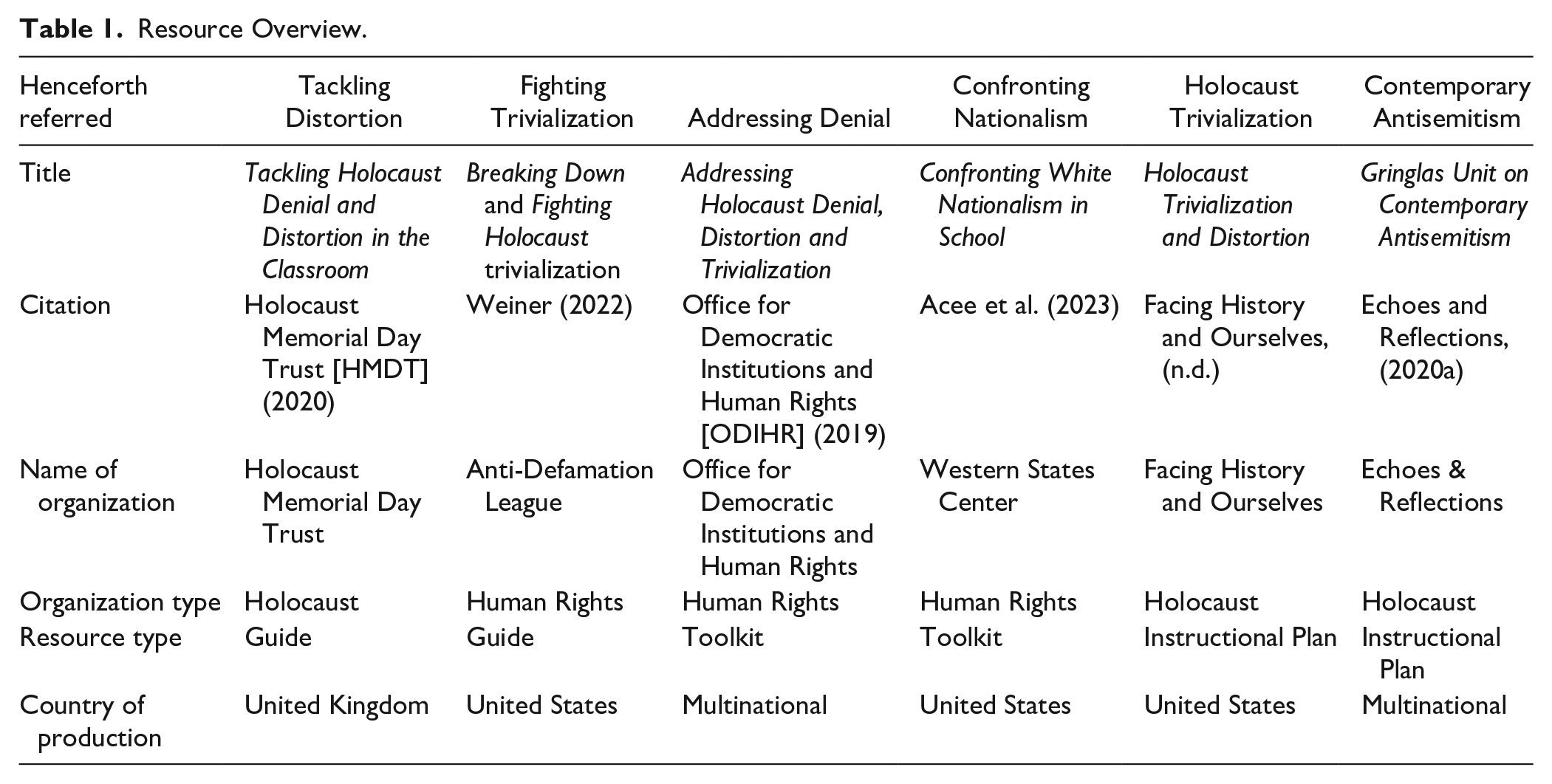
We analyzed six resources on Holocaust analogies, distortion, and/or trivialization that addressed countering extremism. The resources included in this study are listed in Table 1. To ease the reading process, we will henceforward refer to the sources as noted in Table 1. For example, when analyzing Breaking Down and Fighting Holocaust Trivialization (Weiner, 2022), we refer to it as Fighting Trivialization. The reader should reference Table 1 for citations.
Resource Overview.
Statement of Positionality
Knowing who we are as researchers is important as it allows us to acknowledge any bias we bring to the study and can work to monitor the impact of this bias (Peshkin, 1988). For this reason, peer checks between us and peer reviews of drafts of this manuscript were important for improving trustworthiness of the analysis (Saldaña, 2013).
Jeffrey C. Eargle
I am a white male from the Southeastern United States and of a protestant Christian background. A former high school social studies teacher, I now teach social studies methods for both secondary and middle level teacher preparation programs. As a high school teacher, I taught a year-long course on the Holocaust. In my current role, I co-organize and co-facilitate professional development courses with the director of the South Carolina Council on the Holocaust.
Daniel Ian Rubin
I am a white, Jewish male from New York. I was a K12 classroom teacher in English/Language Arts for 22 years and am a National Board Certified Teacher in Adolescence/Young Adult English/Language Arts. I have published over twenty-five books and journal articles in national/international journals in the areas of antisemitism, secondary education, English/Language Arts, and social justice.
Intent of the Study
The intent of this study was not to question the expertise, character, or philosophy of anyone involved in the writing of the resources. We maintain the position that developing educational materials for teachers is challenging work in any political climate, but especially now. We also maintain that the authors of the resources were selected for their expertise in and contributions to Holocaust education, pro-democracy education, anti-racist education, or other relevant fields. The purpose of the study was to focus on the text of the materials and to consider the support provided to teachers in countering extremism and Holocaust trivialization. Additionally, because the focus of the study is not the organizations producing the materials but rather the documents currently accessible to educators, we refer to the resources by thier titles and not the names of the organizations (Table 1).
Terminology
In the present study, we used eight terms that require definition.
Antisemitism
We used the International Holocaust Remembrance Alliance’s (IHRA, 2016) definition of antisemitism as “a certain perception of Jews, which may be expressed as hatred toward Jews.” Antisemitic acts are, thus, defined as follows: “rhetorical and physical manifestations of antisemitism are directed toward Jewish or non-Jewish individuals and/or their property, toward Jewish community institutions and religious facilities.”
Holocaust
For this study, we used the United States Holocaust Memorial Museum’s (USHMM, 2022) definition as found in one of the museum’s printable lesson plans. Under this definition, the Holocaust was the “systematic, state-sponsored persecution and murder of approximately six million European Jews by the Nazi regime and its collaborators in the years leading up to and during World War II” (p. 1). Specifically, the years of the Holocaust are defined as 1933 to 1945.
Holocaust Education
Pearce (2020) described Holocaust education as “a collection of practices, principles adorned with the garbs associated with a field, but bound together by belief, conviction, and resolution rather than being housed within clear conceptual or empirical frameworks” (p. 7). We selected this definition because of the debates regarding Holocaust education as articulated in the above literature review.
Holocaust Organization
We defined a Holocaust organization to include public and non-profit museums, groups, commissions, centers, and councils that provide teachers with educational support in teaching and learning about the Holocaust. While such organizations have a commitment to human rights, democracy, and social justice, their primary focus is on Holocaust Education.
Human Rights Organization
We defined a human rights organization to include public and non-profit museums, groups, commissions, centers, and councils that provide teachers with educational support in teaching and learning about human rights, democracy, and social justice. For these organizations, Holocaust education supports their work in those areas.
Guide
We defined a resource as a guide based on the brevity of the document. While not a one-age or FAQ sheet, a guide is longer (pp. 6–12) with enough content to support teacher learning on Holocaust denial, distortion, and trivialization. However, we understood guides to be the starting point for this learning and may not include instructional plans or practices.
Toolkit
We defined a toolkit as a more extensive text (a chapter or standalone book). While the toolkit may not include specific instructional plans, it includes examples of practice to address Holocaust denial, distortion, and trivialization in the classroom and school.
Instructional Plan
We defined an instructional plan as a detailed lesson plan to be used with students as part of classroom instruction. While background on Holocaust denial, distortion, and trivialization may be present for teacher use, much of the content emerges from instructional material.
Resource Selection
Because the Holocaust is recommended to be taught in the middle and secondary curriculum (Ellison, 2017; Lindquist, 2006) and the Holocaust is taught in both social studies and English language arts (ELA) classrooms (Foster, 2020; Totten & Riley, 2005), we mimicked the approach that middle and high school social studies and ELA teachers may take. Given this, we considered the approach purposeful (Patton, 2002). We began by looking at resources and organizations we have used as educators—Echoes & Reflections and Facing History and Ourselves. We then looked at the resources mentioned by authors in Lemberg and Pope’s (2021) edited volume on Holocaust educators. From there, we began searching with the key words “Holocaust analogies,” “Holocaust distortion,” “Holocaust trivialization,” and “countering extremism.” While we entered this work influenced by COVID-19-related Holocaust analogies, we analyzed resources prior to the pandemic if the resources met the criteria of addressing both distortion or trivialization and extremism. Finally, we selected resources that were easily printable (e.g., PDFs or single webpages), again mimicking approaches a teacher may take. Table 1 provides an overview of the six resources we identified that addressed Holocaust denial, distortion, and trivialization (HDDT).
Framework for Analysis
Transformational leadership is grounded in the use of collaboration to enact change (Eagly et al., 2003). Principals and teachers often engage in transformational leadership to address issues connected to student achievement (Anderson, 2008; Masumoto & Brown-Welty, 2009). Furin (2018) studied five schools in which transformational leadership was used to combat hatred evidenced in racism, neo-Nazis, religious intolerance, and school shootings. Notable to our study, Furin detailed the use of Holocaust education in one school to counter a local neo-Nazi group seeking to recruit young people. Specifically, Furin noted the importance of public pedagogy—the connecting of community and classroom—to support democratic education. To this, Furin observed that “in a democracy [teachers] bear . . . responsibilities for an educated citizenry. Educators need to enter the public sphere and construct space wherein politics and education intersect” (p. 38). Furin concluded that: Educational leaders who are successful in combatting hatred on a continuing basis are those who embrace the central concepts of transformational leadership: community, mission, and vision. These leaders build communities of believers who share a common social justice mission and work to manifest it (p. 115).
Using Furin as our framework, we understood countering hatred—in this case antisemitism—as a collaborative effort between teachers, administrators, parents, and community stakeholders that extends beyond the classroom. We then applied this to document analysis by examining the extent to which the resources—all claiming to counter trivialization—supported teachers in the type of counter practices that Furin investigated.
Resource Analysis
Qualitative research focuses on understanding unique cases (Merriam & Tisdell, 2016). Because we want to understand how resources address Holocaust trivialization in a time of extremism, we determined that qualitative practices would allow us to analyze resources within our present context. During the coding and analysis, we used Holloway and Jefferson’s (2000) core questions for data qualitative research. Once the six resources were selected (Table 1), we printed the resources and open coded by hand for themes across the resources (Merriam, 2009). While we expected antisemitism and Holocaust trivialization to be addressed given the selection process of the resources, we remained open themes identified upon coding. Although not every resource contained each theme, six themes emerged across most of the resources: Antisemitism Framed; Educational Aims; Contemporary Extremism; Conspiracy Theories and Far-right Extremism; Holocaust Denial, Distortion, and Trivialization; and Countering Trivialization. At this stage, we focused on what was observed in the data and why that observation emerged from the data (Holloway & Jefferson, 2000).
From there, the analysis was guided by theories of content analysis (Krippendorff, 2004). We created a chart on a Word document based on the themes. Text from each resource that supported the themes were entered into the chart. Then, using Furin (2018), we coded within the chart to identify the approach toward countering extremism and Holocaust trivialization taken by the resources. As a result, while a resource may have included proposals for countering antisemitism, it was only coded as aligning with Furin if the resource advocated for working across the school and/or with the community. In vivo coding was used to identify specific sentences and passages related to the themes (Saldaña, 2013). Protocol coding (Saldaña, 2013) was used to analyze the resources based on Furin’s (2018) concepts of transformative leadership and countering hatred. During the coding process, Eargle coded using Furin (2018) to ask reflexive questions for interpretation (Holloway & Jefferson, 2000). Eargle then shared findings with Rubin, who provided feedback to Eargle as a form of peer review (Merriam & Tisdell, 2016; Saldaña, 2013). This stage of the process served to build trustworthiness that the interpretation is valid (Holloway & Jefferson, 2000). We continued this through the drafting process.
Examination of Resources
To present the findings of this study, we address each theme individually. We begin with Antisemitism Framed and move to Educational Aims to provide a foundation for understanding the documents as educational resources for addressing antisemitism. We then present findings on the themes of Contemporary Extremism, Conspiracy Theories and Far-right Extremism, Holocaust Denial, Distortion, and Trivialization to contextualize the resources within the current political and social context. We end with an examination of the Countering Trivialization theme to gain an understanding of how the resources support teachers in contesting trivialization.
Antisemitism Framed
All six resources included HDDT as a form of antisemitism. This is concurrent with the literature on Holocaust denial, distortion, and trivialization (Atkins, 2009; Lipstadt, 2020; Schweber, 2006; Stein, 1998; Sztybel, 2006; Whine, 2020). However, variations existed among the resources in terms of how the antisemitism of HDDT was framed. We categorized the framing in two ways—informative and transformational.
We identified three of the sources as informative in how HDDT as a type of antisemitism is framed. For example, in Addressing Denial, the text read, “Whatever lies behind Holocaust denial and distortion, it is often accompanied by or promotes classic anti-Semitic themes, such as accusations of greed, power, deceptiveness and criminality” (p. 1). In this statement, the source explained that Holocaust denial and distortion are aligned with antisemitic tropes. This was extended in Contemporary Antisemitism, which noted that “antisemitism has a global reach, especially through the internet and social media. It is expressed openly in the form of hate speech, violence, and denial and distortion of the Holocaust” (p. 2). In this source, the framing is informative in nature in that it interconnects antisemitism, media, hate speech, violence, and HDDT. Tackling Distortion stated matter-of-factly that “Holocaust denial and distortion are examples of contemporary antisemitism that grew after World War II . . . Holocaust deniers and distorters generally are motivated by their hatred of Jews” (p. 1). Here, the source provided the readers with the origins of Holocaust denial and the connection to antisemitism. However, Tackling Distortion directly addressed the intended audience (i.e., teachers) by noting that, “It is important for educators to help students gain an understanding of the connections distortion and denial have to antisemitism, and the harm this causes to individuals and society” (p. 6). Here the statement included an important, but vague, reference to how antisemitism and HDDT can harm society. While the statements above are correct, they are also more informational in tone.
In contrast, the other three sources were more transformational in the framing of HDDT and antisemitism. For example, in Fighting Trivialization, it is stated that “antisemitism is not just a Jewish issue: healthy, democratic societies do not foster antisemitism” (p. 6). Here, while not addressing HDDT directly, the source projected the clear danger that antisemitism poses to pluralistic democracies. The lesson plan, Holocaust Trivialization, contained a link to an explainer titled Antisemitism and Its Impacts (Facing History and Ourselves, 2023). The document, designed for students to read, explained that antisemitism “can show up in a school as an anti-Jewish bullying incident, in organized white nationalist ideologies, and in memes promoted by politicians, celebrities, and social media influencers” (Facing History and Ourselves, 2023, p. 1). Through this explainer document, Holocaust Trivialization is action-oriented by defining for teachers and students that HDDT can enter the mainstream political rhetoric and that antisemitism may manifest as bullying. This was developed further in Confronting Nationalism through connecting antisemitism to the white nationalist movement. The sources noted that white nationalists “blame the Jewish people as the cause for many of the demographic and political changes they vehemently oppose, such as the successes of the Civil Rights Movement and the feminist movement” (p. 10). This source is transformational as it places current antisemitism within the current context, prompting consideration for the health of the school community (Furin, 2018).
Educational Aims
When analyzing the six resources, we found educational aims to be a consistent component of the materials. While all addressed HDDT, each resource offered advice for teachers regarding the importance of combating HDDT. However, we determined that the sources either suggested vague or basic instructional advice or supported real-world advocacy.
Three of the sources offered instructional advice that, while important, appeared ambiguous without additional support or an instructional goal. For example, in Addressing Denial, teachers were advised to “minimize the risk of . . . anti-Semitism by . . . empowering learners to actively address contemporary anti-Semitism” (p. 4). While this is an important goal, the process of empowering students to engage in political discussions takes time and support (Hess, 2002). Likewise, the text of Contemporary Antisemitism, noted that the materials in the unit plan are “intended to help teachers consider the complexities of teaching contemporary antisemitism and to deliver accurate and sensitive instruction” (p. 1). While the focus on accurate content is critical to combating HDDT (Lindquist, 2008), this statement limits the work to the classroom and assumes that accurate content is all that is needed to combat bigotry. This concept was evidenced in Tackling Distortion. In Tackling Distortion, the resource advised teachers to “always avoid allowing a debate to develop on the known facts of the Holocaust. Refer your students back consistently to the known facts, and wealth of primary evidence and survivor testimony about the Holocaust” (p. 6). Again, while avoiding a debate that entertains HDDT is proper methodology (Lindquist, 2008), the focus remains on classroom instruction. These three resources seem to contain the work of the teacher to the classroom.
In contrast, the other three resources offered advice for advocacy beyond the classroom, if not the school. In Holocaust Trivialization the lesson plan was centered on the consequences of politicians using Holocaust trivialization. To support this, the lesson plan used social media posts and speeches from political leaders comparing COVID-19 mitigation policies to the Holocaust. Because Holocaust Trivialization used examples of far-right politicians, we concluded that the resource took a stronger stand against HDDT. This is more evident in Fighting Trivialization. This source challenged teachers by stating: “If your state does have Holocaust education curriculum guidelines, urge elected officials to conduct an audit of their Holocaust education” (p. 6). This statement moves the role of the teacher beyond classroom instruction and into the role of policy advocate (Ball et al., 2011; Heineke et al., 2015; Little, 2003). However, given that white nationalism has influenced elected officials and that such elected officials use Holocaust trivialization in their rhetoric (Baker et al., 2020; Cohen, 2023; Perry et al., 2021a, 2021b; Steir-Livny, 2022), the resource does not address how teachers should navigate such as situation. That said, the clear move beyond the classroom to community engagement is evident in Confronting Nationalism. In this source, the authors observed that “the threat of white nationalism is a holistic school community issue . . . Strengthening schools against bigoted organizing requires us to remain focused on serving the students whose voices these groups seek to silence” (pp. 4–5). In this, Confronting Nationalism encouraged teachers to move beyond the classroom to develop community-oriented plans to protect children by countering white nationalism. These sources view teachers as both lesson planners and advocates.
Contemporary Extremism
All six resources contextualized HDDT within contemporary far-right extremism. This is concurrent with the literature on Holocaust denial, distortion, and trivialization (Atkins, 2009; Lipstadt, 2020; Schweber, 2006; Stein, 1998; Sztybel, 2006; Whine, 2020). However, variations existed among the resources in terms of how the antisemitism of HDDT was framed. These variations include simply defining white nationalism, explaining the relationship between extremism and COVID-19, and acknowledging the danger extremism presents to children.
Understanding extremism is an important first step in the process of countering HDDT. In the unit plan Contemporary Antisemitism, extremism was broadly, yet correctly, defined. The resource noted that white nationalists believe that “white, Christian identity is superior and [that] they target people of color, immigrants, LGBTQ people, Jews, and others who do not reflect their worldview” (p. 3). Additionally, aligning with Black and Ward (2022), Contemporary Antisemitism noted that “antisemitism is therefore a linchpin of white nationalist hate” (p. 3). Both Holocaust Trivialization, Tackling Distortion, and Fighting Trivialization aligned far-right extremism with COVID-19 anti-vaxxers. Notably, Fighting Trivialization supported teachers and students in understanding that: Anti-vaxxers don the yellow Star of David to imply that public health policies related to the pandemic are comparable to the racist Nazi laws. This action unites anti-vaxxers with neo-Nazis and others, making light of what it means to actually suffer the denial of civil liberties (p. 2).
With this statement, Fighting Trivialization aligned with observations by researchers on the far-right’s use of Holocaust analogies during the COVID-19 pandemic (Cohen, 2023; Lyons & Flower, 2021; Perry et al., 2021a, 2021b; Steir-Livny, 2022). Overall, Contemporary Antisemitism, Holocaust Trivialization, and Fighting Trivialization offered clear definitions and examples to support teachers with understanding background content.
However, Addressing Denial, Tackling Distortion, and Confronting Nationalism offered a different approach to countering HDDT in that these sources acknowledge that students may hold white nationalist beliefs. First, Confronting Nationalism noted that “white nationalist organizers view young people as important targets and a source for strengthening their political base” (p. 7). Likewise, Tackling Distortion advised teachers to recognize that “Holocaust denial and distortion may be a warning sign that students are being drawn into more extremist views and activity, antisemitic or otherwise, which pose a safeguarding concern” (p. 6). This is important because white nationalists actively recruit adolescents (Hersh & Royden, 2023; Nalani & Yoshikawa, 2023). Taking this a step further, Addressing Denial advised teachers to “understand the source of information or inspiration for a student’s expression of Holocaust distortion, trivialization or denial, as it may also indicate an exposure to, or involvement in extremist activities” (p. 8). To this, the text encourages teachers, and administrators, to intervene “to prevent any further escalation, such as violent behaviour” (p. 8). This intervention is important as it meets Furin’s (2018) call for countering bigotry through active anti-hate programs. However, Addressing Denial, Tackling Distortion, and Confronting Nationalism stand out for acknowledging that teachers work with students who are influenced by factors beyond the classroom.
Conspiracy Theories in Far-right Extremism
Five of the six resources addressed the role of conspiracy theories within far-right extremism. This, in general, aligns with research on the central role conspiracy theories play in white nationalist groups (Armaly et al., 2022; Ekman, 2022; Hersh & Royden, 2023; Nilsson, 2022; Piazza & van Doren, 2023; Weiss, 2019). The resource Fighting Trivialization did not explicitly address conspiracy theories. Of the resources that did, various approaches were taken in understanding conspiracy theories.
First, the toolkit Confronting Nationalism addressedconspiracy theories in a matter-of-fact style. The text noted that “white nationalism also trades in conspiracy theories, and most modern conspiracy theories have antisemitism at their core” (p. 10). While this is not incorrect, the resource did not expand beyond this basic description. Holocaust Trivialization and Contemporary Antisemitism, both instructional plans, addressed the Great Replacement as a specific, antisemitic conspiracy theory. In a handout within the Contemporary Antisemitism unit plan, it was explained that “antisemitism is a core feature of white nationalist belief systems because Jews are seen as the organizers of a global conspiracy to bring down the ‘white race’” (Echoes & Reflections, 2020b, p. 1). The acknowledgment of the Great Replacement is important given its leading role in white nationalist ideology (Ekman, 2022; Nilsson, 2022; Weiss, 2019).
While Confronting Nationalism, Holocaust Trivialization, and Contemporary Antisemitism offered important connections between antisemitism and white nationalist extremism, the resources Addressing Denial and Tackling Distortion directly connect conspiracy theories to HDDT. Tackling Distortion explained that “Holocaust denial and distortion intersect with many other forms of denial and conspiracy thinking, such as climate denial, anti-vaccine movements, and claims of fake news” (p. 2). Additionally, Addressing Denial noted that white nationalists “claim that the ‘hoax’ of the Holocaust was created to benefit or advance the interests of the state of Israel” (p. 3). These resources align with Whine’s (2020) observation that white nationalists spread Holocaust denial and distortion as a type of antisemitism.
Holocaust Denial, Distortion, and Trivialization
The six resources were selected because they directly address HDDT. In examining the resources for support in helping teachers counter HDDT, we identified three subthemes: (1) Facts, Knowledge, and Democracy, (2) Position on Comparisons to the Holocaust, and (3) Repudiating Trivialization.
Facts, Knowledge, and Democracy
Lipstadt (2020) noted that Holocaust denial and distortion attempts to deny the facts of the Holocaust. While the lesson plan Holocaust Trivialization did not directly address this issue, the remaining five resources expressed the importance of historical facts to counter HDDT in various ways. Tackling Distortion, Contemporary Antisemitism, and Fighting Trivialization pointed to the importance of facts at a base level. Contemporary Antisemitism simply noted that “Holocaust denial and distortion are irrational and fly in the face of the facts” (p. 1). Similarly, Fighting Trivialization explained that “Holocaust distortion is an attempt to negate or downplay the facts of the Nazi genocide of the Jewish people” (p. 2). However, Tackling Distortion extended on this by noting that HDDT “attempts to delegitimize the facts of the Holocaust” and “are painful insults to its victims and survivors” (p. 2). These resources are not incorrect in their assertions. However, Addressing Denial took the topic further, and was more transformational, by explaining that “effective education about the Holocaust should enable students to identify and reject messages of denial and distortion of historical facts. Educators should discuss the motivations behind using Holocaust denial as a propaganda tool” (p. 6). In contrast, Confronting Nationalism warned teachers and administrators that: Giving bigotry a platform, whether in the media or in a classroom, is dangerous. While multiple perspectives enrich discussions, lending credibility to ideas rooted in bigotry and exclusion weakens our democracy and sets a dangerous precedent for allowing undeserved space in crucial conversations (p. 38).
While Confronting Nationalism did not explicitly address facts, the suggestion was that facts alone should be the focus of lessons about the Holocaust. Across the five sources, Addressing Denial and Confronting Nationalism were coded as more transformational given the advice, albeit conflicting, on teachers addressing the dangers of HDDT.
Position on Comparisons to the Holocaust
While academic comparisons to the Holocaust can be conducted effectively (Denham, 2006; Kirmayer et al., 2014; Sztybel, 2006), superficial comparisons can contribute to Holocaust distortion (Sztybel, 2006). Except for Addressing Denial and Confronting Nationalism, four of the resources took a position on Holocaust comparisons. The resource Tackling Distortion took the position that “minimising or trivialising the impact of the Holocaust” includes “calling other events a ‘Holocaust’ and making inappropriate comparisons with the Holocaust” (p. 3). With this, the indication is clear that superficial comparisons can lead to, if not support, Holocaust trivialization. Additionally, Contemporary Antisemitism explained that Holocaust distortion “may manifest itself” using the word Holocaust “to describe related atrocities or by engaging in false comparisons with other mass crimes” (p. 1). This follows Rosenbaum’s (2019) position that the Holocaust is a uniquely Jewish event and Alexander’s (2002) observation that the Holocaust has become the measuring stick for acts of persecution and genocide.
However, Holocaust Trivialization and Fighting Trivialization took this further by explain that inappropriate Holocaust comparisons are a threat to democracy. For example, Holocaust Trivialization prompted students to understand that free speech is vital to a democracy, yet citizens and politicians must not distort the facts of the Holocaust to advance a political argument. In Fighting Trivialization, it was clearly stated that: “Politicians, protesters, and everyday citizens have increasingly compared public health policies to end the pandemic and the Holocaust. These comparisons trivialize the genocide of Jews in the name of free speech and for the gain of political capital” (p. 1). Both Holocaust Trivialization and Fighting Trivialization positioned these observations with the COVID-19 pandemic, therefore aligning with research on antisemitic trivialization of the Holocaust during the pandemic by far-right groups and politicians (Cohen, 2023; Lyons & Flower, 2021; Perry et al., 2021a, 2021b; Steir-Livny, 2022).
Specific Examples of Trivialization
While we included Holocaust denial and distortion in this study, our initial entry into this investigation began with an interest in Holocaust trivialization. Confronting Nationalism did not address HDDT directly. Of the remaining five resources, most resources examined only Holocaust distortion. Tackling Distortion defined Holocaust distortion as “revising the historical assessment of the period, changing narratives to distort the past, usually seen in national political rhetoric and behaviour” (p. 4). The resource also noted that “claims that other groups/nations suffered as much or more than the Jews” (p. 3) is a concrete example of Holocaust distortion. Addressing Denial explained that Holocaust distortion can be utilized to “omit or manipulate facts in order to serve certain narratives of national identity that are more psychologically comfortable or politically expedient” (p. 3). With more specificity, Contemporary Antisemitism identified examples of Holocaust distortion as “claims that six million Jewish deaths are an exaggeration, that deaths in concentration camps were due to starvation and disease but not Nazi policy, and that the diary of Anne Frank is a forgery” (p. 1). While these examples align with examples on Holocaust distortion (Lipstadt, 2020), the resources do not directly address trivialization.
We found that Fighting Trivialization and Holocaust Trivialization were the only two recent resources to identify and provide an example of Holocaust trivialization. The lesson plan Holocaust Trivialization contained a link to resource for student-use titled Explainer: Antisemitism and Its Impacts (Facing History and Ourselves, 2022). The text of the explainer noted that “Holocaust distortion also includes trivialization—incorporating aspects of the Holocaust . . . in modern contexts by non-Jewish groups who claim they are being persecuted in similar ways and want to draw attention to their own suffering” (p. 8). The document further explained that “misusing these symbols and terms in a different context is offensive because it minimizes the magnitude of genocide and the specific pain and suffering of Jews” (p. 8). This mirrored Fighting Trivialization’s explanation of Holocaust trivialization. According to the resource, anti-vaxxers wearing the Star of David became one of “the most prevalent instances of Holocaust distortion” (p. 2) in the world during the COVID-19 pandemic. While other resources initially noted this as a type of distortion, Fighting Trivialization identified the example as trivialization by noting that comparing COVID-19 mitigation policies to Nazi persecution policies serves to “trivialize Jewish suffering by downplaying the genocide of two-thirds of Europe’s Jews” (p. 2). Aligned with Stein’s (1998) observation that HDDT is best understood within contemporary social and political contexts, both Fighting Trivialization and Holocaust Trivialization addressed Holocaust trivialization related to the COVID-19 pandemic and far-right politics.
Countering Trivialization
The six resources were selected because they assert the goal of countering HDDT and/or extremists who utilize HDDT. In examining the resources designed to help teachers counter HDDT, we based our analysis on an understanding that countering hatred and hate groups is best conducted through pro-democracy pedagogy that strengthens the curriculum while including robust school-community interactions (Furin, 2018). As a result, we examined how the resources countered HDDT both within and beyond the classroom.
Within the Classroom
While the resource Tackling Distortion did not include a direct reference to countering HDDT in the classroom, the other five did. However, the approach to countering HDDT varied. For example, Fighting Trivialization succinctly noted that teachers must engage in “actively countering efforts to distort or trivialize the Holocaust, wherever it occurs” (p. 6). However, the resource did not provide examples on how a teacher may do this. Likewise, Contemporary Antisemitism provided examples of activists who counter antisemitism and discussion prompts encouraging students to be upstanders. While this is important for students to learn and discuss, the instructional plans did not align with Furin (2018).
In contrast to Contemporary Antisemitism, the resources Confronting Nationalism, Holocaust Trivialization, and Addressing Denial stood out at transformational (Furin, 2018) by positioning schools within the community and the current context. Confronting Nationalism noted that “as democratic institutions serving young people, schools have also become battlegrounds for white nationalist and other bigoted groups seeking to grow their bases of support and undermine inclusive democracy” (p. 3). Although this quote did not address the classroom, it established an understanding within the toolkit for how teachers, administrators, and stakeholders must conceptualize the importance of both curriculum and school policies given the current context. Likewise, Holocaust Trivialization prompted teachers to consider their instruction based on the context. In the explainer that accompanies the lesson, it is explained that, because
Beyond the Classroom
The reality of the classroom is impacted by the context beyond it. The resources Holocaust Trivialization and Contemporary Antisemitism did not address countering antisemitism, extremism, or HDDT in the wider school or community. While Tackling Distortion noted that “schools may have formal mechanisms in place for countering identity based hostility and prejudice,” the resources also noted that “this guide is not designed to replace or be part of such systems” (p. 8). This language suggests that the resource is not necessary in contributing to a transformational (Furin, 2018) approach to countering HDDT and extremism. Additionally, Tackling Distortion noted that the guide offers only “practical advice to schools and staff when educating students about the Holocaust and on Holocaust Memorial Day” (p. 8). Furthermore, while Tackling Distortion suggested “it may be appropriate to encourage students . . . to do something to tackle contemporary identity based hostility” at the local or national levels, the resource recommended that this approach is only for “students [who are] are interested in” taking such action (p. 8). As a result, Tackling Distortion both limited the focus on countering HDDT and extremism only to the time during which the Holocaust is being taught and wavered in offering full support for students taking action against HDDT, extremism, and bigotries.
In contrast, Fighting Trivialization, Addressing Denial, and Confronting Nationalism aligned with Furin’s (2018) call for transformational countering of bigotries. In reference to the COVID-19 pandemic, Fighting Trivialization noted that “Holocaust trivialization normalizes latent antisemitic discourse, which can serve as a dog whistle to overt antisemites and their supporters” (p. 6). With this, the resource acknowledged the context and danger of HDDT as the resource encouraged teachers to work with “elected officials, editorial boards, and civic and community leaders to condemn Holocaust comparisons, especially related to COVID-19” (p. 6). Thus, Fighting Trivialization acknowledged the current context and offered guidance on how to actively work with the community to combat HDDT and extremism. More specifically, Addressing Denial noted that “a student’s expression of Holocaust distortion, trivialization or denial, as it may also indicate an exposure to, or involvement in extremist activities” (p. 8). As a result, the resource suggested the teacher intervene “in co-ordination with family, social workers or other members of the school’s staff” (p. 8). Given this, the resources offered guidance on how to counter extremism, HDDT, and bigotry coordinated effort that reaches beyond the classroom with the school, family, and community working as partners.
Like Fighting Trivialization and Addressing Denial, Confronting Nationalism offered a transformational (Furin, 2018), approach to countering HDDT, bigotry, and extremism. The resource was clear to the reader that the purpose of the toolkit is to “help parents, students, teachers, school administrators, and the wider community counter bigoted organizing” (p. 3). The resource differed from others in that the primary focus of the toolkit was on creating collaborative systems within the school and community to combat hate. This approach was taken because the “threat of white nationalism is a holistic school community issue” (p. 4) and that teachers administrators, parents, and stakeholders “must ensure there is no room in our schools for movements that call for dehumanization based on race, religion, sexual or gender identity, ethnicity, or nationality” (p. 5). Given current context of anti-democratic extremism (Armaly et al., 2022; Nilsson, 2022; Piazza & van Doren, 2023; Weiner & Zellman, 2022; Whitehead et al., 2018), Confronting Nationalism noted that “anti-democracy organizing from white nationalist groups” may lead to “pushback from inside and outside your school” (p. 39). As a result, the toolkit offered insight on how schools and communities can “make a plan for how to manage backlash and think about which allies you should seek out in advance” (p. 39). As a result, Confronting Nationalism offered the strongest example transformational countering (Furin, 2018) beyond the classroom.
Discussion of the Findings
Based on the resurgence of antisemitism in recent years (CCDH, 2023), the trivialization of the Holocaust during the COVID-19 pandemic (ADL, 2022; Pickel et al., 2022; Steir-Livny, 2022), the strengthening white nationalist movement (Armaly et al., 2022; Espinoza, 2021; Gonzales, 2020; Kleinfeld, 2021; Miller-Idriss, 2020), and the vulnerability of young people in this context (Aguilar, 2023; CCDH, 2023; Hersh & Royden, 2023; Ingersoll, 2019; Nalani & Yoshikawa, 2023), we entered this study seeking to understand the type of support Holocaust and human rights organizations are providing teachers. To do this, we identified six resources from six organizations specifically written to counter modern right-wing extremism and Holocaust denial, distortion, and trivialization. We then examined the resources using Furin’s (2018) concept of transformational countering, which includes the creation of pro-democracy curriculum and vigorous collaborations between schools, communities, and parents to combat bigotry.
Resource Types and Characteristics
The first question we asked was: “What types of resources are being produced to support teachers in the context of increasing antisemitism and far-right extremism?” This question was asked considering the present context. While the use of the “Auschwitz Analogy” (Steinweis, 2005) or to “Holocaustize” a given scenario (Power, 1999) is nothing new, this type of comparison has taken on new political power due to the COVID-19 pandemic. We found that Holocaust and human rights organizations offered teachers resources such as brief guides, comprehensive toolkits, and detailed instructional plans. The majority, if not all, of the resources contained definitions and examples of topics and themes such as antisemitism, extremism, factual content, and support for democracy. While we did not examine the resources in-depth for best practices in Holocaust education, during the analysis process we did not observe any issue with the resources that would place them outside of what is expected for quality Holocaust education (Lindquist, 2008, 2009; Ragland & Rosenstein, 2014; Riley & Totten, 2002).
Stein (1998) argued that HDDT is best understood within the social and political context in which the analogies and comparisons are used. That said, the publication dates of the resources we studied ranged from 2019 to 2023. At the time of this study—in 2023—only Fighting Trivialization and Holocaust Trivialization directly addressed Holocaust trivialization during and related to the COVID-19 pandemic. Additionally, Addressing Denial and Tackling Distortion referenced trivialization as extensions of or connected to Holocaust distortion. This is not surprising given that Jaspal (2023) noted that modern antisemitism, which we understand to include forms of HDDT, is evolving at such a rapid pace that it can be difficult to identify. Likewise, these findings support Whine’s (2020) conclusion that Holocaust trivialization is a recent mutation of Holocaust denial and distortion. As such, the resources, while potentially helpful for teachers in general, became quickly outdated in the current context.
Holocaust education has roots in preparing students to reject authoritarianism (Friedlander, 1979) and bigotry (Wells & Wingate, 1986). Recently, Holocaust education has been found to promote a civic mission for democracies (Stevick, 2017) and to support preservice candidates’ development as social justice educators (Nowell & Poindexter, 2019). In this study, most of the resources we examined addressed conspiracy theories and extremism in relation to HDDT. While all six sources addressed extremism, Tackling Distortion, Addressing Denial, and Confronting Nationalism included more on contemporary extremism. Interestingly, contemporary conspiracy theories were addressed to a lesser degree. Only two sources, Tackling Extremism and Addressing Denial, provided specific support for teachers to understand conspiracy theories. Our analysis found that, of the five sources that focused on fact-based content, most sources—Tackling Distortion, Fighting Trivialization, and Contemporary Antisemitism—tended to lean on facts alone as the bulwark against extremism and conspiracy theories. However, Ochoa-Becker (2007) reminds us that focusing on facts alone will not preserve democracy; action is required.
Finally, Stein (1998) noted that the Holocaust “belong[s] to Jewish history” and it “belongs to human history” (p. 534). Four of the six resources—Tackling Distortion, Fighting Trivialization, Holocaust Trivialization, and Contemporary Antisemitism—provided positions on comparison to the Holocaust. However, the resources generally equated Holocaust comparisons with HDDT. As such, the resources seemed to avoid entering the discussion around the uniqueness and universality of the Holocaust (Berenbaum, 1990; Friedlander, 1979; Rosenbaum, 2019). As a result, the sources may not adequately support teachers in addressing HDDT in our present context. Legitimate, academic comparisons of events to the Holocaust can provide a deeper understanding of both the Holocaust and the comparable event (Berenbaum, 1990; Denham, 2006; Kirmayer et al., 2014; UNESCO, 2022). Stanton and Tavares (2016) argued that the study of historical events “invites us to make connections to the present moment—not by offering simple answers to the dilemmas we face, but by provoking us to ask more probing questions about our country and our choices” (p. 283). Therefore, in a time when illegitimate, conspiracy-based comparisons are being made, the lack of strong support addressing legitimate, academic comparisons to the Holocaust in the resources means that teachers are not being sufficiently supported.
Countering Holocaust Trivialization
The second question we asked was: “To what extent do the resources serve to counter Holocaust trivialization?” Understanding that teachers must address present-day Holocaust denial, distortion, and trivialization (Whine, 2020), this question was asked considering the present context of far-right extremism. Given that Holocaust distortions and trivialization are propagated by white nationalist groups and politicians (Cohen, 2023; IREHR, 2021; Steir-Livny, 2022), teachers need be equipped to counter this form of antisemitism in conjunction with HDDT. We analyzed the six resources using Furin’s (2018) definition of countering as transformational approach of developing pro-democracy curriculum and building programs that connect the school and community in fighting bigotry. Given this definition, we found that the resources in this study did not consistently meet Furin’s definition of countering.
Antisemitism and HDDT are morphing quickly in the present context (Jaspal, 2023; Whine, 2020). This was evident in the six sources we analyzed. Only Fighting Trivialization and Holocaust Trivialization addressed trivialization with depth. Thus, in general, addressing Holocaust trivialization remained obscured within the resources. While trivialization is rather unclear within the category of Holocaust distortion (Whine, 2020), Holocaust trivialization, particularly COVID-19 analogies, is being used by right-wing extremist groups and politicians (Cohen, 2023; IREHR, 2021; Steir-Livny, 2022). As a result, resources for teachers must work to clearly define Holocaust trivialization and offer concrete examples of trivialization to better counter this form of antisemitism in our schools and communities.
Because antisemitism is a foundational hatred for far-right extremism (Armaly et al., 2022; Ekman, 2022; Hersh & Royden, 2023; Piazza & van Doren, 2023; Santini et al., 2022) and the efficacy of Holocaust education weakens when taught in isolation from the present context (Whine, 2020), we entered the analysis of the resources from the position that one must counter far-right extremism and HDDT together. Given this, while all the resources acknowledged right-wing extremism, only Tackling Distortion, Addressing Denial, and Confronting Nationalism contained support for a transformational countering (Furin, 2018) of far-right extremism. Likewise, because far-right extremist groups target middle and secondary students (Hersh & Royden, 2023; Ingersoll, 2019; Nalani & Yoshikawa, 2023) and seek to impose their ideology on schools ( K. J.Burke et al., 2023; Friedman & Tager, 2022; Nalani & Yoshikawa, 2023), it is problematic that only two resources—Addressing Denial and Confronting Nationalism—offered transformational countering (Furin, 2018) strategies for schools to work with the community to combat antisemitism and bigotry. As such, the majority of the resources we analyzed did not supply teachers, administrators, and stakeholders with enough support for countering antisemitism in the classroom and beyond.
Finally, the far-right, white nationalist extremist groups and politicians represent a threat to democracy (Armaly et al., 2022; Nilsson, 2022; Piazza & van Doren, 2023; Weiner & Zellman, 2022; Whitehead et al., 2018). As stated above, Holocaust education has a deep history of intertwining with pro-democracy and human rights education (Friedlander, 1979; Nowell & Poindexter, 2019; Stevick, 2017; Wells & Wingate, 1986). Our analysis of the six sources found that the materials from human rights organizations aligned with transformational countering (Furin, 2018) methods to a greater degree than the materials from Holocaust organizations. This is particularly evident in the analysis of countering extremism and HDDT in the classroom and in the community. Fighting Trivialization, Addressing Denial, and Confronting Nationalism were produced by the American Jewish Committee, the ODIHR, and the Western States Center, respectively. While these organizations may not specialize in Holocaust education per se, the organizations do specialize in combating antisemitism and/or authoritarianism. This study indicates that these organizations identified how Holocaust education can actively counter extremism and antisemitism in our schools and communities through transformational methods.
Considerations and Implications
Furin (2018) found that the educators who countered bigotry through transformational leadership and community engagement are the “educators who critically examine situations, judge them relative to our highest democratic ideals, and choose to combat intolerance, prejudice, and hatred” (p. xvi). Because this work requires actions beyond the work teachers do in the classroom (Furin, 2018), resources must support teachers in how to engage with principals, district leaders, and community members in countering hatred. Therefore, this study examined six resources designed to support teachers in countering Holocaust denial, distortion and trivialization. We used Furin’s (2018) definition of countering to examine Addressing Denial, Confronting Nationalism, Contemporary Antisemitism, Fighting Trivialization, Holocaust Trivialization, and Tackling Distortion. The resources were selected based on the content related to countering extremism and HDDT. The findings of this study indicate that materials produced to support teachers become quickly outdated given the current context. Additionally, organizations that focus more broadly on supporting human rights provided teachers greater support in countering extremism and HDDT than the organizations that focus more specifically on Holocaust education.
This study brings forth questions for future researchers to consider. To what extent do teachers, administrators, and stakeholders understand the threat to democracy posed by the contemporary far-right, white nationalist movement? How do teachers understand the complexity of Holocaust denial, distortion, and trivialization? To what degree are teachers prepared to nuance the difference between an academic comparison to the Holocaust and a comparison to the Holocaust that serves to distort or trivialize? How do teachers, administrators, and stakeholders implement transformational countering (Furin, 2018) of white nationalism through Holocaust education in the current context? The limitations of the study also offer questions. One limitation is that we selected resources with a national or international reach. What would a study of resources produced by local Holocaust and human rights organizations to counter extremism and Holocaust trivialization reveal? While we selected guides, toolkits, and instructional plans for the diversity of resource types, the findings indicate that toolkits offered better support for schools in countering extremism and HDDT. This could be a limitation. Would a study of a wider range of toolkits produce similar results? Would a wider range of instructional plans contradict the findings of this study?
This study also brings forward considerations for both Holocaust and human rights organizations engaged in developing resources for teachers to counter hatred. We found that the two toolkits, particularly Addressing Denial, to be effective resources in countering hatred and extremism. While lesson or unit plans are attractive—if not traditional—resources to develop, teachers, administrators, and communities need toolkits with clear, actionable directions and processes for countering hatred and extremism. Therefore, it may be worth an organization’s time and effort to develop such resources and for teachers to seek them out as necessary resources for their schools and communities.
We began this article noting that a political cartoon depicting Holocaust trivialization (de Adder, 2021, p. A22) did not explore the threat of extremism thoroughly enough. Understanding how teachers are supported in a time of extremism was the focal point of this study. As former high school teachers, we sympathize with the challenges faced by Holocaust and human rights organizations when developing guides, toolkits, and instructional plans that can be utilized and adapted to a wide range of teaching contexts. Yet, K. J.Burke et al. (2023) argued that countering far-right extremism in schools will only take place when teachers understand “how this movement has intertwined with our own life stories, our communities, and the current educational and political systems in the United States” (p. 293). Only Holocaust Trivialization and Addressing Denial addressed the fact that students may bring antisemitic, extremist ideas into the classroom and only Fighting Trivialization, Addressing Denial, and Confronting Nationalism offered concrete plans for schools and communities to work together to counter white nationalist extremism.
The National Security Council (2021) explained that countering violent extremism “means ensuring that Americans receive the type of civics education that promotes tolerance and respect for all and investing in policies and programs that foster civic engagement and inspire a shared commitment to American democracy” (p. 27). While Holocaust education would seem to align with this mission (Friedlander, 1979; Nowell & Poindexter, 2019; Stevick, 2017; Wells & Wingate, 1986), Holocaust education material may remain impacted by the ongoing academic debate around the uniqueness and universality of the Holocaust (Berenbaum, 1990; Friedlander, 1979; Rosenbaum, 2019). This study indicates that the resources, particularly those produced by Holocaust organizations, are positioned in a struggle between political engagement and academic discourse. For this reason, Steinweis (2005) argued that those involved in Holocaust studies and education must more actively engage in combating Holocaust distortion and trivialization. However, HDDT is a symptom of a larger problem as the resurgence of antisemitic acts (ADL, 2023) is positioned within a growth of anti-democratic, white nationalist extremism (Armaly et al., 2022; Nilsson, 2022; Piazza & van Doren, 2023; Weiner & Zellman, 2022; Whitehead et al., 2018). Studying data on backsliding democracies using findings from the Varieties of Democracy project, Haggard and Kaufman (2021) noted the erosion of democracy in the United States due to far-right extremism. Given this, our study on these six Holocaust resources speaks to Haggard and Kaufman (2021), while posing one final question for researchers and Holocaust educators: What is the role of Holocaust education in a backsliding democracy?
Post-review Coda
We entered this work out of concerns over the danger and fallacy of far-right politicians and activists comparing COVID-19 mitigation policies to the Holocaust (ADL, 2022) and 2022 containing the highest recorded level of antisemitic acts in the United States since tracking began 1979 (ADL, 2023). Our research and drafting were concluded before the October 7, 2023 Hamas attack on Israel. Recently, the Anti-Defamation League (2024) reported 8,873 antisemitic acts in 2023, representing a 140% increase over 2022. In October, November, and December 2023, the Anti-Defamation League documented 5,336 antisemitic acts, exceeding any year on record. The Center for the Study of Contemporary European Jewry [CSCEJ] (2024) and the ADL (2024) observed that antisemitism in the United States was demonstrated by the political left and by liberal activists on college campuses following October 7, 2023. Holocaust trivialization became part of the anti-Israel protests (CSCEJ, 2024).
While we recognize that the present situation in Gaza is a complicated matter and that not all critiques of Israeli policies are antisemitic, the antisemitism following October 7, 2023 speaks to two issues related to the article. First, because antisemitism is found on both the political left and political right (Lipstadt, 2019), teacher resources from Holocaust and human rights organizations must effectively tease out those differences. In addition to considering the role of Holocaust education in a backsliding democracy, we encourage researchers and organizations to consider the role of Holocaust education in understanding the complexity of antisemitism as more than a its association with far-right ideology. Second, our research found that resources become quickly outdated as antisemitism morphs and materializes on the far-right. However, our research remains relevant and important as our present context quickly shifted to a focus on left-wing antisemitism. Therefore, we suggest research into how Holocaust and human right organizations address Holocaust trivialization on the political left within this new context.
Footnotes
Declaration of Conflicting Interests
The author(s) declared no potential conflicts of interest with respect to the research, authorship, and/or publication of this article.
Funding
The author(s) received no financial support for the research, authorship, and/or publication of this article.
